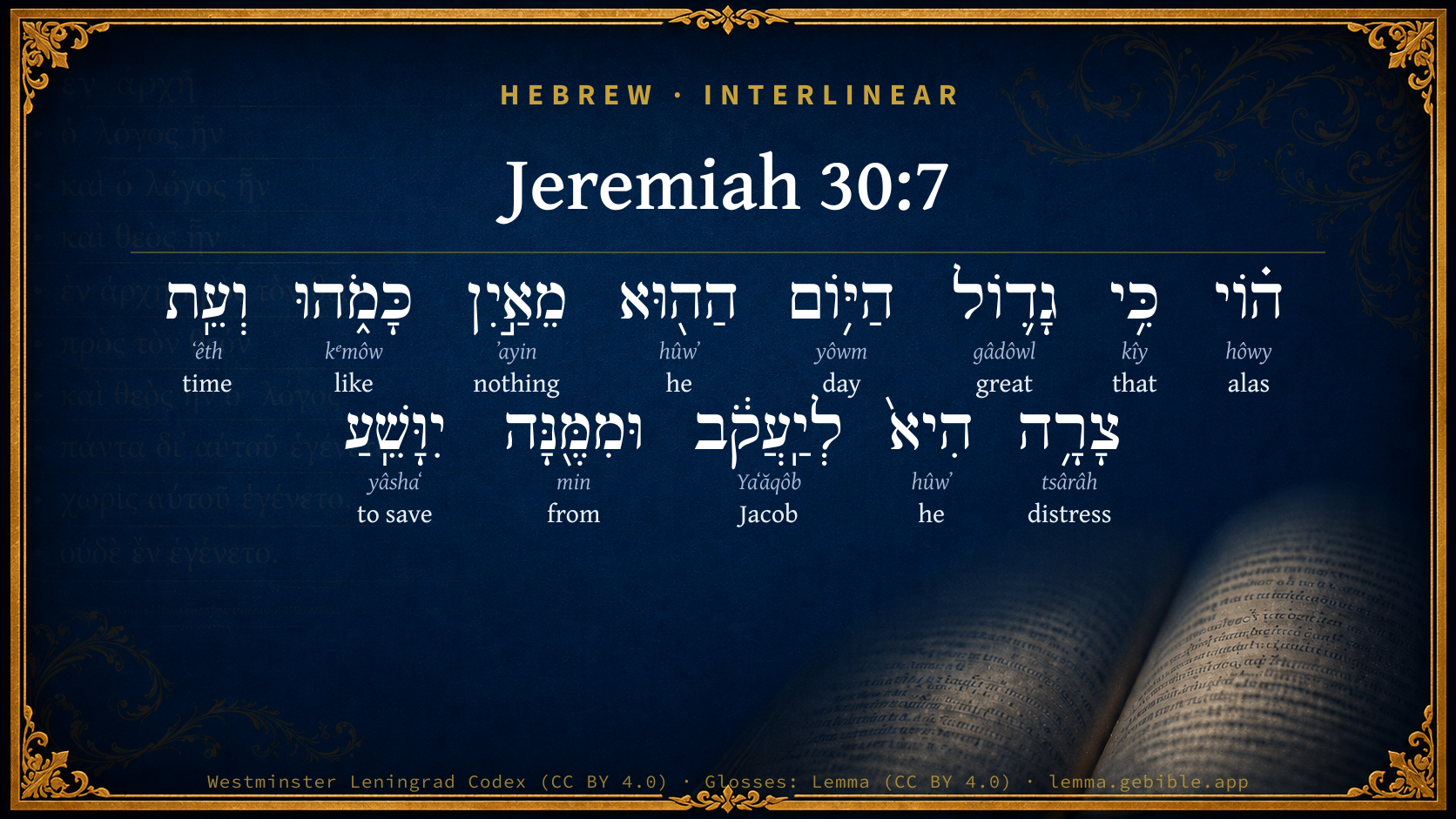
Jeremiah 30:7

Hebrew (Westminster Leningrad Codex) Jeremiah 30:7 appears in the Hebrew Old Testament. The text above is from the Westminster Leningrad Codex. Each word links to its Strong’s number, a concise gloss, and parsing drawn from the Open Scriptures Hebrew Bible morphology. Click any word for its full Brown-Driver-Briggs (BDB) entry.
Download image
Cite this verse

Jeremiah 30:7 (World English Bible). Public Domain. Lemma interlinear Bible study tool, https://lemma.gebible.app/v/jeremiah/30/7.

Show BibTeX & RIS
BibTeX
RIS
English Translation
Alas! for that day is great, so that none is like it: it is even the time of Jacob's trouble; but he shall be saved out of it.
World English Bible · Public Domain
Download a study sheet

One document with this verse’s original text, its word-by-word gloss line, the meaning frame, cross-references with their text, attributed commentary, and full source and license credits — printable, and it pastes into notes with its structure intact.

This verse Autodidact and up

Study sheet (.html) Plain text (.txt)

A passage Seminary Student

Up to 50 verses in one chapter. A passage sheet keeps up to 6 commentary sources and 12 cross-references per verse, in the order this page ranks them, and says so on the sheet whenever that leaves anything out. Ask for a single verse and you get the Autodidact verse sheet above.

Everything on this page stays free to read, with no account — the sheet is a download of what is already on screen, not access to it.

Want to remove ads? Support Godless Engineer
Compare translations 3

The same verse in 3 English versions, stacked beneath the original-language interlinear above. Click any original word for its lexicon entry.

Each is an independent rendering of the whole verse — the interlinear is not word-aligned to these translations.

Highlighted words mark where these versions differ — a whole-verse word diff, not a word-by-word alignment.

  • World English Bible Public Domain
    Alas! for that day is great, so that none is like it: it is even the time of Jacob's trouble; but he shall be saved out of it.
  • King James Version Public Domain
    Alas! for that day is great, so that none is like it: it is even the time of Jacob's trouble, but he shall be saved out of it.
  • unfoldingWord Literal Text CC BY-SA 4.0
    Woe! For that day will be great, with none like it. It will be a time of anxiety for Jacob, but he will be rescued from it.

unfoldingWord Literal Text — © unfoldingWord, licensed CC BY-SA 4.0. Word-aligned USFM3 via Door43 (git.door43.org/unfoldingWord/en_ult).

Versions to compare (up to 4)

3 of 4 selected

Show all 18 translations

Every available English version of this verse, each an independent rendering of the whole verse.

  • World English Bible Public Domain
    Alas! for that day is great, so that none is like it: it is even the time of Jacob's trouble; but he shall be saved out of it.
  • Berean Standard Bible Public Domain
    How awful that day will be! None will be like it! It is the time of Jacob’s distress, but he will be saved out of it.
  • Majority Standard Bible Public Domain
    How awful that day will be! None will be like it! It is the time of Jacob’s distress, but he will be saved out of it.
  • King James Version Public Domain
    Alas! for that day is great, so that none is like it: it is even the time of Jacob's trouble, but he shall be saved out of it.
  • American Standard Version (1901) Public Domain
    Alas! for that day is great, so that none is like it: it is even the time of Jacob's trouble; but he shall be saved out of it.
  • Revised Version (1885) Public Domain
    Alas! for that day is great, so that none is like it: it is even the time of Jacob’s trouble; but he shall be saved out of it.
  • Geneva Bible (1599) Public Domain
    Alas, for this day is great: none hath bene like it: it is euen the time of Iaakobs trouble, yet shall he be deliuered from it.
  • Douay-Rheims (1899) Public Domain
    Alas, for that day is great, neither is there the like to it; and it Is the time of tribulation to Jacob, but he shall be saved out of it.
  • Young's Literal Translation Public Domain
    Wo! for great `is' that day, without any like it, Yea, a time of adversity it `is' to Jacob, Yet out of it he is saved.
  • Literal Standard Version CC BY-SA 4.0
    Woe! For that day [is] great, without any like it, || Indeed, it [is] the time of Jacob’s tribulation, || Yet he is saved out of it.
  • Unlocked Literal Bible CC BY-SA 4.0
    Woe! For that day will be great, with none like it. It will be a time of anxiety for Jacob, but he will be rescued from it.
  • unfoldingWord Literal Text CC BY-SA 4.0
    Woe! For that day will be great, with none like it. It will be a time of anxiety for Jacob, but he will be rescued from it.
  • Darby Bible Public Domain
    Alas! for that day is great, so that none is like it: it is even the time of Jacob's trouble; but he shall be saved out of it.
  • World Messianic Bible Public Domain
    Alas, for that day is great, so that none is like it! It is even the time of Jacob’s trouble; but he will be saved out of it.
  • Webster's Bible Public Domain
    Alas! for that day is great, so that none is like it: it is even the time of Jacob's trouble, but he shall be saved out of it.
  • Free Bible Version CC BY-SA 4.0
    What a terrible day it will be—a day like never before! This is the time of trouble for Jacob's descendants, but they will be rescued from it.
  • Bible in Basic English Public Domain
    Ha! for that day is so great that there is no day like it: it is the time of Jacob's trouble: but he will get salvation from it.
  • JPS Tanakh (1917) Public Domain
    Alas! for that day is great, so that none is like it; and it is a time of trouble unto Jacob, but out of it shall he be saved.

Literal Standard Version (2020), Covenant Press — licensed CC BY-SA 4.0. Text via the HelloAO Bible API (eBible.org). Unlocked Literal Bible (unfoldingWord) — licensed CC BY-SA 4.0. Text via the HelloAO Bible API (eBible.org). unfoldingWord Literal Text — © unfoldingWord, licensed CC BY-SA 4.0. Word-aligned USFM3 via Door43 (git.door43.org/unfoldingWord/en_ult). Free Bible Version, Dr. Jonathan Gallagher — licensed CC BY-SA 4.0. Text via the HelloAO Bible API (eBible.org).

Word by word

More ways to search: Search by grammar → Find every occurrence → Compare this word →

Practice this passage: Drill this verse → Learn its vocabulary →

ה֗וֹי
hôwy
H1945
“alas”
Particle, Interjection
Part of Speech
Particle
Type
Interjection
Full BDB Definition

Origin: a prolonged form of H1930 [akin to H188 ]

TWOT: 485

ah!, alas!, ha!, ho!, O!, woe!
  1. כִּ֥י kîy H3588 “that” Conjunction
  2. גָד֛וֹל gâdôwl H1419 “great” Adjective, Adjective, Masculine, Singular, Absolute
  3. הַיּ֥וֹם yôwm H3117 “the · day” Particle, Definite Article + Noun, Common, Masculine, Singular, Absolute
  4. הַה֖וּא hûwʼ H1931 “the · he” Particle, Definite Article + Pronoun, Personal, 3rd Person, Masculine, Singular
  5. מֵאַ֣יִן ʼayin H369 “from · nothing” Preposition + Particle, Negative
  6. כָּמֹ֑הוּ kᵉmôw H3644 “like · him” Preposition + Suffix, Personal, 3rd Person, Masculine, Singular
  7. וְעֵֽת ʻêth H6256 “and · time of” Conjunction + Noun, Common, Both, Singular, Construct
  8. צָרָ֥ה tsârâh H6869 “distress” Noun, Common, Feminine, Singular, Absolute
  9. הִיא֙ hûwʼ H1931 “he” Pronoun, Personal, 3rd Person, Feminine, Singular
  10. לְיַֽעֲקֹ֔ב Yaʻăqôb H3290 “to/for · Jacob” Preposition + Noun, Proper
  11. וּמִמֶּ֖נָּה min H4480 “and · from · her” Conjunction + Preposition + Suffix, Personal, 3rd Person, Feminine, Singular
  12. יִוָּשֵֽׁעַ yâshaʻ H3467 “to save” Verb, Niphal, Imperfect, 3rd Person, Masculine, Singular

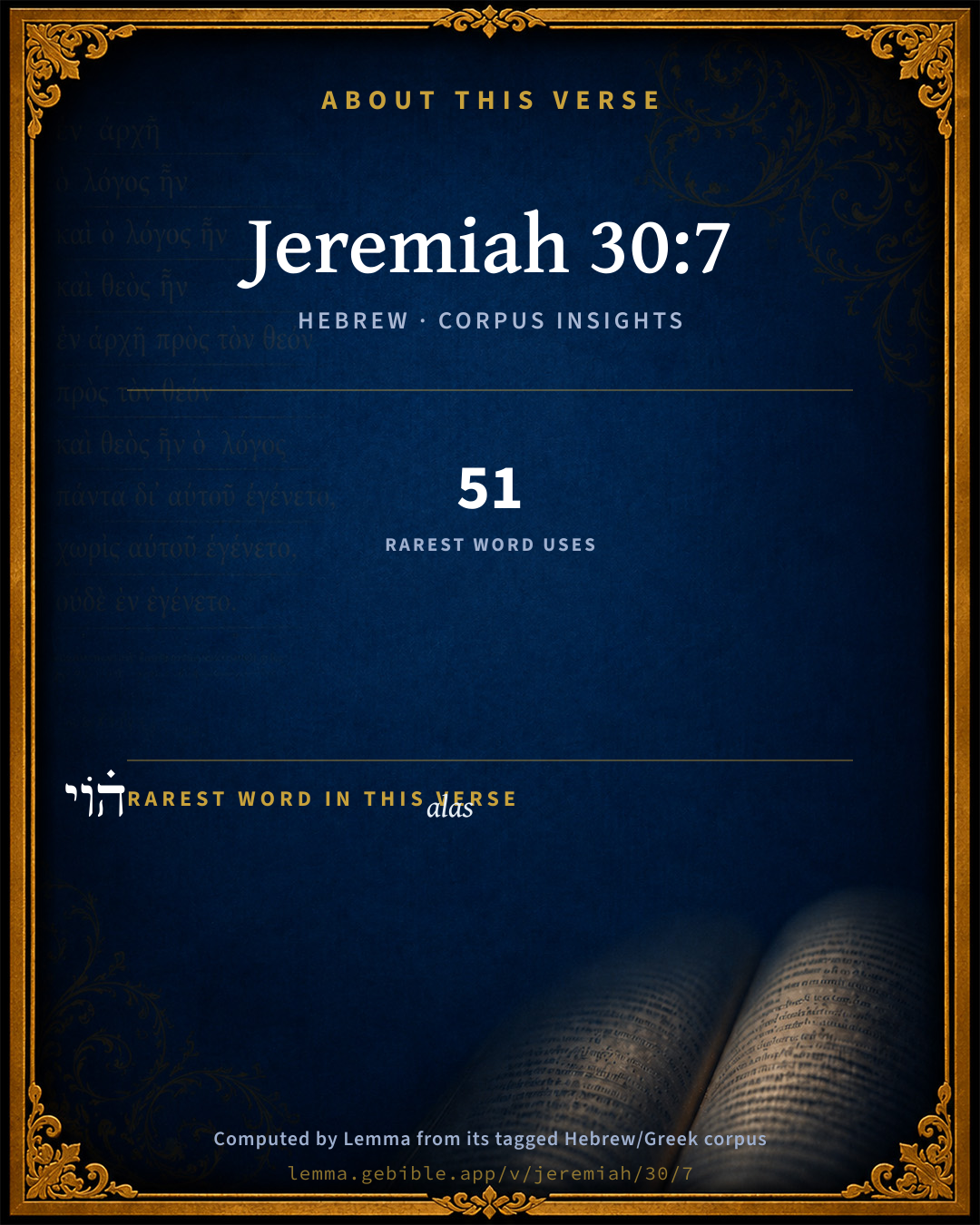
About this verse

These counts appear in no published source. They are computed here, from the morphology-tagged text and Lemma’s own curated glosses. What Lemma adds →

13
words
12
distinct lemmas
Prophets
section

Shared distinctive vocabulary

ה֗וֹי alas H1945 occurs in 47 verses of the Hebrew Bible. Also found in:

Grammatical profile

  • 1 verb
  • 4 nouns
  • 1 adjective
  • 2 pronouns
  • 2 prepositions
  • 1 conjunction
  • 2 particles

Verb forms

  • יִוָּשֵֽׁעַ Niphal · Imperfect

Repetition

A word recurs within this verse — often emphatic in Hebrew:

  • הַה֖וּא he H1931 ×2

Cross-references

28

Topical passages linked to Jeremiah 30:7 in the Treasury of Scripture Knowledge — connected by theme and wording, ordered by reader-vote popularity; previews shown in the World English Bible.

  • Daniel 12:1 "At that time shall Michael stand up, the great prince who stands for the children of your people; and there shall be a time of trouble, such as never was since there was a nation even to that same time: and at that time your people shall be delivered, everyone who shall be found written in the book.
  • Malachi 4:1 "For, behold, the day comes, it burns as a furnace; and all the proud, and all who work wickedness, will be stubble; and the day that comes will burn them up," says Yahweh of Hosts, "that it shall leave them neither root nor branch.
  • Daniel 9:12 He has confirmed his words, which he spoke against us, and against our judges who judged us, by bringing on us a great evil; for under the whole sky has not been done as has been done on Jerusalem.
  • Zechariah 14:1–2 Behold, a day of Yahweh comes, when your spoil will be divided in your midst.
  • Joel 2:11 Yahweh thunders his voice before his army; For his forces are very great; For he is strong who obeys his command; For the day of Yahweh is great and very awesome, And who can endure it?
  • Matthew 24:21–22 for then there will be great oppression, such as has not been from the beginning of the world until now, no, nor ever will be.
  • Romans 11:26 and so all Israel will be saved. Even as it is written, "There will come out of Zion the Deliverer, And he will turn away ungodliness from Jacob.
  • Mark 13:19 For in those days there will be oppression, such as there has not been the like from the beginning of the creation which God created until now, and never will be.
  • Psalms 34:19 Many are the afflictions of the righteous, But Yahweh delivers him out of them all.
  • Jeremiah 30:10 Therefore don't you be afraid, O Jacob my servant, says Yahweh; neither be dismayed, Israel: for, behold, I will save you from afar, and your seed from the land of their captivity; and Jacob shall return, and shall be quiet and at ease, and none shall make him afraid.
  • Hosea 1:11 The children of Judah and the children of Israel will be gathered together, and they will appoint themselves one head, and will go up from the land; for great will be the day of Jezreel.
  • Zephaniah 1:14–18 The great day of Yahweh is near. It is near, and hurries greatly, the voice of the day of Yahweh. The mighty man cries there bitterly.
  • Jeremiah 50:18–20 Therefore thus says Yahweh of Hosts, the God of Israel: Behold, I will punish the king of Babylon and his land, as I have punished the king of Assyria.
  • Lamentations 1:12 Is it nothing to you, all you who pass by? Look, and see if there be any sorrow like my sorrow, which is brought on me, With which Yahweh has afflicted [me] in the day of his fierce anger.
  • Ezekiel 7:6–12 An end is come, the end is come; it awakes against you; behold, it comes.
  • Psalms 25:22 Redeem Israel, God, Out all of his troubles.
  • Hosea 12:2–4 Yahweh also has a controversy with Judah, And will punish Jacob according to his ways; According to his deeds he will repay him.
  • Amos 5:18–20 "Woe to you who desire the day of Yahweh! Why do you long for the day of Yahweh? It is darkness, And not light.
  • Revelation 6:17 for the great day of his wrath has come; and who is able to stand?"
  • Genesis 32:7 Then Jacob was greatly afraid and was distressed: and he divided the people who were with him, and the flocks, and the herds, and the camels, into two companies;
  • Isaiah 2:12–22 For there will be a day of Yahweh of Hosts for all that is proud and haughty, And for all that is lifted up; And it shall be brought low:
  • Isaiah 14:1–2 For Yahweh will have compassion on Jacob, and will yet choose Israel, and set them in their own land: and the foreigner shall join himself with them, and they shall cleave to the house of Jacob.
  • Jeremiah 50:33–34 Thus says Yahweh of hosts: The children of Israel and the children of Judah are oppressed together; and all who took them captive hold them fast; they refuse to let them go.
  • Lamentations 2:13 What shall I testify to you? what shall I liken to you, daughter of Jerusalem? What shall I compare to you, that I may comfort you, virgin daughter of Zion? For your breach is great like the sea: who can heal you?
  • Lamentations 4:6 For the iniquity of the daughter of my people is greater than the sin of Sodom, That was overthrown as in a moment, and no hands were laid on her.
  • Joel 2:31 The sun will be turned into darkness, And the moon into blood, Before the great and terrible day of Yahweh comes.
  • Acts 2:20 The sun will be turned into darkness, And the moon into blood, Before the great and glorious day of the Lord comes.
  • Genesis 32:24–30 Jacob was left alone, and wrestled with a man there until the breaking of the day.

Cross-references courtesy of OpenBible.info (CC BY 4.0).

Hebrew and Greek witnesses Masoretic Hebrew ↔ Greek Septuagint

The same verse in the two great witnesses to the Old Testament, shown verse-for-verse.

These are two independent witnesses, not word-aligned to each other, and the Septuagint is shown in lemma (dictionary) form.

Hebrew Jeremiah 30:7 Masoretic · Westminster Leningrad Codex

ה֗וֹי כִּ֥י גָד֛וֹל הַיּ֥וֹם הַה֖וּא מֵאַ֣יִן כָּמֹ֑הוּ וְעֵֽת צָרָ֥ה הִיא֙ לְיַֽעֲקֹ֔ב וּמִמֶּ֖נָּה יִוָּשֵֽׁעַ

Alas! for that day is great, so that none is like it: it is even the time of Jacob's trouble; but he shall be saved out of it.

World English Bible · Public Domain

Greek LXX Structure differs

In the Septuagint, Jeremiah is about an eighth shorter than the Hebrew and arranges its material differently — the Oracles Against the Nations (Hebrew chapters 46–51) appear in the middle of the Greek book, after 25:13. Because the chapter and verse boundaries do not line up, a verse-for-verse comparison with the Hebrew is not shown.

A verse-for-verse comparison isn’t shown here because the chapters and verses don’t line up. Switch to the LXX edition with the MT / LXX toggle above to read the Greek directly.

Hebrew: Westminster Leningrad Codex (CC BY 4.0). Greek: Septuagint (public domain); English from a public-domain English Septuagint. How the Septuagint differs from the Hebrew →

Targum (Aramaic paraphrase)

1

The Targum is the ancient Jewish Aramaic paraphrase of the Hebrew Scriptures — an interpretive translation, not the Hebrew text itself. Onkelos (literal) and Pseudo-Jonathan (expansive) render the Torah, and Jonathan the Prophets. Coverage is partial: where no permissively-licensed English translation exists for a verse, only the Aramaic is shown. This is verse-level text, not a word-by-word alignment to the Hebrew.

  1. Targum Jonathan Prophets (Joshua–Malachi)
    וַי אֲרֵי רַב יוֹמָא הַהוּא לֵית דִכְוָתֵיהּ וְעִדַן עָקָא הוּא לְיַעֲקֹב וּמִנָהּ יִתְפְּרַק:

    (no public-domain English translation for this verse)

    Targum Jonathan — Aramaic: “Mikraot Gedolot” (public domain). English: “Sefaria Community Translation” (CC0 1.0 (public-domain dedication)); “London "Chaldee Paraphrase," 1871” (public domain). Text via Sefaria.

Commentary

Notes on Jeremiah 30:7 from classic Christian and Jewish commentators (each source and its license shown beneath its notes). The classic Christian expositions comment on the surrounding passage and are grouped to its opening verse, so a note may address several verses; the Jewish commentaries on the Tanakh (Rashi and others) are per-verse, so they appear only where the commentator wrote on this verse.

Lemma curates 59 commentaries, every one of them public domain or Creative Commons licensed, each selected and text-cleaned for this edition rather than reprinted as found. About our sources →

Trapp's Complete Commentary

John Trapp

Jer 30:7 Alas! for that day [is] great, so that none [is] like it: it [is] even the time of Jacob’s trouble; but he shall be saved out of it.

Ver. 7. Alas! for that day is great,] i.e., Troublesome and terrible, somewhat like the last day, the day of judgment, which is therefore also called the "great day," because therein the great God will do great things, &c.

It is even the time of Jacob’s trouble.] Such as never befell him before. Those very days shall be "affliction," so Mark expresseth the last desolation; {Jer 13:19} not "afflicted" only, but "affliction" itself. But though it be the time of Jacob’s troubles, let it be also the time of his trust, for there will be shortly a day of his triumph.

But he shall be saved out of it.] Not from it, but yet out of it; the Lord knoweth how to deliver his: {2Pe 2:9} and though Sense say it will not be; Reason it cannot be; yet Faith gets above and says it shall be; I see the land.

John Trapp, A Commentary or Exposition upon All the Books of the Old and New Testament (1647–1656) — public domain. Text from a community e-Sword module.

The Biblical Illustrator

Joseph S. Exell

Jer_30:7

It is even the time of Jacobs trouble; but he shall be saved out of it.

Jacobs trouble

There is not a malady in human life, but we find its antidote in the Bible; not a wound, but we find its balm; not a spiritual sickness, but we find its remedy there. If there is no time of trouble to Jacob, what deliverance could Jacob want? Of what use is a promise of rest to the weary and heavy laden, unless a man finds himself burdened and oppressed? A promise of salvation is only of value for those who feel their need of it; and an assurance of deliverance is only precious to such as are made sensible of their danger. The language of our text relates primarily and literally to the languishing state of the Church--to the captivity of Israels tribes--to Jacobs trouble on account of the desolation of their city, and the destruction of their temple; and it is not only promised to them that their trouble should be blessed to them, but also that they should be saved out of it. We notice, first, the time of Jacobs trouble; secondly, the timely deliverance promised, He shall be saved out of it; and thirdly, the evidence and display of the truth and faithfulness of God towards Israel and Jacob.

1. Some may inquire why the truth and faithfulness of God should be brought forward. I do not intend to present you with a catalogue of Jacobs troubles; they are too numerous. I will, however, mention a few.

(1) The trouble here spoken of is of a public nature. In its literal sense, it was the distress, calamity, degeneracy, of the Lords people--the scattering and desolation of His inheritance by captivity. I have but a sorry opinion of that mans spirituality who is not troubled for Jacobs, not grieved for Josephs, not afflicted for Zions low, degenerate, sunken, miry condition. It is to my mind, amid all the enjoyments of my soul in Christ, a source of daily trouble. But this degeneracy is not the worst feature in Jacobs trouble. There is such an awful determination evinced to unite the Church and the world, to amalgamate two whom God has separated in His Word, purposes, and dispensations, with the highest and broadest wall of separation.

(2) But Jacobs trouble is not only of a public character; it is also of a personal nature. There is spiritual trouble when a man is first awakened--when the Lord Jesus convinces him of sin, and discovers the spirituality and extent of the Divine law. This is, indeed, a time of trouble; but here is the mercy--he shall be delivered out of it. He that melted your heart will form Christ there, the hope of glory. He that gave you the knowledge of your sins will also give you the knowledge of His Son. Again, it is a time of trouble when the soul is in legal bondage. What a time of trouble, of fear, sorrow, anxiety, dread, gloom, and dismal forebodings do souls in legal bondage pass through, till the Son of God comes Himself and makes them flee. Again, it is a time of personal trouble when the soul is led into the field of battle, and foiled by the enemy. Again, it is a time of personal trouble when we are called to walk in darkness.

(3) Again, there is a time of providential trouble. It was a time of providential trouble to Joseph when sold by his brethren, falsely accused by his mistress, thrown into a dungeon by his master. It was a time of providential trouble to David, when he was hunted by Saul, betrayed by Doeg, threatened to be stoned by his own people, when Ziklag was burned, when driven into the wilderness as a fugitive, and expelled from his throne, family, and palace by his wicked son--but he shall be saved out of it. There were times and troubles to Isaiah, Jeremiah, and Paul, and all the apostles.

2. The timely deliverance. He shall be saved out of it. There is a threefold method in which God saves Jacob out of his trouble. Sometimes by causing his troubles to terminate with a word. He speaks the word, Peace, be still, and not s wave rolls, nor s wind breathes. Sometimes He causes their troubles to terminate by taking the sons of Jacob out of them to glory, and raising them above the reach of them for ever. Sometimes by teaching them how to trust and triumph in Himself; as David says, Though I walk in the midst of trouble Thou wilt revive me. What a marvellous deliverance God effected for His people in the days of bloody Mary. Then there were multitudes of godly men in prison, under sentence to the fire, and expecting the faggots every moment to be kindled, when God suddenly summoned that cruel queen into His presence. Elizabeth succeeded, and His people were rescued Remember, whether trial is domestic, personal, spiritual, temporal, or circumstantial, a Fathers wisdom directs it, a Fathers love superintends it, and a Fathers word will scatter it. And remember, whatever method God may adopt to save you out of your trouble, you, as a son of Jacob, will be enabled to say, It is good for me that I have been afflicted. Sometimes He delivers them by teaching them how to trust Him, and triumph in Him in the midst of troubles. Look at Gideon and his conquest over the Midianites, without a spear, a bow, dart, javelin, sword, arrow, lance, or any weapon of war--with nothing but lamps and pitchers he overcomes them. How different are the troubles of Jacob and Esau, of Isaac and Ishmael, of the Christian and the worldling, of a child and an enemy. The troubles of the worldling are not few. He is liable to all the calamities of life. He has no God to flee to, no sympathising High Priest. Place a Christless man in my circumstances, despair and anguish will be his portion; but s man that shall be saved if he has my God. Is there any relation to, any likeness to, Jacobs sons to be found in you? Is there any distinction between you and Esau? Is there any personal, spiritual difference between you and the world? Can you give an affirmative answer to these questions? If so, the promise and oath of God are on your side; and, however deep or long your troubles may be, you shall be saved out of them. (J. Iron.)

The Biblical Illustrator, edited by Joseph S. Exell (c. 1880s–1900s) — public domain. Text from a community e-Sword module.

Tyndale Open Study Notes

Tyndale Open Resources

30:7 The time of trouble was the Babylonian capture and the final destruction of Judah in 586 BC.

Tyndale Open Study Notes — © Tyndale Open Resources, licensed CC BY-SA 4.0. Text via the HelloAO Bible API.

Geneva Bible (1599)

Geneva Bible translators

Meaning, that the time of their captivity should be grievous.

Geneva Bible (1599) marginal notes — public domain. Text via Bolls.life.

Jamieson, Fausset & Brown

Robert Jamieson, A. R. Fausset & David Brown

great--marked by great calamities (Joe 2:11, Joe 2:31; Amo 5:18; Zep 1:14).

none like it . . . but he shall be saved-- (Dan 12:1). The partial deliverance at Babylon's downfall prefigures the final, complete deliverance of Israel, literal and spiritual, at the downfall of the mystical Babylon (Rev. 18:1-19:21).

Jamieson, Fausset & Brown — Commentary Critical and Explanatory on the Whole Bible (1871) — public domain (CC PDM 1.0). Text via the HelloAO Bible API.

Adam Clarke's Commentary

Verse 7. Alas! for that day is great] When the Medes and Persians with all their forces shall come on the Chaldeans, it will be the day of Jacob's trouble-trial, dismay, and uncertainty; but he shall be delivered out of it-the Chaldean empire shall fall, but the Jews shall be delivered by Cyrus. Jerusalem shall be destroyed by the Romans, but the Israel of God shall be delivered from its ruin. Not one that had embraced Christianity perished in the sackage of that city.

Adam Clarke's Commentary on the Bible (1810–1826) — public domain. Text from a community e-Sword/MySword module.

John Calvin's Commentaries

The Prophet goes on in this verse to describe the grievousness of that punishment for which the people felt no concern, for they disregarded all threatenings, as I have already said, and had now for many years hardened themselves so as to deem as nothing so many dreadful things. This, then, was the reason why he dwelt so much on this denunciation, and exclaimed, Alas! great is that day: “great” is to be taken for dreadful; and he adds, so that there is none like it It was a dreadful spectacle to see the city destroyed, and the Temple partly pulled down and partly consumed by fire: the king, with all the nobility, was driven into exile, his eyes were put out, and his children were slain; and he was afterwards led away in a manner so degraded, that to die a hundred times would have been more desirable than to endure such indignity. Hence the Prophet does not say without reason, that that day would be great, so that none would be like it: and he said this, to shake away the torpidity of the people, for they thought that the holy city, which God had chosen for his habitation, could not fall, nor the Temple perish, he further says, that it would be a time of distress to the people. But at the end of the verse he gives them a hope of God’s mercy, even deliverance from this distress. We now, then, see the design of the Prophet in these verses. — There will be no Lecture tomorrow on account of the Consistory.

John Calvin's Commentaries (1540-1563) — public domain. Text from the Calvin Translation Society English edition (1840s-50s) via the Christian Classics Ethereal Library (ccel.org). Calvin's coverage is partial (roughly two-thirds of the Bible); uncommented books and verses are honest gaps, never fabricated. The 19th-century editor's footnotes and remarks are omitted so the notes are faithfully Calvin's own voice.

The Cambridge Bible for Schools and Colleges

gen. ed. J. J. S. Perowne

7. that day] The expression “the day of the Lord,” in an eschatological sense, is found first in Amos (Jer_5:18), and is adopted by later prophets. Its meaning is developed in two directions according to the teaching which the individual prophet desires to convey. Jehovah, they taught, will some day manifest Himself, it may be in executing terrible judgement upon the sin either of His own nation or of others; but it may also be in the restoration of the former to the privileges which they had forfeited. The description is modified in each case by the occasion; e.g. Isa_2:12 ff. directs the judgement against the material wealth and luxury acquired in the days of Uzziah. Joel (Jer_2:1 ff.) illustrates the punishment by a recent scourge of locusts. Cp. Zep_1:7; Zep_1:14 ff. Here, and in later prophecy in general (see above for the date of this section), the Day results in Israel’s deliverance, a deliverance reached, however, only through suffering.

so that none is like it] The Heb. may be rendered, Whence is any like it? Cp. Jer_10:6.

he shall be saved out of it] Here we have the transition to the joyous note which dominates the rest of the prophecy.

The Cambridge Bible for Schools and Colleges (gen. ed. J. J. S. Perowne; Cambridge University Press, 1878–1918) — public domain. Text from a community e-Sword module.

John Gill's Exposition

Alas! for that day is great,.... For sorrow and distress:

so that none is like it; such were the times of Jerusalem's siege and destruction by the Romans; and which was an emblem of those times of trouble from antichrist in the latter day; see Mat 24:21;

it is even the time of Jacob's trouble: of the church and people of God, the true Israel of God; when Popery will be the prevailing religion in Christendom; when the outward court shall be given to the Gentiles; the witnesses shall be slain; antichrist will be "in statu quo"; and the whore of Rome in all her glory; though it shall not last long:

but he shall be saved out of it; shall come out of those great tribulations into a very happy and comfortable estate; the spirit of life shall enter into the witnesses, and they shall live and ascend to heaven; the vials of God's wrath will be poured upon the antichristian states; the kings of the earth will hate the whore, and burn her with fire; the Gospel will be preached everywhere; the Jews will be converted, and the fulness of the Gentiles be brought in; and an end be put to all trouble; of which there will be no more, nor any occasion of it: or, "therefore he shall be saved out of it" (r); as the effect of the divine compassion to him in such great trouble.

(r) "ideo ex eo servabitur", Schmidt.

John Gill's Exposition of the Whole Bible (1746–1763) — public domain (CC PDM 1.0). Text via the HelloAO Bible API.

Albert Barnes' Notes on the Bible

That day - i. e., the day of the capture of Babylon.

It is even the time of Jacob’s trouble - Rather, and it is a time of trouble to Jacob, i. e., of anxiety to the Jews, for the usages of war were so brutal that they would be in danger when the enemy made their assault.

Albert Barnes' Notes on the Bible (1834–1885) — public domain. Text from a community e-Sword/MySword module.

Haydock's Catholic Bible Commentary

Great, and terrible for this city, the outer walls of which shall be demolished, (Berosus; Calmet) and all its glory perish. (Haydock) --- Of it. Cyrus liberated the Jews, 1 Esdras i.

George Leo Haydock (1774–1849), Haydock's Catholic Family Bible and Commentary, 1859 edition — public domain. Excludes Psalms (Douay-Rheims chapter numbering differs from Protestant) and Deuterocanonical books (Catholic canon only).

Matthew Poole's English Annotations

It is no wonder that there is such a trembling upon all hearts, such a consternation and great complaining; for it will be a time of no ordinary calamity, but of great evil and misery, in the same sense as it is called a great day, Joe 2:11, great and terrible; and Zep 1:14, &c.; there never was such a day before. It will be a day of trouble to those that are the posterity of Jacob, both good and bad; they shall not be delivered from it, but they shall be delivered out of it.

Matthew Poole's English Annotations on the Holy Bible (1683–1685) — public domain. Text from a community e-Sword/MySword module.

Whedon's Commentary on the Bible

Daniel D. Whedon

7. That day — Namely, of the captivity of Babylon. Comp. Joe_2:11; Amo_5:18.

Daniel D. Whedon (gen. ed.), Commentary on the Old and New Testaments (1874–1909) — public domain. Text from a community e-Sword module.

The Pulpit Commentary

That day; i.e. "the day of Jehovah," the day of the great judgment upon the world, of which the fall of Babylon is regarded as the opening scene. It is even the time of Jacob"s trouble; rather, and a time of distress shall it be (even) to Jacob.

The Pulpit Commentary (1880–1919), ed. H.D.M. Spence-Jones & Joseph S. Exell — public domain. Text from a community e-Sword module.

Rashi

Rabbi Shlomo Yitzchaki (Rashi)

that day The day of the assassination of Belshazzar and the downfall of Babylon. Another explanation: the day of the downfall of Gog.

Rashi on the Tanakh — English translations: “The Judaica Press complete Tanach with Rashi, translated by A. J. Rosenberg” (CC BY 4.0); “Pentateuch with Rashi's commentary by M. Rosenbaum and A.M. Silbermann, 1929-1934” (public domain); “The Metsudah Tanach series, Lakewood, N.J” (CC BY 4.0); and “The Book of Joshua, Metsudah Publications, 1997” (CC BY 4.0). Text via Sefaria.

Lesson kit

Teaching starters — assembled from the data on this page, not authored interpretation. Every prompt links to the verse data it draws on. Edit before teaching.

Jeremiah, in the Prophets, opens this verse with 13 words (12 distinct Hebrew lemmas). Its most distinctive word is hôwy (“alas”). A historical commentator’s framing appears above. Read the whole chapter for the surrounding context.

Discussion questions

  1. What does “alas” (hôwy) contribute to the verse as a whole?
  2. How does 1 Kings 13:30, which shares the word «alas», read alongside this verse?
  3. What does the repetition of “he” (2× in this one verse) do in this verse?
  4. These translations render this verse differently. What is at stake in choosing one wording over another?
  5. «יִוָּשֵֽׁעַ» is a Niphal Imperfect verb. How does that grammatical form shape the action described?
  6. Compare how Trapp's Complete Commentary and The Biblical Illustrator read this verse. Where do they agree or differ?

Things to notice

Reading settings

Reading text

Shown beneath each verse's original-language words.

Old Testament
Old Testament edition

Read the OT as the Masoretic Hebrew (MT) or the Greek Septuagint (LXX).

English shown for the Greek Septuagint (in the Hebrew ↔ Greek comparison).

Comparing translations? Open the Compare panel on any verse page to stack up to four side by side.