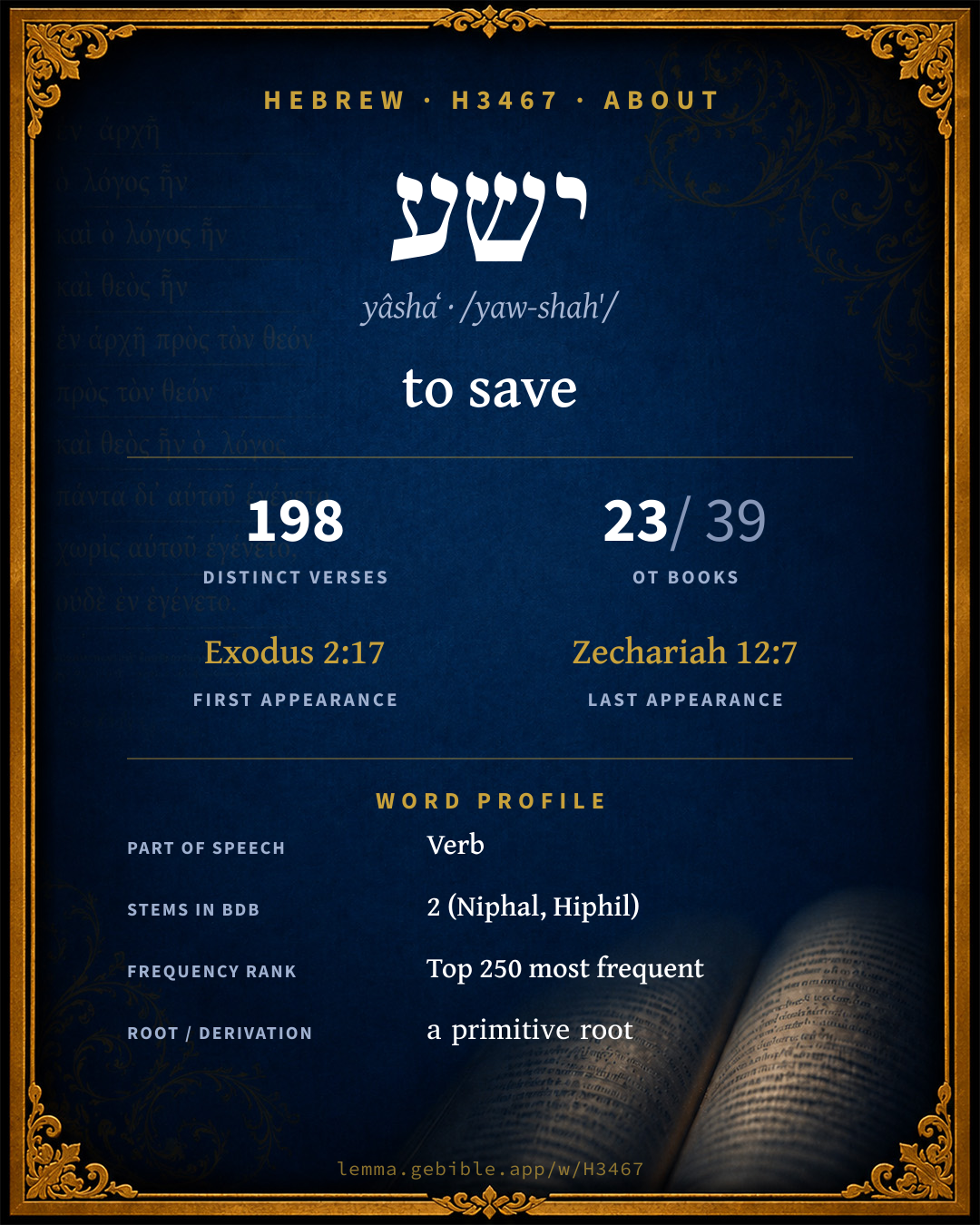
יָשַׁע
to save
also: be saved, be delivered fuller range ↓
Full lexicon entry — Brown-Driver-Briggs (BDB)
From Brown-Driver-Briggs (BDB)
Where this word appears
Grammar key — what these labels mean
Part of speech
- Verb
- An action or state-of-being word.
Noun type
- Common
- A common noun — a general class of person, place, or thing (“king,” “city,” “water”), not a specific name.
Stem
- Hiphil
- The causative active stem (“he caused / brought about”). Here: ‘deliver’
- Niphal
- Usually the simple passive or reflexive of the Qal (“he was written”). Here: ‘be liberated’
Form
- Participle Active
- A verbal adjective expressing ongoing or characteristic action (“writing / one who writes”).
- Infinitive Construct
- A bound verbal noun, frequently with prepositions (“to write / in writing”).
- Imperative
- A direct command (“write!”).
- Sequential Imperfect
- An imperfect with prefixed waw — the standard past-narrative form (waw-consecutive imperfect).
- Imperfect
- An incomplete, ongoing, or future action (“he will / would write”).
- Sequential Perfect
- A perfect with prefixed waw continuing a preceding imperfect or command (waw-consecutive perfect).
- Cohortative
- A first-person volitional form expressing wish or resolve (“let me / let us write”).
- Infinitive Absolute
- An unbound verbal noun, often intensifying or standing in for a finite verb.
- Perfect
- A completed action or state — Hebrew marks aspect (completeness) more than strict tense (“he wrote”).
- Jussive
- A third- or second-person volitional form expressing wish or command (“let him write”).
State
- Absolute
- The independent form of a noun, not bound to a following word.
- Construct
- A noun bound to a following noun in a possessive / “of” relationship (the construct chain).
Person
- 2nd Person
- The one addressed (“you”).
- 3rd Person
- The one spoken about (“he / she / it / they”).
- 1st Person
- The speaker (“I / we”).
Gender
- Masculine
- Grammatically masculine.
- Common
- Either gender — not distinguished for this form.
- Feminine
- Grammatically feminine.
Number
- Singular
- One.
- Plural
- More than one (in Hebrew, generally three or more).
Every verse where H3467 appears in the Book of Judges — 20 distinct verses. Click any verse to open its interlinear word-by-word view. Verse text shown in the World English Bible for context — . Each verse’s Hebrew form is shown with its reference; the English is not keyword-highlighted, since the data carries no word-level English alignment. Use “Compare translations” on any verse to read it across multiple English versions. This concordance covers the Hebrew Bible; Septuagint (Greek Old Testament) occurrences are not indexed here.
Judges
- Judges 2:16 וַ/יּ֣וֹשִׁיע֔וּ/ם conj + Hiphil wimpf 3mp + sfx pers 3mp Yahweh raised up judges, who saved them out of the hand of those who despoiled them.
- Judges 2:18 וְ/הֽוֹשִׁיעָ/ם֙ conj + Hiphil wpf 3ms + sfx pers 3mp When Yahweh raised them up judges, then Yahweh was with the judge, and saved them out of the hand of their enemies all the days of the judge: for it repented Yahweh because of their groaning by reason of those who oppressed them and vexed them.
- Judges 3:9 מוֹשִׁ֛יעַ וַ/יּֽוֹשִׁיעֵ֑/ם Hiphil ptcp.act ms conj + Hiphil wimpf 3ms + sfx pers 3mp When the children of Israel cried to Yahweh, Yahweh raised up a savior to the children of Israel, who saved them, even Othniel the son of Kenaz, Caleb's younger brother.
- Judges 3:15 מוֹשִׁ֗יעַ Hiphil ptcp.act ms But when the children of Israel cried to Yahweh, Yahweh raised them up a savior, Ehud the son of Gera, the Benjamite, a man left-handed. The children of Israel sent tribute by him to Eglon the king of Moab.
- Judges 3:31 וַ/יֹּ֥שַׁע conj + Hiphil wimpf 3ms After him was Shamgar the son of Anath, who struck of the Philistines six hundred men with an ox-goad: and he also saved Israel.
- Judges 6:14 וְ/הוֹשַׁעְתָּ֥ conj + Hiphil wpf 2ms Yahweh looked at him, and said, Go in this your might, and save Israel from the hand of Midian: have not I sent you?
- Judges 6:15 אוֹשִׁ֖יעַ Hiphil impf 1cs He said to him, Oh, Lord, with which shall I save Israel? behold, my family is the poorest in Manasseh, and I am the least in my father's house.
- Judges 6:31 תּוֹשִׁיע֣וּ/ן Hiphil impf 2mp + sfx n Joash said to all who stood against him, Will you contend for Baal? Or will you save him? he who will contend for him, let him be put to death while [it is yet] morning: if he be a god, let him contend for himself, because one has broken down his altar.
- Judges 6:36 מוֹשִׁ֧יעַ Hiphil ptcp.act ms Gideon said to God, If you will save Israel by my hand, as you have spoken,
- Judges 6:37 תוֹשִׁ֧יעַ Hiphil impf 2ms behold, I will put a fleece of wool on the threshing floor; if there be dew on the fleece only, and it be dry on all the ground, then shall I know that you will save Israel by my hand, as you have spoken.
- Judges 7:2 הוֹשִׁ֥יעָה Hiphil pf 3fs Yahweh said to Gideon, The people who are with you are too many for me to give the Midianites into their hand, lest Israel vaunt themselves against me, saying, My own hand has saved me.
- Judges 7:7 אוֹשִׁ֣יעַ Hiphil impf 1cs Yahweh said to Gideon, By the three hundred men who lapped will I save you, and deliver the Midianites into your hand; and let all the people go every man to his place.
- Judges 8:22 הוֹשַׁעְתָּ֖/נוּ Hiphil pf 2ms + sfx pers 1cp Then the men of Israel said to Gideon, Rule you over us, both you, and your son, and your son's son also; for you have saved us out of the hand of Midian.
- Judges 10:1 לְ/הוֹשִׁ֣יעַ prep + Hiphil inf.cs After Abimelech there arose to save Israel Tola the son of Puah, the son of Dodo, a man of Issachar; and he lived in Shamir in the hill-country of Ephraim.
- Judges 10:12 וָ/אוֹשִׁ֥יעָ/ה conj + Hiphil wimpf 1cs + sfx h The Sidonians also, and the Amalekites, and the Maonites, did oppress you; and you cried to me, and I saved you out of their hand.
- Judges 10:13 לְ/הוֹשִׁ֥יעַ prep + Hiphil inf.cs Yet you have forsaken me, and served other gods: therefore I will save you no more.
- Judges 10:14 יוֹשִׁ֥יעוּ Hiphil impf 3mp Go and cry to the gods which you have chosen; let them save you in the time of your distress.
- Judges 12:2 הוֹשַׁעְתֶּ֥ם Hiphil pf 2mp Jephthah said to them, I and my people were at great strife with the children of Ammon; and when I called you, you didn't save me out of their hand.
- Judges 12:3 מוֹשִׁ֗יע Hiphil ptcp.act ms When I saw that you didn't save me, I put my life in my hand, and passed over against the children of Ammon, and Yahweh delivered them into my hand: why then are you come up to me this day, to fight against me?
- Judges 13:5 לְ/הוֹשִׁ֥יעַ prep + Hiphil inf.cs for, behold, you shall conceive, and bear a son; and no razor shall come on his head; for the child shall be a Nazirite to God from the womb: and he shall begin to save Israel out of the hand of the Philistines.
About this entry
At a glance — auto-summarized from this page’s data, not written by a person. Every figure links to its source below. This summary describes the numbers; it doesn’t interpret them.
At its core, ישע (yâshaʻ) means “to save.” It first appears in Exodus 2:17. It turns up in 198 verses across 23 books, a common footprint. The word gravitates to Psalms (29%), then Isaiah and Judges. Read the stem: it spans 2 stems, including Niphal and Hiphil. Dig into 198-verse concordance and the renderings breakdown below.
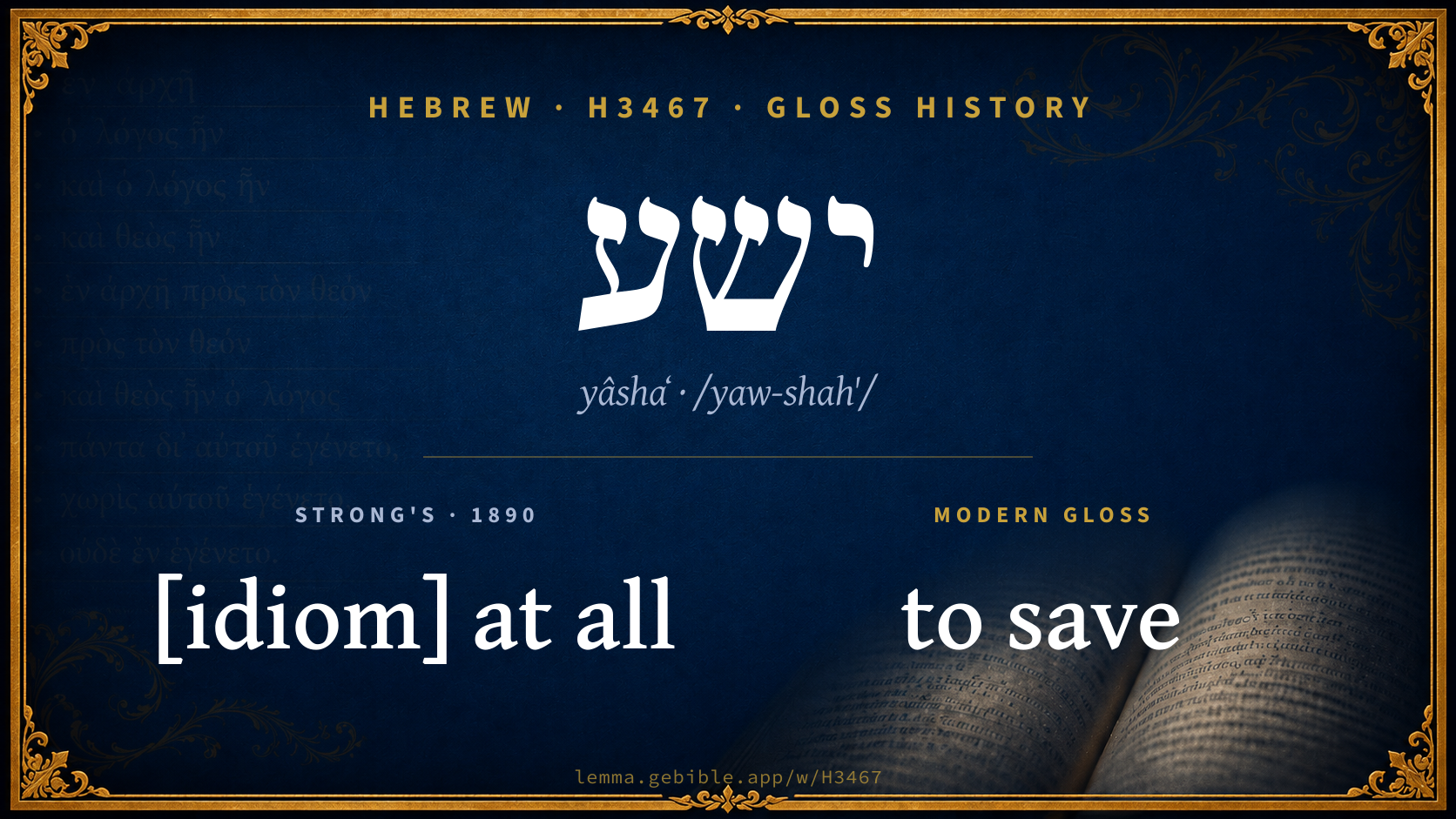
Gloss history
Strong's 1890 vs modern scholarship
About this word
Strong's H3467 catalogs a Hebrew word from the Hebrew Old Testament.
These counts are not copied from any lexicon or concordance. They are computed here, from the morphology-tagged Hebrew Old Testament. What Lemma adds →
- 198
- distinct verses
- The word appears in 198 distinct verses.
- 23 / 39
- OT books
- The word appears in 23 of 39 Old Testament books.
- #232
- by frequency
- Top 250 most frequent Hebrew words (rank 232 of 8,640 Hebrew words by occurrence).
View all 198 occurrences in the concordance →
By section of the Old Testament
By traditional corpus
Conventional, traditional groupings — biblical authorship is debated, so this is a traditional corpus grouping, not an authorship claim. Each share is this word’s portion of its verses in that division of the Hebrew canon. Each figure is a share of the word’s 198 distinct verses.
- Prophets (Nevi'im) 117 verses · 59%
- Writings (Ketuvim) 73 verses · 37%
- Torah (Pentateuch) 8 verses · 4%
How translations render this word
Counts come from each version’s own published word-to-Strong’s tagging or interlinear alignment — an approximate guide to how each version renders this word, not a word-level alignment the data otherwise carries. Because each total is that version’s own tagged count, the per-version totals vary from one another and need not match the appearance or distinct-verse counts above. These counts may also differ from a printed concordance because Lemma counts each distinctly tagged rendering and does not collapse phrase taggings into a single head-word total. This is a fixed set of word-tagged versions (KJV, ASV, BSB, ULT) and does not change with the reading translation you choose elsewhere. Each version’s license is shown beside its name below (and on Sources).
- King James Version: Save 43×, Saved 10×, Saviour 8×
- American Standard Version: Save 44×, Saved 10×, Saviour 10×
- Berean Standard Bible: Save 27×, Save me 17×, Save us 13×
- unfoldingWord Literal Text: Save 34×, Save me 18×, Saved 14×
King James Version Public Domain
Renders H3467 across 205 tagged occurrences — most commonly:
Plus other, less common renderings. Plus 65 renderings that appear only once — usually multi-word phrases or single function words the recovered tagging swept in, not distinct renderings.
American Standard Version Public Domain
Renders H3467 across 204 tagged occurrences — most commonly:
Plus other, less common renderings. Plus 64 renderings that appear only once — usually multi-word phrases or single function words the recovered tagging swept in, not distinct renderings.
Berean Standard Bible Public Domain
Renders H3467 across 203 tagged occurrences — most commonly:
Plus other, less common renderings. Plus 48 renderings that appear only once — usually multi-word phrases or single function words the recovered tagging swept in, not distinct renderings. Not rendered by a distinct English word in 2 further occurrences.
unfoldingWord Literal Text CC BY-SA 4.0
Renders H3467 across 238 tagged occurrences — most commonly:
Plus other, less common renderings. Plus 64 renderings that appear only once — usually multi-word phrases or single function words the recovered tagging swept in, not distinct renderings.
12 senses and sub-senses in the full BDB
Hebrew verbs can shift meaning by stem (binyan): Qal is the basic action, Niphal is often passive or reflexive, Piel often intensifies or makes it factitive, and Hiphil is typically causative. The senses below are grouped under the stem BDB assigns to each.
What do BDB’s symbols mean?
BDB uses these scholarly abbreviations:
| Symbol | Meaning |
|---|---|
| 𝔊 | the Septuagint (the ancient Greek translation, LXX) |
| 𝔙 | the Vulgate (the Latin translation) |
| 𝔖 | the Syriac version (the Peshitta) |
| 𝔗 | the Targum (the Aramaic translation) |
| ψ | the Psalms |
| √ | root (the underlying root or stem) |
| ‖ | parallel passage (a synonymous or contrasted parallel) |
| † | the dagger: every passage where the word occurs is cited |
The 12 senses and sub-senses the full Brown-Driver-Briggs lexicon distinguishes for this word, in lexicon order (not ranked by frequency), with BDB’s own verbatim wording and sub-sense lettering. Shown in Hebrew script with BDB’s own scholarly abbreviations. The condensed entry is in the Lexicon Entry tab. See also the Forms in the corpus table below.
Niphal
- Pf. 3 m. נוֹשַׁע Dt 33:29; Is 45:17; 2 pl. נוֹשַׁעְתֶּם Nu 10:9; 1 pl. נוֹשָׁ֑עְנוּ Je 8:20; Impf. 3 ms. יִוָּשֵׁעַ Je 30:7; Pr 28:18 + 1 S 14:47 (for MT יַרְשִׁיעַ) 𝔊 We Klo Dr Kit Bu; 3 fs. תִּוָּשַׁע Je 23:6; 33:16; אִוָּשֵׁ֑עָה ψ 119:117 Je 17:14 + 8 times Impf.; Imv. pl. הִוָּֽשְׁעוּ Is 45:22; Pt. נוֹשָׁע ψ 33:16 Zc 9:9;— e.g. Deuteronomy 33:29
- 1. be liberated, saved (proposes placed in freedom; cf. for the fig. הִרְחִיב, מֶרְחָב), from external evils Pr 28:18, by God Is 30:15; 45:22; 64:4; Je 4:14; 8:20; 17:14; 23:6; 33:16 ψ 80:4, 8, 20; 119:117; with מִן, Je 30:7; מֵאֹיְבִים Nu 10:9 (P), 2 S 22:4 = ψ 18:4. e.g. Proverbs 28:18
- 2. be saved in battle, victorious Zc 9:9 ψ 33:16 + 1 S 14:47 v. supr.; עַם נוֹשַׁע ביהוה Dt 33:29 a people victorious in י׳ (poem), cf. Is 45:17. e.g. Zechariah 9:9
Hiphil
- Pf. 3 ms. הוֹשִׁיעַ 1 S 9:16 ψ 20:7; הוֹשִׁעַ Zc 12:7; sf. הוֹשִׁיעוֹ ψ 34:7; 1 s. הוֹשַׁעְתִּי Is 43:12 + 4 times, + 14 times Pf.; Impf. יְהוֹשִׁיעַ 1 S 17:47 (v. Dr) ψ 116:6; יוֹשִׁיעַ Is 45:20 + 6 times; וְישַׁע (juss.) Pr 20:22; וַיּוֹשַׁע Ex 14:30 + 7 times; וַיּשַׁע 1 S 23:5 + 2 times; sf. יוֹשִׁיעֲךָ Ho 13:10; יוֹשִׁיעֶנּוּ Is 46:7; ישִׁעֵנוּ 1 S 10:27; ישַׁעֲכֶם Is 35:4 (juss., Dr§ 47. n. 4), etc.; Imv. הוֹשַׁע Je 31:7 ψ 86:2; הוֹשִׁיעָה 2 K 6:26 + 8 times; הוֹשִׁעָה 2 S 14:4 + 19 times Imv.; Inf. abs. הוֹשֵׁעַ 1 S 25:26 + 2 times; cstr. הוֹשִׁיעַ 1 S 14:6 + 14 times + 2 S 3:18 (where read אוֹשִׁיעַ Vrss. Ke We Klo Dr Bu al.), + 7 times Inf.; Pt. מוֹשִׁיעַ Dt 22:27 + 21 times; sf. מוֹשִׁיעָם ψ 106:21 + 8 times sf.; pl. מוֹשִׁיעִים Ob 21 Ne 9:27;— e.g. 1 Samuel 9:16
- 1. deliver, save (proposes give width and breadth to, liberate), in peril, c. acc. pers. vel loc. Ex 2:17 (E) Ju 6:31; 1 S 23:2, 5; 2 S 10:19 = 1 Ch 19:19, 2 K 6:27(×2) ψ 36:7; 72:13 Jb 26:2; with לְ pers. Jos 10:6 (E) Dt 22:27; Ju 10:14; 2 S 10:11 = 1 Ch 19:12 (with acc.), Je 11:12(×2) ψ 72:4; 116:6; abs. הוֹשִׁיעָה הַמֶּלֶךְ Help, O king 2 S 14:4; 2 K 6:26. Specif. save, from evils and troubles: e.g. Exodus 2:17
- a. of heroic men, saving the nation in war Ju 3:31; 6:15; 10:1; 1 S 10:27; Ho 13:10 Je 14:9; these are named מוֹשִׁיעַ saviour Ju 3:9, 15; 2 K 13:5; Is 19:20; Ob 21 Ne 9:27; phr. when they are lacking אֵין מוֹשִׁיעַ Ju 12:3 1 S 11:3; 2 S 22:42 = ψ 18:42, Dt 28:29, 31; Is 47:15; they save מִיַּד from the hand of Ju 2:16; 8:22; 12:2; 13:5 1 S 9:16; Ne 9:27; מכף Ju 6:14; 1 S 4:3; 2 K 16:7. e.g. Judges 3:31
- b. of God, who saves his people from external evils Dt 20:4; Jos 22:22; Ju 3:9; 6:36, 37; 7:7; 10:13; 1 S 14:23, 39; 2 K 14:27; 19:34 = Is 37:35, Is 25:9; 33:22; 35:4; 43:12; 49:25; 63:9; Je 31:7; Ez 34:22; Ho 1:7(×2) Hb 1:2; Zp 3:17, 19; Zc 8:7, 13; 9:16; 10:6; 12:7 ψ 28:9; 69:36; 106:8; 118:25 2 Ch 20:9; or the pious among them Is 38:20; Je 2:27; 17:14 ψ 3:8; 6:5; 7:2; 31:17; 54:3; 55:17; 57:4; 69:2; 71:2, 3; 106:47 = 1 Ch 16:35, ψ 109:26; 119:94, 146; 138:7; Pr 20:22; the king ψ 20:7, 10; David 2 S 8:6, 14; 1 Ch 18:6, 13; thy servant ψ 86:2, 16; חסיד 12:2; דַּכְּאֵי־רוּחַ 34:19; צדיקים 37:40; חוֹסִים 17:7; יראי י׳ 145:19; עם עני 18:28 = 2 S 22:28; עַנְוֵי־אֶרֶץ ψ 76:10; ישׁרי לב 7:11; שַׁח עֵינַיִם Jb 22:29; accordingly God is מוֹשִׁיעַ saviour Is 43:11; 45:15, 21; 63:8; Ho 13:4; מֹשִׁעִי 2 S 22:3; מוֹשִׁיעָם ψ 106:21; מוֹשִׁיעוֹ Je 14:8; מוֹשִׁיעֲךָ Is 43:3; 49:26; 60:16; Je 30:10 = 46:27; is with his people לְהוֹשִׁיעַ Je 15:20; 30:11; 42:11; רַב לְהוֹשִׁיעַ Is 63:1; בֵּית מְצוּדוֹת לְהוֹשִׁיעֵנִי ψ 31:3; Isr. prays הוֹשִׁיעָה יְמִינְךָ O save with thy right hand ψ 60:7 = 108:7, cf. Is 59:1; that from wh. one is saved constr. c. מִן: מִיַּד Ex 14:30 (J) Ju 2:18; 10:12; 1 S 7:8; 2 S 3:18; 2 K 19:19 = Is 37:20, ψ 106:10; 2 Ch 32:22; מֵחָמָס 2 S 22:3; מֵחֶרֶב Jb 5:15; מִכָּל־צָרוֹת ψ 34:7; מִכָּל־רָעוֹת 1 S 10:19; מִצָּרֵינוּ ψ 44:8; מִפִּי אַרְיֵה 22:22; מֹשֹּׁפְטֵי נַפְשׁוֹ 109:31; מֵאַנְשֵׁי דָמִים 59:3; מִמְּצוּקוֹת 107:13, 19. e.g. Deuteronomy 20:4
- c. there is no other salvation, the sword saves not ψ 44:7, or a nation La 4:17, or astrologers Is 47:13, or Asshur Ho 14:4, or other gods Is 45:20; 46:7; Je 2:28. e.g. Psalms 44:7
- 2. save from moral troubles, only in Ez. מִכֹּל מוֹשְׁבֹתֵיהֶם (read, with Co Da al., מְשׁוּבוֹתֵיהֶם) 37:23; מִכֹּל טֻמְאוֹתֵיכֶם 36:29. e.g. Ezekiel 37:23
- 3. give victory to:
- a. of man, c. לְ pers., give victory to, c. agent subj. יַד Ju 7:2; 1 S 25:26, 33, יַד om. v 31; יָמִין Jb 40:14; זְרוֹעַ ψ 44:4. e.g. Judges 7:2
- b. of God, with לְ pers., subj. יָמִין ψ 98:1; זְרוֹעַ Is 59:16; 63:5; Yahweh 1 Ch 18:6, with acc. v 13; abs. gain victory 1 S 14:6; 17:47; וַיּוֹשַׁע תְּשׁוּעָה גְדוֹלָה 1 Ch 11:14. e.g. Psalms 98:1
Senses from the full Brown-Driver-Briggs lexicon (Brown, Driver, Briggs; Oxford 1906 — public domain), digitized via Sefaria, supplemented by the OpenScriptures HebrewLexicon (CC BY 4.0). Full attribution on Sources.
Word origin
vb. Hiph. deliver; Niph. intrans. and pass. (Arabic وَسِعَ be capacious, ii. make wide, spacious, iv. make sufficient, v. viii. be or live in abundance (v. Dr 1 S 14:45) Ph. n.pr. ישע; Sab. יתֿע (royal epith.), n.pr. אליתֿע, יתֿעאל, עמיתֿע, e.g. MordtZMG 1876, 37; 1893, 409, 416, 417, etc. (yet note strange equiv., תֿ = س); not in Aramaic; MI4 השעני he delivered me, l3 (ב)משע deliverance, Sm and So, (but במת ClGann Dr); n.pr.m. משע l1, also l3 [4] Sm and So, but ישע deliverance, ClGann Dr)—
— Brown-Driver-Briggs (Oxford 1906, public domain), digitized via Sefaria, supplemented by the OpenScriptures HebrewLexicon (CC BY 4.0). See Sources.
Origin: a primitive root
Jastrow Dictionary
A second Hebrew/Aramaic lexicon for comparison, covering Aramaic and post-biblical (Talmudic, Targumic, Midrashic) usage that the biblical-Hebrew BDB does not. Matched by lemma rather than by Strong’s number, so a lemma may carry more than one Jastrow headword (shown separately below), and the entries cover usage well beyond the Bible.
יָשַׁע
- cmp. preced. wds.) [to be strong, to recover.]
- to assist, help, deliver. Sot. 34ᵇ (ref. to י̇ה̇וש̇ע̇, Num. XIII, 17) י֗ה֗ יוֹשִׁ֗יעֲ֗ךָ וכ׳ Yah save thee from &c. Meg. 14ᵃ עתידה … שיושִׁיעַ וכ׳ my mother shall bear a son who will deliver Israel; Sot. 11ᵇ שמוֹשִׁיעַ. Midr. Till. to Ps. XVIII, 4 כשתּוֹשִׁיעֵנִי מאויבי when thou shalt have saved me from my enemies. Snh. 73ᵃ, v. מוֹשִׁיעַ. Ber. IV, 4 הוֹשַׁע וכ׳ help, O Lord &c.; a. fr.—V. הוֹשַׁעְנָא. e.g. Numbers 13:17
- to be saved, released. Midr. Till. l. c. אִוָּשֵׁעַ מן וכ׳ let me be delivered from my enemies, and I shall call the Lord the praised One. Tanḥ. Aḥǎré 12 (ref. to ויושע, Ex. XIV, 30) וַיִוָּשַׁע כתיב כביכול הוא נ׳ it may be read vayivvasha (and he was saved), He, as if it were, was delivered. Ib. בעוה"ז הייתם נוֹשָׁעִים ע"י ב"א in this world (the past) you were delivered through human agencies. e.g. Exodus 14:30
A Dictionary of the Targumim, the Talmud Babli and Yerushalmi, and the Midrashic Literature (Marcus Jastrow; London, Luzac, 1903) — Public Domain. Digitized via Sefaria. Digitized via Sefaria. Full attribution on Sources.
Forms in the corpus
The 166 distinct written forms H3467 takes in the Hebrew Bible, most frequent first — each parse links to that stem’s occurrences in the concordance. Hebrew forms include their vowel points and cantillation, so a single lemma takes many written forms.
The 60 most common forms are shown; 106 rarer forms follow in the full concordance.
Same root — word family
Other BDB entries built from the same root as H3467, grouped by Strong’s listed origin. These share a root / origin per the lexicon — not necessarily a shared meaning. Each links to that word’s own entry.
Derived from this word
- ישועה yᵉshûwʻâh H3444 salvation
- ישע yeshaʻ H3468 salvation
- מושעה môwshâʻâh H4190 deliverance
- ωσαννα hōsanná G5614 hosanna
Proper names from this root
People and places named from this root — a name, not an additional meaning of the word.
- הושע Hôwshêaʻ H1954 Hosea
- הושעיה Hôwshaʻyâh H1955 Hoshaiah
- ישעי Yishʻîy H3469 Ishi
- ישעיה Yᵉshaʻyâh H3470 Isaiah
- מישע Mêyshâʻ H4337 Mesha
Compare all same-root words → Showing 4 of 10 — not the complete family. 5 of the same-root words are proper names (people or places). They share a root, not necessarily a meaning.
Septuagint verse parallels
This word appears in 176 verses that also exist in the Greek Old Testament (Septuagint), out of the 198 Hebrew verses it occurs in. You can read those verses in Greek by switching the Old Testament edition to the Septuagint.
Read these verses in the Septuagint
- Exodus 2:17
- Numbers 10:9
- Deuteronomy 20:4
- Joshua 10:6
- Judges 2:16
- 1 Samuel 4:3
- 2 Samuel 3:18
- 2 Kings 6:26
- 1 Chronicles 11:14
- 2 Chronicles 20:9
- Job 5:15
- Psalms 3:7
This is a verse-level parallel only — the same verses exist in both the Hebrew and Greek Old Testaments. No word-level Hebrew↔Greek correspondence is claimed: the data carries no such alignment, so no Greek word is shown as this Hebrew word’s translation. Coverage is not total — the Septuagint omits the deuterocanon and renumbers the Psalms, so some Hebrew verses have no direct Greek parallel.