
Jeremiah 30:10

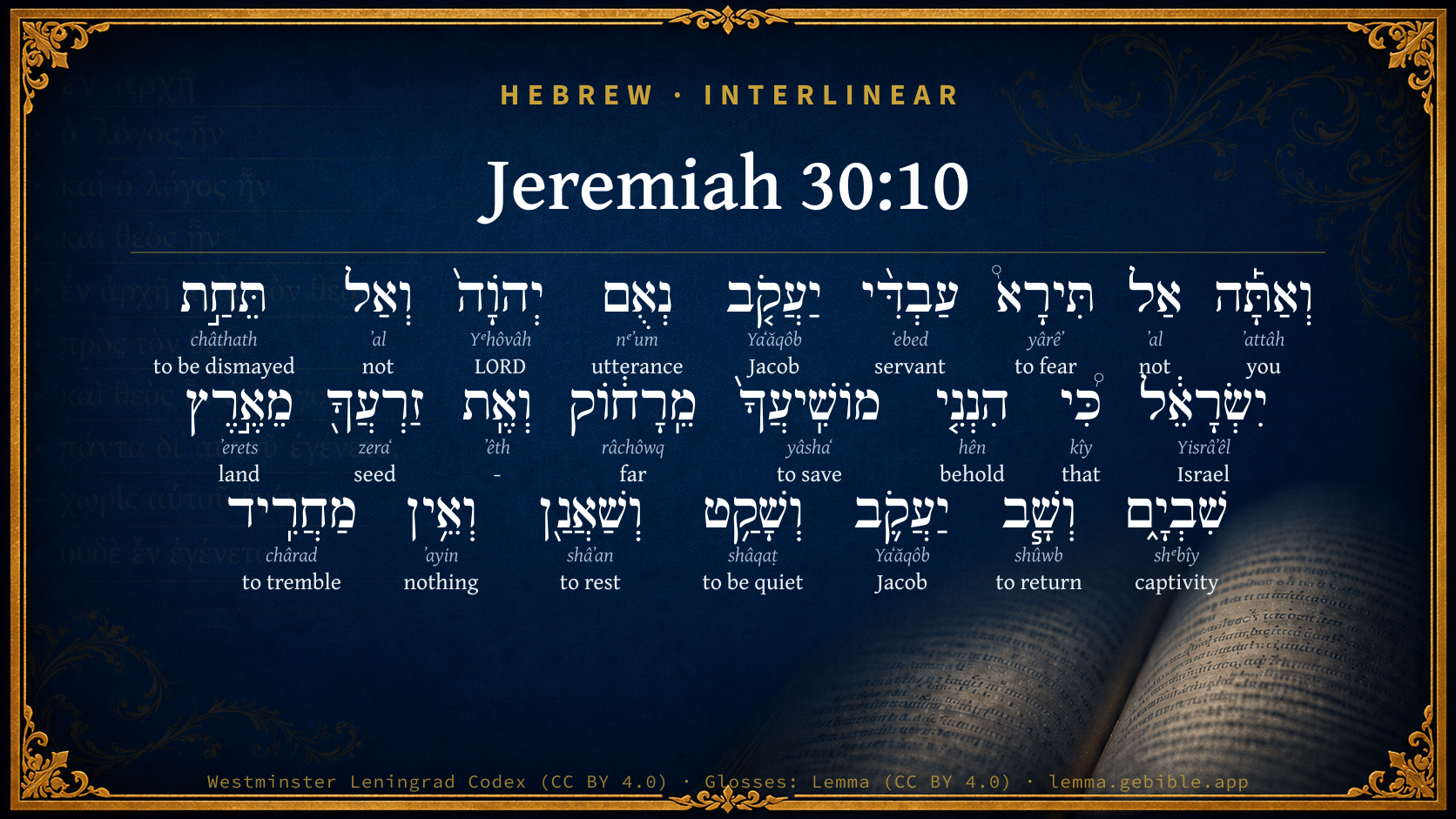
Hebrew (Westminster Leningrad Codex) Jeremiah 30:10 appears in the Hebrew Old Testament. The text above is from the Westminster Leningrad Codex. Each word links to its Strong’s number, a concise gloss, and parsing drawn from the Open Scriptures Hebrew Bible morphology. Click any word for its full Brown-Driver-Briggs (BDB) entry.
Download image
Cite this verse

Jeremiah 30:10 (World English Bible). Public Domain. Lemma interlinear Bible study tool, https://lemma.gebible.app/v/jeremiah/30/10.

Show BibTeX & RIS
BibTeX
RIS
English Translation
Therefore don't you be afraid, O Jacob my servant, says Yahweh; neither be dismayed, Israel: for, behold, I will save you from afar, and your seed from the land of their captivity; and Jacob shall return, and shall be quiet and at ease, and none shall make him afraid.
World English Bible · Public Domain
Download a study sheet

One document with this verse’s original text, its word-by-word gloss line, the meaning frame, cross-references with their text, attributed commentary, and full source and license credits — printable, and it pastes into notes with its structure intact.

This verse Autodidact and up

Study sheet (.html) Plain text (.txt)

A passage Seminary Student

Up to 50 verses in one chapter. A passage sheet keeps up to 6 commentary sources and 12 cross-references per verse, in the order this page ranks them, and says so on the sheet whenever that leaves anything out. Ask for a single verse and you get the Autodidact verse sheet above.

Everything on this page stays free to read, with no account — the sheet is a download of what is already on screen, not access to it.

Want to remove ads? Support Godless Engineer
Compare translations 3

The same verse in 3 English versions, stacked beneath the original-language interlinear above. Click any original word for its lexicon entry.

Each is an independent rendering of the whole verse — the interlinear is not word-aligned to these translations.

Highlighted words mark where these versions differ — a whole-verse word diff, not a word-by-word alignment.

  • World English Bible Public Domain
    Therefore don't you be afraid, O Jacob my servant, says Yahweh; neither be dismayed, Israel: for, behold, I will save you from afar, and your seed from the land of their captivity; and Jacob shall return, and shall be quiet and at ease, and none shall make him afraid.
  • King James Version Public Domain
    Therefore fear thou not, O my servant Jacob, saith the LORD; neither be dismayed, O Israel: for, lo, I will save thee from afar, and thy seed from the land of their captivity; and Jacob shall return, and shall be in rest, and be quiet, and none shall make him afraid.
  • unfoldingWord Literal Text CC BY-SA 4.0
    So you, my servant Jacob, do not fear—this is Yahweh’s declaration—and do not be dismayed, Israel. For see, I am about to bring you back from far away, and your descendants from the land of captivity. Jacob will return and be at peace; he will be secure, and there will be no more terror.

unfoldingWord Literal Text — © unfoldingWord, licensed CC BY-SA 4.0. Word-aligned USFM3 via Door43 (git.door43.org/unfoldingWord/en_ult).

Versions to compare (up to 4)

3 of 4 selected

Show all 18 translations

Every available English version of this verse, each an independent rendering of the whole verse.

  • World English Bible Public Domain
    Therefore don't you be afraid, O Jacob my servant, says Yahweh; neither be dismayed, Israel: for, behold, I will save you from afar, and your seed from the land of their captivity; and Jacob shall return, and shall be quiet and at ease, and none shall make him afraid.
  • Berean Standard Bible Public Domain
    As for you, O Jacob My servant, do not be afraid, declares the LORD, and do not be dismayed, O Israel. For I will surely save you out of a distant place, your descendants from the land of their captivity! Jacob will return to quiet and ease, with no one to make him afraid.
  • Majority Standard Bible Public Domain
    As for you, O Jacob My servant, do not be afraid, declares the LORD, and do not be dismayed, O Israel. For I will surely save you out of a distant place, your descendants from the land of their captivity! Jacob will return to quiet and ease, with no one to make him afraid.
  • King James Version Public Domain
    Therefore fear thou not, O my servant Jacob, saith the LORD; neither be dismayed, O Israel: for, lo, I will save thee from afar, and thy seed from the land of their captivity; and Jacob shall return, and shall be in rest, and be quiet, and none shall make him afraid.
  • American Standard Version (1901) Public Domain
    Therefore fear thou not, O Jacob my servant, saith Jehovah; neither be dismayed, O Israel: for, lo, I will save thee from afar, and thy seed from the land of their captivity; and Jacob shall return, and shall be quiet and at ease, and none shall make him afraid.
  • Revised Version (1885) Public Domain
    Therefore fear thou not, O Jacob my servant, saith the LORD; neither be dismayed, O Israel: for, lo, I will save thee from afar, and thy seed from the land of their captivity; and Jacob shall return, and shall be quiet and at ease, and none shall make him afraid.
  • Geneva Bible (1599) Public Domain
    Therefore feare not, O my seruant Iaakob, saith the Lord, neither be afrayde, O Israel: for loe, I will deliuer thee from a farre countrey, and thy seede from the lande of their captiuitie, and Iaakob shall turne againe, and shalbe in rest and prosperitie and none shall make him afraide.
  • Douay-Rheims (1899) Public Domain
    Therefore fear thou not, my servant Jacob, saith the Lord, neither be dismayed, O Israel: for behold, I will save thee from a country afar off, and thy seed from the land of their captivity: and Jacob shall return, and be at rest, and abound with all good things, and there shall be none whom he may fear:
  • Young's Literal Translation Public Domain
    And thou, be not afraid, My servant Jacob, An affirmation of Jehovah, Nor be affrighted, O Israel, For, lo, I am saving thee from afar, And thy seed from the land of their captivity, And Jacob hath turned back and rested, And is quiet, and there is none troubling.
  • Literal Standard Version CC BY-SA 4.0
    And you, do not be afraid, My servant Jacob, || A declaration of YHWH, || Nor be frightened, O Israel, || For behold, I am saving you from afar, || And your seed from the land of their captivity, || And Jacob has turned back and rested, || And is quiet, and there is none troubling.
  • Unlocked Literal Bible CC BY-SA 4.0
    So you, my servant Jacob, do not fear—this is Yahweh's declaration—and do not be dismayed, Israel. For see, I am about to bring you back from far away, and your descendants from the land of captivity. Jacob will return and be at peace; he will be secure, and there will be no more terror.
  • unfoldingWord Literal Text CC BY-SA 4.0
    So you, my servant Jacob, do not fear—this is Yahweh’s declaration—and do not be dismayed, Israel. For see, I am about to bring you back from far away, and your descendants from the land of captivity. Jacob will return and be at peace; he will be secure, and there will be no more terror.
  • Darby Bible Public Domain
    And thou, my servant Jacob, fear not, saith Jehovah; neither be dismayed, O Israel: for behold, I will save thee from afar, and thy seed from the land of their captivity; and Jacob shall return, and shall be in rest, and at ease, and none shall make [him] afraid.
  • World Messianic Bible Public Domain
    Therefore don’t be afraid, O Jacob my servant, says the LORD. Don’t be dismayed, Israel. For, behold, I will save you from afar, and save your offspring from the land of their captivity. Jacob will return, and will be quiet and at ease. No one will make him afraid.
  • Webster's Bible Public Domain
    Therefore fear thou not, O my servant Jacob, saith the LORD; neither be dismayed, O Israel: for lo, I will save thee from afar, and thy seed from the land of their captivity; and Jacob shall return, and shall be in rest, and quiet, and none shall make him afraid.
  • Free Bible Version CC BY-SA 4.0
    As far as you're concerned, my servant Jacob, don't be afraid, declares the Lord, Israel, don't be discouraged. I promise to save you from your distant places of exile, your descendants from the countries where they're being held captive. The descendants of Jacob will go home to a quiet and comfortable life, free from any threats.
  • Bible in Basic English Public Domain
    So have no fear, O Jacob, my servant, says the Lord; and do not be troubled, O Israel: for see, I will make you come back from far away, and your seed from the land where they are prisoners; and Jacob will come back, and will be quiet and at peace, and no one will give him cause for fear.
  • JPS Tanakh (1917) Public Domain
    Therefore fear thou not, O Jacob My servant, saith the LORD; neither be dismayed, O Israel; for, lo, I will save thee from afar, and thy seed from the land of their captivity; and Jacob shall again be quiet and at ease, and none shall make him afraid.

Literal Standard Version (2020), Covenant Press — licensed CC BY-SA 4.0. Text via the HelloAO Bible API (eBible.org). Unlocked Literal Bible (unfoldingWord) — licensed CC BY-SA 4.0. Text via the HelloAO Bible API (eBible.org). unfoldingWord Literal Text — © unfoldingWord, licensed CC BY-SA 4.0. Word-aligned USFM3 via Door43 (git.door43.org/unfoldingWord/en_ult). Free Bible Version, Dr. Jonathan Gallagher — licensed CC BY-SA 4.0. Text via the HelloAO Bible API (eBible.org).

Word by word

More ways to search: Search by grammar → Find every occurrence → Compare this word →

Practice this passage: Drill this verse → Learn its vocabulary →

וְשַׁאֲנַ֖ן
shâʼan
H7599
“and · to rest”
Conjunction + Verb, Palel, Sequential Perfect, 3rd Person, Masculine, Singular
Part of Speech
Conjunction + Verb
Stem
Palel
Form
Sequential Perfect
Person
3rd Person
Gender
Masculine
Number
Singular
Full BDB Definition

Origin: a primitive root

TWOT: 2304

(Pilel) to be at ease, be at peace, rest, rest securely, be quiet
  1. וְאַתָּ֡ה ʼattâh H859 “and · you” Conjunction + Pronoun, Personal, 2nd Person, Masculine, Singular
  2. אַל ʼal H408 “not” Particle, Negative
  3. תִּירָא֩ yârêʼ H3372 “to fear” Verb, Qal, Jussive, 2nd Person, Masculine, Singular
  4. עַבְדִּ֨י ʻebed H5650 “servant · my” Noun, Common, Masculine, Singular, Construct + Suffix, Personal, 1st Person, Common, Singular
  5. יַעֲקֹ֤ב Yaʻăqôb H3290 “Jacob” Noun, Proper
  6. נְאֻם nᵉʼum H5002 “utterance of” Noun, Common, Masculine, Singular, Construct
  7. יְהֹוָה֙ Yᵉhôvâh H3068 “LORD” Noun, Proper
  8. וְאַל ʼal H408 “and · not” Conjunction + Particle, Negative
  9. תֵּחַ֣ת châthath H2865 “to be dismayed” Verb, Niphal, Jussive, 2nd Person, Masculine, Singular
  10. יִשְׂרָאֵ֔ל Yisrâʼêl H3478 “Israel” Noun, Proper
  11. כִּ֠י kîy H3588 “that” Conjunction
  12. הִנְנִ֤י hên H2005 “behold · me” Particle, Demonstrative + Suffix, Personal, 1st Person, Common, Singular
  13. מוֹשִֽׁיעֲךָ֙ yâshaʻ H3467 “saving · you” Verb, Hiphil, Participle Active, Masculine, Singular, Construct + Suffix, Personal, 2nd Person, Masculine, Singular
  14. מֵֽרָח֔וֹק râchôwq H7350 “from · far” Preposition + Adjective, Adjective, Masculine, Singular, Absolute
  15. וְאֶֽת ʼêth H853 “and · -” Conjunction + Particle, Direct Object
  16. זַרְעֲךָ֖ zeraʻ H2233 “seed · your” Noun, Common, Masculine, Singular, Construct + Suffix, Personal, 2nd Person, Masculine, Singular
  17. מֵאֶ֣רֶץ ʼerets H776 “from · land of” Preposition + Noun, Common, Both, Singular, Construct
  18. שִׁבְיָ֑ם shᵉbîy H7628 “captivity · their” Noun, Common, Both, Singular, Construct + Suffix, Personal, 3rd Person, Masculine, Plural
  19. וְשָׁ֧ב shûwb H7725 “and · to return” Conjunction + Verb, Qal, Sequential Perfect, 3rd Person, Masculine, Singular
  20. יַעֲקֹ֛ב Yaʻăqôb H3290 “Jacob” Noun, Proper
  21. וְשָׁקַ֥ט shâqaṭ H8252 “and · to be quiet” Conjunction + Verb, Qal, Sequential Perfect, 3rd Person, Masculine, Singular
  22. וְאֵ֥ין ʼayin H369 “and · nothing” Conjunction + Particle, Negative
  23. מַחֲרִֽיד chârad H2729 “trembling” Verb, Hiphil, Participle Active, Masculine, Singular, Absolute

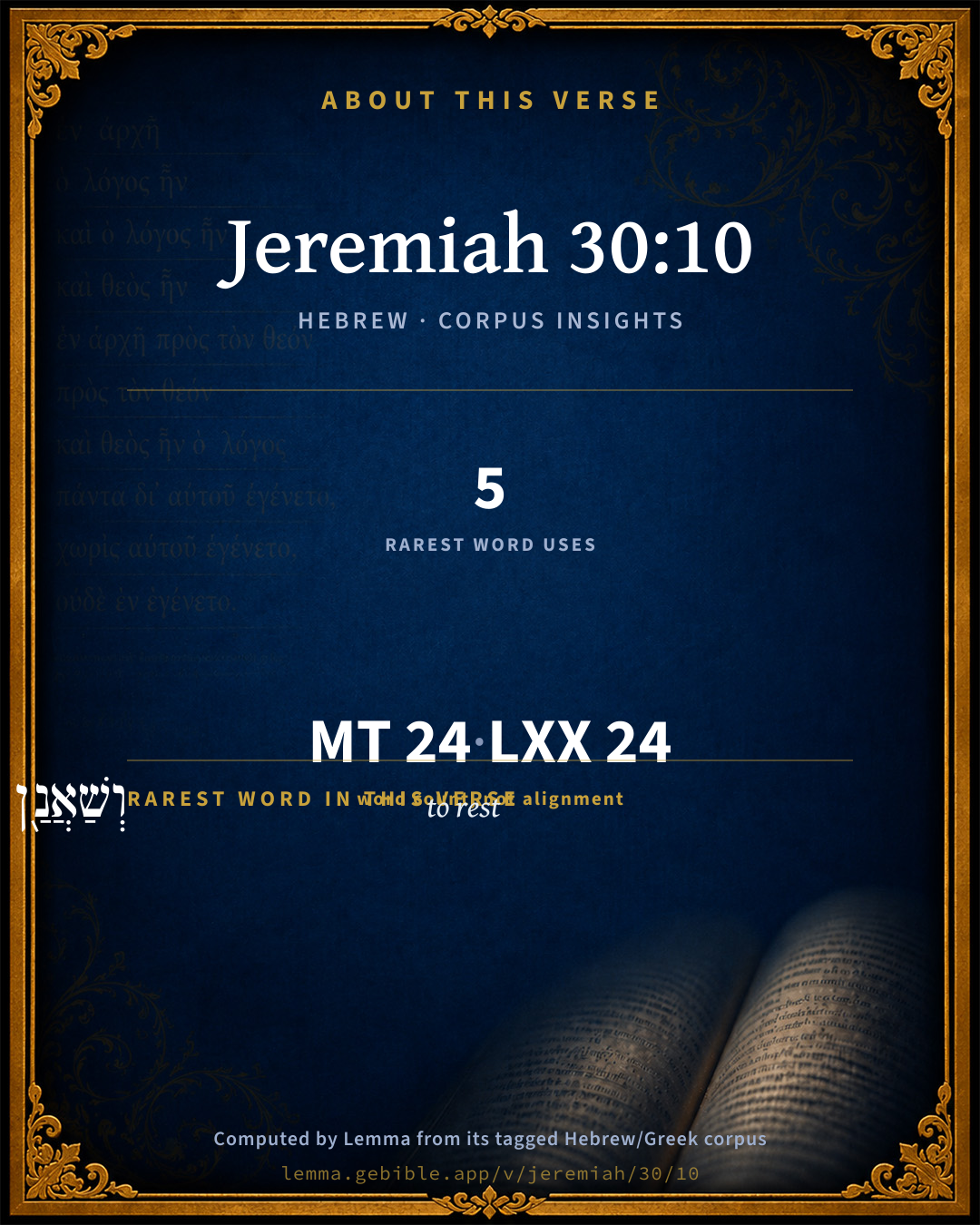
About this verse

These counts appear in no published source. They are computed here, from the morphology-tagged text and Lemma’s own curated glosses. What Lemma adds →

24
words
22
distinct lemmas
Prophets
section

Notable vocabulary

The rarest word here is וְשַׁאֲנַ֖ן to rest H7599 — appearing just 5 times in the whole Hebrew Bible.

Shared distinctive vocabulary

וְשַׁאֲנַ֖ן to rest H7599 occurs in 5 verses of the Hebrew Bible. Also found in:

Grammatical profile

  • 7 verbs
  • 9 nouns
  • 1 adjective
  • 1 pronoun
  • 1 conjunction
  • 5 particles

Verb forms

  • תִּירָא֩ Qal · Jussive
  • תֵּחַ֣ת Niphal · Jussive
  • מוֹשִֽׁיעֲךָ֙ Hiphil · Participle Active
  • וְשָׁ֧ב Qal · Sequential Perfect
  • וְשָׁקַ֥ט Qal · Sequential Perfect
  • וְשַׁאֲנַ֖ן Palel · Sequential Perfect
  • מַחֲרִֽיד Hiphil · Participle Active

Repetition

Words recur within this verse — often emphatic in Hebrew:

  • יַעֲקֹ֤ב Jacob H3290 ×2
  • אַל not H408 ×2

Hebrew & Septuagint length

In the original languages it is 24 Hebrew tokens and 24 Greek tokens — but the two are counted differently (Hebrew bundles its prefixes and suffixes into one token; the Greek is in lemma form), so that isn’t a like-for-like length.

Cross-references

29

Topical passages linked to Jeremiah 30:10 in the Treasury of Scripture Knowledge — connected by theme and wording, ordered by reader-vote popularity; previews shown in the World English Bible.

  • Jeremiah 46:27–28 But don't be afraid you, Jacob my servant, neither be dismayed, Israel: for, behold, I will save you from afar, and your seed from the land of their captivity; and Jacob shall return, and shall be quiet and at ease, and none shall make him afraid.
  • Isaiah 43:5 Don't be afraid; for I am with you: I will bring your seed from the east, and gather you from the west;
  • Jeremiah 29:14 I will be found by you, says Yahweh, and I will turn again your captivity, and I will gather you from all the nations, and from all the places where I have driven you, says Yahweh; and I will bring you again to the place from where I caused you to be carried away captive.
  • Isaiah 44:2 Thus says Yahweh who made you, and formed you from the womb, who will help you: Don't be afraid, Jacob my servant; and you, Jeshurun, whom I have chosen.
  • Isaiah 35:9 No lion shall be there, nor shall any ravenous animal go up thereon; they shall not be found there; but the redeemed shall walk [there]:
  • Hosea 2:18 In that day I will make a covenant for them with the animals of the field, And with the birds of the sky, And with the creeping things of the ground. I will break the bow, the sword, and the battle out of the land, And will make them lie down safely.
  • Jeremiah 3:18 In those days the house of Judah shall walk with the house of Israel, and they shall come together out of the land of the north to the land that I gave for an inheritance to your fathers.
  • Jeremiah 23:3 I will gather the remnant of my flock out of all the countries where I have driven them, and will bring them again to their folds; and they shall be fruitful and multiply.
  • Jeremiah 23:8 but, As Yahweh lives, who brought up and who led the seed of the house of Israel out of the north country, and from all the countries where I had driven them. They shall dwell in their own land.
  • Jeremiah 33:16 In those days shall Judah be saved, and Jerusalem shall dwell safely; and this is [the name] by which she shall be called: Yahweh our righteousness.
  • John 12:15 "Don't be afraid, daughter of Zion. Behold, your King comes, sitting on a donkey's colt."
  • Genesis 15:1 After these things the word of Yahweh came to Abram in a vision, saying, "Don't be afraid, Abram. I am your shield, your exceedingly great reward."
  • Deuteronomy 31:6–8 Be strong and of good courage, don't be afraid, nor be scared of them: for Yahweh your God, he it is who does go with you; he will not fail you, nor forsake you.
  • Isaiah 41:10–15 Don't you be afraid, for I am with you; don't be dismayed, for I am your God; I will strengthen you; yes, I will help you; yes, I will uphold you with the right hand of my righteousness.
  • Isaiah 46:11 calling a ravenous bird from the east, the man of my counsel from a far country; yes, I have spoken, I will also bring it to pass; I have purposed, I will also do it.
  • Isaiah 46:13 I bring near my righteousness, it shall not be far off, and my salvation shall not wait; and I will place salvation in Zion for Israel my glory.
  • Isaiah 54:4 Don't be afraid; for you shall not be ashamed: neither be confounded; for you shall not be disappointed: for you shall forget the shame of your youth; and the reproach of your widowhood shall you remember no more.
  • Isaiah 60:4–22 Lift up your eyes round about, and see: they all gather themselves together, they come to you; your sons shall come from far, and your daughters shall be carried in the arms.
  • Jeremiah 23:6 In his days Judah shall be saved, and Israel shall dwell safely; and this is his name by which he shall be called: Yahweh our righteousness.
  • Jeremiah 30:3 For, behold, the days come, says Yahweh, that I will turn again the captivity of my people Israel and Judah, says Yahweh; and I will cause them to return to the land that I gave to their fathers, and they shall possess it.
  • Ezekiel 16:52 You also, bear you your own shame, in that you have given judgment for your sisters; through your sins that you have committed more abominable than they, they are more righteous that you: yes, be also confounded, and bear your shame, in that you have justified your sisters.
  • Ezekiel 34:25–28 I will make with them a covenant of peace, and will cause evil animals to cease out of the land; and they shall dwell securely in the wilderness, and sleep in the woods.
  • Ezekiel 38:11 and you shall say, I will go up to the land of unwalled villages; I will go to those who are at rest, who dwell securely, all of them dwelling without walls, and having neither bars nor gates;
  • Micah 4:3–4 And he will judge between many peoples, And will decide concerning strong nations afar off. They will beat their swords into plowshares, And their spears into pruning hooks. Nation will not lift up sword against nation, Neither will they learn war any more.
  • Zephaniah 3:15–17 Yahweh has taken away your judgments. He has thrown out your enemy. The King of Israel, Yahweh, is in the midst of you. You will not be afraid of evil any more.
  • Zechariah 2:4–5 and said to him, "Run, speak to this young man, saying, 'Jerusalem will be inhabited as villages without walls, because of the multitude of men and cattle in it.
  • Zechariah 3:10 In that day,' says Yahweh of hosts, 'you will invite every man his neighbor under the vine and under the fig tree.'"
  • Zechariah 8:4–8 Thus says Yahweh of Hosts: "Old men and old women will again dwell in the streets of Jerusalem, every man with his staff in his hand for very age.
  • Isaiah 49:25 But thus says Yahweh, Even the captives of the mighty shall be taken away, and the prey of the terrible shall be delivered; for I will contend with him who contends with you, and I will save your children.

Cross-references courtesy of OpenBible.info (CC BY 4.0).

Hebrew and Greek witnesses Masoretic Hebrew ↔ Greek Septuagint

The same verse in the two great witnesses to the Old Testament, shown verse-for-verse.

These are two independent witnesses, not word-aligned to each other, and the Septuagint is shown in lemma (dictionary) form.

Hebrew Jeremiah 30:10 Masoretic · Westminster Leningrad Codex

וְאַתָּ֡ה אַל תִּירָא֩ עַבְדִּ֨י יַעֲקֹ֤ב נְאֻם יְהֹוָה֙ וְאַל תֵּחַ֣ת יִשְׂרָאֵ֔ל כִּ֠י הִנְנִ֤י מוֹשִֽׁיעֲךָ֙ מֵֽרָח֔וֹק וְאֶֽת זַרְעֲךָ֖ מֵאֶ֣רֶץ שִׁבְיָ֑ם וְשָׁ֧ב יַעֲקֹ֛ב וְשָׁקַ֥ט וְשַׁאֲנַ֖ן וְאֵ֥ין מַחֲרִֽיד

Therefore don't you be afraid, O Jacob my servant, says Yahweh; neither be dismayed, Israel: for, behold, I will save you from afar, and your seed from the land of their captivity; and Jacob shall return, and shall be quiet and at ease, and none shall make him afraid.

World English Bible · Public Domain

Greek LXX Structure differs

In the Septuagint, Jeremiah is about an eighth shorter than the Hebrew and arranges its material differently — the Oracles Against the Nations (Hebrew chapters 46–51) appear in the middle of the Greek book, after 25:13. Because the chapter and verse boundaries do not line up, a verse-for-verse comparison with the Hebrew is not shown.

A verse-for-verse comparison isn’t shown here because the chapters and verses don’t line up. Switch to the LXX edition with the MT / LXX toggle above to read the Greek directly.

On this verse, The Cambridge Bible for Schools and Colleges discusses the Septuagint’s reading. Read the note in Commentary ↓

Hebrew: Westminster Leningrad Codex (CC BY 4.0). Greek: Septuagint (public domain); English from a public-domain English Septuagint. How the Septuagint differs from the Hebrew →

Targum (Aramaic paraphrase)

1

The Targum is the ancient Jewish Aramaic paraphrase of the Hebrew Scriptures — an interpretive translation, not the Hebrew text itself. Onkelos (literal) and Pseudo-Jonathan (expansive) render the Torah, and Jonathan the Prophets. Coverage is partial: where no permissively-licensed English translation exists for a verse, only the Aramaic is shown. This is verse-level text, not a word-by-word alignment to the Hebrew.

  1. Targum Jonathan Prophets (Joshua–Malachi)
    וְאַתְּ לָא תִדְחַל עַבְדִי יַעֲקֹב אֲמַר יְיָ וְלָא תִתְּבַר יִשְׂרָאֵל אֲרֵי הָאֲנָא פָרֵיק לָךְ מֵרָחֵיק וְיַת בְּנָךְ מֵאֲרַע גַלְוַתְכוֹן וִיתוּבוּן דְבֵית יַעֲקֹב וְיִשְׁקְטוּן וְיִשְׁרוֹן לְרֻחְצָן וְלֵית דְמָנִיד:

    (no public-domain English translation for this verse)

    Targum Jonathan — Aramaic: “Mikraot Gedolot” (public domain). English: “Sefaria Community Translation” (CC0 1.0 (public-domain dedication)); “London "Chaldee Paraphrase," 1871” (public domain). Text via Sefaria.

Commentary

Notes on Jeremiah 30:10 from classic Christian and Jewish commentators (each source and its license shown beneath its notes). The classic Christian expositions comment on the surrounding passage and are grouped to its opening verse, so a note may address several verses; the Jewish commentaries on the Tanakh (Rashi and others) are per-verse, so they appear only where the commentator wrote on this verse.

Lemma curates 59 commentaries, every one of them public domain or Creative Commons licensed, each selected and text-cleaned for this edition rather than reprinted as found. About our sources →

Matthew Henry's Commentary

In these verses, as in those foregoing, the deplorable case of the Jews in captivity is set forth, but many precious promises are given them that in due time they should be relieved and a glorious salvation wrought for them.

I. God himself appeared against them: he scattered them (Jer 30:11); he did all these things unto them, Jer 30:15. All their calamities came from his hands; whoever were the instruments, he was the principal agent. And this made their case very sad that God, even their own God, spoke concerning them, to pull down and to destroy. Now, 1. This was intended by him as a fatherly chastisement, and no other (Jer 30:11): "I will correct thee in measure, or according to judgment, with discretion, no more than thou deservest, nay, no more than thou canst well bear." What God does against his people is in a way of correction, and that correction is always moderated and always proceeds from love: "I will not leave thee altogether unpunished, as thou art ready to think I should, because of thy relation to me." Note, A profession of religion, though ever so plausible, will be far from securing to us impunity in sin. God is no respecter of persons, but will show his hatred of sin wherever he finds it, and that he hates it most in those that are nearest to him. God here corrects his people for the multitude of their iniquity, and because their sins were increased, Jer 30:14, Jer 30:15. Are our sorrows multiplied at any time and do they increase? We must acknowledge that it is because our sins have been multiplied and they have increased. Iniquities grow in us, and therefore troubles grow upon us. But, 2. What God intended as a fatherly chastisement they and others interpreted as an act of hostility; they looked upon him as having wounded them with the wound of an enemy and with the chastisement of a cruel one (Jer 30:14), as if he had designed their ruin, and neither mitigated the correction nor had any mercy in reserve for them. It did indeed seem as if God had dealt thus severely with them, as if he had turned to be their enemy and had fought against them, Isa 63:10. Job complains that God had become cruel to him and multiplied his wounds. When troubles are great and long we have need carefully to watch over our own hearts, that we entertain not such hard thoughts as these of God and his providence. His are the chastisements of a merciful one, not of a cruel one, whatever they may appear.

II. Their friends forsook them, and were shy of them. None of those who had courted them in their prosperity would take notice of them now in their distress, Jer 30:13. It is commonly thus when families go to decay; those hang off from them that had been their hangers-on. In two cases we are glad of the assistance of our friends and need their service: - 1. If we be impeached, accused, or reproached, we expect that our friends should appear in vindication of us, should speak a good word for us when we cannot put on a face to speak for ourselves; but here there is none to plead thy cause, none to stand up in thy defence, none to intercede for thee with thy oppressors; therefore God will plead their cause, for he might well wonder there was none to uphold a people that had been so much the favourites of Heaven, Isa 63:5. 2. If we be sick, or sore, or wounded, we expect our friends should attend us, advise us, sympathize with us, and, if occasion be, lend a hand for the applying of healing medicines; but here there is none to do that, none to bind up thy wounds, and by counsels and comforts to make proper applications to thy case; nay (Jer 30:14), All thy lovers have forgotten thee; out of sight out of mind; instead of seeking thee, they forsake thee. Such as this has often been the case of religion and serious godliness in the world; those that from their education, profession, and hopeful beginnings, one might have expected to be its friends and lovers, its patrons and protectors, desert it, forget it, and have nothing to say in its defence, nor will do any thing towards the healing of its wounds. Observe, Thy lovers have forgotten thee, for I have wounded thee. When God is against a people who will be for them? Who can be for them so as to do them any kindness? See Job 30:11. Now, upon this account, their case seemed desperate and past relief (Jer 30:12): Thy bruise is incurable, thy wound grievous, and (Jer 30:15) thy sorrow is incurable. The condition of the Jews in captivity was such as no human power could redress the grievances of; there they were like a valley full of dead and dry bones, which nothing less than Omnipotence can put life into. Who could imagine that a people so diminished, so impoverished, should ever be restored to their own land and re-established there? So many were the aggravations of their calamity that their sorrow would not admit of any alleviation, but they seemed to be hardened in it, and their souls refused to be comforted, till divine consolations proved strong ones, too strong to be borne down even by the floods of grief that overwhelmed them. Thy sorrow is incurable because thy sins, instead of being repented of and forsaken, were increased. Note, Incurable griefs are owing to incurable lusts. Now in this deplorable condition they are looked upon with disdain (Jer 30:17): They called thee an outcast, abandoned by all, abandoned to ruin; they said, This is Zion, whom no man seeks after. When they looked on the place where the city and temple had been built they called that an outcast; now all was in ruins, there was no resort to it, no residence in it, none asked the way to Zion, as formerly; no man seeks after it. When they looked on the people that formerly dwelt in Zion, but were now in captivity (and we read of Zion dwelling with the daughter of Babylon, Zac 2:7), they called them outcasts; these are those who belong to Zion, and are wont to talk much of it and weep at the remembrance of it, but no man seeks after them, or enquires concerning them. Note, It is often the lot of Zion to be deserted and despised by those about her.

III. For all this God will work deliverance and salvation for them in due time. Though no other hand, nay, because no other hand, can cure their wound, his will, and shall. 1. Though he seemed to stand at a distance from them, yet he assures them of his presence with them, his powerful and gracious presence: I will save thee, Jer 30:10. I am with thee, to save thee, Jer 30:11. When they are in their troubles he is with them, to save them from sinking under them; when the time has come for their deliverance he is with them, to be ready upon the first opportunity, to save them out of their trouble. 2. Though they were at a distance, remote from their own land, afar off in the land of their captivity, yet there shall salvation find them out, thence shall it fetch them, them and their seed, for they also shall be known among the Gentiles, and distinguished from them, that they may return, Jer 30:10. 3. Though they were now full of fears, and continually alarmed, yet the time shall come when they shall be in rest and quiet, safe and easy, and none shall make them afraid, Jer 30:10. 4. Though the nations into which they were dispersed should be brought to ruin, yet they should be preserved from that ruin (Jer 30:11): Though I make a full end of the nations whither I have scattered thee, and there might be danger of thy being lost among them, yet I will not make a full end of thee. It was promised that in the peace of these nations they should have peace (Jer 29:7), and yet in the destruction of these nations they should escape destruction. God's church may sometimes be brought very low, but he will not make a full end of it, Jer 5:10, Jer 5:18. 5. Though God correct them, and justly, for their sins, their manifold transgressions and mighty sins, yet he will return in mercy to them, and even their sin shall not prevent their deliverance when God's time shall come. 6. Though their adversaries were mighty, God will bring them down, and break their power (Jer 30:16): All that devour thee shall be devoured, and thus Zion's cause will be pleaded and will be made to appear to all the world a righteous cause. Thus Zion's deliverance will be brought about by the destruction of her oppressors; and thus her enemies will be recompensed for all the injury they have done her; for there is a God that judges in the earth, a God to whom vengeance belongs. "They shall every one of them, without exception, go into captivity, and the day will come when those that now spoil thee shall be a spoil." Those that lead into captivity shall go into captivity, Rev 13:10. This might serve to oblige the present conquerors to use their captives well, because the wheel would turn round, and the day would come when they also should be captives, and let them do now as they would then be done by. 7. Though the wound seem incurable, God will make a cure of it (Jer 30:17): I will restore health unto thee. Be the disease ever so dangerous, the patient is safe if God undertakes the cure.

IV. Upon the whole matter, they are cautioned against inordinate fear and grief, for in these precious promises there is enough to silence both. 1. They must not tremble as those that have no hope in the apprehension of future further trouble that might threaten them (Jer 30:10): Fear thou not, O my servant Jacob! neither be dismayed. Note, Those that are God's servants must not give way to disquieting fears, whatever difficulties and dangers may be before them. 2. They must not sorrow as those that have no hope for the troubles which at present they lie under, Jer 30:15. "Why criest thou for thy affliction? It is true thy carnal confidences fail thee, creatures are physicians of no value, but I will heal thy wound, and therefore, Why criest thou? Why dost thou fret and complain thus? It is for thy sin (Jer 30:14, Jer 30:15), and therefore, instead of repining, thou shouldest be repenting. Wherefore should a man complain for the punishment of his sins? The issue will be good at last, and therefore rejoice in hope."

Matthew Henry's Commentary on the Whole Bible (1708–1710) — public domain (CC PDM 1.0). Text via the HelloAO Bible API.

The Cambridge Bible for Schools and Colleges

gen. ed. J. J. S. Perowne

10. from afar] from thy distant land of exile.

none shall make him afraid] Cp. Isa_17:2 (flocks lying undisturbed).

10, 11. These vv. occur again in Jer_46:27 f. They are found there, but not here, in LXX. It is not improbable that they existed separately and were inserted later in both places independently. Jer_30:10 bears a strong resemblance to 2 Isaiah (e.g. Isa_43:5 ff.).

The Cambridge Bible for Schools and Colleges (gen. ed. J. J. S. Perowne; Cambridge University Press, 1878–1918) — public domain. Text from a community e-Sword module.

Trapp's Complete Commentary

John Trapp

Jer 30:10 Therefore fear thou not, O my servant Jacob, saith the LORD; neither be dismayed, O Israel: for, lo, I will save thee from afar, and thy seed from the land of their captivity; and Jacob shall return, and shall be in rest, and be quiet, and none shall make [him] afraid.

Ver. 10. Therefore fear thou not, O my servant Jacob.] This is Isaiah like; and indeed the prophet here setteth himself verbis consolantissimis, by words of comfort, as one saith, with most cordial comforts, to cheer the hearts of God’s poor afflicted.

John Trapp, A Commentary or Exposition upon All the Books of the Old and New Testament (1647–1656) — public domain. Text from a community e-Sword module.

Joseph Benson's Commentary

Jer 30:10-11. Fear thou not, O my servant Jacob — As if God had utterly forsaken thee or cast thee off. See the margin. For, lo, I will save thee from afar — I will restore you from your captivity, though you should be dispersed into the most distant countries. And though this be not accomplished in the Jews of the present age, it shall be made good to their posterity, who are beloved for their fathers’ sake, as St. Paul speaks, Rom 11:28. And Jacob shall be in rest and quiet, &c. — Shall enjoy peace and safety. Though I make a full end of all nations whither I have scattered thee — Such as the Assyrians, Chaldeans, Egyptians; yet will I not make a full end of thee — The Jews to this day continue a remarkable monument of the truth and immutability of God’s promises. Where now are all the nations which carried them into captivity, and trod them under foot? All, all are perished; their kingdoms overturned, their laws and languages abolished, their very names, as nations, extinct; not the least footsteps remaining of their having ever been a people: for God had determined to make a full end of them. But the people of the Jews, though carried into captivity, slain by the sword, destroyed by pestilence and famine, and every other method of destruction, do yet remain a people: under all the revolutions and changes of kingdoms, languages, and people, they still exist unmixed; and, though for their heinous sins they are scattered abroad among all nations, they still preserve their name, language, and most of their ancient ceremonies and customs, for God has promised not to make a full end of them. But I will correct thee in measure — Or, according to judgment, as למשׁפשׂsignifies, that is, with discretion, not more than thou deservest, nay, not more than thou canst well bear. God’s afflicting his people is in a way of correction, and that correction is always moderated, and always proceeds from love. And will not leave thee altogether unpunished — As thou art ready to think I should do because of thy relation to me. Observe, reader, a profession of religion, though never so plausible, will be far from securing to us impunity in sin. God is no respecter of persons, but will show his hatred of sin wherever he finds it, and he always hates it most in those that are nearest to him.

Joseph Benson's Commentary on the Old and New Testaments (1811–1818) — public domain. Text from a community e-Sword module.

Tyndale Open Study Notes

Tyndale Open Resources

30:10 The gathering of exiles would include those held in Babylon and also those who were scattered in distant lands. The Lord’s promised gifts would include peace and quiet without fearsome enemies.

Tyndale Open Study Notes — © Tyndale Open Resources, licensed CC BY-SA 4.0. Text via the HelloAO Bible API.

Jamieson, Fausset & Brown

Robert Jamieson, A. R. Fausset & David Brown

from afar--Be not afraid as if the distance of the places whither ye are to be dispersed precludes the possibility of return.

seed--Though through the many years of captivity intervening, you yourselves may not see the restoration, the promise shall be fulfilled to your seed, primarily at the return from Babylon, fully at the final restoration.

quiet . . . none . . . make . . . afraid-- (Jer 23:6; Zac 14:11).

Jamieson, Fausset & Brown — Commentary Critical and Explanatory on the Whole Bible (1871) — public domain (CC PDM 1.0). Text via the HelloAO Bible API.

John Calvin's Commentaries

The Prophet enforces his doctrine by an exhortation; for it would not be sufficient simply to assure us of God’s paternal love and goodwill, unless we were encouraged to hope for it, because experience teaches us how backward and slow we are to embrace the promises of God. This, then, is the reason why the Prophet exhorts and encourages the faithful to entertain hope. Were there in us that promptitude and alacrity which we ought to have, we should be content even with one word; for what can be wished for beyond God’s testimony respecting his favor? But our listlessness renders many goads necessary. Hence, when doctrine precedes, it is necessary to add exhortations to stimulate us; and these confirm the doctrine, so that the grace of God may flourish effectually in our hearts.

He addresses “Jacob” and “Israel;” but they mean the same, as in many other places. These duplicates, as they are called, are common, we know, in the Hebrew language; for the same words are repeated for the sake of emphasis. So, in this passage, there is more force when Jeremiah mentions two names, than if he had said only, “Fear not thou, Jacob, and be not afraid.” He then says, Fear not thou, Jacob; and Israel, be not thou afraid And he does this, that the Jews might remember that God had not only been once propitious to their father Jacob, but many times; for from the womb he bore a symbol of that primogeniture which God had destined for him; and he afterwards had, for the sake of honor, the name of Israel given to him. As, then, God had in various ways, and in succession, manifested his goodness to Jacob, the people might hence entertain more hope.

He calls him his servant; not that the Jews were worthy of so honorable a title; but God had regard to himself, and his gratuitous adoption, rather than to their merits. He did not then call them servants, because they were obedient, for we know how contumaciously they rejected both God and his Prophets; but because he had adopted them. So when David says,

“I am thy servant, and the son of thine handmaid,” (Psalm 116:16)

he does not boast of his obedience, nor claim to himself any deserving virtue, but, on the contrary, declares, that before he was created in the womb, he was God’s servant through his gratuitous adoption. Hence, he adds, “I am the son of thine handmaid,” as though he had said, “I belong to thee by an hereditary right, because I am descended from that nation which thou hast been pleased to choose for thy peculiar people.” We now then see that the name servant, ought not to be understood as intimating the merits of the people, and that their obedience is not here commended, as though they had truly and faithfully responded to the call of God, but that their gratuitous adoption is alone extolled.

He adds, Behold, I will save thee from far He first declares that he would be ready to save the people when the suitable time came; for behold here intimates certainty. And he subjoins, from far, lest the people should fail in their confidence; for they had been driven into distant exile; and distance is a great obstacle. Were any one to promise to us an advantageous retreat, without calling us away to some unknown country, we could more easily embrace the promise; but were any one to say, “I promise to you the largest income in Syria, and you shall have there whatever may be deemed necessary to make your life happy;” would you not reply, “What! shall I pass over the sea, that I may live there? it is better for me to live here in comparative poverty than to be a king there.” As, then, a difficulty might have presented itself to the Jews, when they saw that they had been driven away into very remote countries, the Prophet adds, that this circumstance would be no obstacle so as to prevent God to save them: I will save you then from far; as though he had said, that his hands were long enough, so that he could extend them as far as Chaldea, and draw them from thence.

He then adds, and thy seed from the land of their captivity As the expectation of seventy years was long, God refers what he promises to their seed. There is no doubt but that the Prophet reminded the Jews, that the time determined by God was to be waited for in patience, as was the case with Abraham, Isaac, and Jacob; for though they knew that they would be strangers in the land which God had promised them, yet they did not on that account despise or disregard the favor promised them. Abraham received in faith what he had heard from God’s mouth,

“I will give thee this land;”

and yet he knew that he would be there a stranger and a sojourner. (Genesis 12:7) His children had to exercise the same patience. Abraham had indeed been warned of a very long delay; for God had declared that his seed would be in bondage for four hundred years. (Genesis 15:13) Here, then, the Prophet exhorts the people of his time to entertain hope, according to the example of their father, and not to despise God’s favor, because its fruit did not immediately appear; for Abraham did not enjoy the land as long as he lived, and yet he preferred it to his own country; Isaac did the same; and Jacob followed the example of his fathers. This, then, is the reason why the Prophet mentions seed, as though he had said, “If the fruit of redemption will not come to you, yet God will not disappoint your hope, for your posterity shall find that he is true and faithful.”

If any one had then objected, and said, “What is that to me?” the objection would have been preposterous; for why had God promised to their posterity a return to their own country? was it not thus to testify his love towards them? And whence came their freedom, and whence God’s paternal love, except from the covenant? We hence see that the salvation of the fathers was included in the benefit which their sons enjoyed. And therefore, though the fruition of that benefit was not visibly granted to the fathers, yet they partook in part of the fruit, for it was made certain to them, that God would become the deliverer of his people even in death itself.

He adds that which is the main thing in a happy life, that they would be at rest and in a quiet state, so that none would terrify them; for a return to their own country would not have been of any great importance, without a quiet possession of it. Hence the Prophet, after having said that God would come to save the people, and that distance would not prevent him to fulfill and complete what he had promised, now adds, that this benefit would be confirmed, for God would no more allow strangers to lead the Jews into exile, or to rule over them as they had done. God then promises here the continuance of his favor.

But as this did not happen to the Jews, we must again conclude that this prophecy cannot be otherwise interpreted than of Christ’s kingdom. And Daniel is the best interpreter of this matter; for he says, that the people were to be exposed to many miseries and calamities after their return, and that they were not to hope to build the Temple and the city except in great troubles. The Jews then were always terrified. We also know, that while building the Temple, they held the trowel in one hand and the sword in the other, for they often had to bear the assaults of their enemies. (Nehemiah 4:17) Since, then, the Jews ever suffered inquietude until the coming of Christ, it follows, that until his coming, this promise was never accomplished. Then the benefit of which the Prophet speaks here is peculiar to the kingdom of Christ. Now, since from the time Christ was manifested to the world, we see that the world has been agitated by many storms, yea, all things have been in confusion; it follows, that this passage cannot be explained of external rest and earthly tranquillity. It ought, therefore, to be understood according to the character of his kingdom. As, then, Christ’s kingdom is spiritual, it follows that a tranquil and quiet state is promised here, not because no enemies shall disturb us or offer us molestation, but because we shall especially enjoy peace with God, and our life shall be safe, being protected by the hand and guardianship of God. Then spiritual tranquillity is what is to be understood here, the fruit of which the faithful experience in their own consciences, though always assailed by the world, according to what Christ says,

“My peace I give to you, not such as the world gives,” (John 14:27)

and again,

“In the world ye shall have tribulation; but be of good cheer, I have overcome the world.” (John 16:33)

It follows —

John Calvin's Commentaries (1540-1563) — public domain. Text from the Calvin Translation Society English edition (1840s-50s) via the Christian Classics Ethereal Library (ccel.org). Calvin's coverage is partial (roughly two-thirds of the Bible); uncommented books and verses are honest gaps, never fabricated. The 19th-century editor's footnotes and remarks are omitted so the notes are faithfully Calvin's own voice.

Ellicott's Commentary for English Readers

(10) Therefore fear thou not.—The higher strain of language into which the prophecy has here risen is indicated by the parallelism of the two clauses in each member of the sentence. The whole verse is poetic in its form. The words have in them something of the ring of Isa_41:10.

A Bible Commentary for English Readers, edited by Charles John Ellicott (1878–1897) — public domain. Text from a community e-Sword module.

John Gill's Exposition

Therefore fear thou not, O my servant Jacob, saith the Lord,.... Since the Messiah, who is the Lord God, should be raised up to thorn, whom they should serve, and he should save them; and so had nothing to fear from their enemies; and had no reason to doubt of salvation and deliverance, seeing so great a person was engaged for them. The language is very much like the Prophet Isaiah's:

neither be dismayed, O Israel: the same thing in other words; for Jacob and Israel are the same; and to fear and be dismayed are much alike:

for, lo, I will save thee from afar; from a far country; not from Babylon only, but from all distant countries where they are dispersed, east, west, north, or south; distance of place should be no hinderance to their salvation, and so need be no objection in their minds to it:

and thy seed from the land of their captivity; their children should come forth with them: it seems to respect future times; that though this should not be accomplished in the persons of the Israelites then living, yet should be in their posterity:

and Jacob shall return, and shall be in rest, and be quiet, and none shall make him afraid; which was not fulfilled upon the Jews' return from the Babylonish captivity; for they quickly met with much opposition and disturbance in the rebuilding of their city and temple; and afterwards from Antiochus, in the times of the Maccabees, by whom they were greatly disquieted; and at last by the Romans, by whom their nation was subdued and ruined; wherefore this respects the quiet and peaceable times they shall have when they are converted, and have embraced the Christian religion.

John Gill's Exposition of the Whole Bible (1746–1763) — public domain (CC PDM 1.0). Text via the HelloAO Bible API.

Albert Barnes' Notes on the Bible

These two verses are considered by some very similar in style to the last 27 chapters of Isaiah. The contrast, however, between the full end made with the pagan, and the certainty that Israel shall never so perish, is one of Jeremiah’s most common topics.

Jer 30:11

In measure - See the Jer 10:24 note.

Albert Barnes' Notes on the Bible (1834–1885) — public domain. Text from a community e-Sword/MySword module.

Matthew Poole's English Annotations

You that are my servants, and the posterity of Jacob, though your captivity be threescore and ten years, yet be not afraid that I have quite forgotten you, or my promise made to your fathers. For I will assure you, that though I have for your sins sent you afar off, yet you are not beyond the reach of my saving arm; you shall return out of the captivity of Babylon, and be at rest: as they were for one hundred and fifty years during the time of the Persian monarchy; a short history of which we have in the books of Ezra and Nehemiah.

Matthew Poole's English Annotations on the Holy Bible (1683–1685) — public domain. Text from a community e-Sword/MySword module.

Whedon's Commentary on the Bible

Daniel D. Whedon

10. From afar — The distance is not invincible to Jehovah’s power. The mention of seed, however, suggests that this glad hour of deliverance may be in the still distant future.

Daniel D. Whedon (gen. ed.), Commentary on the Old and New Testaments (1874–1909) — public domain. Text from a community e-Sword module.

The Pulpit Commentary

Vers. 10, 11. Therefore fear thou not, O my servant Jacob, etc. These two verses, omitted in the Septuagint, are among the passages which Hitzig (carrying out an idea of Movers) attributes to the editorial hand of the author (a pious Jew of the Captivity, according to him) of Isaiah 40-66, and it cannot be denied that the tone and phraseology of ver. 10 is more akin to that of Isa 40 Isa 66, than to those of the greater part of Jeremiah. Graf, in controverting Hitzig"s view, points out, however, that the expressions referred to by Hitzig as "Deutero-Isaianic," are also found in other books besides the latter part of Isaiah, and that, on the other hand, "the expressions of ver. 11 are all as foreign to Isaiah 40-66, as they are current in Jeremiah." As for the expression, "my servant Jacob." (which only occurs again in Jeremiah in the duplicate of this passage, Jer_46:27, Jer_46:28, and which is specially characteristic of the second part of Isaiah), it is worth noticing that it is found once in the Book of Ezekiel, (Eze_37:25) which, on Hitzig"s theory, was written before the so called Second Isaiah. It still remains for the student to consider whether these two verses are not an insertion by some later hand (without attempting to discover whose that hand was). That the prophetic writings have received additions from editors and scribes is a fact which cannot reasonably be gainsaid, supported as it is by the phenomena of the historical books. It would be very natural for a pious Jew in the Captivity, not wholly devoid himself of the spirit of prophecy, to encourage his people, in the Name of the Lord, with this glowing word of promise.

Vers. 10, 11. "Fear not.

I WHY ISRAEL MIGHT FEAR. For various reasons, viz.:

1. Present trouble. Already some had been led into exile. What was thus experienced seemed to presage future and worse distress. Grief tends to despondency. In disappointment we are ready to think that all things must grow worse and worse.

2. The anticipation of necessary punishment. This is confirmed in the prophetic message for I cannot leave thee altogether unpunished." Guilt is the parent of fear. "Conscience makes cowards of us all.

3. Incurable wretchedness. (Ver. 12) Left to themselves, the people were in a hopeless condition.

(1) They could not cure their moral disease; Josiah"s abortive reformation was a proof of this.

(2) They could not cure their external distress; it was vain to attempt to break the yoke of great Babylon.

4. Solitude. "All thy lovers have forgotten thee" (ver. 14). In the hour of trial boon companions fall away and leave their wretched comrade forlorn and helpless. The soul must face its darkest trouble alone. While society dispels fear, the silence and desertion of loneliness provoke it. It is not surprising, therefore, that with so many concurrent incentives to fear Israel should be overwhelmed with it, nor is it surprising that similar causes should produce a similar effect among us. Yet it is not the less deplorable. Fear is an evil. It is distressing beyond measure. The vague and threatening specters of horror that haunt the imagination of the soul when it is a slave to fear may be far more painful than the real evils of which they are the magnified shadows.. But fear is injurious as well as painful. It paralyzes effort, dissuades from dangerous tasks of duty, drives to rash and foolish resorts for escape. It is important to see if so sad and injurious a condition can be avoided.

II WHY ISRAEL SHOULD NOT FEAR. For various reasons, viz.:

1. The security of God"s service. Israel was God"s servant. It is reasonable to suppose that God will protect and save those whom he honours with his name and calls to his work.

2. The promise of ultimate deliverance. "Lo, I will save thee from afar," etc. Fear may threaten now, but rest and quietude will come in the future. Fear must be overcome by hope, the darkness of the near future triumphed over by the exceeding brightness of the greater future. We shall not fear what the world can do against us when we live in the hope of what eternity will do for us. Looking at ourselves, we see our wounds incurable, and we despair; looking at the good Physician, we see the promise of health, and we hope.

3. The assurance of the presence of God. "For I am with thee." Thus Abraham was not to fear because God was his "Shield, and exceeding great Reward"; (Gen_15:1) and David could say, "Though I walk through the valley of the shadow of death, I will fear no evil: for thou art with me; thy rod and thy staff they comfort me". (Psa_23:4) When hope fails faith may yet be strong. Better than the vision of the future haven far over the waves are the strong hand and sure eye of the pilot with us in the storm. When the hope of heaven fails faith in God may still sustain us.

4. A knowledge of the limitation and good purpose of suffering. This is

(1) given to correct, either as chastisement for sin, or as pruning to make the fruit bearing branch more fruitful; and

(2) given only in just measure, not beyond desert, requirement, or endurance. If we have these reasonable thoughts about our troubles they will not be able to conjure up the terrors of illimitable distress which they naturally inspire when we do not see that they are controlled by purposes of Divine goodness.

The Pulpit Commentary (1880–1919), ed. H.D.M. Spence-Jones & Joseph S. Exell — public domain. Text from a community e-Sword module.

unfoldingWord translationNotes

Door43 World Missions Community

General Information:

Yahweh continues speaking to the people of Israel.

my servant Jacob ... Israel

"Jacob" and "Israel" are the two names of the ancestor of the Israelites, and these names are metonyms for the Israelites. AT: "descendants of Jacob ... you Israelite people" (See: Metonymy)

this is Yahweh's declaration

Yahweh speaks of himself by name to express the certainty of what he is declaring. See how you translated this in Jeremiah 1:8. AT: "this is what Yahweh has declared" or "this is what I, Yahweh, have declared" (See: First, Second, or Third Person)

do not be dismayed

"do not be discouraged"

For see, I am

"Listen carefully while I tell you why: I am"

from the land of captivity

The abstract noun "captivity" can be translated using the noun "captive." AT: "from the place where they were captives" (See: Abstract Nouns)

Jacob will return ... he will be secure

Jacob's name is a metonym for his descendants. Yahweh speaks to Jacob as if he were speaking to another person. You may need to make explicit to where Jacob will return. AT: "Jacob will return to his own land ... he will be secure" or "The descendants of Jacob will return ... they will be secure" or "You descendants of Jacob will return ... you will be secure" (See: Metonymy and Assumed Knowledge and Implicit Information)

secure

"safe"

where I have scattered you

"where I have sent you"

But I will certainly not put an end to you

"But I will not completely destroy you" (See: Euphemism)

will certainly not leave you unpunished

This can be translated in active form. AT: "will certainly punish you" (See: Double Negatives)

translationWords

servant

Jacob

fear

Yahweh

declare

descend

captive

peace

terror

save

nation

discipline

just

unfoldingWord translationNotes — © Distant Shores Media and the Door43 World Missions Community, licensed CC BY-SA 4.0. Source: git.door43.org/Door43/en_tn.

Rashi

Rabbi Shlomo Yitzchaki (Rashi)

And you, fear not Because of all the evils that you will see befalling Babylon in whose midst you are.

and at ease like וְֹשָקֵט.

Rashi on the Tanakh — English translations: “The Judaica Press complete Tanach with Rashi, translated by A. J. Rosenberg” (CC BY 4.0); “Pentateuch with Rashi's commentary by M. Rosenbaum and A.M. Silbermann, 1929-1934” (public domain); “The Metsudah Tanach series, Lakewood, N.J” (CC BY 4.0); and “The Book of Joshua, Metsudah Publications, 1997” (CC BY 4.0). Text via Sefaria.

Lesson kit

Teaching starters — assembled from the data on this page, not authored interpretation. Every prompt links to the verse data it draws on. Edit before teaching.

Jeremiah, in the Prophets, opens this verse with 24 words (22 distinct Hebrew lemmas). Its most distinctive word is shâʼan (“to rest”). A historical commentator’s framing appears above. Read the whole chapter for the surrounding context.

Discussion questions

  1. How does “to rest” (shâʼan) shape what this verse is saying?
  2. How does Job 3:18, which shares the word «to rest», read alongside this verse?
  3. What does the repetition of “Jacob” (2× in this one verse) do in this verse?
  4. The translations on this page render this verse differently — a whole-verse word diff, not a word-by-word alignment. What might account for the different wordings?
  5. «תִּירָא֩» is a Qal Jussive verb. How does that grammatical form shape the action described?
  6. Compare how Matthew Henry's Commentary and The Cambridge Bible for Schools and Colleges read this verse. Where do they agree or differ?

Things to notice

Reading settings

Reading text

Shown beneath each verse's original-language words.

Old Testament
Old Testament edition

Read the OT as the Masoretic Hebrew (MT) or the Greek Septuagint (LXX).

English shown for the Greek Septuagint (in the Hebrew ↔ Greek comparison).

Comparing translations? Open the Compare panel on any verse page to stack up to four side by side.