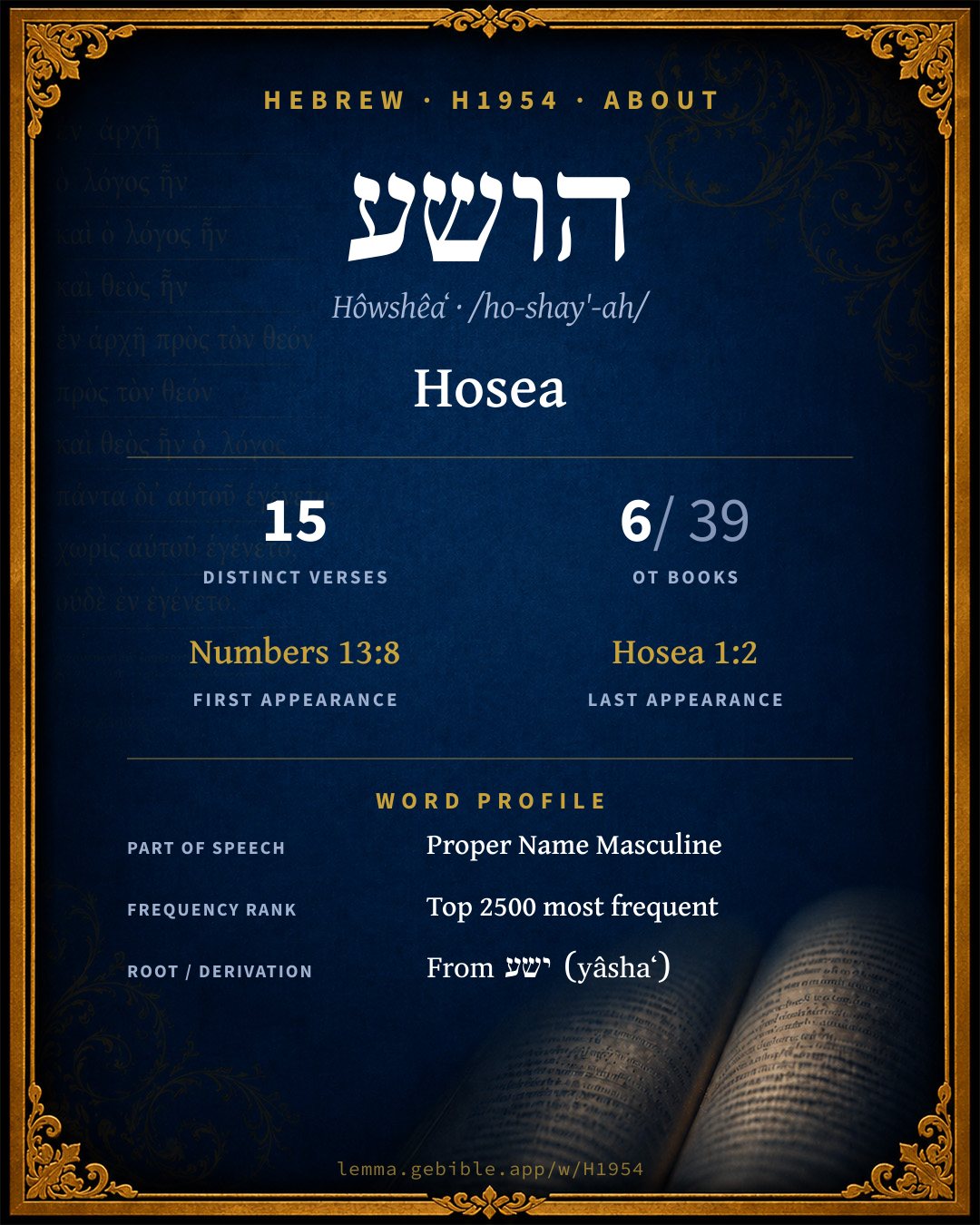
הוֹשֵׁעַ
Hosea
BDB lists 6 entries for ‘Hosea’ fuller range ↓
Full lexicon entry — Brown-Driver-Briggs (BDB)
From Brown-Driver-Briggs (BDB)
Where this word appears
Grammar key — what these labels mean
Part of speech
- Noun
- A naming word — a person, place, thing, or idea.
Noun type
- Proper
- A name of a specific person, place, or people (e.g. Abraham, Zion, Israel).
Every verse where H1954 appears — 15 distinct verses across 6 books. Click any verse to open its interlinear word-by-word view. Verse text shown in the World English Bible for context — . Each verse’s Hebrew form is shown with its reference; the English is not keyword-highlighted, since the data carries no word-level English alignment. Use “Compare translations” on any verse to read it across multiple English versions. This concordance covers the Hebrew Bible; Septuagint (Greek Old Testament) occurrences are not indexed here.
Numbers 2 verses
Deuteronomy 1 verse
2 Kings 8 verses
- 2 Kings 15:30 הוֹשֵׁ֣עַ n Proper Hoshea the son of Elah made a conspiracy against Pekah the son of Remaliah, and struck him, and killed him, and reigned in his place, in the twentieth year of Jotham the son of Uzziah.
- 2 Kings 17:1 הוֹשֵׁ֨עַ n Proper In the twelfth year of Ahaz king of Judah began Hoshea the son of Elah to reign in Samaria over Israel, [and reigned] nine years.
- 2 Kings 17:3 הוֹשֵׁ֨עַ֙ n Proper Against him came up Shalmaneser king of Assyria; and Hoshea became his servant, and brought him tribute.
- 2 Kings 17:4 בְּ/הוֹשֵׁ֜עַ prep + n Proper The king of Assyria found conspiracy in Hoshea; for he had sent messengers to So king of Egypt, and offered no tribute to the king of Assyria, as he had done year by year: therefore the king of Assyria shut him up, and bound him in prison.
- 2 Kings 17:6 לְ/הוֹשֵׁ֗עַ prep + n Proper In the ninth year of Hoshea the king of Assyria took Samaria, and carried Israel away to Assyria, and placed them in Halah, and on the Habor, the river of Gozan, and in the cities of the Medes.
- 2 Kings 18:1 לְ/הוֹשֵׁ֥עַ prep + n Proper Now it happened in the third year of Hoshea son of Elah king of Israel, that Hezekiah the son of Ahaz king of Judah began to reign.
- 2 Kings 18:9 לְ/הוֹשֵׁ֥עַ prep + n Proper It happened in the fourth year of king Hezekiah, which was the seventh year of Hoshea son of Elah king of Israel, that Shalmaneser king of Assyria came up against Samaria, and besieged it.
- 2 Kings 18:10 לְ/הוֹשֵׁ֨עַ֙ prep + n Proper At the end of three years they took it: in the sixth year of Hezekiah, which was the ninth year of Hoshea king of Israel, Samaria was taken.
1 Chronicles 1 verse
Nehemiah 1 verse
Hosea 2 verses
- Hosea 1:1 הוֹשֵׁ֨עַ֙ n Proper The word of Yahweh that came to Hosea the son of Beeri, in the days of Uzziah, Jotham, Ahaz, and Hezekiah, kings of Judah, and in the days of Jeroboam the son of Joash, king of Israel.
- Hosea 1:2 בְּ/הוֹשֵׁ֑עַ הוֹשֵׁ֗עַ prep + n Proper n Proper When Yahweh spoke at the first by Hosea, Yahweh said to Hosea, "Go, take for yourself a wife of prostitution and children of unfaithfulness; for the land commits great adultery against from Yahweh."
About this entry
At a glance — auto-summarized from this page’s data, not written by a person. Every figure links to its source below. This summary describes the numbers; it doesn’t interpret them.
“Hosea” is the headline sense of the Hebrew name הושע (Hôwshêaʻ). More than half of its appearances fall in 2 Kings. The Hebrew Bible uses it across 15 verses — uncommon. First canonically at Numbers 13:8, it enters the text early. See 15-verse concordance and the renderings breakdown below.
Gloss history
Strong's 1890 vs modern scholarship
About this word
Strong's H1954 catalogs a Hebrew word from the Hebrew Old Testament.
These counts are not copied from any lexicon or concordance. They are computed here, from the morphology-tagged Hebrew Old Testament. What Lemma adds →
- 15
- distinct verses
- The word appears in 15 distinct verses.
- 6 / 39
- OT books
- The word appears in 6 of 39 Old Testament books.
- #1,752
- by frequency
- Top 2500 most frequent Hebrew words (rank 1,752 of 8,640 Hebrew words by occurrence).
View all 15 occurrences in the concordance →
By section of the Old Testament
By traditional corpus
Conventional, traditional groupings — biblical authorship is debated, so this is a traditional corpus grouping, not an authorship claim. Each share is this word’s portion of its verses in that division of the Hebrew canon. Each figure is a share of the word’s 15 distinct verses.
- Prophets (Nevi'im) 10 verses · 67%
- Torah (Pentateuch) 3 verses · 20%
- Writings (Ketuvim) 2 verses · 13%
How translations render this word
Counts come from each version’s own published word-to-Strong’s tagging or interlinear alignment — an approximate guide to how each version renders this word, not a word-level alignment the data otherwise carries. Because each total is that version’s own tagged count, the per-version totals vary from one another and need not match the appearance or distinct-verse counts above. These counts may also differ from a printed concordance because Lemma counts each distinctly tagged rendering and does not collapse phrase taggings into a single head-word total. This is a fixed set of word-tagged versions (KJV, ASV, BSB, ULT) and does not change with the reading translation you choose elsewhere. Each version’s license is shown beside its name below (and on Sources).
BDB lists this Strong’s number as 2 distinct words (homographs). Each count above pools all of them and is not split by sense — see the Senses section below. A low-frequency rendering may belong to a different one of those words, not the primary meaning.
- King James Version†: Hoshea 9×, Hosea 2×, Oshea 2×
- American Standard Version†: Hoshea 11×, Hosea 2×
- Berean Standard Bible†: Hoshea 12×
- unfoldingWord Literal Text†: Hoshea 12×, Hosea 2×
King James Version Public Domain
Renders H1954 across 16† tagged occurrences — most commonly:
Plus 3 renderings that appear only once — usually multi-word phrases or single function words the recovered tagging swept in, not distinct renderings.
American Standard Version Public Domain
Renders H1954 across 16† tagged occurrences — most commonly:
Plus 3 renderings that appear only once — usually multi-word phrases or single function words the recovered tagging swept in, not distinct renderings.
Berean Standard Bible Public Domain
Renders H1954 across 16† tagged occurrences — most commonly:
Plus 4 renderings that appear only once — usually multi-word phrases or single function words the recovered tagging swept in, not distinct renderings.
unfoldingWord Literal Text CC BY-SA 4.0
Renders H1954 across 16† tagged occurrences — most commonly:
Plus 2 renderings that appear only once — usually multi-word phrases or single function words the recovered tagging swept in, not distinct renderings.
Senses in the full BDB
What do BDB’s symbols mean?
BDB uses these scholarly abbreviations:
| Symbol | Meaning |
|---|---|
| 𝔊 | the Septuagint (the ancient Greek translation, LXX) |
| 𝔙 | the Vulgate (the Latin translation) |
| 𝔖 | the Syriac version (the Peshitta) |
| 𝔗 | the Targum (the Aramaic translation) |
| ψ | the Psalms |
| √ | root (the underlying root or stem) |
| ‖ | parallel passage (a synonymous or contrasted parallel) |
| † | the dagger: every passage where the word occurs is cited |
The 5 senses and sub-senses the full Brown-Driver-Briggs lexicon distinguishes for this word, in lexicon order (not ranked by frequency), with BDB’s own verbatim wording and sub-sense lettering. Shown in Hebrew script with BDB’s own scholarly abbreviations. The condensed entry is in the Lexicon Entry tab. See also the Forms in the corpus table below.
- 1. orig. name of Joshua according to Nu 13:8, 16 (P), 𝔊 Αυση, cf. Dt 32:44 (J; prob. error, v. Dr), 𝔊 Ιησους, v. יְהוֹשׁוּעַ p. 221 supr. e.g. Numbers 13:8
- 2. last king of Israel 2 K 15:30; 17:1, 3, 4, 6; 18:1, 9, 10, 𝔊 Ωσηε. e.g. 2 Kings 15:30
- 3. the prophet Hosea Ho 1:1, 2(×2), 𝔊 Ωσηε. e.g. Hosea 1:1
- 4. an Ephraimite chief under David 1 Ch 27:20, 𝔊 Ωση(ε). e.g. 1 Chronicles 27:20
- 5. a chief under Nehemiah Ne 10:24, 𝔊 Ωσηθα, Ωσηε. e.g. Nehemiah 10:24
Senses from the full Brown-Driver-Briggs lexicon (Brown, Driver, Briggs; Oxford 1906 — public domain), digitized via Sefaria, supplemented by the OpenScriptures HebrewLexicon (CC BY 4.0). Full attribution on Sources.
Word origin
n.pr.m. (salvation; on form, cf. הַשְׁמֵד, הַמְשֵׁל; on pronunciation v. HptZA ii, 261 Anm. 2 JägerBAS i, 468)—
— Brown-Driver-Briggs (Oxford 1906, public domain), digitized via Sefaria, supplemented by the OpenScriptures HebrewLexicon (CC BY 4.0). See Sources.
Derived from ישע (yâshaʻ) (H3467) — to save.
Forms in the corpus
The 12 distinct written forms H1954 takes in the Hebrew Bible, most frequent first — each parse links to that state’s occurrences in the concordance. Hebrew forms include their vowel points and cantillation, so a single lemma takes many written forms.
| Form | Parsing | Example | Uses |
|---|---|---|---|
| לְ/הוֹשֵׁ֥עַ | Noun, Proper | 2 Kings 18:1 | 3 |
| הוֹשֵׁ֥עַ | Noun, Proper | Nehemiah 10:23 | 2 |
| הוֹשֵׁ֨עַ֙ | Noun, Proper | Hosea 1:1 | 2 |
| בְּ/הוֹשֵׁ֑עַ | Noun, Proper | Hosea 1:2 | 1 |
| בְּ/הוֹשֵׁ֜עַ | Noun, Proper | 2 Kings 17:4 | 1 |
| הוֹשֵׁ֖עַ | Noun, Proper | 1 Chronicles 27:20 | 1 |
| הוֹשֵׁ֗עַ | Noun, Proper | Hosea 1:2 | 1 |
| הוֹשֵׁ֣עַ | Noun, Proper | 2 Kings 15:30 | 1 |
| הוֹשֵׁ֨עַ | Noun, Proper | 2 Kings 17:1 | 1 |
| וְ/הוֹשֵׁ֥עַ | Noun, Proper | Deuteronomy 32:44 | 1 |
| לְ/הוֹשֵׁ֗עַ | Noun, Proper | 2 Kings 17:6 | 1 |
| לְ/הוֹשֵׁ֨עַ֙ | Noun, Proper | 2 Kings 18:10 | 1 |
Same root — word family
Other BDB entries built from the same root as H1954, grouped by Strong’s listed origin. These share a root / origin per the lexicon — not necessarily a shared meaning. Each links to that word’s own entry.
Derives from
Shares the same root
- ישועה yᵉshûwʻâh H3444 salvation
- ישע yeshaʻ H3468 salvation
- מושעה môwshâʻâh H4190 deliverance
- ωσαννα hōsanná G5614 hosanna
Proper names from this root
People and places named from this root — a name, not an additional meaning of the word.
- הושעיה Hôwshaʻyâh H1955 Hoshaiah
- ישעי Yishʻîy H3469 Ishi
- ישעיה Yᵉshaʻyâh H3470 Isaiah
- מישע Mêyshâʻ H4337 Mesha
- Ωσηε Hōsēé G5617 Hosea
Compare all same-root words → Showing 4 of 11 — not the complete family. 5 of the same-root words are proper names (people or places). They share a root, not necessarily a meaning.
Bible dictionary
Public-domain dictionary articles matched to this entry by name (Hosea). A biblical name can be shared by more than one person or place, so an article may treat several.
Easton's Bible Dictionary · M. G. Easton, 1897
Salvation, the son of Beeri, and author of the book of prophecies bearing his name. He belonged to the kingdom of Israel. "His Israelitish origin is attested by the peculiar, rough, Aramaizing diction, pointing to the northern part of Palestine; by the intimate acquaintance he evinces with the localities of Ephraim (5:1; 6:8, 9; 12:12; 14:6, etc.); by passages like 1:2, where the kingdom is styled the land', and 7:5, where the Israelitish king is designated as our' king." The period of his ministry (extending to some sixty years) is indicated in the superscription (Hos. 1:1, 2). He is the only prophet of Israel who has left any written prophecy.
Smith's Bible Dictionary · William Smith, 1863
(salvation), son of Beeri, and first of the minor prophets. Probably the life, or rather the prophetic career, of Hosea extended from B.C. 784 to 723, a period of fifty-nine years. The prophecies of Hosea were delivered in the kingdom of Israel. Jeroboam II was on the throne, and Israel was at the height of its earthly splendor. Nothing is known of the prophet's life excepting what may be gained from his book.
Hitchcock's Bible Names Dictionary · Roswell D. Hitchcock, 1869
Hoshea, savior; safety
Classic public-domain reference works; full attribution on Sources.
Septuagint verse parallels
This word appears in 14 verses that also exist in the Greek Old Testament (Septuagint), out of the 15 Hebrew verses it occurs in. You can read those verses in Greek by switching the Old Testament edition to the Septuagint.
Read these verses in the Septuagint
This is a verse-level parallel only — the same verses exist in both the Hebrew and Greek Old Testaments. No word-level Hebrew↔Greek correspondence is claimed: the data carries no such alignment, so no Greek word is shown as this Hebrew word’s translation. Coverage is not total — the Septuagint omits the deuterocanon and renumbers the Psalms, so some Hebrew verses have no direct Greek parallel.