
Psalms 20:9

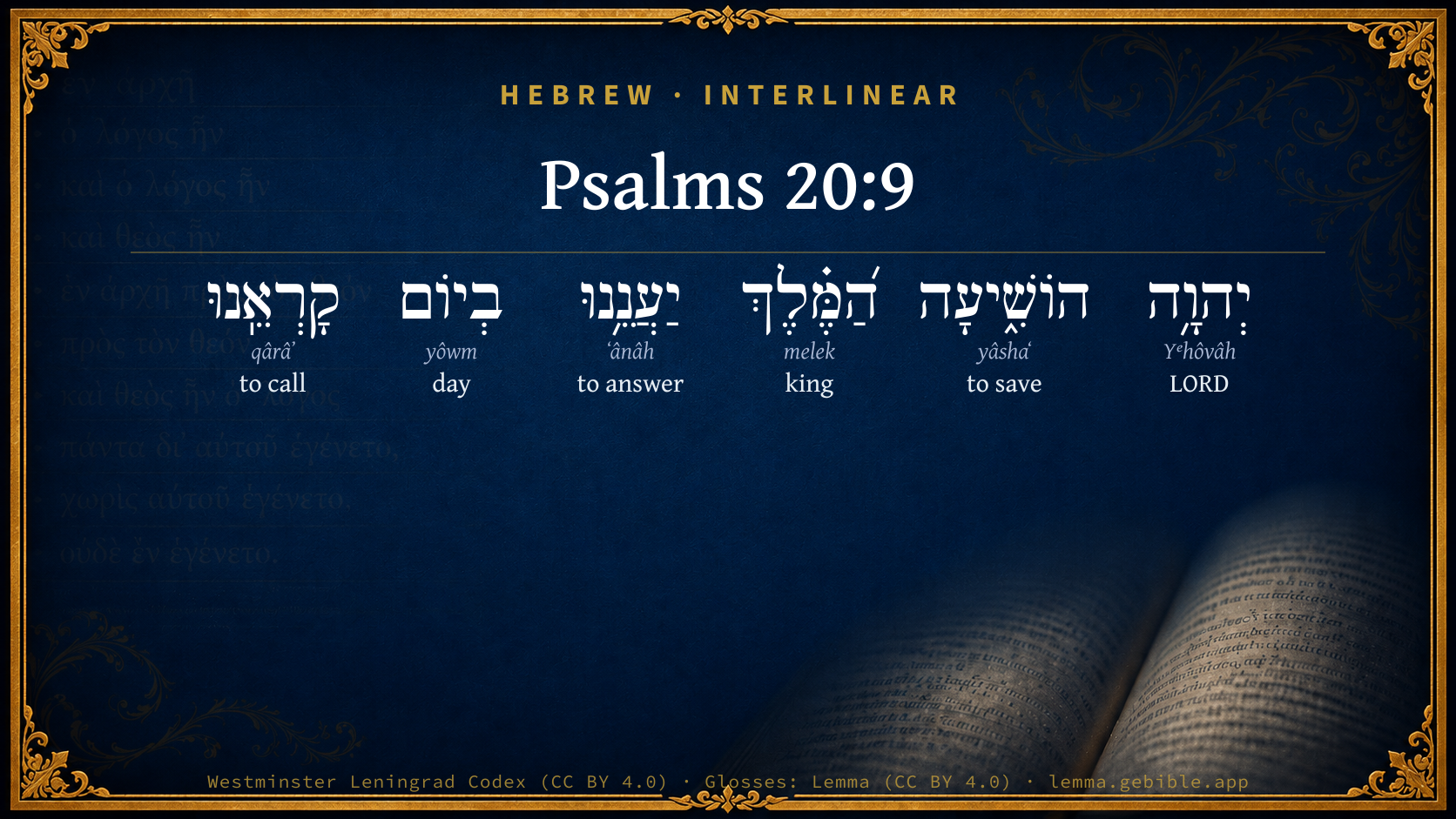
Hebrew (Westminster Leningrad Codex) Psalms 20:9 appears in the Hebrew Old Testament. The text above is from the Westminster Leningrad Codex. Each word links to its Strong’s number, a concise gloss, and parsing drawn from the Open Scriptures Hebrew Bible morphology. Click any word for its full Brown-Driver-Briggs (BDB) entry.
Download image
Cite this verse

Psalms 20:9 (World English Bible). Public Domain. Lemma interlinear Bible study tool, https://lemma.gebible.app/v/psalms/20/9.

Show BibTeX & RIS
BibTeX
RIS
English Translation
Save, Yahweh; Let the King answer us when we call!
World English Bible · Public Domain
Download a study sheet

One document with this verse’s original text, its word-by-word gloss line, the meaning frame, cross-references with their text, attributed commentary, and full source and license credits — printable, and it pastes into notes with its structure intact.

This verse Autodidact and up

Study sheet (.html) Plain text (.txt)

A passage Seminary Student

Up to 50 verses in one chapter. A passage sheet keeps up to 6 commentary sources and 12 cross-references per verse, in the order this page ranks them, and says so on the sheet whenever that leaves anything out. Ask for a single verse and you get the Autodidact verse sheet above.

Everything on this page stays free to read, with no account — the sheet is a download of what is already on screen, not access to it.

Want to remove ads? Support Godless Engineer
Compare translations 3

The same verse in 3 English versions, stacked beneath the original-language interlinear above. Click any original word for its lexicon entry.

Each is an independent rendering of the whole verse — the interlinear is not word-aligned to these translations.

Highlighted words mark where these versions differ — a whole-verse word diff, not a word-by-word alignment.

  • World English Bible Public Domain
    Save, Yahweh; Let the King answer us when we call!
  • King James Version Public Domain
    Save, LORD: let the king hear us when we call.
  • unfoldingWord Literal Text CC BY-SA 4.0
    Save, Yahweh; may the king answer us on the day we call.

unfoldingWord Literal Text — © unfoldingWord, licensed CC BY-SA 4.0. Word-aligned USFM3 via Door43 (git.door43.org/unfoldingWord/en_ult).

Versions to compare (up to 4)

3 of 4 selected

Show all 18 translations

Every available English version of this verse, each an independent rendering of the whole verse.

  • World English Bible Public Domain
    Save, Yahweh; Let the King answer us when we call!
  • Berean Standard Bible Public Domain
    O LORD, save the king. Answer us on the day we call.
  • Majority Standard Bible Public Domain
    O LORD, save the king. Answer us on the day we call.
  • King James Version Public Domain
    Save, LORD: let the king hear us when we call.
  • American Standard Version (1901) Public Domain
    Save, Jehovah: Let the King answer us when we call. Psalm 21 For the Chief Musician. A Psalm of David.
  • Revised Version (1885) Public Domain
    Save, LORD: let the King answer us when we call.
  • Geneva Bible (1599) Public Domain
    Saue Lord: let the King heare vs in the day that we call.
  • Douay-Rheims (1899) Public Domain
    They are bound, and have fallen; but we are risen, and are set upright. O Lord, save the king: and hear us in the day that we shall call upon thee.
  • Young's Literal Translation Public Domain
    O Jehovah, save the king, He doth answer us in the day we call!
  • Literal Standard Version CC BY-SA 4.0
    O YHWH, save the king, || He answers us in the day we call!
  • Unlocked Literal Bible CC BY-SA 4.0
    Yahweh, rescue the king; help us when we call.
  • unfoldingWord Literal Text CC BY-SA 4.0
    Save, Yahweh; may the king answer us on the day we call.
  • Darby Bible Public Domain
    Save, Jehovah! Let the king answer us in the day we call.
  • World Messianic Bible Public Domain
    Save, LORD! Let the King answer us when we call!
  • Webster's Bible Public Domain
    \\20:8\\They are brought down and fallen: but we are raised, and stand upright.
  • Free Bible Version CC BY-SA 4.0
    May the Lord save the king! Please answer us when we call for help!
  • Bible in Basic English Public Domain
    Come to our help, Lord: let the king give ear to our cry.
  • JPS Tanakh (1917) Public Domain
    (20-10) Save, LORD; let the King answer us in the day that we call.

Literal Standard Version (2020), Covenant Press — licensed CC BY-SA 4.0. Text via the HelloAO Bible API (eBible.org). Unlocked Literal Bible (unfoldingWord) — licensed CC BY-SA 4.0. Text via the HelloAO Bible API (eBible.org). unfoldingWord Literal Text — © unfoldingWord, licensed CC BY-SA 4.0. Word-aligned USFM3 via Door43 (git.door43.org/unfoldingWord/en_ult). Free Bible Version, Dr. Jonathan Gallagher — licensed CC BY-SA 4.0. Text via the HelloAO Bible API (eBible.org).

Word by word

More ways to search: Search by grammar → Find every occurrence → Compare this word →

Practice this passage: Drill this verse → Learn its vocabulary →

About this verse

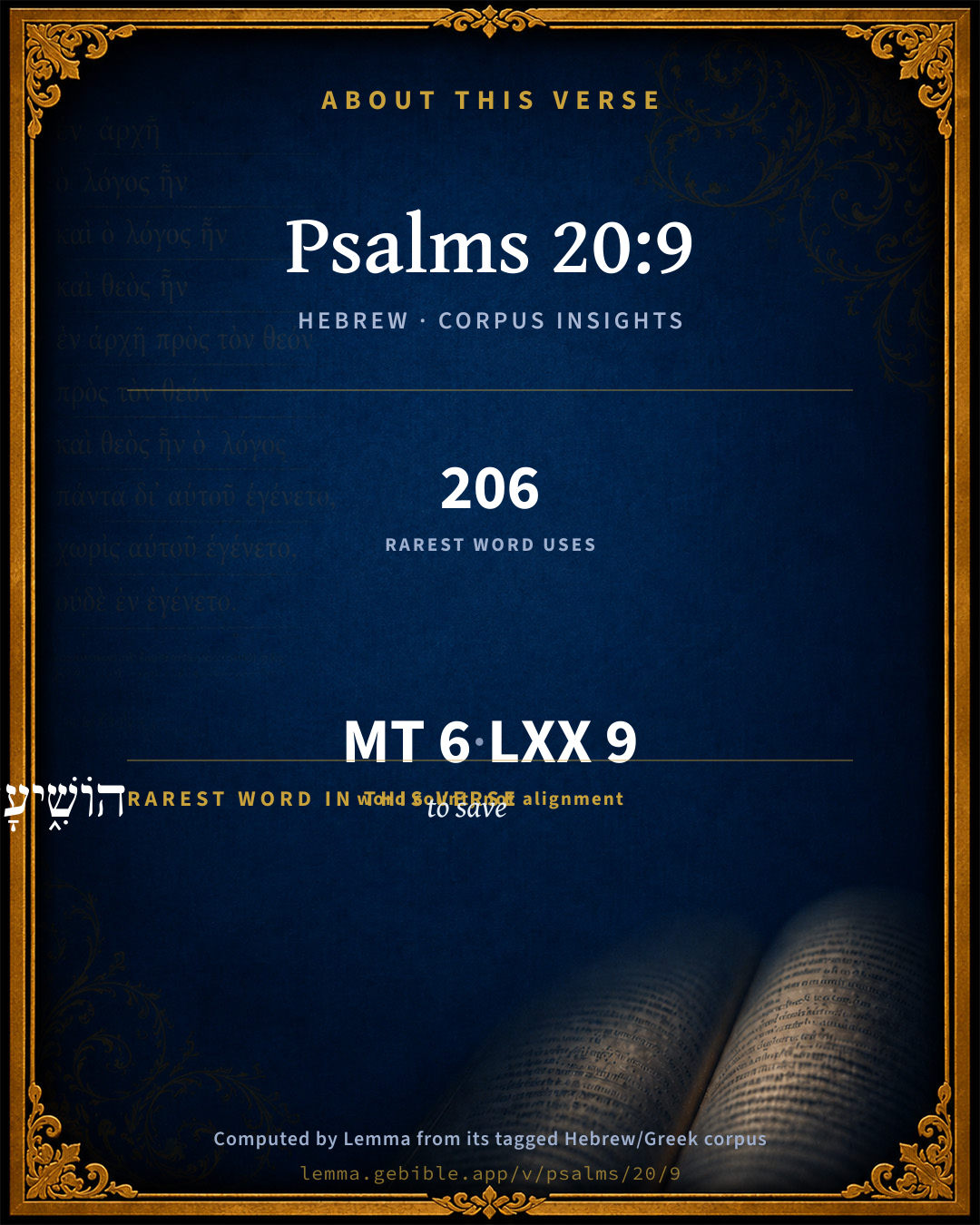
These counts appear in no published source. They are computed here, from the morphology-tagged text and Lemma’s own curated glosses. What Lemma adds →

6
words
6
distinct lemmas
Wisdom
section

Grammatical profile

  • 3 verbs
  • 3 nouns

Verb forms

  • הוֹשִׁ֑יעָה Hiphil · Imperative
  • יַעֲנֵ֥נוּ Qal · Imperfect
  • קָרְאֵֽנוּ Qal · Infinitive Construct

Hebrew & Septuagint length

In English translation the verse runs 10 words from the Hebrew and 15 from the Septuagint (LXX English) — closely comparable.

A rough comparison of the two English renderings, which tokenize alike — not a word-level alignment.

Word counts can differ between the Hebrew and the Greek without any difference in meaning — e.g. the Hebrew direct-object marker אֵת has no separate Greek word, and Greek often adds the article ὁ.

In the original languages it is 6 Hebrew tokens and 9 Greek tokens — but the two are counted differently (Hebrew bundles its prefixes and suffixes into one token; the Greek is in lemma form), so that isn’t a like-for-like length.

Cross-references

9

Topical passages linked to Psalms 20:9 in the Treasury of Scripture Knowledge — connected by theme and wording, ordered by reader-vote popularity; previews shown in the World English Bible.

  • Psalms 5:2 Listen to the voice of my cry, my King and my God; For to you do I pray.
  • Psalms 44:4 You are my King, God. Command victories for Jacob!
  • Psalms 118:25–26 Save us now, we beg you, Yahweh; Yahweh, we beg you, now send prosperity.
  • Psalms 74:12 Yet God is my King of old, Working salvation in the midst of the earth.
  • Matthew 21:15 But when the chief priests and the scribes saw the wonderful things that he did, and the children who were crying in the temple and saying, "Hosanna to the son of David!" they were indignant,
  • Psalms 17:6 I have called on you, for you will answer me, God: Turn your ear to me. Hear my speech.
  • Matthew 21:9 The multitudes who went before him, and who followed kept shouting, "Hosanna to the son of David! Blessed is he who comes in the name of the Lord! Hosanna in the highest!"
  • Psalms 2:6–10 "Yet I have set my king on my holy hill of Zion."
  • Psalms 24:7 Lift up your heads, you gates; Be lifted up, you everlasting doors: The King of glory will come in.

Cross-references courtesy of OpenBible.info (CC BY 4.0).

Hebrew and Greek witnesses Masoretic Hebrew ↔ Greek Septuagint

The same verse in the two great witnesses to the Old Testament, shown verse-for-verse.

You’re reading Greek Psalm 19 (Hebrew Psalm 20). The Septuagint counts the superscription, so verse numbers can differ from the Hebrew — chapter-level alignment, not verse-by-verse. Numbering follows Rahlfs.

These are two independent witnesses, not word-aligned to each other, and the Septuagint is shown in lemma (dictionary) form.

Hebrew Psalms 20:9 Masoretic · Westminster Leningrad Codex

יְהוָ֥ה הוֹשִׁ֑יעָה הַ֝מֶּ֗לֶךְ יַעֲנֵ֥נוּ בְיוֹם קָרְאֵֽנוּ

Save, Yahweh; Let the King answer us when we call!

World English Bible · Public Domain

Greek LXX Greek Psalm 19:9 Septuagint · lemma form

αὐτός συνποδίζω καί πίπτω ἐγώ δέ ἀναἵστημι καί ἀναὀρθόω

O Lord, save the king: and hear us in whatever day we call upon you.

LXX2012 (modern English Septuagint) · Public Domain

On this verse, Adam Clarke's Commentary discusses the Septuagint’s reading. Read the note in Commentary ↓

Hebrew: Westminster Leningrad Codex (CC BY 4.0). Greek: Septuagint (public domain); English from LXX2012 (modern English Septuagint) (Public Domain). How the Septuagint differs from the Hebrew →

Commentary

Notes on Psalms 20:9 from classic Christian and Jewish commentators (each source and its license shown beneath its notes). The classic Christian expositions comment on the surrounding passage and are grouped to its opening verse, so a note may address several verses; the Jewish commentaries on the Tanakh (Rashi and others) are per-verse, so they appear only where the commentator wrote on this verse.

Lemma curates 59 commentaries, every one of them public domain or Creative Commons licensed, each selected and text-cleaned for this edition rather than reprinted as found. About our sources →

Adam Clarke's Commentary

Verse 9. Save, Lord] This verse was spoken by all the congregation, and was the chorus and conclusion of the piece.

The verse may be read, Lord, save the king! He will hear as in the day of our calling. The Vulgate, Septuagint, AEthiopic, Arabic, Anglo-Saxon, read the verse thus: Lord, save the king! and hear us whensoever we shall call upon thee. The Syriac reads differently: The Lord will save us: and our king will hear us in the day in which we shall call upon him. This refers all to GOD: while the others refer the latter clause to DAVID. Lord, save David; and David will save us. "If thou preservest him, he will be thy minister for good to us." This appears to be the easiest sense of the place, and harmonizes with all the rest.

ANALYSIS OF THE TWENTIETH PSALM

This Psalm is a form of prayer delivered by David to the people, to be used by them for the king, when he went out to battle against his enemies.

In this Psalm there are the following parts: -

I. A benediction of the people for their king, Ps 20:1-4.

II. A congratulation or triumph of the people after the victory, supposed to be already obtained, Ps 20:5-8.

III. A petition, Ps 20:9.

I. The benediction directed to David's person. The particulars; that he may have,

1. Audience in his necessity: "The Lord hear thee in the day of trouble."

2. Protection: "The name of the God of Jacob defend thee," Ps 20:1.

3. Help and strength in battle: "Send thee help-strengthen thee;" which is amplified, 1. By the place: "Help from the sanctuary;" 2. "Strength out of Zion."

4. Acceptance of his person; testified by the acceptance of his offerings and sacrifices, Ps 20:3.

5. Answers to his petitions: "Grant thee according to thy own heart, and fulfil all thy counsel," Ps 20:4; which is plainly set down in the next verse: "The Lord fulfil all thy petitions," Ps 20:5.

This benediction being ended, they persuade themselves that the prayer of it shall be granted, because it will redound to God's glory; and they will be thankful, and honour him for the victory.

1. "We will rejoice in thy salvation." Or Do this, "that we may rejoice."

2. "In the name of our God will we set up our banners." We will enter the city joyfully, with displayed banners, which we still erect as trophies to the honour of God.

II. Now follow the congratulation and triumph of their faith: for they give thanks as for a victory already obtained; as to their faith it was certain. Before they prayed for audience and protection: here they testify they are certain and secure of both.

1. Of protection: "Now know I that the Lord will save," c.

2. Of audience: "He will hear from his holy heaven."

3. Of help: "With the saving strength of his right hand," Ps 20:6.

The certainty they had of this victory proceeded solely from their confidence in God. And this they illustrate by an argument drawn a dissimili: they were not like others who trust more to their arms than to their prayers more to their numbers than to God.

1. "Some trust in chariots, and some in horses;" as the Ammonites, Ps 20:2; Ps 10:6.

2. But we do not so: "We will remember the name of the Lord our God; the Lord of hosts, mighty in battle." Arms may be used by good or bad men; but the difference lies in the object, the end, and the confidence. A bad cause cannot have God's concurrence: a good cause will have his countenance and support.

3. And therefore the success was according to the confidence. 1. They who trusted in their arms, c., are brought down, and fallen. 2. We who trusted in the Lord our God, are risen, and stand upright, Ps 20:8.

III. The third part contains a short ejaculation, and is the sum of the Psalm.

1. "Save, Lord!" Thou alone canst save us: in thee, and in none other, do we put our trust.

2. "Let the king hear us." We propose to continue in prayer and faith therefore, when we call, let the king, the Messiah, which thou hast set on thy holy hill, Ps 2:6, hear us. Or, according to another arrangement of the words: 1. Lord, save our king. Make him wise and good, preserve his person, and prosper his government; that we may have peace in our time, and secular prosperity. 2. Hear thou us when we call. Let us have also spiritual prosperity, that we may perfectly love thee, and worthily magnify thy name.-[Anglo-Saxon] "O thou Lord, health give the king."-Anglo-Saxon.

Adam Clarke's Commentary on the Bible (1810–1826) — public domain. Text from a community e-Sword/MySword module.

Trapp's Complete Commentary

John Trapp

Psa 20:9 Save, LORD: let the king hear us when we call.

Ver. 9. Save, Lord] A short but pithy prayer: Quam multa quam paucis.

Let the king hear us] They beg of God that the king may hear them, so as to govern and defend them in equity and tranquillity; or, Respondent Rex (so Aben Ezra rendereth it), Let the king say Amen to our prayers to thee and our requests to him.

John Trapp, A Commentary or Exposition upon All the Books of the Old and New Testament (1647–1656) — public domain. Text from a community e-Sword module.

Whedon's Commentary on the Bible

Daniel D. Whedon

9. Save, Lord—By a slight change in the punctuation of the Hebrew text, placing the Athnach after king instead of “save,” the verse would read:—

O Jehovah, save the king,

He will answer in the day of our calling.

This view accords with Psa_20:6, where “anointed” answers to “king” in Psa_20:9, and both refer to the petition Psa_20:1. With this, also, the Septuagint and Vulgate agree; and in the Messianic application of the psalm, it coincides with the phrases “O Jehovah, save now,” of Psa_118:25, and “Hosanna to the Son of David,” of Mat_21:9. See notes on the last two passages quoted.

Daniel D. Whedon (gen. ed.), Commentary on the Old and New Testaments (1874–1909) — public domain. Text from a community e-Sword module.

Keil & Delitzsch

C. F. Keil & F. Delitzsch

(Heb.: v. 10) After this solo voice, the chorus again come on. The song is closed, as it was opened, by the whole congregation; and is rounded off by recurring to its primary note, praying for the accomplishment of that which is sought and pledged. The accentuation construes המּלך with יעננוּ as its subject, perhaps in consideration of the fact, that הושׁיעה is not usually followed by a governed object, and because thus a medium is furnished for the transition from address to direct assertion. But if in a Psalm, the express object of which is to supplicate salvation for the king, המלך הושׁיעה stand side by side, then, in accordance with the connection, המלך must be treated as the object; and more especially since Jahve is called מלך רב, in Psa 48:3, and the like, but never absolutely המלך. Wherefore it is, with Hupfeld, Hitzig, and others, to be rendered according to the lxx and Vulgate, Domine salvum fac regem. The New Testament cry Ὡσαννὰ τῷ υἱῷ Δαυίδ is a peculiar application of this Davidic "God bless the king (God save the king)," which is brought about by means of Psa 118:25. The closing line, Psa 20:9, is an expanded Amen.

Keil & Delitzsch — Biblical Commentary on the Old Testament (1861–1891) — public domain (CC PDM 1.0). Text via the HelloAO Bible API. (Old Testament only.)

J. A. Alexander on Psalms

Joseph Addison Alexander

10. (Psa 20:9). Jehovah, save! Let the King hear us in the day we call, or still more closely, in the day of our calling. The Septuagint and Vulgate make the king a part of the first clause: "Jehovah, save the king" (Domino salvum fac regem). But this not only violates the masoretic accents, which, though not ultimately binding, are entitled to respect as a traditional authority, but separates the verb in the last clause from its subject, so that both the ancient versions just referred to have been under the necessity of changing the third into the second person (hear us). The first clause is besides more expressive and emphatic without the king than with it. Nothing could be more pregnant or sonorous than the laconic prayer, Jehovah, save! The object is, of course, to be supplied from Psa 20:7 (6), and from the tenor of the whole psalm. The other construction, it is true, enables us to make the King of this verse the same person with the Anointed of Psa 20:7 (6). But far from any disadvantage, there is great force and beauty, in referring the expected blessing to the true King of Israel, whom David and his followers only represented. See Deu 33:5, Psa 48:3 (2), Mat 5:35.—By taking the last verb as a future proper (the King will hear us) the psalm may be made to close with a promise, or rather with a confident anticipation of God's blessing. Most interpreters, however, prefer to make it optative, and thus to let the psalm conclude as it began, with an expression of intense desire.

Joseph Addison Alexander, The Psalms Translated and Explained (1850) — public domain. Text from a community e-Sword module.

Geneva Bible (1599)

Geneva Bible translators

Let the king be able to deliver us by thy strength, when we seek unto him for succor.

Geneva Bible (1599) marginal notes — public domain. Text via Bolls.life.

Jamieson, Fausset & Brown

Robert Jamieson, A. R. Fausset & David Brown

let the king hear--as God's representative, delivered to deliver. Perhaps a better sense is, "LORD, save the king; hear us when we call," or pray.

Next: Psalms Chapter 21

Jamieson, Fausset & Brown — Commentary Critical and Explanatory on the Whole Bible (1871) — public domain (CC PDM 1.0). Text via the HelloAO Bible API.

John Calvin's Commentaries

9. Save, O Jehovah! etc. Some read in one sentence, O Jehovah! save the king; This is the reading of the Septuagint. Its words are, Κυριε σωσον τον βασιλεα. The reading of the Vulgate is the same. Calvin’s rendering, which is also that of our English version, agrees with the masoretical punctuation; but the Septuagint has followed a different pointing.

“The breath of our nostrils, the anointed of the Lord, of whom we said, Under his shadow we shall live among the heathen.” (Lamentations 4:20)

Whenever, therefore, God promises the restoration of his church, he sets forth a symbol or pledge of its salvation in the kingdom. We now see that it is not without very good reason that the faithful are introduced asking succor from their king, under whose guardianship and protection they were placed, and who, as the vicegerent of God, presided over them; as the Prophet Micah says, (Micah 2:13,) “Their king shall pass before them, and the Lord on the head of them;” by which words he intimates, that their king will be as it were a mirror in which they may see reflected the image of God. To return to the present passage:— The expression, Save, O Jehovah, is elliptical, but it has greater emphasis than if the object for which salvation is sought had been mentioned; for by this means David shows that this salvation belongs in common to the whole body of the church. In Psalm 118:25, there is a prayer in the same words, and it is certain that it is the very same prayer. In short, this is a prayer, that God, by blessing the king, would show himself the Savior of the whole people. In the last clause of the verse there is expressed the means of this salvation. The people pray that the king may be furnished with power from God to deliver them whenever they are in distress, and cry to him for help. Let the king hear us in the day that we call upon him. God had not promised that his people would be saved in any other way than by the hand and conduct of the king whom he had given them. In the present day, when Christ is now manifested to us, let us learn to yield him this honor — to renounce all hope of salvation from any other quarter, and to trust to that salvation only which he shall bring to us from God his Father. And of this we shall then only become partakers when, being all gathered together into one body, under the same Head, we shall have mutual care one of another, and when none of us will have his attention so engrossed with his own advantage and individual interest, as to be indifferent to the welfare and happiness of others.

John Calvin's Commentaries (1540-1563) — public domain. Text from the Calvin Translation Society English edition (1840s-50s) via the Christian Classics Ethereal Library (ccel.org). Calvin's coverage is partial (roughly two-thirds of the Bible); uncommented books and verses are honest gaps, never fabricated. The 19th-century editor's footnotes and remarks are omitted so the notes are faithfully Calvin's own voice.

Ellicott's Commentary for English Readers

(9) Save Lord . . .—The Authorised Version follows the accentuation of the Masoretic text, but spoils the rhythm, and interrupts the sense. The LXX. and Vulg., followed by all modern commentators, dividing the verse differently render, “Jehovah, save the king,” whence our National Anthem. Jehovah thus becomes the subject of the verb hear in the last clause. “May He hear us in the day of our calling.” The change from second to third person is characteristic of the Hebrew manner of conquering emotion, and allowing the close of a poem to die away in calm and subdued language. (Comp. Psa_110:7.)

A Bible Commentary for English Readers, edited by Charles John Ellicott (1878–1897) — public domain. Text from a community e-Sword module.

The Cambridge Bible for Schools and Colleges

gen. ed. J. J. S. Perowne

9. Concluding prayer of the people.

The rendering of A.V. and R.V. follows the punctuation of the Massoretic text. The prayer for the earthly king is addressed to the heavenly King whose representative he is. But Jehovah is not elsewhere styled absolutely the King (Psa_145:1 and Isa_6:5 are not complete parallels); and the verse appears to correspond to Psa_20:6. It seems best to follow the LXX and Vulg. in reading O Lord, save the king; and answer us &c. The rendering of the Vulg. Domine salvum fac regem is the origin of the familiar God save the king. See note on 1Sa_10:24. The P.B.V., Save Lord, and hear us, O King of heaven, when we call upon thee, is a free combination of the Heb. and Vulg. (LXX).

The Cambridge Bible for Schools and Colleges (gen. ed. J. J. S. Perowne; Cambridge University Press, 1878–1918) — public domain. Text from a community e-Sword module.

John Gill's Exposition

Save, Lord,.... Not "the king", as the Septuagint, Ethiopic, and Arabic versions read the words, joining the word "king" to them, which is in the next clause; but this, as Aben Ezra observes, is not right, because of the accent "athnach", which divides these words from the following; rather the word us may be supplied; and so the Syriac version renders it, "the Lord will deliver us"; and the Targum is, "O Lord", , "redeem us", or "save us"; that is, with a temporal, spiritual, and eternal salvation: this petition is directed to Jehovah the Father, as the following is to the King Messiah;

let the King hear us when we call; for not God the Father is here meant, though he is an everlasting King, the King of kings; and who hears his people, when they call upon him, and while they are calling; yet he is rarely, if ever, called "the King", without any other additional epithet; whereas the Messiah often is, as in the next psalm, Psa 20:1; and prayer is made to him, and he hears and receives the prayers of his people; and, as Mediator, presents them to his Father perfumed with his much incense; for he is a Priest as well as a King.

Next: Psalms Chapter 21

John Gill's Exposition of the Whole Bible (1746–1763) — public domain (CC PDM 1.0). Text via the HelloAO Bible API.

Albert Barnes' Notes on the Bible

Save, Lord - “Yahweh, save.” This is still an earnest prayer. Confident as they are of success and triumph, yet they do not forget their dependence on God; they do not forget that victory must come from his hand. There was, indeed, exultation, but it was exultation in the belief that God would grant success - an exultation connected with, and springing from prayer. Prayer is not inconsistent with the most confident anticipation of success in any undertaking; and confidence of success can only spring from prayer.

Let the King - That is, let “God,” spoken of here as the Great King. The connection and the parallelism demand this interpretation, for to God only is this prayer addressed. He is here invoked as the supreme monarch. A king going forth to war implores the protection of a greater king than himself - the King of all nations; and who, therefore, had the disposal of the whole result of the conflict in which he was about to engage.

Hear us when we call - As we now call on him; its we shall call on him in the day of battle. Thus the close of the psalm corresponds with the beginning. In the beginning Psa 20:1-4 there is an earnest “desire” that God would hear the suppliant in the day of trouble; in the close there is an earnest “prayer” to him from all the people that he “would” thus bear. The desire of the blessing goes forth in the form of prayer, for God only can grant the objects of our desire. The whole psalm, therefore, is an expression of a strong confidence in God; of a sense of the most complete dependence on him; and of that assurance of success which often comes into the soul, in an important and difficult undertaking, when we have committed the whole cause to God. The psalm, too, is a model for us to imitate when we embark in any great and arduous enterprise. The desire for success should be accompanied with earnest prayer and supplication on our part; and when our friends express the desire that we may be successful, there should have been on our part such acts of devotion - such manifest reliance on God - such religious trust - that they can simply pray for our success to be in accordance with our own prayer. Never should we look for success unless our undertaking has been preceded by prayer; and when our best preparations have been made, our hope of success is not primarily and mainly in them, but only in God.

Albert Barnes' Notes on the Bible (1834–1885) — public domain. Text from a community e-Sword/MySword module.

Matthew Poole's English Annotations

Either,

1. David. So the sense is, O Lord, preserve and assist the king, that when we are distressed and cry to him for help, he may be able and ready to help us. Or,

2. God, the supreme Monarch, the King of kings, and in a peculiar manner the King of Israel, hear and answer us, when we pray for our king and people. And for the change of persons in this verse, nothing is more common. Or,

3. Christ, called

the King both in the Old and New Testament. But this verse is by divers learned men rendered thus, Lord, save the king; he (i.e. the Lord)

will hear us (or, let him hear us; for the future tense is oft put imperatively)

when we cry or call upon him. And this version is very agreeable to the Hebrew text. For whereas the only ground of the other translation is, that the Hebrew accent called athnach is put under the word save, which is supposed to stop the sense there, it is sufficiently evident that athnach doth not always make such a distinction in these poetical books, as appears from Psa 11:5; 17:10; 19:4; 22:31, and therefore this may seem to be the better version.

Matthew Poole's English Annotations on the Holy Bible (1683–1685) — public domain. Text from a community e-Sword/MySword module.

The Treasury of David

Charles H. Spurgeon

Ver. 9. The Psalm is here recapitulated. That Jesus might himself be delivered, and might then, as our King, hear us, is the two fold desire of the Psalm. The first request is granted, and the second is sure to all the seed; and therefore we may close the Psalm with the hearty shout, "God save the King." "God save King Jesus, and may he soon come to reign."

None.

Ver. 9. Save, Lord. One of the shortest and most pithy prayers in the Bible.

Ver. 9. (last clause).

1. To whom we come, and what then. To a king.

2. How we come, and what it means. We call.

3. What we want, and what it implies. Hear us.

Charles H. Spurgeon's The Treasury of David (1869–1885) — public domain. Psalms only. Text from a community e-Sword/MySword module.

The Pulpit Commentary

Save, Lord! This punctuation is adopted by Delitzsch, Kay, Professor Alexander, Hengstenberg, and our Revisers; but is opposed by Rosenmuller, Bishop Horsley, Ewald, Hupfeld, Cheyne, and the "Speaker"s Commentary." It has the Hebrew Masoretie text in its favour, the Septuagint and Vulgate against it. Authorities are thus nearly equally balanced on the point; and we are at liberty to translate either, "Save, Lord: may the King hear us when we call!" or, "O Lord save the king: maybe hear us when we call (upon him)!" On the whole, perhaps, the former is preferable (see the arguments of Professor Alexander, "Commentary on the Psalms," p. 94).

The Pulpit Commentary (1880–1919), ed. H.D.M. Spence-Jones & Joseph S. Exell — public domain. Text from a community e-Sword module.

John Wesley's Explanatory Notes

Let the king - God, the supreme monarch, the king of kings, and in a peculiar manner the king of Israel.

John Wesley, Explanatory Notes Upon the Whole Bible (1754–1765) — public domain. Text via the GEBible commentary corpus.

unfoldingWord translationNotes

Door43 World Missions Community

Yahweh, rescue the king

Possible interpretations are 1) the people ask God to protect the king or 2) the king continues to speak about himself in the third person.

the king; help us when we call

Some translations understand the Hebrew differently. Some translate it as the people speaking to Yahweh their king. AT: "King, help us when we call you"

translationWords

Yahweh

king

call

unfoldingWord translationNotes — © Distant Shores Media and the Door43 World Missions Community, licensed CC BY-SA 4.0. Source: git.door43.org/Door43/en_tn.

Rashi

Rabbi Shlomo Yitzchaki (Rashi)

but we rise and gain strength We gain strength over them, as (below 147:6): “strengthens (מעודד) the humble,” an expression of strength.

Rashi on the Tanakh — English translations: “The Judaica Press complete Tanach with Rashi, translated by A. J. Rosenberg” (CC BY 4.0); “Pentateuch with Rashi's commentary by M. Rosenbaum and A.M. Silbermann, 1929-1934” (public domain); “The Metsudah Tanach series, Lakewood, N.J” (CC BY 4.0); and “The Book of Joshua, Metsudah Publications, 1997” (CC BY 4.0). Text via Sefaria.

Lesson kit

Teaching starters — assembled from the data on this page, not authored interpretation. Every prompt links to the verse data it draws on. Edit before teaching.

Psalms, in the Wisdom, opens this verse with 6 words (6 distinct Hebrew lemmas). Its most distinctive word is yâshaʻ (“to save”). A historical commentator’s framing appears above. Read the whole chapter for the surrounding context.

Discussion questions

  1. How does “to save” (yâshaʻ) shape what this verse is saying?
  2. How does Psalms 5:2, which shares this passage’s theme, read alongside this verse?
  3. The translations on this page render this verse differently — a whole-verse word diff, not a word-by-word alignment. What might account for the different wordings?
  4. «הוֹשִׁ֑יעָה» is a Hiphil Imperative verb. How does that grammatical form shape the action described?
  5. Compare how Adam Clarke's Commentary and Trapp's Complete Commentary read this verse. Where do they agree or differ?

Things to notice

Reading settings

Reading text

Shown beneath each verse's original-language words.

Old Testament
Old Testament edition

Read the OT as the Masoretic Hebrew (MT) or the Greek Septuagint (LXX).

English shown for the Greek Septuagint (in the Hebrew ↔ Greek comparison).

Comparing translations? Open the Compare panel on any verse page to stack up to four side by side.