
Isaiah 60:16

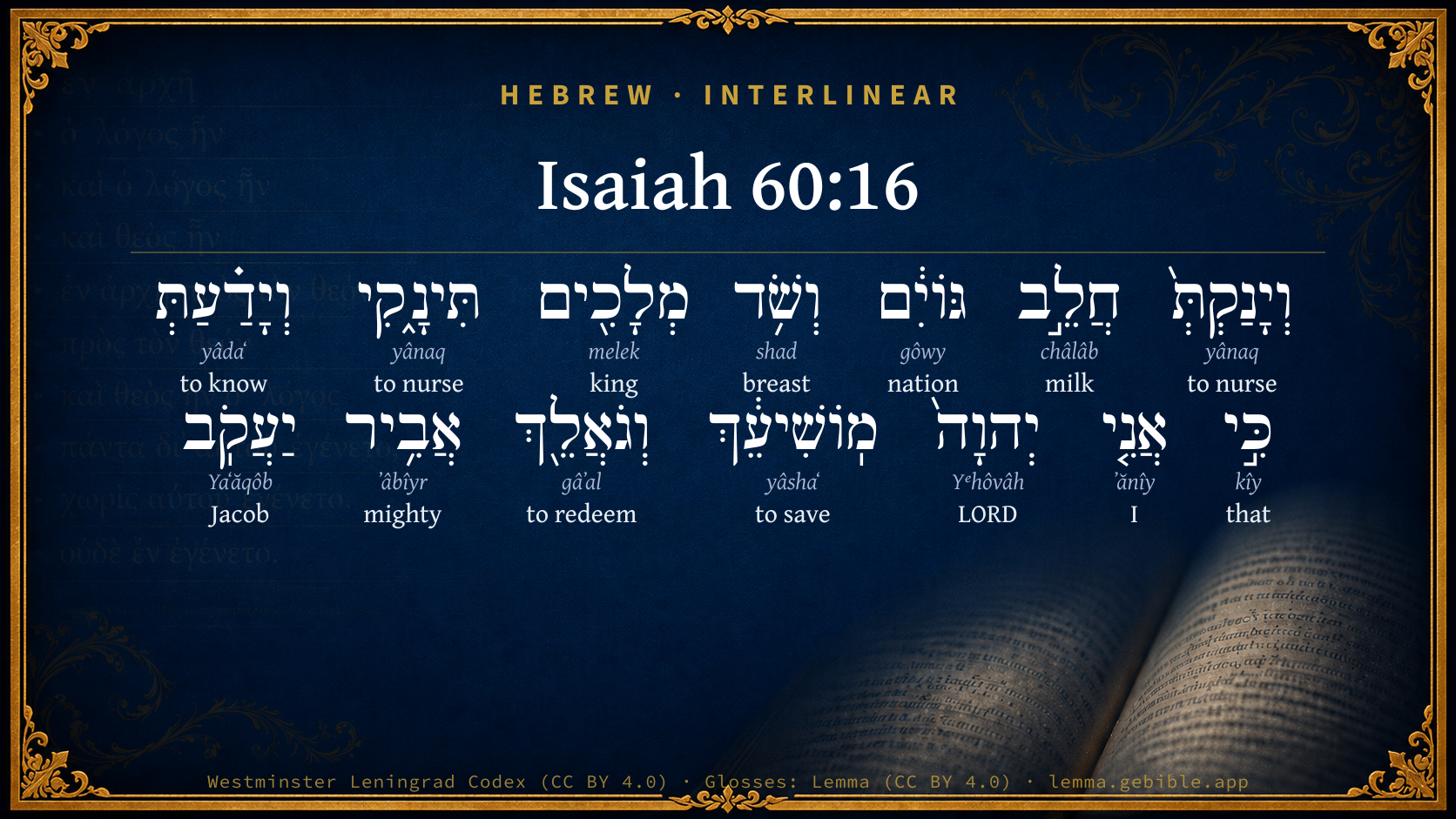
Hebrew (Westminster Leningrad Codex) Isaiah 60:16 appears in the Hebrew Old Testament. The text above is from the Westminster Leningrad Codex. Each word links to its Strong’s number, a concise gloss, and parsing drawn from the Open Scriptures Hebrew Bible morphology. Click any word for its full Brown-Driver-Briggs (BDB) entry.
Download image
Cite this verse

Isaiah 60:16 (World English Bible). Public Domain. Lemma interlinear Bible study tool, https://lemma.gebible.app/v/isaiah/60/16.

Show BibTeX & RIS
BibTeX
RIS
English Translation
You shall also suck the milk of the nations, and shall suck the breast of kings; and you shall know that I, Yahweh, am your Savior, and your Redeemer, the Mighty One of Jacob.
World English Bible · Public Domain
Download a study sheet

One document with this verse’s original text, its word-by-word gloss line, the meaning frame, cross-references with their text, attributed commentary, and full source and license credits — printable, and it pastes into notes with its structure intact.

This verse Autodidact and up

Study sheet (.html) Plain text (.txt)

A passage Seminary Student

Up to 50 verses in one chapter. A passage sheet keeps up to 6 commentary sources and 12 cross-references per verse, in the order this page ranks them, and says so on the sheet whenever that leaves anything out. Ask for a single verse and you get the Autodidact verse sheet above.

Everything on this page stays free to read, with no account — the sheet is a download of what is already on screen, not access to it.

Want to remove ads? Support Godless Engineer
Compare translations 3

The same verse in 3 English versions, stacked beneath the original-language interlinear above. Click any original word for its lexicon entry.

Each is an independent rendering of the whole verse — the interlinear is not word-aligned to these translations.

Highlighted words mark where these versions differ — a whole-verse word diff, not a word-by-word alignment.

  • World English Bible Public Domain
    You shall also suck the milk of the nations, and shall suck the breast of kings; and you shall know that I, Yahweh, am your Savior, and your Redeemer, the Mighty One of Jacob.
  • King James Version Public Domain
    Thou shalt also suck the milk of the Gentiles, and shalt suck the breast of kings: and thou shalt know that I the LORD am thy Saviour and thy Redeemer, the mighty One of Jacob.
  • unfoldingWord Literal Text CC BY-SA 4.0
    And you will suck the milk of the nations, and you will nurse the breast of kings. And you will know that I, Yahweh, your Savior and your Redeemer, the Mighty One of Jacob.

unfoldingWord Literal Text — © unfoldingWord, licensed CC BY-SA 4.0. Word-aligned USFM3 via Door43 (git.door43.org/unfoldingWord/en_ult).

Versions to compare (up to 4)

3 of 4 selected

Show all 18 translations

Every available English version of this verse, each an independent rendering of the whole verse.

  • World English Bible Public Domain
    You shall also suck the milk of the nations, and shall suck the breast of kings; and you shall know that I, Yahweh, am your Savior, and your Redeemer, the Mighty One of Jacob.
  • Berean Standard Bible Public Domain
    You will drink the milk of nations and nurse at the breasts of royalty; you will know that I, the LORD, am your Savior and your Redeemer, the Mighty One of Jacob.
  • Majority Standard Bible Public Domain
    You will drink the milk of nations and nurse at the breasts of royalty; you will know that I, the LORD, am your Savior and your Redeemer, the Mighty One of Jacob.
  • King James Version Public Domain
    Thou shalt also suck the milk of the Gentiles, and shalt suck the breast of kings: and thou shalt know that I the LORD am thy Saviour and thy Redeemer, the mighty One of Jacob.
  • American Standard Version (1901) Public Domain
    Thou shalt also suck the milk of the nations, and shalt suck the breast of kings; and thou shalt know that I, Jehovah, am thy Saviour, and thy Redeemer, the Mighty One of Jacob.
  • Revised Version (1885) Public Domain
    Thou shalt also suck the milk of the nations, and shalt suck the breast of kings: and thou shalt know that I the LORD am thy saviour, and thy redeemer, the Mighty One of Jacob.
  • Geneva Bible (1599) Public Domain
    Thou shalt also sucke ye milke of the Gentiles, and shalt sucke the breastes of Kings: and thou shalt know, that I the Lord am thy Sauiour, and thy Redeemer, the mightie one of Iaakob.
  • Douay-Rheims (1899) Public Domain
    And thou shalt suck the milk of the Gentiles, and thou shalt be nursed with the breasts of kings: and thou shalt know that I am the Lord thy Saviour, and thy Redeemer, the Mighty One of Jacob.
  • Young's Literal Translation Public Domain
    And thou hast sucked the milk of nations, Yea, the breast of kings thou suckest, And thou hast known that I, Jehovah, Thy Saviour, and Thy Redeemer, `Am' the Mighty One of Jacob.
  • Literal Standard Version CC BY-SA 4.0
    And you have sucked the milk of nations, || Indeed, you suckle the breast of kings, || And you have known that I, YHWH, || Your Savior, and Your Redeemer, || [Am] the Mighty One of Jacob.
  • Unlocked Literal Bible CC BY-SA 4.0
    You will also drink the milk of the nations, and will nurse at the breast of kings; you will know that I, Yahweh, am your Savior and your Redeemer, the Mighty One of Jacob.
  • unfoldingWord Literal Text CC BY-SA 4.0
    And you will suck the milk of the nations, and you will nurse the breast of kings. And you will know that I, Yahweh, your Savior and your Redeemer, the Mighty One of Jacob.
  • Darby Bible Public Domain
    And thou shalt suck the milk of the nations, and shalt suck the breast of kings; and thou shalt know that I, Jehovah, [am] thy Saviour and thy Redeemer, the Mighty One of Jacob.
  • World Messianic Bible Public Domain
    You will also drink the milk of the nations, and will nurse from royal breasts. Then you will know that I, the LORD, am your Savior, your Redeemer, the Mighty One of Jacob.
  • Webster's Bible Public Domain
    Thou shalt also suck the milk of the Gentiles, and shalt suck the breast of kings: and thou shalt know that I the LORD am thy Savior and thy Redeemer, the mighty one of Jacob.
  • Free Bible Version CC BY-SA 4.0
    Nations will provide you with what you need, kings will take care of you as if you were their own children. You will know that I, the Lord, am your Savior and Redeemer, the Mighty One of Jacob.
  • Bible in Basic English Public Domain
    And you will take the milk of the nations, flowing from the breast of kings; and you will see that I, the Lord, am your saviour, and he who takes up your cause, the Strong One of Jacob.
  • JPS Tanakh (1917) Public Domain
    Thou shalt also suck the milk of the nations, and shalt suck the breast of kings; and thou shalt know that I the LORD am thy Saviour, and I, the Mighty One of Jacob, thy Redeemer.

Literal Standard Version (2020), Covenant Press — licensed CC BY-SA 4.0. Text via the HelloAO Bible API (eBible.org). Unlocked Literal Bible (unfoldingWord) — licensed CC BY-SA 4.0. Text via the HelloAO Bible API (eBible.org). unfoldingWord Literal Text — © unfoldingWord, licensed CC BY-SA 4.0. Word-aligned USFM3 via Door43 (git.door43.org/unfoldingWord/en_ult). Free Bible Version, Dr. Jonathan Gallagher — licensed CC BY-SA 4.0. Text via the HelloAO Bible API (eBible.org).

Word by word

More ways to search: Search by grammar → Find every occurrence → Compare this word →

Practice this passage: Drill this verse → Learn its vocabulary →

אֲבִ֥יר
ʼâbîyr
H46
“mighty of”
Adjective, Adjective, Masculine, Singular, Construct
Part of Speech
Adjective
Type
Adjective
Gender
Masculine
Number
Singular
State
Construct
Full BDB Definition

Origin: from H82

TWOT: 13c

strong, mighty - used only to describe God - the Strong - old name for God (poetic)
  1. וְיָנַקְתְּ֙ yânaq H3243 “and · to nurse” Conjunction + Verb, Qal, Sequential Perfect, 2nd Person, Feminine, Singular
  2. חֲלֵ֣ב châlâb H2461 “milk of” Noun, Common, Masculine, Singular, Construct
  3. גּוֹיִ֔ם gôwy H1471 “nations” Noun, Common, Masculine, Plural, Absolute
  4. וְשֹׁ֥ד shad H7699 “and · breast of” Conjunction + Noun, Common, Masculine, Singular, Construct
  5. מְלָכִ֖ים melek H4428 “kings” Noun, Common, Masculine, Plural, Absolute
  6. תִּינָ֑קִי yânaq H3243 “to nurse” Verb, Qal, Imperfect, 2nd Person, Feminine, Singular
  7. וְיָדַ֗עַתְּ yâdaʻ H3045 “and · to know” Conjunction + Verb, Qal, Sequential Perfect, 2nd Person, Feminine, Singular
  8. כִּ֣י kîy H3588 “that” Conjunction
  9. אֲנִ֤י ʼănîy H589 “I” Pronoun, Personal, 1st Person, Common, Singular
  10. יְהוָה֙ Yᵉhôvâh H3068 “LORD” Noun, Proper
  11. מֽוֹשִׁיעֵ֔ךְ yâshaʻ H3467 “saving · you” Verb, Hiphil, Participle Active, Masculine, Singular, Construct + Suffix, Personal, 2nd Person, Feminine, Singular
  12. וְגֹאֲלֵ֖ךְ gâʼal H1350 “and · redeeming · you” Conjunction + Verb, Qal, Participle Active, Masculine, Singular, Construct + Suffix, Personal, 2nd Person, Feminine, Singular
  13. יַעֲקֹֽב Yaʻăqôb H3290 “Jacob” Noun, Proper

About this verse

These counts appear in no published source. They are computed here, from the morphology-tagged text and Lemma’s own curated glosses. What Lemma adds →

14
words
13
distinct lemmas
Prophets
section

Notable vocabulary

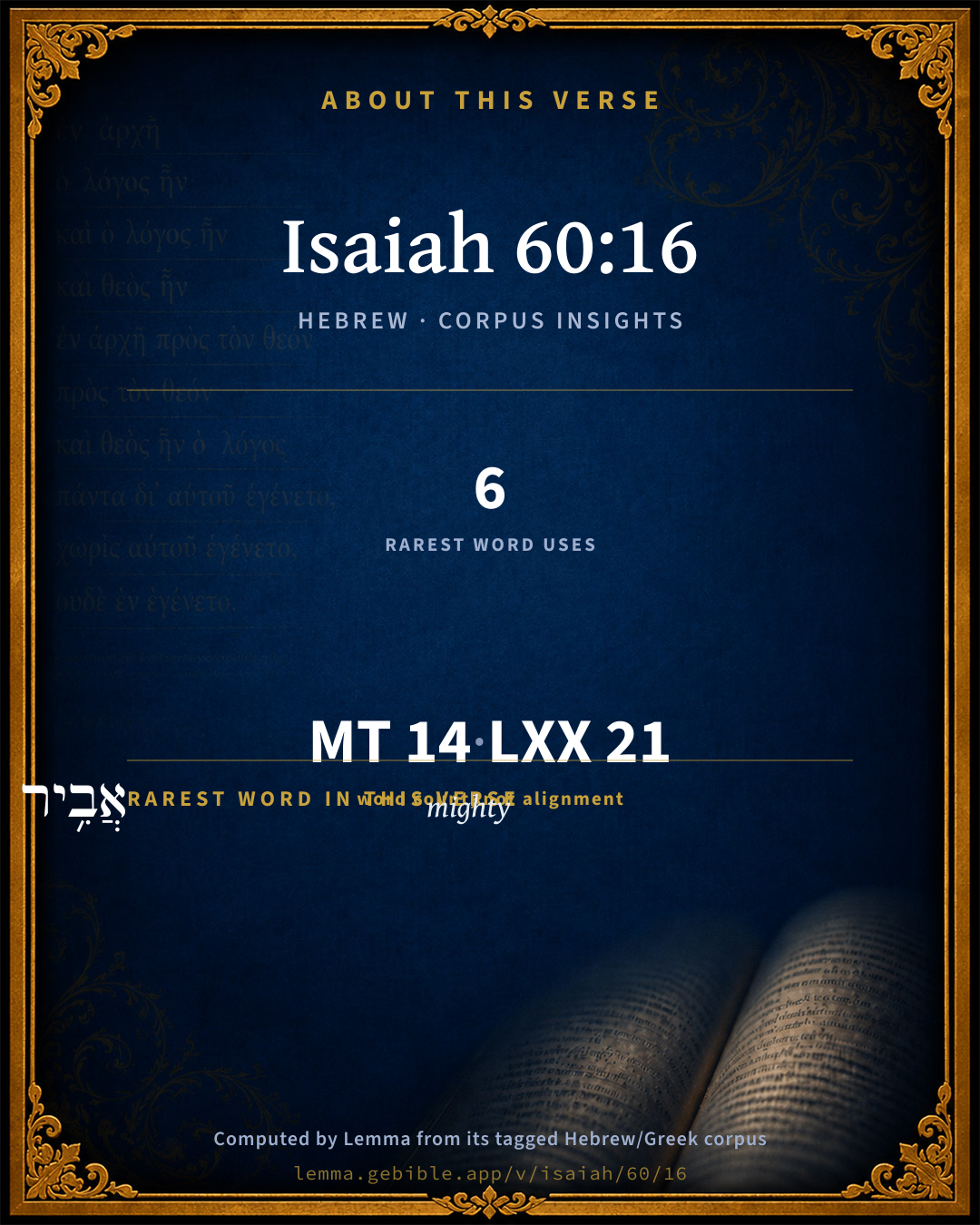
The rarest word here is אֲבִ֥יר mighty H46 — appearing just 6 times in the whole Hebrew Bible.

Shared distinctive vocabulary

אֲבִ֥יר mighty H46 occurs in 6 verses of the Hebrew Bible. Also found in:

Grammatical profile

  • 5 verbs
  • 6 nouns
  • 1 adjective
  • 1 pronoun
  • 1 conjunction

Verb forms

  • וְיָנַקְתְּ֙ Qal · Sequential Perfect
  • תִּינָ֑קִי Qal · Imperfect
  • וְיָדַ֗עַתְּ Qal · Sequential Perfect
  • מֽוֹשִׁיעֵ֔ךְ Hiphil · Participle Active
  • וְגֹאֲלֵ֖ךְ Qal · Participle Active

Repetition

A word recurs within this verse — often emphatic in Hebrew:

  • וְיָנַקְתְּ֙ to nurse H3243 ×2

Hebrew & Septuagint length

In English translation the verse runs 34 words from the Hebrew and 35 from the Septuagint (LXX English) — closely comparable.

A rough comparison of the two English renderings, which tokenize alike — not a word-level alignment.

Word counts can differ between the Hebrew and the Greek without any difference in meaning — e.g. the Hebrew direct-object marker אֵת has no separate Greek word, and Greek often adds the article ὁ.

In the original languages it is 14 Hebrew tokens and 21 Greek tokens — but the two are counted differently (Hebrew bundles its prefixes and suffixes into one token; the Greek is in lemma form), so that isn’t a like-for-like length.

Cross-references

7

Topical passages linked to Isaiah 60:16 in the Treasury of Scripture Knowledge — connected by theme and wording, ordered by reader-vote popularity; previews shown in the World English Bible.

  • Isaiah 49:23 Kings shall be your nursing fathers, and their queens your nursing mothers: they shall bow down to you with their faces to the earth, and lick the dust of your feet; and you shall know that I am Yahweh; and those who wait for me shall not be disappointed.
  • Isaiah 66:11–12 that you may suck and be satisfied with the breasts of her consolations; that you may milk out, and be delighted with the abundance of her glory.
  • Isaiah 66:14 You shall see [it], and your heart shall rejoice, and your bones shall flourish like the tender grass: and the hand of Yahweh shall be known toward his servants; and he will have indignation against his enemies.
  • Isaiah 61:6 But you shall be named the priests of Yahweh; men shall call you the ministers of our God: you shall eat the wealth of the nations, and in their glory shall you boast yourselves.
  • Isaiah 43:3–4 For I am Yahweh your God, the Holy One of Israel, your Savior; I have given Egypt as your ransom, Ethiopia and Seba in your place.
  • Ezekiel 34:30 They shall know that I, Yahweh, their God am with them, and that they, the house of Israel, are my people, says the Lord Yahweh.
  • Isaiah 59:20 A Redeemer will come to Zion, and to those who turn from disobedience in Jacob, says Yahweh.

Cross-references courtesy of OpenBible.info (CC BY 4.0).

Hebrew and Greek witnesses Masoretic Hebrew ↔ Greek Septuagint

The same verse in the two great witnesses to the Old Testament, shown verse-for-verse.

These are two independent witnesses, not word-aligned to each other, and the Septuagint is shown in lemma (dictionary) form.

Hebrew Isaiah 60:16 Masoretic · Westminster Leningrad Codex

וְיָנַקְתְּ֙ חֲלֵ֣ב גּוֹיִ֔ם וְשֹׁ֥ד מְלָכִ֖ים תִּינָ֑קִי וְיָדַ֗עַתְּ כִּ֣י אֲנִ֤י יְהוָה֙ מֽוֹשִׁיעֵ֔ךְ וְגֹאֲלֵ֖ךְ אֲבִ֥יר יַעֲקֹֽב

You shall also suck the milk of the nations, and shall suck the breast of kings; and you shall know that I, Yahweh, am your Savior, and your Redeemer, the Mighty One of Jacob.

World English Bible · Public Domain

Greek LXX Isaiah 60:16 Septuagint · lemma form

καί θηλάζω γάλα ἔθνος καί πλοῦτος βασιλεύς ἐσθίω καί γιγνώσκω ὅτι ἐγώ κύριος ὁ σώζω σύ καί ἐκαἱρέω σύ θεός ἰσραήλ

And you shall suck the milk of the Gentiles, and shall eat the wealth of kings: and shall know that I am the Lord that saves you and delivers you, the Holy One of Israel.

LXX2012 (modern English Septuagint) · Public Domain

On this verse, Haydock's Catholic Bible Commentary discusses the Septuagint’s reading. Read the note in Commentary ↓

Hebrew: Westminster Leningrad Codex (CC BY 4.0). Greek: Septuagint (public domain); English from LXX2012 (modern English Septuagint) (Public Domain). How the Septuagint differs from the Hebrew →

Targum (Aramaic paraphrase)

1

The Targum is the ancient Jewish Aramaic paraphrase of the Hebrew Scriptures — an interpretive translation, not the Hebrew text itself. Onkelos (literal) and Pseudo-Jonathan (expansive) render the Torah, and Jonathan the Prophets. Coverage is partial: where no permissively-licensed English translation exists for a verse, only the Aramaic is shown. This is verse-level text, not a word-by-word alignment to the Hebrew.

  1. Targum Jonathan Prophets (Joshua–Malachi)
    וְתִסְבְּעִין נִכְסֵי עַמְמַיָא וּבְבִזַת מַלְכִין תִּתְפַּנְקִין וְתֵידְעִין אֲרֵי אֲנָא יְיָ פָּרְקִיךְ וּמְשֵׁיזְבִיךְ תַּקִיפָא דְיַעֲקֹב:

    And thou shalt be satisfied with the riches of the nations, and in the spoil of their kings thou shalt delight thyself; and thou shalt know that I am the Lord, thy Saviour and thy Redeemer, the mighty One of Jacob.

    Targum Jonathan — Aramaic: “Mikraot Gedolot” (public domain). English: “Sefaria Community Translation” (CC0 1.0 (public-domain dedication)); “London "Chaldee Paraphrase," 1871” (public domain). Text via Sefaria.

Commentary

Notes on Isaiah 60:16 from classic Christian and Jewish commentators (each source and its license shown beneath its notes). The classic Christian expositions comment on the surrounding passage and are grouped to its opening verse, so a note may address several verses; the Jewish commentaries on the Tanakh (Rashi and others) are per-verse, so they appear only where the commentator wrote on this verse.

Lemma curates 59 commentaries, every one of them public domain or Creative Commons licensed, each selected and text-cleaned for this edition rather than reprinted as found. About our sources →

Trapp's Complete Commentary

John Trapp

Isa 60:16 Thou shalt also suck the milk of the Gentiles, and shalt suck the breast of kings: and thou shalt know that I the LORD [am] thy Saviour and thy Redeemer, the mighty One of Jacob.

Ver. 16. Thou shalt also suck the milk of the Gentiles.] Satiaberis divitiis populorum, saith the Chaldee. Thou shalt be satisfied with the riches of the peoples.

And shalt suck the breast of kings,] i.e., With kingly dainties and delicacies, saith Zanchez after the Rabbis.

John Trapp, A Commentary or Exposition upon All the Books of the Old and New Testament (1647–1656) — public domain. Text from a community e-Sword module.

The Biblical Illustrator

Joseph S. Exell

Isa_60:16

Thou shalt also suck the milk of the Gentiles

The Church served by nations and kings

The nations and their kings now give up to the Church their vital substance, as a mother or nurse gives to the child the milk of her breasts; and the Church thereby has rich nourishment for prosperous growth, ever fresh material for joy and thanksgiving.

We can by no means think of enrichment by plunder; the sucking is that of a child, not a vampire. (F. Delitzsch, D. D.)

Religion advanced by wealth and power

All interpreters agree with the Targum in applying this verse to the influx of wealth and power and whatever else the kings and nations of the earth can contribute to the progress of the true religion. The figure is derived from De

33:19. (J. A. Alexander.)

The perpetual excellencies of the Gospel Church

(Isa_60:15-16):--Considering how short Jerusalems excellency was, and how short it came of the vast compass of this promise, we must look for the full accomplishment of it in the perpetual excellencies of the Gospel Church, far exceeding those of the Old Testament Church, and the glorious privileges and advantages of the Christian religion, which are indeed the joy of many generations. Two things are here spoken of as her excellency and joy, in opposition to her having been forsaken and hated.

1. She shall find herself countenanced by her neighbours. The nations and their kings that are brought to embrace Christianity shall lay themselves out for the good of the Church, and maintain its interests with the tenderness and affection that the nurse shows to the child at her breast.

2. She shall find herself countenanced by her God. Thou shalt know that I, the Lord, I am thy Saviour, etc. (M. Henry.)

Sucking the milk of the nations

Not suck their blood--that is not the spirit of the Gospel. (M. Henry.)

The Biblical Illustrator, edited by Joseph S. Exell (c. 1880s–1900s) — public domain. Text from a community e-Sword module.

Joseph Benson's Commentary

Isa 60:16-17. Thou shalt also suck the milk of the Gentiles — A metaphor taken from children drawing nourishment from the breast. The sense is, that the church should draw, or receive, the wealth of nations, and the riches and power of kings, and whatever is most excellent; and that it should come freely and affectionately, as milk flows from the breast of the mother. And thou shalt know — Namely, shall experience; that I the Lord — Hebrew, Jehovah; am thy Saviour — That I have undertaken to save, and that I do and will save thee; the mighty One of Jacob — Not only of the literal, but also, and especially, of the spiritual Jacob, or Israel: as if he had said, These things will certainly be accomplished, for he is the mighty God, and so is able; and the God of Jacob, and so is obliged by covenant with, and relation to them, to deliver and protect his people. For brass I will bring gold, &c. — Here we have the effect of the preceding promise: Thy poverty shall be turned to riches, all things shall be altered for the best: it is an allusion to the days of Solomon, when gold was as plentiful as brass. If these words be considered as intended to be taken literally, it is sufficiently evident that they are not applicable to Jerusalem, which was never so enriched, after it was rebuilt, as to have greater riches than the Jews possessed before the wars which they waged with the Babylonians; nor was their state happier. And after Herod the Great, they were in a much worse condition, Judea being reduced to a province of the Roman empire, and governed and pillaged by the deputies or vicegerents of the emperors. Therefore all this is undoubtedly spoken of the Christian Church and of spiritual riches, namely, the privileges and blessings of the gospel. I will also make thy officers peace — That is, men of peace, loving, meek, and friendly. This was far from being the case with the Jews after their return out of captivity; for, though those who were first set over them, after their return, namely, Zerubbabel, Nehemiah, and others, governed them peaceably and mildly, yet it was not so in the following times; and after their high-priests took upon them the government, they grievously plundered and oppressed the people, and contended with one another with the most outrageous and cruel discord, as appears from Josephus, the Jewish historian. But the governors of the Christian Church, that is, of that church which only deserves the name of Christian, have been, and always will be, mild and gentle, and men of peace and clemency. And thine exactors — Or rulers, as Dr. Waterland renders נגשׂיŠ. Righteousness — Most righteous, as before peace was put for peaceable.

Joseph Benson's Commentary on the Old and New Testaments (1811–1818) — public domain. Text from a community e-Sword module.

Geneva Bible (1599)

Geneva Bible translators

Both high and low shall be ready to help and succor thee.

Geneva Bible (1599) marginal notes — public domain. Text via Bolls.life.

Jamieson, Fausset & Brown

Robert Jamieson, A. R. Fausset & David Brown

suck--Thou shalt draw to thyself and enjoy all that is valuable of the possessions of the Gentiles, &c. (Isa 49:23; Isa 61:6; Isa 66:11-12).

know--by the favors bestowed on thee, and through thee on the Gentiles.

Jamieson, Fausset & Brown — Commentary Critical and Explanatory on the Whole Bible (1871) — public domain (CC PDM 1.0). Text via the HelloAO Bible API.

Ellicott's Commentary for English Readers

(16) Thou shalt also suck the milk of the Gentiles . . .—The metaphor is bold, but the prophet had already presented it in a less startling form in Isa_49:23. What is meant in either case is that the new Jerusalem shall be supported by the offerings of the Gentiles.

A Bible Commentary for English Readers, edited by Charles John Ellicott (1878–1897) — public domain. Text from a community e-Sword module.

The Cambridge Bible for Schools and Colleges

gen. ed. J. J. S. Perowne

16. For the figure in the first half of the verse, cf. ch. Isa_49:23; the second half is repeated from Isa_49:26.

The Cambridge Bible for Schools and Colleges (gen. ed. J. J. S. Perowne; Cambridge University Press, 1878–1918) — public domain. Text from a community e-Sword module.

John Gill's Exposition

Thou shalt also suck the milk of the Gentiles,.... Partake of their riches and wealth; so the Targum,

"and ye shall be satisfied with the substance of the people:''

or drink of the sincere milk of the word of the Gospel, which Gentiles have been favoured with for many ages; for this seems to have regard to Jewish converts, though not to them only, but as they, with the converted Gentiles, will make up one church state, and partake of the same privileges:

and shall suck the breast of kings; who shall now be converted in various places, come into the church, and be nursing fathers to it; help and assist the people of God with their riches to carry on divine worship in an honourable manner; and to protect and defend them with their power; see Psa 72:9. The Targum is,

"in the spoil of kings ye shall delight yourselves;''

and it may also design the breasts of consolation, the ordinances of the Gospel, such as Christian kings will suck, and Jews and Gentiles shall do the same, Isa 66:11,

and thou shalt know that I the Lord am thy Saviour and thy Redeemer, the mighty One of Jacob; the Jews, being called, shall seek the Lord their God, the true Messiah, and shall look unto him by faith, whom they have pierced; shall know, own, and acknowledge him to be their Redeemer and Saviour; who must be fit and qualified for such an office and work, and equal to it, being the mighty One of Jacob, whom before they and their ancestors rejected and despised.

John Gill's Exposition of the Whole Bible (1746–1763) — public domain (CC PDM 1.0). Text via the HelloAO Bible API.

Albert Barnes' Notes on the Bible

Thou shalt suck the milk of the Gentiles - This expression means, ‘Whatever is valuable and rich which they possess shall contribute to your welfare.’ The idea is the same substantially which occurs in the previous parts of the chapter, that the riches of the pagan world would become tributary to the advancement of the true religion.

And thou shall suck the breast of kings - The Chaldee renders this, ‘And thou shalt be satisfied with the riches of the people, and shalt delight thyself with the spoil of kings.’ The phrase to suck ‘the breast of kings is unusual; but the sense is simple and plain, that kings and their wealth should be made to contribute to sustain the church. See the sentiment explained in the notes at Isa 49:23.

And thou shalt know - By the protection which shall be extended to thee, and by the accession which shall be made to thee, thou shalt have full proof that Yahweh is thy protector and friend. The conversion of the pagan world shall demonstrate that Yahweh is the friend of his church and people.

Albert Barnes' Notes on the Bible (1834–1885) — public domain. Text from a community e-Sword/MySword module.

Haydock's Catholic Bible Commentary

Kings. Thou shalt be treated like royal babes, chap. xlix. 23. (Calmet) --- Septuagint, "and thou shalt eat the riches of kings." (Haydock)

George Leo Haydock (1774–1849), Haydock's Catholic Family Bible and Commentary, 1859 edition — public domain. Excludes Psalms (Douay-Rheims chapter numbering differs from Protestant) and Deuterocanonical books (Catholic canon only).

Matthew Poole's English Annotations

Thou shalt also suck, & c.; a metaphor taken from children sucking nourishment from the breast. The sense is, that the church should draw or drain the wealth of nations, and the riches and power of kings, and whatever is most excellent, and that it should come freely and affectionately, as milk flows from the breast of the mother; the same thing intended Isa 49:23, and in the foregoing verses. Thou shalt know, i.e. experience it; knowing is often put for an experimental knowing.

The mighty one of Jacob; styled so either with reference to Jacob’s person, he being the first that gave God this title, Gen 49:24; or with reference to Jacob’s posterity, viz. the Jews. These things will certainly be accomplished; for he is the mighty God, and so able; and the God of Jacob, so obliged by covenant and relation.

Matthew Poole's English Annotations on the Holy Bible (1683–1685) — public domain. Text from a community e-Sword/MySword module.

Whedon's Commentary on the Bible

Daniel D. Whedon

16. Suck the milk… the breast, etc. — The meaning here is, that Zion-Jerusalem, or the Messianic Church, shall draw on the resources of the more wealthy Gentiles as well as of kings: allegorical of being cherished with tenderest regard by them. From this, Zion is made to know that Jehovah is her all-compensating Lord and Saviour, mighty to save.

Daniel D. Whedon (gen. ed.), Commentary on the Old and New Testaments (1874–1909) — public domain. Text from a community e-Sword module.

The Pulpit Commentary

Thou shalt also suck the milk of the Gentiles. (comp. Deu_33:19) As a child at the mother"s breast, thou shall obtain kindly nourishment through the means of the Gentiles, who acknowledge thee for their superior, and place all their means at thy disposal (supra, vers. 5-11). Among these, the most liberal, and the most prompt to render aid, will be their kings (see the comment on ver. 10). Thou shall know that I the Lord am thy Saviour. This clause is repeated Isa_49:26. It is a phrase containing in it a mysterious depth of promise.

"The Mighty One of Jacob.

"And thou shalt know that I the Lord am thy Saviour, and thy Redeemer, the Mighty One of Jacob." It is singular and significant that Jehovah should here be so closely identified with Jacob,.and not, as usual, with the three great patriarchs. We are to get our ideas of him as a Saviour and Redeemer precisely from what he was to Jacob, and what he did for Jacob. Now, the striking thing in the life of Jacob is that he had much more trouble with himself than with his circumstances. The cursory view might make much of the changeableness and the hardships of Jacob"s checkered life; but he easily mastered his circumstances. The deeper view sees throughout the career a constant struggle with the bad self, which never gets more than a partial victory, until life draws near to its close, and then the hero of a thousand fights with the bad self is enabled to speak of "the angel that redeemed me from all evil." That angel the prophet suggestively calls the "Mighty One of Jacob." This, then, is our point. The glory of God our Redeemer is that he can redeem us from our bad selves. Show what is meant by and included in the "bad self.

I THE STRUGGLE WITH THE BAD SELF IS A SECRET STRUGGLE, We do not talk about it. We do not put forth any signs of it. Men think our earthly troubles are our great troubles, but the truth is that no cry goes forth from us with such intensity of passion as the cry which no fellow-creature hears, "O wretched man that I am! who shall deliver me from the body of this death?" Nobody knows how hard we are trying to put away the "old man with his corruptions.

II THE STRUGGLE WITH THE BAD SELF IS A HOPELESS STRUGGLE. It is if we carry it on in our own strength. "Who can say, I have made my heart clean, I am pure from my sin?" What Jacob-like man or woman ever yet sang a victory-song over his own giant self, and praised the weapons and the skill that gained the triumph? Jacobs that try to get quit of the bad self in their own strength end in the dust, under giant Self"s foot.

III THE STRUGGLE WITH THE BAD SELF IS JUST THE STRUGGLE IN WHICH WE MAY HAVE, AND SHOULD REJOICE TO HAVE, A DIVINE HELPER. He, the "Mighty One of Jacob," has access to souls, and influence on souls. He "strengtheneth us with strength in the soul." He will not cease his gracious working until his people are "all glorious within." Of this we may be sure, in this we may have supreme consolation-over the secret inner strife of our souls, the Lord, the Saviour, the Redeemer, graciously presides. R.T.

The Pulpit Commentary (1880–1919), ed. H.D.M. Spence-Jones & Joseph S. Exell — public domain. Text from a community e-Sword module.

John Wesley's Explanatory Notes

Shalt suck - That the church shall draw, or receive the wealth of nations, and the riches, and power of kings, and whatever is most excellent, and that it shall come freely, and affectionately, as milk flows from the breast of the mother.

John Wesley, Explanatory Notes Upon the Whole Bible (1754–1765) — public domain. Text via the GEBible commentary corpus.

J. A. Alexander on Isaiah

Joseph Addison Alexander

“And thou shalt suck the milk of nations, and the breast of kings shalt thou suck, and thou shalt know that I, Jehovah, am thy Savior, and (that) thy Redeemer (is) the Mighty One of Jacob.” All interpreters agree in applying this verse to the influx of wealth and power and whatever else the kings and nations of the earth can contribute to the progress of the true religion. The figure is derived from Deu 33:19, ‘they shall suck the abundance of the seas’. The catachresis in the second clause is not a mere rhetorical blunder, but an example of the sense overmastering the style, a license the occasional use of which is characteristic of a bold and energetic writer. It also serves the useful purpose of showing how purely tropical the language is. Each member of the last clause contains a subject and a predicate, and therefore a complete proposition. The sense is not merely that Jehovah is the Mighty One of Jacob, but that the Mighty God of Jacob is Israel’s Redeemer, and the self-existent everlasting God his Savior.

Joseph Addison Alexander, The Prophecies of Isaiah (1846–1847; New York: Scribner, 1870–1878) — public domain. Text from a community e-Sword module.

Scofield Reference Notes

C. I. Scofield

redeemer

Heb. goel, Redemp. (Kinsman type). (See Scofield "Isa 59:20")

The Scofield Reference Bible (1917 edition), notes by C. I. Scofield — public domain. Text from a community e-Sword module.

Rashi

Rabbi Shlomo Yitzchaki (Rashi)

and the breast of kings Heb. וְשֹׁד, an expression of breasts (שָׁדַיִם) and ‘you shall suck’ proves it.

Rashi on the Tanakh — English translations: “The Judaica Press complete Tanach with Rashi, translated by A. J. Rosenberg” (CC BY 4.0); “Pentateuch with Rashi's commentary by M. Rosenbaum and A.M. Silbermann, 1929-1934” (public domain); “The Metsudah Tanach series, Lakewood, N.J” (CC BY 4.0); and “The Book of Joshua, Metsudah Publications, 1997” (CC BY 4.0). Text via Sefaria.

Ibn Ezra

Rabbi Abraham ibn Ezra

The milk of nations. Their money; they will pay tribute.

שד Breast. It is the same as שָׁדַיִם. The form of the nouns is not constant.

Ibn Ezra on the Tanakh — English translations: “Sefaria Community Translation” (CC0 1.0 (public-domain dedication)); “Yalkut, Sifsei Chachomim Chumash, Metsudah Publications, 2009” (CC BY 4.0); and “Commentary of Ibn Ezra on Isaiah - trans. by M. Friedlander, 1873” (public domain). Text via Sefaria.

Lesson kit

Teaching starters — assembled from the data on this page, not authored interpretation. Every prompt links to the verse data it draws on. Edit before teaching.

Isaiah, in the Prophets, opens this verse with 14 words (13 distinct Hebrew lemmas). Its most distinctive word is ʼâbîyr (“mighty”). A historical commentator’s framing appears above. Read the whole chapter for the surrounding context.

Discussion questions

  1. What does “mighty” (ʼâbîyr) contribute to the verse as a whole?
  2. Genesis 49:24 shares the word «mighty» with this verse. How do the two illuminate each other?
  3. “to nurse” occurs 2× in this one verse. What is the effect of the repetition?
  4. These translations render this verse differently; the difference is in the English rendering, not the original. What questions does that raise?
  5. The verb «וְיָנַקְתְּ֙» is Qal Sequential Perfect. How does its form color the action?
  6. Reading how Trapp's Complete Commentary and The Biblical Illustrator read this verse, where do the two commentators agree and where do they part?

Things to notice

Reading settings

Reading text

Shown beneath each verse's original-language words.

Old Testament
Old Testament edition

Read the OT as the Masoretic Hebrew (MT) or the Greek Septuagint (LXX).

English shown for the Greek Septuagint (in the Hebrew ↔ Greek comparison).

Comparing translations? Open the Compare panel on any verse page to stack up to four side by side.