
Psalms 116:6

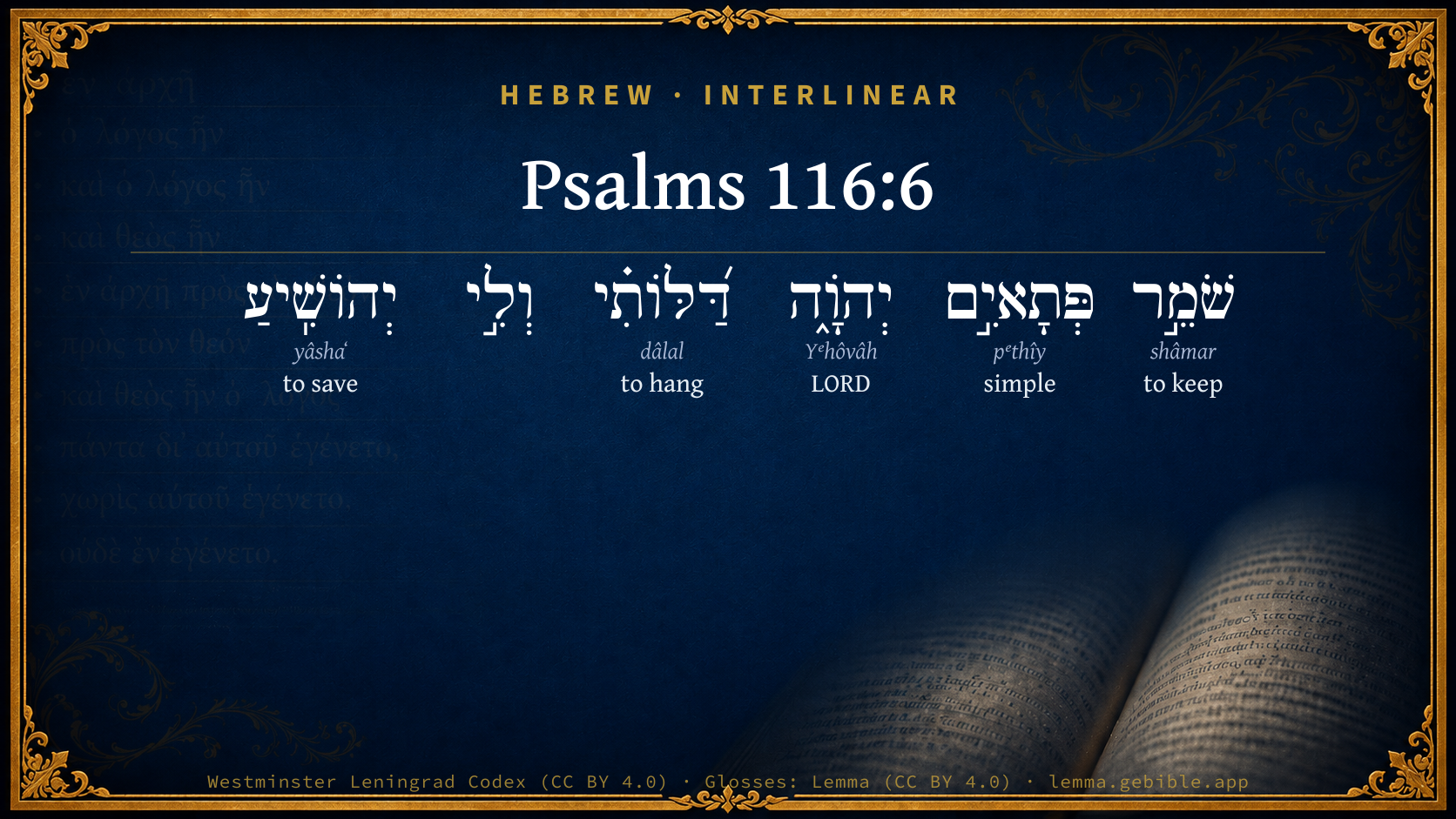
Hebrew (Westminster Leningrad Codex) Psalms 116:6 appears in the Hebrew Old Testament. The text above is from the Westminster Leningrad Codex. Each word links to its Strong’s number, a concise gloss, and parsing drawn from the Open Scriptures Hebrew Bible morphology. Click any word for its full Brown-Driver-Briggs (BDB) entry.
Download image
Cite this verse

Psalms 116:6 (World English Bible). Public Domain. Lemma interlinear Bible study tool, https://lemma.gebible.app/v/psalms/116/6.

Show BibTeX & RIS
BibTeX
RIS
English Translation
Yahweh preserves the simple. I was brought low, and he saved me.
World English Bible · Public Domain
Download a study sheet

One document with this verse’s original text, its word-by-word gloss line, the meaning frame, cross-references with their text, attributed commentary, and full source and license credits — printable, and it pastes into notes with its structure intact.

This verse Autodidact and up

Study sheet (.html) Plain text (.txt)

A passage Seminary Student

Up to 50 verses in one chapter. A passage sheet keeps up to 6 commentary sources and 12 cross-references per verse, in the order this page ranks them, and says so on the sheet whenever that leaves anything out. Ask for a single verse and you get the Autodidact verse sheet above.

Everything on this page stays free to read, with no account — the sheet is a download of what is already on screen, not access to it.

Want to remove ads? Support Godless Engineer
Compare translations 3

The same verse in 3 English versions, stacked beneath the original-language interlinear above. Click any original word for its lexicon entry.

Each is an independent rendering of the whole verse — the interlinear is not word-aligned to these translations.

Highlighted words mark where these versions differ — a whole-verse word diff, not a word-by-word alignment.

  • World English Bible Public Domain
    Yahweh preserves the simple. I was brought low, and he saved me.
  • King James Version Public Domain
    The LORD preserveth the simple: I was brought low, and he helped me.
  • unfoldingWord Literal Text CC BY-SA 4.0
    Yahweh guards the naive; I was low, and he saved me.

unfoldingWord Literal Text — © unfoldingWord, licensed CC BY-SA 4.0. Word-aligned USFM3 via Door43 (git.door43.org/unfoldingWord/en_ult).

Versions to compare (up to 4)

3 of 4 selected

Show all 17 translations

Every available English version of this verse, each an independent rendering of the whole verse.

  • World English Bible Public Domain
    Yahweh preserves the simple. I was brought low, and he saved me.
  • Berean Standard Bible Public Domain
    The LORD preserves the simplehearted; I was helpless, and He saved me.
  • Majority Standard Bible Public Domain
    The LORD preserves the simplehearted; I was helpless, and He saved me.
  • King James Version Public Domain
    The LORD preserveth the simple: I was brought low, and he helped me.
  • American Standard Version (1901) Public Domain
    Jehovah preserveth the simple: I was brought low, and he saved me.
  • Revised Version (1885) Public Domain
    The LORD preserveth the simple: I was brought low, and he saved me.
  • Geneva Bible (1599) Public Domain
    The Lord preserueth the simple: I was in miserie and he saued me.
  • Young's Literal Translation Public Domain
    A preserver of the simple `is' Jehovah, I was low, and to me He giveth salvation.
  • Literal Standard Version CC BY-SA 4.0
    YHWH [is] a preserver of the simple, || I was low, and He gives salvation to me.
  • Unlocked Literal Bible CC BY-SA 4.0
    Yahweh protects the naive; I was brought low, and he saved me.
  • unfoldingWord Literal Text CC BY-SA 4.0
    Yahweh guards the naive; I was low, and he saved me.
  • Darby Bible Public Domain
    Jehovah keepeth the simple: I was brought low, and he saved me.
  • World Messianic Bible Public Domain
    The LORD preserves the simple. I was brought low, and he saved me.
  • Webster's Bible Public Domain
    The LORD preserveth the simple: I was brought low, and he helped me.
  • Free Bible Version CC BY-SA 4.0
    The Lord takes care of those who are powerless; when I was brought down he saved me.
  • Bible in Basic English Public Domain
    The Lord keeps the simple; I was made low, and he was my saviour.
  • JPS Tanakh (1917) Public Domain
    The LORD preserveth the simple; I was brought low, and He saved me.

Literal Standard Version (2020), Covenant Press — licensed CC BY-SA 4.0. Text via the HelloAO Bible API (eBible.org). Unlocked Literal Bible (unfoldingWord) — licensed CC BY-SA 4.0. Text via the HelloAO Bible API (eBible.org). unfoldingWord Literal Text — © unfoldingWord, licensed CC BY-SA 4.0. Word-aligned USFM3 via Door43 (git.door43.org/unfoldingWord/en_ult). Free Bible Version, Dr. Jonathan Gallagher — licensed CC BY-SA 4.0. Text via the HelloAO Bible API (eBible.org).

Word by word

More ways to search: Search by grammar → Find every occurrence → Compare this word →

Practice this passage: Drill this verse → Learn its vocabulary →

דַּ֝לּוֹתִ֗י
dâlal
H1809
“to hang”
Verb, Qal, Perfect, 1st Person, Common, Singular
Part of Speech
Verb
Stem
Qal
Form
Perfect
Person
1st Person
Gender
Common
Number
Singular
Full BDB Definition

Origin: a primitive root (compare H1802 )

TWOT: 433

to hang, languish, hang down, be low - (Qal) - to hang low - to be low - of distress (figuratively) - to languish, look weakly (of eyes) - (Niphal) to be brought low, be laid low
  1. שֹׁמֵ֣ר shâmar H8104 “keeping” Verb, Qal, Participle Active, Masculine, Singular, Absolute
  2. פְּתָאיִ֣ם pᵉthîy H6612 “simple ones” Noun, Common, Masculine, Plural, Absolute
  3. יְהֹוָ֑ה Yᵉhôvâh H3068 “LORD” Noun, Proper
  4. יְהוֹשִֽׁיעַ yâshaʻ H3467 “to save” Verb, Hiphil, Imperfect, 3rd Person, Masculine, Singular

About this verse

These counts appear in no published source. They are computed here, from the morphology-tagged text and Lemma’s own curated glosses. What Lemma adds →

6
words
5
distinct lemmas
Wisdom
section

Notable vocabulary

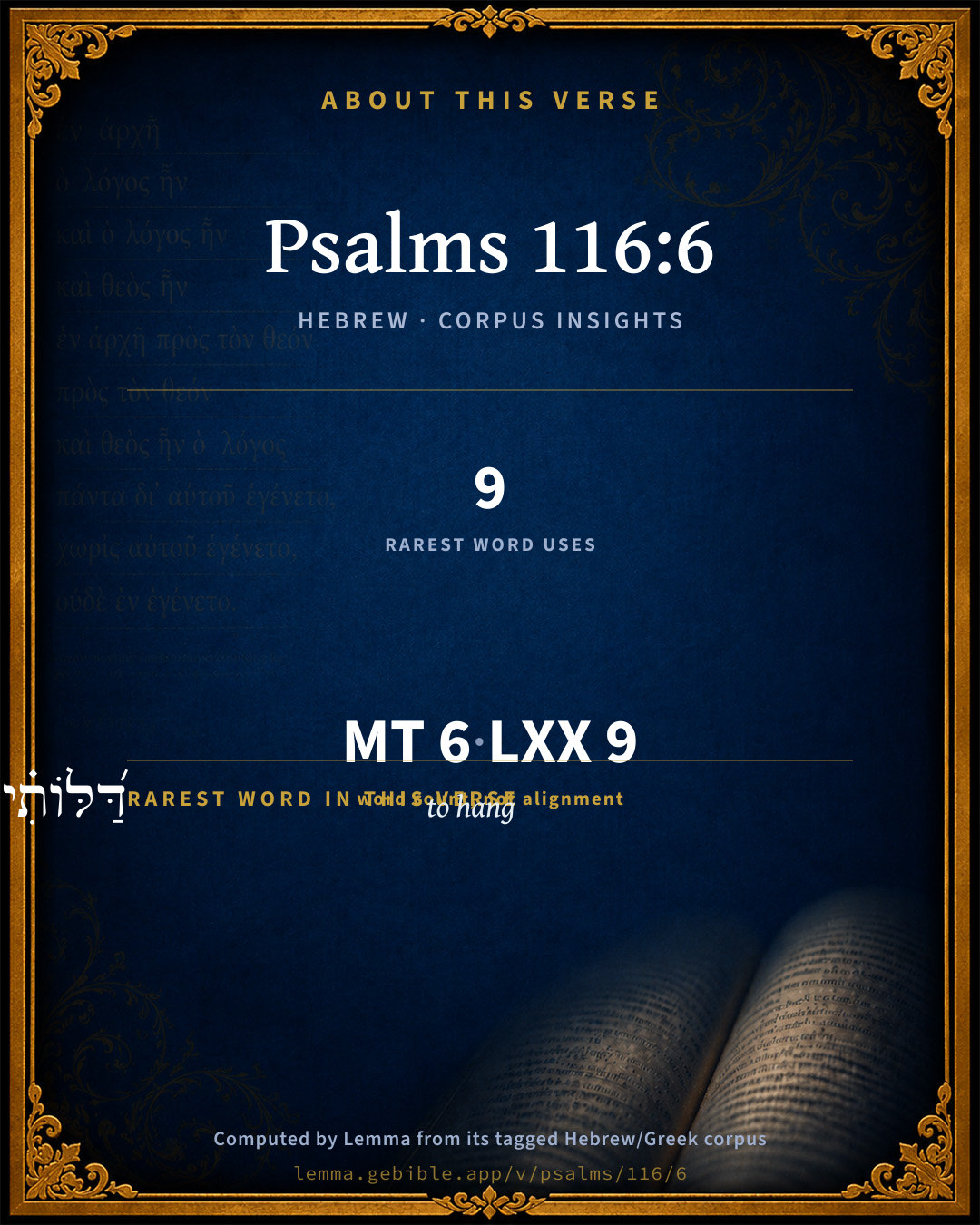
The rarest word here is דַּ֝לּוֹתִ֗י to hang H1809 — appearing just 9 times in the whole Hebrew Bible.

Shared distinctive vocabulary

דַּ֝לּוֹתִ֗י to hang H1809 occurs in 9 verses of the Hebrew Bible. Also found in:

Grammatical profile

  • 3 verbs
  • 2 nouns
  • 1 preposition

Verb forms

  • שֹׁמֵ֣ר Qal · Participle Active
  • דַּ֝לּוֹתִ֗י Qal · Perfect
  • יְהוֹשִֽׁיעַ Hiphil · Imperfect

Hebrew & Septuagint length

In English translation the verse runs 12 words from the Hebrew and 14 from the Septuagint (LXX English) — closely comparable.

A rough comparison of the two English renderings, which tokenize alike — not a word-level alignment.

Word counts can differ between the Hebrew and the Greek without any difference in meaning — e.g. the Hebrew direct-object marker אֵת has no separate Greek word, and Greek often adds the article ὁ.

In the original languages it is 6 Hebrew tokens and 9 Greek tokens — but the two are counted differently (Hebrew bundles its prefixes and suffixes into one token; the Greek is in lemma form), so that isn’t a like-for-like length.

Cross-references

11

Topical passages linked to Psalms 116:6 in the Treasury of Scripture Knowledge — connected by theme and wording, ordered by reader-vote popularity; previews shown in the World English Bible.

  • Psalms 19:7 Yahweh's law is perfect, restoring the soul. Yahweh's testimony is sure, making wise the simple.
  • Psalms 142:6 Listen to my cry, For I am in desperate need. Deliver me from my persecutors, For they are stronger than me.
  • Matthew 11:25 At that time, Jesus answered, "I thank you, Father, Lord of heaven and earth, that you hid these things from the wise and understanding, and revealed them to infants.
  • Psalms 79:8 Don't hold the iniquities of our forefathers against us. Let your tender mercies speedily meet us, For we are in desperate need.
  • Psalms 25:21 Let integrity and uprightness preserve me, For I wait for you.
  • Psalms 106:43 Many times he delivered them, But they were rebellious in their counsel, And were brought low in their iniquity.
  • Isaiah 35:8 A highway shall be there, and a way, and it shall be called The way of holiness. The unclean shall not pass over it, but is shall be for for him who walks in the Way. Wicked fools will not go there.
  • Romans 16:19 For your obedience has become known to all. I rejoice therefore over you. But I desire to have you wise in that which is good, but innocent in that which is evil.
  • 2 Corinthians 1:12 For our boasting is this: the testimony of our conscience, that in holiness and sincerity of God, not in fleshly wisdom but in the grace of God we behaved ourselves in the world, and more abundantly toward you.
  • 2 Corinthians 11:3 But I am afraid that somehow, as the serpent deceived Eve in his craftiness, so your minds might be corrupted from the simplicity that is in Christ.
  • Colossians 3:22 Servants, obey in all things those who are your masters according to the flesh, not just when they are looking, as men-pleasers, but in singleness of heart, fearing God.

Cross-references courtesy of OpenBible.info (CC BY 4.0).

Hebrew and Greek witnesses Masoretic Hebrew ↔ Greek Septuagint

The same verse in the two great witnesses to the Old Testament, shown verse-for-verse.

You’re reading Greek Psalm 114 (Hebrew Psalm 116). The Septuagint counts the superscription, so verse numbers can differ from the Hebrew — chapter-level alignment, not verse-by-verse. Numbering follows Rahlfs.

These are two independent witnesses, not word-aligned to each other, and the Septuagint is shown in lemma (dictionary) form.

Hebrew Psalms 116:6 Masoretic · Westminster Leningrad Codex

שֹׁמֵ֣ר פְּתָאיִ֣ם יְהֹוָ֑ה דַּ֝לּוֹתִ֗י וְלִ֣י יְהוֹשִֽׁיעַ

Yahweh preserves the simple. I was brought low, and he saved me.

World English Bible · Public Domain

Greek LXX Greek Psalm 114:6 Septuagint · lemma form

φυλάσσω ὁ νήπιος ὁ κύριος ταπεινόω καί σώζω ἐγώ

they have ears, but they can’t hear; they have noses, but they can’t smell;

LXX2012 (modern English Septuagint) · Public Domain

On this verse, Ellicott's Commentary for English Readers discusses the Septuagint’s reading. Read the note in Commentary ↓

Hebrew: Westminster Leningrad Codex (CC BY 4.0). Greek: Septuagint (public domain); English from LXX2012 (modern English Septuagint) (Public Domain). How the Septuagint differs from the Hebrew →

Commentary

Notes on Psalms 116:6 from classic Christian and Jewish commentators (each source and its license shown beneath its notes). The classic Christian expositions comment on the surrounding passage and are grouped to its opening verse, so a note may address several verses; the Jewish commentaries on the Tanakh (Rashi and others) are per-verse, so they appear only where the commentator wrote on this verse.

Lemma curates 59 commentaries, every one of them public domain or Creative Commons licensed, each selected and text-cleaned for this edition rather than reprinted as found. About our sources →

Trapp's Complete Commentary

John Trapp

Psa 116:6 The LORD preserveth the simple: I was brought low, and he helped me.

Ver. 6. The Lord preserveth, the simple] Heb. the persuasible (opposed to the scorner, Pro 19:25), the plain hearted (opposed to the guileful, 2Co 1:12; 2Co 11:3 Rom 16:19), the destitute of human help, that committeth himself to God, and patiently resteth on him for support and help, Psa 102:1-17.

I was brought low] Or, drawn dry; I was at a great under, at a low ebb; I was exhausted or emptied as a pond, strengthless, succourless, clean gone in a manner.

And he helped me] The knowledge that David had of God’s goodness was experimental. See the like Rom 8:2. A carnal man knoweth God’s excellencies and will revealed in his word only, as we know far countries by maps; but an experienced Christian, as one that hath himself been long there, 1Co 2:14-16.

John Trapp, A Commentary or Exposition upon All the Books of the Old and New Testament (1647–1656) — public domain. Text from a community e-Sword module.

The Biblical Illustrator

Joseph S. Exell

Psa_116:6

I was brought low and He helped me.

Gods method of helping

Thousands of times has this experience of the psalmist been repeated. It is the Divine method. Bring low and then help. Cast down and then lift up. There are some diseases of the human system which the skilful physician thus treats. He begins at once to deplete and bring down the patient, reducing him little by little till the unskilled observer trembles lest life itself will depart. But at the right moment when the disease has been expelled the restoratives are applied, and a new life enters into the system. And there is a rapid and healthy building up. Brought low he has been helped. So in all Gods gracious dealings with human souls, this is His method. Take the process in conversion. First comes the terrible conviction. The soul discovers depth after depth of the evil within it, till it seems as though its condition were absolutely hopeless. And when this process is complete, and the soul is thoroughly cast down, brought low, then the Infinite Helper stretches forth His hand. Then power from on high comes. And thus through all the stages of the Christian life. The soul is brought low, pride is humbled, lofty looks are brought down, and then the help comes. Was is not thus with poor sinning Peter? He had grown self-reliant. He could even boast of his resolution and firmness. But when the trial came he was weaker than weakness itself, and fell; terribly, disgracefully fell. He wept bitterly. But just when the humiliation was complete he was reinstated in his office, and commissioned to feed Christs sheep. He was brought low and he was helped. Ask the aged and experienced disciple of to-day how it had been with him in the long years of his pilgrimage. He will tell you that he has many times been laid low, even in the dust, and just then he has been helped. Divine help is neither welcomed nor appreciated till the soul is taught its need of it in the stern school of experience. The process may not be pleasant at the time, but an infallible, Physician superintends it. (Anon.)

The Biblical Illustrator, edited by Joseph S. Exell (c. 1880s–1900s) — public domain. Text from a community e-Sword module.

J. A. Alexander on Psalms

Joseph Addison Alexander

6. (Psa 116:6) A preserver of the simple (is) Jehovah; I was brought low, and to me he brought salvation. Here again the first word is an active participle, keeping the simple, i.e. habitually watching over them. For the mcaning of the simple, see above, on Psa 19:7. The word brought, twice used in translating this verse, has nothing distinctly corresponding to it in the Hebrew, but by a fortuitous coincidence, enters into two English phrases, by which the original verbs may best be represented. The verb translated brought low means to be reduced, in person, strength, or circumstances. See above, on Psa 79:8, and compare the cognate adjective in Psa 41:1. The other is the common Hebrew verb to save, here expressed by a circumlocution, for the purpose of retaining the original construction with the preposition to, which also occurs above, Psa 72:4; Psa 86:16.

Joseph Addison Alexander, The Psalms Translated and Explained (1850) — public domain. Text from a community e-Sword module.

Tyndale Open Study Notes

Tyndale Open Resources

116:6 People with childlike faith readily receive his wisdom and instruction (19:7-11; Matt 18:3-4).

Tyndale Open Study Notes — © Tyndale Open Resources, licensed CC BY-SA 4.0. Text via the HelloAO Bible API.

Adam Clarke's Commentary

Verse 6. The Lord preserved the simple] פתאים pethaim, which all the Versions render little ones. Those who are meek and lowly of heart, who feel the spirit of little children, these he preserves, as he does little children; and he mentions this circumstance, because the Lord has a peculiar regard for these young ones, and gives his angels charge concerning them. Were it otherwise, children are exposed to so many dangers and deaths, that most of them would fall victims to accidents in their infancy.

Adam Clarke's Commentary on the Bible (1810–1826) — public domain. Text from a community e-Sword/MySword module.

Ellicott's Commentary for English Readers

(6) The simple.—Inexperienced, in a good sense, as often in Proverbs. LXX. and Vulg., “babes.”

Brought low.—See Note, Psa_30:2.

A Bible Commentary for English Readers, edited by Charles John Ellicott (1878–1897) — public domain. Text from a community e-Sword module.

The Cambridge Bible for Schools and Colleges

gen. ed. J. J. S. Perowne

6. the simple] Those whose want of wisdom and experience exposes them to danger. Cp. Psa_19:7; Psa_119:130. LXX τὰ νήπια, babes; cp. Mat_11:25.

I was brought low] Cp. Psa_79:8; Psa_142:6.

and he helped me] R.V. saved. Cp. Psa_116:13.

The Cambridge Bible for Schools and Colleges (gen. ed. J. J. S. Perowne; Cambridge University Press, 1878–1918) — public domain. Text from a community e-Sword module.

John Gill's Exposition

The Lord preserveth the simple,.... Such as have but a small degree of understanding, either in things natural or spiritual, in comparison of others; babes, as the Septuagint, Vulgate Latin, Syriac, Arabic, and Ethiopic versions render it, so in the Talmud (i); see Mat 11:25. Such who are sensible of their lack of wisdom, and what they have they do not lean unto or trust in, but being sensible of their weakness commit themselves to the Lord; they are sincere and upright, harmless and inoffensive, artless and incautious, and so easily imposed upon by designing men; but the Lord preserves them, as from sin, from a total and final falling away by it, so from gross errors and heresies; he preserves them from the snares and pollutions of the world, and from the temptations of Satan, so as not to be overcome with them; he preserves them by his Spirit, power, and grace, safe to his kingdom and glory.

I was brought low and he helped me; the psalmist returns to his own case, and gives an instance of the divine goodness in himself; he had been brought low by affliction of body, by distress of enemies, through want of the necessaries and conveniences of life; he had been brought low as to spiritual things, through the weakness of grace, the prevalence of corruption, the temptations of Satan, and the hidings of God's face; but the Lord helped him to bear up under all this; he put underneath his everlasting arms, and upheld him with the right hand of his righteousness; he helped him out of his low estate, and delivered him out of all his troubles, when none else could; when things were at the greatest extremity, and he in the utmost distress, just ready to go down into silence and dwell there, Psa 94:17. The Targum is,

"he looked upon me to redeem me.''

(i) T. Bab. Sanhedrin, fol. 110. 2.

John Gill's Exposition of the Whole Bible (1746–1763) — public domain (CC PDM 1.0). Text via the HelloAO Bible API.

Albert Barnes' Notes on the Bible

The Lord preserveth the simple - The Septuagint renders this “babes” - νήπια nēpia. The Hebrew word has reference to simplicity or folly, as in Pro 1:22. It then refers to those who are the opposite of cautious or cunning; to those who are open to persuasion; to those who are easily enticed or seduced. The verb from which the word is derived - פתה pâthâh - means to open, to expand; then, to be open, frank, ingenuous, easily persuaded or enticed. Thus it may express either the idea of being simple in the sense of being foolish, easily seduced and led astray; or, simple in the sense of being open, frank, ingenuous, trustful, sincere. The latter is evidently its meaning here. It refers to one of the characteristics of true piety - that of unsuspecting trust in God. It would describe one who yields readily to truth and duty; one who has singleness of aim in the desire to honor God; one who is without guile, trick, or cunning. Such a man was Nathanael Joh 1:47 : “Behold an Israelite indeed, in whom is no guile.” The Hebrew word used here is rendered simple, Psa 19:7; Psa 119:130; Pro 1:4, Pro 1:22, Pro 1:32; Pro 7:7; Pro 8:5; Pro 9:4; Pro 14:15, Pro 14:18; Pro 19:25; Pro 21:11; Pro 22:3; Pro 27:12; Eze 45:20; and foolish, Pro 9:6. It does not elsewhere occur. The meaning here is, that the Lord preserves or keeps those who have simple and unwavering trust in him; those who are sincere in their professions; those who rely on his word.

I was brought low - By affliction and trial. The Hebrew literally means to hang down, to be pendulous, to swing, to wave - as a bucket in a well, or as the slender branches of the palm, the willow, etc. Then it means to be slack, feeble, weak, as in sickness, etc. See the notes at Psa 79:8. Here it probably refers to the prostration of strength by disease.

And he helped me - He gave me strength; he restored me.

Albert Barnes' Notes on the Bible (1834–1885) — public domain. Text from a community e-Sword/MySword module.

Matthew Poole's English Annotations

The simple; sincere and plain-hearted persons, who dare not use those frauds and crafty and wicked artifices in saving themselves or destroying their enemies, but wait upon God with honest hearts in his way and for his time of deliverance; which was the case of David, who, though he had the prospect and the promise of the kingdom, yet would not make haste to it by indirect courses, as by cutting off Saul, when he had great provocation and fair opportunity to do it; of which see 1Sa 24; 1Sa 26. Such persons he calls simple or foolish, as this word is commonly rendered, not because they are really so, but because the world esteems them so.

Matthew Poole's English Annotations on the Holy Bible (1683–1685) — public domain. Text from a community e-Sword/MySword module.

The Treasury of David

Charles H. Spurgeon

Ver. 6. The LORD preserveth the simple. Those who have a great deal of wit may take care of themselves. Those who have no worldly craft and subtlety and guile, but simply trust in God, and do the right, may depend upon it that God's care shall be over them. The worldly wise with all their prudence shall be taken in their own craftiness, but those who walk in their integrity with single minded truthfulness before God shall be protected against the wiles of their enemies, and enabled to outlive their foes. Though the saints are like sheep in the midst of wolves, and comparatively defenceless, yet there are more sheep in the world than wolves, and it is highly probable that the sheep will feed in safety when not a single wolf is left upon the face of the earth: even so the meek shall inherit the earth when the wicked shall be no more.

I was brought low, and he helped me, simple though I was, the Lord did not pass me by. Though reduced in circumstances, slandered in character, depressed in spirit, and sick in body, the Lord helped me. There are many ways in which the child of God may be brought low, but the help of God is as various as the need of his people: he supplies our necessities when impoverished, restores our character when maligned, raises up friends for us when deserted, comforts us when desponding, and heals our diseases when we are sick. There are thousands in the church of God at this time who can each one of them say for himself, "I was brought low, and he helped me." Whenever this can be said it should be said to the praise of the glory of his grace, and for the comforting of others who may pass through the like ordeal. Note how David after stating the general doctrine that the Lord preserveth the simple, proves and illustrates it from his own personal experience. The habit of taking home a general truth and testing the power of it in our own case is an exceedingly blessed one; it is the way in which the testimony of Christ is confirmed in us, and so we become witnesses unto the Lord our God.

Ver. 6. The Lord preserveth the simple. God taketh most care of them that, being otherwise least cared for, wholly depend on him. These are in a good sense simple ones; simple in the world's account, and simple in their own eyes. Such as he that said, "I am a worm, and no man; a reproach of men, and despised of the people." Ps 22:6. And again, "I am poor and needy, yet the Lord thinketh on me." Ps 40:17. These are those poor ones of a contrite spirit on whom the Lord looketh. Isa 66:2. Of such fatherless is God a father; and of such widows a judge. Read Ps 68:5, and Ps 146:7-9. Yea, read observantly the histories of the Gospel, and well weigh who they were to whom Christ in the days of his flesh afforded succour, and you shall find them to be such simple ones as are here intended.

By such objects the free grace and merciful mind of the Lord is best manifested. Their case being most miserable, in reference to human helps, the greater doth God's mercy appear to be; and since there is nothing in them to procure favour or succour from God, for in their own and others' eyes they are nothing, what God doth for them evidently appeareth to be freely done.

Behold here how of all others they who seem to have least cause to trust on God have most cause to trust on him. Simple persons, silly wretches, despicable fools in the world's account, who have not subtle brains, or crafty wits to search after indirect means, have, notwithstanding, enough to support them, in the grand fact that they are such as the Lord preserveth. Now, who knoweth not that "It is better to trust in the Lord, than to put confidence in man; it is better to trust in the Lord, than to put confidence in princes"? Ps 118:8-9. William Gouge.

Ver. 6. The Lord preserveth the simple. How delightful it is to be able to reflect on the character of God as preserving the soul. The word properly signifies to defend us at any season of danger. The Hebrew word which is translated "simple, "signifies one who has no control over himself, one that cannot resist the power and influence of those around, and one, therefore, subject to the greatest peril from which he has naturally no deliverance. "The Lord preserveth": his eye is upon them, his hand is over them, and they cannot fall. The word "simple" signifies likewise those that are ignorant of their condition, and not watching over their foes. Delightful thought, that though we may be thus ignorant, yet we are blessed with the means of escape! We may be simple to the last extent, and our simplicity may be such as to involve our mind in the greatest doubt: the Lord preserveth us, and let us rest in him. It is delightful to reflect, that it is the simple in whom the Lord delights, whom he loves to bless. We are sometimes especially in the condition in which we may be inclined to make the inquiry, how we may be saved. We suppose there are many truths to be apprehended, many principles to be realized before we can be saved. No; "the Lord preserveth the simple." We may be able to reconcile scarcely any of the doctrines of Christianity with each other; we may find ourselves in the greatest perplexity when we examine the evidences on which they rest; we may be exposed to great difficulty when we seek to apply them to practical usefulness; but still we may adopt the language before us: The LORD preserveth the simple: I was brought low, and he helped me. Return unto thy rest, O my soul. R. S. M'All, 1834.

Ver. 6. The LORD preserveth the simple. The term simple equals the "simplicity" of the New Testament, namely, that pure mind towards God, which, without looking out for help from any other quarter, and free from ali dissimulation, expects salvation from him alone. Augustus F. Tholuck.

Ver. 6. The simple. They are such as honestly keep the plain way of God's commandments, without those slights, or creeks of carnal policy, for which men are m the world esteemed wise; see Ge 25:27, where Jacob is called a plain man. Simple or foolish he calls them, because they are generally so esteemed amongst the wise of the world; not that they are so silly as they are esteemed; for if the Lord can judge of wisdom or folly, the only fool is the Atheist and profane person (Ps 14:1); the only wise man in the world is the plain, downright Christian (De 4:6), who keeps himself precisely in all states to that plain, honest course the Lord hath prescribed him. To such simple ones, God's fools, who in their misery and affliction keep them only to the means of deliverance and comfort which the Lord hath prescribed them, belongs this blessing of preservation from mischief, or destruction: so Solomon (Pr 16:17), "The highway of the upright is to depart from evil." "He that keepeth his way preserveth his soul"; see also Pr 19:16, 23; for exemplification see in Asa, 2Ch 14:9-12 16: 7-9, read the excellent speech of Hanani the seer. William Slater, 1638.

Ver. 6. I was brought low. By affliction and trial. The Hebrew literally means to hang down, to be pendulous, to swing, to waveas a bucket in a well, or as the slender branches of the palm, the willow, etc. Then it means to be slack, feeble, weak, as in sickness, etc. It probably refers to the prostration of strength by disease. And he helped me. He gave me strength; he restored me. Albert Barnes.

Ver. 6. I was brought low, and he helped me. The word translated "brought low, "ygtld a tld, properly signifieth to be drawn dry. The metaphor is taken from ponds, or brooks, or rivers that are clean exhausted and dried up, where water utterly faileth. Thus doth Isaiah use this word, "The brooks shall be emptied and dried up, " Isa 19:6, yray wkrhw wlld. Being applied to man, it setteth out such an one as is spent, utterly wasted, for, as we use to speak, clean gone, who hath no ability to help himself, no means of help, no hope of help from others.

The other word whereby the succour which God afforded is expressed, and translated "helped" eyvwhy ab evy, signifies such help as frees out of danger. It is usually translated "to save." William Gouge.

Ver. 6. I was brought low, and he helped me. Then is the time of help, when men are brought low: and therefore God who does all things in due time when I was brought low, then helped me. Wherefore, O my soul, let it never trouble thee how low soever thou be brought, for when thy state is at the lowest, then is God's assistance at the nearest. We may truly say, God's ways are not as the ways of the world; for in the world when a man is once brought low, he is commonly trampled upon, and nothing is heard then but, "down with him, down to the ground": but with God it is otherwise; for his delight is to raise up them that fall, and when they are brought low, then to help them. Hence it is no such hard case for a man to be brought low, may I not rather say his case is happy? For is it not better to be brought low, and have God to help him, than to be set aloft and left to help himself? At least, O my body, this may be a comfort to thee: for thou art sure to be brought low, as low as the grave, which is low indeed; yet there thou mayest rest in hope; for even there the Lord will not fail to help thee. Sir Richard Baker.

Ver. 6. He helped me. Helped me both to bear the worst and to hope the best; helped me to pray, else desire had failed helped me to wait, else faith had failed. Matthew Henry.

Ver. 6.

1. A singular class"simple."

2. A singular fact"the Lord preserveth the simple."

3. A singular proof of the fact"I was, "etc.

Psalms 116:7*

Charles H. Spurgeon's The Treasury of David (1869–1885) — public domain. Psalms only. Text from a community e-Sword/MySword module.

Whedon's Commentary on the Bible

Daniel D. Whedon

6. Simple—Not here such as want understanding. (as Pro_1:4; Pro_1:22,) but such as are of pure, unmixed, guileless hearts, to whom the promise is always due, (Psa_19:7; Psa_119:130;) the childlike spirit. Psa_8:2; Mat_11:25.

Brought low—Reduced to wretchedness, as in Psa_116:3; Jdg_6:6; Psa_79:8

Daniel D. Whedon (gen. ed.), Commentary on the Old and New Testaments (1874–1909) — public domain. Text from a community e-Sword module.

The Pulpit Commentary

The Lord preserveth the simple; i.e. "the simple-minded those who are without guile or artifice. (comp. Psa_19:7) I was brought low. The same verb is used here as in Isa_38:14, where it is translated "fail" ("mine eyes fail"). It expresses extreme weakness, or exhaustion. And he helped me; or, "saved me". (comp. Isa_38:20)

Simple as opposed to guileful.

"The Lord preserveth the simple." This is not the "simple" of the Book of Proverbs the young, inexperienced, susceptible souls, who are only too easily led astray. "Simple" hero rather means gentle, sincere, genuine, inoffensive, guileless, not ordering conduct by the subtlety of this world"s wisdom; this very simplicity, which lays them most readily open to attack, is in itself an appeal for God"s protection. Compare our Lord"s commendation of the passive graces in his Beatitudes, especially this, "Blessed are the poor in spirit.

I THE SIMPLE MAN LETS GOD WORK. "The Lord preserveth the simple." He has no confidence to make his own plans; he waits to know and fit in with God"s plans for him. This may seem weakness; and it sometimes is weakness. But it need not be. It should only be the simplicity of the child-spirit, which depends on the father, and has the fullest confidence in the fatherly wisdom and ways. He has no confidence in his own working out of the plan. So he leans on Divine help continually, ever saying, "What I know not, that teach thou me;" "Hold thou me up, and I shall be safe," This, too, may seem to be weakness, but it is not; it is only man meeting fully the conditions of his being, for man is as a climbing plant, only strong and able to attain his best when he leans upon the strong. It is the problem of life, and the simple man most easily solves it How can humanity reach its best? The simple man says, "By being always open to God"s working in us.

II THE GUILEFUL MAN DOES HIS OWN WORK. He is quite satisfied with his own plans. They are such as will bring the best possible to himself. He has an eye to the "main chance" always, and means to secure it straightforwardly if he can, otherwise if he cannot. And he is quite satisfied with his resources. There is nothing that he cannot do, or thinks he cannot do. Life is to him the sphere in which things have to yield to his wishes. The guileful man has no particular need of God, and, indeed, he sometimes finds him in his way, and so is aroused to an active antagonism. "God is not in all his thoughts." There is no place in him for humility self-confidence fills all the space. There is no call to prayer, for he wants no help. He is sufficient unto himself, or thinks he is. The guileful man will not have it that he is a dependent creature.

III THE GUILEFUL MAN REACHES PRESENT RESULTS; THE SIMPLE MAN REACHES ABIDING RESULTS. This is precisely the difference which having God makes. With out him there is nothing that abideth. With him everything worth having abideth forever. R.T.

The Pulpit Commentary (1880–1919), ed. H.D.M. Spence-Jones & Joseph S. Exell — public domain. Text from a community e-Sword module.

Lesson kit

Teaching starters — assembled from the data on this page, not authored interpretation. Every prompt links to the verse data it draws on. Edit before teaching.

Psalms, in the Wisdom, opens this verse with 6 words (5 distinct Hebrew lemmas). Its most distinctive word is dâlal (“to hang”). A historical commentator’s framing appears above. Read the whole chapter for the surrounding context.

Discussion questions

  1. How does “to hang” (dâlal) shape what this verse is saying?
  2. Judges 6:6 shares the word «to hang» with this verse. How do the two illuminate each other?
  3. The translations on this page render this verse differently — a whole-verse word diff, not a word-by-word alignment. What might account for the different wordings?
  4. The verb «שֹׁמֵ֣ר» is Qal Participle Active. How does its form color the action?
  5. Reading how Trapp's Complete Commentary and The Biblical Illustrator read this verse, where do the two commentators agree and where do they part?

Things to notice

Reading settings

Reading text

Shown beneath each verse's original-language words.

Old Testament
Old Testament edition

Read the OT as the Masoretic Hebrew (MT) or the Greek Septuagint (LXX).

English shown for the Greek Septuagint (in the Hebrew ↔ Greek comparison).

Comparing translations? Open the Compare panel on any verse page to stack up to four side by side.