Judges 3:31

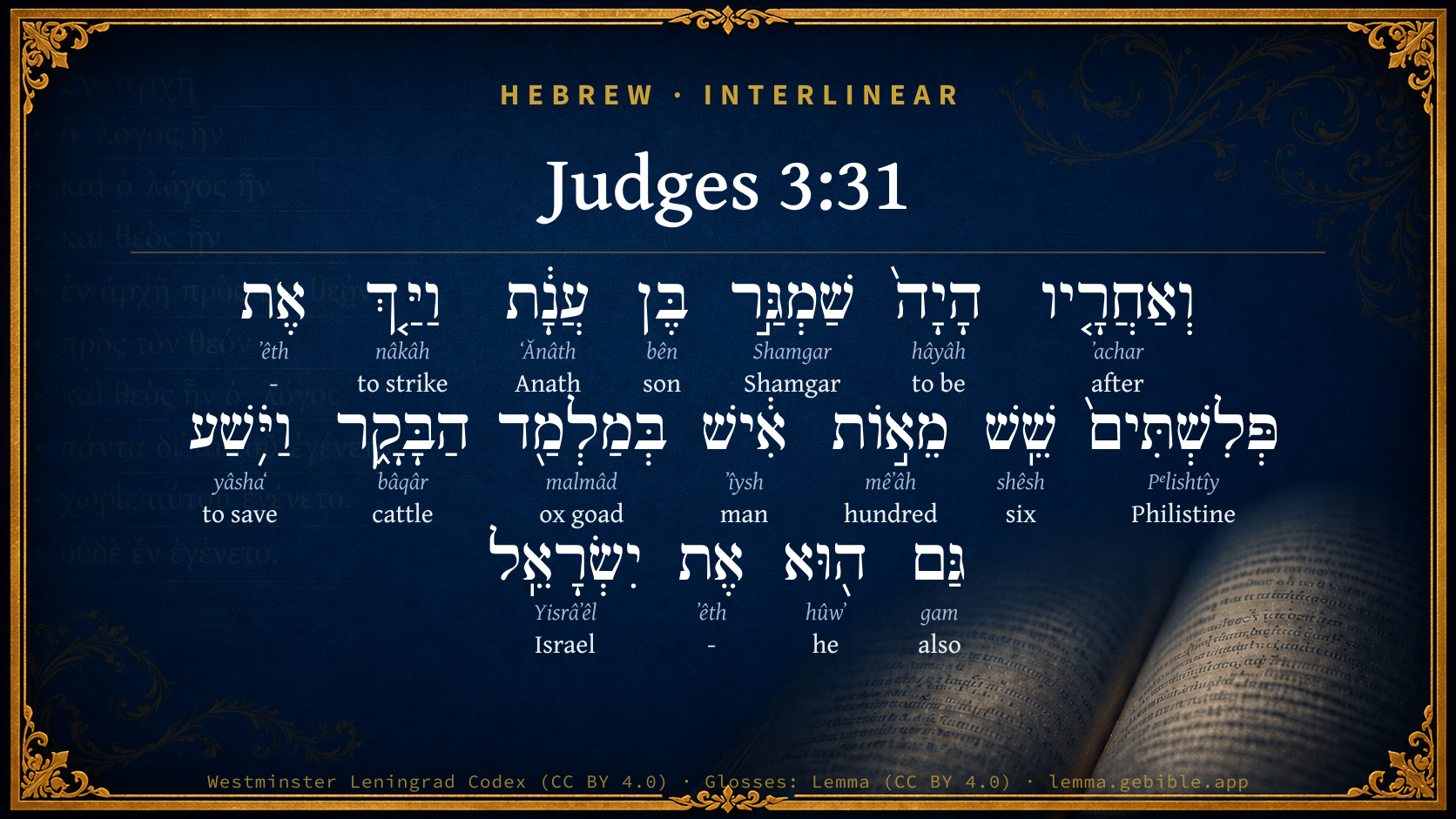
Hebrew (Westminster Leningrad Codex) Judges 3:31 appears in the Hebrew Old Testament. The text above is from the Westminster Leningrad Codex. Each word links to its Strong’s number, a concise gloss, and parsing drawn from the Open Scriptures Hebrew Bible morphology. Click any word for its full Brown-Driver-Briggs (BDB) entry.
Download image
Cite this verse

Judges 3:31 (World English Bible). Public Domain. Lemma interlinear Bible study tool, https://lemma.gebible.app/v/judges/3/31.

Show BibTeX & RIS
BibTeX
RIS
English Translation
After him was Shamgar the son of Anath, who struck of the Philistines six hundred men with an ox-goad: and he also saved Israel.
World English Bible · Public Domain
Highlights Full analysis ↓
Download a study sheet

One document with this verse’s original text, its word-by-word gloss line, the meaning frame, cross-references with their text, attributed commentary, and full source and license credits — printable, and it pastes into notes with its structure intact.

This verse Autodidact and up

Study sheet (.html) Plain text (.txt)

A passage Seminary Student

Up to 50 verses in one chapter. A passage sheet keeps up to 6 commentary sources and 12 cross-references per verse, in the order this page ranks them, and says so on the sheet whenever that leaves anything out. Ask for a single verse and you get the Autodidact verse sheet above.

Everything on this page stays free to read, with no account — the sheet is a download of what is already on screen, not access to it.

Want to remove ads? Support Godless Engineer
Compare translations 3

The same verse in 3 English versions, stacked beneath the original-language interlinear above. Click any original word for its lexicon entry.

Each is an independent rendering of the whole verse — the interlinear is not word-aligned to these translations.

Highlighted words mark where these versions differ — a whole-verse word diff, not a word-by-word alignment.

  • World English Bible Public Domain
    After him was Shamgar the son of Anath, who struck of the Philistines six hundred men with an ox-goad: and he also saved Israel.
  • King James Version Public Domain
    And after him was Shamgar the son of Anath, which slew of the Philistines six hundred men with an ox goad: and he also delivered Israel.
  • unfoldingWord Literal Text CC BY-SA 4.0
    After him was Shamgar, the son of Anath, and he struck Philistines, 600 men, with a goad of the ox. So he also saved Israel.

unfoldingWord Literal Text — © unfoldingWord, licensed CC BY-SA 4.0. Word-aligned USFM3 via Door43 (git.door43.org/unfoldingWord/en_ult).

Versions to compare (up to 4)

3 of 4 selected

Show all 18 translations

Every available English version of this verse, each an independent rendering of the whole verse.

  • World English Bible Public Domain
    After him was Shamgar the son of Anath, who struck of the Philistines six hundred men with an ox-goad: and he also saved Israel.
  • Berean Standard Bible Public Domain
    After Ehud came Shamgar son of Anath. And he too saved Israel, striking down six hundred Philistines with an oxgoad.
  • Majority Standard Bible Public Domain
    After Ehud came Shamgar son of Anath. And he too saved Israel, striking down six hundred Philistines with an oxgoad.
  • King James Version Public Domain
    And after him was Shamgar the son of Anath, which slew of the Philistines six hundred men with an ox goad: and he also delivered Israel.
  • American Standard Version (1901) Public Domain
    And after him was Shamgar the son of Anath, who smote of the Philistines six hundred men with an ox-goad: and he also saved Israel.
  • Revised Version (1885) Public Domain
    And after him was Shamgar the son of Anath, which smote of the Philistines six hundred men with an ox goad: and he also saved Israel.
  • Geneva Bible (1599) Public Domain
    And after him was Shamgar the sonne of Anath, which slewe of the Philistims sixe hundreth men with an oxe goade, and he also deliuered Israel.
  • Douay-Rheims (1899) Public Domain
    After him was Samgar the son of Anath, who slew of the Philistines six hundred men with a ploughshare: and he also defended Israel.
  • Young's Literal Translation Public Domain
    And after him hath been Shamgar son of Anath, and he smiteth the Philistines -- six hundred men -- with an ox-goad, and he saveth -- he also -- Israel.
  • Literal Standard Version CC BY-SA 4.0
    And after him has been Shamgar son of Anath, and he strikes the Philistines—six hundred men—with an ox-goad, and he also saves Israel.
  • Unlocked Literal Bible CC BY-SA 4.0
    After Ehud the next judge was Shamgar son of Anath who killed 600 men of the Philistines with a stick used to goad cattle. He also delivered Israel from danger.
  • unfoldingWord Literal Text CC BY-SA 4.0
    After him was Shamgar, the son of Anath, and he struck Philistines, 600 men, with a goad of the ox. So he also saved Israel.
  • Darby Bible Public Domain
    After him was Shamgar the son of Anath, who killed six hundred of the Philistines with an oxgoad; and he too delivered Israel.
  • World Messianic Bible Public Domain
    After him was Shamgar the son of Anath, who struck six hundred men of the Philistines with an ox goad. He also saved Israel.
  • Webster's Bible Public Domain
    And after him was Shamgar the son of Anath, who slew of the Philistines six hundred men with an ox-goad; and he also delivered Israel.
  • Free Bible Version CC BY-SA 4.0
    After Ehud was Shamgar, son of Anath, who killed six hundred Philistines with an oxgoad. He also rescued Israel.
  • Bible in Basic English Public Domain
    And after him came Shamgar, the son of Anath, who put to death six hundred Philistines with an ox-stick; and he was another saviour of Israel.
  • JPS Tanakh (1917) Public Domain
    And after him was Shamgar the son of Anath, who smote of the Philistines six hundred men with an ox-goad; and he also saved Israel.

Literal Standard Version (2020), Covenant Press — licensed CC BY-SA 4.0. Text via the HelloAO Bible API (eBible.org). Unlocked Literal Bible (unfoldingWord) — licensed CC BY-SA 4.0. Text via the HelloAO Bible API (eBible.org). unfoldingWord Literal Text — © unfoldingWord, licensed CC BY-SA 4.0. Word-aligned USFM3 via Door43 (git.door43.org/unfoldingWord/en_ult). Free Bible Version, Dr. Jonathan Gallagher — licensed CC BY-SA 4.0. Text via the HelloAO Bible API (eBible.org).

Word by word

More ways to search: Search by grammar → Find every occurrence → Compare this word →

Practice this passage: Drill this verse → Learn its vocabulary →

בְּמַלְמַ֖ד
malmâd
H4451
“in/at · ox goad of”
Preposition + Noun, Common, Masculine, Singular, Construct
Part of Speech
Preposition + Noun
Type
Common
Gender
Masculine
Number
Singular
State
Construct
Full BDB Definition

Origin: from H3925

TWOT: 1116b

ox goad
  1. וְאַחֲרָ֤יו ʼachar H310 “and · after · him” Conjunction + Preposition + Suffix, Personal, 3rd Person, Masculine, Singular
  2. הָיָה֙ hâyâh H1961 “to be” Verb, Qal, Perfect, 3rd Person, Masculine, Singular
  3. שַׁמְגַּ֣ר Shamgar H8044 “Shamgar” Noun, Proper
  4. בֶּן bên H1121 “son of” Noun, Common, Masculine, Singular, Construct
  5. עֲנָ֔ת ʻĂnâth H6067 “Anath” Noun, Proper
  6. וַיַּ֤ךְ nâkâh H5221 “and · to strike” Conjunction + Verb, Hiphil, Sequential Imperfect, 3rd Person, Masculine, Singular
  7. אֶת ʼêth H853 “-” Particle, Direct Object
  8. פְּלִשְׁתִּים֙ Pᵉlishtîy H6430 “Philistines” Noun, Gentilic, Masculine, Plural, Absolute
  9. שֵֽׁשׁ shêsh H8337 “six” Adjective, Cardinal number, Feminine, Singular, Absolute
  10. מֵא֣וֹת mêʼâh H3967 “hundred” Adjective, Cardinal number, Both, Plural, Absolute
  11. אִ֔ישׁ ʼîysh H376 “man” Noun, Common, Masculine, Singular, Absolute
  12. הַבָּקָ֑ר bâqâr H1241 “the · cattle” Particle, Definite Article + Noun, Common, Both, Singular, Absolute
  13. וַיֹּ֥שַׁע yâshaʻ H3467 “and · to save” Conjunction + Verb, Hiphil, Sequential Imperfect, 3rd Person, Masculine, Singular
  14. גַּם gam H1571 “also” Particle, Accusative
  15. ה֖וּא hûwʼ H1931 “he” Pronoun, Personal, 3rd Person, Masculine, Singular
  16. אֶת ʼêth H853 “-” Particle, Direct Object
  17. יִשְׂרָאֵֽל Yisrâʼêl H3478 “Israel” Noun, Proper

About this verse

These counts appear in no published source. They are computed here, from the morphology-tagged text and Lemma’s own curated glosses. What Lemma adds →

18
words
17
distinct lemmas
Historical
section

Notable vocabulary

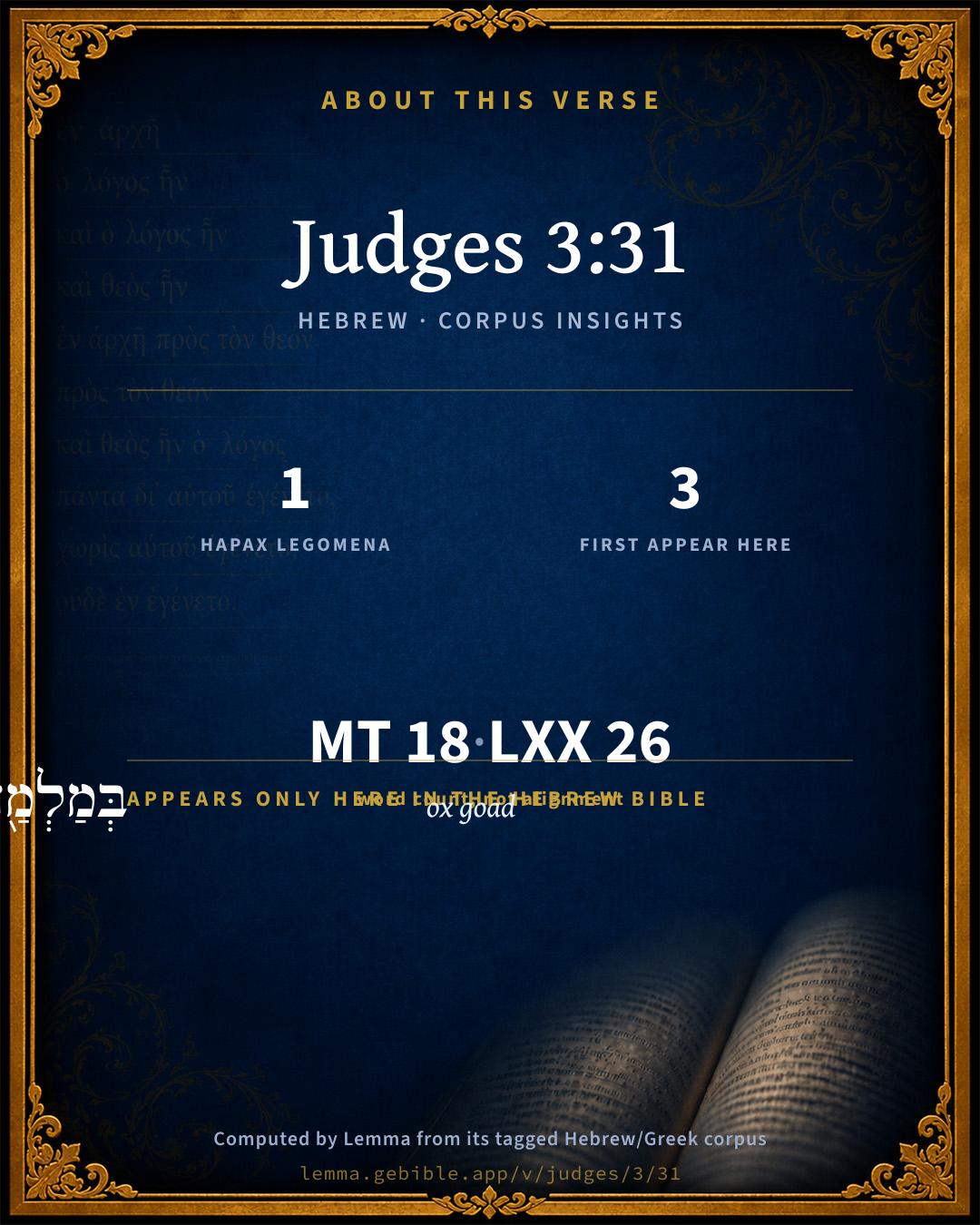
1 hapax legomenon — a word that appears only here in the entire Hebrew Bible:

  • בְּמַלְמַ֖ד ox goad H4451

First appearance in Scripture

These words make their first canonical appearance in the Hebrew Bible here:

  • שַׁמְגַּ֣ר Shamgar H8044
  • עֲנָ֔ת Anath H6067
  • בְּמַלְמַ֖ד ox goad H4451

Shared distinctive vocabulary

שַׁמְגַּ֣ר Shamgar H8044 occurs in 2 verses of the Hebrew Bible. Also found in:

Grammatical profile

  • 3 verbs
  • 8 nouns
  • 2 adjectives
  • 1 pronoun
  • 1 preposition
  • 3 particles

Verb forms

  • הָיָה֙ Qal · Perfect
  • וַיַּ֤ךְ Hiphil · Sequential Imperfect
  • וַיֹּ֥שַׁע Hiphil · Sequential Imperfect

Hebrew & Septuagint length

In English translation the verse runs 24 words from the Hebrew and 35 from the Septuagint (LXX English) — the Septuagint runs noticeably longer here. See the side-by-side →

A rough comparison of the two English renderings, which tokenize alike — not a word-level alignment.

Word counts can differ between the Hebrew and the Greek without any difference in meaning — e.g. the Hebrew direct-object marker אֵת has no separate Greek word, and Greek often adds the article ὁ.

In the original languages it is 18 Hebrew tokens and 26 Greek tokens — but the two are counted differently (Hebrew bundles its prefixes and suffixes into one token; the Greek is in lemma form), so that isn’t a like-for-like length.

Cross-references

14

Topical passages linked to Judges 3:31 in the Treasury of Scripture Knowledge — connected by theme and wording, ordered by reader-vote popularity; previews shown in the World English Bible.

  • Judges 5:6 In the days of Shamgar the son of Anath, In the days of Jael, the highways were unoccupied, The travelers walked through byways.
  • 1 Samuel 17:47 and that all this assembly may know that Yahweh doesn't save with sword and spear: for the battle is Yahweh's, and he will give you into our hand.
  • 1 Samuel 17:50 So David prevailed over the Philistine with a sling and with a stone, and struck the Philistine, and killed him; but there was no sword in the hand of David.
  • 1 Corinthians 1:17 For Christ sent me not to baptize, but to preach the Gospel--not in wisdom of words, so that the cross of Christ wouldn't be made void.
  • Judges 2:16 Yahweh raised up judges, who saved them out of the hand of those who despoiled them.
  • Judges 5:8 They chose new gods; Then was war in the gates: Was there a shield or spear seen Among forty thousand in Israel?
  • Judges 15:15 He found a fresh jawbone of a donkey, and put forth his hand, and took it, and struck a thousand men therewith.
  • 1 Samuel 13:19–22 Now there was no smith found throughout all the land of Israel; for the Philistines said, Lest the Hebrews make them swords or spears:
  • Judges 4:1 The children of Israel again did that which was evil in the sight of Yahweh, when Ehud was dead.
  • Judges 4:3–24 The children of Israel cried to Yahweh: for he had nine hundred chariots of iron; and twenty years he mightily oppressed the children of Israel.
  • Judges 10:7 The anger of Yahweh was kindled against Israel, and he sold them into the hand of the Philistines, and into the hand of the children of Ammon.
  • Judges 10:17 Then the children of Ammon were gathered together, and encamped in Gilead. The children of Israel assembled themselves together, and encamped in Mizpah.
  • Judges 11:4–33 It happened after a while, that the children of Ammon made war against Israel.
  • 1 Samuel 4:1 The word of Samuel came to all Israel. Now Israel went out against the Philistines to battle, and encamped beside Ebenezer: and the Philistines encamped in Aphek.

Cross-references courtesy of OpenBible.info (CC BY 4.0).

Hebrew and Greek witnesses Masoretic Hebrew ↔ Greek Septuagint

The same verse in the two great witnesses to the Old Testament, shown verse-for-verse.

Here the Septuagint runs noticeably longer than the Hebrew — LXX2012 (modern English Septuagint) 35 words vs World English Bible 24. A rough length comparison of the two English translations, not a word-level alignment — read both below.

These are two independent witnesses, not word-aligned to each other, and the Septuagint is shown in lemma (dictionary) form.

Hebrew Judges 3:31 Masoretic · Westminster Leningrad Codex

וְאַחֲרָ֤יו הָיָה֙ שַׁמְגַּ֣ר בֶּן עֲנָ֔ת וַיַּ֤ךְ אֶת פְּלִשְׁתִּים֙ שֵֽׁשׁ מֵא֣וֹת אִ֔ישׁ בְּמַלְמַ֖ד הַבָּקָ֑ר וַיֹּ֥שַׁע גַּם ה֖וּא אֶת יִשְׂרָאֵֽל

After him was Shamgar the son of Anath, who struck of the Philistines six hundred men with an ox-goad: and he also saved Israel.

World English Bible · Public Domain

Greek LXX Judges 3:31 Septuagint · lemma form

καί μετά αὐτός ἀναἵστημι σαμεγαρ υἱός διναχ καί πατάσσω ὁ ἀλλόφυλος εἰς ἑξακόσιοι ἀνήρ ἐν ὁ ἀροτρόπους ὁ βοῦς καί σώζω καί γέ αὐτός ὁ ἰσραήλ

And after him rose up Samegar the son of Dinach, and struck the Philistines to the number of six hundred men with a plowshare such as is drawn by oxen; and he too delivered Israel.

LXX2012 (modern English Septuagint) · Public Domain

On this verse, Whedon's Commentary on the Bible discusses the Septuagint’s reading. Read the note in Commentary ↓

Hebrew: Westminster Leningrad Codex (CC BY 4.0). Greek: Septuagint (public domain); English from LXX2012 (modern English Septuagint) (Public Domain). How the Septuagint differs from the Hebrew →

Targum (Aramaic paraphrase)

1

The Targum is the ancient Jewish Aramaic paraphrase of the Hebrew Scriptures — an interpretive translation, not the Hebrew text itself. Onkelos (literal) and Pseudo-Jonathan (expansive) render the Torah, and Jonathan the Prophets. Coverage is partial: where no permissively-licensed English translation exists for a verse, only the Aramaic is shown. This is verse-level text, not a word-by-word alignment to the Hebrew.

  1. Targum Jonathan Prophets (Joshua–Malachi)
    וּבַתְרוֹהִי הֲוָה שַׁמְגַר בַּר עֲנָת וּקְטַל יַת פְּלִשְׁתָּאֵי שִׁית מְאָה גַבְרִין בִּפְרַשׁ תּוֹרַיָא וּפְרַק אַף הוּא יַת יִשְׂרָאֵל:

    (no public-domain English translation for this verse)

    Targum Jonathan — Aramaic: “Mikraot Gedolot” (public domain). English: “Sefaria Community Translation” (CC0 1.0 (public-domain dedication)); “London "Chaldee Paraphrase," 1871” (public domain). Text via Sefaria.

Commentary

Notes on Judges 3:31 from classic Christian and Jewish commentators (each source and its license shown beneath its notes). The classic Christian expositions comment on the surrounding passage and are grouped to its opening verse, so a note may address several verses; the Jewish commentaries on the Tanakh (Rashi and others) are per-verse, so they appear only where the commentator wrote on this verse.

Lemma curates 59 commentaries, every one of them public domain or Creative Commons licensed, each selected and text-cleaned for this edition rather than reprinted as found. About our sources →

Trapp's Complete Commentary

John Trapp

Jdg 3:31 And after him was Shamgar the son of Anath, which slew of the Philistines six hundred men with an ox goad: and he also delivered Israel.

Ver. 31. And after him was Shamgar.] Who if he were not Judex, yet surely he was Vindex, renowned for this one thing only, that he slew so many of the enemy with so mean a weapon. Samson did the like with the jaw bone of an ass. What cannot the Lord do when his will is that his people shall be helped with a little help, {Dan 11:34} that through weaker means they may see God’s greater strength

John Trapp, A Commentary or Exposition upon All the Books of the Old and New Testament (1647–1656) — public domain. Text from a community e-Sword module.

The Biblical Illustrator

Joseph S. Exell

Jdg_3:31

Shamgar the son of Anath.

Shamgar

This is one of the most singular and astonishing battles in the history of the world. If Shamgar had been stationed in some Thermopylae, where the foe could only come one or two at a time it would not have been so wonderful; but he was in the open field, literally surrounded by six hundred desperadoes, bent on plunder and death. It gives us some idea of what pluck can do for a man when fired with the love of home and country. To my mind, there is something wonderful, almost miraculous, in this strange battle and unparalleled victory. I wonder, first of all, how he could muster courage to face so many, and how he escaped when surrounded by such a multitude. I wonder also, that when the Philistines saw that they were being slaughtered at every blow, and that they had no power to injure their mysterious antagonist, that they fought on and stood their ground until the last man was slain. It only shows that men may have courage in fighting on the side of evil without a particle of truth or righteousness to inspire them; that they will sacrifice their lives on the altar of a bad cause as well as a good one.

I. Men determine their future by the manner in which they meet the duties and provocations of the present. God never selects a lazy, idle man, when He is going to choose a person to do some noble work. He promotes none but busy men. Shamgar was ploughing when the Philistines came upon him. It speaks well for him that he had heart to plough at such a time, for the whole country was thrown into great fear and discouragement. Few men, I am inclined to think, had courage enough just then to plough. Such men are an inspiration and a blessing to any community. So far as we can ascertain, Shamgar was an humble labouring man. Yet his heroic conduct on this occasion brought him into notice, and raised him to be one of the judges of Israel. The world is looking for men who can bring things to pass. Noble deeds are the stairway leading to greatness and honour. If you would be trusted, first learn to be honest; if you would rule, first learn how to obey; if you would rise to a more important position, fill the place where you are to overflowing with yourself, and God will soon beckon you to a wider sphere.

II. In the absence of success, it is poor logic to throw the blame on our instruments or surroundings. The workman is more than his tools. The spirit and skill of the worker tower above his surroundings, and give value and significance to the instruments he wields. Shamgar fought this battle with an ox goad. However discouraging your circumstances, if you give yourself fully to God, and walk in the full honours of uprightness before Him, the great Captain of our salvation will not only give you blessed foretastes of the rest that remaineth for the people of God, but He will also enable you to cut your way to victory through all the spiritual Philistines that may confront you, even though your instruments may be as insignificant as those of Shamgar.

III. In our life work we should be natural, and use the instruments we know best how to handle. Shamgar fought with the ex-goad. He knew so well how to handle it that, at close range, it was a terrible weapon to come in contact with. He could kill more men with it in a crowd than with sword or musket. He knew the spring and feel of it so perfectly that every stroke brought two or three Philistines to the ground. What we want in order to our greatest possible efficiency is, not somebody elses way of doing things, but our own, trained and sanctified by the grace of God. No two persons are exactly alike; and so there are phases of work which each individual is constitutionally fitted to do which no other person can ever do quite as well.

IV. New instrumentalities should not be condemned simply because they are new and out of the regular order, but should be judged and valued according to their results. As a weapon of destruction the ox goad was unknown up to this time; but, judged of by its results, it was worthy of high appreciation. It may be that, in the past, the Church has been a little too conservative in the matter of new agency; that she has been too much inclined to condemn any agency that was not officially sanctioned or technically approved. There is nothing that carries conviction like the logic of facts, and nothing succeeds like success. Think of one man against six hundred, with nothing in his hands but an ox goad. You may not be as well qualified for the work as some others; but still God has a work for you to do, and He will help you to do it if you do your best and trust Him. It may be that your sphere is humble and obscure, but you can live a noble life and do grand work in obscurity. Some of the greatest evangelists of our own day teach us two lessons--

1. That sanctified individuality is the condition of usefulness and the great want of the times.

2. That the vast majority of Christians have talent enough to become each a mighty power, in the hands of God, to hasten the millennial glory of the future. (T. Kelly.)

A man for the time

From this let all true patriots take heart--with the hour and the peril comes the man required.

I. The apparent incompatibility and insufficiency of the deliverer and his weapon. A herdman carrying a goad, an ugly implement some eight or ten feet long, and shod with iron. Uncouth, without such military training as the science of the times could give, destitute of such arms as the Philistines would be likely to fear. He could only be looked upon as an improvised leader with an extemporised armament. Opposed to him was a host led by hereditary chieftains. Now, as ever, the Philistine opponents of Christ and the truth grin inanely at the rabble rout, as they deem the Lords host to be. They sneer at the Word, albeit they bear many scars inflicted by that old Damascene blade. They laugh at the praying, the preaching, and the labour of the unlearned and ignorant men whom the Lord has called to do His work.

II. The triumphant efficacy of both. Shamgars generalship, strong arm, awful ox-goad, proved to be no laughing matters. The soul of a patriot, the genius of a leader, the skill of a strategist, were all in him. Neither devil, lords, nor army had much time to sneer when Shamgar reached them. They had mistaken the man, the instrument, and the God behind all. History repeats and spiritualises itself. For, we ask, in what is the augury, whence is the success of our Christian warfare, waged against the enemies of God and man? In numbers, literary efficiency, dialectical skill, scientific theology? Not so; Satan can beat us out of the field in every one of these. He is constantly doing it. Not all the drum-beating, banner-waving, and shouting of our conferences and demonstrations ever frighten him. But his doom is sealed when a Christ-filled Shamgar leads. That man who on his knees pleads and waits to know, Lord, what wilt Thou have me to do?--such are the men we want, the men we should pray for, the men we ought to be. The fact that we are Christians should be a certificate that we are surrendered, Christ-filled men, or our profession is a lie. Would that all were so. Oh, that all may become so! Whatever the sacrifice involved, there is no more happy life, and, at its close, can be no more glorious epitaph than he saved Israel! (James Dann.)

Shamgar: mean instruments

1. How absurd it is for any man to blame his tools for bad work. Shamgar used an ox-goad; Samson wielded the jawbone of an ass; David had but a sling and stone. Some times we think what wonders we could do if we had better instruments.

2. How important it is that men should use those instruments which they can handle most skilfully. Shamgar knew how to use the ox-goad, and David knew how to use the sling and stone.

3. How foolish it would be to ridicule the instruments when the results are so obviously good. Look at the six hundred dead men! Look at the slain giant! Look at the prostrate walls of Jericho! The rule applies to every department of life. It applies to preaching. It applies to foreign missions. It applies to every Christian effort.

4. How victories are sometimes won in the face of the greatest improbabilities. One man against six hundred! Some men would have succumbed under the mere pressure of numbers, but Shamgar fought the crowd. Do not let us blame men for working with instruments that have not been officially or technically approved. The one great object is to do good. What meaner instrument can there be than the Cross? (J. Parker, D. D.)

Shamgars ox-goad

Shamgar considered not whether he was equipped for attacking Philistines, but turned on them from the plough, his blood leaping in him with swift indignation. The instrument of his assault was not made for the use to which it was put: the power lay in the arm that wielded the goad and the fearless will of the man who struck for his own birthright, freedom--for Israels birth right, to be the servant of no other race. Undoubtedly it is well that in any efforts made for the Church or for society men should consider how they are to act, and should furnish themselves in the best manner for the work that is to be done. No outfit of knowledge, skill, experience, is to be despised. A man does not serve the world better in ignorance than in learning, in bluntness than in refinement. But the serious danger for such an age as our own is that strength may be frittered away and zeal expended in the mere preparation of weapons, in the mere exercise before the war begins. The important points at issue are apt to be lost sight of, and the vital distinctions on which the whole battle turns to fade away in an atmosphere of compromise. (R. A. Watson, M. A.)

Shamgars ox-goad

The ox-goad was not much; but Shamgar with the ox-goad, that was the sight to see. Perhaps you cannot work the ox-goad. It fitted Shamgar, and he fitted it; but, after all, it was the man. It is the man. I read Wesleys sermons--those sermons that routed the Philistines of a hundred years ago, and delivered Israel over all this England; I read those sermons of Wesley and Whitefield, and, I say, what is in them? You would be tired of them from me. Why? You see the obvious answer. You look at that ox-goad and say, There is not much in that; neither is there. It was the man, and God in the man. One was taken to see a famous sword that had belonged to a famous swordsman, and when he saw it he said, I do not see much in that sword, and there came the obvious answer, No, but you should have seen the arm that wielded it. Shamgars hand grew into the hilt of that ox-goad, and it became part of him. The ox-goad and Shamgar, again, became part of the arm of the Lord God Almighty. That was all in it, and that may be in you and me, God taking our individuality and consecrating it and using it for His eternal glory. Now, be yourself, whether you be at the plough or at the desk; God can do His work with the ox-goad; He can do it with the pen; He can do it with anything if it lies near His hand. And, last of all, what honourable mention this ploughman gets: He also delivered Israel. Why, the mighty Joshua did no more! (John McNeill.)

Great results with imperfect tools

Many of the discoveries in astronomy, chemistry, mathematics, navigation, and science generally, were made with very imperfect instruments. Dr. Valentine Motts remarkable surgical skill is the more honourable because of his comparatively poor instruments. True genius shows itself in accomplishing grand results with imperfect tools. Rittenhouse, whose name is a synonym for marvellous scientific attainments, worked in boyhood on his fathers farm, and calculated eclipses on plough-handles and fences; and, although studying alone, made himself master of Newtons Principia, and discovered for himself the method of fluxions when in his nineteenth year. It is little wonder that when he observed the transit of Venus (June 3, 1769), while in his private observatory at Norriton, he fainted from excitement at the moment of apparent contact. Benjamin West, the Anglo-American painter, made his first colours from leaves and berries, and his first brushes were taken from a cats tail. Thus self-taught, at the age of sixteen he practised portrait-painting in the villages near Philadelphia, his first historical picture being The Death of Socrates. Humphry Davy had but little opportunity to acquire scientific knowledge, but he made old pans, kettles, and bottles contribute to his success as he experimented in the attic of the apothecary shop in which he was employed. Over a stable in London lived Michael Faraday, a poor boy who made a living by carrying news papers to customers. While apprenticed to a bookbinder and engaged in binding the Encyclopaedia Britannica, his eyes fell on the article on electricity. He had only a glass vial, an old pan, and a few other articles with which to make experiments. A friend took him to hear Sir Humphry Davy lecture on chemistry. Later the great Davy called on the humble Michael. The years pass, and Tyndall said of Faraday, He is the greatest experimental philosopher the world has ever seen..

The Biblical Illustrator, edited by Joseph S. Exell (c. 1880s–1900s) — public domain. Text from a community e-Sword module.

Joseph Benson's Commentary

Jdg 3:31. After him was Shamgar — He was the third judge of the Israelites, and delivered them from some small oppressions which they suffered from the Philistines. The sacred text gives us no further particulars concerning him than that he slew six hundred of them with an ox-goad; or, as the Latin and Greek versions render it, with a plough-share. Indeed the Hebrew מלמד הבקר, malmad habakar, signifies any instrument by which oxen are broken to labour. The Philistines, it seems, were more careful than any other nation to strip the Israelites of all their military weapons whenever they had them in subjection; and if this was the case at present, it is likely that the expression means only such rustic instruments as he could lay his hand on. It is probable he was following the plough when the Philistines made an inroad into the country, and having neither sword nor spear, when God put it into his heart to oppose them, he took up the instrument which was next at hand. “It is no matter,” says Henry, “how weak the weapon is, if God direct and strengthen the arm. An ox- goad, when God pleaseth, shall do more than Goliah’s sword. And sometimes he chooseth to work by such unlikely means, that the excellence of the power may appear to be of God,” and that he may have all the glory. If we may believe Mr. Maundrell, however, he saw goads used in Palestine which were of an extraordinary size, several of them being about eight feet long, and at the thicker end six inches in circumference. They were armed, he tells us, at the smaller end, with a sharp prickle for driving the oxen, and at the other end with a small spade or paddle of iron, strong and massy, for cleansing the plough from the clay that is wont to encumber it in working. And he conjectures it was with such a goad as one of these that Shamgar made this prodigious slaughter, and judges that such an instrument “was not less fit, perhaps fitter, than a sword for such an execution.” See Journey from Aleppo, p. 110. It is evident, however, that the sacred writer here does not attribute the slaughter made, and victory obtained by Shamgar, to the excellence of the weapon which he used, but to the power of God.

Joseph Benson's Commentary on the Old and New Testaments (1811–1818) — public domain. Text from a community e-Sword module.

Whedon's Commentary on the Bible

Daniel D. Whedon

EXPLOITS OF SHAMGAR, Jdg_3:31.

31. Shamgar — His tribe is not known, but it is probable that he belonged to a tribe bordering on the Philistines — Judah, Simeon, or Dan. The particulars of this Philistine oppression are unknown, but the fact here recorded shows that these enemies of the sea-coast had troubled Israel before the days of Samson.

Which slew — We are not to suppose that he slew, or smote, all these six hundred on one occasion, or one day; nor is it necessary to maintain that he performed the feat without any assistance.

Oxgoad — מלמד— The Septuagint and Vulgate render this word ploughshare. The oxgoad was about eight feet long and six inches in circumference, at one end pointed with iron, and at the other having an iron paddle for removing dirt from the plough. Why Shamgar had no better weapon we do not know, unless it be because the Philistines had conquered a part of Israel and disarmed them. Compare Jdg_5:8, and 1Sa_13:19. Perhaps he was attacked in the field while ploughing, and made a brave defence with the utensil in his hand.

Daniel D. Whedon (gen. ed.), Commentary on the Old and New Testaments (1874–1909) — public domain. Text from a community e-Sword module.

Lange's Commentary on the Holy Scriptures

Shamgar smites six hundred Philistines with an ox—goad

Jdg_3:31

31And after him was Shamgar the son of Anath, which [and he] slew [smote] of the Philistines six hundred men with an ox-goad; and he also [he, too,] delivered Israel.

EXEGETICAL AND DOCTRINAL

After him. After his example. Following Ehud’s example,41 Shamgar smote the Philistines. That the expression is not to be taken of time, as if on the death of Ehud Shamgar had succeeded him, is evident from Jdg_4:1. Moreover, if that were the meaning, a statement of the years of Shamgar would not be absent. The hypothesis of Josephus, that he governed one year, is untenable. Accordingly, the other Jewish expositors have properly assigned the exploit of Shamgar to the time of Ehud, i.e. to the period of eighty years.

Shamgar,42 the son of Anath. To what tribe he belonged, is not stated. If it be correct to connect עֲנָת with עֲנָתוֹת, Anathoth (cf. Kaplan, Erets Kedumim, ii. 142), it will follow that like Ehud he was of Benjamin, and defended the territory of that tribe in the west against the Philistines, as Ehud did in the east against the Moabites. His whole history, as here given, consists of a single heroic exploit, in which he repulsed an attack of the Philistines with extraordinary strength.43

With an ox-goad. The Septuagint gives ἀροτροπύς, by which it evidently means the plough-handle, stiva, that part which the ploughman holds in his hand, and with which he guides the plough.44 More correct, however, is the rendering “ox-goad” (cf. Bochart, Hierozoicon, i. 385); פְּרַשׁ תּוֹרַיָּא, as the Targum has it. It was the “prick” against which the oxen “kicked,” when struck with it. The Greeks called it βουπλῆξ. With such an instrument, King Lycurgus is said to have attacked the wandering Bacchus and his followers45 (Il. vi. 135). There is a tradition in Holstein that in the Swedish time a peasant armed with a pole put to flight a multitude of Swedes who had entered his house and threatened to burn it (Müllenhoff, Sagen, etc., p. 81).

He delivered Israel. He procured victory for them, and assisted them over the danger of present and local subjugation. But to “deliver” is not to “judge.” Nor is there any mention of the “Spirit of the Lord’ in connection with him.

HOMILETICAL AND PRACTICAL

Shamgar the deliverer with the ox-goad. Courageous examples find worthy followers. Shamgar trode in Ehud’s footsteps. One triumphs with a sword, the other with an implement of peace. Hence we may infer, says Origen, that a judge of the church need not always carry a sword, and be full of severity and admonitions to repentance, but should also be like a husbandman, “who, gradually opening the earth with his plough, prepares it for the reception of good seed.”

Starke: When God wishes to terrify the enemy, He needs not many men, nor strong defense and preparation for the purpose.—Gerlach: Shamgar’s deed is probably to be viewed only as the effect of a sudden outbreak of holy enthusiasm, under the influence of which he seized the first best weapon, and put to flight the enemy whom some terror from God had scared.

[Henry: 1. God can make those eminently serviceable to his glory and the church’s good, whose extraction, education, and employment are very obscure. He that has the residue of the Spirit, could, when he pleased, make ploughmen judges and generals, and fishermen apostles. 2. It is no matter what the weapon is, if God direct and strengthen the arm. An ox-goad, when God pleases, shall do more than Goliath’s sword. And sometimes He chooses to work by such unlikely means, that the excellency of the power may appear to be of God.—Tr.]

Footnotes:

[41][Bachmann observes that this and similar interpretations of this expression, militate against the analogy of Jdg_10:1; Jdg_10:3; Jdg_12:8; Jdg_12:11; Jdg_12:13, in all which passages אַחֲרֵי refers to the duration of the official or natural life of the previously mentioned person. Appealing to Jdg_5:6, where the “days of Shamgar” are described in such a way as to exclude the supposition that they belonged to the period of “rest” obtained by Ehud, he makes them synchronous with some part of the Canaanite oppression under Jabin. While the Canaanites subjugated the northern part of the And, the Philistines attempted to extend their power in the south, which occasioned the conflicts of Shamgar with them.—Tr.]

[42] שַׁמְגַּר. The ancients translated it: Nomen Advence, “Name of a stranger.” Ehud was the son of a certain גֵּרָא. Perhaps Shamgar also is somehow related to that name.

[43][Bachmann: “We are undoubtedly to think here of a marauding band like those brought to view in 1Sa_30:1 ff. and Job_1:15, against whom Shamgar, either engaged at the moment in ploughing, or else seizing the first weapon that came to hand, proceeded with an ox-goad, with such effect as to strike down six hundred of them.”—Tr.]

[44]This interpretation of the LXX. has nothing to do (as Bertheau thinks) with the reading מִלְבַד הַבָּקָר, found by Augustine.

[45]This legend is copiously treated by Nonnus, on the basis of Homer’s version of it. It is remarkable that although the scene is laid in “Arabia,” Nonnus nevertheless transfers the above-mentioned event and the city of Lycurgus to Carmel and the Erythræan Sea. It is doubtless true, as Köhler observes (Die Dionysiaka von Nonnus von Panopolis, Halle, 1853, pp. 76, 77), that by βουπλῆξ Nonnus appears to have understood an axe. The Roman poets also give an axe to Lycurgus.

Lange's Commentary on the Holy Scriptures (Critical, Doctrinal, and Homiletical), ed. John Peter Lange, English translation edited by Philip Schaff (1864–1880) — public domain. Text from a community e-Sword module.

Geneva Bible (1599)

Geneva Bible translators

So that it is not the number, nor the means that God regardeth, when he will get the victory.

Geneva Bible (1599) marginal notes — public domain. Text via Bolls.life.

Matthew Henry's Commentary

When it is said the land had rest eighty years, some think it meant chiefly of that part of the land which lay eastward on the banks of Jordan, which had been oppressed by the Moabites; but it seems, by this passage here, that the other side of the country which lay south-west was in that time infested by the Philistines, against whom Shamgar made head. 1. It seems Israel needed deliverance, for he delivered Israel; how great the distress was Deborah afterwards related in her song (Jdg 5:6), that in the days of Shamgar the highways were unoccupied, etc.; that part of the country which lay next to the Philistines was so infested with plunderers that people could not travel the roads in safety, but were in danger of being set upon and robbed, nor durst they dwell in the unguarded villages, but were forced to take shelter in the fortified cities. 2. God raised him up to deliver them, as it should seem, while Ehud was yet living, but superannuated. So inconsiderable were the enemies for number that it seems the killing of 600 of them amounted to a deliverance of Israel, and so many he slew with an ox-goad, or, as some read it, a plough-share. It is probable that he was himself following the plough when the Philistines made an inroad upon the country to ravage it, and God put it into his heart to oppose them; the impulse being sudden and strong, and having neither sword nor spear to do execution with, he took the instrument that was next at hand, some of the tools of his plough, and with that killed so many hundred men and came off unhurt. See here, (1.) That God can make those eminently serviceable to his glory and his church's good whose extraction, education, and employment, are very mean and obscure. He that has the residue of the Spirit could, when he pleased, make ploughmen judges and generals, and fishermen apostles. (2.) It is no matter how weak the weapon is if God direct and strengthen the arm. An ox-goad, when God pleases, shall do more than Goliath's sword. And sometimes he chooses to work by such unlikely means, that the excellency of the power may appear to be of God.

Matthew Henry's Commentary on the Whole Bible (1708–1710) — public domain (CC PDM 1.0). Text via the HelloAO Bible API.

Jamieson, Fausset & Brown

Robert Jamieson, A. R. Fausset & David Brown

after him was Shamgar--No notice is given of the tribe or family of this judge; and from the Philistines being the enemy that roused him into public service, the suffering seems to have been local--confined to some of the western tribes.

slew . . . six hundred men with an oxgoad--This instrument is eight feet long and about six inches in circumference. It is armed at the lesser end with a sharp prong for driving the cattle, and on the other with a small iron paddle for removing the clay which encumbers the plough in working. Such an instrument, wielded by a strong arm, would do no mean execution. We may suppose, however, for the notice is very fragmentary, that Shamgar was only the leader of a band of peasants, who by means of such implements of labor as they could lay hold of at the moment, achieved the heroic exploit recorded.

Next: Judges Chapter 4

Jamieson, Fausset & Brown — Commentary Critical and Explanatory on the Whole Bible (1871) — public domain (CC PDM 1.0). Text via the HelloAO Bible API.

Adam Clarke's Commentary

Verse 31. And after him was Shamgar the son of Anath] Dr. Hales supposes that "Shamgar's administration in the West included Ehud's administration of eighty years in the East; and that, as this administration might have been of some continuance, so this Philistine servitude which is not noticed elsewhere, might have been of some duration; as may be incidentally collected from Deborah's thanksgiving, Jud 5:6."

Slew - six hundred men with an ox-goad] מלמד הבקר malmad habbakar, the instructer of the oxen. This instrument is differently understood by the versions: the Vulgate has vomere, with the coulter or ploughshare, a dreadful weapon in the hand of a man endued with so much strength; the Septuagint has αροτροποδι των βοων, with the ploughshare of the oxen; the Chaldee, Syriac, and Arabic, understand it of the goad, as does our translation.

1. THAT the ox-goad, still used in Palestine, is a sufficiently destructive weapon if used by a strong and skilful hand, is evident enough from the description which Mr. Maundrell gives of this implement, having seen many of them both in Palestine and Syria: "It was observable," says he, "that in ploughing they used goads of an extraordinary size; upon measuring of several I found them about eight feet long, and at the bigger end about six inches in circumference. They were armed at the lesser end with a sharp prickle for driving the oxen, and at the other end with a small spade or paddle of iron, strong and massy, for cleansing the plough from the clay that encumbers it in working." See his Journey from Aleppo, c., 7th edit., pp. 110, 111. In the hands of a strong, skilful man, such an instrument must be more dangerous and more fatal than any sword.

It is worthy of remark that the ox-goad is represented by Homer to have been used prior to this time in the same way. In the address of Diomed to Glaucus, Iliad. lib. vi., ver. 129, Lycurgus is represented as discomfiting Bacchus and the Bacchanals with this weapon. The siege of Troy, according to the best chronologers, happened within the time of the Israelitish judges.

Ουκ αν εγωγε θεοισιν επουρανιοισι μαχοιμην·

Ουδε γαρ ουδε Δρυαντος υἱος κρατερος Λυκουργος

* * * * * * * * *

Σευε κατ' ηγαθεον Νυσσηΐον· αἱ δ' ἁμα πασαι

Θυσθλα χαμαι κατεχευαν, ὑπ' ανδροφονοιο Λυκουργου

Θεινομεναι βουπληγι.

"I fight not with the inhabitants of heaven

That war Lycurgus, son of Dryas, waged,

Nor long survived. - From Nyssa's sacred heights

He drove the nurses of the frantic god,

Thought drowning Bacchus: to the ground they cast

All cast, their leafy wands; while, ruthless, he

Spared not to smite them with his murderous goad."

The meaning of this fable is: Lycurgus, king of Thrace, finding his subjects addicted to drunkenness, proscribed the cultivation of the vine in his dominions, and instituted agriculture in its stead; thus θυσθλα, the thyrsi, were expelled, βουπληγι, by the ox-goad. The account, however, shows that Shamgar was not the only person who used the ox-goad as an offensive weapon. If we translate βουπληξ a cart-whip, the parallel is lost.

2. It appears that Shamgar was merely a labouring man; that the Philistines were making an inroad on the Israelites when the latter were cultivating their fields; that Shamgar and his neighbours successfully resisted them; that they armed themselves with their more portable agricultural instruments; and that Shamgar, either with a ploughshare or an ox-goad, slew six hundred of those marauders.

3. The case of Ehud killing Eglon is a very serious one; and how far he was justified in this action is with all a question of importance, and with not a few a question of difficulty. "Is it right to slay a tyrant?" I, without hesitation, answer, No individual has a right to slay any man, except it be in his own defence, when a person attacks him in order to take away his life. "But may not any of his oppressed subjects put an end to the life of a tyrant?" No. The state alone can judge whether a king is ruling contrary to the laws and constitution of that state; and if that state have provided laws for the punishment of a ruler who is endeavouring to destroy or subvert that constitution, then let him be dealt with according to those laws. But no individual or number of individuals in that state has any right to dispose of the life of the ruler but according to law. To take his life in any other way is no less than murder. It is true God, the author of life and the judge of all men, may commission one man to take away the life of a tyrant. But the pretension to such a commission must be strong, clear, and unequivocal; in short, if a man think he have such a commission, to be safe, he should require the Lord to give him as full an evidence of it as he did to Moses; and when such a person comes to the people, they should require him to give as many proofs of his Divine call as the Hebrews did Moses, before they should credit his pretensions. "But had not Ehud a Divine call?" I cannot tell. If he had, he did not murder Eglon; if he had not, his act, however it succeeded, was a murderous act; and if he had no message from God, (and there is no proof that he had,) then he was a most base and hypocritical assassin. The sacred historian says nothing of his motives nor call; he mentions simply the fact, and leaves it without either observation or comment, and every reader is left to draw his own inference.

The life of any ruler can only be at the disposal of the constitution, or that system of rules, laws, and regulations, by which the people he rules should be governed; if he rule not according to these, he is, ipso facto, deposed from his government. If he break the constitution, to the great injury or ruin of his subjects, then he is to be judged by those laws according to which he must have pledged himself to govern. If a king be deposed on any other account, it is rebellion. If his life be taken away by any means but those provided by the constitution, it is murder. No pretended or proved tyranny can justify his being taken off in any other way, or on any other account. And what constitution in the civilized world provides for the death of the supreme magistrate? It is true the good people, as they were called, of England and France, have each under a pretense of law, beheaded their king; and they endeavoured to justify their conduct on the ground that those kings had broken the constitution: this being proved, they should have been deposed. But by what law, either of those nations or of the civilized world, were their lives taken away? Let it be remembered that the inflation of the punishment of death, either against or without law, is murder.

Adam Clarke's Commentary on the Bible (1810–1826) — public domain. Text from a community e-Sword/MySword module.

Ellicott's Commentary for English Readers

(31) Shamgar.—Mentioned here alone, and alluded to in Jdg_5:6.

The son of Anath.—There was a Beth-anath in Naphtali, but Shamgar could hardly have belonged to Northern Israel. We know nothing of Shamgar’s tribe or family, but, as neither his name nor that of his father is Jewish, it has been conjectured that he may have been a Kenite; a conjecture which derives some confirmation from his juxtaposition with Jael in Jdg_5:6. Shamgar means “name of a stranger” (comp. Grershom, “a stranger there”). Samgar-Nebo is the name of a Babylonian general (Jer_39:3).

Six hundred men.—It has been most needlessly assumed that he slew them single-handed, and not, as is probable, at the head of a band of peasants armed with the same rude weapons as himself. If he slew 600 with his own hand, the whole number that perished would almost certainly have been added. There is, indeed, no impossibility (even apart from Divine assistance, which is implied though not expressly attributed to him) in the supposition that in a battle which may have lasted for more than one day a single chief may with his own hand have killed this number, for we are told that in a night battle against Moawijah, Ali raised a shout each time he had killed an enemy, and his voice was heard 300 times in one night; and a story closely resembling that of Shamgar is narrated of a Swedish peasant; but the question here is merely one of interpretation, and nothing is more common in Scripture, as in all literature, than to say that a leader personally did what was done under his leadership, e.g., “Saul has slain his thousands, and David his ten thousands” (1Sa_18:7).

With an ox goad.—The LXX. (Codex B) and Vulgate have “with a ploughshare;” and the Alexandrian Codex of the LXX. renders it “besides the oxen.” These translations are not tenable. The phrase occurs here alone—bemalmad ha bâkâr; literally, “with a thing to teach oxen.” There can be little doubt that an ox-goad is meant. In the East they are sometimes formidable implements, eight feet long, pointed with a strong sharp iron head. The use of them—since whips were not used for cattle—is alluded to in 1Sa_13:21; Act_9:5. Being disarmed, the Israelites would be unable to find any more effective weapon (Jdg_5:6; Jdg_5:8). Disarmament was the universal policy of ancient days (1Sa_13:19); and this reduced the Israelites to the use of inventive skill in very simple weapons (1Sa_17:40; 1Sa_17:43). Samson had nothing better than the jawbone of an ass (Jdg_15:15). Similarly the Thracian king Lycurgus is said to have chased the Bacchanals with an ox-goad (bouplêgi, II. vi. 134), and that in this very neighbourhood (“near Carmel,” Nonnus, Dionys. 20). The Athenians, in their painting of Marathon, in the Pœcile, represented the gigantic rustic, Echetlus, who was supposed to have slain so many of the Persians, with his ploughshare (Pausan. i. 15, § 4). Comp. Hom. Iliad, vi. 134.

He also delivered Israel.—Josephus (Antt. v. 4, § 3), following some Jewish hagadah, says that Shamgar was chosen judge, but died in the first year of his office. This may have been a mere inference, from his being passed over in Jdg_4:1. He does not mention his deed of prowess.

A Bible Commentary for English Readers, edited by Charles John Ellicott (1878–1897) — public domain. Text from a community e-Sword module.

The Cambridge Bible for Schools and Colleges

gen. ed. J. J. S. Perowne

31. Shamgar the son of Anath] was unknown to the author of Jdg_4:1, who passes at once from Ehud to Deborah. Shamgar is often reckoned as one of the minor Judges, but the account given of him is not modelled on the form of Jdg_10:1-5, Jdg_12:8-15; no date is attached to the period of his activity, and he is not included in the chronology of the Book. It is clear that this brief notice was inserted after the Dtc. compiler had done his work. Further, an exploit against the Philistines in the period between Ehud and Deborah comes too early; the Philistines do not appear in history as enemies of Israel till the time of Saul (in the Samson story they are not yet the aggressors); the verse would be more in place after Jdg_16:31, and there in fact some mss. of the LXX actually insert it as well as here (so Aldine edn. of LXX, Syro-Hexaplar and Slav. Versions). Its present position is no doubt due to the mention of Shamgar ben Anâth in Jdg_5:6, which gives the impression that he was an oppressor, not a deliverer, of Israel in the days just before Deborah: he has no connexion with the Philistine country; the area of the oppression lies in the district of the northern tribes. This is all that we know of Shamgar1[30]. His name is foreign; cf. Sangara, a Hittite king of Carchemish in the time of Ashurnasipal and Shalmaneser II1[31] (the Samgar-nebo of Jer_39:3 is probably a textual error); no Israelite could have been called ‘son of (the goddess) Anâth,’ who was worshipped in early times in Syria and Palestine, as appears from the old Canaanite place-names, Anathoth, Beth-anath etc.2[32] It is curious that one of the allies of the Hittite king Sangara just mentioned bears the name Bur-anati (king of Jasbuki3[33]). The exploit here recorded resembles that of Samson in Jdg_15:14 f., and still more closely that of Shammah ben Agee, one of David’s mighty men, at Lehi, 2Sa_23:11 f. (which has been influenced by Samson’s story); cf. also 2Sa_21:15-22. It is probable that the author of this verse derived his particulars in a general way from these sources, and attached them to the Shamgar of Jdg_5:6.

[30] Nestle in Journ. Th. St. xiii. p. 424 f. shews that in some early Latin chronologies Shamgar was both placed after Samson, and regarded as an oppressor though also as a judge!

[31] Keilinschriftliche Bibliothek i. p. 139.

[32] See further NSI., p. 80 f.

[33] KB. i. 159. This has been pointed out by Ball in Smith’s Dict. of the Bible2, s.v. Ishbak.

an ox goad] A pole from 6 to 8 feet long, with a pointed end of iron, the κέντρον of Act_26:14; it could be used readily as a spear.

The Cambridge Bible for Schools and Colleges (gen. ed. J. J. S. Perowne; Cambridge University Press, 1878–1918) — public domain. Text from a community e-Sword module.

Albert Barnes' Notes on the Bible

From this verse and Jdg 5:6 we may gather that Shamgar was contemporary with Jael, and that he only procured a temporary and partial deliverance for Israel by his exploit. He may have been of the tribe of Judah.

An ox goad - An instrument of wood about eight feet long, armed with an iron spike or point at one end, with which to spur the ox at plow, and with an iron scraper at the other end with which to detach the earth from the plowshare when it became encumbered with it. The fact of their deliverer having no better weapon enhances his faith, and the power of his divine helper. At the same time it shows how low the men of Judah were brought at this time, being disarmed by their oppressors Jdg 5:8, as was also the case later 1Sa 13:19.

Albert Barnes' Notes on the Bible (1834–1885) — public domain. Text from a community e-Sword/MySword module.

Haydock's Catholic Bible Commentary

Samgar. His reign seems to have been short, and only perhaps extended over the tribes of Juda, Simeon, and Dan, while Debbora governed in another part. Some exclude him from the list of judges. But Josephus, Origen, &c., allow his title, with most of the moderns. (Calmet) --- The Alex.[Alexandrian?] Chronicle gives his reign of 24 years, which Salien would understand, as if he had acted under the orders of Aod, when the latter was grown too old, if the author had not said that "after the death of Aod, Samgar, his son, judged Israel 24 years," which he subtracts from the 80 years allotted to Aod. He makes Bocci succeed Abisue in the pontificate, at the same time, which Salien admits, in the year of the world 2696. --- Hundred. Septuagint, "as far as 600," which might be at different times, when the Philistines were dispersed through the country in order to plunder. --- Plough-share. Septuagint aratropodi. (Haydock) --- Some translate the Hebrew, "an ox-goad." Maundrell describes those, which are used in Palestine, as eight feet long; and, at the thick end, 10 inches round, with a kind of spade, to clean the plough, while the other end is very sharp. Samgar might probably use such an instrument. From its being mentioned, we may gather that he did not engage the enemy in a pitched battle, (Calmet) but as he could find an opportunity. Thus Samson slew 1000 of the same nation with the jaw-bone of an ass, chap xv. (Haydock) --- Defended. Hebrew and Septuagint, "saved," which shews that he was a proper judge. (Menochius) --- It is true, he did not rescue the Israelites entirely, but he stood up in their defence. (Calmet) --- The duration of his government is not specified, nor is it said that the land rested, because he ruled for a short time only: Josephus says not quite a year; and the roads were continually infested with the incursions of the Philistines on the south, and of the Chanaanites on the North, chap. v. 6. Samgar seems to have been a ploughman, and he seized the first weapon that came to hand. The Hungarians and Spaniards formerly defended themselves against the attacks of the Turks and Moors with their plough-shares, in memory of which the Spaniards long after went armed to plough. The most valiant Roman generals, Camillus, Curius, Cincinnatus, and Fabricius, were called from the plough to the Dictatorship; and Pliny ([Natural History?] xviii.) observes, that "countrymen make the best soldiers."

George Leo Haydock (1774–1849), Haydock's Catholic Family Bible and Commentary, 1859 edition — public domain. Excludes Psalms (Douay-Rheims chapter numbering differs from Protestant) and Deuterocanonical books (Catholic canon only).

Matthew Poole's English Annotations

Slew six hundred men with an ox-goad; as Samson did a thousand with the jaw-bone of an ass; both being miraculous actions, and not at all incredible to him that believes a God, who could easily give strength both to the persons and to their weapons to effect this.

Matthew Poole's English Annotations on the Holy Bible (1683–1685) — public domain. Text from a community e-Sword/MySword module.

The Pulpit Commentary

Of the Philistines. This is an isolated movement of the Philistines, alluded to in Jud_1:10:11, but of which we have no further details. In Jud_1:10:6 we read of Israel worshipping the gods of the Phllistines, and of an alliance between the Ammonites and Philistines to vex Israel; but the precise connection between the events of the two chapters, or the exact time when either occurred, cannot be determined with certainty. Nothing more is known of Shamgar, except the mention of him in Deborah"s song. (Jud_1:5:6)

Shamgar.

A long interval has elapsed. The moral effect of Ehud"s feat is beginning to lessen. Another warning is required. It is given from the opposite side of Israel in the incursion of six hundred Philistines. These are not many, but they may be spies, pickets, the vanguard of great armies. If any effect is to be produced upon those who are behind them it must be by a sudden and. decisive blow. The example of Ehud is a precedent. Another hero rises to deliver Israel at a stroke. And by a rude and apparently ill-adapted weapon. Shamgar illustrates:

I THE INFLUENCE OF EXAMPLE. "After him an Ehud inspires a Shamgar.

II OF THE GREAT EFFECTS WHICH MAY BE PRODUCED BY IMPERFECT MEANS WHEN ZEALOUSLY AND SEASONABLY USED. The slaying of the six hundred deterred perhaps a whole series of invasions. It lent itself easily to poetic treatment, and appealed to popular imagination. The inspiration of the deed was unmistakable. A common man, a rude implement used by Jehovah at a set time for the deliverance of his people.

III OF THE SIGNIFICANCE AND VALUE OF A SINGLE GREAT DEED, We hear nothing of Shamgar before or after.

1. Its greatness lay in the agent rather than the means. Previous preparation of character was required.

2. The moral effect was sudden, wide-spread, and decisive. God used it for a greater purpose than was immediately contemplated.

3. But it did not qualify for permanent official usefulness. It was followed up by no spiritual witness, or succession of services. It might be that Shamgar outlived his fame, or obscured it by unworthy life, etc. The constant service ought to supplement the individual exploit. M.

The Pulpit Commentary (1880–1919), ed. H.D.M. Spence-Jones & Joseph S. Exell — public domain. Text from a community e-Sword module.

John Wesley's Explanatory Notes

An ox goad - As Samson did a thousand with the jaw-bone of an ass; both being miraculous actions, and not at all incredible to him that believes a God, who could easily give strength to effect this. It is probable Shamgar was following the plough, when the Philistines made an inroad into the country. And having neither sword nor spear, when God put it into his heart to oppose them, he took the instrument that was next at hand. It is no matter how weak the weapon is, if God direct and strengthen the arm.

John Wesley, Explanatory Notes Upon the Whole Bible (1754–1765) — public domain. Text via the GEBible commentary corpus.

Keil & Delitzsch

C. F. Keil & F. Delitzsch

After him (Ehud) was, i.e., there rose up, Shamgar the son of Anath. He smote the Philistines, who had probably invaded the land of the Israelites, six hundred men, with an ox-goad, so that he also (like Othniel and Ehud, Jdg 3:9 and Jdg 3:15) delivered Israel. הבּקר מלמד, ἁπ. λεγ., signifies, according to the Rabbins and the ancient versions, an instrument with which they trained and drove oxen; and with this the etymology agrees, as למד is used in Hos 10:11 and Jer 31:18 to denote the training of the young ox. According to Rashi, בּקר מלמד is the same as דּרבן, βούκεντρον, in Sa1 13:21. According to Maundrell in Paulus' Samml. der merkw. Reisen nach d. Or. i. p. 139, the country people in Palestine and Syria use when ploughing goads about eight feet long and six inches in circumference at the thick end. At the thin end they have a sharp point to drive the oxen, and at the other end a small hoe, to scrape off any dirt that may stick to the plough. Shamgar may have smitten the Philistines with some such instrument as this, just as the Edonian prince Lycurgus is described by Homer (Il. vi. 135) as putting Dionysius and the Bacchantines to flight with a βουπλήξ. Nothing is recorded about the descent of Shamgar, either here or in the Song of Deborah, in Jdg 5:6. The heroic deed recorded of him must be regarded, as O. v. Gerlach affirms, as "merely the result of a holy inspiration that suddenly burst forth within him, in which he seized upon the first weapon that came to his hand, and put to flight the enemy when scared by a terror for God, just as Samson did on a later occasion." For he does not seem to have secured for the Israelites any permanent victory over the Philistines. Moreover, he is not called judge, nor is the period of his labours taken into account, but in Jdg 4:1 the renewed apostasy of Israel from the Lord is dated from the death of Ehud.

Keil & Delitzsch — Biblical Commentary on the Old Testament (1861–1891) — public domain (CC PDM 1.0). Text via the HelloAO Bible API. (Old Testament only.)

Kretzmann's Popular Commentary

Paul E. Kretzmann

Shamgar

v. 31. And after him, following his example in the west, was Shamgar, the son of Anath, which slew of the Philistines six hundred men with an ox goad, a primitive, but effective instrument or weapon on account of the sharp iron prick at the end; and he also delivered Israel, apparently from a local subjugation. In these narratives both the righteousness and the goodness of the Lord is apparent. For God punishes transgressions of every kind, often with great severity, but when the transgressors turn to Him in true repentance He is glad to send them help and salvation. It is for us to keep our Savior in mind at all times and thus to avoid all wilful sins.

Paul E. Kretzmann, Popular Commentary of the Bible (1921–1924) — public domain. Text from a community e-Sword module.

unfoldingWord translationNotes

Door43 World Missions Community

judge

God appointed judges to lead the people of Israel in times of trouble after they entered the Promised Land and before they had kings. Often judges rescued the Israelites from their enemies.

Shamgar

The name of a man. (See: How to Translate Names)

Anath

The name of a man. (See: How to Translate Names)

600 men

"six hundred men" (See: Numbers)

a stick used to goad cattle

Cattle farmers would poke their cattle with a sharp stick to make them move. AT "a stick used to urge cattle to move" or "a stick used to direct cattle"

He also delivered Israel from danger

The word "danger" refers to enemies that tried to harm the people of Israel. AT: "He also delivered the people of Israel from their enemies" (See: Metonymy)

translationWords

judge, judges

Philistines

deliver

unfoldingWord translationNotes — © Distant Shores Media and the Door43 World Missions Community, licensed CC BY-SA 4.0. Source: git.door43.org/Door43/en_tn.

Rashi

Rabbi Shlomo Yitzchaki (Rashi)

With a goad. A saddle spur, "aiguillon" in old French.

Rashi on the Tanakh — English translations: “The Judaica Press complete Tanach with Rashi, translated by A. J. Rosenberg” (CC BY 4.0); “Pentateuch with Rashi's commentary by M. Rosenbaum and A.M. Silbermann, 1929-1934” (public domain); “The Metsudah Tanach series, Lakewood, N.J” (CC BY 4.0); and “The Book of Joshua, Metsudah Publications, 1997” (CC BY 4.0). Text via Sefaria.

Lesson kit

Teaching starters — assembled from the data on this page, not authored interpretation. Every prompt links to the verse data it draws on. Edit before teaching.

Judges, in the Historical, opens this verse with 18 words (17 distinct Hebrew lemmas). Its most distinctive word is malmâd (“ox goad”). The Greek Septuagint runs longer here. A historical commentator’s framing appears above. Read the whole chapter for the surrounding context.

Discussion questions

  1. The word malmâd carries the sense “ox goad.” How does it shape the verse?
  2. 1 word here appears nowhere else in the Hebrew Bible. Why might the author reach for such rare wording?
  3. 3 words make their first appearance in Scripture here. What does this debut establish?
  4. How does Judges 5:6, which shares the word «Shamgar», read alongside this verse?
  5. The Septuagint runs longer here than the Hebrew. What might account for the difference?
  6. These translations render this verse differently. What is at stake in choosing one wording over another?
  7. «הָיָה֙» is a Qal Perfect verb. How does that grammatical form shape the action described?
  8. Compare how Trapp's Complete Commentary and The Biblical Illustrator read this verse. Where do they agree or differ?

Things to notice

Reading settings

Reading text

Shown beneath each verse's original-language words.

Old Testament
Old Testament edition

Read the OT as the Masoretic Hebrew (MT) or the Greek Septuagint (LXX).

English shown for the Greek Septuagint (in the Hebrew ↔ Greek comparison).

Comparing translations? Open the Compare panel on any verse page to stack up to four side by side.