
Judges 3:15

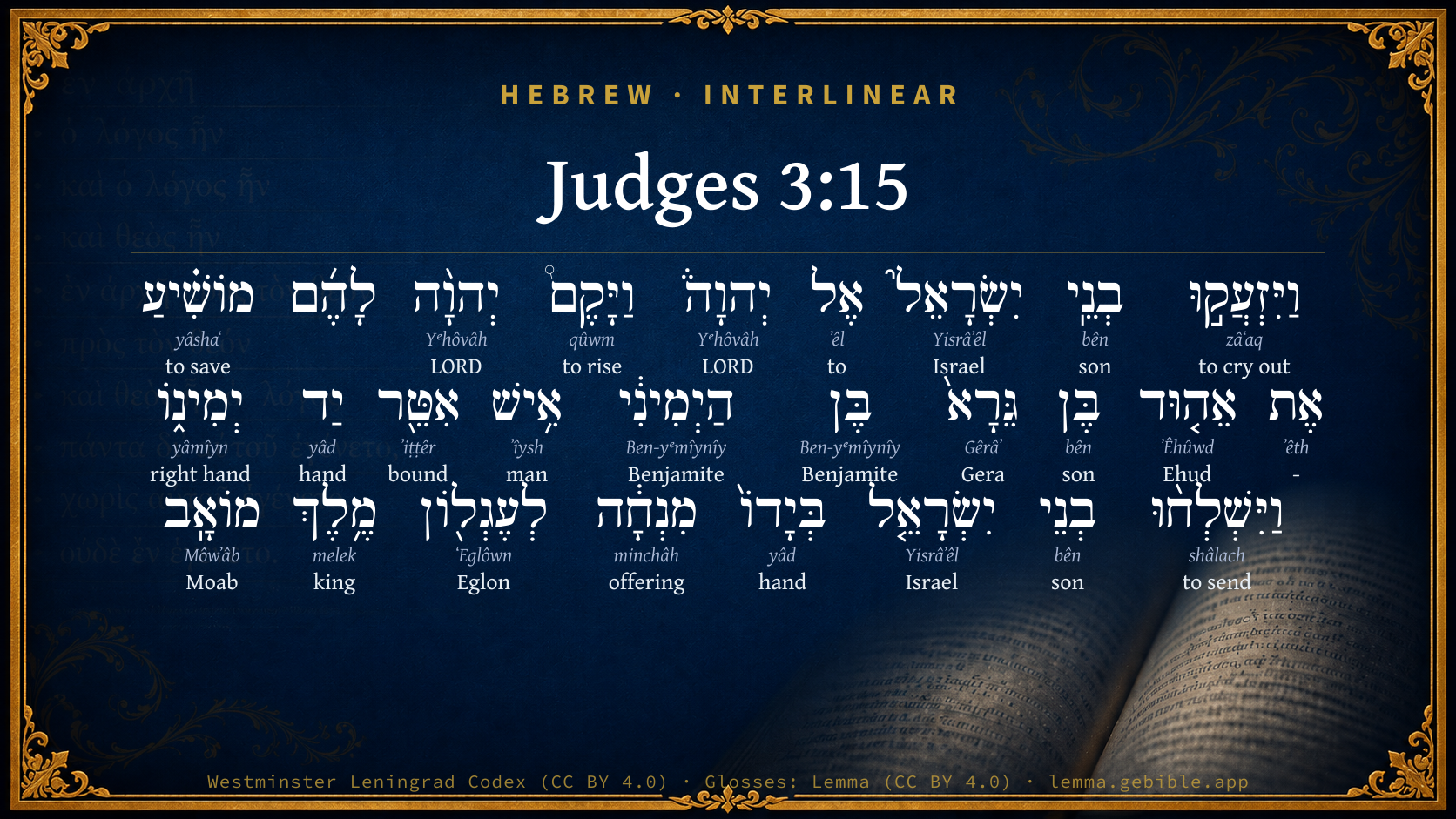
Hebrew (Westminster Leningrad Codex) Judges 3:15 appears in the Hebrew Old Testament. The text above is from the Westminster Leningrad Codex. Each word links to its Strong’s number, a concise gloss, and parsing drawn from the Open Scriptures Hebrew Bible morphology. Click any word for its full Brown-Driver-Briggs (BDB) entry.
Download image
Cite this verse

Judges 3:15 (World English Bible). Public Domain. Lemma interlinear Bible study tool, https://lemma.gebible.app/v/judges/3/15.

Show BibTeX & RIS
BibTeX
RIS
English Translation
But when the children of Israel cried to Yahweh, Yahweh raised them up a savior, Ehud the son of Gera, the Benjamite, a man left-handed. The children of Israel sent tribute by him to Eglon the king of Moab.
World English Bible · Public Domain
Highlights
  • 3 first appearances in the Hebrew Bible
Full analysis ↓
Download a study sheet

One document with this verse’s original text, its word-by-word gloss line, the meaning frame, cross-references with their text, attributed commentary, and full source and license credits — printable, and it pastes into notes with its structure intact.

This verse Autodidact and up

Study sheet (.html) Plain text (.txt)

A passage Seminary Student

Up to 50 verses in one chapter. A passage sheet keeps up to 6 commentary sources and 12 cross-references per verse, in the order this page ranks them, and says so on the sheet whenever that leaves anything out. Ask for a single verse and you get the Autodidact verse sheet above.

Everything on this page stays free to read, with no account — the sheet is a download of what is already on screen, not access to it.

Want to remove ads? Support Godless Engineer
Compare translations 3

The same verse in 3 English versions, stacked beneath the original-language interlinear above. Click any original word for its lexicon entry.

Each is an independent rendering of the whole verse — the interlinear is not word-aligned to these translations.

Highlighted words mark where these versions differ — a whole-verse word diff, not a word-by-word alignment.

  • World English Bible Public Domain
    But when the children of Israel cried to Yahweh, Yahweh raised them up a savior, Ehud the son of Gera, the Benjamite, a man left-handed. The children of Israel sent tribute by him to Eglon the king of Moab.
  • King James Version Public Domain
    But when the children of Israel cried unto the LORD, the LORD raised them up a deliverer, Ehud the son of Gera, a Benjamite, a man lefthanded: and by him the children of Israel sent a present unto Eglon the king of Moab.
  • unfoldingWord Literal Text CC BY-SA 4.0
    Then the sons of Israel cried out to Yahweh, and Yahweh raised up a savior for them, Ehud, the son of Gera, a Benjaminite, a man impeded in his right hand. And the sons of Israel sent tribute by his hand to Eglon, the king of Moab.

unfoldingWord Literal Text — © unfoldingWord, licensed CC BY-SA 4.0. Word-aligned USFM3 via Door43 (git.door43.org/unfoldingWord/en_ult).

Versions to compare (up to 4)

3 of 4 selected

Show all 18 translations

Every available English version of this verse, each an independent rendering of the whole verse.

  • World English Bible Public Domain
    But when the children of Israel cried to Yahweh, Yahweh raised them up a savior, Ehud the son of Gera, the Benjamite, a man left-handed. The children of Israel sent tribute by him to Eglon the king of Moab.
  • Berean Standard Bible Public Domain
    And again they cried out to the LORD, and He raised up Ehud son of Gera, a left-handed Benjamite, as their deliverer. So they sent him with tribute to Eglon king of Moab.
  • Majority Standard Bible Public Domain
    And again they cried out to the LORD, and He raised up Ehud son of Gera, a left-handed Benjamite, as their deliverer. So they sent him with tribute to Eglon king of Moab.
  • King James Version Public Domain
    But when the children of Israel cried unto the LORD, the LORD raised them up a deliverer, Ehud the son of Gera, a Benjamite, a man lefthanded: and by him the children of Israel sent a present unto Eglon the king of Moab.
  • American Standard Version (1901) Public Domain
    But when the children of Israel cried unto Jehovah, Jehovah raised them up a saviour, Ehud the son of Gera, the Benjamite, a man left-handed. And the children of Israel sent tribute by him unto Eglon the king of Moab.
  • Revised Version (1885) Public Domain
    But when the children of Israel cried unto the LORD, the LORD raised them up a saviour, Ehud the son of Gera, the Benjamite, a man lefthanded: and the children of Israel sent a present by him unto Eglon the king of Moab.
  • Geneva Bible (1599) Public Domain
    But when the children of Israel cried vnto the Lord, the Lord stirred them vp a sauiour, Ehud the sonne of Gera the sonne of Iemini, a man lame of his right hande: and the children of Israel sent a present by him vnto Eglon King of Moab.
  • Douay-Rheims (1899) Public Domain
    And afterwards they cried to the Lord, who raised them up a saviour called Aod, the son of Gera, the son of Jemini, who used the left hand as well as the right. And the children of Israel sent presents to Eglon king of Moab by him.
  • Young's Literal Translation Public Domain
    And the sons of Israel cry unto Jehovah, and Jehovah raiseth to them a saviour, Ehud son of Gera, a Benjamite (a man -- shut of his right hand), and the sons of Israel send by his hand a present to Eglon king of Moab;
  • Literal Standard Version CC BY-SA 4.0
    And the sons of Israel cry to YHWH, and YHWH raises a savior to them, Ehud son of Gera, a Benjamite (a man [with] his right hand bound), and the sons of Israel send a present by his hand to Eglon king of Moab;
  • Unlocked Literal Bible CC BY-SA 4.0
    When the people of Israel called out to Yahweh, Yahweh raised up someone who would help them, Ehud son of Gera, a Benjamite, a left-handed man. The people of Israel sent him, with their tribute payment, to Eglon king of Moab.
  • unfoldingWord Literal Text CC BY-SA 4.0
    Then the sons of Israel cried out to Yahweh, and Yahweh raised up a savior for them, Ehud, the son of Gera, a Benjaminite, a man impeded in his right hand. And the sons of Israel sent tribute by his hand to Eglon, the king of Moab.
  • Darby Bible Public Domain
    But when the people of Israel cried to the LORD, the LORD raised up for them a deliverer, Ehud, the son of Gera, the Benjaminite, a left-handed man. The people of Israel sent tribute by him to Eglon the king of Moab.
  • World Messianic Bible Public Domain
    But when the children of Israel cried to the LORD, the LORD raised up a savior for them: Ehud the son of Gera, the Benjamite, a left-handed man. The children of Israel sent tribute by him to Eglon the king of Moab.
  • Webster's Bible Public Domain
    But when the children of Israel cried to the LORD, the LORD raised them up a deliverer, Ehud the son of Gera, a Benjaminite, a man left-handed: and by him the children of Israel sent a present to Eglon king of Moab.
  • Free Bible Version CC BY-SA 4.0
    Again the Israelites cried out to the Lord to help them, and he provided someone to rescue them, Ehud, son of Gera the Benjamite, a left-handed man. The Israelites sent him to pay the tribute to Eglon, king of Moab.
  • Bible in Basic English Public Domain
    Then when the children of Israel made prayer to the Lord, he gave them a saviour, Ehud, the son of Gera, the Benjamite, a left-handed man; and the children of Israel sent an offering by him to Eglon, king of Moab.
  • JPS Tanakh (1917) Public Domain
    But when the children of Israel cried unto the LORD, the LORD raised them up a saviour, Ehud the son of Gera, the Benjamite, a man left-handed; and the children of Israel sent a present by him unto Eglon the king of Moab.

Literal Standard Version (2020), Covenant Press — licensed CC BY-SA 4.0. Text via the HelloAO Bible API (eBible.org). Unlocked Literal Bible (unfoldingWord) — licensed CC BY-SA 4.0. Text via the HelloAO Bible API (eBible.org). unfoldingWord Literal Text — © unfoldingWord, licensed CC BY-SA 4.0. Word-aligned USFM3 via Door43 (git.door43.org/unfoldingWord/en_ult). Free Bible Version, Dr. Jonathan Gallagher — licensed CC BY-SA 4.0. Text via the HelloAO Bible API (eBible.org).

Word by word

More ways to search: Search by grammar → Find every occurrence → Compare this word →

Practice this passage: Drill this verse → Learn its vocabulary →

אִטֵּ֖ר
ʼiṭṭêr
H334
“bound of”
Adjective, Adjective, Masculine, Singular, Construct
Part of Speech
Adjective
Type
Adjective
Gender
Masculine
Number
Singular
State
Construct
Full BDB Definition

Origin: from H332

TWOT: 74a

bound, impeded (on the right, i.e., left-handed), shut, shut up
  1. וַיִּזְעֲק֣וּ zâʻaq H2199 “and · to cry out” Conjunction + Verb, Qal, Sequential Imperfect, 3rd Person, Masculine, Plural
  2. בְנֵֽי bên H1121 “sons of” Noun, Common, Masculine, Plural, Construct
  3. יִשְׂרָאֵל֮ Yisrâʼêl H3478 “Israel” Noun, Proper
  4. אֶל ʼêl H413 “to” Preposition
  5. יְהוָה֒ Yᵉhôvâh H3068 “LORD” Noun, Proper
  6. וַיָּקֶם֩ qûwm H6965 “and · to rise” Conjunction + Verb, Hiphil, Sequential Imperfect, 3rd Person, Masculine, Singular
  7. יְהוָ֨ה Yᵉhôvâh H3068 “LORD” Noun, Proper
  8. מוֹשִׁ֗יעַ yâshaʻ H3467 “saving” Verb, Hiphil, Participle Active, Masculine, Singular, Absolute
  9. אֶת ʼêth H853 “-” Particle, Direct Object
  10. אֵה֤וּד ʼÊhûwd H164 “Ehud” Noun, Proper
  11. בֶּן bên H1121 “son of” Noun, Common, Masculine, Singular, Construct
  12. גֵּרָא֙ Gêrâʼ H1617 “Gera” Noun, Proper
  13. בֶּן Ben-yᵉmîynîy H1145 “Benjamite” Noun, Gentilic, Masculine, Singular, Construct
  14. הַיְמִינִ֔י Ben-yᵉmîynîy H1145 “the · Benjamite” Particle, Definite Article + Noun, Gentilic, Masculine, Singular, Absolute
  15. אִ֥ישׁ ʼîysh H376 “man” Noun, Common, Masculine, Singular, Absolute
  16. יַד yâd H3027 “hand of” Noun, Common, Both, Singular, Construct
  17. יְמִינ֑וֹ yâmîyn H3225 “right hand · his” Noun, Common, Feminine, Singular, Construct + Suffix, Personal, 3rd Person, Masculine, Singular
  18. וַיִּשְׁלְח֨וּ shâlach H7971 “and · to send” Conjunction + Verb, Qal, Sequential Imperfect, 3rd Person, Masculine, Plural
  19. בְנֵי bên H1121 “sons of” Noun, Common, Masculine, Plural, Construct
  20. יִשְׂרָאֵ֤ל Yisrâʼêl H3478 “Israel” Noun, Proper
  21. בְּיָדוֹ֙ yâd H3027 “in/at · hand · his” Preposition + Noun, Common, Both, Singular, Construct + Suffix, Personal, 3rd Person, Masculine, Singular
  22. מִנְחָ֔ה minchâh H4503 “offering” Noun, Common, Feminine, Singular, Absolute
  23. לְעֶגְל֖וֹן ʻEglôwn H5700 “to/for · Eglon” Preposition + Noun, Proper
  24. מֶ֥לֶךְ melek H4428 “king of” Noun, Common, Masculine, Singular, Construct
  25. מוֹאָֽב Môwʼâb H4124 “Moab” Noun, Proper

About this verse

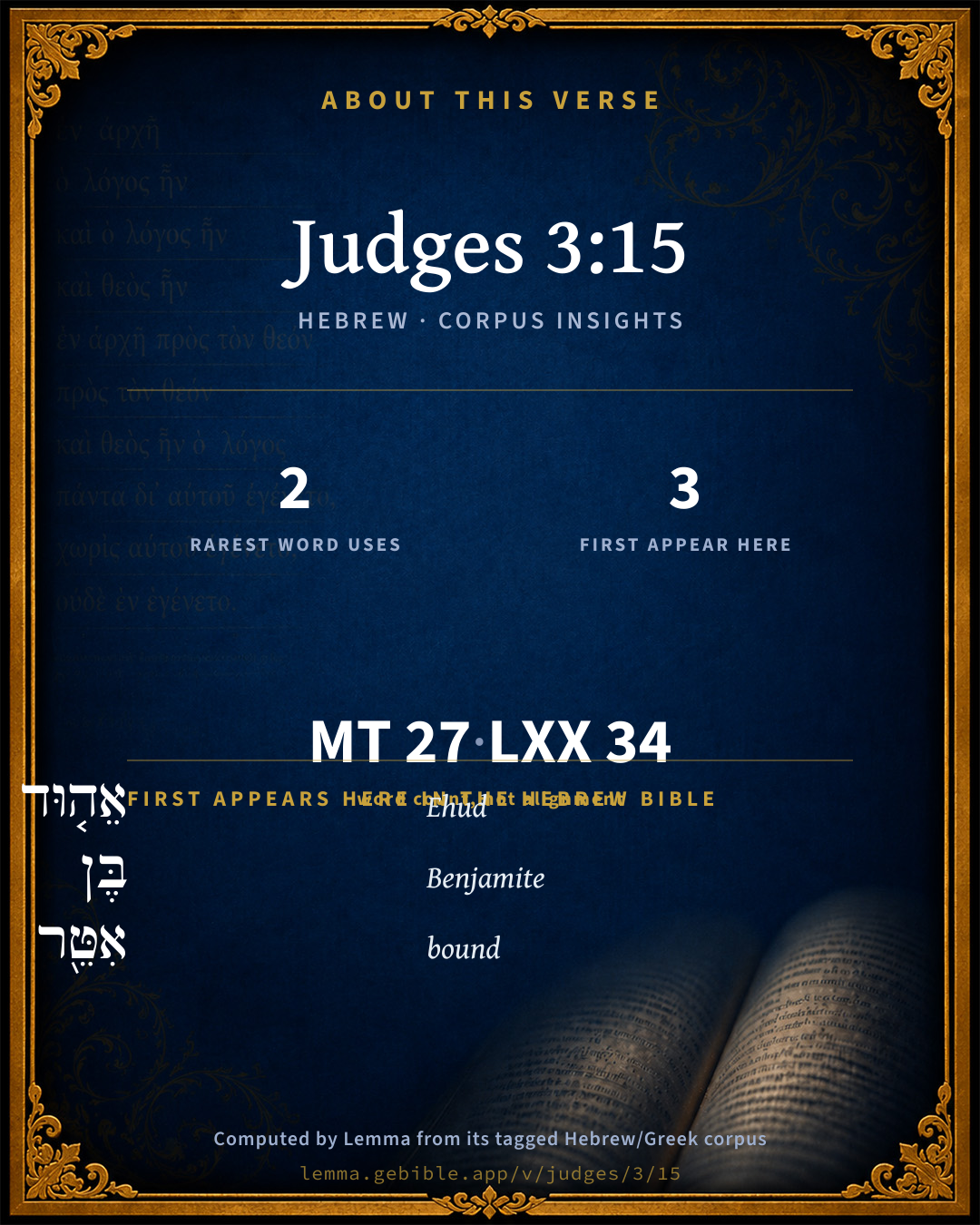
These counts appear in no published source. They are computed here, from the morphology-tagged text and Lemma’s own curated glosses. What Lemma adds →

27
words
20
distinct lemmas
Historical
section

Notable vocabulary

The rarest word here is אִטֵּ֖ר bound H334 — appearing just 2 times in the whole Hebrew Bible.

First appearance in Scripture

These words make their first canonical appearance in the Hebrew Bible here:

  • אֵה֤וּד Ehud H164
  • בֶּן Benjamite H1145
  • אִטֵּ֖ר bound H334

Shared distinctive vocabulary

אִטֵּ֖ר bound H334 occurs in 2 verses of the Hebrew Bible. Also found in:

Grammatical profile

  • 4 verbs
  • 19 nouns
  • 1 adjective
  • 2 prepositions
  • 1 particle

Verb forms

  • וַיִּזְעֲק֣וּ Qal · Sequential Imperfect
  • וַיָּקֶם֩ Hiphil · Sequential Imperfect
  • מוֹשִׁ֗יעַ Hiphil · Participle Active
  • וַיִּשְׁלְח֨וּ Qal · Sequential Imperfect

Repetition

Words recur within this verse — often emphatic in Hebrew:

  • בְנֵֽי son H1121 ×3
  • יִשְׂרָאֵל֮ Israel H3478 ×2
  • יְהוָה֒ LORD H3068 ×2
  • בֶּן Benjamite H1145 ×2
  • יַד hand H3027 ×2

Hebrew & Septuagint length

In English translation the verse runs 39 words from the Hebrew and 48 from the Septuagint (LXX English) — closely comparable.

A rough comparison of the two English renderings, which tokenize alike — not a word-level alignment.

Word counts can differ between the Hebrew and the Greek without any difference in meaning — e.g. the Hebrew direct-object marker אֵת has no separate Greek word, and Greek often adds the article ὁ.

In the original languages it is 27 Hebrew tokens and 34 Greek tokens — but the two are counted differently (Hebrew bundles its prefixes and suffixes into one token; the Greek is in lemma form), so that isn’t a like-for-like length.

Cross-references

13

Topical passages linked to Judges 3:15 in the Treasury of Scripture Knowledge — connected by theme and wording, ordered by reader-vote popularity; previews shown in the World English Bible.

  • Judges 3:9 When the children of Israel cried to Yahweh, Yahweh raised up a savior to the children of Israel, who saved them, even Othniel the son of Kenaz, Caleb's younger brother.
  • Psalms 78:34 When he killed them, then they inquired after him. They returned and sought God earnestly.
  • Judges 20:16 Among all this people there were seven hundred chosen men left-handed; everyone could sling stones at a hair-breadth, and not miss.
  • Isaiah 36:16 Don't listen to Hezekiah: for thus says the king of Assyria, Make your peace with me, and come out to me; and eat you everyone of his vine, and everyone of his fig tree, and drink you everyone the waters of his own cistern;
  • Jeremiah 33:3 Call to me, and I will answer you, and will show you great things, and difficult, which you don't know.
  • 1 Samuel 10:27 But certain worthless fellows said, How shall this man save us? They despised him, and brought him no present. But he held his peace.
  • 1 Chronicles 12:2 They were armed with bows, and could use both the right hand and the left in slinging stones and in shooting arrows from the bow: they were of Saul's brothers of Benjamin.
  • Psalms 50:15 Call on me in the day of trouble. I will deliver you, and you will honor me."
  • Psalms 90:15 Make us glad for as many days as you have afflicted us, For as many years as we have seen evil.
  • Proverbs 18:16 A man's gift makes room for him, And brings him before great men.
  • Proverbs 19:6 Many will entreat the favor of a ruler, And everyone is a friend to a man who gives gifts.
  • Proverbs 21:14 A gift in secret pacifies anger; And a bribe in the cloak, strong wrath.
  • Jeremiah 29:12–13 You shall call on me, and you shall go and pray to me, and I will listen to you.

Cross-references courtesy of OpenBible.info (CC BY 4.0).

Hebrew and Greek witnesses Masoretic Hebrew ↔ Greek Septuagint

The same verse in the two great witnesses to the Old Testament, shown verse-for-verse.

These are two independent witnesses, not word-aligned to each other, and the Septuagint is shown in lemma (dictionary) form.

Hebrew Judges 3:15 Masoretic · Westminster Leningrad Codex

וַיִּזְעֲק֣וּ בְנֵֽי יִשְׂרָאֵל֮ אֶל יְהוָה֒ וַיָּקֶם֩ יְהוָ֨ה לָהֶ֜ם מוֹשִׁ֗יעַ אֶת אֵה֤וּד בֶּן גֵּרָא֙ בֶּן הַיְמִינִ֔י אִ֥ישׁ אִטֵּ֖ר יַד יְמִינ֑וֹ וַיִּשְׁלְח֨וּ בְנֵי יִשְׂרָאֵ֤ל בְּיָדוֹ֙ מִנְחָ֔ה לְעֶגְל֖וֹן מֶ֥לֶךְ מוֹאָֽב

But when the children of Israel cried to Yahweh, Yahweh raised them up a savior, Ehud the son of Gera, the Benjamite, a man left-handed. The children of Israel sent tribute by him to Eglon the king of Moab.

World English Bible · Public Domain

Greek LXX Judges 3:15 Septuagint · lemma form

καί κράζω ὁ υἱός ἰσραήλ πρός κύριος καί ἀγείρω αὐτός σωτήρ ὁ αωδ υἱός γηρα υἱός ὁ ιεμενι ἀνήρ ἀμφοτεροδέξιος καί ἐκ ἀποστέλλω ὁ υἱός ἰσραήλ δῶρον ἐν χείρ αὐτός ὁ εγλωμ βασιλεύς μωαβ

And the children of Israel cried to the Lord; and he raised up to them a savior, Aod the son of Gera a son of Jemeni, a man who used both hands alike: and the children of Israel sent gifts by his hand to Eglom king of Moab.

LXX2012 (modern English Septuagint) · Public Domain

On this verse, Adam Clarke's Commentary discusses the Septuagint’s reading. Read the note in Commentary ↓

Hebrew: Westminster Leningrad Codex (CC BY 4.0). Greek: Septuagint (public domain); English from LXX2012 (modern English Septuagint) (Public Domain). How the Septuagint differs from the Hebrew →

Targum (Aramaic paraphrase)

1

The Targum is the ancient Jewish Aramaic paraphrase of the Hebrew Scriptures — an interpretive translation, not the Hebrew text itself. Onkelos (literal) and Pseudo-Jonathan (expansive) render the Torah, and Jonathan the Prophets. Coverage is partial: where no permissively-licensed English translation exists for a verse, only the Aramaic is shown. This is verse-level text, not a word-by-word alignment to the Hebrew.

  1. Targum Jonathan Prophets (Joshua–Malachi)
    וּזְעִיקוּ בְנֵי יִשְׂרָאֵל קֳדָם יְיָ וַאֲקֵים יְיָ לְהוֹן פָּרִיק יַת אֵהוּד בַּר גֵרָא בַּר שִׁבְטָא דְבִנְיָמִין גַבְרָא גְמִיד בִּידֵיהּ דְיַמִינָא וְשַׁדָרוּ בְנֵי יִשְׂרָאֵל בִּידֵיהּ תִּקְרוּבְתָּא לְעֶגְלוֹן מַלְכָּא דְמוֹאָב:

    (no public-domain English translation for this verse)

    Targum Jonathan — Aramaic: “Mikraot Gedolot” (public domain). English: “Sefaria Community Translation” (CC0 1.0 (public-domain dedication)); “London "Chaldee Paraphrase," 1871” (public domain). Text via Sefaria.

Commentary

Notes on Judges 3:15 from classic Christian and Jewish commentators (each source and its license shown beneath its notes). The classic Christian expositions comment on the surrounding passage and are grouped to its opening verse, so a note may address several verses; the Jewish commentaries on the Tanakh (Rashi and others) are per-verse, so they appear only where the commentator wrote on this verse.

Lemma curates 59 commentaries, every one of them public domain or Creative Commons licensed, each selected and text-cleaned for this edition rather than reprinted as found. About our sources →

Trapp's Complete Commentary

John Trapp

Jdg 3:15 But when the children of Israel cried unto the LORD, the LORD raised them up a deliverer, Ehud the son of Gera, a Benjamite, a man lefthanded: and by him the children of Israel sent a present unto Eglon the king of Moab.

Ver. 15. A Benjamite, a man left-handed.] Scaeva fuit, and no less valiant than that Roman Scaeva, a soldier of Caesar’s, who at the siege of Dyrrachium so long alone resisted Pompey’s army till he had two hundred and twenty darts sticking in his shield,

“ Densam portans in pectore sylvam." ” - Lucan.

And no less famous in his way was Mr William Perkins, lame of his right hand, as Ehud, but yet so as that with a left-handed pen he stabbed the Eglon of Rome to the heart. Of him one writeth thus: -

“ Dextera quantumvis fuerit tibi manca, docendi

Pollebas mira dexteritate tamen. ”

John Trapp, A Commentary or Exposition upon All the Books of the Old and New Testament (1647–1656) — public domain. Text from a community e-Sword module.

Joseph Benson's Commentary

Jdg 3:15. A Benjamite — This tribe was next to Eglon, and doubtless most afflicted by him; and hence God raised a deliverer. Left-handed — Which is here noted as a considerable circumstance in the following story. The Seventy render the word αμφοτεροδεξιον, who could use both his hands alike, which is probably the true meaning, as the same quality is ascribed to seven hundred chosen men of the tribe of Benjamin, chap. Jdg 20:16, all of whom one can hardly believe to have had no use of their right hands. The children of Israel sent a present — Some interpreters understand by this the tribute which had been imposed upon them; but it rather signifies a voluntary present above their usual payments, whereby they hoped to mollify his mind and render him favourable to them. For the Hebrew word mincha is used for such offerings as were presented to God in order to obtain his gracious regards.

Joseph Benson's Commentary on the Old and New Testaments (1811–1818) — public domain. Text from a community e-Sword module.

Geneva Bible (1599)

Geneva Bible translators

Or, Benjamin.

Or, left handed.

Geneva Bible (1599) marginal notes — public domain. Text via Bolls.life.

Jamieson, Fausset & Brown

Robert Jamieson, A. R. Fausset & David Brown

Ehud the son of Gera--descended from Gera, one of Benjamin's sons (Gen 46:21).

left-handed--This peculiarity distinguished many in the Benjamite tribe (Jdg 20:16). But the original word is rendered in some versions "both-handed," a view countenanced by Ch1 12:2.

by him the children of Israel sent a present unto Eglon the king of Moab--the yearly tribute, which, according to Eastern fashion, would be borne with ostentatious ceremony and offered (Jdg 3:18) by several messengers.

Jamieson, Fausset & Brown — Commentary Critical and Explanatory on the Whole Bible (1871) — public domain (CC PDM 1.0). Text via the HelloAO Bible API.

Adam Clarke's Commentary

Verse 15. Ehud the son of Gera - a man left handed] איש אטר יד ימינו ish itter yad yemino, a man lame in his right hand, and therefore obliged to use his left. The Septuagint render it ανδρα αμφοτεροδεξιον, an ambidexter, a man who could use both hands alike. The Vulgate, qui utraque manu pro dextera utebatur, a man who could use either hand as a right hand, or to whom right and left were equally ready. This is not the sense of the original, but it is the sense in which most interpreters understand it. It is well known that to be an ambidexter was in high repute among the ancients: Hector boasts of it: -

Αυταρ εγων εν οιδα μαχας τ,ανδροκτασιας τε·

Οιδ' επι δεξια, οιδ' επ' αριστερα νωμησαι βων

Αζαλεην, το μοι εστι ταλαυρινον πολεμιζειν.

Iliad, lib. vii., ver. 237.

"But am in arms well practiced; many a Greek

Hath bled by me, and I can shift my shield

From right to left; reserving to the last

Force that suffices for severest toil."

COWPER.

Asteropaeus is also represented by Homer as an ambidexter, from which he derives great advantages in fight: -

Ὡς φατ' απειλησας· ὁ δ' ανεσχετο διος Αχιλλευς

Πηλιαδα μελιην· ὁ δ' ὁμαρτη δουρασιν αμφις

Ἡρως Αστεροπαιος, επει περιδεξιος ηε.

Iliad, lib. xxi., ver. 161.

"So threatened he. Then raised Achilles high

The Pelian ash: - and his two spears at once

Alike, (a practised warrior,) with both hands

Asteropaeus hurled."

COWPER.

We are informed by Aristotle, that Plato recommended to all soldiers to acquire by study and exercise an equal facility of losing both hands. Speaking of Plato, he says: Και την εν τοις πολεμικοισασκεσιν, ὁπως αμφιδεξιοι γινωνται κατα την μελετην, ὡς δεον μη την μεν χρησιμον ειναι ταιν χεροιν, την δε αχρηστον. - De Repub., lib. ii., cap. 12. "He (Plato) also made a law concerning their warlike exercises, that they should acquire a habit of using both hands alike; as it is not fit that one of the hands should be useful and the other useless."

In Jdg 20:16 of this book we have an account of seven hundred men of Benjamin, each of whom was אטר יד ימינו itter yad yemino, lame of his right hand, and yet slinging stones to a hair's breadth without missing: these are generally thought to be ambidexters.

Sent a present unto Eglon] This is generally understood to be the tribute money which the king of Moab had imposed on the Israelites.

Adam Clarke's Commentary on the Bible (1810–1826) — public domain. Text from a community e-Sword/MySword module.

Ellicott's Commentary for English Readers

(15) Ehud the son of Gera.—In Gen_46:21 Gera is a son of Benjamin; in 1Ch_8:3 he is a son of Bela, son of Benjamin. The name Gera was hereditary in the tribe of Benjamin (see 2Sa_19:18; 1Ch_8:1-7), and the Jews so constantly omit steps in their genealogies that we can never be sure that “son” means more than “descendant.” Ehud seems to be another form of Abihud (1Ch_8:1-8). St. Jerome explains it to mean “one who praises “or “is praised.” Josephus calls him a young man, and even “a youth” (neaniskos).

A Benjamite.—“Ben-ha-jemînî,” as in Psa_7:1. The word is generally written undivided, so that here the LXX., Vulgate, and Luther have “son of Jemini.” No doubt the Syriac, Arabic, and Chaldee rightly understood it to mean a Benjamite, but still there seems to be an intentional play on words, for “Ben-ha-jemînî” may also mean “a son of the right hand, who,” as the writer adds, “was helpless with his right hand” (Ben-ha-jemînî eesh ittêr jad-jemînî).

Lefthanded—Marg., “Shut of his right hand.” Luther also renders it “links” but the LXX. and the Vulgate take it to mean “ambidextrous,” i.e., able to use his left hand as well as his right (LXX., amphoterodexion; Vulg., qui utrague manu pro dexterâ utebatur). Josephus says that he was “best skilled in using his left hand, in which was his whole strength” (Antt. v. 4, § 2). This rendering is merely an inference, from the fact that in Jdg_20:15-16 (comp. 1Ch_12:2) there are “700 chosen men left-handed.” (See the Note on that verse.) The Hebrew ittêr, however, is correctly rendered “shut” in the margin of our version (comp. Psa_69:16, “lest the pit shut her mouth upon me “), and cannot possibly mean “ambidextrous.” No doubt Ehud, like other Benjamites, might have been trained to use the sling with the left hand, but it does not follow that he may not have had some accident which maimed the right hand; and if so it would avert all suspicion from him in his dreadful purpose. Ehud in that case was a Hebrew Scœvola. Stobæus mentions some African tribes which, like the Benjamites, were “left-hand fighters” (aristeromachoi), and for the same cause an Egyptian tribe was known as the Euonymitae. The Greek Laius has the same meaning.

By him.—Either because he was the chief of one of their houses (1Ch_8:6), or perhaps because he had intimated to them his design. The narrative in Judges 20 falls chronologically in the days of Phinehas and, therefore, Ehud’s act occurred at a still earlier period after the conquest; for Ehud would hardly have been chosen for this honourable function after the terrible degradation and decimation of the tribe of Benjamin. Possibly Eglon’s invasion occurred soon after Joshua’s death.

Sent a present.—The Hebrew word is minchah, here euphemistically used for “tribute,” as it is elsewhere. (2Sa_8:6 : “And the Syrians became servants to David, and brought gifts.” 1Ki_4:21 : “They [the Philistines] brought presents and served Solomon.” Psa_72:10 : “The kings of Sheba and Seba shall bring gifts.”)

A Bible Commentary for English Readers, edited by Charles John Ellicott (1878–1897) — public domain. Text from a community e-Sword module.

The Cambridge Bible for Schools and Colleges

gen. ed. J. J. S. Perowne

15. Ehud the son of Gera] Both names occur in the Benjamite genealogies, Gen_46:21, 1Ch_7:10; 1Ch_8:3; 1Ch_8:5; 1Ch_8:7; it has been suggested that both belonged to clans and not to individuals. Gera was certainly a clan, 2Sa_16:5 (‘Shimei ben Gera’); but the Chronicler may have adopted (1Ch_7:10) the name of Ehud merely from here, or the clan Ehud may have taken its name from the hero of this story. With the mention of Ehud the ancient narrative probably begins.

a man lefthanded] lit. restricted as to his right hand, the word only again in Jdg_20:16. This peculiarity has a bearing upon what follows: being left-handed he naturally fastened his sword on the right side instead of the left, and thus was able to conceal a weapon without rousing suspicion.

a present] An euphemism for tribute (2Sa_8:2; 2Sa_8:6; 1Ki_4:21 etc.), which was paid in kind, and therefore had to be ‘carried1[29].’

[29] The Black Obelisk of Shalmaneser II (860–825 b.c.) in the Brit. Mus., Nimroud Central Saloon, No. 98, contains a sculptured relief of Israelites carrying tribute in the time of Jehu: an illustration of the obelisk is given in the Brit. Mus. Guide to Bab. and Assyr. Antiquities, Plate ii.

The Cambridge Bible for Schools and Colleges (gen. ed. J. J. S. Perowne; Cambridge University Press, 1878–1918) — public domain. Text from a community e-Sword module.

John Gill's Exposition

But Ehud made him a dagger, which had two edges, of a cubit length,.... A little sword, as Josephus calls it (y), with two edges, that it might cut both ways, and do the execution he designed by it, and was about half a yard long; which he could the more easily conceal, and use for his purpose:

and he did gird it under his raiment; that it might not be seen, and give occasion of suspicion; this was a military garment, the "sagum", as the Vulgate Latin version, which was coarse, and made of wool, and reached to the ankle, and was buttoned upon the shoulder, and put over the coat (z); the Septuagint makes use of a word Suidas (a) interprets a coat of mail:

upon his right thigh; whereas a sword is more commonly girt upon the left; though some observe, from various writers, that the eastern people used to gird their swords on their right thigh; or this was done that it might be the less discernible and suspected, and chiefly as being most convenient for him, a lefthanded man, to draw it out upon occasion.

(y) Ibid. (Antiqu. l. 5. c. 4. sect. 2.) (z) Vid. Valtrinum de re militar. Roman. l. 3. c. 13. (a) In voce

John Gill's Exposition of the Whole Bible (1746–1763) — public domain (CC PDM 1.0). Text via the HelloAO Bible API.

Albert Barnes' Notes on the Bible

But when the children of Israel cried unto the Lord, the Lord raised them up a deliverer - The very same words as are used at Jdg 3:9. See, too, Jdg 2:16, Jdg 2:18, and Neh 9:27.

Ehud “the Benjamite” was of the family or house of Gera 2Sa 16:5, the son of Bela, Benjamin’s first-born, born before Jacob’s descent into Egypt Gen 46:21, and then included among “the sons of Benjamin.” The genealogy in 1Ch 8:6 intimates that Ehud (apparently written Abihud in Jdg 3:3) became the head of a separate house.

Left-handed - See the margin. The phrase is thought to describe not so much a defect as the power to use left and right hands equally well (compare Jdg 20:16; 1Ch 12:2).

A present - i. e. tribute 2Sa 8:2, 2Sa 8:6; 1Ki 4:21; Psa 72:10. The employment of Ehud for this purpose points him out as a chief of some distinction. He would be attended by a numerous suite Jdg 3:18. We may conclude that the destruction of the Benjamites Judg. 20 had not taken place at this time.

Albert Barnes' Notes on the Bible (1834–1885) — public domain. Text from a community e-Sword/MySword module.

Haydock's Catholic Bible Commentary

Aod, signifies "praise," whence perhaps Josephus calls him Judes which has the same import. (Menochius) --- He was a descendant of Jemini or Benjamin, by his son Gera, Genesis xlvi. 1. --- Right. Septuagint and many interpreters agree, that Aod was "Ambidexter," a quality which Plato exhorted those who were designed for war, to strive to acquire. Several of the heroes before Troy are praised on this account; and the Scripture takes particular notice of 700 citizens of Gabaa, who could use both hands alike, and could hit even a hair with a stone, chap. xx. 16. The Jews explain itter, very absurdly; Aod "had his right hand maimed or tied:" (Calmet) and Protestants render "a man left-handed." (Haydock) --- This would be a very awkward recommendation for a warrior, though it is pretended that such are more resolute, and more difficult to encounter than others. The number of the men at Gabaa who are praised for their skill, as well as the brave men of David, (1 Paralipomenon xii. 2,) shews sufficiently that the term does not mean left-handed. But the Scripture here takes notice that Aod could use his left hand so well, because he placed his dagger, contrary to custom, on his right side, and the motions of his left hand would not be so narrowly watched. Rufin does not agree with the present text of Josephus, which indeed seems very confused saying, "that all the strength of Aod lay in his left hand." Gelenius also translates, utraque manu ex æquo promptus; (Antiquities v. 5,) so that perhaps the Greek of Josephus may have been altered. --- Presents; that is, tribute; an odious expression, instead of which the Scripture often puts presents, 1 Kings x. 27., and 1 Paralipomenon xviii. 2. No tribute was imposed in Persia till the reign of Darius Hystaspes; the subject had to make presents to the king. (Herodotus iii. 89.) (Calmet)

George Leo Haydock (1774–1849), Haydock's Catholic Family Bible and Commentary, 1859 edition — public domain. Excludes Psalms (Douay-Rheims chapter numbering differs from Protestant) and Deuterocanonical books (Catholic canon only).

Matthew Poole's English Annotations

A Benjamite, Heb. the son of Gemini, who was of the tribe of Benjamin, 2Sa 16:11; 19:17; 1Ki 2:8. This tribe was next to him and doubtless most afflicted by him; and hence God raiseth a deliverer.

Left-handed; which is here noted, partly as a mark of his courage, and strength, and activity; see Jdg 20:16; and principally as a considerable circumstance in the following story, whereby he might more advantageously and unsuspectedly give the deadly blow.

Matthew Poole's English Annotations on the Holy Bible (1683–1685) — public domain. Text from a community e-Sword/MySword module.

Whedon's Commentary on the Bible

Daniel D. Whedon

15. Cried unto the Lord — History repeats itself, because like causes produce like effects. A second oppression calls forth a second cry.

Left-handed — Heb, lamed (margin, shut) in the right hand. The Septuagint reads, αμφοτεροδεξιον, which is well translated in the Vulgate by, who used either hand for a right hand. “The phrase,” says Hervey, “must originally have described an accidental defect; but when we read of seven hundred chosen men of Benjamin all left-handed, (Jdg_20:16; 1Ch_12:2,) and skilful slingers, it is obvious that this was no accidental defect, but an acquired art.” The name Benjamin, son of my right hand, seems to have been a misnomer in the case of his numerous left-handed progeny.

A present unto Eglon — Either the annual tribute, brought with formality and parade, or a gratuity, to soften the severity of Eglon.

Daniel D. Whedon (gen. ed.), Commentary on the Old and New Testaments (1874–1909) — public domain. Text from a community e-Sword module.

The Pulpit Commentary

Left-handed. It was a peculiarity of the warriors of the tribe of Benjamin to be left-handed. (see Jud_1:20:16 1Ch_12:2) A left-handed man wearing no sword or dagger on his left side, and using his right hand for other purposes, would naturally throw a man off his guard. Thus Joab took Amasa by the beard with his right hand to kiss him, and then smote him with the sword in his left hand. (2Sa_20:10) A deliverer. Hebrew, a saviour (ver. 9). A present, i.e. their tribute.

Vers. 15-26. Ehud.

There is no grandeur of character about Ehud, nor can he boast of an illustrious descent; yet he is sufficient for the purpose of delivering Israel. The defectiveness of the instrument makes the Divine agent the more conspicuous. We see here:

I GOD"S USE OF OBSCURE AGENTS AND INSTRUMENTALITIES. He was of the less important tribe; personally obscure; physically defective. So God uses the weak things of this world to confound the mighty, etc., that the praise may be given to the true source of power and wisdom. On the present occasion the choice was singularly felicitous, as it emphasised both subjection and deliverance as Divine. The left-handedness of Ehud also becomes curiously and instructively prominent. His very defect proved his fitness for the special task he had to accomplish. Is his power but a one-sided one, and hardly available for regular service? If he be in earnest an opportunity will be given for its effective use. It is exacted by God"s servants that they do what they can; the rest is to be left with himself.

II DEFECTIVE POWERS AND CHARACTER RESTRICTED TO THEIR PROPER SPHERE. We can see from the history that the moral character of Ehud is not high. His success, humanly speaking, depended on duplicity, boldness, sleight of hand. He has decision enough to improve upon the advantage which he has thus obtained, and to weaken the enemy by a terrible blow. But there is no sign of the judicial faculty, nor even of great military skill. He rendered a signal service, and then apparently retired into obscurity. He held no high office, or great public responsibility. M.

HOMILIES BY W.F. ADENEY Ver. 15. A man left-handed.

The left-handed man may be regarded as a type of the abnormal, the eccentric. The existence and position of such people deserves notice.

I THE PROVIDENTIAL GOODNESS OF GOD PERMITS PECULIAR VARIATIONS FROM THE NORMAL TYPE OF HUMANITY. God does not form all men according to one exact pattern. There is great variety in the nature, capacity, position, and vocation of men. While most are more or less near to the central type, some are far removed from it.

1. Such people should be treated with delicacy and consideration. In the present instance the variation is too slight to be an affliction, but in more severe cases the sufferers are likely to be painfully conscious of their peculiarity. Christian courtesy will devise means of making this as little apparent as possible.

2. The common human likeness which belongs to all men should be recognised beneath the few discrepancies which strike us forcibly just because they contrast with the multitudinous points of agreement. The peculiarities are superficial. The deeper nature is true to the normal type of the great human family. The left-handed man has the same heart as the right-handed man. If we had more breadth of sympathy, more care for real and deep human qualities, and less regard for superficial and trivial points, we should recognise more genuine humanity in the most eccentric people.

3. Peculiarities of constitution should be borne with calm faith in the wisdom and goodness of God. They may be severe enough to constitute a heavy cross. Yet they come from the hand of our Father who will not willingly afflict. It is well therefore to proceed to see how they may be turned to good accounts or how the evil of them may be ameliorated.

II DIRECT ADVANTAGES MAY BE DERIVED FROM THE PECULIARITIES OF ABNORMAL CONSTITUTIONS. Ehud is able to effect his terrible purpose the more securely through the surprise occasioned by his unexpected action (ver. 21). It is foolish to aim at eccentricity, because such an aim would result in abnormal habits without abnormal capacities. But where the peculiarity is natural it must be regarded as providential, and we should then cast about to see if it may not be turned to some advantage, so that the thing which appears at first as nothing but a hindrance may be found a source of some special aptitude. If the peculiarity be a positive affliction, it may enable those who suffer from it to sympathise with and help their companions in similar affliction. Thus the blind may have a mission to the blind. If the peculiarity compel an unusual manner of acting it may be the means of accomplishing some special but much-needed work.

III PECULIAR DISADVANTAGES IN ONE DIRECTION ARE OFTEN COMPENSATED FOR BY PECULIAR ADVANTAGES IN ANOTHER. The man who is weak in the right band, is left-handed, i.e. he has special strength and skill with his left hand. The blind often have a rare skill in music. Muscular weakness is often accompanied by intellectual. strength, deficient health by fine spiritual powers. Therefore instead of complaining of the peculiarity with which he is tried it would be well if the person who suffered under it were to be thankful for the special advantages with which he may be favoured. No peculiarity which may seem to exclude from the advantages of human society will sever from the love of God or from the sympathy of Christ the Good Physician. A.

The Pulpit Commentary (1880–1919), ed. H.D.M. Spence-Jones & Joseph S. Exell — public domain. Text from a community e-Sword module.

John Wesley's Explanatory Notes

A Benjamite - This tribe was next to Eglon, and doubtless most afflicted by him; and hence God raiseth a deliverer. Left handed - Which is here noted, as a considerable circumstance in the following story.

John Wesley, Explanatory Notes Upon the Whole Bible (1754–1765) — public domain. Text via the GEBible commentary corpus.

Keil & Delitzsch

C. F. Keil & F. Delitzsch

But when the Israelites cried to the Lord for help, He set them free through the Benjaminite Ehud, whom He raised up as their deliverer. Ehud was "the son of Gera." This probably means that he was a descendant of Gera, since Gera himself, according to Ch1 8:3, was a son of Bela the son of Benjamin, and therefore was a grandson of Benjamin; and Shimei the contemporary of David, a man belonging to the tribe of Benjamin, is also called a son of Gera in Sa2 16:5; Sa2 19:17. At the same time, it is possible that the name Gera does not refer to the same person in these different passages, but that the name was repeated again and again in the same family. "A man shut with regard to his right hand," i.e., hindered in the use of his right hand, not necessarily crippled, but in all probability disabled through want of use from his youth upwards. That the expression does not mean crippled, is confirmed by the fact that it is used again in connection with the 700 brave slingers in the army of the Benjaminites in Jdg 20:16, and it certainly cannot be supposed that they were all actual cripples. So much is certain, however, that it does not mean ἀμφοτεροδέξιος, qui utraque manu pro dextera utebatur (lxx, Vulg.), since אטר signifies clausit (shut) in Psa 69:16. It is merely with reference to what follows that this peculiarity is so distinctly mentioned. - The Israelites sent a present by him to king Eglon. בידו does not mean in, but through, his hand, i.e., through his intervention, for others were actually employed to carry the present (Jdg 3:18), so that Ehud merely superintended the matter. Minchah, a gift or present, is no doubt a euphemism for tribute, as in Sa2 8:2, Sa2 8:6; Kg1 5:1.

Keil & Delitzsch — Biblical Commentary on the Old Testament (1861–1891) — public domain (CC PDM 1.0). Text via the HelloAO Bible API. (Old Testament only.)

unfoldingWord translationNotes

Door43 World Missions Community

called out to Yahweh

Here this means to shout or speak loudly to someone far away. It can also mean to ask someone for help, especially God.

raised up someone

Yahweh appointing someone to do a special service for him is spoken of as if he raised or lifted up the person. (See: Metaphor)

Ehud ... Gera

These are names of men. (See: How to Translate Names)

left-handed

Ehud was better able to hold a sword with his left hand.

translationWords

people group

Israel

call

Yahweh

raise

Benjamin

send

tribute

Moab

unfoldingWord translationNotes — © Distant Shores Media and the Door43 World Missions Community, licensed CC BY-SA 4.0. Source: git.door43.org/Door43/en_tn.

Rashi

Rabbi Shlomo Yitzchaki (Rashi)

Whose right arm was immobile. Yonasan renders "A man whose right arm was shrunken." "Gamid" in the Aramaic always indicates something shrunken by disease, "retrait", "shrunk" in old French. He could not utilize his right arm. In Hebrew, "closed", as in "Let not the well close its mouth over me." His right arm was "closed"—he could not utilize it.

Rashi on the Tanakh — English translations: “The Judaica Press complete Tanach with Rashi, translated by A. J. Rosenberg” (CC BY 4.0); “Pentateuch with Rashi's commentary by M. Rosenbaum and A.M. Silbermann, 1929-1934” (public domain); “The Metsudah Tanach series, Lakewood, N.J” (CC BY 4.0); and “The Book of Joshua, Metsudah Publications, 1997” (CC BY 4.0). Text via Sefaria.

Lesson kit

Teaching starters — assembled from the data on this page, not authored interpretation. Every prompt links to the verse data it draws on. Edit before teaching.

Judges, in the Historical, opens this verse with 27 words (20 distinct Hebrew lemmas). Its most distinctive word is ʼiṭṭêr (“bound”). A historical commentator’s framing appears above. Read the whole chapter for the surrounding context.

Discussion questions

  1. What does “bound” (ʼiṭṭêr) contribute to the verse as a whole?
  2. 3 words make their first appearance in Scripture here. What does this debut establish?
  3. How does Judges 20:16, which shares the word «bound», read alongside this verse?
  4. What does the repetition of “son” (3× in this one verse) do in this verse?
  5. These translations render this verse differently. What is at stake in choosing one wording over another?
  6. «וַיִּזְעֲק֣וּ» is a Qal Sequential Imperfect verb. How does that grammatical form shape the action described?
  7. Compare how Trapp's Complete Commentary and Joseph Benson's Commentary read this verse. Where do they agree or differ?

Things to notice

Reading settings

Reading text

Shown beneath each verse's original-language words.

Old Testament
Old Testament edition

Read the OT as the Masoretic Hebrew (MT) or the Greek Septuagint (LXX).

English shown for the Greek Septuagint (in the Hebrew ↔ Greek comparison).

Comparing translations? Open the Compare panel on any verse page to stack up to four side by side.