Isaiah 38:20

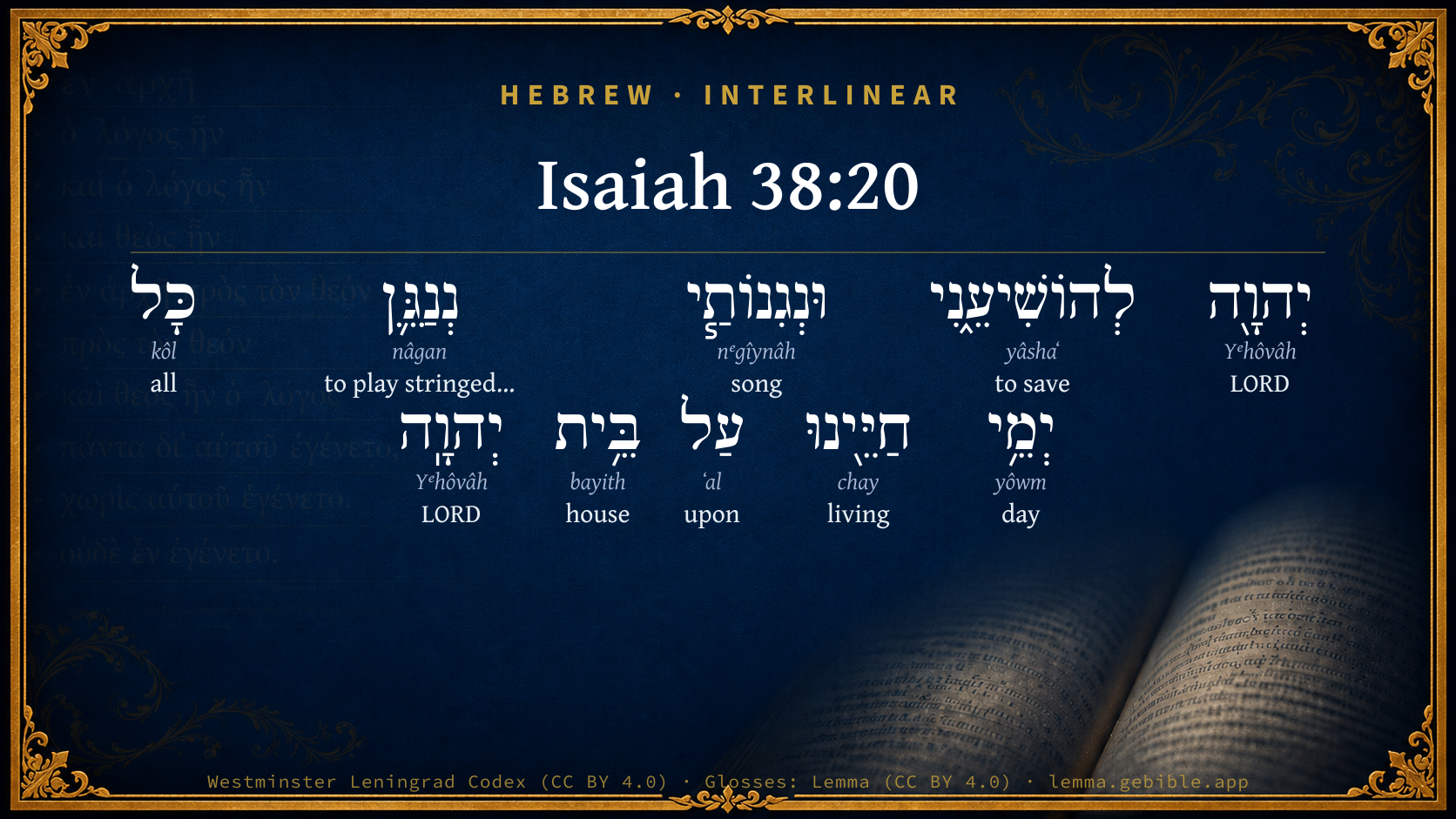
Hebrew (Westminster Leningrad Codex) Isaiah 38:20 appears in the Hebrew Old Testament. The text above is from the Westminster Leningrad Codex. Each word links to its Strong’s number, a concise gloss, and parsing drawn from the Open Scriptures Hebrew Bible morphology. Click any word for its full Brown-Driver-Briggs (BDB) entry.
Download image
Cite this verse

Isaiah 38:20 (World English Bible). Public Domain. Lemma interlinear Bible study tool, https://lemma.gebible.app/v/isaiah/38/20.

Show BibTeX & RIS
BibTeX
RIS
English Translation
Yahweh is [ready] to save me: Therefore we will sing my songs with stringed instruments All the days of our life in the house of Yahweh.
World English Bible · Public Domain
Download a study sheet

One document with this verse’s original text, its word-by-word gloss line, the meaning frame, cross-references with their text, attributed commentary, and full source and license credits — printable, and it pastes into notes with its structure intact.

This verse Autodidact and up

Study sheet (.html) Plain text (.txt)

A passage Seminary Student

Up to 50 verses in one chapter. A passage sheet keeps up to 6 commentary sources and 12 cross-references per verse, in the order this page ranks them, and says so on the sheet whenever that leaves anything out. Ask for a single verse and you get the Autodidact verse sheet above.

Everything on this page stays free to read, with no account — the sheet is a download of what is already on screen, not access to it.

Want to remove ads? Support Godless Engineer
Compare translations 3

The same verse in 3 English versions, stacked beneath the original-language interlinear above. Click any original word for its lexicon entry.

Each is an independent rendering of the whole verse — the interlinear is not word-aligned to these translations.

Highlighted words mark where these versions differ — a whole-verse word diff, not a word-by-word alignment.

  • World English Bible Public Domain
    Yahweh is [ready] to save me: Therefore we will sing my songs with stringed instruments All the days of our life in the house of Yahweh.
  • King James Version Public Domain
    The LORD was ready to save me: therefore we will sing my songs to the stringed instruments all the days of our life in the house of the LORD.
  • unfoldingWord Literal Text CC BY-SA 4.0
    Yahweh to save me, and we will play my stringed instruments all of the days of our lives in the house of Yahweh.”

unfoldingWord Literal Text — © unfoldingWord, licensed CC BY-SA 4.0. Word-aligned USFM3 via Door43 (git.door43.org/unfoldingWord/en_ult).

Versions to compare (up to 4)

3 of 4 selected

Show all 18 translations

Every available English version of this verse, each an independent rendering of the whole verse.

  • World English Bible Public Domain
    Yahweh is [ready] to save me: Therefore we will sing my songs with stringed instruments All the days of our life in the house of Yahweh.
  • Berean Standard Bible Public Domain
    The LORD will save me; we will play songs on stringed instruments all the days of our lives in the house of the LORD.
  • Majority Standard Bible Public Domain
    The LORD will save me; we will play songs on stringed instruments all the days of our lives in the house of the LORD.
  • King James Version Public Domain
    The LORD was ready to save me: therefore we will sing my songs to the stringed instruments all the days of our life in the house of the LORD.
  • American Standard Version (1901) Public Domain
    Jehovah is `ready' to save me: Therefore we will sing my songs with stringed instruments All the days of our life in the house of Jehovah.
  • Revised Version (1885) Public Domain
    The LORD is ready to save me: therefore we will sing my songs to the stringed instruments all the days of our life in the house of the LORD.
  • Geneva Bible (1599) Public Domain
    The Lord was ready to saue me: therefore we will sing my song, all the dayes of our life in the House of the Lord.
  • Douay-Rheims (1899) Public Domain
    O Lord, save me, and we will sing our psalms all the days of our life in the house of the Lord.
  • Young's Literal Translation Public Domain
    Like myself to-day -- a father to sons Doth make known of Thy faithfulness, O Jehovah -- to save me: And my songs we sing all days of our lives In the house of Jehovah.'
  • Literal Standard Version CC BY-SA 4.0
    Like myself today; A father makes known to [his] sons of Your faithfulness, || O YHWH—to save me: And we sing my songs all [the] days of our lives || In the house of YHWH.”
  • Unlocked Literal Bible CC BY-SA 4.0
    Yahweh is about to save me, and we will celebrate with music all the days of our lives in the house of Yahweh.”
  • unfoldingWord Literal Text CC BY-SA 4.0
    Yahweh to save me, and we will play my stringed instruments all of the days of our lives in the house of Yahweh.”
  • Darby Bible Public Domain
    Jehovah was [purposed] to save me. -- And we will play upon my stringed instruments all the days of our life, in the house of Jehovah.
  • World Messianic Bible Public Domain
    The LORD will save me. Therefore we will sing my songs with stringed instruments all the days of our life in the LORD’s house.
  • Webster's Bible Public Domain
    The LORD was ready to save me: therefore we will sing my songs to the stringed instruments all the days of our life in the house of the LORD.
  • Free Bible Version CC BY-SA 4.0
    The Lord saved me! We will sing my songs with stringed instruments all the days of our lives in the Lord's Temple.”
  • Bible in Basic English Public Domain
    O Lord, quickly be my saviour; so we will make my songs to corded instruments all the days of our lives in the house of the Lord.
  • JPS Tanakh (1917) Public Domain
    The LORD is ready to save me; therefore we will sing songs to the stringed instruments all the days of our life in the house of the LORD.

Literal Standard Version (2020), Covenant Press — licensed CC BY-SA 4.0. Text via the HelloAO Bible API (eBible.org). Unlocked Literal Bible (unfoldingWord) — licensed CC BY-SA 4.0. Text via the HelloAO Bible API (eBible.org). unfoldingWord Literal Text — © unfoldingWord, licensed CC BY-SA 4.0. Word-aligned USFM3 via Door43 (git.door43.org/unfoldingWord/en_ult). Free Bible Version, Dr. Jonathan Gallagher — licensed CC BY-SA 4.0. Text via the HelloAO Bible API (eBible.org).

Word by word

More ways to search: Search by grammar → Find every occurrence → Compare this word →

Practice this passage: Drill this verse → Learn its vocabulary →

וּנְגִנוֹתַ֧י
nᵉgîynâh
H5058
“and · songs of”
Conjunction + Noun, Common, Feminine, Plural, Construct
Part of Speech
Conjunction + Noun
Type
Common
Gender
Feminine
Number
Plural
State
Construct
Full BDB Definition

Origin: from H5059

TWOT: 1292 . 1a

music, song, taunt song - music (of stringed instrument) - song - taunting or mocking song
  1. יְהוָ֖ה Yᵉhôvâh H3068 “LORD” Noun, Proper
  2. לְהוֹשִׁיעֵ֑נִי yâshaʻ H3467 “to save · me” Preposition + Verb, Hiphil, Infinitive Construct + Suffix, Personal, 1st Person, Common, Singular
  3. נְנַגֵּ֛ן nâgan H5059 “to play stringed instrument” Verb, Piel, Imperfect, 1st Person, Common, Plural
  4. כָּל kôl H3605 “all of” Noun, Common, Masculine, Singular, Construct
  5. יְמֵ֥י yôwm H3117 “days of” Noun, Common, Masculine, Plural, Construct
  6. חַיֵּ֖ינוּ chay H2416 “living things · our” Noun, Common, Masculine, Plural, Construct + Suffix, Personal, 1st Person, Common, Plural
  7. עַל ʻal H5921 “upon” Preposition
  8. בֵּ֥ית bayith H1004 “house of” Noun, Common, Masculine, Singular, Construct
  9. יְהוָֽה Yᵉhôvâh H3068 “LORD” Noun, Proper

About this verse

These counts appear in no published source. They are computed here, from the morphology-tagged text and Lemma’s own curated glosses. What Lemma adds →

10
words
9
distinct lemmas
Prophets
section

Notable vocabulary

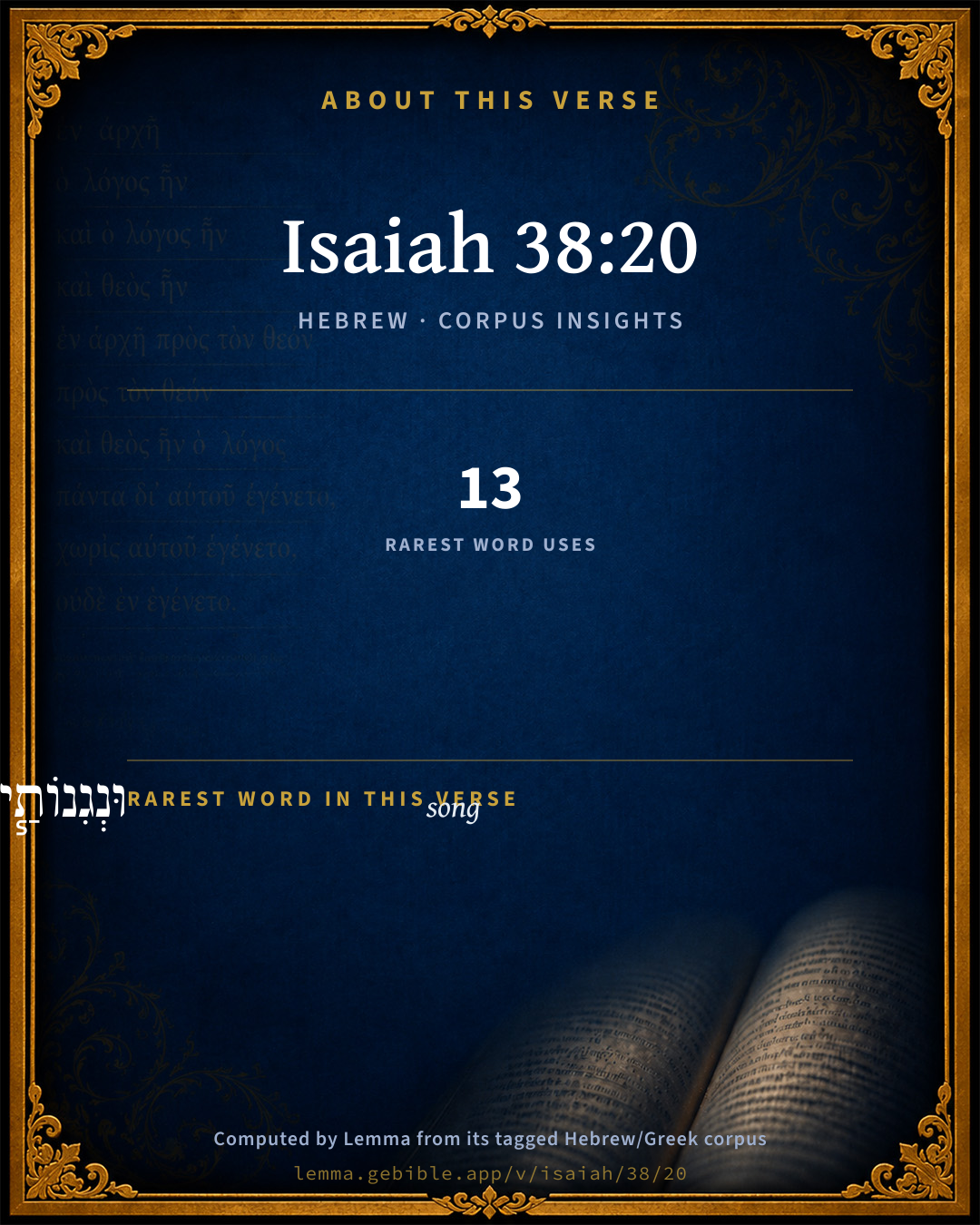
The rarest word here is וּנְגִנוֹתַ֧י song H5058 — appearing just 13 times in the whole Hebrew Bible.

Shared distinctive vocabulary

וּנְגִנוֹתַ֧י song H5058 occurs in 13 verses of the Hebrew Bible. Also found in:

Grammatical profile

  • 2 verbs
  • 7 nouns
  • 1 preposition

Verb forms

  • לְהוֹשִׁיעֵ֑נִי Hiphil · Infinitive Construct
  • נְנַגֵּ֛ן Piel · Imperfect

Repetition

A word recurs within this verse — often emphatic in Hebrew:

  • יְהוָ֖ה LORD H3068 ×2

Hebrew & Septuagint length

In English translation the verse runs 26 words from the Hebrew and 26 from the Septuagint (LXX English) — the same length.

A rough comparison of the two English renderings, which tokenize alike — not a word-level alignment.

Word counts can differ between the Hebrew and the Greek without any difference in meaning — e.g. the Hebrew direct-object marker אֵת has no separate Greek word, and Greek often adds the article ὁ.

Cross-references

12

Topical passages linked to Isaiah 38:20 in the Treasury of Scripture Knowledge — connected by theme and wording, ordered by reader-vote popularity; previews shown in the World English Bible.

  • Psalms 116:2 Because he has turned his ear to me, Therefore I will call on him as long as I live.
  • Psalms 145:2 Every day I will praise you. I will extol your name forever and ever.
  • Psalms 150:4 Praise him with tambourine and dancing! Praise him with stringed instruments and flute!
  • Psalms 9:13–14 Have mercy on me, Yahweh. See my affliction by those who hate me, And lift me up from the gates of death;
  • Psalms 27:5–6 For in the day of trouble he will keep me secretly in his pavilion. In the covert of his tent he will hide me. He will lift me up on a rock.
  • Psalms 30:11–12 You have turned my mourning into dancing for me. You have removed my sackcloth, and clothed me with gladness,
  • Psalms 33:2 Give thanks to Yahweh with the lyre. Sing praises to him with the harp of ten strings.
  • Psalms 51:15 Lord, open my lips. My mouth shall declare your praise.
  • Psalms 66:13–15 I will come into your temple with burnt offerings. I will pay my vows to you,
  • Psalms 68:25 The singers went before, the minstrels followed after, In the midst of the ladies playing with tambourines,
  • Psalms 116:17–19 I will offer to you the sacrifice of thanksgiving, And will call on the name of Yahweh.
  • Habakkuk 3:19 Yahweh, the Lord, is my strength. He makes my feet like deer's feet, And enables me to go in high places. For the music director, on my stringed instruments.

Cross-references courtesy of OpenBible.info (CC BY 4.0).

Hebrew and Greek witnesses Masoretic Hebrew ↔ Greek Septuagint

The same verse in the two great witnesses to the Old Testament, shown verse-for-verse.

These are two independent witnesses, not word-aligned to each other, and the Septuagint is shown in lemma (dictionary) form.

Hebrew Isaiah 38:20 Masoretic · Westminster Leningrad Codex

יְהוָ֖ה לְהוֹשִׁיעֵ֑נִי וּנְגִנוֹתַ֧י נְנַגֵּ֛ן כָּל יְמֵ֥י חַיֵּ֖ינוּ עַל בֵּ֥ית יְהוָֽה

Yahweh is [ready] to save me: Therefore we will sing my songs with stringed instruments All the days of our life in the house of Yahweh.

World English Bible · Public Domain

Greek LXX Isaiah 38:20 Septuagint · lemma form

κύριος ὁ σωτηρία ἐγώ καί οὐ παύω εὐλογέω σύ μετά ψαλτήριον πᾶς ὁ ἡμέρα ὁ ζωή ἐγώ κατέναντι ὁ οἶκος ὁ θεός

O God of my salvation; and I will not cease blessing you with the lute all the days of my life before the house of God.

LXX2012 (modern English Septuagint) · Public Domain

On this verse, John Gill's Exposition discusses the Septuagint’s reading. Read the note in Commentary ↓

Hebrew: Westminster Leningrad Codex (CC BY 4.0). Greek: Septuagint (public domain); English from LXX2012 (modern English Septuagint) (Public Domain). How the Septuagint differs from the Hebrew →

Targum (Aramaic paraphrase)

1

The Targum is the ancient Jewish Aramaic paraphrase of the Hebrew Scriptures — an interpretive translation, not the Hebrew text itself. Onkelos (literal) and Pseudo-Jonathan (expansive) render the Torah, and Jonathan the Prophets. Coverage is partial: where no permissively-licensed English translation exists for a verse, only the Aramaic is shown. This is verse-level text, not a word-by-word alignment to the Hebrew.

  1. Targum Jonathan Prophets (Joshua–Malachi)
    יְיָ לְמִפְרְקָנָא אֲמַר יְיָ וְנִגוּן תּוּשְׁבַּחְתֵּהּ נְנַגֵן כָּל יְמֵי חַיָנָא עַל בֵּית מַקְדְשָׁא דַיָי:

    The Lord has promised to save us: and we will sing the song of His praise all the days of our life in the house of the sanctuary of the Lord.

    Targum Jonathan — Aramaic: “Mikraot Gedolot” (public domain). English: “Sefaria Community Translation” (CC0 1.0 (public-domain dedication)); “London "Chaldee Paraphrase," 1871” (public domain). Text via Sefaria.

Commentary

Notes on Isaiah 38:20 from classic Christian and Jewish commentators (each source and its license shown beneath its notes). The classic Christian expositions comment on the surrounding passage and are grouped to its opening verse, so a note may address several verses; the Jewish commentaries on the Tanakh (Rashi and others) are per-verse, so they appear only where the commentator wrote on this verse.

Lemma curates 59 commentaries, every one of them public domain or Creative Commons licensed, each selected and text-cleaned for this edition rather than reprinted as found. About our sources →

Trapp's Complete Commentary

John Trapp

Isa 38:20 The LORD [was ready] to save me: therefore we will sing my songs to the stringed instruments all the days of our life in the house of the LORD.

Ver. 20. The Lord was ready to save.] Heb., The Lord to save. Servati sumus ut serviamus. Hezekiah was the better for his sickness: God had brought health out of it, as he doth out of all his, by bringing the body of death into a consumption.

Therefore we will sing my songs.] Quales quaeso illi? saith Scultetus; what kind of songs would he sing in the house of the Lord and in the hearing of all the people, as long as he had a day to live? Surely this here recorded among and above the rest, though it set forth his queritations and infirmities: Deprimunt se sancti ut Deus exaltetur. The saints gladly abase themselves, if thereby God may be exalted.

John Trapp, A Commentary or Exposition upon All the Books of the Old and New Testament (1647–1656) — public domain. Text from a community e-Sword module.

Geneva Bible (1599)

Geneva Bible translators

He showeth what is the use of the Congregation and Church, to wit, to give the Lord thanks for his benefits.

Geneva Bible (1599) marginal notes — public domain. Text via Bolls.life.

Jamieson, Fausset & Brown

Robert Jamieson, A. R. Fausset & David Brown

was ready--not in the Hebrew; "Jehovah was for my salvation," that is, saved me (compare Isa 12:2).

we--I and my people.

in the house of the Lord--This song was designed, as many of the other Psalms, as a form to be used in public worship at stated times, perhaps on every anniversary of his recovery; hence "all the days of our life."

lump of figs--a round cake of figs pressed into a mass (Sa1 25:18). God works by means; the meanest of which He can make effectual.

boil--inflamed ulcer, produced by the plague.

Jamieson, Fausset & Brown — Commentary Critical and Explanatory on the Whole Bible (1871) — public domain (CC PDM 1.0). Text via the HelloAO Bible API.

Ellicott's Commentary for English Readers

(20) Was ready.—Better, as fitting in with the praise and hope of the close of the prayer, is ready.

We will sing.—The king identifies himself with the great congregation, perhaps even yet more closely with the Levite minstrels of the Temple whom he had done so much to train and re-organise.

A Bible Commentary for English Readers, edited by Charles John Ellicott (1878–1897) — public domain. Text from a community e-Sword module.

The Cambridge Bible for Schools and Colleges

gen. ed. J. J. S. Perowne

20. Perhaps a liturgical appendix, adapting the psalm for congregational use. Hence the transition from 1st pers. sing, to 1st pers. plu.

we will sing … instruments] Rather, we will play with string music (“we” including the Levites or the congregation). The word for “string music” is Nìgînôth, which occurs frequently in the headings of the Psalms. Here and in Hab_3:9 it has the suffix of 1st pers. sing. (“my”), which it is very difficult to explain.

The Cambridge Bible for Schools and Colleges (gen. ed. J. J. S. Perowne; Cambridge University Press, 1878–1918) — public domain. Text from a community e-Sword module.

John Gill's Exposition

For Isaiah had said,.... Before the above writing was made, which ends in the preceding verse; for this and the following are added by Isaiah, or some other person, taken out of Kg2 20:7. The Septuagint version adds, "to Hezekiah"; but the speech seems rather directed to some of his servants, or those that were about him:

let them take a lump of figs, and lay it for a plaster upon the boil, and he shall recover; which was done, and he did accordingly recover. Aben Ezra, Jarchi, and. Kimchi, all of them say, that this was a miracle within a miracle, since figs are hurtful to ulcers; and so say others; though it is observed by some, that they are useful for the ripening and breaking of ulcers; however, it was not from the natural force of these figs, but by the power of God, that this cure was effected; for, without that, it was impossible so malignant an ulcer and so deadly a sickness as Hezekiah's were could have been cured, and especially so suddenly; nor were these figs used as a medicine, but as a sign of recovery, according to the Lord's promise, and as a means of assisting Hezekiah's faith in it.

John Gill's Exposition of the Whole Bible (1746–1763) — public domain (CC PDM 1.0). Text via the HelloAO Bible API.

Albert Barnes' Notes on the Bible

The Lord was ready to save me - He was prompt, quick to save me. He did not hesitate or delay.

Therefore we will sing my songs - That is, my family and nation. The song of Hezekiah was designed evidently not as a mere record, but to be used in celebrating the praises of God, and probably in a public manner in the temple. The restoration of the monarch was a fit occasion for public rejoicing; and it is probable that this ode was composed to be used by the company of singers that were employed constantly in the temple.

To the stringed instruments - We will set it to music, and will use it publicly (see the notes at Isa 5:12).

Albert Barnes' Notes on the Bible (1834–1885) — public domain. Text from a community e-Sword/MySword module.

Matthew Poole's English Annotations

Was ready to save me; was a present help to me, ready to hear and succour me upon my prayer in my great extremity.

We; both I and my people, who are concerned in me, and for me will sing forth those songs of praise which are due especially from me, for God’s great mercy to me.

Will sing my songs to the stringed instruments, according to the custom of those times.

Matthew Poole's English Annotations on the Holy Bible (1683–1685) — public domain. Text from a community e-Sword/MySword module.

Whedon's Commentary on the Bible

Daniel D. Whedon

20. The Lord was ready to save me — Did not delay when the king’s moral condition of submission was to all obvious. The king proposes a public rejoicing — praises set to music on stringed instruments, (see Isa_5:12,) to be given in the temple.

Daniel D. Whedon (gen. ed.), Commentary on the Old and New Testaments (1874–1909) — public domain. Text from a community e-Sword module.

The Pulpit Commentary

The Lord was ready to save me; rather, came to my rescue; came and saved me. Therefore we will sing my songs to the stringed instruments; rather, therefore will we play my stringed instruments. Hezekiah calls the stringed instruments his, because he had recalled their use, and re-established them as a part of the temple service after the suspension of that service by Ahaz. (2Ch_29:30) His intention now is to take continual part with the Levites in (he choral praises of God, which were a part of the daily worship of the temple. This is to him the natural mode of expressing his thankfulness to God for the mercy vouchsafed him.

Music in the heart.

"The Lord was ready to save me: therefore we will sing my songs to the stringed instruments all the days of our life in the house of the Lord." The graver question is Are we ready to be saved? God"s arm is not shortened, that he cannot save. And his love to us is the same through all the long centuries. Christ touched the real cause of distance: "Ye will not come to me, that ye might have life.

I THE READINESS OF GOD. "All things are now ready," said Christ; and in view of the Redeemer"s great work in all the ages, God was a Saviour. God makes affirmation concerning this. "As I live, saith the Lord, I have no pleasure in the death of the wicked; but that the wicked turn from his way and live". (Eze_33:11) This reveals the gracious disposition of God. We must ever remember that it is the beautiful nature of God that is revealed in the parables and in the passion of our Lord. Like the fountain ever ready to leap forth, he is ready to forgive.

II THE MINSTRELSY OF THE CHURCH. Music has accompanied devotion in all ages. It awakens the slumbering sensibilities of the soul. It is not only an expression of feeling, it is a quickener of it. "Therefore we will sing my songs to the stringed instruments." These songs are the glorious heritage of the Church. They are heard every sabbath day in cathedral and church, in city, village, and hamlet. The great revelation of God is one, alike in the old and the new dispensations. In all ages God is a Saviour. Therefore there is nothing out of date in the inspired psalms. They belong to all ages of history, all eras of time. When we have passed away, our children will still lift up to God their praises and thanksgivings in the strains of the sweet singers of Israel.

III THE PERPETUITY OF PRAISE. "All the days of our life." For that would be a strange day on which there was nothing to praise God for no new mercy, no fresh deliverance, no special bounty. "Every day will I bless thee, and praise thy Name for ever and ever." Yes; on life"s last day it may be like the venerable Dr. Guthrie, as he lay a-dying, we shall say, Sing me a bairn"s hymn." The days of our life may be few or many, but in them all we shall have occasion to realize the fatherhood of God, and the redemption which is in Jesus Christ.

IV THE PLACE OF DEVOTION. "In the house of the Lord." This will ever be sacred to the true Christian. What memories of sacred vision and of spiritual emotion are connected with the sanctuary! What fellowship we have had there with each other and with God! The best part of our nature has been developed there the part which, like God himself, "n o man hath seen at any time, or indeed can see." For, apart from the associations of place, there is the inspiration of mutual faith, mutual hope, mutual service, and mutual love. Thus we meet and mingle in the house of the Lord, till, clothed with white robes and with palms in our hands, we join the victors who utter their hallelujahs around the throne of the Lamb, in the house not made with hands, eternal in the heavens. W.M.S.

The Pulpit Commentary (1880–1919), ed. H.D.M. Spence-Jones & Joseph S. Exell — public domain. Text from a community e-Sword module.

John Wesley's Explanatory Notes

Was ready - Was a present help.

John Wesley, Explanatory Notes Upon the Whole Bible (1754–1765) — public domain. Text via the GEBible commentary corpus.

J. A. Alexander on Isaiah

Joseph Addison Alexander

“Jehovah to save me! And my songs we will play, all the days of our life, at the house of Jehovah.” The obvious ellipsis in the first clause may be variously filled with came, hastened, commanded, was ready, be pleased, or with the verb is, is to save for will save. The reference to the future and the past is equally admissible, since God, in one sense, had already saved him, and in another was to save him still. The singular form, ‘my song’, refers to Hezekiah as the author of this composition; the plurals, we will sing and our lives, to the multitude who might be expected to join in his public thanksgiving, not only at first, but in after ages. The general sense is that of public and perpetual praise, the promise of which closes this remarkable production.

Joseph Addison Alexander, The Prophecies of Isaiah (1846–1847; New York: Scribner, 1870–1878) — public domain. Text from a community e-Sword module.

unfoldingWord translationNotes

Door43 World Missions Community

General Information:

Hezekiah continues his written prayer.

save me

This refers to him being saved from dying. It can be made more explicit. AT: "save me from dying" (See: Assumed Knowledge and Implicit Information)

we will celebrate

Here "we" refers to Hezekiah and the people of Judah. (See: Inclusive "We")

translationWords

Yahweh

save

house of God

unfoldingWord translationNotes — © Distant Shores Media and the Door43 World Missions Community, licensed CC BY-SA 4.0. Source: git.door43.org/Door43/en_tn.

Ibn Ezra

Rabbi Abraham ibn Ezra

The Lord. Supply hath said, or will say, or will command.

And my songs, the songs which I shall compose. We will sing. I, and the singers in the temple, will sing, all our life.

Ibn Ezra on the Tanakh — English translations: “Sefaria Community Translation” (CC0 1.0 (public-domain dedication)); “Yalkut, Sifsei Chachomim Chumash, Metsudah Publications, 2009” (CC BY 4.0); and “Commentary of Ibn Ezra on Isaiah - trans. by M. Friedlander, 1873” (public domain). Text via Sefaria.

Lesson kit

Teaching starters — assembled from the data on this page, not authored interpretation. Every prompt links to the verse data it draws on. Edit before teaching.

Isaiah, in the Prophets, opens this verse with 10 words (9 distinct Hebrew lemmas). Its most distinctive word is nᵉgîynâh (“song”). A historical commentator’s framing appears above. Read the whole chapter for the surrounding context.

Discussion questions

  1. What does “song” (nᵉgîynâh) contribute to the verse as a whole?
  2. Job 30:9 shares the word «song» with this verse. How do the two illuminate each other?
  3. “LORD” occurs 2× in this one verse. What is the effect of the repetition?
  4. These translations render this verse differently. What is at stake in choosing one wording over another?
  5. The verb «לְהוֹשִׁיעֵ֑נִי» is Hiphil Infinitive Construct. How does its form color the action?
  6. Reading how Trapp's Complete Commentary and Geneva Bible (1599) read this verse, where do the two commentators agree and where do they part?

Things to notice

  • These translations choose different wording for 9 words in this verse.
  • “LORD” occurs 2× in this single verse.
  • 9 distinct Hebrew lemmas span 10 words in this verse.

Reading settings

Reading text

Shown beneath each verse's original-language words.

Old Testament
Old Testament edition

Read the OT as the Masoretic Hebrew (MT) or the Greek Septuagint (LXX).

English shown for the Greek Septuagint (in the Hebrew ↔ Greek comparison).

Comparing translations? Open the Compare panel on any verse page to stack up to four side by side.