
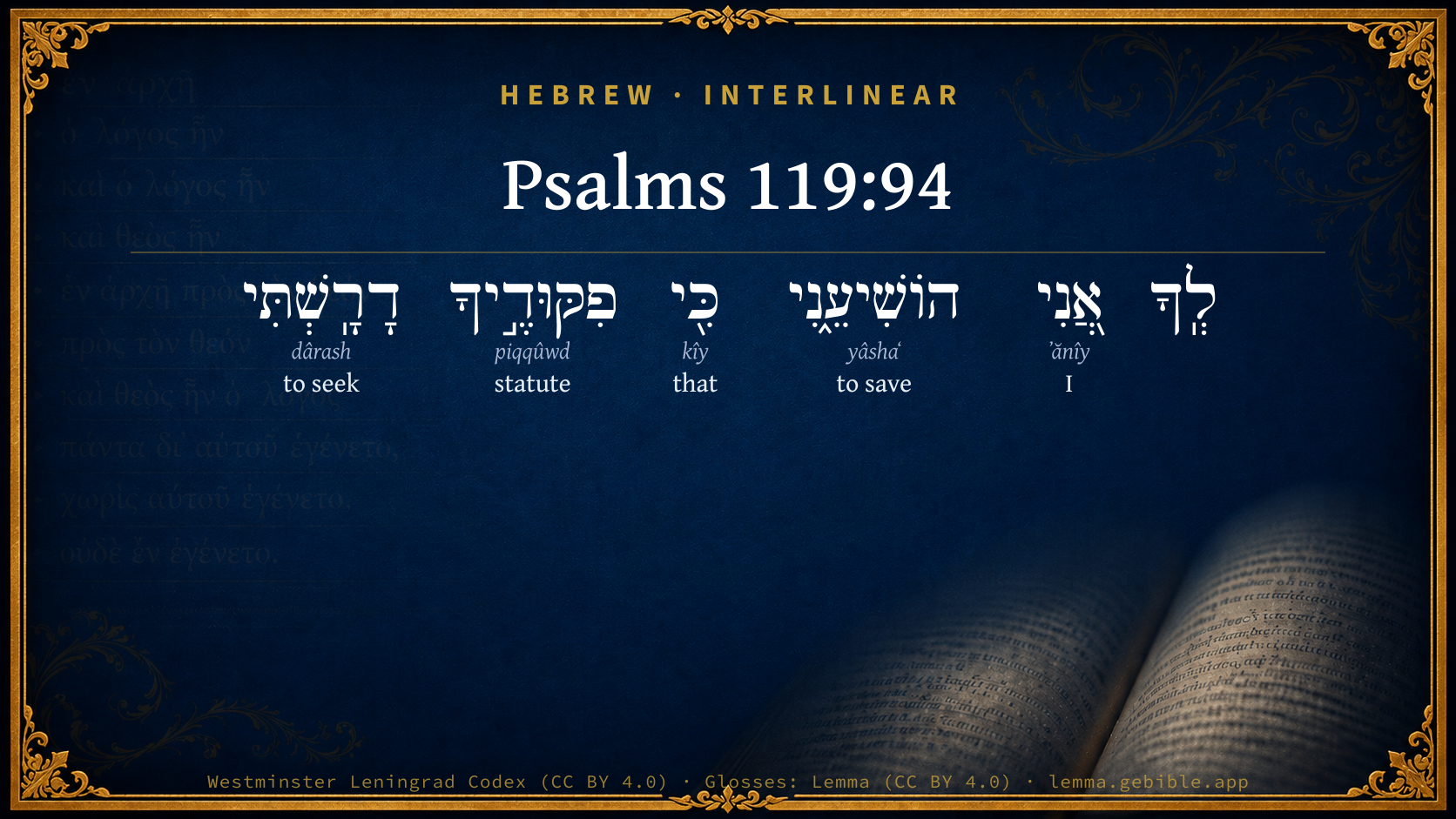
Psalms 119:94

Hebrew (Westminster Leningrad Codex) Psalms 119:94 appears in the Hebrew Old Testament. The text above is from the Westminster Leningrad Codex. Each word links to its Strong’s number, a concise gloss, and parsing drawn from the Open Scriptures Hebrew Bible morphology. Click any word for its full Brown-Driver-Briggs (BDB) entry.
Download image
Cite this verse

Psalms 119:94 (World English Bible). Public Domain. Lemma interlinear Bible study tool, https://lemma.gebible.app/v/psalms/119/94.

Show BibTeX & RIS
BibTeX
RIS
English Translation
I am yours. Save me, for I have sought your precepts.
World English Bible · Public Domain
Download a study sheet

One document with this verse’s original text, its word-by-word gloss line, the meaning frame, cross-references with their text, attributed commentary, and full source and license credits — printable, and it pastes into notes with its structure intact.

This verse Autodidact and up

Study sheet (.html) Plain text (.txt)

A passage Seminary Student

Up to 50 verses in one chapter. A passage sheet keeps up to 6 commentary sources and 12 cross-references per verse, in the order this page ranks them, and says so on the sheet whenever that leaves anything out. Ask for a single verse and you get the Autodidact verse sheet above.

Everything on this page stays free to read, with no account — the sheet is a download of what is already on screen, not access to it.

Want to remove ads? Support Godless Engineer
Compare translations 3

The same verse in 3 English versions, stacked beneath the original-language interlinear above. Click any original word for its lexicon entry.

Each is an independent rendering of the whole verse — the interlinear is not word-aligned to these translations.

Highlighted words mark where these versions differ — a whole-verse word diff, not a word-by-word alignment.

  • World English Bible Public Domain
    I am yours. Save me, for I have sought your precepts.
  • King James Version Public Domain
    I am thine, save me: for I have sought thy precepts.
  • unfoldingWord Literal Text CC BY-SA 4.0
    I am yours; save me, for I seek your precepts.

unfoldingWord Literal Text — © unfoldingWord, licensed CC BY-SA 4.0. Word-aligned USFM3 via Door43 (git.door43.org/unfoldingWord/en_ult).

Versions to compare (up to 4)

3 of 4 selected

Show all 17 translations

Every available English version of this verse, each an independent rendering of the whole verse.

  • World English Bible Public Domain
    I am yours. Save me, for I have sought your precepts.
  • Berean Standard Bible Public Domain
    I am Yours; save me, for I have sought Your precepts.
  • Majority Standard Bible Public Domain
    I am Yours; save me, for I have sought Your precepts.
  • King James Version Public Domain
    I am thine, save me: for I have sought thy precepts.
  • American Standard Version (1901) Public Domain
    I am thine, save me; For I have sought thy precepts.
  • Revised Version (1885) Public Domain
    I am thine, save me; for I have sought thy precepts.
  • Geneva Bible (1599) Public Domain
    I am thine, saue me: for I haue sought thy precepts.
  • Young's Literal Translation Public Domain
    I `am' Thine, save Thou me, For Thy precepts I have sought.
  • Literal Standard Version CC BY-SA 4.0
    I [am] Yours, save me, for I have sought Your precepts.
  • Unlocked Literal Bible CC BY-SA 4.0
    I am yours; save me, for I seek your instructions.
  • unfoldingWord Literal Text CC BY-SA 4.0
    I am yours; save me, for I seek your precepts.
  • Darby Bible Public Domain
    I am thine, save me; for I have sought thy precepts.
  • World Messianic Bible Public Domain
    I am yours. Save me, for I have sought your precepts.
  • Webster's Bible Public Domain
    I am thine, save me; for I have sought thy precepts.
  • Free Bible Version CC BY-SA 4.0
    I belong to you, so please save me! I am committed to following your rules.
  • Bible in Basic English Public Domain
    I am yours, O be my saviour; for my desire has been for your rules.
  • JPS Tanakh (1917) Public Domain
    I am Thine, save me; for I have sought Thy precepts.

Literal Standard Version (2020), Covenant Press — licensed CC BY-SA 4.0. Text via the HelloAO Bible API (eBible.org). Unlocked Literal Bible (unfoldingWord) — licensed CC BY-SA 4.0. Text via the HelloAO Bible API (eBible.org). unfoldingWord Literal Text — © unfoldingWord, licensed CC BY-SA 4.0. Word-aligned USFM3 via Door43 (git.door43.org/unfoldingWord/en_ult). Free Bible Version, Dr. Jonathan Gallagher — licensed CC BY-SA 4.0. Text via the HelloAO Bible API (eBible.org).

Word by word

More ways to search: Search by grammar → Find every occurrence → Compare this word →

Practice this passage: Drill this verse → Learn its vocabulary →

About this verse

These counts appear in no published source. They are computed here, from the morphology-tagged text and Lemma’s own curated glosses. What Lemma adds →

6
words
5
distinct lemmas
Wisdom
section

Notable vocabulary

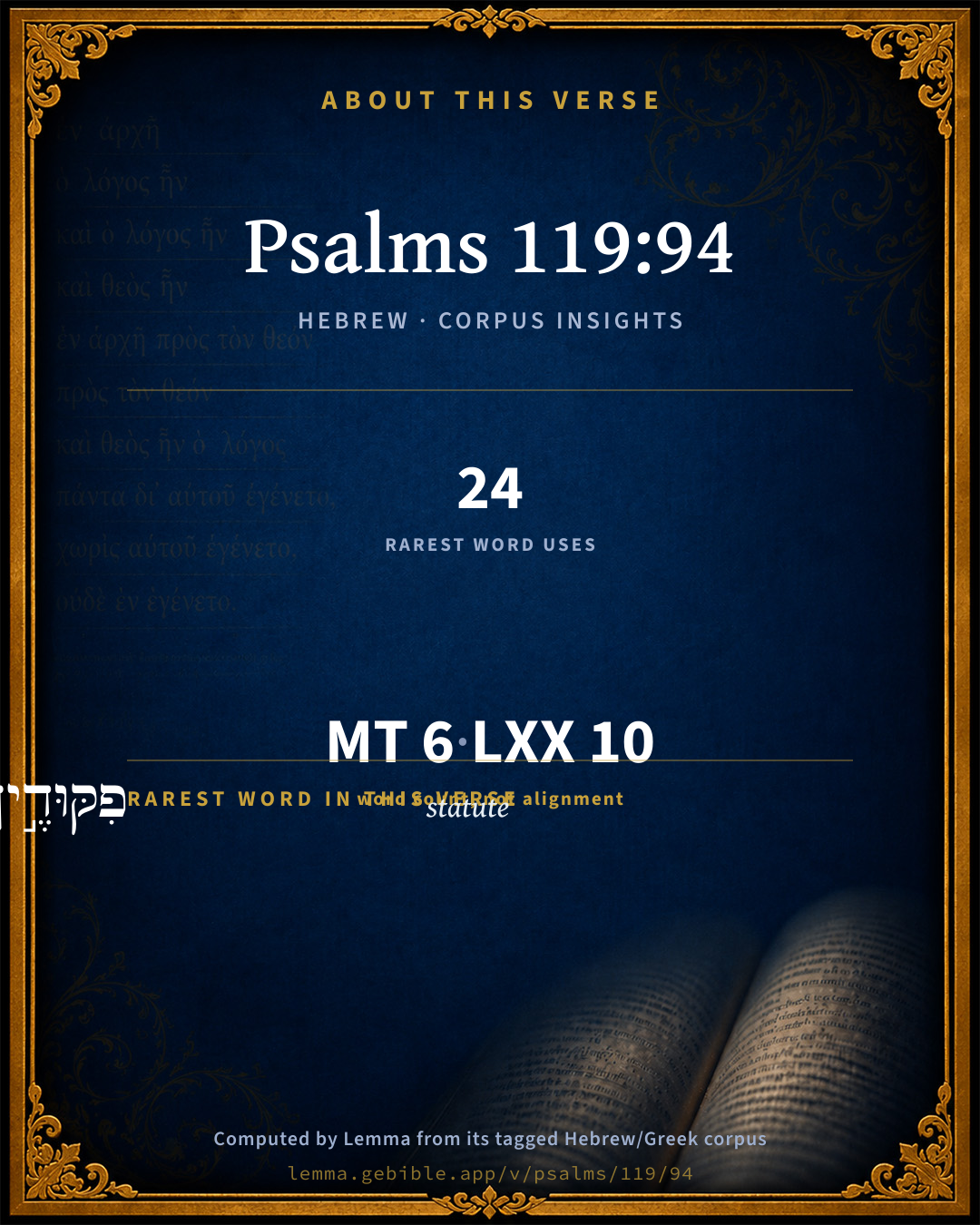
The rarest word here is פִקּוּדֶ֣יךָ statute H6490 — appearing just 24 times in the whole Hebrew Bible.

Shared distinctive vocabulary

פִקּוּדֶ֣יךָ statute H6490 occurs in 24 verses of the Hebrew Bible. Also found in:

Grammatical profile

  • 2 verbs
  • 1 noun
  • 1 pronoun
  • 1 preposition
  • 1 conjunction

Verb forms

  • הוֹשִׁיעֵ֑נִי Hiphil · Imperative
  • דָרָֽשְׁתִּי Qal · Perfect

Hebrew & Septuagint length

In English translation the verse runs 11 words from the Hebrew and 12 from the Septuagint (LXX English) — closely comparable.

A rough comparison of the two English renderings, which tokenize alike — not a word-level alignment.

Word counts can differ between the Hebrew and the Greek without any difference in meaning — e.g. the Hebrew direct-object marker אֵת has no separate Greek word, and Greek often adds the article ὁ.

In the original languages it is 6 Hebrew tokens and 10 Greek tokens — but the two are counted differently (Hebrew bundles its prefixes and suffixes into one token; the Greek is in lemma form), so that isn’t a like-for-like length.

Cross-references

11

Topical passages linked to Psalms 119:94 in the Treasury of Scripture Knowledge — connected by theme and wording, ordered by reader-vote popularity; previews shown in the World English Bible.

  • Zephaniah 3:17 Yahweh, your God, is in the midst of you, a mighty one who will save. He will rejoice over you with joy. He will rest in his love. He will rejoice over you with singing.
  • Psalms 86:2 Preserve my soul, for I am godly. You, my God, save your servant who trusts in you.
  • Psalms 119:27 Let me understand the teaching of your precepts! Then I will meditate on your wondrous works.
  • Isaiah 44:2 Thus says Yahweh who made you, and formed you from the womb, who will help you: Don't be afraid, Jacob my servant; and you, Jeshurun, whom I have chosen.
  • Isaiah 64:8–10 But now, Yahweh, you are our Father; we are the clay, and you our potter; and we all are the work of your hand.
  • Acts 27:23–24 For there stood by me this night an angel, belonging to the God whose I am and whom I serve,
  • Isaiah 44:5 One shall say, I am Yahweh's; and another shall call [himself] by the name of Jacob; and another shall subscribe with his hand to Yahweh, and surname [himself] by the name of Israel.
  • Joshua 10:4–6 Come up to me, and help me, and let us strike Gibeon; for it has made peace with Joshua and with the children of Israel.
  • Psalms 119:40 Behold, I long for your precepts! Revive me in your righteousness.
  • Psalms 119:173 Let your hand be ready to help me, For I have chosen your precepts.
  • Isaiah 41:8–10 But you, Israel, my servant, Jacob whom I have chosen, the seed of Abraham my friend,

Cross-references courtesy of OpenBible.info (CC BY 4.0).

Hebrew and Greek witnesses Masoretic Hebrew ↔ Greek Septuagint

The same verse in the two great witnesses to the Old Testament, shown verse-for-verse.

You’re reading Greek Psalm 118 (Hebrew Psalm 119). The Septuagint counts the superscription, so verse numbers can differ from the Hebrew — chapter-level alignment, not verse-by-verse. Numbering follows Rahlfs.

These are two independent witnesses, not word-aligned to each other, and the Septuagint is shown in lemma (dictionary) form.

Hebrew Psalms 119:94 Masoretic · Westminster Leningrad Codex

לְֽךָ אֲ֭נִי הוֹשִׁיעֵ֑נִי כִּ֖י פִקּוּדֶ֣יךָ דָרָֽשְׁתִּי

I am yours. Save me, for I have sought your precepts.

World English Bible · Public Domain

Greek LXX Greek Psalm 118:94 Septuagint · lemma form

σός εἰμί ἐγώ σώζω ἐγώ ὅτι ὁ δικαίωμα σύ ἐκζητέω

I am your, save me; for I have sought out your ordinances.

LXX2012 (modern English Septuagint) · Public Domain

Hebrew: Westminster Leningrad Codex (CC BY 4.0). Greek: Septuagint (public domain); English from LXX2012 (modern English Septuagint) (Public Domain). How the Septuagint differs from the Hebrew →

Commentary

Notes on Psalms 119:94 from classic Christian and Jewish commentators (each source and its license shown beneath its notes). The classic Christian expositions comment on the surrounding passage and are grouped to its opening verse, so a note may address several verses; the Jewish commentaries on the Tanakh (Rashi and others) are per-verse, so they appear only where the commentator wrote on this verse.

Lemma curates 59 commentaries, every one of them public domain or Creative Commons licensed, each selected and text-cleaned for this edition rather than reprinted as found. About our sources →

Trapp's Complete Commentary

John Trapp

Psa 119:94 I [am] thine, save me; for I have sought thy precepts.

Ver. 94. I am thine, save me] Every man will see to his own, unless he be worse than an infidel; and shall not God?

For I have sought thy precepts] And can thereby prove myself to be thine. Where it is implied that all that we are to seek in our obedience are the precepts themselves; the thing especially we are to aim at is obedience itself to the precepts.

John Trapp, A Commentary or Exposition upon All the Books of the Old and New Testament (1647–1656) — public domain. Text from a community e-Sword module.

The Biblical Illustrator

Joseph S. Exell

Psa_119:94

I am Thine, save me; for I have sought Thy precepts.

God the Owner and Saviour of man

I. Owner.

1. All men are His by necessity--

(1) Absolutely.

(2) Indefeasibly.

(3) For ever.

2. All good men are His by consecration. This surrender is mans primary duty, the one act necessary to give moral worth and acceptance to all acts in life.

II. Saviour. Save me--

1. From practically ignoring Thy claims.

2. From acting inconsistently with Thy claims. (Homilist.)

The believers plea

I. The relation to God which is claimed in the text.

1. Its origin.

2. Its dignity and blessedness.

3. The duties involved in it.

(1) Loyalty.

(2) Diligence.

(3) Obedience.

(4) Love.

4. The graces exemplified in pleading it.

(1) Humility.

(2) Faith.

(3) The spirit of adoption.

(4) Complete and implicit dependence.

(5) Love and devotion.

5. The evidence by which this relation is supported:--I have sought Thy precepts.

II. The plea which the psalmist founds upon his relation to God. Save me. It is a brief petition, but it comprehends every blessing. It is the craving after spiritual freedom; the longing to be delivered from the bondage of corruption and the body of death, the panting to be transformed, renewed and sanctified. (C. F. Childe, M. A.)

The Biblical Illustrator, edited by Joseph S. Exell (c. 1880s–1900s) — public domain. Text from a community e-Sword module.

J. A. Alexander on Psalms

Joseph Addison Alexander

94. (Psa 119:94) Thine am I—save me—for thy precepts I have sought. The original form of the first clause is, to thee (am) I. Sought, as in Psa 119:2; Psa 119:10; Psa 119:45.

Joseph Addison Alexander, The Psalms Translated and Explained (1850) — public domain. Text from a community e-Sword module.

Geneva Bible (1599)

Geneva Bible translators

He proveth by effect that he is God’s child, because he seeketh to understand his word.

Geneva Bible (1599) marginal notes — public domain. Text via Bolls.life.

Matthew Henry's Commentary

Here, 1. David claims relation to God: "I am thine, devoted to thee and owned by thee, thine in covenant." He does not say, Thou art mine (as Dr. Manton observes), though that follows of course, because that were a higher challenge; but, I am thine, expressing himself in a more humble and dutiful way of resignation; nor does he say, I am thus, but, I am thine, not pleading his own good property or qualification, but God's propriety in him: "I am thine, not my own, not the world's." 2. He proves his claim: "I have sought thy precepts; I have carefully enquired concerning my duty and diligently endeavoured to do it." This will be the best evidence that we belong to God; all that are his, though they have not found perfection, are seeking it. 3. He improves his claim: "I am thine; save me; save me from sin, save me from ruin." Those that have in sincerity given up themselves to God to be his may be sure that he will protect them and preserve them to his heavenly kingdom, Mal 3:18.

Matthew Henry's Commentary on the Whole Bible (1708–1710) — public domain (CC PDM 1.0). Text via the HelloAO Bible API.

Adam Clarke's Commentary

Verse 94. I am thine, save me] He who can say this need fear no evil. In all trials, temptations, dangers, afflictions, persecutions, I am thine. Thy enemies wish to destroy me! Lord, look to thy servant; thy servant looks to thee. O how sovereign is such a word against all the evils of life! I am THINE! therefore save thine OWN!

Adam Clarke's Commentary on the Bible (1810–1826) — public domain. Text from a community e-Sword/MySword module.

John Calvin's Commentaries

94. I am thine, save me. In the first place, he takes encouragement to pray from the consideration, that he is one of God’s own stamp and coinage, as we speak. In the second place, he proves that he is God’s from the fact of his keeping his commandments. This ought not, however, to be understood as if he boasted of any merit which he possessed; as, in dealing with men, it is customary to adduce something meritorious which we have done as an argument for obtaining what we desire: — I have always loved and esteemed you, I have always studied to promote your honor and advantage; my service has always been ready at your command. But David rather brings forward the unmerited grace of God, and that alone; for no man, by any efforts of his own, acquires the high honor of being under the protection of God — an honor which proceeds solely from his free adoption. The blessing which God had conferred upon him is therefore here adduced as an argument why he should not forsake the work which he had commenced. When he affirms, that he was earnestly intent upon the Divine commandments, that also depended upon the Divine calling; for he did not begin to apply his mind to God’s commandments before he was called and received into his household. As he desires, in this verse, that the Lord would save him, so, in the next verse, he expresses the need he had of being saved, saying, that the wicked sought for him to destroy him; by which he, at the same time, declares the constancy of his godliness, inasmuch as he then set his mind upon the law of God — a point worthy of special notice. Those who, at other times, would the forward and willing to follow God, know not to what side to turn themselves when they are assailed by the wicked, and, in that case, are very prone to follow unhallowed counsel. It is therefore a great virtue to do God the honor of resting contented with his promises alone, when the wicked conspire for our destruction, and when, to all human appearance, our life is in jeopardy. To consider God’s testimonies is, in this place, equivalent to applying our minds to the word of God, which sustains us against all assaults, effectually allays all fears, and restrains us from following any perverse counsels.

John Calvin's Commentaries (1540-1563) — public domain. Text from the Calvin Translation Society English edition (1840s-50s) via the Christian Classics Ethereal Library (ccel.org). Calvin's coverage is partial (roughly two-thirds of the Bible); uncommented books and verses are honest gaps, never fabricated. The 19th-century editor's footnotes and remarks are omitted so the notes are faithfully Calvin's own voice.

The Cambridge Bible for Schools and Colleges

gen. ed. J. J. S. Perowne

94. sought] Or, studied. Cp. Psa_119:45.

The Cambridge Bible for Schools and Colleges (gen. ed. J. J. S. Perowne; Cambridge University Press, 1878–1918) — public domain. Text from a community e-Sword module.

John Gill's Exposition

Thou through thy commandments hast made me wiser than mine enemies,.... David had his enemies, as every good man has: and these are often cunning and crafty ones, at least in wickedness; many of them are wise and prudent as to natural things, wiser in worldly things and political matters than the children of light, and often lay deep schemes and take crafty counsel against the saints; and yet they, by attending to the word and commands of God, and being under his direction and counsel, counterwork the designs of their enemies, and overturn their schemes and measures, which are brought to confusion; honesty being in the issue the best policy. However, the people of God are wiser than they in the best things; in the affair of salvation; in things relating to a future state, and their happiness there; which wisdom they attain unto through the Word of God, which is written for their learning; through the Scriptures, which are able to make men wise to salvation: these are the means, and no more; for it is God that is the efficient cause, or makes the means effectual, to make them wise, and wiser than others; it is owing to his divine teachings, to his Spirit and grace. The words may be rendered, "it hath made me wiser in thy commandments than mine enemies" (d); that is, the law; and so is another reason why it was so greatly loved by him: or, "thy commandments", that is, everyone of thy commandments, "have made me wiser", &c. (e). Joseph Kimchi give, this as the sense,

"by mine enemies thou hast made me wise (f); thou hast learned me thy commandments, so that I see they cannot remove thy law from my mouth;''

for they are ever with me; that is, the commandments of God, or his law, and the precepts of it; they were his privy counsellors, with whom on all occasions he consulted, and so became wiser than his enemies, and outwitted them: these were always near him, in his heart and in his mouth; he was ever thinking and speaking of them, and so did not forget the instructions they gave him; they were ever before his eyes, as the rule of his conduct.

(d) So Junius & Tremellius. (e) So Cocceius, Muis, Gejerus and the Targum. (f) "Fas est et ab hoste doceri", Ovid.

John Gill's Exposition of the Whole Bible (1746–1763) — public domain (CC PDM 1.0). Text via the HelloAO Bible API.

Albert Barnes' Notes on the Bible

I am thine - All that he had, and was, belonged to God. This is an expression of a fact, and of a purpose: a fact about which he had no doubt; a purpose ever to be the Lord’s. This is indicative of the real state of feeling in the heart of a pious man. He feels that he is the Lord’s; he has no other desire than to be his forever.

Save me - Deliver me from my enemies; from sin; from hell. As he belonged to God, he prayed that God would save and preserve his own.

For I have sought thy precepts - I feel assured or confident that this has been the aim and purpose of my life. On this ground I plead that thou wilt keep and preserve me. A man who feels assured that he is a friend of God has a right to appeal to him for protection, and he will not appeal to him in vain.

Albert Barnes' Notes on the Bible (1834–1885) — public domain. Text from a community e-Sword/MySword module.

Matthew Poole's English Annotations

I am thine by creation and redemption, and manifold obligations, as also by my own choice and designation. I have devoted myself to thy service, and committed myself to thy care.

Matthew Poole's English Annotations on the Holy Bible (1683–1685) — public domain. Text from a community e-Sword/MySword module.

The Treasury of David

Charles H. Spurgeon

Ver. 94. I am thine, save me. A comprehensive prayer with a prevailing argument. Consecration is a good plea for preservation. If we are conscious that we are the Lord's we may be confident that he will save us. We are the Lord's by creation, election, redemption, surrender, and acceptance; and hence our firm hope and assured belief that he will save us. A man will surely save his own child: Lord, save me. The need of salvation is better seen by the Lord's people than by any others, and hence their prayer "save me"; they know that only God can save them, and hence they cry to him alone; and they know that no merit can be found in themselves, and hence they urge a reason fetched from the grace of God, "I am thine." "For I have sought thy precepts." Thus had he proved that he was the Lord's. He might not have attained to all the holiness which he desired, but he had studiously aimed at being obedient to the Lord, and hence he begged to be saved even to the end. A man may be seeking the doctrines and the promises, and yet be unrenewed in heart; but to seek the precepts is a sure sign of grace; no one ever heard of a rebel or a hypocrite seeking the precepts. The Lord had evidently wrought a great work upon the Psalmist, and he besought him to carry it on to completion. Saving is linked with seeking, "save me, for I have sought"; and when the Lord sets us seeking he will not refuse us the saving. He who seeks holiness is already saved: if we have sought the Lord we may be sure that the Lord has sought us, and will certainly save us.

Ver. 94. I am thine, save me. David, a man after God's own heart, would be saved, but not after the manner of the men of this world, that would be saved to be their own and to enjoy themselves at their own will; but he in being saved would be God's, and at his disposing: "I am thine, save me."

There is a threefold strength in this argument.

1. The law of nature, which obliges a father to be good to his child, the husband to his wife, etc., and God hath subjected himself more unto the law of nature, he lies more under it, than any of these; and doth more perfectly, fully, and gloriously fulfil this law of nature than any; there is no father like him, no friend, no husband like him. "Can a woman forget her sucking child? Yet will I not forget thee:" Isa 44:15. A mother can hardly do it; nature teacheth her to have bowels, and a merciful remembrance towards her child; much, note will I, saith God.

2. When we can say to God, "I am thine, "we plead the covenant which God hath made with us, wherein he is become our father and friend: and this is that which was pleaded in Isa 63:16: "Doubtless thou art our father, though Abraham be ignorant of us, and Israel acknowledge us not (because they are gone, and so have no cognizance of us now); yet thou, O Lord, art our Father, our Redeemer; thy name is from everlasting." See what a conclusion here is made; doubtless thou art our Father, and therefore we call to thee for help.

3. There is this encouragement and strength that the spirit of, a man receives in thus arguing with God, that if he can say in truth, "I am thine, "God much more will say to the creature, "I am thine." If we have so much love to offer ourselves to God, to become his; much more will the love of God make him to become ours; for God loves first, and most, and surest. If mine heart rise toward God, much more is the heart of God toward me; because there love is in the fountain. Never did a spouse speak to her husband, whom her soul loved to the highest, more willingly, and say, "I am thine, "than the spirit of an upright man saith to God, "Lord, I am thine." And he loves him with a love of thankfulness. Hast thou given thyself to me, saith he, and shall I then withhold myself from thee? Hast thou, who art so great, done all this for me, and shall I stand out against thee? The gracious man will willingly acknowledge himself to be the Lord's. The saints often do this: David above twenty times comes with this acknowledgment in this psalm, and in Ps 116:16: "I am thy servant; I am thy servant." To say it once was not enough; he saith it again, to show the sincerity of his spirit, and to witness that his heart was fully pleased with this, that he was not his own, but the Lord's. The knowledge of our interest in God doth much further our approaches to God. When a man is once assured, and can say with a clear spirit, "I am thine, "he will naturally cry, "Save me." Such a man is a man of prayer, he is much in addresses to God, and conversing with him. Joseph Symonds, 1653.

Ver. 94. I am thine. This is an excellent motive to draw from the Lord help in trouble, "I am thine." Thine by creation, I was made by thee; thine by adoption, I was assigned over to thee; thine by donation, I was given to thee; thine by marriage, I was espoused to thee; thine by redemption, I was purchased by thee; thine by stipulation, I have vowed myself unto thee. Richard Greenham.

Ver. 94. For I have sought thy precepts. See here how David qualifies his protestation: from his earnest affection to l he word of God, he proves that he was God's man and not his own servant. It is not words, but affections and actions which must prove us to be the Lord's. Tuus sum, quia id solum qued tuum est quaesivi:I am thine because I sought nothing but that which is thine, and how I might please thee. Mihi in tuis justificationibus est omne poatrimonium:in the observance of thy precepts is all my patrimony. William Cowper.

Ver. 94.

1. David claims relation to God: "I am thine" devoted to thee, and owned by thee, thine in covenant.

2. He proves his claim: "I am thine, save me; for Y have sought thy precepts"; i.e., I have carefully enquired concerning my duty, and diligently endeavoured to do it.

3. He Improves. His claim: "I am thine, save me." Save me from sin, save me from ruin. Mr. Henry.

Ver. 94

1. A great prayer: "Save me."

2. A grand prayer: "I am thine."

3. A gracious experience: "I have sought, "etc.

Ver. 94.

1. Relation: "I am thine."

2. Preservation: "save me."

3. Obligation: "I have sought, "etc. G.R.

Ver. 94.

1. God's child humbly points out to him his responsibility: "I am thine."

2. Ventures to urge his own sincerity: he has at least "sought."

3. With these two hands extended, he utters a sharp cry for help: "save me." W.B.H.

Ver. 94. Multum in parvo.

1. A profession.

2. A prayer.

3. A plea. C.A.D.

Ver. 94.

1. God's interest in us.

2. Our interest in God. W.D.

Ver. 94. The characteristics of personal religion.

1. Personal devotedness to God: "I am thine."

2. Personal obedience rendered: "I have sought thy precepts."

3. Personal expectation cherished: "save me." J.F.

Ver. 94. The courage obedience gives.

1. It emboldens us to a firm assurance: "I am thine, for I have, " etc.

(a) We become God's by faith alone.

(b) But the assurance of being his cannot exist without

obedience; obedience proves the faith to ourselves;

satisfies us concerning grace received.

(c) Poor obedience always interferes with assurance.

2. It emboldens us to pray, and in prayer: "Save me."

(a) The Christian's prayers are only of faith and offered

in faith.

(b) Yet disobedience makes: him shrink from approaching God

in prayer, and renders him feeble in petitioning.

(c) Obedience is humble but bold. The middle clause of the

text applies equally to the first and third clauses. J.F.

Psalms 119:95*

Charles H. Spurgeon's The Treasury of David (1869–1885) — public domain. Psalms only. Text from a community e-Sword/MySword module.

The Pulpit Commentary

I am thine, save me. "Save me," i.e. as being thine own thy true servant and follower. For I have sought thy precepts. And thus shown my fidelity.

The Pulpit Commentary (1880–1919), ed. H.D.M. Spence-Jones & Joseph S. Exell — public domain. Text from a community e-Sword module.

Lesson kit

Teaching starters — assembled from the data on this page, not authored interpretation. Every prompt links to the verse data it draws on. Edit before teaching.

Psalms, in the Wisdom, opens this verse with 6 words (5 distinct Hebrew lemmas). Its most distinctive word is piqqûwd (“statute”). A historical commentator’s framing appears above. Read the whole chapter for the surrounding context.

Discussion questions

  1. What does “statute” (piqqûwd) contribute to the verse as a whole?
  2. Psalms 19:8 shares the word «statute» with this verse. How do the two illuminate each other?
  3. The translations on this page render this verse differently — a whole-verse word diff, not a word-by-word alignment. What might account for the different wordings?
  4. The verb «הוֹשִׁיעֵ֑נִי» is Hiphil Imperative. How does its form color the action?
  5. Reading how Trapp's Complete Commentary and The Biblical Illustrator read this verse, where do the two commentators agree and where do they part?

Things to notice

Reading settings

Reading text

Shown beneath each verse's original-language words.

Old Testament
Old Testament edition

Read the OT as the Masoretic Hebrew (MT) or the Greek Septuagint (LXX).

English shown for the Greek Septuagint (in the Hebrew ↔ Greek comparison).

Comparing translations? Open the Compare panel on any verse page to stack up to four side by side.