Jeremiah 23:6

Hebrew (Westminster Leningrad Codex) Jeremiah 23:6 appears in the Hebrew Old Testament. The text above is from the Westminster Leningrad Codex. Each word links to its Strong’s number, a concise gloss, and parsing drawn from the Open Scriptures Hebrew Bible morphology. Click any word for its full Brown-Driver-Briggs (BDB) entry.
Download image
Cite this verse

Jeremiah 23:6 (World English Bible). Public Domain. Lemma interlinear Bible study tool, https://lemma.gebible.app/v/jeremiah/23/6.

Show BibTeX & RIS
BibTeX
RIS
English Translation
In his days Judah shall be saved, and Israel shall dwell safely; and this is his name by which he shall be called: Yahweh our righteousness.
World English Bible · Public Domain
Download a study sheet

One document with this verse’s original text, its word-by-word gloss line, the meaning frame, cross-references with their text, attributed commentary, and full source and license credits — printable, and it pastes into notes with its structure intact.

This verse Autodidact and up

Study sheet (.html) Plain text (.txt)

A passage Seminary Student

Up to 50 verses in one chapter. A passage sheet keeps up to 6 commentary sources and 12 cross-references per verse, in the order this page ranks them, and says so on the sheet whenever that leaves anything out. Ask for a single verse and you get the Autodidact verse sheet above.

Everything on this page stays free to read, with no account — the sheet is a download of what is already on screen, not access to it.

Want to remove ads? Support Godless Engineer
Compare translations 3

The same verse in 3 English versions, stacked beneath the original-language interlinear above. Click any original word for its lexicon entry.

Each is an independent rendering of the whole verse — the interlinear is not word-aligned to these translations.

Highlighted words mark where these versions differ — a whole-verse word diff, not a word-by-word alignment.

  • World English Bible Public Domain
    In his days Judah shall be saved, and Israel shall dwell safely; and this is his name by which he shall be called: Yahweh our righteousness.
  • King James Version Public Domain
    In his days Judah shall be saved, and Israel shall dwell safely: and this is his name whereby he shall be called, THE LORD OUR RIGHTEOUSNESS.
  • unfoldingWord Literal Text CC BY-SA 4.0
    In his days Judah will be saved, and Israel will dwell in safety. And this his name by which he will be called: ‘Yahweh our righteousness.’” p

unfoldingWord Literal Text — © unfoldingWord, licensed CC BY-SA 4.0. Word-aligned USFM3 via Door43 (git.door43.org/unfoldingWord/en_ult).

Versions to compare (up to 4)

3 of 4 selected

Show all 18 translations

Every available English version of this verse, each an independent rendering of the whole verse.

  • World English Bible Public Domain
    In his days Judah shall be saved, and Israel shall dwell safely; and this is his name by which he shall be called: Yahweh our righteousness.
  • Berean Standard Bible Public Domain
    In His days Judah will be saved, and Israel will dwell securely. And this is His name by which He will be called: The LORD Our Righteousness.
  • Majority Standard Bible Public Domain
    In His days Judah will be saved, and Israel will dwell securely. And this is His name by which He will be called: The LORD Our Righteousness.
  • King James Version Public Domain
    In his days Judah shall be saved, and Israel shall dwell safely: and this is his name whereby he shall be called, THE LORD OUR RIGHTEOUSNESS.
  • American Standard Version (1901) Public Domain
    In his days Judah shall be saved, and Israel shall dwell safely; and this is his name whereby he shall be called: Jehovah our righteousness.
  • Revised Version (1885) Public Domain
    In his days Judah shall be saved, and Israel shall dwell safely: and this is his name whereby he shall be called, The LORD is our righteousness.
  • Geneva Bible (1599) Public Domain
    In his dayes Iudah shalbe saued, and Israel shall dwell safely, and this is the Name wherby they shall call him, The Lord our righteousnesse.
  • Douay-Rheims (1899) Public Domain
    In those days shall Juda be saved, and Israel shall dwell confidently: and this is the name that they shall call him: the Lord our just one.
  • Young's Literal Translation Public Domain
    In his days is Judah saved, and Israel dwelleth confidently, And this his name that Jehovah proclaimeth him, `Our Righteousness.'
  • Literal Standard Version CC BY-SA 4.0
    Judah is saved in His days, and Israel dwells confidently, || And this [is] His Name that YHWH proclaims Him: Our Righteousness.
  • Unlocked Literal Bible CC BY-SA 4.0
    In his days Judah will be rescued, and Israel will live in security. Then this is the name by which he will be called: Yahweh is our righteousness.
  • unfoldingWord Literal Text CC BY-SA 4.0
    In his days Judah will be saved, and Israel will dwell in safety. And this his name by which he will be called: ‘Yahweh our righteousness.’” p
  • Darby Bible Public Domain
    In his days Judah shall be saved, and Israel shall dwell in safety; and this is his name whereby he shall be called, Jehovah our Righteousness.
  • World Messianic Bible Public Domain
    In his days Judah will be saved, and Israel will dwell safely. This is his name by which he will be called: The LORD our righteousness.
  • Webster's Bible Public Domain
    In his days Judah shall be saved, and Israel shall dwell in safety: and this is his name by which he shall be called, JEHOVAH OUR RIGHTEOUSNESS.
  • Free Bible Version CC BY-SA 4.0
    When he is king, Judah will be saved, and Israel will live in safety. This is the name he will be called: The Lord Who Makes Us Right.
  • Bible in Basic English Public Domain
    In his days Judah will have salvation and Israel will be living without fear: and this is the name by which he will be named, The Lord is our righteousness.
  • JPS Tanakh (1917) Public Domain
    In his days Judah shall be saved, and Israel shall dwell safely; and this is his name whereby he shall be called, The LORD is our righteousness.

Literal Standard Version (2020), Covenant Press — licensed CC BY-SA 4.0. Text via the HelloAO Bible API (eBible.org). Unlocked Literal Bible (unfoldingWord) — licensed CC BY-SA 4.0. Text via the HelloAO Bible API (eBible.org). unfoldingWord Literal Text — © unfoldingWord, licensed CC BY-SA 4.0. Word-aligned USFM3 via Door43 (git.door43.org/unfoldingWord/en_ult). Free Bible Version, Dr. Jonathan Gallagher — licensed CC BY-SA 4.0. Text via the HelloAO Bible API (eBible.org).

Word by word

More ways to search: Search by grammar → Find every occurrence → Compare this word →

Practice this passage: Drill this verse → Learn its vocabulary →

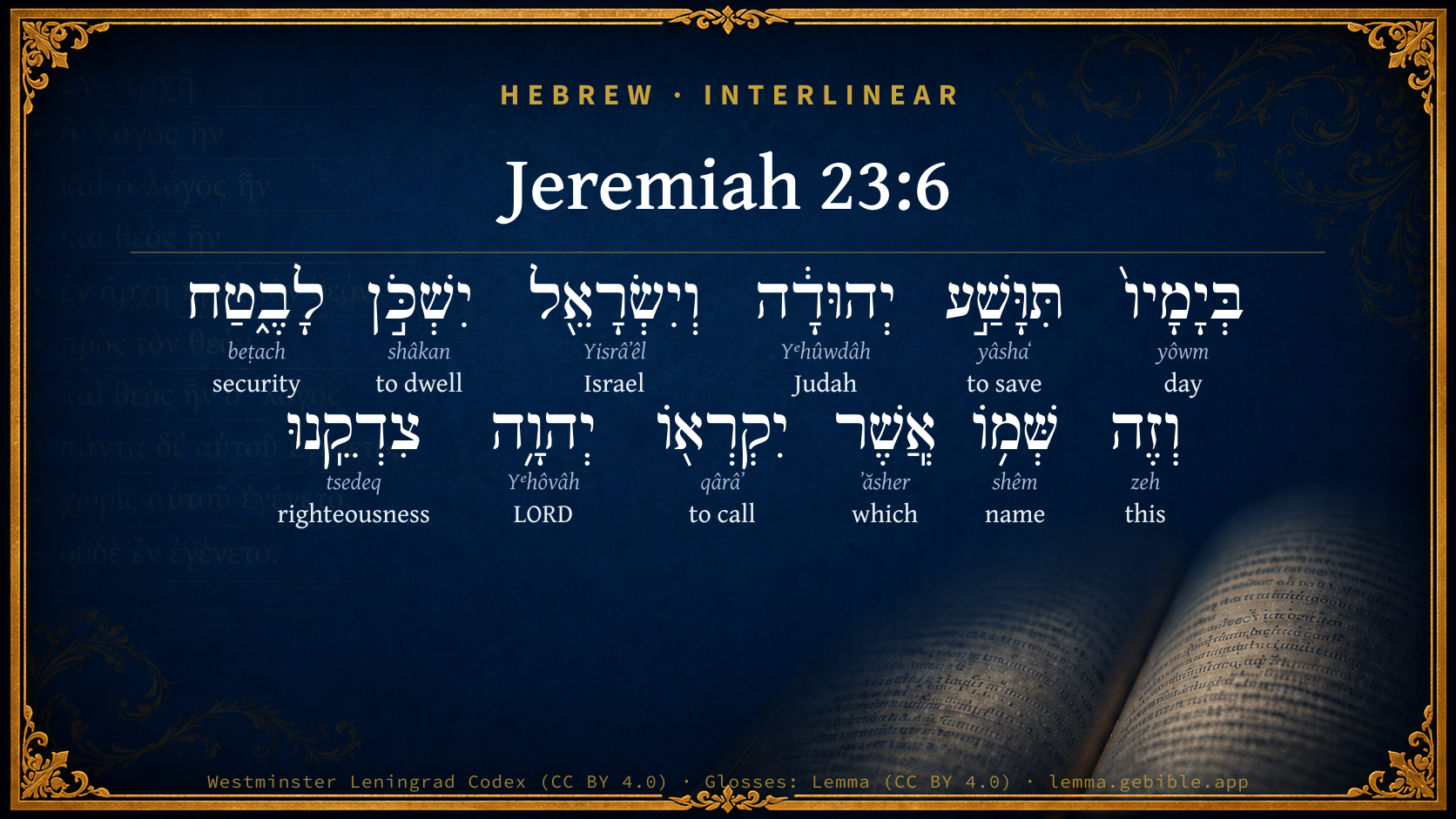
לָבֶ֑טַח
beṭach
H983
“to/for · security”
Preposition + Noun, Common, Masculine, Singular, Absolute
Part of Speech
Preposition + Noun
Type
Common
Gender
Masculine
Number
Singular
State
Absolute
Full BDB Definition

Origin: from H982

TWOT: 233a

security, safety - securely
  1. בְּיָמָיו֙ yôwm H3117 “in/at · days · his” Preposition + Noun, Common, Masculine, Plural, Construct + Suffix, Personal, 3rd Person, Masculine, Singular
  2. תִּוָּשַׁ֣ע yâshaʻ H3467 “to save” Verb, Niphal, Imperfect, 3rd Person, Feminine, Singular
  3. יְהוּדָ֔ה Yᵉhûwdâh H3063 “Judah” Noun, Proper
  4. וְיִשְׂרָאֵ֖ל Yisrâʼêl H3478 “and · Israel” Conjunction + Noun, Proper
  5. יִשְׁכֹּ֣ן shâkan H7931 “to dwell” Verb, Qal, Imperfect, 3rd Person, Masculine, Singular
  6. וְזֶה zeh H2088 “and · this” Conjunction + Pronoun, Demonstrative, Masculine, Singular
  7. שְּׁמ֥וֹ shêm H8034 “name · his” Noun, Common, Masculine, Singular, Construct + Suffix, Personal, 3rd Person, Masculine, Singular
  8. אֲֽשֶׁר ʼăsher H834 “which” Particle, Relative
  9. יִקְרְא֖וֹ qârâʼ H7121 “to call · him” Verb, Qal, Imperfect, 3rd Person, Masculine, Singular + Suffix, Personal, 3rd Person, Masculine, Singular
  10. יְהוָ֥ה Yᵉhôvâh H3068 “LORD” Noun, Proper
  11. צִדְקֵֽנוּ tsedeq H6664 “righteousness · our” Noun, Common, Masculine, Singular, Construct + Suffix, Personal, 1st Person, Common, Plural

About this verse

These counts appear in no published source. They are computed here, from the morphology-tagged text and Lemma’s own curated glosses. What Lemma adds →

12
words
12
distinct lemmas
Prophets
section

Shared distinctive vocabulary

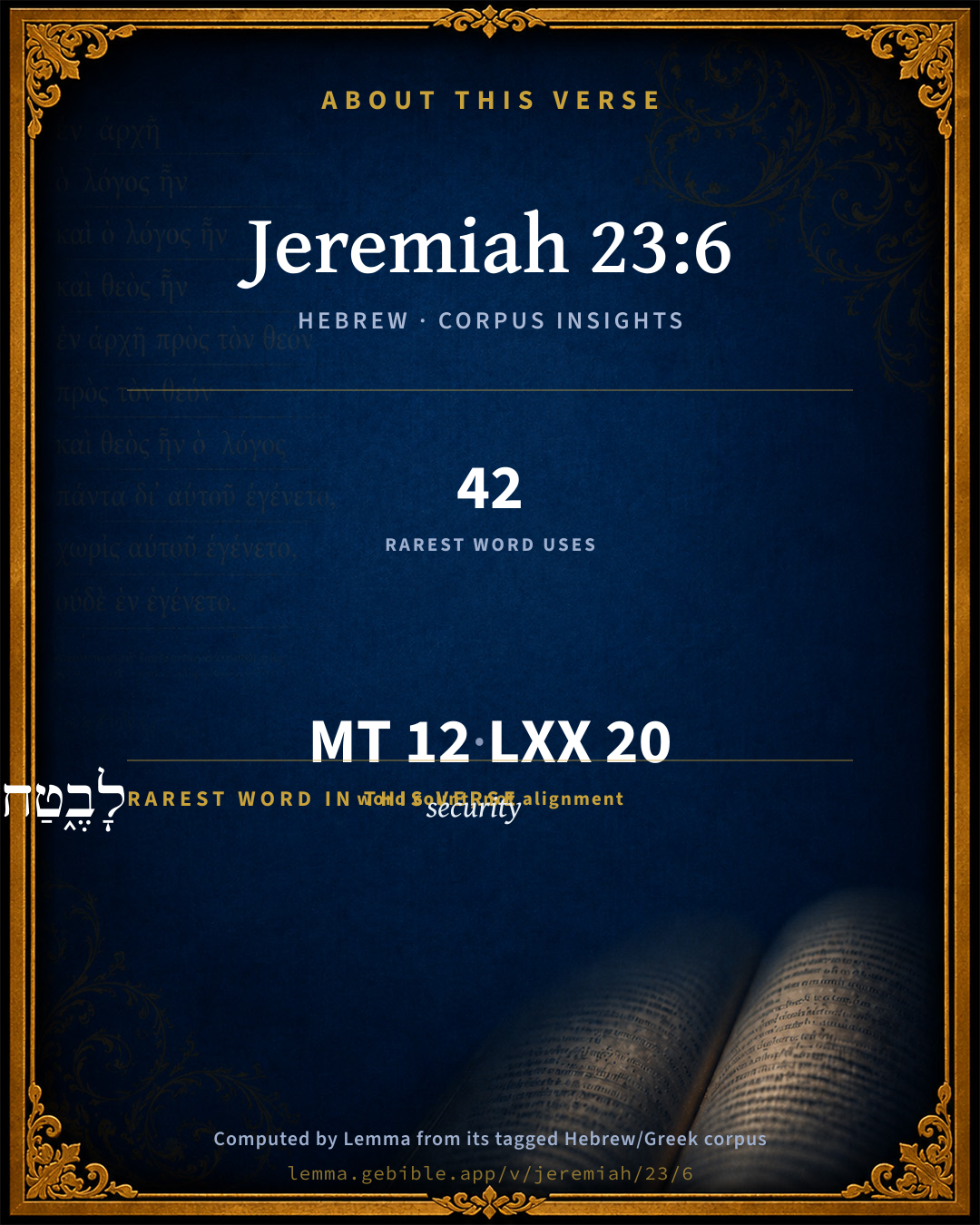
לָבֶ֑טַח security H983 occurs in 41 verses of the Hebrew Bible. Also found in:

Grammatical profile

  • 3 verbs
  • 7 nouns
  • 1 pronoun
  • 1 particle

Verb forms

  • תִּוָּשַׁ֣ע Niphal · Imperfect
  • יִשְׁכֹּ֣ן Qal · Imperfect
  • יִקְרְא֖וֹ Qal · Imperfect

Hebrew & Septuagint length

In the original languages it is 12 Hebrew tokens and 20 Greek tokens — but the two are counted differently (Hebrew bundles its prefixes and suffixes into one token; the Greek is in lemma form), so that isn’t a like-for-like length.

Cross-references

35

Topical passages linked to Jeremiah 23:6 in the Treasury of Scripture Knowledge — connected by theme and wording, ordered by reader-vote popularity; previews shown in the World English Bible.

  • 1 Corinthians 1:30 But of him, you are in Christ Jesus, who was made to us wisdom from God, and righteousness and sanctification, and redemption:
  • Philippians 3:9 and be found in him, not having a righteousness of my own, that which is of the law, but that which is through faith in Christ, the righteousness which is from God by faith;
  • Jeremiah 33:16 In those days shall Judah be saved, and Jerusalem shall dwell safely; and this is [the name] by which she shall be called: Yahweh our righteousness.
  • Matthew 1:21–23 She shall bring forth a son. You shall call his name Jesus, for it is he who shall save his people from their sins."
  • Isaiah 7:14 Therefore the Lord himself will give you a sign. Behold, the virgin will conceive, and bear a son, and shall call his name Immanuel.
  • Isaiah 54:17 No weapon that is formed against you shall prosper; and every tongue that shall rise against you in judgment you shall condemn. This is the heritage of the servants of Yahweh, and their righteousness which is of me, says Yahweh.
  • Daniel 9:24 Seventy weeks are decreed on your people and on your holy city, to finish disobedience, and to make an end of sins, and to make reconciliation for iniquity, and to bring in everlasting righteousness, and to seal up vision and prophecy, and to anoint the most holy.
  • Romans 3:22 even the righteousness of God through faith in Jesus Christ to all and on all those who believe. For there is no distinction,
  • Romans 11:26–27 and so all Israel will be saved. Even as it is written, "There will come out of Zion the Deliverer, And he will turn away ungodliness from Jacob.
  • Deuteronomy 33:28–29 Israel dwells in safety, The fountain of Jacob alone, In a land of grain and new wine; Yes, his heavens drop down dew.
  • Psalms 130:7–8 Israel, hope in Yahweh, For with Yahweh there is loving kindness. With him is abundant redemption.
  • Jeremiah 32:37 Behold, I will gather them out of all the countries, where I have driven them in my anger, and in my wrath, and in great indignation; and I will bring them again to this place, and I will cause them to dwell safely:
  • Isaiah 9:6 For to us a child is born, to us a son is given; and the government shall be on his shoulder: and his name shall be called Wonderful, Counselor, Mighty God, Everlasting Father, Prince of Peace.
  • Jeremiah 30:10 Therefore don't you be afraid, O Jacob my servant, says Yahweh; neither be dismayed, Israel: for, behold, I will save you from afar, and your seed from the land of their captivity; and Jacob shall return, and shall be quiet and at ease, and none shall make him afraid.
  • Zechariah 14:9–11 Yahweh will be King over all the earth. In that day Yahweh will be one, and his name one.
  • Luke 19:9–10 Jesus said to him, "Today, salvation has come to this house, because he also is a son of Abraham.
  • 2 Corinthians 5:21 For him who knew no sin he made to be sin on our behalf; so that in him we might become the righteousness of God.
  • Zechariah 2:4–5 and said to him, "Run, speak to this young man, saying, 'Jerusalem will be inhabited as villages without walls, because of the multitude of men and cattle in it.
  • Zechariah 10:6 "I will strengthen the house of Judah, And I will save the house of Joseph, And I will bring them back; For I have mercy on them; And they will be as though I had not cast them off: For I am Yahweh their God, and I will hear them.
  • Luke 1:71–74 Salvation from our enemies, and from the hand of all who hate us;
  • Isaiah 12:1–2 In that day you will say, "I will give thanks to you, Yahweh; for though you were angry with me, your anger has turned away and you comfort me.
  • Isaiah 35:9 No lion shall be there, nor shall any ravenous animal go up thereon; they shall not be found there; but the redeemed shall walk [there]:
  • Isaiah 45:24–25 Only in Yahweh, it is said of me, is righteousness and strength; even to him shall men come; and all those who were incensed against him shall be disappointed.
  • Ezekiel 34:25–28 I will make with them a covenant of peace, and will cause evil animals to cease out of the land; and they shall dwell securely in the wilderness, and sleep in the woods.
  • Ezekiel 37:24–28 My servant David shall be king over them; and they all shall have one shepherd: they shall also walk in my ordinances, and observe my statutes, and do them.
  • Hosea 1:7 But I will have mercy on the house of Judah, and will save them by Yahweh their God, and will not save them by bow, nor by sword, nor by battle, by horses, nor by horsemen."
  • Hosea 2:18 In that day I will make a covenant for them with the animals of the field, And with the birds of the sky, And with the creeping things of the ground. I will break the bow, the sword, and the battle out of the land, And will make them lie down safely.
  • Obadiah 1:17 But in Mount Zion, there will be those who escape, and it will be holy. The house of Jacob will possess their possessions.
  • Obadiah 1:21 Saviors will go up on Mount Zion to judge the mountains of Esau, and the kingdom will be Yahweh's.
  • Zephaniah 3:13 The remnant of Israel will not do iniquity, nor speak lies, neither will a deceitful tongue be found in their mouth, for they will feed and lie down, and no one will make them afraid."
  • Zechariah 3:10 In that day,' says Yahweh of hosts, 'you will invite every man his neighbor under the vine and under the fig tree.'"
  • 1 Kings 4:25 Judah and Israel lived safely, every man under his vine and under his fig tree, from Dan even to Beersheba, all the days of Solomon.
  • Isaiah 2:4 He will judge between the nations, And will decide concerning many peoples; And they shall beat their swords into plowshares, And their spears into pruning-hooks. Nation shall not lift up sword against nation, Neither shall they learn war any more.
  • Isaiah 33:22 For Yahweh is our judge, Yahweh is our lawgiver, Yahweh is our king; he will save us.
  • Isaiah 45:17 [But] Israel shall be saved by Yahweh with an everlasting salvation: you shall not be disappointed nor confounded world without end.

Cross-references courtesy of OpenBible.info (CC BY 4.0).

Hebrew and Greek witnesses Masoretic Hebrew ↔ Greek Septuagint

The same verse in the two great witnesses to the Old Testament, shown verse-for-verse.

These are two independent witnesses, not word-aligned to each other, and the Septuagint is shown in lemma (dictionary) form.

Hebrew Jeremiah 23:6 Masoretic · Westminster Leningrad Codex

בְּיָמָיו֙ תִּוָּשַׁ֣ע יְהוּדָ֔ה וְיִשְׂרָאֵ֖ל יִשְׁכֹּ֣ן לָבֶ֑טַח וְזֶה שְּׁמ֥וֹ אֲֽשֶׁר יִקְרְא֖וֹ יְהוָ֥ה צִדְקֵֽנוּ

In his days Judah shall be saved, and Israel shall dwell safely; and this is his name by which he shall be called: Yahweh our righteousness.

World English Bible · Public Domain

Greek LXX Structure differs

In the Septuagint, Jeremiah is about an eighth shorter than the Hebrew and arranges its material differently — the Oracles Against the Nations (Hebrew chapters 46–51) appear in the middle of the Greek book, after 25:13. Because the chapter and verse boundaries do not line up, a verse-for-verse comparison with the Hebrew is not shown.

A verse-for-verse comparison isn’t shown here because the chapters and verses don’t line up. Switch to the LXX edition with the MT / LXX toggle above to read the Greek directly.

On this verse, Keil & Delitzsch discusses the Septuagint’s reading. Read the note in Commentary ↓

Hebrew: Westminster Leningrad Codex (CC BY 4.0). Greek: Septuagint (public domain); English from a public-domain English Septuagint. How the Septuagint differs from the Hebrew →

Targum (Aramaic paraphrase)

1

The Targum is the ancient Jewish Aramaic paraphrase of the Hebrew Scriptures — an interpretive translation, not the Hebrew text itself. Onkelos (literal) and Pseudo-Jonathan (expansive) render the Torah, and Jonathan the Prophets. Coverage is partial: where no permissively-licensed English translation exists for a verse, only the Aramaic is shown. This is verse-level text, not a word-by-word alignment to the Hebrew.

  1. Targum Jonathan Prophets (Joshua–Malachi)
    בְּיוֹמוֹהִי יִתְפָּרְקוּן דְבֵית יְהוּדָה וְיִשְׂרָאֵל יִשְׁרֵי לְרָחֲצָן וְדֵין שְׁמֵיהּ דִיהוֹן קָרָן לֵיהּ יִתְעַבְּדָן לָנָא זַכְוָן מִן קֳדָם יְיָ בְּיוֹמוֹהִי:

    (no public-domain English translation for this verse)

    Targum Jonathan — Aramaic: “Mikraot Gedolot” (public domain). English: “Sefaria Community Translation” (CC0 1.0 (public-domain dedication)); “London "Chaldee Paraphrase," 1871” (public domain). Text via Sefaria.

Commentary

Notes on Jeremiah 23:6 from classic Christian and Jewish commentators (each source and its license shown beneath its notes). The classic Christian expositions comment on the surrounding passage and are grouped to its opening verse, so a note may address several verses; the Jewish commentaries on the Tanakh (Rashi and others) are per-verse, so they appear only where the commentator wrote on this verse.

Lemma curates 59 commentaries, every one of them public domain or Creative Commons licensed, each selected and text-cleaned for this edition rather than reprinted as found. About our sources →

Trapp's Complete Commentary

John Trapp

Jer 23:6 In his days Judah shall be saved, and Israel shall dwell safely: and this [is] his name whereby he shall be called, THE LORD OUR RIGHTEOUSNESS.

Ver. 6. This is the name whereby he shall be called, The Lord our Righteousness.] Jehovah Tsidkenu. {a} This is a most mellifluous and sweet name of our Lord Jesus Christ, importing his Godhead, as the righteous Branch of David {Jer 23:5} did his manhood; and besides assuring us that as he hath for us fulfilled all righteousness, {Mat 3:15} so he is by God made unto us righteousness, {1Co 1:30} and that we are become the righteousness of God in him. {2Co 5:21} This one name of Christ is a strong tower; {Pro 18:10} it is such as will answer all our doubts and objections, were they never so many, had we but skill to spell all the letters in it. Cyprian was wont to comfort his friends thus, Venit Antichristus, sed superveniet Christus; Antichrist will come, but then Christ will be at the heels of him. We may well comfort ourselves against all evils and enemies with this consideration, Christ is "Jehovah our righteousness." God hath "laid help on one that is mighty," and he came to "bring in everlasting righteousness." {Dan 9:24} Why then should we "fear in the days of evil, when the iniquities of our heels shall compass us about." {Psa 49:5} Domine Satan, saith Luther somewhere, nihil me movent minae terrores tui; est enim unus qui vocatur Iehovah iustitia nostra, in quem credo: Is legem abrogavit, peccatum damnavit, mortem abolevit, infernum destruxit, estque O Satan, Satan tuus {b} - that is, You, Sir Satan, your menaces and terrors trouble me not. For why? There is one whose name is called the Lord our righteousness, on whom I believe. He it is who hath abrogated the law, condemned, sin, abolished death, destroyed hell, and is a Satan to thee, O Satan. Surely this brave saying of Luther may well be reckoned among such of his sentences as a man would fetch, rather than be without them, upon his knees from Rome or Jerusalem.

{a} Vocat Scriptura nomen Messiae Iehova Tsidkenu, quia erit Mediator Deus, per cuius manus consecuturi sumus iustitiam a Deo ipso, inquit Rabbinus quidam in lib. Ikharim.

{b} Luth., tom. iv. fol. 55 A.

John Trapp, A Commentary or Exposition upon All the Books of the Old and New Testament (1647–1656) — public domain. Text from a community e-Sword module.

The Pulpit Commentary

Israel shall dwell safely. In the parallel passage (Jer_33:16) we read "Jerusalem," and there can hardly be a doubt that "Jerusalem" ought to be restored here. This is not the only instance in which, by mistake, the scribe has written "Israel" instead of "Jerusalem". (Jer_32:30, 32 51:49 Zep_3:14 Zec_12:1) In Zec_1:19 the scribe discovered his mistake, and wrote the right word, "Jerusalem," after the wrong one, "Israel," but without canceling the latter (Gratz, "Monatsschrift," 1880, pp. 97-101). And this is his name whereby he shall be called. There is a various reading, which may be rendered either, whereby they shall call (him , or her), or, which they shall proclaim, supported by the Peshito, Targum, Vulgate, and a few manuscripts (St. Jerome, too, mentions this reading). There is also a more important difference among the commentators as to the person who was to bear the name. The older Christian interpreters contended with all their might for the view that the name belonged to the Messiah, partly on real philological grounds, partly with the illegitimate theological object of obtaining a proof-text for the orthodox doctrine of the person of the Messiah and (in the case of Protestant writers) of justification. It is much to the credit of Hengstenberg that he sets this object aside, and while maintaining the Messianic reference of the pronoun interprets the name with a single eye to the requirements of the context, "He by whom and under whom Jehovah will be our righteousness." The objection is that in the parallel passage (Jer_33:16) Jeremiah assigns the name "Jehovah-Tsidkenu," not to the Messiah, but to Jerusalem. The prophet must be allowed to be his best interpreter, so that we must, it would seem, at any rate, reject the Messianic reference. But then how are we to explain the pronoun? It is right to refer the parallel pronoun in Jer_33:16 to "Jerusalem," because the pronoun there is feminine, and evidently refers to a city, but it is not natural in our passage to explain "his name" of "Israel," seeing that the subject of the noun in the parallel line is, not Israel, but the Messiah. is the text here correct? A comparison of the parallel psalms 14 and lift, and of the corresponding chapters in Samuel, Kings, and Chronicles, will show how easily errors made their way into duplicate copies of the same passage. Granting that we have such duplicate copies of this prophecy in Jeremiah, there can be no doubt which is the more original; the form of Jer_23:6 has a difficulty from which Jer_33:16 is free a difficulty of interpretation and a difficulty also of grammar. For, as Ewald has already pointed out ("Hebrew Grammar," b), the contracted suffix is very rarely attached to the simple imperfect, and the clear style in which this section is written justifies us in regarding any unusual form with suspicion. "Israel" thus was probably written by mistake for "Jerusalem," and this error soon led to others first, the omission of "her," and then the prefixing of "his name" for clearness, and (on the part of the authors of the points) the mispointing of the verb (so as to include in the form the pronoun "him"). It is some confirmation of this view that there are several other passages in which the words "Israel" and "Jerusalem" appear to have been confounded (see preceding note). Read, therefore, as in Jer_33:16, And this is the name wherewith she shall be called. THE LORD OUR RIGHTEOUSNESS ; Hebrew, Yahveh (Jehovah) Tsidkenu. The name is formed on the analogy of other symbolic names, such as El-elohe-Israel, (Gen_33:20) Jehovah-Nisei, (Exo_17:15) and especially Jehovah-Shammah, (Eze_48:35) also a name of Jerusalem. These names are, in fact, sentences; Jehovah-Shammah, for instance, means "The Lord (is) there;" and the name in the present verse, "The Lord (is) our Righteousness" (Hengstenberg"s view mentioned above seems less natural). It is singular that Zedekiah"s name should come so near to that announced by the prophet. But there is still a difference between them. Zedekiah must mean "The Lord (is) righteousness," i.e. is ever faithful to his revealed principles of action. But Jehovah-Tsidkenu may be correctly paraphrased, "The Lord is the author of our prosperity," or, more strictly, "of the justification of our claims in the sight of our enemies". (comp. Isa_45:24 Isa_50:8 Isa_54:17 Isa_58:8 Isa_62:1, Isa_62:2) Similar applications of forensic language are familiar, e.g. "When they speak with their enemies". (Psa_127:5)

The new name.

See also Jer_33:16. God"s people are to have a new name. In the epistle to the Church at Pergamos, every one "that overcometh" is assured that he will receive "a white stone, and in the stone a new name written". (Rev_2:17) This is suggestive, not only of a change of character, but of a change of reputation. The redeemed will no longer be thought of in connection with the old associations of their sin and shame. These will be forgotten, and a new name given to them, describing their holier character and happier condition. Consider the significance of this new name Lord our Righteousness.

I GOD IS THE RIGHTEOUSNESS OF HIS PEOPLE.

1. He justifies his people in the face of their maligners by proving the rightness of their cause. For this, like David, they may appeal to him. (Psa_35:23, Psa_35:24)

2. God"s righteousness is the ideal of righteousness for his people. True righteousness is that which is after God"s mind. Men have their notions of right, which are often perverted by passion and prejudice. But the redeemed have a vision of a higher law and a purer type of goodness. God is righteousness to them. He is the Good, the only true Good. (Mar_10:18)

3. God is the Source of righteousness to his people. None can make himself righteous; righteousness is an inspiration. This idea is suggested by Plato in the "Meno," where he represents Socrates as saying, "To sum up our inquiry the result seems to be, if we are at all right in our view, that virtue is neither natural nor acquired, but an instinct given by God to the virtuous;" and again, "Then, Meno, the conclusion is that virtue comes to the virtuous by the gift of God." How singularly near is this to St. Paul"s teaching about the righteousness of God without the Law! (Rom_3:21-26)

II RIGHTEOUSNESS IS COEXTENSIVE WITH SALVATION. When the people are saved, they receive the new name. We are not delivered on account of our righteousness, but in our sin and need and ill desert. Nevertheless, salvation brings righteousness, includes the gift of righteousness is, indeed, essentially a restoration of righteousness, a deliverance from sin to a state of holiness. The two ideas may be separated in thought; they cannot be separated in experience. It would be unjust and unholy for God to deliver a man from the penalties of his sin while he remained in the practice of it. But when deliverance comes, no part of it is more full of joy and blessedness to the redeemed, and none reflects more glory on the Redeemer than the salvation from the power of sin and the creation of a new nature of holiness.

III THE DIVINE RIGHTEOUSNESS IS CONFERRED THROUGH CHRIST. The giving of the new name follows the advent of the Messiah and the exercise of his kingly rule. Here we are carried beyond the vague and apparently casual Platonic notion of the inspiration of virtue to the definite Christian doctrine of righteousness through Christ.

1. Christ secures redemption for us by his life work and his sacrificial death, and with this comes righteousness.

2. Christ is the incarnation of the Divine righteousness, and breathes that into us by his vital contact with his people.

3. Christ rules in righteousness over a people whom he teaches to follow and obey him with righteousness. Therefore, if we crave the honor and the blessedness of the new name, let us yield our souls in trust and obedience to the claims and grace of Christ.

HOMILIES BY S. CONWAY Ver. 6. "The Lord our Righteousness.

How pleasant it is, after a traveler has for long days of travel been occupied in passing through a dreary, monotonous country, to come to a region where Nature puts on her loveliest and most attractive aspect; where, instead of fiat plains, unrelieved by hill or dale, or any object on which the wearied eye can fasten with delight, you find yourself in a land of noble rivers and rushing torrents, lofty mountains and exquisite valleys, flourishing cities and noble buildings! With what pleasure does the traveler enter such region after the far different and far less delightful scenes he has been fatigued with for so long! Now, akin to such pleasure is that of the persevering student of these prophecies of Jeremiah, when at length, quitting the monotonous and painful recitals of Israel"s sins, and the distressing records of the dread judgments of God which were to come upon them in consequence, with which the foregoing chapters have been mainly filled, he enters, in these verses which belong to our text, on a portion of the prophet"s writings which tells, not of sin, but of righteousness; not of the Lord the Avenger, but of the Lord the Redeemer and Savior; the Restorer because the Righteousness of his people. It is like an oasis in the desert; like what Elim must have been to the Israelites after their weary journey to Marah, where burning heat and thirst and much distress had been their continued lot. And no doubt Jeremiah and the faithful few who adhered to him were wont to solace their saddened minds by turning their thoughts, as they do here, away from the dark and terrible present to the bright and happy future when Israel should dwell safely under the rule of the Lord their Righteousness. That was a bright onlook, by means of which the heavy burden of the days in which the prophet actually lived and labored became more endurable, and their spirits were kept from being utterly overwhelmed. Now, concerning this glorious name of Jehovah, "the Lord our Righteousness," we will first show that

I THIS NAME BELONGS TO THE LORD JESUS CHRIST. It is impossible to conceive of any devout Jew ascribing the name of Jehovah to an ordinary earthly monarch, however great or famous he might be. Every Israelite would count it blasphemy so to speak of him. Moreover, the extravagance of the assertions here made, if regarded as descriptive of an earthly monarch, preclude the possibility of their having been so intended. How could any such be called the righteousness of his people? Zerubbabel was undoubtedly a noble prince, and in such measure as was possible to him answered to the prophetic description. He was a branch of the house of David, and nothing is known against him. But his power was very limited, and in no sense did he fill up the portraiture that is given here. Jew and Christian alike agree that neither he nor any of his obscure descendants could possibly answer to this name of "the Lord our Righteousness." Both alike affirm that the promised Messiah is meant, and to him along can it belong. And that our Lord Jesus was that Messiah the Scriptures constantly assert. He was "the Root and the Offspring of David," was born of the house and lineage of David" according to the flesh. He was the tender Shoot, the Sprout that sprang from the original root when all the stock and branches of the stately tree that had once grown on that root had died down, decayed, and disappeared. But he was more than the Branch of Jesse: he was the Lord from heaven, the Son of God. Therefore to speak of him as Jehovah is consistent with all the Scripture representations of his Divine dignity. And although the day of his complete triumph has not yet come, nor is his kingdom fully set up, still we clearly see its beginnings, its advance, and its continual growth, so that it is not hard to believe in all those coming glories of his reign on which the ancient prophets, as Jeremiah here, loved to dwell. On all these grounds, therefore, we claim this high and sacred title for the Lord Jesus Christ. He the Church has held all along is "the Lord our Righteousness" whom the inspired prophet foretold. And

II THIS NAME IS ALTOGETHER APPROPRIATE TO HIM. Not because of the righteousness of his character alone, nor either because of the happy condition to which he would one day bring the Jewish people. We believe that he will do for them all that is here said. We see no objection to the taking of the promises made concerning them in their literal meaning. But if this were all that is contained in this name, then St. Paul could not be justified in claiming, as he perpetually does, the righteousness of Christ to be to and upon all them that believe. This view is limited to no one age, no one country, no one people, but reaches out to all everywhere and of every age. But the true justification of this glorious title lies in such facts as these:

1. The Lord Jesus makes us righteous in Gods esteem. God ever demands righteousness. It is his incessant appeal here in all these prophecies. But it is here that men have ever failed. They have evaded this Divine demand, and have endeavored to substitute all manner of things in its place, and so to compensate for it. They have refused nothing so long as they might be let off this. Hence the word of the Lord, "There is none righteous, no, not one." It is in this emergency that "the Lord our Righteousness" comes forward, takes up our case, and causes us to be esteemed righteous before God causes us to be looked upon as what we really are not; as righteous when there is much unrighteousness in us all, and scarce aught else in some. Of course this is objected to and caviled at not a little, and many fail to see how it can righteously be. But all the while the like is occurring every day. Does not the government of a land continually do things which involve the whole people of the land, although many of them may entirely disapprove? Still it is the whole country that is regarded as acting by and through its government. And yet we assent to this arrangement, this principle of representation, as equitable, just, and necessary. And not merely in dealings between man and man, but in those between God and man, this same principle of representation may be seen perpetually at work. Assuredly the whole human race was represented in its first parents, and God held it to be so, so that the consequences of their actions have passed over to their posterity right down to the present day. And in each family the head of it involves all the members, so that there are many innocent victims of their fathers" sin, and more, we trust, who are recipients of favors won by their fathers" virtues and obedience to God"s will rather than their own. It is the principle of representation again. Is it, then, a thing to wonder at that a good and gracious God should devise another system of representation to meet and counteract that which has wrought so much ill? That is, is it to be wondered at that the Lord Jesus Christ should be constituted as much the Head and Representative of his people as Adam was constituted the head and representative of all who have descended from him; that there should be a second Adam as well as a first, and that Christ should be that second Adam, as St. Paul declares he is? Surely there is nothing unreasonable in all this. It is in harmony with what we perpetually see. And if he who is our Representative desired so to be, as our Lord did for he yearned to draw all men unto and into him surely this, his own desire, makes his being constituted our Representative more reasonable still. And because he qualified himself for this office so perfectly. He came and was one of us, lived our life, bore our burdens, submitted to our sorrows, bore the penalty of our sins, "was in all points tempted like as we are, yet without sin., Now, if the principle of representation be just at all, surely it is still more so that the Lord Jesus should be that Representative. But if he be, then, because he is altogether righteous, acceptable, and well pleasing before God, we must be so too; yea, we are so, for he is "the Lord our Righteousness." God looks not upon us, but he beholds Christ, who is "our Shield;" he looks on "the face of his Anointed." "We are accepted in the Beloved." "Christ is made unto us righteousness.

2. And he makes us to be as the righteous in our conditions. So only can the paramount and predominant features of God"s dealing with us now be accounted for. Man being what he is, why should he be dealt with so mercifully as he is? The answer is, because it is the Lord who is our Righteousness. I see a number of poor destitute people taken, and clothed, and fed, and dealt with in all kind and beautiful ways, and I ask the explanation, I am at once pointed to some one who has secured all this favor for them, and by whose kindness it has become theirs. And when I see man, despising God, prayerless, sinning daringly day by day, ungrateful, evil, disobedient continually, destitute of all goodness, and yet treated with all kindness and love, must I not conclude that the righteousness of another is the secret of his mercies, and the real cause of the goodly portion he enjoys?

3. But Christ is "the Lord our Righteousness" because he makes us righteous in ourselves. If it were possible that God could forever esteem and deal with as righteous, not only those who were not righteous, but who never could become so, we should find it difficult to maintain the truth taught us by this name. But God"s counting us righteous in Christ is reasonable and right, because we are in the sure way to become so. For when any come to the Lord Jesus Christ in living faith, a new will is given them. They are, as our Lord says, "born again." It is as on a railway, where by one movement of the points the whole train is turned on to another line, and proceeds afterwards in quite a different direction. So by this coming to Christ the man is placed on another line, started in a new direction; a new will is his, and he is a new man. When the turbid stream of the Rhone falls into the Lake of Geneva it loses its old character, and its waters assimilate themselves to the exquisite clearness and color of that lake, so that when they flow out at the other end they are as a new river altogether things have passed away, and all things are become new." So is it in the great change when a man comes to Christ. And when we remember that whilst man looketh at the outward appearance, God looketh at the heart, it is easy to see that God may count a man to be righteous whom we should not think so at all. If the will, the heart, be Christ"s, though it may be once and again overborne by the fierce rush of temptation, as David"s was, yet, because the heart is right, God counts that man righteous still. And this new will, the new heart, ever tends to embody and express itself in act. It will be like a hidden fire, struggling and struggling on till it can find vent and work its good desire. And it shall do this in due time. Meanwhile God but anticipates; looks on to the harvest as the husbandman does even when the blade has not shown itself as yet above the ground. But he imputes the righteousness of the harvest to those fields though not a blade appears. The parent imputes the righteousness of the intelligent, loving youth to the little infant just born, not because it has it, but because he believes it will have it. And God counts us as righteous, not alone because Christ is our Representative, but because he will restore our souls. He will make us righteous in ourselves as well as before God. And he does this by setting before us in his own life the perfect example, and attracting us thereto by an ever-increasing attraction; and by imparting to us his own Spirit, who nourishes us in all goodness; and by bringing to bear upon us the mightiest motives which can ever control or influence the human heart love, gratitude, holy fear, bright, blessed hope, all these and yet others; so day by day does he strengthen and confirm the good will which, when we first came to him, he gave us as his first gift. Thus does he make those righteous whom God for his sake now counts to be so. And now

III CAN WE SAY THAT THE LORD IS "OUR" RIGHTEOUSNESS? We may have correct views on this great doctrine, we may believe in a general and abstract way that the Lord is the Righteousness of his people, but all this is far short of being able to say that the Lord is our Righteousness. We can only say this as we daily and habitually trust him as we "keep touch" with him, as it were, continually looking to him and. relying upon him. For faith, it is which vitalizes our connection with him. The wires of the electric cable may stretch all the way beneath the ocean, and each shore of the Atlantic be joined together by them; but there is no communication until the electric current is sent along that cable, and then the circuit is complete. And so the channel along which our faith may pass is provided; but until faith goes from our heart that electric force of faith the connecting bond may almost as well not be. Until then Christ is a Representative of man before God, but he is not our Representative. It is faith that vitalizes that connection, and he is not our Righteousness until we believe. Faith brings us into real union with him, reproduces in us the mind which was in him, lays hold on the grace which he holds out to us, leads us to repent, to love, to obey, to follow him in the daily walk and conversation. Remember, the Lord demands righteousness. We have it not in ourselves. In this our destitution the Lord comes to us and offers to be our Righteousness. We have but to appropriate and claim that which he offers. Shall we be so sinful, so mad, as to refuse? The great day when the banquet for God"s saints shall be spread is hastening on, and we shall all of us be eager to crowd in and take our place there with the blessed. But what if, when the King comes in to view his guests, we have not on the wedding-garment, but are dressed in some robe of our own, which we think will answer as well? You know how he was dealt with who presumed so to do. Oh, then, that such may not be our doom, let us hasten unto Christ, and pray him now and forever to be "the Lord our Righteousness. C.

The Pulpit Commentary (1880–1919), ed. H.D.M. Spence-Jones & Joseph S. Exell — public domain. Text from a community e-Sword module.

Keil & Delitzsch

C. F. Keil & F. Delitzsch

Jer 23:6 exhibits the welfare which the "branch" will, by His wise and just rule, secure for the people. Judah shall be blessed with welfare (נושׁע), and Israel dwell safely; that blessing will come into fulfilment which Moses set before the people's view in Deu 33:28. יהוּדה as the totality of the inhabitants is construed as feminine, as in Jer 3:7; Jer 14:2, etc. Israel denotes the ten tribes. Under the just sceptre of the Messiah, all Israel will reach the destiny designed for it by the Lord, will, as God's people, attain to full dignity and glory.

This is the name by which they shall call Him, the branch of David: Jahveh our Righteousness. The suffix in יקראו refers to "righteous branch." Instead of the 3 pers. sing. יקרא with the suffix ו, some codd. have the plur. יקראוּ. This some polemical authors, such as Raim., Martini, Galatin, hold to be the true reading; and they affirmed the other had proceeded from the Jews, with the design of explaining away the deity of the Messiah. The Jews translated, they said: This is the name whereby Jahveh will call him: Our Righteousness; which is indeed the rendering of R. Saad. Gaon apud Aben Ezra, and of Menasse ben Israel. But this rendering is rejected by most Jewish comm. as being at variance with the accents, so that the impugned reading could not well have been invented by the Jews for polemical purposes. יקראו is attested by most codd., and is rendered by the lxx, so that the sense can be none other than: they will call the righteous branch of David "Jahveh our Righteousness." Most comm., including even Hitz., admit that the suffix refers to צמח, the principal person in both verses. Only Ew., Graf, and Ng. seek to refer it to Israel, because in Jer 33:16 the same name is given to Jerusalem. But the passage cited does not prove the case. To call any one by a name universally denotes in the prophetic usage: to set him forth as that which the name expresses; so here: the branch of David will manifest Himself to the people of Israel as Jahve Tsidkenu. This name is variously expounded. The older Christian comm. understand that the Messiah is here called Jehovah, and must therefore be true God, and that He is called our righteousness, inasmuch as He justifies us by His merit.

(Note: Thus the Vulg. renders: Dominus justus noster; and even Calv. says: Quicunque sine contentione et amarulentia judicant, facile vident, idem nomen competer in Christum, quatenus est Deus, sicuti nomen filii Davidis respectu humanae naturae ei tribuitur. - Omnibus aequis et moderatis hoc constabit, Christum hic insigniri duplici elogio, ut in eo nobis commendet propheta tam deitatis gloriam, quam veritatem humanae naturae; and by the righteousness he understands justification by the merits of Christ.)

But the rabbinical interpreters, headed by the Chald., take the name to be an abbreviation of a sentence; so e.g., Kimchi: Israel vocabit Messiam hoc nomine, quia ejus temporibus Domini justitia nobis firma, jugis et non recedet. They appeal to Jer 33:17 and to other passages, such as Exo 17:15, where Moses calls the altar "Jahveh my Banner," and Gen 33:20, where Jacob gives to the altar built by him the name El elohe Jisrael. Hgstb. has rightly pronounced for this interpretation. The passages cited show who in such names an entire sentence is conveyed. "Jahveh my Banner" is as much as to say: This altar is dedicated to Jahveh my banner, or to the Almighty, the God of Israel. So all names compounded of Jahveh; e.g., Jehoshua = Jahveh salvation, brief for: he to whom Jahveh vouchsafes salvation. So Tsidkijahu = Jahve's righteousness, for: he to whom Jahveh deals righteousness. To this corresponds Jahveh Tsidkenu: he by whom Jahveh deals righteousness. We are bound to take the name thus by the parallel passage, Jer 33:16, where the same name is given to Jerusalem, to convey the thought, that by the Messiah the Lord will make Jerusalem the city of Righteousness, will give His righteousness to it, will adorn and glorify it therewith.

צדקנוּ is not to be referred, as it is by the ancient Church comm., to justification through the forgiveness of sins. With this we have not here to do, but with personal righteousness, which consists in deliverance from all unrighteousness, and which is bound up with blessedness. Actual righteousness has indeed the forgiveness of sins for its foundation, and in this respect justification is not to be wholly excluded; but this latter is here subordinate to actual righteousness, which the Messiah secures for Israel by the righteousness of His reign. The unrighteousness of the former kings has brought Israel and Judah to corruption and ruin; the righteousness of the branch to be hereafter raised up to David will remove all the ruin and mischief from Judah, and procure for them the righteousness and blessedness which is of God. - "What Jeremiah," as is well remarked by Hgstb., "sums up in the name Jehovah Tsidkenu, Ezekiel expands at length in the parallel Eze 34:25-31 : the Lord concludes with them a covenant of peace; rich blessings fall to their lot; He breaks their yoke, frees them from bondage; they do not become the heathen's prey." These divine blessings are also to be conferred upon the people by means of the righteous branch. What the ancient Church comm. found in the name was true as to the substance. For as no man is perfectly righteous, so no mere earthly king can impart to the people the righteousness of Jahveh in the full sense of the term; only He who is endowed with the righteousness of God. In so far the Godhead of this King is contained implicite in the name; only we must not understand that he that bore the name is called Jahveh. But that righteousness, as the sum of all blessing, is set before the people's view, we may gather from the context, especially from Jer 23:7 and Jer 23:8, where it is said that the blessings to be conferred will outshine all former manifestations of God's grace. This is the sense of both verses, which, save in the matter of a trifling change in Jer 23:8, are verbally repeated from Jer 16:14 and Jer 16:15, where they have already been expounded.

(Note: The lxx have omitted both these verses here, and have placed them at the end of the chapter, after Jer 23:40; but by their contents they do not at all belong to that, whereas after Jer 23:6 they are very much in place, as even Hitz. admits. In the text of the lxx handed down, Jer 23:6 ends with the words: ̓Ιωσεδὲκ ἐν τοῖς προφήταις; and ̓Ιωσεδὲκ may be said to correspond to יהוה צדקנוּ, and ἐν τοῖς προφήταις to לנּביאים, Jer 23:9. Hitz. and Gr. therefore infer that Jer 23:7 and Jer 23:8 were wanting also in the Heb. text used by the translator, and that they must have been added by way of supplement, most probably from another MS. This inference is thought to find support in the assumption that, because the Greek MSS have no point between ̓Ιωσεδὲκ and ἐν τοῦς προφήταις, therefore the Alexandrian translator must have joined these words together so as to make one - meaningless - sentence. A thoroughly uncritical conclusion, which could be defended only if the Alex. translators had punctuated their Greek text as we have it punctuated in our printed editions. And if a later reader of the lxx had added the verses from the Hebrew text, then he would certainly have intercalated them at the spot where they stood in the original, i.e., between Jer 23:6 and Jer 23:9. Their displacement to a position after Jer 23:40 is to be explained from the fact that in Jer 16:14 and Jer 16:15 they immediately follow a threatening: and is manifestly the work of the translator himself, who omitted them after Jer 23:6, understanding them as of threatening import, because a threatening seemed to him to be out of place after Jer 23:6.)

Keil & Delitzsch — Biblical Commentary on the Old Testament (1861–1891) — public domain (CC PDM 1.0). Text via the HelloAO Bible API. (Old Testament only.)

Tyndale Open Study Notes

Tyndale Open Resources

23:6 This ruler would have the name The Lord Is Our Righteousness (Hebrew Yahweh Tsidqenu), an interesting reversal of Zedekiah’s Hebrew name (Tsidqiyyahu), which means “Righteous is the Lord.” Zedekiah’s character and the chaos of his reign were the opposite of the future King’s character and the salvation and safety that his reign would offer.

Tyndale Open Study Notes — © Tyndale Open Resources, licensed CC BY-SA 4.0. Text via the HelloAO Bible API.

Jamieson, Fausset & Brown

Robert Jamieson, A. R. Fausset & David Brown

Judah . . . Israel . . . dwell safely--Compare Jer 33:16, where "Jerusalem" is substituted for "Israel" here. Only Judah, and that only in part, has as yet returned. So far are the Jews from having enjoyed, as yet, the temporal blessings here foretold as the result of Messiah's reign, that their lot has been, for eighteen centuries, worse than ever before. The accomplishment must, therefore, be still future, when both Judah and Israel in their own land shall dwell safely under a Christocracy, far more privileged than even the old theocracy (Jer 32:37; Deu 33:28; Isa. 54:1-17; 60:1-22; Isa 65:17-25; Zac 14:11).

shall be called, the Lord--that is, shall be (Isa 9:6) "Jehovah," God's incommunicable name. Though when applied to created things, it expresses only some peculiar connection they have with Jehovah (Gen 22:14; Exo 17:15), yet when applied to Messiah it must express His Godhead manifested in justifying power towards us (Ti1 3:16).

our--marks His manhood, which is also implied in His being a Branch raised unto David, whence His human title, "Son of David" (compare Mat 22:42-45).

Righteousness--marks His Godhead, for God alone can justify the ungodly (compare Rom 4:5; Isa 45:17, Isa 45:24-25).

Jamieson, Fausset & Brown — Commentary Critical and Explanatory on the Whole Bible (1871) — public domain (CC PDM 1.0). Text via the HelloAO Bible API.

Adam Clarke's Commentary

Verse 6. In his days Judah shall be saved] The real Jew is not one who has his circumcision in the flesh, but in the spirit. The real Israel are true believers in Christ Jesus; and the genuine Jerusalem is the Church of the first-born, and made free, with all her children, from the bondage of sin, Satan, death, and hell. All these exist only in the days of the Messiah. All that went before were the types or significators of these glorious Gospel excellencies.

And this is his name whereby he shall be called, THE LORD OUR RIGHTEOUSNESS.] I shall give the Hebrew text of this important passage: וזה שמו אשר יקראו יהוה צדקנו vezeh shemo asher yikreo Yehovah tsidkenu, which the Septuagint translate as follows, Και τουτο το ονομα αυτον ὁ καλεσει αυτον Κυριος, Ιωσεδεκ, "And this is his name which the Lord shall call him Josedek."

Dahler translates the text thus: -

Et voici le nom dont on l'appellera:

L'Eternel, Auteur de notre felicite.

"And this is the name by which he shall be called; The Lord, the Author of our happiness."

Dr. Blayney seems to follow the Septuagint; he translates thus, "And this is the name by which Jehovah shall call him, OUR RIGHTEOUSNESS."

In my old MS. Bible, the first English translation ever made, it is thus: - And this is the name that thei schul clepen him: oure rigtwise Lord.

Coverdale's, the first complete English translation of the Scriptures ever printed, (1535,) has given it thus: - And this is the name that they shall call him: even the Lorde oure rightuous Maker.

Matthews (1549) and Becke (1549) follow Coverdale literally; but our present translation of the clause is borrowed from Cardmarden, (Rouen, 1566,) "Even the Lord our righteousness."

Dr. Blayney thus accounts for his translation: - "Literally, according to the Hebrew idiom, - 'And this is his name by which Jehovah shall call, Our Righteousness;' a phrase exactly the same as, 'And Jehovah shall call him so;' which implies that God would make him such as he called him, that is, our Righteousness, or the author and means of our salvation and acceptance. So that by the same metonymy Christ is said to 'have been made of God unto us wisdom, and righteousness and sanctification, and redemption,' 1Co 1:30.

"I doubt not that some persons will be offended with me for depriving them, by this translation, of a favourite argument for proving the Divinity of our Saviour from the Old Testament. But I cannot help it; I have done it with no ill design, but purely because I think, and am morally sure, that the text, as it stands, will not properly admit of any other construction. The Septuagint have so translated before me, in an age when there could not possibly be any bias or prejudice either for or against the fore-mentioned doctrine, a doctrine which draws its devisive proofs from the New Testament only."

Dahler paraphrases, - "This Prince shall be surnamed by his people, 'The Lord, the author of our happiness.' The people shall feel themselves happy under him; and shall express their gratitude to him."

I am satisfied that both the translation from Cardmarden downwards, and the meaning put on these words, are incorrect. I prefer the translation of Blayney to all others; and that it speaks any thing about the imputed righteousness of Christ, cannot possibly be proved by any man who understands the original text. As to those who put the sense of their creed upon the words, they must be content to stand out of the list of Hebrew critics. I believe Jesus to be Jehovah; but I doubt much whether this text calls him so. No doctrine so vitally important should be rested on an interpretation so dubious and unsupported by the text. That all our righteousness, holiness, and goodness, as well as the whole of our salvation, come by HIM, from HIM, and through HIM, is fully evident from the Scriptures; but this is not one of the passages that support this most important truth. See Clarke on Jer 33:16.

Adam Clarke's Commentary on the Bible (1810–1826) — public domain. Text from a community e-Sword/MySword module.

John Calvin's Commentaries

It then follows, that Judah shall be saved in the days of this king. By days we are not to understand the life only of Christ, which he lived in this world, but that perpetuity of which Isaiah speaks, when in wonder he asks,

“His age who shall declare?” (Isaiah 53:8;)

for he died once, that he might live to God, according to what Paul says. (Romans 6:10.) It was then but a short beginning of life when Christ was manifested in the world, and held converse with men; but his life is to continue for ever. It is then the same thing as though the Prophet had said, that when Christ came and descended from the Father, the Church would be saved.

If it be now asked, “How long shall it be saved?” the answer is, “As long as the King himself shall continue; and there is no end to his kingdom.” It follows then that the salvation of the Church will be for ever. This is the import of the whole.

Now, though the Prophet speaks of the deliverance of the people, there is yet no doubt but that he especially sets forth what properly belongs to the kingdom of Christ. He is set over us as a king, that he might be our Savior; and his salvation, though it extends to our bodies, ought yet to be viewed as properly belonging to our souls; for the kingdom of Christ is spiritual, and so is everything connected with it. Hence, when the Prophet says that saved would be Judah, it is the same thing as though he promised that the happiness of the Church would be real and solid under Christ.

He adds, Israel shall dwell in confidence; for in a happy life the first thing is, that we possess tranquil and quiet minds; for tranquillity has not been without reason commended by the ancients. When all things which men covet are heaped together, and what they think necessary for happiness, they yet cannot be otherwise than miserable if their minds are not in a right state. It is not then without cause that tranquillity is added, when mention is made of salvation. And experience itself teaches us, that we have no salvation, unless we, relying on Christ the Mediator, have peace with God, as Paul also mentions it as the fruit of faith, and shews that we cannot otherwise but be always miserable: we have peace, he says, with God. (Romans 5:1.) He hence also concludes that our very miseries are a help to our salvation; for afflictions prove patience, patience exercises hope, and hope never makes us ashamed; and the proof of this is added, because God thus really shews that he is present with us.

We hence see how fitly the Prophet connects tranquillity of mind with happiness. Moreover it is certain that we do not yet enjoy either salvation or peace, such as are here promised; but let us learn by faith what salvation is, and also what is rest even in the midst of the agitations to which we are continually exposed; for we recumb on God when we cast our anchor in heaven. Since, then, the Prophet says here that Judah would be saved and that Israel would be in a tranquil state, let us know that he includes the whole kingdom of Christ from the beginning to the end, and that therefore it is no wonder that he speaks of that perfect happiness, the first fruits of which now only appear.

He then adds, And this is the name by which they shall call him, Jehovah our Righteousness By these words the Prophet shews more clearly that he speaks not generally of David’s posterity, however excellent they may have been, but of the Mediator, who had been promised, and on whom depended the salvation of the people; for he says that this would be his name, Jehovah our Righteousness

Those Jews, who seem more modest than others, and dare not, through a dogged pertinacity, to corrupt this passage, do yet elude the application of this title to Christ, though it be suitable to him; for they say that the name is given to him, because he is the minister of God’s justice, as though it was said, that whenever this king appeared all would acknowledge God’s justice as shining forth in him. And they adduce other similar passages, as when Moses calls the altar, “Jehovah my banner,” or my protection. (Exodus 17:15.) But there is no likeness whatever between an altar and Christ. For the same purpose they refer to another passage, where it is said,

“And this is the name by which they shall call Jerusalem, Jehovah our peace.” (Ezekiel 48:35)

Now Moses meant nothing else than that the altar was a monument of God’s protection; and Ezekiel only teaches, that the Church would be as it were a mirror in which God’s mercy would be seen, as it would shine forth then, as it were, visibly. But this cannot for the same reason be applied to Christ; he is set forth here as a Redeemer, and a name is given to him, — what name? the name of God. But the Jews object and say, that he was God’s minister, and that it might therefore be in a sense applied to him, though he was no more than a man.

But all who without strife and prejudice judge of things, can easily see that this name is suitably applied to Christ, as he is God; and the Son of David belongs to him as he is man. The Son of David and Jehovah is one and the same Redeemer. Why is he called the Son of David? even because it was necessary that he should be born of that family. Why then is he called Jehovah? we hence conclude that there is something in him more excellent than what is human; and he is called Jehovah, because he is the only-begotten Son of God, of one and the same essence, glory, eternity, and divinity with the Father.

It hence appears evident to all who judge impartially and considerately, that Christ is set forth here in his twofold character, so that the Prophet brings before us both the glory of his divinity and the reality of his humanity. And we know how necessary it was that Christ should come forth as God and man; for salvation cannot be expected in any other way than from God; and Christ must confer salvation on us, and not only be its minister. And then, as he is God, he justifies us, regenerates us, illuminates us into a hope of eternal life; to conquer sin and death is doubtless what only can be effected by divine power. Hence Christ, except he was God, could not have performed what we had to expect from him. It was also necessary that he should become man, that he might unite us to himself; for we have no access to God, except we become the friends of Christ; and how can we be so made, except by a brotherly union? It was not then without the strongest reason, that the Prophet here sets Christ before us both as a true man and the Son of David, and also as God or Jehovah, for he is the only-begotten Son of God, and ever the same in wisdom and glory with the Father, as John testifies in Jeremiah 17:5, 11.

We now then perceive the simple and real meaning of this passage, even that God would restore his Church, because what he had promised respecting a Redeemer stood firm and inviolable. Then he adds what this Redeemer would be and what was to be expected from him; he declares that he would be the true God and yet the Son of David; and he also bids us to expect righteousness from him, and everything necessary to a full and perfect happiness.

But by saying, God our righteousness, the Prophet still more fully shews that righteousness is not in Christ as though it were only his own, but that we have it in common with him, for he has nothing separate from us. God, indeed, must ever be deemed just, though iniquity prevailed through the whole world; and men, were they all wicked, could do nothing to impugn or mar the righteousness of God. But yet God is not our righteousness as he is righteous in himself, or as having his own peculiar righteousness; and as he is our judge, his own righteousness is adverse to us. But Christ’s righteousness is of another kind: it is ours, because Christ is righteous not for himself, but possesses a righteousness which he communicates to us. We hence see that the true character of Christ is here set forth, not that he would come to manifest divine justice, but to bring righteousness, which would avail to the salvation of men, For if we regard God in himself, as I have said, he is indeed righteous, but is not our righteousness. If, then, we desire to have God as our righteousness, we must seek Christ; for this cannot be found except in him. The righteousness of God has been set forth to us in Christ; and all who turn away from him, though they may take many circuitous courses, can yet never find the righteousness of God. Hence Paul says that he has been given or made to us righteousness, — for what end? that we might be made the righteousness of God in him. (1 Corinthians 1:30.) Since, then, Christ is made our righteousness, and we are counted the righteousness of God in him, we hence learn how properly and fitly it has been said that he would be Jehovah, not only that the power of his divinity might defend us, but also that we might become righteous in him, for he is not only righteous for himself, but he is our righteousness.

John Calvin's Commentaries (1540-1563) — public domain. Text from the Calvin Translation Society English edition (1840s-50s) via the Christian Classics Ethereal Library (ccel.org). Calvin's coverage is partial (roughly two-thirds of the Bible); uncommented books and verses are honest gaps, never fabricated. The 19th-century editor's footnotes and remarks are omitted so the notes are faithfully Calvin's own voice.

Ellicott's Commentary for English Readers

(6) Judah shall be saved, and Israel shall dwell safely.—The true King shall reign over a re-united people. The Ten Tribes of the Northern Kingdom, as well as the two of the Southern, should find in Him deliverance and peace.

Whereby he shall be called.—Literally, whereby one shall call him, the indefinite, almost impersonal active having the force of the English passive.

The Lord our Righteousness.—It is significant that in Jer_33:16 the same name is given to Jerusalem. There it is clearly not, in logical language, the predicate of the city, but that which she takes as her watchword, and blazons, as it were, on her banner; and we cannot consistently press more than that meaning here. So in Eze_48:35 the new name of Jerusalem is “Jehovah-shammah” (= the Lord is there). So in Exo_17:15 Moses calls the altar which he builds “Jehovah-nissi” (= the Lord is my banner). The interpretation which sees in the words (1) the identification of the Messianic King with Jehovah, the Eternal, and (2) the doctrine of imputed righteousness, must accordingly be regarded as one of the applications of the words rather than their direct meaning. That meaning would seem to be that the King, the righteous Branch, will look to Jehovah as giving and working righteousness. Some commentators, indeed, refer the pronoun “he” to Israel, and not to the righteous Branch. We cannot forget that, at the very time when Jeremiah uttered this prophecy, a king was on the throne whose name (Zedekiah = righteous is Jehovah) implied the same thought. His reign had been a miserable failure, and the prophet looks forward to a time when the ideal, which was then far off, should at last be realised. If with many critics we refer the prediction to the reign of Jehoiakim (see Note on Jer_23:1), we might almost see in Mattaniah’s adoption of the new name a boast that he was about to fulfil it. The Christ, we may say, answered to the name, not as being Himself one with Jehovah, though He was that, but as doing the Father’s will, and so fulfilling all righteousness (comp. Mat_3:15).

A Bible Commentary for English Readers, edited by Charles John Ellicott (1878–1897) — public domain. Text from a community e-Sword module.

The Cambridge Bible for Schools and Colleges

gen. ed. J. J. S. Perowne

6. Israel shall dwell safely] Cp. Deu_33:28. The Northern Tribes as well as Judah shall be restored, and form one kingdom.

he shall be called] The Messiah’s work shall be indicated by the name that He is to bear.

The Lord is our righteousness] as indicating the ideal righteousness which is then to characterize the nation. Cp. Isa_1:26; Isa_60:21; Isa_61:3. Of that righteousness Jehovah is to be the source. Cp. Eze_48:35 “The Lord is there,” mg. Jehovah-shammah. Cp. also Jer_33:16, where the same name is given to Jerusalem. The A.V. (“The Lord our righteousness”) survives in R.V. mg. but, as we see must be the case from the passage last referred to, the prophet is not identifying the Messiah with Jehovah.

The Cambridge Bible for Schools and Colleges (gen. ed. J. J. S. Perowne; Cambridge University Press, 1878–1918) — public domain. Text from a community e-Sword module.

John Gill's Exposition

In his days Judah shall be saved,.... In the days of the Messiah, the righteous Branch, and reigning prosperous King, not only the people of the Jews, God's elect among them, but all that truly embrace him, and confess him, as Judah's name signifies, shall be saved from all their sins; from the law, its curse and condemnation; and from wrath to come; and from all their spiritual enemies. In the latter part of his days all Israel shall be saved, Rom 11:26;

and Israel shall dwell safely; without any fear of enemies, being saved from them; being in that city, the church, which has salvation for walls and bulwarks; angels encamping about them; the Lord as a wall of fire around them; the Spirit lifting up a standard against their enemies, when they come in like a flood; and the Messiah their rock and refuge, and strong tower, their strength and righteousness; as follows: for all the salvation and safety of the Lord's people are owing to the righteousness of Christ; the effect of which is peace, quietness, and assurance for ever:

and this is his name whereby he shall be called, THE LORD OUR RIGHTEOUSNESS; because he is the author of righteousness to his people, and is only so; no creature could be the author of it; unrighteous man cannot be the author of righteousness; and the righteousness of an angel is of no advantage to man; and indeed neither of the other divine Persons is the Lord our righteousness; for though they are both Jehovah, the Father and the Spirit, yet not our righteousness: the Father appointed and sent Christ to work it out; he approved and accepted of it, when wrought out; and imputes it to his people; but is not the author of it: so the Spirit convinces of the need of it; reveals it, and brings it near; works faith to receive it; and applies it, and pronounces a person justified by it; but is not the author of it; that the Son of God only is; who is become so by his obedience to the law, and by bearing the penalty of it; and who, having been delivered for our offences, rose again for our justification: and this righteousness, which he has wrought out to the satisfaction of law and justice, becomes "ours"; it being signed for us, and wrought out for us, by a free gift of it is given to us; ours through the imputation of it to us by the Father, and in virtue of our union to Christ, and interest in him; and through the application of it to us by the Spirit of God; who puts it upon us, and clothes us with it, and enables us to lay hold upon it, and claim interest in it; and which may be meant by Christ being "called our righteousness"; for the meaning is, not that he should commonly go by this name; but only that he should be that unto us which it signifies; and that we should by faith, even every true Israelite, every believer, call him our righteousness; say that we have righteousness in him make mention of that continually, and express our desires to be found atone in it; for so the words may be rendered, "and this is the name whereby he shall call him (g), THE LORD OUR RIGHTEOUSNESS"; and a sweet name to a sensible sinner it is; to one that has felt the guilt of sin in his conscience; seen his need of a righteousness, and the worth of it. That the Messiah is here meant is acknowledged by the Jews, ancient and modern (h).

(g) "hoc nomen ejus est quo vocabit eum Israel", Junius & Tremellius; "quo vocabit eum unusquique", Piscator. (h) T. Bab. Bava Bathra, fol. 75. 2. Echa Rabbati, fol. 50. 1. R. Saadiah Gaon in Dan vii. 13. R. Albo, Sepher Ikkarim, l. 2. c. 28. Abarbinel, Mashmiah Jeshuah. fol. 35. 2. Caphtor fol. 87. 1. Yalkut Simeoni, par. 2. fol. 75. 2. Kimchi in loc. & in Ezek. xlviii. 35. & Ben Melech in loc.

John Gill's Exposition of the Whole Bible (1746–1763) — public domain (CC PDM 1.0). Text via the HelloAO Bible API.

Albert Barnes' Notes on the Bible

This is his name whereby he shall be called - From remote antiquity the person here spoken of has been understood to be “the righteous germ,” and this alone is in accordance with the grammar and the sense. Nevertheless, because Jeremiah Jer 33:15-16 applies the name also to Jerusalem, some understand it of Israel.

the Lord OUR RIGHTEOUSNESS - Messiah is here called:

(1) Yahweh, and

(2) our righteousness, because He justifies us by His merits.

Some render, He by whom Yahweh works righteousness. Righteousness is in that case personal holiness, which is the work of the Spirit after justification.

Albert Barnes' Notes on the Bible (1834–1885) — public domain. Text from a community e-Sword/MySword module.

Haydock's Catholic Bible Commentary

Saved: less disturbed. The world shall be redeemed, Luke ii. 14., and Ephesians ii. 14. --- Just. Hebrew, "Justice," by whom we are made just. He is the true God, Colossians ii. 9, 14. No man could bear this title: and Grotius insidiously attempts to apply it to the Jews, though the Chaldean, &c., clearly speak of the Messias. He [Grotius] must be read with great caution. (Calmet) --- Septuagint, "This is his name, which the Lord will call him, Josedech. In the prophets. (9.) My," &c. (Haydock) --- Josedech means "the Lord justice." (Calmet) --- Symmachus, "Lord, justify us."

George Leo Haydock (1774–1849), Haydock's Catholic Family Bible and Commentary, 1859 edition — public domain. Excludes Psalms (Douay-Rheims chapter numbering differs from Protestant) and Deuterocanonical books (Catholic canon only).

Matthew Poole's English Annotations

During the reign and kingdom of the Messias (whose kingdom is an everlasting kingdom) the people of God, typified by Judah and Israel, the true Israel of God, those that are Jews indeed, shall be saved with a spiritual salvation; for he was therefore called Jesus, because he was to save his people from their sins, Mat 1:21, and God will be a special protection to them. The name wherewith this Branch shall be called shall be,

The Lord our Righteousness. Some have applied this to the people, as if the people should be so called, or should say, The Lord hath dealt graciously with us; or, In the Lord we have righteousness. But this will appear but the new invention of some who either cannot or will not understand how Christ should be his people’s righteousness, those who consider not that it is the Branch which was before spoken of, and that the word people is not to be found going before; there is indeed a mention of Judah and Israel, but surely they were not to be other men’s righteousness, and if that had been the prophet’s meaning, he would not have said, The Lord our, but the Lord their righteousness. Nor is the only place where Christ is called our righteouness, 1Co 1:30. This place is an eminent proof of the Godhead of Christ, he is here called Jehovah; and what is proper to God alone, viz. to justify, is here applied to Christ. The prophet saith Christ shall be so called, that is, by his people, who should believe in him and trust in him alone for that righteousness wherein they should at the last day stand before God: thus he was to bring in everlasting righteousness, Dan 9:24. He, who knew no sin, was made sin (that is, a sacrifice for sin) for us, that we might be-made the righteousness of God in him.

Matthew Poole's English Annotations on the Holy Bible (1683–1685) — public domain. Text from a community e-Sword/MySword module.

Whedon's Commentary on the Bible

Daniel D. Whedon

6. Judah… Israel — The prophet writes as though Israel had not been destroyed; and this was true in a sense deeper and more spiritual than that in which she had been destroyed. The passing away of her political power was a mere incident. The spiritual results of the long centuries of divine tuition and discipline were still conserved. There had been reared a temple of spiritual truth which even the shock of war could not cast down. Israel and Judah are still complementary parts of God’s indestructible Church.

Whereby he shall be called — Literally, he shall call him, or one shall call him. The subject is either Jehovah understood, or the verb is impersonal, which is the preferable view. The object “he” is clearly the Personage of the preceding verse. A few commentators, mainly because of Jer_33:16, refer it to the Jewish people, but most unwarrantably.

The Lord our Righteousness — “Though the Hebrew language admitted into ordinary appellations the name of the Deity, yet this is the case solely in compound, and never in uncompounded, names. Such are either memorials of some great event, (for instance, Gen_6:14; Gen_22:14; Exo_17:15; Jdg_6:24, etc.,) or virtual promises of some future deliverance, as Jer_33:16; Eze_48:35; or names of the Deity, as in Isa_7:16; Isa_9:6.” (Dean Smith, in loc.) The import of the name is, that Jehovah will, by the Messiah, establish among his people a reign of righteousness. The phrase does not look directly to outward and technical justification, but to holiness of heart and life.

Daniel D. Whedon (gen. ed.), Commentary on the Old and New Testaments (1874–1909) — public domain. Text from a community e-Sword module.

John Wesley's Explanatory Notes

Judah - During the reign and kingdom of the Messiah the people of God typified by Judah and Israel shall be saved with a spiritual salvation, and God will be a special protection to them. And this - The name wherewith this branch shall be called, shall be, The Lord our righteousness. This place is an eminent proof of the Godhead of Christ, he is here called Jehovah, and what is proper to God alone, namely to justify, is here applied to Christ. He who knew no sin, was made sin, (that is, a sacrifice for sin) for us, that we might be made, the righteousness of God in him.

John Wesley, Explanatory Notes Upon the Whole Bible (1754–1765) — public domain. Text via the GEBible commentary corpus.

Rashi

Rabbi Shlomo Yitzchaki (Rashi)

The Lord is our righteousness The Lord will vindicate us during this one’s days.

Rashi on the Tanakh — English translations: “The Judaica Press complete Tanach with Rashi, translated by A. J. Rosenberg” (CC BY 4.0); “Pentateuch with Rashi's commentary by M. Rosenbaum and A.M. Silbermann, 1929-1934” (public domain); “The Metsudah Tanach series, Lakewood, N.J” (CC BY 4.0); and “The Book of Joshua, Metsudah Publications, 1997” (CC BY 4.0). Text via Sefaria.

Lesson kit

Teaching starters — assembled from the data on this page, not authored interpretation. Every prompt links to the verse data it draws on. Edit before teaching.

Jeremiah, in the Prophets, opens this verse with 12 words (12 distinct Hebrew lemmas). Its most distinctive word is beṭach (“security”). A historical commentator’s framing appears above. Read the whole chapter for the surrounding context.

Discussion questions

  1. How does “security” (beṭach) shape what this verse is saying?
  2. Genesis 34:25 shares the word «security» with this verse. How do the two illuminate each other?
  3. These translations render this verse differently. What is at stake in choosing one wording over another?
  4. The verb «תִּוָּשַׁ֣ע» is Niphal Imperfect. How does its form color the action?
  5. Reading how Trapp's Complete Commentary and The Pulpit Commentary read this verse, where do the two commentators agree and where do they part?

Things to notice

Reading settings

Reading text

Shown beneath each verse's original-language words.

Old Testament
Old Testament edition

Read the OT as the Masoretic Hebrew (MT) or the Greek Septuagint (LXX).

English shown for the Greek Septuagint (in the Hebrew ↔ Greek comparison).

Comparing translations? Open the Compare panel on any verse page to stack up to four side by side.