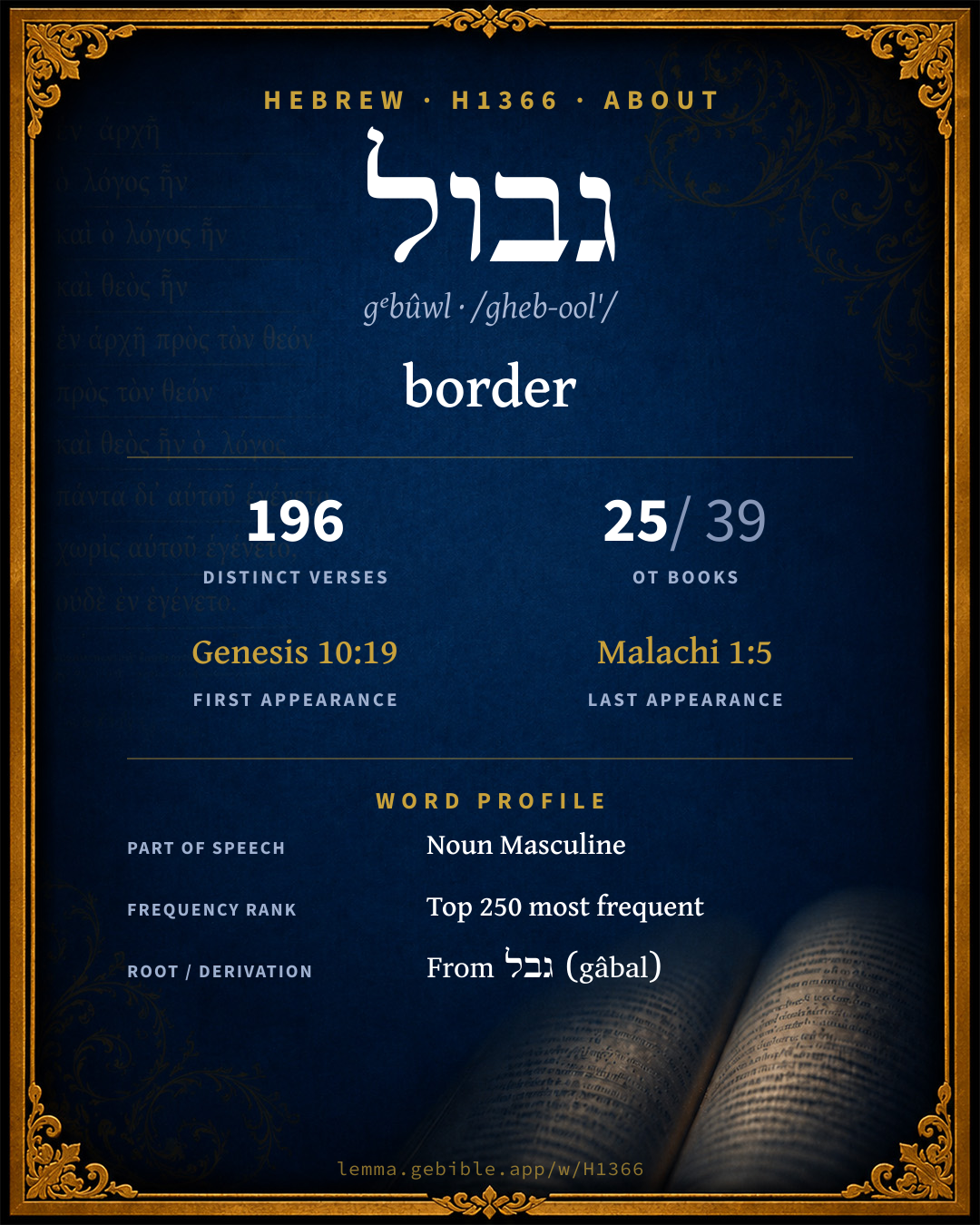
גְּבוּל
border
‘border’ is one of 4 main senses fuller range ↓
Full lexicon entry — Brown-Driver-Briggs (BDB)
From Brown-Driver-Briggs (BDB)
Where this word appears
See every Construct-state word in the Hebrew Bible →
Grammar key — what these labels mean
Part of speech
- Noun
- A naming word — a person, place, thing, or idea.
Noun type
- Common
- A common noun — a general class of person, place, or thing (“king,” “city,” “water”), not a specific name.
State
- Construct
- A noun bound to a following noun in a possessive / “of” relationship (the construct chain).
- Absolute
- The independent form of a noun, not bound to a following word.
Gender
- Masculine
- Grammatically masculine.
Number
- Singular
- One.
- Plural
- More than one (in Hebrew, generally three or more).
Grammatical forms
- Noun, Common, Masculine, Singular, Construct 164 times (68%)
- Noun, Common, Masculine, Singular, Absolute 70 times (29%)
- Noun, Common, Masculine, Plural, Construct 7 times (3%)
Parsed forms decoded from the imported morphology (morphhb / Westminster Leningrad Codex — WLC text public domain, morphhb tagging CC BY 4.0), counted across 241 parsed occurrences — not distinct verses.
Every verse where H1366 appears — 196 distinct verses across 25 books. Click any verse to open its interlinear word-by-word view. Verse text shown in the World English Bible for context — . Each verse’s Hebrew form is shown with its reference; the English is not keyword-highlighted, since the data carries no word-level English alignment. Use “Compare translations” on any verse to read it across multiple English versions. This concordance covers the Hebrew Bible; Septuagint (Greek Old Testament) occurrences are not indexed here.
Genesis 3 verses
- Genesis 10:19 גְּב֤וּל n c ms cs The border of the Canaanites was from Sidon, as you go toward Gerar, to Gaza; as you go toward Sodom, Gomorrah, Admah, and Zeboiim, to Lasha.
- Genesis 23:17 גְּבֻל֖/וֹ n c ms cs + sfx pers 3ms So the field of Ephron, which was in Machpelah, which was before Mamre, the field, the cave which was therein, and all the trees that were in the field, that were in all the border of it round about, were made sure
- Genesis 47:21 גְבוּל n c ms cs As for the people, he moved them to the cities from one end of the border of Egypt even to the other end of it.
Exodus 7 verses
- Exodus 8:2 גְּבוּלְ/ךָ֖ n c ms cs + sfx pers 2ms If you refuse to let them go, behold, I will plague all your borders with frogs:
- Exodus 10:4 בִּ/גְבֻלֶֽ/ךָ prep + n c ms cs + sfx pers 2ms Or else, if you refuse to let my people go, behold, tomorrow I will bring locusts into your country,
- Exodus 10:14 גְּב֣וּל n c ms cs The locusts went up over all the land of Egypt, and rested in all the borders of Egypt. They were very grievous. Before them there were no such locusts as they, neither after them shall be such.
- Exodus 10:19 גְּב֥וּל n c ms cs Yahweh turned an exceeding strong west wind, which took up the locusts, and drove them into the Red Sea. There remained not one locust in all the borders of Egypt.
- Exodus 13:7 גְּבֻלֶֽ/ךָ n c ms cs + sfx pers 2ms Unleavened bread shall be eaten throughout the seven days; and no leavened bread shall be seen with you, neither shall there be yeast seen with you, in all your borders.
- Exodus 23:31 גְּבֻלְ/ךָ֗ n c ms cs + sfx pers 2ms I will set your border from the Red Sea even to the sea of the Philistines, and from the wilderness to the River; for I will deliver the inhabitants of the land into your hand, and you shall drive them out before you.
- Exodus 34:24 גְּבוּלֶ֑/ךָ n c ms cs + sfx pers 2ms For I will drive out nations before you and enlarge your borders; neither shall any man desire your land when you go up to appear before Yahweh, your God, three times in the year.
Numbers 23 verses
- Numbers 20:16 גְבוּלֶֽ/ךָ n c ms cs + sfx pers 2ms and when we cried to Yahweh, he heard our voice, and sent an angel, and brought us forth out of Egypt: and, behold, we are in Kadesh, a city in the uttermost of your border.
- Numbers 20:17 גְּבוּלֶֽ/ךָ n c ms cs + sfx pers 2ms Please let us pass through your land: we will not pass through field or through vineyard, neither will we drink of the water of the wells: we will go along the king's highway; we will not turn aside to the right hand nor to the left, until we have passed your border.
- Numbers 20:21 בִּ/גְבֻל֑/וֹ prep + n c ms cs + sfx pers 3ms Thus Edom refused to give Israel passage through his border: why Israel turned away from him.
- Numbers 20:23 גְּב֥וּל n c ms cs Yahweh spoke to Moses and Aaron in Mount Hor, by the border of the land of Edom, saying,
- Numbers 21:13 מִ/גְּב֣וּל גְּב֣וּל prep + n c ms cs n c ms cs From there they traveled, and encamped on the other side of the Arnon, which is in the wilderness, that comes out of the border of the Amorites: for the Arnon is the border of Moab, between Moab and the Amorites.
- Numbers 21:15 לִ/גְב֥וּל prep + n c ms cs The slope of the valleys That inclines toward the dwelling of Ar, Leans on the border of Moab.
- Numbers 21:22 גְּבֻלֶֽ/ךָ n c ms cs + sfx pers 2ms Let me pass through your land: we will not turn aside into field, or into vineyard; we will not drink of the water of the wells: we will go by the king's highway, until we have passed your border.
- Numbers 21:23 בִּ/גְבֻל/וֹ֒ prep + n c ms cs + sfx pers 3ms Sihon would not allow Israel to pass through his border: but Sihon gathered all his people together, and went out against Israel into the wilderness, and came to Jahaz; and he fought against Israel.
- Numbers 21:24 גְּב֖וּל n c ms cs Israel struck him with the edge of the sword, and possessed his land from the Arnon to the Jabbok, even to the children of Ammon; for the border of the children of Ammon was strong.
- Numbers 22:36 גְּב֣וּל הַ/גְּבֽוּל n c ms cs ptcl def.art + n c ms When Balak heard that Balaam was come, he went out to meet him to the City of Moab, which is on the border of the Arnon, which is in the utmost part of the border.
- Numbers 33:44 בִּ/גְב֥וּל prep + n c ms cs They traveled from Oboth, and encamped in Iye-abarim, in the border of Moab.
- Numbers 34:3 גְּב֣וּל n c ms cs then your south quarter shall be from the wilderness of Zin along by the side of Edom, and your south border shall be from the end of the Salt Sea eastward;
- Numbers 34:4 הַ/גְּב֨וּל ptcl def.art + n c ms and your border shall turn about southward of the ascent of Akrabbim, and pass along to Zin; and the goings out of it shall be southward of Kadesh-barnea; and it shall go forth to Hazar Addar, and pass along to Azmon;
- Numbers 34:5 הַ/גְּב֛וּל ptcl def.art + n c ms and the border shall turn about from Azmon to the brook of Egypt, and the goings out of it shall be at the sea.
- Numbers 34:6 וּ/גְב֣וּל וּ/גְב֑וּל גְּב֥וּל conj + n c ms cs conj + n c ms n c ms cs For the western border, you shall have the great sea and the border [of it]: this shall be your west border.
- Numbers 34:7 גְּב֣וּל n c ms cs This shall be your north border: from the great sea you shall mark out for you Mount Hor;
- Numbers 34:8 הַ/גְּבֻ֖ל ptcl def.art + n c ms from Mount Hor you shall mark out to the entrance of Hamath; and the goings out of the border shall be at Zedad;
- Numbers 34:9 הַ/גְּבֻל֙ גְּב֥וּל ptcl def.art + n c ms n c ms cs and the border shall go forth to Ziphron, and the goings out of it shall be at Hazar Enan: this shall be your north border.
- Numbers 34:10 לִ/גְב֣וּל prep + n c ms You shall mark out your east border from Hazar Enan to Shepham;
- Numbers 34:11 הַ/גְּבֻ֧ל הַ/גְּב֔וּל ptcl def.art + n c ms ptcl def.art + n c ms and the border shall go down from Shepham to Riblah, on the east side of Ain; and the border shall go down, and shall reach to the side of the sea of Chinnereth eastward;
- Numbers 34:12 הַ/גְּבוּל֙ ptcl def.art + n c ms and the border shall go down to the Jordan, and the goings out of it shall be at the Salt Sea. This shall be your land according to the borders of it round about.
- Numbers 35:26 גְּבוּל֙ n c ms cs But if the manslayer shall at any time go beyond the border of his city of refuge, where he flees,
- Numbers 35:27 לִ/גְב֖וּל prep + n c ms cs and the avenger of blood find him outside of the border of his city of refuge, and the avenger of blood kill the manslayer; he shall not be guilty of blood,
Deuteronomy 13 verses
- Deuteronomy 2:4 בִּ/גְבוּל֙ prep + n c ms cs Command you the people, saying, You are to pass through the border of your brothers the children of Esau, who dwell in Seir; and they will be afraid of you: take good heed to yourselves therefore;
- Deuteronomy 2:18 גְּב֥וּל n c ms cs You are this day to pass over Ar, the border of Moab:
- Deuteronomy 3:14 גְּב֥וּל n c ms cs Jair the son of Manasseh took all the region of Argob, to the border of the Geshurites and the Maacathites, and called them, even Bashan, after his own name, Havvoth Jair, to this day.)
- Deuteronomy 3:16 וּ/גְבֻ֑ל גְּב֖וּל conj + n c ms n c ms cs To the Reubenites and to the Gadites I gave from Gilead even to the valley of the Arnon, the middle of the valley, and the border [of it], even to the river Jabbok, which is the border of the children of Ammon;
- Deuteronomy 3:17 וּ/גְבֻ֑ל conj + n c ms the Arabah also, and the Jordan and the border [of it], from Chinnereth even to the sea of the Arabah, the Salt Sea, under the slopes of Pisgah eastward.
- Deuteronomy 11:24 גְּבֻלְ/כֶֽם n c ms cs + sfx pers 2mp Every place whereon the sole of your foot shall tread shall be yours: from the wilderness, and Lebanon, from the river, the river Euphrates, even to the hinder sea shall be your border.
- Deuteronomy 12:20 גְּבֽוּלְ/ךָ֮ n c ms cs + sfx pers 2ms When Yahweh your God shall enlarge your border, as he has promised you, and you shall say, I will eat flesh, because your soul desires to eat flesh; you may eat flesh, after all the desire of your soul.
- Deuteronomy 16:4 גְּבֻלְ/ךָ֖ n c ms cs + sfx pers 2ms There shall be no yeast seen with you in all your borders seven days; neither shall any of the flesh, which you sacrifice the first day at even, remain all night until the morning.
- Deuteronomy 19:3 גְּב֣וּל n c ms cs You shall prepare you the way, and divide the borders of your land, which Yahweh your God causes you to inherit, into three parts, that every manslayer may flee there.
- Deuteronomy 19:8 גְּבֻ֣לְ/ךָ֔ n c ms cs + sfx pers 2ms If Yahweh your God enlarge your border, as he has sworn to your fathers, and give you all the land which he promised to give to your fathers;
- Deuteronomy 19:14 גְּב֣וּל n c ms cs You shall not remove your neighbor's landmark, which they of old time have set, in your inheritance which you shall inherit, in the land that Yahweh your God gives you to possess it.
- Deuteronomy 27:17 גְּב֣וּל n c ms cs Cursed be he who removes his neighbor's landmark. All the people shall say, Amen.
- Deuteronomy 28:40 גְּבוּלֶ֑/ךָ n c ms cs + sfx pers 2ms You shall have olive trees throughout all your borders, but you shall not anoint yourself with the oil; for your olive shall cast [its fruit].
Joshua 59 verses
- Joshua 1:4 גְּבוּלְ/כֶֽם n c ms cs + sfx pers 2mp From the wilderness, and this Lebanon, even to the great river, the river Euphrates, all the land of the Hittites, and to the great sea toward the going down of the sun, shall be your border.
- Joshua 12:2 גְּב֖וּל n c ms cs Sihon king of the Amorites, who lived in Heshbon, and ruled from Aroer, which is on the edge of the valley of the Arnon, and [the city that is in] the middle of the valley, and half Gilead, even to the river Jabbok, the border of the children of Ammon;
- Joshua 12:4 וּ/גְב֗וּל conj + n c ms cs and the border of Og king of Bashan, of the remnant of the Rephaim, who lived at Ashtaroth and at Edrei,
- Joshua 12:5 גְּב֥וּל גְּב֖וּל n c ms cs n c ms cs and ruled in Mount Hermon, and in Salecah, and in all Bashan, to the border of the Geshurites and the Maacathites, and half Gilead, the border of Sihon king of Heshbon.
- Joshua 13:3 גְּב֤וּל n c ms cs from the Shihor, which is before Egypt, even to the border of Ekron northward, [which] is reckoned to the Canaanites; the five lords of the Philistines; the Gazites, and the Ashdodites, the Ashkelonites, the Gittites, and the Ekronites; also the Avvim,
- Joshua 13:4 גְּב֥וּל n c ms cs on the south; all the land of the Canaanites, and Mearah that belongs to the Sidonians, to Aphek, to the border of the Amorites;
- Joshua 13:10 גְּב֖וּל n c ms cs and all the cities of Sihon king of the Amorites, who reigned in Heshbon, to the border of the children of Ammon;
- Joshua 13:11 וּ/גְב֧וּל conj + n c ms cs and Gilead, and the border of the Geshurites and Maacathites, and all Mount Hermon, and all Bashan to Salecah;
- Joshua 13:16 הַ/גְּב֗וּל ptcl def.art + n c ms Their border was from Aroer, that is on the edge of the valley of the Arnon, and the city that is in the middle of the valley, and all the plain by Medeba;
- Joshua 13:23 גְּבוּל֙ וּ/גְב֑וּל n c ms cs conj + n c ms The border of the children of Reuben was the Jordan, and the border [of it]. This was the inheritance of the children of Reuben according to their families, the cities and the villages of it.
- Joshua 13:25 הַ/גְּב֔וּל ptcl def.art + n c ms Their border was Jazer, and all the cities of Gilead, and half the land of the children of Ammon, to Aroer that is before Rabbah;
- Joshua 13:26 גְּב֥וּל n c ms cs and from Heshbon to Ramath Mizpeh, and Betonim; and from Mahanaim to the border of Debir;
- Joshua 13:27 וּ/גְבֻ֑ל conj + n c ms and in the valley, Beth Haram, and Beth Nimrah, and Succoth, and Zaphon, the rest of the kingdom of Sihon king of Heshbon, the Jordan and the border [of it], to the uttermost part of the sea of Chinnereth beyond the Jordan eastward.
- Joshua 13:30 גְבוּלָ֗/ם n c ms cs + sfx pers 3mp Their border was from Mahanaim, all Bashan, all the kingdom of Og king of Bashan, and all the towns of Jair, which are in Bashan, sixty cities:
- Joshua 15:1 גְּב֨וּל n c ms cs The lot for the tribe of the children of Judah according to their families was to the border of Edom, even to the wilderness of Zin southward, at the uttermost part of the south.
- Joshua 15:2 גְּב֣וּל n c ms cs Their south border was from the uttermost part of the Salt Sea, from the bay that looks southward;
- Joshua 15:4 הַ/גְּב֖וּל גְּב֥וּל ptcl def.art + n c ms n c ms cs and it passed along to Azmon, and went out at the brook of Egypt; and the goings out of the border were at the sea: this shall be your south border.
- Joshua 15:5 וּ/גְב֥וּל וּ/גְב֞וּל conj + n c ms conj + n c ms The east border was the Salt Sea, even to the end of the Jordan. The border of the north quarter was from the bay of the sea at the end of the Jordan;
- Joshua 15:6 הַ/גְּבוּל֙ הַ/גְּב֔וּל ptcl def.art + n c ms ptcl def.art + n c ms and the border went up to Beth Hoglah, and passed along by the north of Beth Arabah; and the border went up to the stone of Bohan the son of Reuben;
- Joshua 15:7 הַ/גְּב֥וּל הַ/גְּבוּל֙ ptcl def.art + n c ms ptcl def.art + n c ms and the border went up to Debir from the valley of Achor, and so northward, looking toward Gilgal, that is over against the ascent of Adummim, which is on the south side of the river; and the border passed along to the waters of En Shemesh, and the goings out of it were at En Rogel;
- Joshua 15:8 הַ/גְּב֜וּל הַ/גְּב֜וּל ptcl def.art + n c ms ptcl def.art + n c ms and the border went up by the valley of the son of Hinnom to the side of the Jebusite southward (the same is Jerusalem); and the border went up to the top of the mountain that lies before the valley of Hinnom westward, which is at the uttermost part of the valley of Rephaim northward;
- Joshua 15:9 הַ/גְּב֜וּל הַ/גְּבוּל֙ ptcl def.art + n c ms ptcl def.art + n c ms and the border extended from the top of the mountain to the spring of the waters of Nephtoah, and went out to the cities of Mount Ephron; and the border extended to Baalah (the same is Kiriath Jearim);
- Joshua 15:10 הַ/גְּב֨וּל ptcl def.art + n c ms and the border turned about from Baalah westward to Mount Seir, and passed along to the side of Mount Jearim on the north (the same is Chesalon), and went down to Beth-shemesh, and passed along by Timnah;
- Joshua 15:11 הַ/גְּב֜וּל הַ/גְּבוּל֙ הַ/גְּב֖וּל ptcl def.art + n c ms ptcl def.art + n c ms ptcl def.art + n c ms and the border went out to the side of Ekron northward; and the border extended to Shikkeron, and passed along to Mount Baalah, and went out at Jabneel; and the goings out of the border were at the sea.
- Joshua 15:12 וּ/גְב֣וּל וּ/גְב֑וּל גְּב֧וּל conj + n c ms cs conj + n c ms n c ms cs The west border was to the great sea, and the border [of it]. This is the border of the children of Judah round about according to their families.
- Joshua 15:21 גְּב֥וּל n c ms cs The uttermost cities of the tribe of the children of Judah toward the border of Edom in the South were Kabzeel, and Eder, and Jagur,
- Joshua 15:47 ה/גבול וּ/גְבֽוּל ptcl def.art + n c ms conj + n c ms Ashdod, its towns and its villages; Gaza, its towns and its villages; to the brook of Egypt, and the great sea, and the border [of it].
- Joshua 16:2 גְּב֥וּל n c ms cs and it went out from Bethel to Luz, and passed along to the border of the Archites to Ataroth;
- Joshua 16:3 גְּב֣וּל גְּב֧וּל n c ms cs n c ms cs and it went down westward to the border of the Japhletites, to the border of Beth Horon the lower, even to Gezer; and the goings out of it were at the sea.
- Joshua 16:5 גְּב֥וּל גְּב֤וּל n c ms cs n c ms cs The border of the children of Ephraim according to their families was [thus]: the border of their inheritance eastward was Ataroth Addar, to Beth Horon the upper;
- Joshua 16:6 הַ/גְּב֜וּל הַ/גְּב֛וּל ptcl def.art + n c ms ptcl def.art + n c ms and the border went out westward at Michmethath on the north; and the border turned about eastward to Taanath Shiloh, and passed along it on the east of Janoah;
- Joshua 16:8 הַ/גְּב֥וּל ptcl def.art + n c ms From Tappuah the border went along westward to the brook of Kanah; and the goings out of it were at the sea. This is the inheritance of the tribe of the children of Ephraim according to their families;
- Joshua 17:7 גְבוּל הַ/גְּבוּל֙ n c ms cs ptcl def.art + n c ms The border of Manasseh was from Asher to Michmethath, which is before Shechem; and the border went along to the right hand, to the inhabitants of En Tappuah.
- Joshua 17:8 גְּב֥וּל n c ms cs The land of Tappuah belonged to Manasseh; but Tappuah on the border of Manasseh belonged to the children of Ephraim.
- Joshua 17:9 הַ/גְּבוּל֩ וּ/גְב֤וּל ptcl def.art + n c ms conj + n c ms cs The border went down to the brook of Kanah, southward of the brook: these cities belonged to Ephraim among the cities of Manasseh: and the border of Manasseh was on the north side of the brook, and the goings out of it were at the sea:
- Joshua 17:10 גְּבוּל֑/וֹ n c ms cs + sfx pers 3ms southward it was Ephraim's, and northward it was Manasseh's, and the sea was his border; and they reached to Asher on the north, and to Issachar on the east.
- Joshua 18:5 גְּבוּל/וֹ֙ גְּבוּלָ֖/ם n c ms cs + sfx pers 3ms n c ms cs + sfx pers 3mp They shall divide it into seven portions: Judah shall abide in his border on the south, and the house of Joseph shall abide in their border on the north.
- Joshua 18:11 גְּב֣וּל n c ms cs The lot of the tribe of the children of Benjamin came up according to their families: and the border of their lot went out between the children of Judah and the children of Joseph.
- Joshua 18:12 הַ/גְּב֛וּל הַ/גְּבוּל֩ ptcl def.art + n c ms ptcl def.art + n c ms Their border on the north quarter was from the Jordan; and the border went up to the side of Jericho on the north, and went up through the hill-country westward; and the goings out of it were at the wilderness of Beth Aven.
- Joshua 18:13 הַ/גְּב֜וּל הַ/גְּבוּל֙ ptcl def.art + n c ms ptcl def.art + n c ms The border passed along from there to Luz, to the side of Luz (the same is Bethel), southward; and the border went down to Ataroth Addar, by the mountain that lies on the south of Beth Horon the lower.
- Joshua 18:14 הַ/גְּבוּל֩ ptcl def.art + n c ms The border extended [there], and turned about on the west quarter southward, from the mountain that lies before Beth Horon southward; and the goings out of it were at Kiriath Baal (the same is Kiriath Jearim), a city of the children of Judah: this was the west quarter.
- Joshua 18:15 הַ/גְּבוּל֙ ptcl def.art + n c ms The south quarter was from the uttermost part of Kiriath Jearim; and the border went out westward, and went out to the spring of the waters of Nephtoah;
- Joshua 18:16 הַ/גְּב֜וּל ptcl def.art + n c ms and the border went down to the uttermost part of the mountain that lies before the valley of the son of Hinnom, which is in the valley of Rephaim northward; and it went down to the valley of Hinnom, to the side of the Jebusite southward, and went down to En Rogel;
- Joshua 18:19 הַ/גְּב֜וּל הַ/גְּב֗וּל גְּב֥וּל ptcl def.art + n c ms ptcl def.art + n c ms n c ms cs and the border passed along to the side of Beth Hoglah northward; and the goings out of the border were at the north bay of the Salt Sea, at the south end of the Jordan: this was the south border.
- Joshua 19:10 גְּב֥וּל n c ms cs The third lot came up for the children of Zebulun according to their families; and the border of their inheritance was to Sarid;
- Joshua 19:11 גְבוּלָ֧/ם n c ms cs + sfx pers 3mp and their border went up westward, even to Maralah, and reached to Dabbesheth; and it reached to the brook that is before Jokneam;
- Joshua 19:12 גְּב֥וּל n c ms cs and it turned from Sarid eastward toward the sunrise to the border of Chisloth Tabor; and it went out to Daberath, and went up to Japhia;
- Joshua 19:14 הַ/גְּב֔וּל ptcl def.art + n c ms and the border turned about it on the north to Hannathon; and the goings out of it were at the valley of Iphtah El;
- Joshua 19:18 גְּבוּלָ֑/ם n c ms cs + sfx pers 3mp Their border was to Jezreel, and Chesulloth, and Shunem,
- Joshua 19:22 הַ/גְּב֨וּל גְּבוּלָ֖/ם ptcl def.art + n c ms n c ms cs + sfx pers 3mp and the border reached to Tabor, and Shahazumah, and Beth-shemesh; and the goings out of their border were at the Jordan: sixteen cities with their villages.
- Joshua 19:25 גְּבוּלָ֑/ם n c ms cs + sfx pers 3mp Their border was Helkath, and Hali, and Beten, and Achshaph,
- Joshua 19:29 הַ/גְּבוּל֙ הַ/גְּבוּל֙ ptcl def.art + n c ms ptcl def.art + n c ms and the border turned to Ramah, and to the fortified city of Tyre; and the border turned to Hosah; and the goings out of it were at the sea by the region of Achzib;
- Joshua 19:33 גְבוּלָ֗/ם n c ms cs + sfx pers 3mp Their border was from Heleph, from the oak in Zaanannim, and Adaminekeb, and Jabneel, to Lakkum; and the goings out of it were at the Jordan;
- Joshua 19:34 הַ/גְּב֥וּל ptcl def.art + n c ms and the border turned westward to Aznoth Tabor, and went out from there to Hukkok; and it reached to Zebulun on the south, and reached to Asher on the west, and to Judah at the Jordan toward the sunrise.
- Joshua 19:41 גְּב֣וּל n c ms cs The border of their inheritance was Zorah, and Eshtaol, and Irshemesh,
- Joshua 19:46 הַ/גְּב֖וּל ptcl def.art + n c ms and Me-jarkon, and Rakkon, with the border over against Joppa.
- Joshua 19:47 גְבוּל n c ms cs The border of the children of Dan went out beyond them; for the children of Dan went up and fought against Leshem, and took it, and struck it with the edge of the sword, and possessed it, and lived therein, and called Leshem, Dan, after the name of Dan their father.
- Joshua 22:25 וּ/גְב֣וּל conj + n c ms for Yahweh has made the Jordan a border between us and you, you children of Reuben and children of Gad; you have no portion in Yahweh: so might your children make our children cease from fearing Yahweh.
- Joshua 24:30 בִּ/גְב֣וּל prep + n c ms cs They buried him in the border of his inheritance in Timnathserah, which is in the hill-country of Ephraim, on the north of the mountain of Gaash.
Judges 7 verses
- Judges 1:18 גְּבוּלָ֔/הּ גְּבוּלָ֑/הּ גְּבוּלָֽ/הּ n c ms cs + sfx pers 3fs n c ms cs + sfx pers 3fs n c ms cs + sfx pers 3fs Also Judah took Gaza with the border of it, and Ashkelon with the border of it, and Ekron with the border of it.
- Judges 1:36 וּ/גְבוּל֙ conj + n c ms cs The border of the Amorites was from the ascent of Akrabbim, from the rock, and upward.
- Judges 2:9 בִּ/גְב֣וּל prep + n c ms cs They buried him in the border of his inheritance in Timnath Heres, in the hill country of Ephraim, on the north of the mountain of Gaash.
- Judges 11:18 בִּ/גְב֣וּל גְּב֥וּל prep + n c ms cs n c ms cs Then they went through the wilderness, and went around the land of Edom, and the land of Moab, and came by the east side of the land of Moab, and they encamped on the other side of the Arnon; but they didn't come within the border of Moab, for the Arnon was the border of Moab.
- Judges 11:20 בִּ/גְבֻל֔/וֹ prep + n c ms cs + sfx pers 3ms But Sihon didn't trust Israel to pass through his border; but Sihon gathered all his people together, and encamped in Jahaz, and fought against Israel.
- Judges 11:22 גְּב֣וּל n c ms cs They possessed all the border of the Amorites, from the Arnon even to the Jabbok, and from the wilderness even to the Jordan.
- Judges 19:29 גְּב֥וּל n c ms cs When he was come into his house, he took a knife, and laid hold on his concubine, and divided her, limb by limb, into twelve pieces, and sent her throughout all the borders of Israel.
1 Samuel 10 verses
- 1 Samuel 5:6 גְּבוּלֶֽי/הָ n c mp cs + sfx pers 3fs But the hand of Yahweh was heavy on them of Ashdod, and he destroyed them, and struck them with tumors, even Ashdod and the borders of it.
- 1 Samuel 6:9 גְּבוּל֤/וֹ n c ms cs + sfx pers 3ms Behold; if it goes up by the way of its own border to Beth-shemesh, then he has done us this great evil: but if not, then we shall know that it is not his hand that struck us; it was a chance that happened to us."
- 1 Samuel 6:12 גְּב֖וּל n c ms cs The cattle took the straight way by the way to Beth-shemesh; they went along the highway, lowing as they went, and didn't turn aside to the right hand or to the left; and the lords of the Philistines went after them to the border of Beth-shemesh.
- 1 Samuel 7:13 בִּ/גְב֣וּל prep + n c ms cs So the Philistines were subdued, and they came no more within the border of Israel: and the hand of Yahweh was against the Philistines all the days of Samuel.
- 1 Samuel 7:14 גְּבוּלָ֔/ן n c ms cs + sfx pers 3fp The cities which the Philistines had taken from Israel were restored to Israel, from Ekron even to Gath; and the border of it did Israel deliver out of the hand of the Philistines. There was peace between Israel and the Amorites.
- 1 Samuel 10:2 בִּ/גְב֥וּל prep + n c ms cs When you are departed from me today, then you shall find two men by Rachel's tomb, in the border of Benjamin at Zelzah; and they will tell you, The donkeys which you went to seek are found; and, behold, your father has left off caring for the donkeys, and is anxious for you, saying, What shall I do for my son?
- 1 Samuel 11:3 גְּב֣וּל n c ms cs The elders of Jabesh said to him, Give us seven days' respite, that we may send messengers to all the borders of Israel; and then, if there be none to save us, we will come out to you.
- 1 Samuel 11:7 גְּב֣וּל n c ms cs He took a yoke of oxen, and cut them in pieces, and sent them throughout all the borders of Israel by the hand of messengers, saying, Whoever doesn't come forth after Saul and after Samuel, so shall it be done to his oxen. The dread of Yahweh fell on the people, and they came out as one man.
- 1 Samuel 13:18 הַ/גְּב֔וּל ptcl def.art + n c ms and another company turned the way to Beth Horon; and another company turned the way of the border that looks down on the valley of Zeboim toward the wilderness.
- 1 Samuel 27:1 גְּב֣וּל n c ms cs David said in his heart, I shall now perish one day by the hand of Saul: there is nothing better for me than that I should escape into the land of the Philistines; and Saul will despair of me, to seek me any more in all the borders of Israel: so shall I escape out of his hand.
2 Samuel 1 verse
1 Kings 2 verses
- 1 Kings 1:3 גְּב֣וּל n c ms cs So they sought for a beautiful young lady throughout all the borders of Israel, and found Abishag the Shunammite, and brought her to the king.
- 1 Kings 4:21 גְּב֣וּל n c ms cs Solomon ruled over all the kingdoms from the River to the land of the Philistines, and to the border of Egypt: they brought tribute, and served Solomon all the days of his life.
2 Kings 5 verses
- 2 Kings 3:21 הַ/גְּבֽוּל ptcl def.art + n c ms Now when all the Moabites heard that the kings had come up to fight against them, they gathered themselves together, all who were able to put on armor, and upward, and stood on the border.
- 2 Kings 10:32 גְּב֥וּל n c ms cs In those days Yahweh began to cut off from Israel: and Hazael struck them in all the borders of Israel;
- 2 Kings 14:25 גְּב֣וּל n c ms cs He restored the border of Israel from the entrance of Hamath to the sea of the Arabah, according to the word of Yahweh, the God of Israel, which he spoke by his servant Jonah the son of Amittai, the prophet, who was of Gath Hepher.
- 2 Kings 15:16 גְּבוּלֶ֨י/הָ֙ n c mp cs + sfx pers 3fs Then Menahem struck Tiphsah, and all who were therein, and the borders of it, from Tirzah: because they didn't open to him, therefore he struck it; and all the women therein who were with child he ripped up.
- 2 Kings 18:8 גְּבוּלֶ֑י/הָ n c mp cs + sfx pers 3fs He struck the Philistines to Gaza and the borders of it, from the tower of the watchmen to the fortified city.
1 Chronicles 4 verses
- 1 Chronicles 4:10 גְּבוּלִ/י֙ n c ms cs + sfx pers 1cs Jabez called on the God of Israel, saying, Oh that you would bless me indeed, and enlarge my border, and that your hand might be with me, and that you would keep me from evil, that it not be to my sorrow! God granted him that which he requested.
- 1 Chronicles 6:54 בִּ/גְבוּלָ֑/ם prep + n c ms cs + sfx pers 3mp Now these are their dwelling-places according to their encampments in their borders: to the sons of Aaron, of the families of the Kohathites (for theirs was the [first] lot),
- 1 Chronicles 6:66 גְבוּלָ֔/ם n c ms cs + sfx pers 3mp Some of the families of the sons of Kohath had cities of their borders out of the tribe of Ephraim.
- 1 Chronicles 21:12 גְּב֣וּל n c ms cs either three years of famine; or three months to be consumed before your foes, while the sword of your enemies overtakes you; or else three days the sword of Yahweh, even pestilence in the land, and the angel of Yahweh destroying throughout all the borders of Israel. Now therefore consider what answer I shall return to him who sent me.
2 Chronicles 2 verses
Job 1 verse
Psalms 5 verses
- Psalms 78:54 גְּב֣וּל n c ms cs He brought them to the border of his sanctuary, To this mountain, which his right hand had taken.
- Psalms 104:9 גְּֽבוּל n c ms You have set a boundary that they may not pass over; That they don't turn again to cover the earth.
- Psalms 105:31 גְּבוּלָֽ/ם n c ms cs + sfx pers 3mp He spoke, and swarms of flies came, And lice in all their borders.
- Psalms 105:33 גְּבוּלָֽ/ם n c ms cs + sfx pers 3mp He struck their vines and also their fig trees, And shattered the trees of their country.
- Psalms 147:14 גְּבוּלֵ֥/ךְ n c ms cs + sfx pers 2fs He makes peace in your borders. He fills you with the finest of the wheat.
Proverbs 3 verses
- Proverbs 15:25 גְּב֣וּל n c ms cs Yahweh will uproot the house of the proud, But he will keep the widow's borders intact.
- Proverbs 22:28 גְּב֣וּל n c ms cs Don't move the ancient boundary stone, Which your fathers have set up.
- Proverbs 23:10 גְּב֣וּל n c ms cs Don't move the ancient boundary stone. Don't encroach on the fields of the fatherless:
Isaiah 4 verses
- Isaiah 15:8 גְּב֣וּל n c ms cs For the cry is gone round about the borders of Moab; the wailing of it to Eglaim, and the wailing of it to Beer-elim.
- Isaiah 19:19 גְּבוּלָ֖/הּ n c ms cs + sfx pers 3fs In that day shall there be an altar to Yahweh in the midst of the land of Egypt, and a pillar at the border of it to Yahweh.
- Isaiah 54:12 גְּבוּלֵ֖/ךְ n c ms cs + sfx pers 2fs I will make your pinnacles of rubies, and your gates of emeralds, and all your border of precious stones.
- Isaiah 60:18 בִּ/גְבוּלָ֑יִ/ךְ prep + n c mp cs + sfx pers 2fs Violence shall no more be heard in your land, desolation nor destruction within your borders; but you shall call your walls Salvation, and your gates Praise.
Jeremiah 4 verses
- Jeremiah 5:22 גְּב֣וּל n c ms Don't you fear me? says Yahweh: won't you tremble at my presence, who have placed the sand for the bound of the sea, by a perpetual decree, that it can't pass it? and though the waves of it toss themselves, yet they can't prevail; though they roar, yet they can't pass over it.
- Jeremiah 15:13 גְּבוּלֶֽי/ךָ n c mp cs + sfx pers 2ms Your substance and your treasures will I give for a spoil without price, and that for all your sins, even in all your borders.
- Jeremiah 17:3 גְּבוּלֶֽי/ךָ n c mp cs + sfx pers 2ms My mountain in the field, I will give your substance and all your treasures for a spoil, [and] your high places, because of sin, throughout all your borders.
- Jeremiah 31:17 לִ/גְבוּלָֽ/ם prep + n c ms cs + sfx pers 3mp There is hope for your latter end, says Yahweh; and [your] children shall come again to their own border.
Ezekiel 34 verses
- Ezekiel 11:10 גְּב֥וּל n c ms cs You shall fall by the sword; I will judge you in the border of Israel; and you shall know that I am Yahweh.
- Ezekiel 11:11 גְּב֥וּל n c ms cs This [city] shall not be your caldron, neither shall you be the flesh in the midst of it; I will judge you in the border of Israel;
- Ezekiel 27:4 גְּבוּלָ֑יִ/ךְ n c mp cs + sfx pers 2fs Your borders are in the heart of the seas; your builders have perfected your beauty.
- Ezekiel 29:10 גְּב֥וּל n c ms cs therefore, behold, I am against you, and against your rivers, and I will make the land of Egypt an utter waste and desolation, from the tower of Seveneh even to the border of Ethiopia.
- Ezekiel 40:12 וּ/גְב֞וּל גְּב֖וּל conj + n c ms n c ms and a border before the lodges, one cubit [on this side], and a border, one cubit on that side; and the lodges, six cubits on this side, and six cubits on that side.
- Ezekiel 43:12 גְּבֻל֞/וֹ n c ms cs + sfx pers 3ms This is the law of the house: on the top of the mountain the whole limit of it round about shall be most holy. Behold, this is the law of the house.
- Ezekiel 43:13 וּ/גְבוּלָ֨/הּ conj + n c ms cs + sfx pers 3fs These are the measures of the altar by cubits (the cubit is a cubit and a handbreadth): the bottom shall be a cubit, and the breadth a cubit, and the border of it by the edge of it round about a span; and this shall be the base of the altar.
- Ezekiel 43:17 וְ/הַ/גְּבוּל conj + ptcl def.art + n c ms The ledge shall be fourteen [cubits] long by fourteen broad in the four sides of it; and the border about it shall be half a cubit; and the bottom of it shall be a cubit round about; and the steps of it shall look toward the east.
- Ezekiel 43:20 הַ/גְּב֖וּל ptcl def.art + n c ms You shall take of the blood of it, and put it on the four horns of it, and on the four corners of the ledge, and on the border round about: thus shall you cleanse it and make atonement for it.
- Ezekiel 45:1 גְּבוּלָ֖/הּ n c ms cs + sfx pers 3fs Moreover, when you shall divide by lot the land for inheritance, you shall offer an offering to Yahweh, a holy portion of the land; the length shall be the length of twenty-five thousand [reeds], and the breadth shall be ten thousand: it shall be holy in all the border of it round about.
- Ezekiel 45:7 מִ/גְּב֥וּל גְּב֥וּל prep + n c ms cs n c ms cs [Whatever is] for the prince [shall be] on the one side and on the other side of the holy offering and of the possession of the city, in front of the holy offering and in front of the possession of the city, on the west side westward, and on the east side eastward; and in length answerable to one of the portions, from the west border to the east border.
- Ezekiel 47:13 גְבוּל֙ n c ms Thus says the Lord Yahweh: This shall be the border, by which you shall divide the land for inheritance according to the twelve tribes of Israel: Joseph [shall have two] portions.
- Ezekiel 47:15 גְּב֣וּל n c ms cs This shall be the border of the land: On the north side, from the great sea, by the way of Hethlon, to the entrance of Zedad;
- Ezekiel 47:16 גְּב֣וּל גְּב֣וּל גְּב֥וּל n c ms cs n c ms cs n c ms cs Hamath, Berothah, Sibraim, which is between the border of Damascus and the border of Hamath; Hazer Hatticon, which is by the border of Hauran.
- Ezekiel 47:17 גְב֜וּל גְּב֣וּל וּ/גְב֣וּל n c ms n c ms cs conj + n c ms cs The border from the sea, shall be Hazar Enon at the border of Damascus; and on the north northward is the border of Hamath. This is the north side.
- Ezekiel 47:18 מִ/גְּב֛וּל prep + n c ms The east side, between Hauran and Damascus and Gilead, and the land of Israel, shall be the Jordan; from the [north] border to the east sea shall you measure. This is the east side.
- Ezekiel 47:20 מִ/גְּב֕וּל prep + n c ms The west side shall be the great sea, from the [south] border as far as over against the entrance of Hamath. This is the west side.
- Ezekiel 48:1 גְּב֨וּל n c ms cs Now these are the names of the tribes: From the north end, beside the way of Hethlon to the entrance of Hamath, Hazar Enan at the border of Damascus, northward beside Hamath, (and they shall have their sides east [and] west), Dan, one [portion].
- Ezekiel 48:2 גְּב֣וּל n c ms cs By the border of Dan, from the east side to the west side, Asher, one [portion].
- Ezekiel 48:3 גְּב֣וּל n c ms cs By the border of Asher, from the east side even to the west side, Naphtali, one [portion].
- Ezekiel 48:4 גְּב֣וּל n c ms cs By the border of Naphtali, from the east side to the west side, Manasseh, one [portion].
- Ezekiel 48:5 גְּב֣וּל n c ms cs By the border of Manasseh, from the east side to the west side, Ephraim, one [portion].
- Ezekiel 48:6 גְּב֣וּל n c ms cs By the border of Ephraim, from the east side even to the west side, Reuben, one [portion].
- Ezekiel 48:7 גְּב֣וּל n c ms cs By the border of Reuben, from the east side to the west side, Judah, one [portion].
- Ezekiel 48:8 גְּב֣וּל n c ms cs By the border of Judah, from the east side to the west side, shall be the offering which you shall offer, twenty-five thousand [reeds] in breadth, and in length as one of the portions, from the east side to the west side: and the sanctuary shall be in the midst of it.
- Ezekiel 48:12 גְּב֖וּל n c ms cs It shall be to them an offering from the offering of the land, a thing most holy, by the border of the Levites.
- Ezekiel 48:13 גְּב֣וּל n c ms cs Answerable to the border of the priests, the Levites shall have twenty-five thousand in length, and ten thousand in breadth: all the length shall be twenty-five thousand, and the breadth ten thousand.
- Ezekiel 48:21 גְּב֣וּל גְּב֣וּל n c ms cs n c ms cs The residue shall be for the prince, on the one side and on the other of the holy offering and of the possession of the city; in front of the twenty-five thousand of the offering toward the east border, and westward in front of the twenty-five thousand toward the west border, answerable to the portions, it shall be for the prince: and the holy offering and the sanctuary of the house shall be in the midst of it.
- Ezekiel 48:22 גְּב֣וּל גְּב֣וּל n c ms cs n c ms cs Moreover from the possession of the Levites, and from the possession of the city, being in the midst of that which is the prince's, between the border of Judah and the border of Benjamin, it shall be for the prince.
- Ezekiel 48:24 גְּב֣וּל n c ms cs By the border of Benjamin, from the east side to the west side, Simeon, one [portion].
- Ezekiel 48:25 גְּב֣וּל n c ms cs By the border of Simeon, from the east side to the west side, Issachar, one [portion].
- Ezekiel 48:26 גְּב֣וּל n c ms cs By the border of Issachar, from the east side to the west side, Zebulun, one [portion].
- Ezekiel 48:27 גְּב֣וּל n c ms cs By the border of Zebulun, from the east side to the west side, Gad, one [portion].
- Ezekiel 48:28 גְּב֣וּל גְב֜וּל n c ms cs n c ms By the border of Gad, at the south side southward, the border shall be even from Tamar to the waters of Meribath Kadesh, to the brook [of Egypt], to the great sea.
Hosea 1 verse
Joel 1 verse
Amos 2 verses
- Amos 1:13 גְּבוּלָֽ/ם n c ms cs + sfx pers 3mp Thus says Yahweh: "For three transgressions of the children of Ammon, yes, for four, I will not turn away its punishment; Because they have ripped open the pregnant women of Gilead, That they may enlarge their border.
- Amos 6:2 גְּבוּלָ֖/ם מִ/גְּבֻלְ/כֶֽם n c ms cs + sfx pers 3mp prep + n c ms cs + sfx pers 2mp Go to Calneh, and see; And from there go to Hamath the great; Then go down to Gath of the Philistines. Are they better than these kingdoms? Or is their border greater than your border?
Obadiah 1 verse
Micah 1 verse
Zephaniah 1 verse
Malachi 2 verses
- Malachi 1:4 גְּב֣וּל n c ms cs Whereas Edom says, "We are beaten down, but we will return and build the waste places;" thus says Yahweh of Hosts, "They shall build, but I will throw down; and men will call them 'The Wicked Land,' even the people against whom Yahweh shows wrath forever."
- Malachi 1:5 לִ/גְב֥וּל prep + n c ms cs Your eyes will see, and you will say, "Yahweh is great--even beyond the border of Israel!"
About this entry
At a glance — auto-summarized from this page’s data, not written by a person. Every figure links to its source below. This summary describes the numbers; it doesn’t interpret them.
At its core, גבול (gᵉbûwl) means “border.” One archaism survives in the King James Version — “coast” — where modern Bibles read “border”; see the renderings breakdown. It turns up in 196 verses across 25 books, a common footprint. The word gravitates to Joshua (30%), then Ezekiel and Numbers. Carrying more than one sense, it rewards its full sense range. Dig into 196-verse concordance and the renderings breakdown below.
Gloss history
Strong's 1890 vs modern scholarship
About this word
Strong's H1366 catalogs a Hebrew word from the Hebrew Old Testament.
These counts are not copied from any lexicon or concordance. They are computed here, from the morphology-tagged Hebrew Old Testament. What Lemma adds →
- 196
- distinct verses
- The word appears in 196 distinct verses.
- 25 / 39
- OT books
- The word appears in 25 of 39 Old Testament books.
- #196
- by frequency
- Top 250 most frequent Hebrew words (rank 196 of 8,640 Hebrew words by occurrence).
View all 196 occurrences in the concordance →
By section of the Old Testament
By traditional corpus
Conventional, traditional groupings — biblical authorship is debated, so this is a traditional corpus grouping, not an authorship claim. Each share is this word’s portion of its verses in that division of the Hebrew canon. Each figure is a share of the word’s 196 distinct verses.
- Prophets (Nevi'im) 135 verses · 69%
- Torah (Pentateuch) 46 verses · 23%
- Writings (Ketuvim) 15 verses · 8%
How translations render this word
Counts come from each version’s own published word-to-Strong’s tagging or interlinear alignment — an approximate guide to how each version renders this word, not a word-level alignment the data otherwise carries. Because each total is that version’s own tagged count, the per-version totals vary from one another and need not match the appearance or distinct-verse counts above. These counts may also differ from a printed concordance because Lemma counts each distinctly tagged rendering and does not collapse phrase taggings into a single head-word total. This is a fixed set of word-tagged versions (KJV, ASV, BSB, ULT) and does not change with the reading translation you choose elsewhere. Each version’s license is shown beside its name below (and on Sources).
- King James Version: Border 115×, Coast 36×, Borders 12×
- American Standard Version: Border 153×, Borders 7×, Throughout all the borders 4×
- Berean Standard Bible: Border 70×, Territory 49×, Borders 15×
- unfoldingWord Literal Text: Border 93×, Border of 64×, Borders 15×
King James Version Public Domain
Renders H1366 across 240 tagged occurrences — most commonly:
Plus other, less common renderings. Plus 38 renderings that appear only once — usually multi-word phrases or single function words the recovered tagging swept in, not distinct renderings. Not rendered by a distinct English word in 1 further occurrence.
American Standard Version Public Domain
Renders H1366 across 240 tagged occurrences — most commonly:
Plus other, less common renderings. Plus 42 renderings that appear only once — usually multi-word phrases or single function words the recovered tagging swept in, not distinct renderings.
Berean Standard Bible Public Domain
Renders H1366 across 208 tagged occurrences — most commonly:
Plus other, less common renderings. Plus 35 renderings that appear only once — usually multi-word phrases or single function words the recovered tagging swept in, not distinct renderings. Not rendered by a distinct English word in 33 further occurrences.
unfoldingWord Literal Text CC BY-SA 4.0
Renders H1366 across 247 tagged occurrences — most commonly:
Plus other, less common renderings. Plus 25 renderings that appear only once — usually multi-word phrases or single function words the recovered tagging swept in, not distinct renderings.
13 senses and sub-senses in the full BDB
What do BDB’s symbols mean?
BDB uses these scholarly abbreviations:
| Symbol | Meaning |
|---|---|
| 𝔊 | the Septuagint (the ancient Greek translation, LXX) |
| 𝔙 | the Vulgate (the Latin translation) |
| 𝔖 | the Syriac version (the Peshitta) |
| 𝔗 | the Targum (the Aramaic translation) |
| ψ | the Psalms |
| √ | root (the underlying root or stem) |
| ‖ | parallel passage (a synonymous or contrasted parallel) |
| † | the dagger: every passage where the word occurs is cited |
The 13 senses and sub-senses the full Brown-Driver-Briggs lexicon distinguishes for this word, in lexicon order (not ranked by frequency), with BDB’s own verbatim wording and sub-sense lettering. Shown in Hebrew script with BDB’s own scholarly abbreviations. The condensed entry is in the Lexicon Entry tab. See also the Forms in the corpus table below.
- 1. border, boundary,
- a. of a land or people: Canaanites Gn 10:19 (J), Edom Nu 20:23 Jos 15:1, 21 (all P) cf. Ob 7, Amorites Nu 21:13 (E) Jos 13:4 (D) cf. 12:5 (D) Ju 1:36, Moab Nu 21:13, 15; 22:36 (E) 33:44 (P) Dt 2:18 Ju 11:18(×2) 2 K 3:21 Is 15:8, Ammon Nu 21:24 (E) Dt 3:16 Jos 12:2; 13:10 (all D) Am 1:13, Bashan Jos 12:4 (D), Egypt 1 K 5:1 = 2 Ch 9:26, Is 19:19; especially of promised land Ex 23:31; 34:24 (JE) Nu 34:3 + 13 times Nu 34 (all P) Dt 11:24; 12:20; 16:4 Jos 1:4 (D), cf. Ez 45:1 + 10 times Ez 45–48; also of Israel 2 K 14:25 Am 6:2 Mal 1:5. e.g. Genesis 10:19
- b. boundary of smaller divisions, e.g. Geshurites Dt 3:14 Jos 12:5; 13:11 (all D), cf. Jos 16:2, 3 (J) 19:12 (P); especially of tribes of Israel Dt 3:16, 17 Jos 13:30 (all D) 13:16 + 60 times Jos 13–19 (P);—15:47 read גדול v. supr. Jos 22:25 (P) & 17:8; 18:11; 24:30 (JE), cf. 1 Ch 6:39, 51 2 Ch 11:13 Ez 48:1 + 15 times Ez 48 (incl. v 22(×2) q. del. Co);—in 1 S 13:18 read for גְּבוּל, הַגֶּבַע 𝔊 We Dr e.g. Deuteronomy 3:14
- c. boundary of territory belonging to an individual,—of field, piece of ground, etc. Gn 23:17 (P) Dt 19:14; 27:17, Jos 24:30 (E) = Ju 2:9 1 Ch 4:10 Pr 15:25; 22:28; 23:10 Ho 5:10. e.g. Genesis 23:17
- d. border of stream Nu 22:36. e.g. Numbers 22:36
- e. limit to waters of deep ψ 104:9 cf. Je 5:22. e.g. Psalms 104:9
- f. a concrete object marking limit, (α) barrier in Ezekiel’s temple Ez 40:12 (del. 𝔊 𝔖 Co) v 12; (β) border of altar Ez 43:13, 17, 20; (γ) surrounding wall of restored Zion Is 54:12 (so 𝔊 Ew Kn Che; De Brd territory, Di undecided). e.g. Ezekiel 40:12
- 2. territory (enclosed within boundary),
- a. of land or people Gn 47:21 (J) Ex 7:27 (P) 10:4, 14 (‖ ארץ) v 19; 13:7 (all J), Nu 20:16, 17, 21; 21:22 (E; ‖ ארץ) = Ju 11:20, Nu 21:23 (E) Dt 2:4; 19:3 (גּ׳ אַרְצְךָ) v 8; 28:40 Jos 18:5(×2) (E) Ju 11:22; 19:29 2 S 21:5 1 K 1:3 2 K 10:32 1 Ch 21:12 (‖ ארץ) ψ 105:31 (= ארץ in ‖ Ez 8:16, 17) v 33; 147:14 Je 31:17 Ez 11:10, 11 Jo 4:6 Zp 2:8. e.g. Genesis 47:21
- b. territory of a city (or limit of such territory) Nu 35:26, 27 Jos 13:26 Ju 1:18(×3) Ez 47:16(×2); 17(×2) (del. 𝔊 Co) 48:1 Am 6:2. e.g. Numbers 35:26
- c. territory about Ezekiel’s temple Ez 43:12. e.g. Ezekiel 43:12
- d. pl. in like sense (only use of pl.), of land Mi 5:5 Is 60:18 (‖ ארץ) Je 15:13; 17:3, cf. city 1 S 5:6 2 K 15:16; 18:8; so Ez 27:4 of Tyre. e.g. Micah 5:5
- e. fig. territory (region) of darkness Jb 38:20; territory of wickedness Mal 1:4 (of Edom); territory of his holiness ψ 78:54 (of Canaan). e.g. Job 38:20
Senses from the full Brown-Driver-Briggs lexicon (Brown, Driver, Briggs; Oxford 1906 — public domain), digitized via Sefaria, supplemented by the OpenScriptures HebrewLexicon (CC BY 4.0). Full attribution on Sources.
Word origin
n.m. Nu 34, 3 border, boundary, territory (NH id., Punic gubulim (pl., PlautPoen. i. 9)—גְּבוּל Gn 10:19 + 168 times + Jos 15:47 Kt (but read Qr גָּדוֹל); גְּבֻל Nu 21:13 + 9 times; (both, in abs. & cstr., e.g. abs. Nu 22:36; 34:8, cstr. Gn 10:19 2 S 21:5); sf. גְּבוּלִי 1 Ch 4:10, גְּבוּלְךָ Ex 7:27, גְבֻלְךָ Ex 23:31 + 3 times, etc.; pl. (8 times) only sf. גְּבוּלֶיךָ Je 15:13; 17:3, etc.;—
— Brown-Driver-Briggs (Oxford 1906, public domain), digitized via Sefaria, supplemented by the OpenScriptures HebrewLexicon (CC BY 4.0). See Sources.
Derived from גבל (gâbal) (H1379) — to border.
Jastrow Dictionary
A second Hebrew/Aramaic lexicon for comparison, covering Aramaic and post-biblical (Talmudic, Targumic, Midrashic) usage that the biblical-Hebrew BDB does not. Matched by lemma rather than by Strong’s number, so a lemma may carry more than one Jastrow headword (shown separately below), and the entries cover usage well beyond the Bible.
גְּבוּל I
- [heap, mound,]
- 1. landmark, boundary; limit; qualification. B. Bath. 69ᵇ (ref. to Gen. XXIII, 17) מי שצריך לג׳ סביב such trees as require boundaries (small trees, are included in the sale). Ab. Zar. 24ᵇ ג׳ יש לה this assertion (לוקחין מהן בהמה לקרבן, ib. 23ᵇ) must be qualified. Y. Ḥall. I, 57ᵇ top (ref. to Is. XXVIII, 25) ע"כ גְּבוּלוֹ של לחם so far goes the definition of bread, i.e. only these species can be called leḥem. e.g. Genesis 23:17
- 2. (in gen.) country, contrad. to the sanctuary (מקדש) and Jerusalem. Keth. 24ᵇ, a. fr. קדשי הג׳ the sacred gifts (T’rumah &c.) set apart and consumed outside of the Temple and Jerusalem.—Pl. גְּבוּלִים, גְּבוּלִין. B. Bath. 56ᵃ עיירות העומדות על הג׳ border-towns.—Shek. VII, 3 נמצא בג׳ if found outside of Jerusalem. R. Hash. 30ᵃ; a. fr.—V. גּוֹבֶל.
*גְּבוּל II
- G’bul (High-land), cmp. גַּבְלָא. Sot. IX, 15; Snh. 97ᵃ אנשי (ה)ג׳ (Ms. M. Snh., a. Cant. R. to II, 13 גָּלִיל).
A Dictionary of the Targumim, the Talmud Babli and Yerushalmi, and the Midrashic Literature (Marcus Jastrow; London, Luzac, 1903) — Public Domain. Digitized via Sefaria. Digitized via Sefaria. Full attribution on Sources.
Forms in the corpus
The 94 distinct written forms H1366 takes in the Hebrew Bible, most frequent first — each parse links to that state’s occurrences in the concordance. Hebrew forms include their vowel points and cantillation, so a single lemma takes many written forms.
The 60 most common forms are shown; 34 rarer forms follow in the full concordance.
Same root — word family
Other BDB entries built from the same root as H1366, grouped by Strong’s listed origin. These share a root / origin per the lexicon — not necessarily a shared meaning. Each links to that word’s own entry.
Derives from
Shares the same root
Derived from this word
Proper names from this root
People and places named from this root — a name, not an additional meaning of the word.
Compare all same-root words → Showing 4 of 6 — not the complete family. 1 of the same-root words is a proper name (a person or place). They share a root, not necessarily a meaning.
Septuagint verse parallels
This word appears in 191 verses that also exist in the Greek Old Testament (Septuagint), out of the 196 Hebrew verses it occurs in. You can read those verses in Greek by switching the Old Testament edition to the Septuagint.
Read these verses in the Septuagint
- Genesis 10:19
- Exodus 8:2
- Numbers 20:16
- Deuteronomy 2:4
- Joshua 1:4
- Judges 1:18
- 1 Samuel 5:6
- 2 Samuel 21:5
- 1 Kings 1:3
- 2 Kings 3:21
- 1 Chronicles 4:10
- 2 Chronicles 9:26
This is a verse-level parallel only — the same verses exist in both the Hebrew and Greek Old Testaments. No word-level Hebrew↔Greek correspondence is claimed: the data carries no such alignment, so no Greek word is shown as this Hebrew word’s translation. Coverage is not total — the Septuagint omits the deuterocanon and renumbers the Psalms, so some Hebrew verses have no direct Greek parallel.