Isaiah 15:8

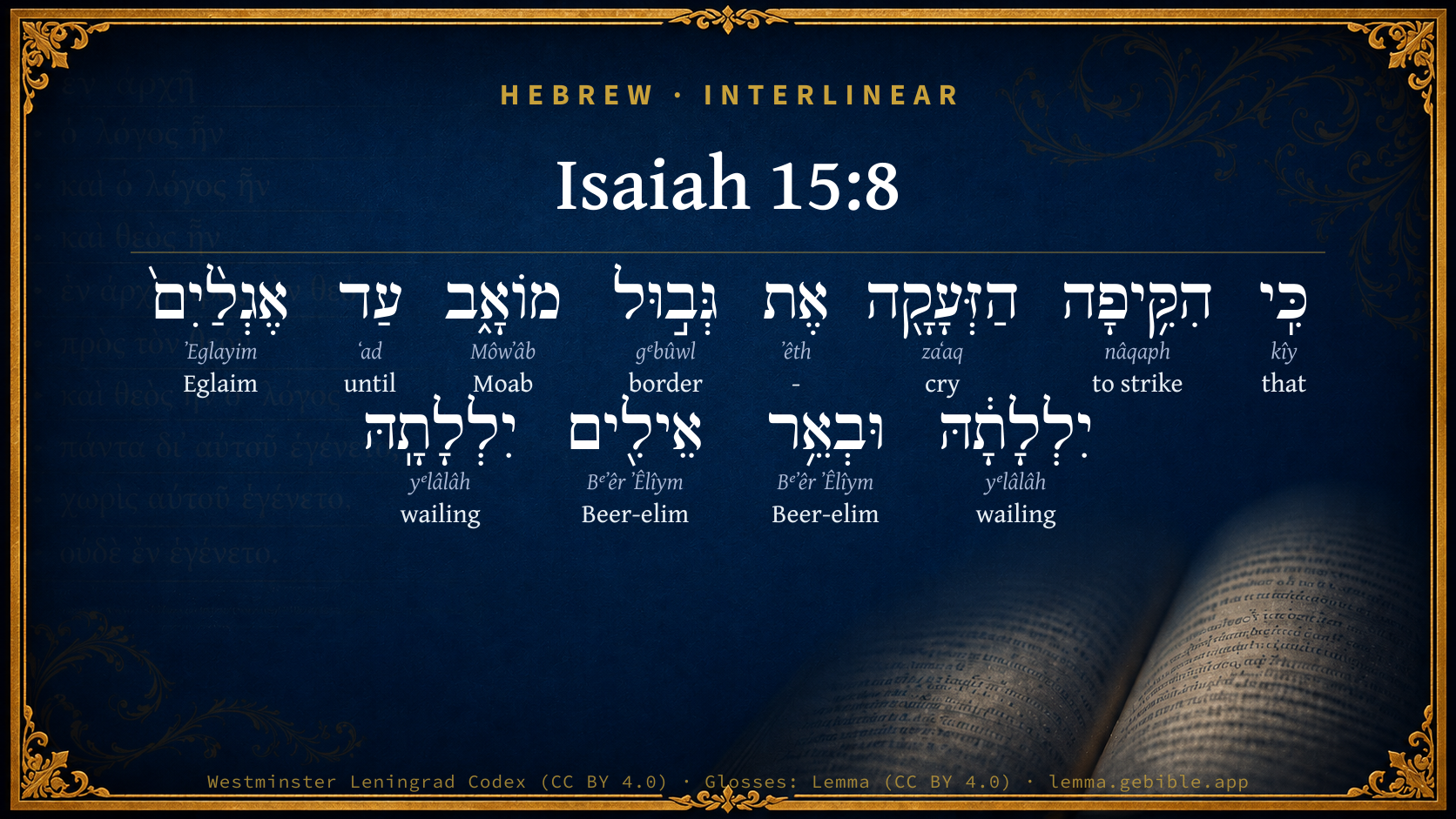
Hebrew (Westminster Leningrad Codex) Isaiah 15:8 appears in the Hebrew Old Testament. The text above is from the Westminster Leningrad Codex. Each word links to its Strong’s number, a concise gloss, and parsing drawn from the Open Scriptures Hebrew Bible morphology. Click any word for its full Brown-Driver-Briggs (BDB) entry.
Download image
Cite this verse

Isaiah 15:8 (World English Bible). Public Domain. Lemma interlinear Bible study tool, https://lemma.gebible.app/v/isaiah/15/8.

Show BibTeX & RIS
BibTeX
RIS
English Translation
For the cry is gone round about the borders of Moab; the wailing of it to Eglaim, and the wailing of it to Beer-elim.
World English Bible · Public Domain
Highlights
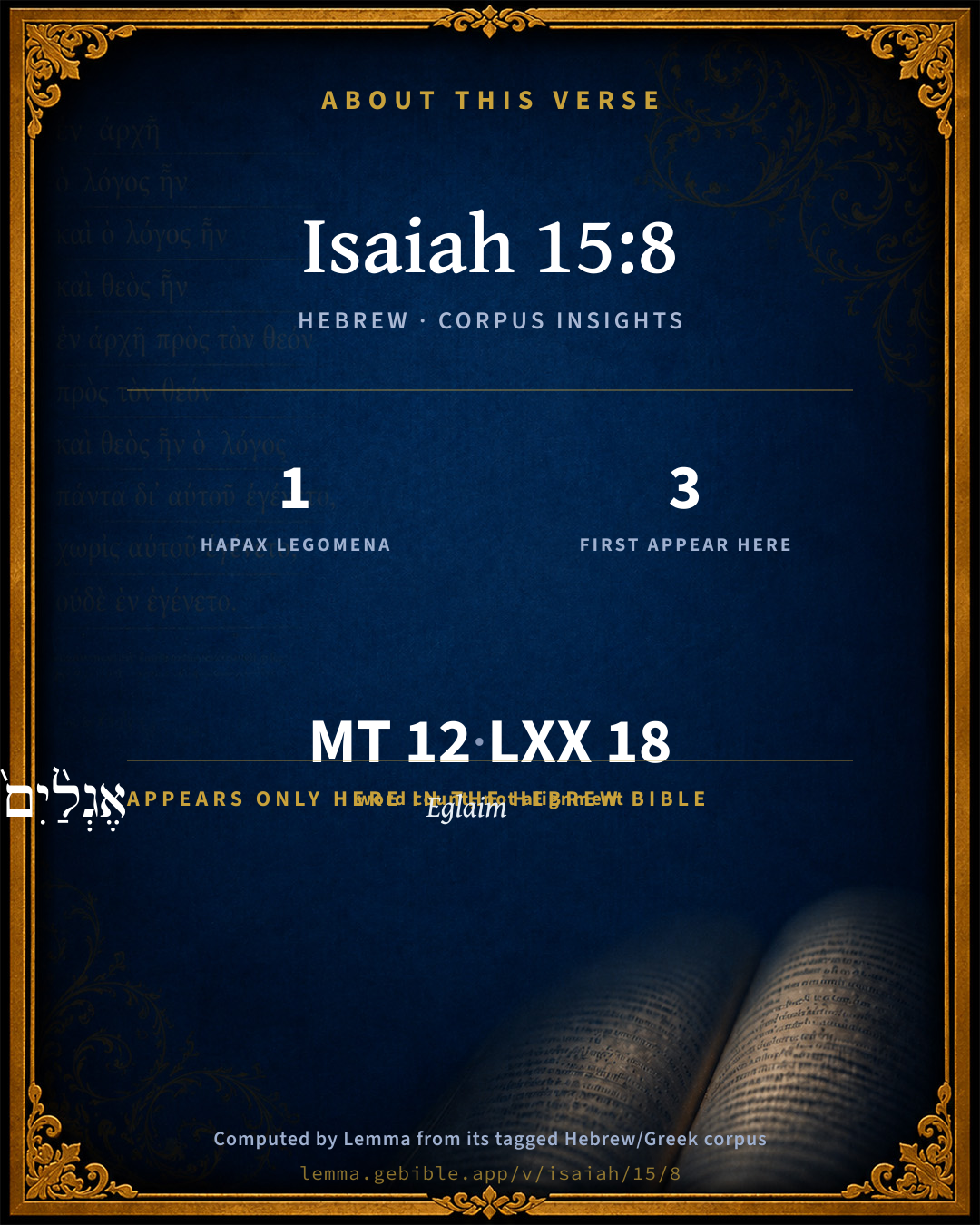
  • 1 hapax legomenon — only here in the Hebrew Bible
  • 3 first appearances in the Hebrew Bible
Full analysis ↓
Download a study sheet

One document with this verse’s original text, its word-by-word gloss line, the meaning frame, cross-references with their text, attributed commentary, and full source and license credits — printable, and it pastes into notes with its structure intact.

This verse Autodidact and up

Study sheet (.html) Plain text (.txt)

A passage Seminary Student

Up to 50 verses in one chapter. A passage sheet keeps up to 6 commentary sources and 12 cross-references per verse, in the order this page ranks them, and says so on the sheet whenever that leaves anything out. Ask for a single verse and you get the Autodidact verse sheet above.

Everything on this page stays free to read, with no account — the sheet is a download of what is already on screen, not access to it.

Want to remove ads? Support Godless Engineer
Compare translations 3

The same verse in 3 English versions, stacked beneath the original-language interlinear above. Click any original word for its lexicon entry.

Each is an independent rendering of the whole verse — the interlinear is not word-aligned to these translations.

Highlighted words mark where these versions differ — a whole-verse word diff, not a word-by-word alignment.

  • World English Bible Public Domain
    For the cry is gone round about the borders of Moab; the wailing of it to Eglaim, and the wailing of it to Beer-elim.
  • King James Version Public Domain
    For the cry is gone round about the borders of Moab; the howling thereof unto Eglaim, and the howling thereof unto Beerelim.
  • unfoldingWord Literal Text CC BY-SA 4.0
    For the outcry goes around the border of Moab; its wailing to Eglaim, and its wailing, Beer Elim.

unfoldingWord Literal Text — © unfoldingWord, licensed CC BY-SA 4.0. Word-aligned USFM3 via Door43 (git.door43.org/unfoldingWord/en_ult).

Versions to compare (up to 4)

3 of 4 selected

Show all 18 translations

Every available English version of this verse, each an independent rendering of the whole verse.

  • World English Bible Public Domain
    For the cry is gone round about the borders of Moab; the wailing of it to Eglaim, and the wailing of it to Beer-elim.
  • Berean Standard Bible Public Domain
    For their outcry echoes to the border of Moab. Their wailing reaches Eglaim; it is heard in Beer-elim.
  • Majority Standard Bible Public Domain
    For their outcry echoes to the border of Moab. Their wailing reaches Eglaim; it is heard in Beer-elim.
  • King James Version Public Domain
    For the cry is gone round about the borders of Moab; the howling thereof unto Eglaim, and the howling thereof unto Beerelim.
  • American Standard Version (1901) Public Domain
    For the cry is gone round about the borders of Moab; the wailing thereof unto Eglaim, and the wailing thereof unto Beer-elim.
  • Revised Version (1885) Public Domain
    For the cry is gone round about the borders of Moab; the howling thereof unto Eglaim, and the howling thereof unto Beer-elim.
  • Geneva Bible (1599) Public Domain
    For the crie went round about the borders of Moab: and the howling thereof vnto Eglaim, and the skriking thereof vnto Beer Elim,
  • Douay-Rheims (1899) Public Domain
    For the cry is gone round about the border of Moab: the howling thereof unto Gallim, and unto the well of Elim the cry thereof.
  • Young's Literal Translation Public Domain
    For gone round hath the cry the border of Moab, Unto Eglaim `is' its howling, And to Beer-Elim `is' its howling.
  • Literal Standard Version CC BY-SA 4.0
    For the cry has gone around the border of Moab, || Its howling [is] to Eglaim, || And its howling [is] to Beer-Elim.
  • Unlocked Literal Bible CC BY-SA 4.0
    The cry has gone around the territory of Moab; the wailing as far as Eglaim and Beer Elim.
  • unfoldingWord Literal Text CC BY-SA 4.0
    For the outcry goes around the border of Moab; its wailing to Eglaim, and its wailing, Beer Elim.
  • Darby Bible Public Domain
    For the cry goeth round about the borders of Moab; the howling thereof unto Eglaim, and the howling thereof unto Beer-elim.
  • World Messianic Bible Public Domain
    For the cry has gone around the borders of Moab, its wailing to Eglaim, and its wailing to Beer Elim.
  • Webster's Bible Public Domain
    For the cry hath gone round the borders of Moab, her howling to Eglaim, and her howling to Beer-elim.
  • Free Bible Version CC BY-SA 4.0
    Their cry of grief echoes through the whole country of Moab; their wailing and mourning extends all the way from Eglaim to Beer-elim.
  • Bible in Basic English Public Domain
    For the cry has gone round the limits of Moab; as far as to Eglaim and Beer-elim.
  • JPS Tanakh (1917) Public Domain
    For the cry is gone round about the borders of Moab; the howling thereof unto Eglaim, and the howling thereof unto Beer-elim.

Literal Standard Version (2020), Covenant Press — licensed CC BY-SA 4.0. Text via the HelloAO Bible API (eBible.org). Unlocked Literal Bible (unfoldingWord) — licensed CC BY-SA 4.0. Text via the HelloAO Bible API (eBible.org). unfoldingWord Literal Text — © unfoldingWord, licensed CC BY-SA 4.0. Word-aligned USFM3 via Door43 (git.door43.org/unfoldingWord/en_ult). Free Bible Version, Dr. Jonathan Gallagher — licensed CC BY-SA 4.0. Text via the HelloAO Bible API (eBible.org).

Word by word

More ways to search: Search by grammar → Find every occurrence → Compare this word →

Practice this passage: Drill this verse → Learn its vocabulary →

About this verse

These counts appear in no published source. They are computed here, from the morphology-tagged text and Lemma’s own curated glosses. What Lemma adds →

12
words
10
distinct lemmas
Prophets
section

Notable vocabulary

1 hapax legomenon — a word that appears only here in the entire Hebrew Bible:

  • אֶגְלַ֨יִם֙ Eglaim H97

First appearance in Scripture

These words make their first canonical appearance in the Hebrew Bible here:

  • אֶגְלַ֨יִם֙ Eglaim H97
  • יִלְלָתָ֔הּ wailing H3215
  • וּבְאֵ֥ר Beer-elim H879

Grammatical profile

  • 1 verb
  • 8 nouns
  • 1 preposition
  • 1 conjunction
  • 1 particle

Verb forms

  • הִקִּ֥יפָה Hiphil · Perfect

Repetition

Words recur within this verse — often emphatic in Hebrew:

  • יִלְלָתָ֔הּ wailing H3215 ×2
  • וּבְאֵ֥ר Beer-elim H879 ×2

Hebrew & Septuagint length

In English translation the verse runs 24 words from the Hebrew and 27 from the Septuagint (LXX English) — closely comparable.

A rough comparison of the two English renderings, which tokenize alike — not a word-level alignment.

Word counts can differ between the Hebrew and the Greek without any difference in meaning — e.g. the Hebrew direct-object marker אֵת has no separate Greek word, and Greek often adds the article ὁ.

In the original languages it is 12 Hebrew tokens and 18 Greek tokens — but the two are counted differently (Hebrew bundles its prefixes and suffixes into one token; the Greek is in lemma form), so that isn’t a like-for-like length.

Cross-references

4

Topical passages linked to Isaiah 15:8 in the Treasury of Scripture Knowledge — connected by theme and wording, ordered by reader-vote popularity; previews shown in the World English Bible.

  • Isaiah 15:2–5 They are gone up to Bayith, and to Dibon, to the high places, to weep: Moab wails over Nebo, and over Medeba; on all their heads is baldness, every beard is cut off.
  • Jeremiah 48:20–24 Moab is disappointed; for it is broken down: wail and cry; tell you it by the Arnon, that Moab is laid waste.
  • Jeremiah 48:31–34 Therefore will I wail for Moab; yes, I will cry out for all Moab: for the men of Kir Heres shall they mourn.
  • Ezekiel 47:10 It shall happen, that fishermen shall stand by it: from En Gedi even to En Eglaim shall be a place for the spreading of nets; their fish shall be after their kinds, as the fish of the great sea, exceeding many.

Cross-references courtesy of OpenBible.info (CC BY 4.0).

Hebrew and Greek witnesses Masoretic Hebrew ↔ Greek Septuagint

The same verse in the two great witnesses to the Old Testament, shown verse-for-verse.

These are two independent witnesses, not word-aligned to each other, and the Septuagint is shown in lemma (dictionary) form.

Hebrew Isaiah 15:8 Masoretic · Westminster Leningrad Codex

כִּֽי הִקִּ֥יפָה הַזְּעָקָ֖ה אֶת גְּב֣וּל מוֹאָ֑ב עַד אֶגְלַ֨יִם֙ יִלְלָתָ֔הּ וּבְאֵ֥ר אֵילִ֖ים יִלְלָתָֽהּ

For the cry is gone round about the borders of Moab; the wailing of it to Eglaim, and the wailing of it to Beer-elim.

World English Bible · Public Domain

Greek LXX Isaiah 15:8 Septuagint · lemma form

συνἅπτω γάρ ὁ βοή ὁ ὅριον ὁ μωαβῖτις ὁ αγαλλιμ καί ὀλολυγμός αὐτός ἕως ὁ φρέαρ ὁ αιλιμ

For the cry has reached the border of the region of Moab, even of Agalim; and her howling has gone as far as the well of Aelim.

LXX2012 (modern English Septuagint) · Public Domain

Hebrew: Westminster Leningrad Codex (CC BY 4.0). Greek: Septuagint (public domain); English from LXX2012 (modern English Septuagint) (Public Domain). How the Septuagint differs from the Hebrew →

Targum (Aramaic paraphrase)

1

The Targum is the ancient Jewish Aramaic paraphrase of the Hebrew Scriptures — an interpretive translation, not the Hebrew text itself. Onkelos (literal) and Pseudo-Jonathan (expansive) render the Torah, and Jonathan the Prophets. Coverage is partial: where no permissively-licensed English translation exists for a verse, only the Aramaic is shown. This is verse-level text, not a word-by-word alignment to the Hebrew.

  1. Targum Jonathan Prophets (Joshua–Malachi)
    אֲרֵי אַקְפַת צִוְחָתָא יַת תְּחוּם מוֹאָב עַד אֶגְלַיִם מְיַלְלִין וּבְאֵר אֵלִים מְצַוְחִין:

    For the cry encompasses the border of Moab; unto Eglaim are they howling, and unto Beer Elim they are crying aloud.

    Targum Jonathan — Aramaic: “Mikraot Gedolot” (public domain). English: “Sefaria Community Translation” (CC0 1.0 (public-domain dedication)); “London "Chaldee Paraphrase," 1871” (public domain). Text via Sefaria.

Commentary

Notes on Isaiah 15:8 from classic Christian and Jewish commentators (each source and its license shown beneath its notes). The classic Christian expositions comment on the surrounding passage and are grouped to its opening verse, so a note may address several verses; the Jewish commentaries on the Tanakh (Rashi and others) are per-verse, so they appear only where the commentator wrote on this verse.

Lemma curates 59 commentaries, every one of them public domain or Creative Commons licensed, each selected and text-cleaned for this edition rather than reprinted as found. About our sources →

Trapp's Complete Commentary

John Trapp

Isa 15:8 For the cry is gone round about the borders of Moab; the howling thereof unto Eglaim, and the howling thereof unto Beerelim.

Ver. 8. For the cry is gone round about, &c.] When the prophet thus describeth the mourning of the Moabites as excessive, and as a fruit of their unbelief, we must learn to moderate our mourning for outward losses and crosses, and that out of hope of God’s mercy promised to his penitent suppliants.

The howling thereof unto Eglaim.] See on Isa 15:2.

John Trapp, A Commentary or Exposition upon All the Books of the Old and New Testament (1647–1656) — public domain. Text from a community e-Sword module.

Jamieson, Fausset & Brown

Robert Jamieson, A. R. Fausset & David Brown

Eglaim-- (Eze 47:10), En-eglaim. Not the Agalum of EUSEBIUS, eight miles from Areopolis towards the south; the context requires a town on the very borders of Moab or beyond them.

Beer-elim--literally, "the well of the Princes"--(so Num 21:16-18). Beyond the east borders of Moab.

Jamieson, Fausset & Brown — Commentary Critical and Explanatory on the Whole Bible (1871) — public domain (CC PDM 1.0). Text via the HelloAO Bible API.

Ellicott's Commentary for English Readers

(8) The cry is gone round about . . .—The extent of the lamentation is emphasised by naming its farthest points. It reaches (1) Eglaim (“two pools”), probably the same as the En-Eglaim of Eze_47:10, as near the Dead Sea. Eusebius (Onomast.) names it as eight miles south of Areopolis or Rabbath Moab. Josephus mentions a town Agalla as near Zoar (Ant. xii. 1, 4); (2) Beer-Elim (“the well of the terebinths”), perhaps the same as the “well” on the borders of Moab of Num_21:16.

(8) The waters of Dimon.—Probably the same as Dibon, the name being slightly altered (m and b, as labial letters, are closely connected in all languages) so as to resemble the Hebrew word for “blood” (dam), or dum (“silent”). Men should call the stream no more by the name of Dimon, but by that of the blood, or the silent river. (See Note on Isa_21:11.)

I will bring more . . .—i.e., sorrow upon sorrow. The “lions” are either literally such, as in 2Ki_17:25, prowling through the streets of the deserted city (see Notes on Isa_13:21), or symbols of Assyrian or other invaders (Jer_4:7; Jer_5:6).

A Bible Commentary for English Readers, edited by Charles John Ellicott (1878–1897) — public domain. Text from a community e-Sword module.

The Cambridge Bible for Schools and Colleges

gen. ed. J. J. S. Perowne

8. Summing up the effect of the previous description and explaining the forsaking of the land.

the cry (of destruction, Isa_15:5) is gone round …] We should expect the two places in the second half of the verse to mark the extreme limits of the country—the “Dan and Beersheba” of Moab. Eglaim is probably the village Αἰγαλείμ mentioned by Eusebius as lying 8 Roman miles S. of Rabba. Beer-elim (“well of the mighty ones”?) is unknown, but has been plausibly identified with the “well” (Bì’çr) of Num_21:16-18, in northern Moab.

The Cambridge Bible for Schools and Colleges (gen. ed. J. J. S. Perowne; Cambridge University Press, 1878–1918) — public domain. Text from a community e-Sword module.

John Gill's Exposition

For the cry is gone found about the borders of Moab,.... The cry of destruction and howling because of it; the places mentioned, as is observed by some, being upon the borders of the land. Heshbon was on the north east, Elealeh on the north west, Jahaz on the south west, Horonaim further west, Zoar the utmost west, and the places following seem to be upon the borders likewise:

the howling thereof unto Eglaim; which word signifies a border, and so the Arabic word Agalon; some take it to be the same with the brooks of Arnon, Num 21:13 said so be the border of Moab:

and the howling thereof unto Beerelim; the same with Beer, Num 21:16 called Beerelim, or "the well of the mighty ones", being dug by the princes of Israel, Num 21:18.

John Gill's Exposition of the Whole Bible (1746–1763) — public domain (CC PDM 1.0). Text via the HelloAO Bible API.

Albert Barnes' Notes on the Bible

For the cry is gone round about ... - The cry of distress and calamity has encompassed the whole land of Moab. There is no part of the land which is not filled with lamentation and distress.

The howling - The voice of wailing on account of the distress.

Unto Eglaim - This was a city of Moab east of the Dead Sea, which, Eusebius says, was eight miles south of Ar, and hence, says Rosenmuller, it was not far from the south border of Moab. It is mentioned by Josephus (“Ant.” xiv. 1), as one of the twelve cities in that region which was overthrown by Alexander the Great.

Unto Beer-elim - literally, “the well of the princes.” Perhaps the same as that mentioned in Num 21:14-18, as being in the land of Moab, and near to Ar:

The princes digged the well,

The nobles of the people digged it.

Albert Barnes' Notes on the Bible (1834–1885) — public domain. Text from a community e-Sword/MySword module.

Haydock's Catholic Bible Commentary

Cry. Of iniquity, or rather of grief.

George Leo Haydock (1774–1849), Haydock's Catholic Family Bible and Commentary, 1859 edition — public domain. Excludes Psalms (Douay-Rheims chapter numbering differs from Protestant) and Deuterocanonical books (Catholic canon only).

Matthew Poole's English Annotations

Their cry fills all the parts of the country.

Matthew Poole's English Annotations on the Holy Bible (1683–1685) — public domain. Text from a community e-Sword/MySword module.

Whedon's Commentary on the Bible

Daniel D. Whedon

8, 9. The cry is gone round about — Moab becomes in this picture the prey of the enemy throughout. The wail extends from one extreme of the land to the other.

Eglaim — A double fountain. Eusebius says it was eight Roman miles south of Ar. The place was probably a town site.

Beer-elim — Was to the northeast, if Num_21:16-17, be an indication to judge from.

Waters of Dimon — By easy change of labials, בfor מ, this was Dibon, already noticed. So Gesenius. But this is scarcely better than the theory which makes Dimon come from דמ, blood, the same word, less the final letter, appended, perhaps, to mean place of blood, and so named, it may be, from the facts in the scene described in third chapter of 2 Kings. There it is shown what part blood played in the defeat of Moab by the allied kings of Judah, Israel, and Edom, who swept around the south end of the Dead Sea to attack Moab, and how appropriately the place of attack was called Dimon. The waters of

Dimon shall be full of blood — The morning sun-glare upon newly-opened waters on the plain below, led the Moabites to suppose the confederate enemy had broken with and fallen upon each other, with pools of blood as the consequence. This gave courage to Moab to dash after booty into a supposed abandoned camp rather than an ambush, which it was. Thus Moab met the lions (allied kings, or at least Judah and its government; see 2Ki_3:21-26) and was driven back to his stronghold, on the walls of which he desperately sacrificed to his god Chemosh his son and heir. Such a horror was too much for the invaders, and they retired from the contest.

Does not the celebrated Moabite inscription found in Dibon, in 1870, refer to this scene? Tristram believes the Moab stone, or the monolith of Mesha, to have been brought from the south and walled into the latter structure at Dibon, and thus the ancient Phoenician record was so long preserved from being effaced. (See Land of Moab, page 149.)

It is worthy of note, that the description in these latter verses is apparently of scenes about to occur, if not of some, also, already past, and quoted from the ancient prophecy before assumed as the basis for this prophecy, and of that in Jeremiah, chap. 48.

Daniel D. Whedon (gen. ed.), Commentary on the Old and New Testaments (1874–1909) — public domain. Text from a community e-Sword module.

The Pulpit Commentary

Eglaim... Beer-Elim. Unknown sites on the borders of Moab, both probably towards the south. The enemy has come in from the north, and has driven the population southwards. A hope has been entertained of the pursuit slackening; but it is disappointed. The enemy causes grief and howling" in every part of the territory.

The Pulpit Commentary (1880–1919), ed. H.D.M. Spence-Jones & Joseph S. Exell — public domain. Text from a community e-Sword module.

John Wesley's Explanatory Notes

The cry - Their cry fills all the parts of the country.

John Wesley, Explanatory Notes Upon the Whole Bible (1754–1765) — public domain. Text via the GEBible commentary corpus.

J. A. Alexander on Isaiah

Joseph Addison Alexander

The lamentation is not confined to any one part of the country. “For the cry goes round the border of Moab (i.e., entirely surrounds it); even to Eglaim (is) its howling (heard), and to Beer Elim its howling.” The meaning is not that the land is externally surrounded by lamentation, but that lamentation fills it.

Joseph Addison Alexander, The Prophecies of Isaiah (1846–1847; New York: Scribner, 1870–1878) — public domain. Text from a community e-Sword module.

unfoldingWord translationNotes

Door43 World Missions Community

General Information:

This continues the prophecy about the people of Moab. God describes events that will happen in the future as if it is happening in the present. (See: Isaiah 15:1-2)

The cry has gone around the territory of Moab

People's crying out and others hearing it is spoken of as if the cry had gone out. AT: "People all over the territory of Moab cry out" (See: Metaphor)

the wailing as far as Eglaim and Beer Elim

The words "has gone" are understood. People's wailing and others hearing it is spoken of as if the wailing had gone as far away as these two places. AT: "the wailing has gone as far as Egalim and Beer Elim" or "people even as far away as Elaim and Beer Elim wail"

Eglaim ... Beer Elim ... Dimon

These are names of cities and towns. Dimon was the principal city of the country of Moab. Several modern versions have "Dibon" instead of "Dimon." (See: How to Translate Names)

but I will bring even more upon Dimon

Here "I" refers to Yahweh. Also, "Dimon" refers to the people who live there. AT: "but I will cause even more trouble for the people of Dimon" (See: Metonymy)

translationWords

water

blood

lions

unfoldingWord translationNotes — © Distant Shores Media and the Door43 World Missions Community, licensed CC BY-SA 4.0. Source: git.door43.org/Door43/en_tn.

Rashi

Rabbi Shlomo Yitzchaki (Rashi)

Eglaim...Beer-elim They are places on the border of Moab.

her wail the wail of Moab.

and Beer- elim And to Beer elim.

Rashi on the Tanakh — English translations: “The Judaica Press complete Tanach with Rashi, translated by A. J. Rosenberg” (CC BY 4.0); “Pentateuch with Rashi's commentary by M. Rosenbaum and A.M. Silbermann, 1929-1934” (public domain); “The Metsudah Tanach series, Lakewood, N.J” (CC BY 4.0); and “The Book of Joshua, Metsudah Publications, 1997” (CC BY 4.0). Text via Sefaria.

Ibn Ezra

Rabbi Abraham ibn Ezra

עד Unto. To be repeated before באר אלים unto Beer Elim.

Ibn Ezra on the Tanakh — English translations: “Sefaria Community Translation” (CC0 1.0 (public-domain dedication)); “Yalkut, Sifsei Chachomim Chumash, Metsudah Publications, 2009” (CC BY 4.0); and “Commentary of Ibn Ezra on Isaiah - trans. by M. Friedlander, 1873” (public domain). Text via Sefaria.

Lesson kit

Teaching starters — assembled from the data on this page, not authored interpretation. Every prompt links to the verse data it draws on. Edit before teaching.

Isaiah, in the Prophets, opens this verse with 12 words (10 distinct Hebrew lemmas). Its most distinctive word is ʼEglayim (“Eglaim”). A historical commentator’s framing appears above. Read the whole chapter for the surrounding context.

Discussion questions

  1. The word ʼEglayim carries the sense “Eglaim.” How does it shape the verse?
  2. 1 word here appears nowhere else in the Hebrew Bible. Why might the author reach for such rare wording?
  3. 3 words make their first appearance in Scripture here. What does this debut establish?
  4. How does Isaiah 15:2–5, which shares this passage’s theme, read alongside this verse?
  5. What does the repetition of “wailing” (2× in this one verse) do in this verse?
  6. These translations render this verse differently; the difference is in the English rendering, not the original. What questions does that raise?
  7. «הִקִּ֥יפָה» is a Hiphil Perfect verb. How does that grammatical form shape the action described?
  8. Compare how Trapp's Complete Commentary and Jamieson, Fausset & Brown read this verse. Where do they agree or differ?

Things to notice

  • 1 word in this verse appears nowhere else in the Hebrew Bible.
  • 3 words make their first canonical appearance in Scripture here.
  • This verse counts 12 Hebrew ↔ 18 Greek words.
  • These translations choose different wording for 16 words in this verse.
  • “wailing” occurs 2× in this single verse.

Reading settings

Reading text

Shown beneath each verse's original-language words.

Old Testament
Old Testament edition

Read the OT as the Masoretic Hebrew (MT) or the Greek Septuagint (LXX).

English shown for the Greek Septuagint (in the Hebrew ↔ Greek comparison).

Comparing translations? Open the Compare panel on any verse page to stack up to four side by side.