Joshua 19:33

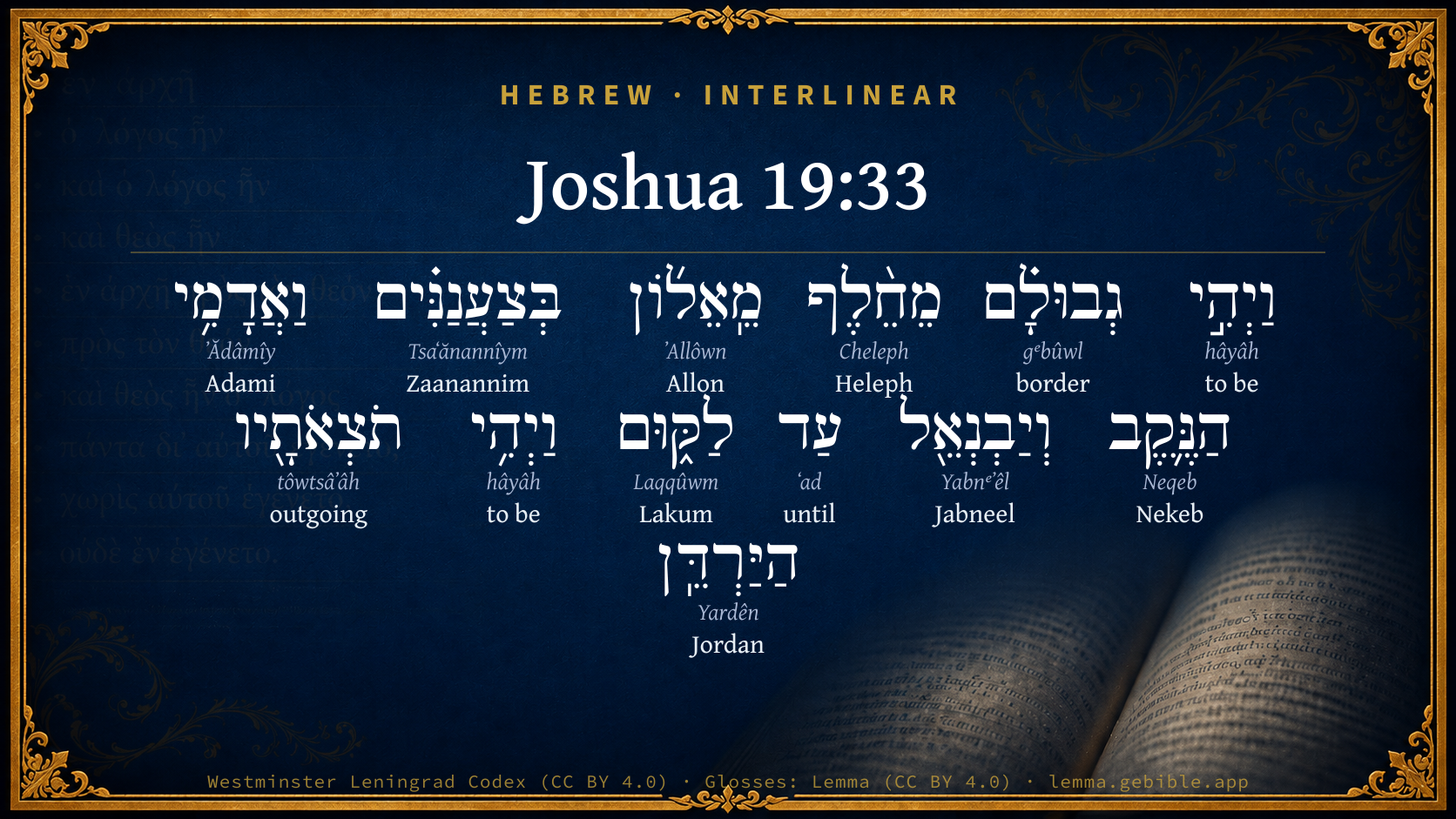
Hebrew (Westminster Leningrad Codex) Joshua 19:33 appears in the Hebrew Old Testament. The text above is from the Westminster Leningrad Codex. Each word links to its Strong’s number, a concise gloss, and parsing drawn from the Open Scriptures Hebrew Bible morphology. Click any word for its full Brown-Driver-Briggs (BDB) entry.
Download image
Cite this verse

Joshua 19:33 (World English Bible). Public Domain. Lemma interlinear Bible study tool, https://lemma.gebible.app/v/joshua/19/33.

Show BibTeX & RIS
BibTeX
RIS
English Translation
Their border was from Heleph, from the oak in Zaanannim, and Adaminekeb, and Jabneel, to Lakkum; and the goings out of it were at the Jordan;
World English Bible · Public Domain
Highlights
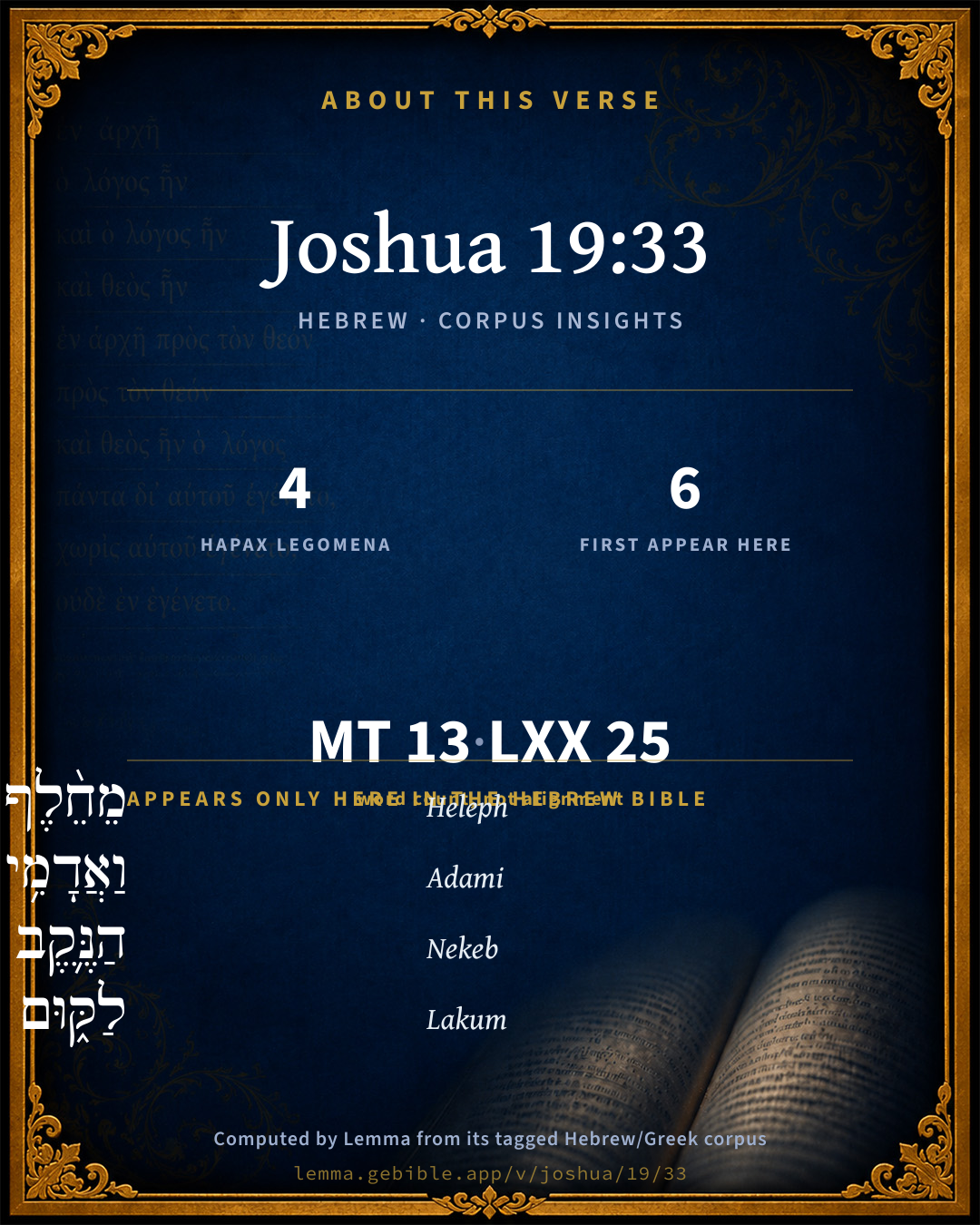
  • 4 hapax legomena — only here in the Hebrew Bible
  • 6 first appearances in the Hebrew Bible
Full analysis ↓
Download a study sheet

One document with this verse’s original text, its word-by-word gloss line, the meaning frame, cross-references with their text, attributed commentary, and full source and license credits — printable, and it pastes into notes with its structure intact.

This verse Autodidact and up

Study sheet (.html) Plain text (.txt)

A passage Seminary Student

Up to 50 verses in one chapter. A passage sheet keeps up to 6 commentary sources and 12 cross-references per verse, in the order this page ranks them, and says so on the sheet whenever that leaves anything out. Ask for a single verse and you get the Autodidact verse sheet above.

Everything on this page stays free to read, with no account — the sheet is a download of what is already on screen, not access to it.

Want to remove ads? Support Godless Engineer
Compare translations 3

The same verse in 3 English versions, stacked beneath the original-language interlinear above. Click any original word for its lexicon entry.

Each is an independent rendering of the whole verse — the interlinear is not word-aligned to these translations.

Highlighted words mark where these versions differ — a whole-verse word diff, not a word-by-word alignment.

  • World English Bible Public Domain
    Their border was from Heleph, from the oak in Zaanannim, and Adaminekeb, and Jabneel, to Lakkum; and the goings out of it were at the Jordan;
  • King James Version Public Domain
    And their coast was from Heleph, from Allon to Zaanannim, and Adami, Nekeb, and Jabneel, unto Lakum; and the outgoings thereof were at Jordan:
  • unfoldingWord Literal Text CC BY-SA 4.0
    And their border was from Heleph, from the oak in Zaanannim, and Adami Nekeb and Jabneel, unto Lakkum. And its goings out were the Jordan.

unfoldingWord Literal Text — © unfoldingWord, licensed CC BY-SA 4.0. Word-aligned USFM3 via Door43 (git.door43.org/unfoldingWord/en_ult).

Versions to compare (up to 4)

3 of 4 selected

Show all 18 translations

Every available English version of this verse, each an independent rendering of the whole verse.

  • World English Bible Public Domain
    Their border was from Heleph, from the oak in Zaanannim, and Adaminekeb, and Jabneel, to Lakkum; and the goings out of it were at the Jordan;
  • Berean Standard Bible Public Domain
    Their border started at Heleph and the great tree of Zaanannim, passing Adami-nekeb and Jabneel as far as Lakkum and ending at the Jordan.
  • Majority Standard Bible Public Domain
    Their border started at Heleph and the great tree of Zaanannim, passing Adami-nekeb and Jabneel as far as Lakkum and ending at the Jordan.
  • King James Version Public Domain
    And their coast was from Heleph, from Allon to Zaanannim, and Adami, Nekeb, and Jabneel, unto Lakum; and the outgoings thereof were at Jordan:
  • American Standard Version (1901) Public Domain
    And their border was from Heleph, from the oak in Zaanannim, and Adaminekeb, and Jabneel, unto Lakkum; and the goings out thereof were at the Jordan;
  • Revised Version (1885) Public Domain
    And their border was from Heleph, from the oak in Zaanannim, and Adami-nekeb, and Jabneel, unto Lakkum; and the goings out thereof were at Jordan:
  • Geneva Bible (1599) Public Domain
    And their coast was from Heleph, and from Allon in Zaanannim, and Adaminekeb, and Iabneel, euen to Lakum, and the ends thereof are at Iorden.
  • Douay-Rheims (1899) Public Domain
    And the border began from Heleph and Elon to Saananim, and Adami, which is Neceb, and Jebnael even to Lecum: and their outgoings unto the Jordan:
  • Young's Literal Translation Public Domain
    and their border is from Heleph, from Allon in Zaanannim, and Adami, Nekeb, and Jabneel, unto Lakkum, and its outgoings are `at' the Jordan;
  • Literal Standard Version CC BY-SA 4.0
    and their border is from Heleph, from Allon in Zaanannim, and Adami, Nekeb, and Jabneel, to Lakkum, and its outgoings are [at] the Jordan;
  • Unlocked Literal Bible CC BY-SA 4.0
    Their border ran from Heleph, from the oak at Zaanannim, on to Adami Nekeb and Jabneel, as far as Lakkum; it ended at the Jordan.
  • unfoldingWord Literal Text CC BY-SA 4.0
    And their border was from Heleph, from the oak in Zaanannim, and Adami Nekeb and Jabneel, unto Lakkum. And its goings out were the Jordan.
  • Darby Bible Public Domain
    And their border was from Heleph, from the oak of Zaanannim; and Adami-nekeb and Jabneel to Lakkum; and ended at the Jordan;
  • World Messianic Bible Public Domain
    Their border was from Heleph, from the oak in Zaanannim, Adami-nekeb, and Jabneel, to Lakkum. It ended at the Jordan.
  • Webster's Bible Public Domain
    And their border was from Heleph, from Allon to Zaanannim, and Adami, Nekeb, and Jabneel, to Lakum; and the limits thereof were at Jordan:
  • Free Bible Version CC BY-SA 4.0
    Their boundary began at Heleph, by the oak at Zaananim, and went across to Adami-nekeb, Jabneel, and up to Lakkum, and ending at the Jordan.
  • Bible in Basic English Public Domain
    And their limit was from Heleph, from the oak-tree in Zaanannim, and Adami-hannekeb and Jabneel, as far as Lakkum, ending at Jordan;
  • JPS Tanakh (1917) Public Domain
    And their border was from Heleph, from Elon-beza-anannim, and Adami-nekeb, and Jabneel, unto Lakkum; and the goings out thereof were at the Jordan.

Literal Standard Version (2020), Covenant Press — licensed CC BY-SA 4.0. Text via the HelloAO Bible API (eBible.org). Unlocked Literal Bible (unfoldingWord) — licensed CC BY-SA 4.0. Text via the HelloAO Bible API (eBible.org). unfoldingWord Literal Text — © unfoldingWord, licensed CC BY-SA 4.0. Word-aligned USFM3 via Door43 (git.door43.org/unfoldingWord/en_ult). Free Bible Version, Dr. Jonathan Gallagher — licensed CC BY-SA 4.0. Text via the HelloAO Bible API (eBible.org).

Word by word

More ways to search: Search by grammar → Find every occurrence → Compare this word →

Practice this passage: Drill this verse → Learn its vocabulary →

מֵחֵ֨לֶף
Cheleph
H2501
“from · Heleph”
Preposition + Noun, Proper
Part of Speech
Preposition + Noun
Type
Proper
Full BDB Definition

Origin: the same as H2500

TWOT: None

Heleph = "exchange" - the place from which the boundary of Naphtali started, site unknown
  1. וַיְהִ֣י hâyâh H1961 “and · to be” Conjunction + Verb, Qal, Sequential Imperfect, 3rd Person, Masculine, Singular
  2. גְבוּלָ֗ם gᵉbûwl H1366 “border · their” Noun, Common, Masculine, Singular, Construct + Suffix, Personal, 3rd Person, Masculine, Plural
  3. מֵֽאֵל֜וֹן ʼAllôwn H438 “from · Allon” Preposition + Noun, Common, Masculine, Singular, Absolute
  4. בְּצַעֲנַנִּ֗ים Tsaʻănannîym H6815 “in/at · Zaanannim” Preposition + Noun, Proper
  5. וַאֲדָמִ֥י ʼĂdâmîy H129 “and · Adami” Conjunction + Noun, Proper
  6. הַנֶּ֛קֶב Neqeb H5346 “Nekeb” Noun, Proper
  7. וְיַבְנְאֵ֖ל Yabnᵉʼêl H2995 “and · Jabneel” Conjunction + Noun, Proper
  8. עַד ʻad H5704 “until” Preposition
  9. לַקּ֑וּם Laqqûwm H3946 “Lakum” Noun, Proper
  10. וַיְהִ֥י hâyâh H1961 “and · to be” Conjunction + Verb, Qal, Sequential Imperfect, 3rd Person, Masculine, Singular
  11. תֹצְאֹתָ֖יו tôwtsâʼâh H8444 “outgoings · his” Noun, Common, Feminine, Plural, Construct + Suffix, Personal, 3rd Person, Masculine, Singular
  12. הַיַּרְדֵּֽן Yardên H3383 “the · Jordan” Particle, Definite Article + Noun, Proper

About this verse

These counts appear in no published source. They are computed here, from the morphology-tagged text and Lemma’s own curated glosses. What Lemma adds →

13
words
12
distinct lemmas
Historical
section

Notable vocabulary

4 hapax legomena — words that appear only here in the entire Hebrew Bible:

  • מֵחֵ֨לֶף Heleph H2501
  • וַאֲדָמִ֥י Adami H129
  • הַנֶּ֛קֶב Nekeb H5346
  • לַקּ֑וּם Lakum H3946

First appearance in Scripture

These words make their first canonical appearance in the Hebrew Bible here:

  • מֵחֵ֨לֶף Heleph H2501
  • מֵֽאֵל֜וֹן Allon H438
  • בְּצַעֲנַנִּ֗ים Zaanannim H6815
  • וַאֲדָמִ֥י Adami H129
  • הַנֶּ֛קֶב Nekeb H5346
  • לַקּ֑וּם Lakum H3946

Shared distinctive vocabulary

מֵֽאֵל֜וֹן Allon H438 occurs in 2 verses of the Hebrew Bible. Also found in:

Grammatical profile

  • 2 verbs
  • 10 nouns
  • 1 preposition

Verb forms

  • וַיְהִ֣י Qal · Sequential Imperfect
  • וַיְהִ֥י Qal · Sequential Imperfect

Repetition

A word recurs within this verse — often emphatic in Hebrew:

  • וַיְהִ֣י to be H1961 ×2

Hebrew & Septuagint length

In English translation the verse runs 26 words from the Hebrew and 25 from the Septuagint (LXX English) — closely comparable.

A rough comparison of the two English renderings, which tokenize alike — not a word-level alignment.

Word counts can differ between the Hebrew and the Greek without any difference in meaning — e.g. the Hebrew direct-object marker אֵת has no separate Greek word, and Greek often adds the article ὁ.

In the original languages it is 13 Hebrew tokens and 25 Greek tokens — but the two are counted differently (Hebrew bundles its prefixes and suffixes into one token; the Greek is in lemma form), so that isn’t a like-for-like length.

Cross-references

1

Topical passages linked to Joshua 19:33 in the Treasury of Scripture Knowledge — connected by theme and wording, ordered by reader-vote popularity; previews shown in the World English Bible.

  • Judges 4:11 Now Heber the Kenite had separated himself from the Kenites, even from the children of Hobab the brother-in-law of Moses, and had pitched his tent as far as the oak in Zaanannim, which is by Kedesh.

Cross-references courtesy of OpenBible.info (CC BY 4.0).

Hebrew and Greek witnesses Masoretic Hebrew ↔ Greek Septuagint

The same verse in the two great witnesses to the Old Testament, shown verse-for-verse.

These are two independent witnesses, not word-aligned to each other, and the Septuagint is shown in lemma (dictionary) form.

Hebrew Joshua 19:33 Masoretic · Westminster Leningrad Codex

וַיְהִ֣י גְבוּלָ֗ם מֵחֵ֨לֶף מֵֽאֵל֜וֹן בְּצַעֲנַנִּ֗ים וַאֲדָמִ֥י הַנֶּ֛קֶב וְיַבְנְאֵ֖ל עַד לַקּ֑וּם וַיְהִ֥י תֹצְאֹתָ֖יו הַיַּרְדֵּֽן

Their border was from Heleph, from the oak in Zaanannim, and Adaminekeb, and Jabneel, to Lakkum; and the goings out of it were at the Jordan;

World English Bible · Public Domain

Greek LXX Joshua 19:33 Septuagint · lemma form

καί γίγνομαι ὁ ὅριον αὐτός μοολαμ καί μωλα καί βεσεμιιν καί αρμε καί ναβωκ καί ιεφθαμαι ἕως δωδαμ καί γίγνομαι ὁ διέξοδος αὐτός ὁ ἰορδάνης

And their borders were Moolam, and Mola, and Besemiin, and Arme, and Naboc, and Jephthamai, as far as Dodam; and their goings out were Jordan.

LXX2012 (modern English Septuagint) · Public Domain

Hebrew: Westminster Leningrad Codex (CC BY 4.0). Greek: Septuagint (public domain); English from LXX2012 (modern English Septuagint) (Public Domain). How the Septuagint differs from the Hebrew →

Targum (Aramaic paraphrase)

1

The Targum is the ancient Jewish Aramaic paraphrase of the Hebrew Scriptures — an interpretive translation, not the Hebrew text itself. Onkelos (literal) and Pseudo-Jonathan (expansive) render the Torah, and Jonathan the Prophets. Coverage is partial: where no permissively-licensed English translation exists for a verse, only the Aramaic is shown. This is verse-level text, not a word-by-word alignment to the Hebrew.

  1. Targum Jonathan Prophets (Joshua–Malachi)
    וַהֲוָה תְּחוּמְהוֹן מֵחֵלֶף מֵאַלוֹן בְּצַעֲנַנִים וַאֲדָמִי הַנֶקֶב וְיַבְנְאֵל עַד לַקוּם וַהֲווֹן מַפְקָנוֹהִי לְיַרְדְנָא:

    (no public-domain English translation for this verse)

    Targum Jonathan — Aramaic: “Mikraot Gedolot” (public domain). English: “Sefaria Community Translation” (CC0 1.0 (public-domain dedication)); “London "Chaldee Paraphrase," 1871” (public domain). Text via Sefaria.

Commentary

Notes on Joshua 19:33 from classic Christian and Jewish commentators (each source and its license shown beneath its notes). The classic Christian expositions comment on the surrounding passage and are grouped to its opening verse, so a note may address several verses; the Jewish commentaries on the Tanakh (Rashi and others) are per-verse, so they appear only where the commentator wrote on this verse.

Lemma curates 59 commentaries, every one of them public domain or Creative Commons licensed, each selected and text-cleaned for this edition rather than reprinted as found. About our sources →

John Gill's Exposition

And then the coast turneth westward to Aznothtabor,.... This was the southern border, reaching from east to west; it began at Aznothtabor, which Jerom (g) says was a village in his time belonging to the country of Diocaesarea, in the plains; there is another place called Chislothtabor, on the borders of Zebulun, Jos 19:12,

and goeth out from thence to Hukkok: there the southern border ended, which was in the border of Asher, and is the same with Helkath, Jos 19:25; with which compare Ch1 6:75,

and reacheth to Zebulun on the south side, and reacheth to Asher on the west side and to Judah upon Jordan towards the sunrising; so that as it was bounded by Lebanon, on the north, near to which some of the cities were, mentioned in Jos 19:33, it had Zebulun on the south, Asher on the west, and Jordan to the east; for by Judah is not meant the tribe of Judah, from which Naphtali was at a great distance, but a city so called, as Fuller (h) seems rightly to conjecture.

(g) De loc. Heb. fol. 88. I. (h) Pisgah-Sight, B. 2. c. 4. p. 104.

John Gill's Exposition of the Whole Bible (1746–1763) — public domain (CC PDM 1.0). Text via the HelloAO Bible API.

Geneva Bible (1599)

Geneva Bible translators

These cities were in the country of Zaanannim.

Geneva Bible (1599) marginal notes — public domain. Text via Bolls.life.

Ellicott's Commentary for English Readers

(33) And their coast was . . .—This verse is thus translated by Conder, “Their coast was from Heleph and the Plain of Bitzanannim and Adami, Nekeb, and Jabneel,unto Lakum,and the outgoings were at Jordan.”

The east border of the tribe is Jordan, including the waters of Merom and the Sea of Galilee. The tribe of Issachar on the south, and the tribes of Zebulun and Asher on the west, are conterminous with Naphtali.

The places mentioned are identified as follows:—

Heleph.—(Beit Lif, sheet 4). The plain of Bitzanannim (Kh.-Bessum, sheet 6). Adami (Kh.-Admah, sheet 9): this is the southernmost of all the towns named. Nekeb (Kh.-Seiyâdeh, sheet 6). Jabneel (Yemma, sheet 5). All the above places, except Heleph, lie near the Sea of Galilee, on the south-west side.

A Bible Commentary for English Readers, edited by Charles John Ellicott (1878–1897) — public domain. Text from a community e-Sword module.

The Cambridge Bible for Schools and Colleges

gen. ed. J. J. S. Perowne

33. And their coast] The territory appropriated to the tribe was bounded (a) on the west by Asher, (b) on the south by Zebulun and Issachar, (c) on the east by the Sea of Gennesaret and the Jordan, while (d) on the north it reached far up into Cœle-Syria, “the splendid valley which separates the two ranges of Lebanon.”

from Heleph] Apparently the west border towards Asher is first described, with the north and east boundary. The southern border is defined in Jos_19:34. Heleph is unknown.

Allon to Zaanannim] = the oak, or terebinth, by Zaanannim. It is the same place, on the N. W. of Lake Merom, as that mentioned in Jdg_4:11, where Sisera was slain by Jael, “the wife of Heber the Kenite,” and derived its name Zaanannim or Zaanaim, the unloading of Tents, from the strange sight of the encampment of nomads in tents amidst the regular cities and villages of the mountains.” “Even to the present day the Bedouins more or less friendly disposed wander about in the north of Palestine, in the plain of Jezreel, on Gilboa, and on Tabor.” See Lange’s Commentary. “The reconnaissance survey along the watershed from Hûnin led across a succession of mountain peaks, forming the great western vale of the Jordan. The highlands—we are in the tribe of Naphtali—form a series of valleys with which the country is intersected, the ridges between them being described as somewhat of the character of open glades, gently sloping towards the sea. The hills are well wooded, though the oaks are being thinned out to supply the Damascus market with charcoal. At the last peak the hill slopes to the southward, overlooking a little plain, one mile wide and two long, lying sheltered among the surrounding hills. This is the plain of Zaanaim.” Our Work in Palestine, pp. 174, 175.

Adami, Nekeb, Jabneel, Lakum, are all unknown.

and the outgoings thereof] The boundary is traced from the southwest towards the north-east to the sources of the Jordan, above the Lake of Galilee.

The Cambridge Bible for Schools and Colleges (gen. ed. J. J. S. Perowne; Cambridge University Press, 1878–1918) — public domain. Text from a community e-Sword module.

Albert Barnes' Notes on the Bible

From Allon to Zaanannim - Render “from the oak forest at Zaanannim.” From Jdg 4:11 it appears that this oak or oak-forest was near Kedesh.

Adami, Nekeb - Render “Adami of the Pass.” Possibly the ancient “Deir el Ahmar” (“red cloister”), which derives its name from the color of the soil in the neighborhood, as perhaps Adami did. The spot lies about 8 miles northwest of Baalbek.

Albert Barnes' Notes on the Bible (1834–1885) — public domain. Text from a community e-Sword/MySword module.

Haydock's Catholic Bible Commentary

Heleph seems to have been on the north-eastern limits of Nephthali. The cities on the Jordan southwards, as far as Genesareth, are specified. (Haydock)

George Leo Haydock (1774–1849), Haydock's Catholic Family Bible and Commentary, 1859 edition — public domain. Excludes Psalms (Douay-Rheims chapter numbering differs from Protestant) and Deuterocanonical books (Catholic canon only).

Matthew Poole's English Annotations

Their coast; their northern border, drawn from west to east, as appears, because when this coast is described and brought to its end, the coast is said to turn from the east westward, Jos 19:34. The outgoings, i.e. the end of that coast.

Matthew Poole's English Annotations on the Holy Bible (1683–1685) — public domain. Text from a community e-Sword/MySword module.

Whedon's Commentary on the Bible

Daniel D. Whedon

33. The cities here mentioned are so far unknown that there is great difficulty in attempting an accurate description of the boundaries of this tribe. The northern and a part of the western boundary seem to have been identical, running mainly in a northeasterly direction, and Heleph, the starting point, seems to have been some central place on this line, from which the border ran first eastward, but somewhat towards the north, and then seaward. Jos_19:34. [Van de Velde proposes to identify Heleph with Beitlif, an ancient site about twelve miles southeast of Tyre and about the same distance west of Kades. It stands on the edge of a very marked ravine, which may very possibly have formed a part of the border of Naphtali and Asher.

Allon — As the Hebrew word means an oak, some critics very plausibly understand it of some remarkable tree near Zaanannim, and render, From the oak at Zaanannim. This was probably the same tree by which Heber the Kenite pitched his tent. See Jdg_4:11, note.

Out-goings… at Jordan — That is, this northwestern boundary terminated at the upper sources of the Jordan.]

Daniel D. Whedon (gen. ed.), Commentary on the Old and New Testaments (1874–1909) — public domain. Text from a community e-Sword module.

The Pulpit Commentary

From Allon to Zaanannim Or, the oak which is at Zaanannim. (cf. Allon-bachuth, the oak of weeping, Gen_35:8) Zaanannim is the same as the Zaanaim mentioned in Jud_1:4:11. For the Keri is Zaanannim there, and the word here rightly translated "oak" is rendered there "plain, as in Gen_12:6 and elsewhere. It has been supposed to lie northwest of Lake Huleh, the ancient Merom, whence we find that the scene of that famous battle was assigned to the tribe of Naphtali. The border of Naphtali is more lightly traced than any previous one, and is regarded as being sufficiently defined, save toward the north, by the boundaries of the other tribes.

The Pulpit Commentary (1880–1919), ed. H.D.M. Spence-Jones & Joseph S. Exell — public domain. Text from a community e-Sword module.

John Wesley's Explanatory Notes

Their coast - Their northern border drawn from west to east, as appears, because when this coast is described and brought to its end, the coast is said to turn from the east westward, ver. 34. The out-goings - The end of that coast.

John Wesley, Explanatory Notes Upon the Whole Bible (1754–1765) — public domain. Text via the GEBible commentary corpus.

Lesson kit

Teaching starters — assembled from the data on this page, not authored interpretation. Every prompt links to the verse data it draws on. Edit before teaching.

Joshua, in the Historical, opens this verse with 13 words (12 distinct Hebrew lemmas). Its most distinctive word is Cheleph (“Heleph”). A historical commentator’s framing appears above. Read the whole chapter for the surrounding context.

Discussion questions

  1. What does “Heleph” (Cheleph) contribute to the verse as a whole?
  2. This verse holds 4 words here found nowhere else in the Hebrew Bible. What might the rare words draw attention to?
  3. 6 words here appear for the first time in Scripture. What is being introduced at this debut?
  4. 1 Chronicles 4:37 shares the word «Allon» with this verse. How do the two illuminate each other?
  5. “to be” occurs 2× in this one verse. What is the effect of the repetition?
  6. These translations render this verse differently. What is at stake in choosing one wording over another?
  7. The verb «וַיְהִ֣י» is Qal Sequential Imperfect. How does its form color the action?
  8. Reading how John Gill's Exposition and Geneva Bible (1599) read this verse, where do the two commentators agree and where do they part?

Things to notice

  • 4 words in this verse appear nowhere else in the Hebrew Bible.
  • 6 words make their first canonical appearance in Scripture here.
  • This verse counts 13 Hebrew ↔ 25 Greek words.
  • These translations choose different wording for 13 words in this verse.
  • “to be” occurs 2× in this single verse.

Reading settings

Reading text

Shown beneath each verse's original-language words.

Old Testament
Old Testament edition

Read the OT as the Masoretic Hebrew (MT) or the Greek Septuagint (LXX).

English shown for the Greek Septuagint (in the Hebrew ↔ Greek comparison).

Comparing translations? Open the Compare panel on any verse page to stack up to four side by side.