
Joshua 19:25

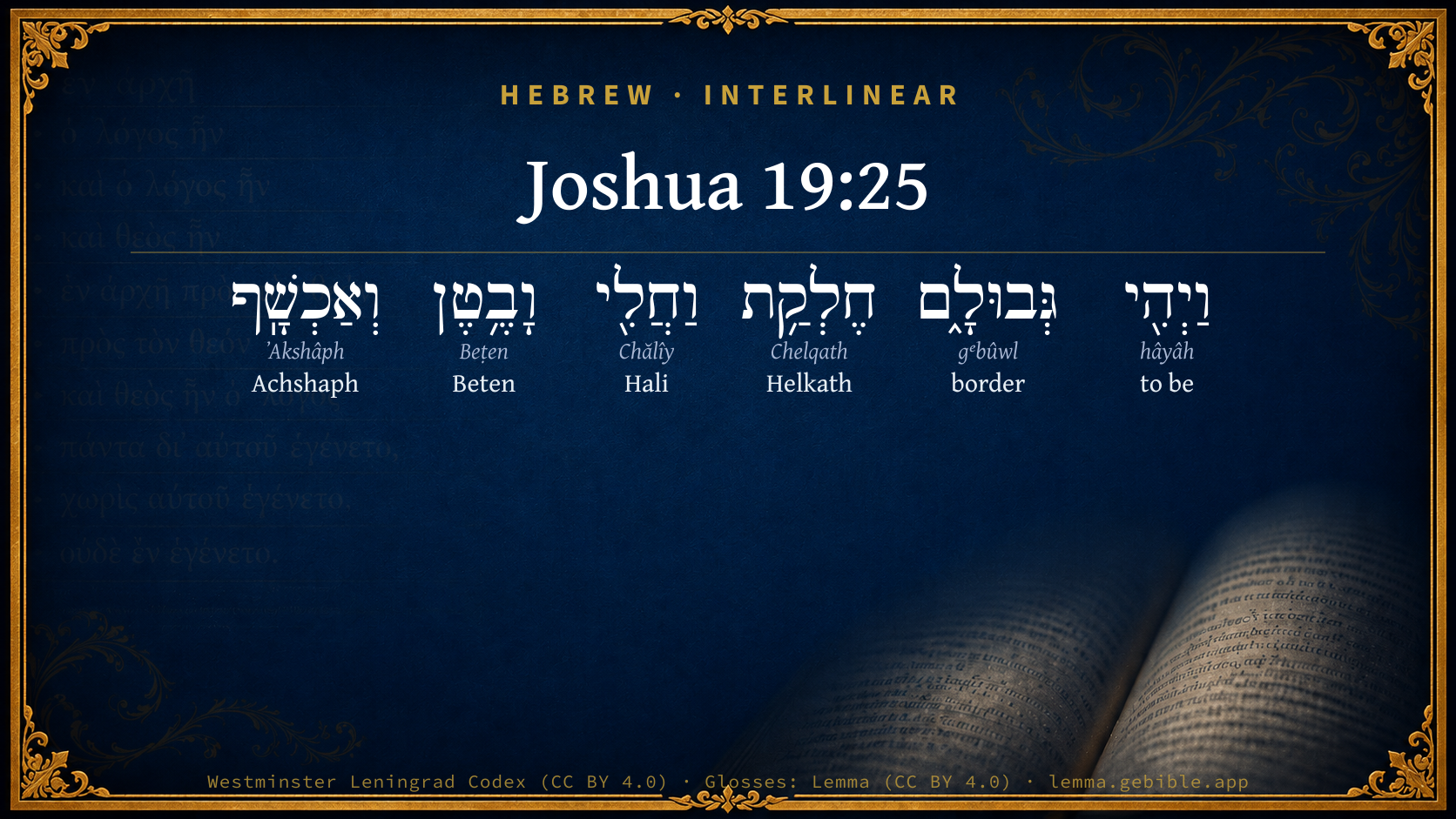
Hebrew (Westminster Leningrad Codex) Joshua 19:25 appears in the Hebrew Old Testament. The text above is from the Westminster Leningrad Codex. Each word links to its Strong’s number, a concise gloss, and parsing drawn from the Open Scriptures Hebrew Bible morphology. Click any word for its full Brown-Driver-Briggs (BDB) entry.
Download image
Cite this verse

Joshua 19:25 (World English Bible). Public Domain. Lemma interlinear Bible study tool, https://lemma.gebible.app/v/joshua/19/25.

Show BibTeX & RIS
BibTeX
RIS
English Translation
Their border was Helkath, and Hali, and Beten, and Achshaph,
World English Bible · Public Domain
Highlights
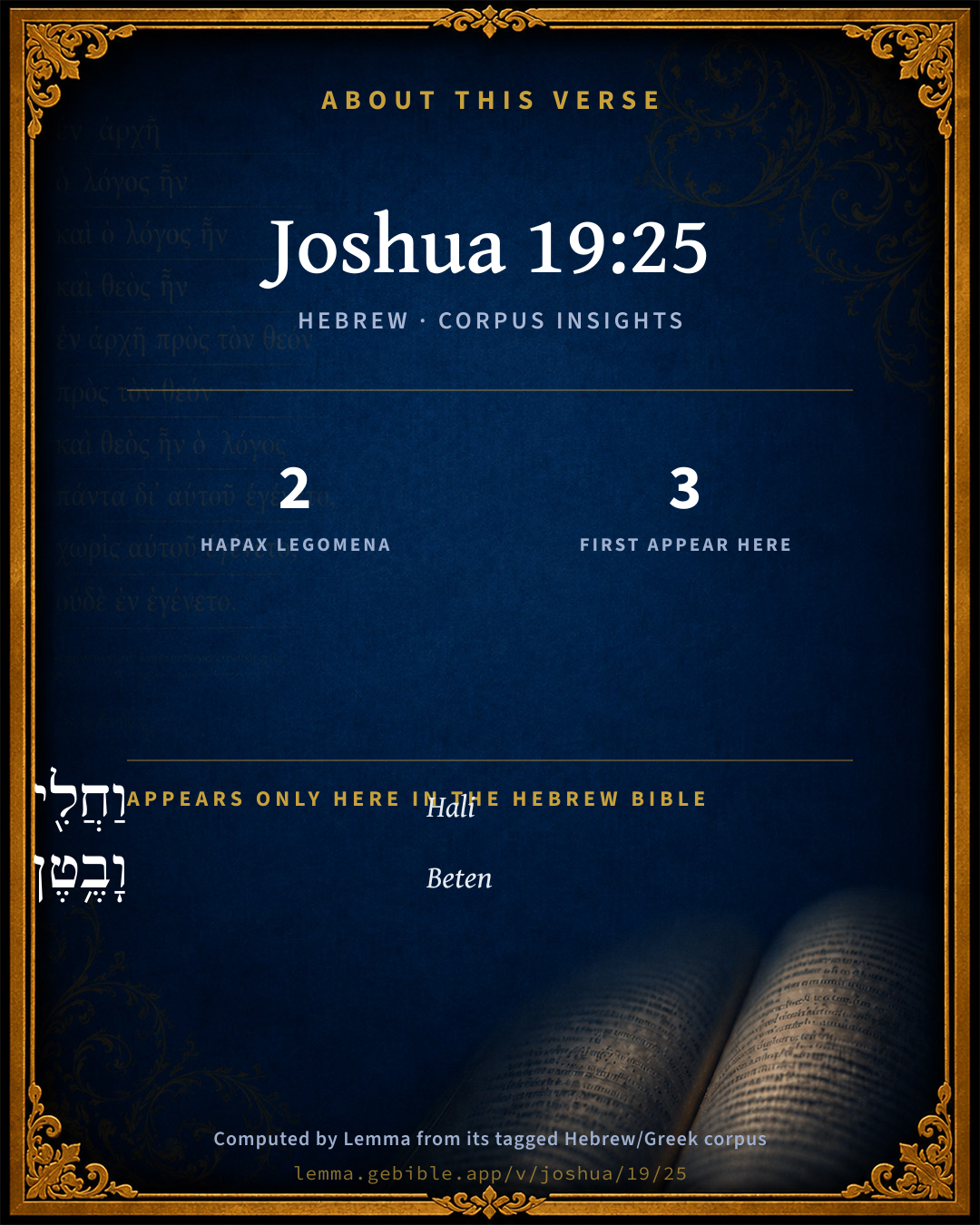
  • 2 hapax legomena — only here in the Hebrew Bible
  • 3 first appearances in the Hebrew Bible
Full analysis ↓
Download a study sheet

One document with this verse’s original text, its word-by-word gloss line, the meaning frame, cross-references with their text, attributed commentary, and full source and license credits — printable, and it pastes into notes with its structure intact.

This verse Autodidact and up

Study sheet (.html) Plain text (.txt)

A passage Seminary Student

Up to 50 verses in one chapter. A passage sheet keeps up to 6 commentary sources and 12 cross-references per verse, in the order this page ranks them, and says so on the sheet whenever that leaves anything out. Ask for a single verse and you get the Autodidact verse sheet above.

Everything on this page stays free to read, with no account — the sheet is a download of what is already on screen, not access to it.

Want to remove ads? Support Godless Engineer
Compare translations 3

The same verse in 3 English versions, stacked beneath the original-language interlinear above. Click any original word for its lexicon entry.

Each is an independent rendering of the whole verse — the interlinear is not word-aligned to these translations.

Highlighted words mark where these versions differ — a whole-verse word diff, not a word-by-word alignment.

  • World English Bible Public Domain
    Their border was Helkath, and Hali, and Beten, and Achshaph,
  • King James Version Public Domain
    And their border was Helkath, and Hali, and Beten, and Achshaph,
  • unfoldingWord Literal Text CC BY-SA 4.0
    And their border Helkath and Hali and Beten and Akshaph

unfoldingWord Literal Text — © unfoldingWord, licensed CC BY-SA 4.0. Word-aligned USFM3 via Door43 (git.door43.org/unfoldingWord/en_ult).

Versions to compare (up to 4)

3 of 4 selected

Show all 18 translations

Every available English version of this verse, each an independent rendering of the whole verse.

  • World English Bible Public Domain
    Their border was Helkath, and Hali, and Beten, and Achshaph,
  • Berean Standard Bible Public Domain
    Their territory included Helkath, Hali, Beten, Achshaph,
  • Majority Standard Bible Public Domain
    Their territory included Helkath, Hali, Beten, Achshaph,
  • King James Version Public Domain
    And their border was Helkath, and Hali, and Beten, and Achshaph,
  • American Standard Version (1901) Public Domain
    And their border was Helkath, and Hali, and Beten, and Achshaph,
  • Revised Version (1885) Public Domain
    And their border was Helkath, and Hali, and Beten, and Achshaph,
  • Geneva Bible (1599) Public Domain
    And their coast was Helcath, and Hali, and Beten, and Achshaph,
  • Douay-Rheims (1899) Public Domain
    And their border was Halcath and Chali and Beten and Axaph,
  • Young's Literal Translation Public Domain
    and their border is Helkath, and Hali, and Beten, and Achshaph,
  • Literal Standard Version CC BY-SA 4.0
    and their border is Helkath, and Hali, and Beten, and Achshaph,
  • Unlocked Literal Bible CC BY-SA 4.0
    Their territory included Helkath, Hali, Beten, Akshaph,
  • unfoldingWord Literal Text CC BY-SA 4.0
    And their border Helkath and Hali and Beten and Akshaph
  • Darby Bible Public Domain
    And their territory was Helkath, and Hali, and Beten, and Acshaph,
  • World Messianic Bible Public Domain
    Their border was Helkath, Hali, Beten, Achshaph,
  • Webster's Bible Public Domain
    And their border was Helkath, and Hali, and Beten, and Achshaph,
  • Free Bible Version CC BY-SA 4.0
    Their allocation included the towns of Helkath, Hali, Beten, Acshaph,
  • Bible in Basic English Public Domain
    And their limit was Helkath and Hali and Beten and Achshaph
  • JPS Tanakh (1917) Public Domain
    And their border was Helkath, and Hali, and Beten, and Achshaph;

Literal Standard Version (2020), Covenant Press — licensed CC BY-SA 4.0. Text via the HelloAO Bible API (eBible.org). Unlocked Literal Bible (unfoldingWord) — licensed CC BY-SA 4.0. Text via the HelloAO Bible API (eBible.org). unfoldingWord Literal Text — © unfoldingWord, licensed CC BY-SA 4.0. Word-aligned USFM3 via Door43 (git.door43.org/unfoldingWord/en_ult). Free Bible Version, Dr. Jonathan Gallagher — licensed CC BY-SA 4.0. Text via the HelloAO Bible API (eBible.org).

Word by word

More ways to search: Search by grammar → Find every occurrence → Compare this word →

Practice this passage: Drill this verse → Learn its vocabulary →

About this verse

These counts appear in no published source. They are computed here, from the morphology-tagged text and Lemma’s own curated glosses. What Lemma adds →

6
words
6
distinct lemmas
Historical
section

Notable vocabulary

2 hapax legomena — words that appear only here in the entire Hebrew Bible:

  • וַחֲלִ֖י Hali H2482
  • וָבֶ֥טֶן Beten H991

First appearance in Scripture

These words make their first canonical appearance in the Hebrew Bible here:

  • חֶלְקַ֥ת Helkath H2520
  • וַחֲלִ֖י Hali H2482
  • וָבֶ֥טֶן Beten H991

Shared distinctive vocabulary

חֶלְקַ֥ת Helkath H2520 occurs in 2 verses of the Hebrew Bible. Also found in:

Grammatical profile

  • 1 verb
  • 5 nouns

Verb forms

  • וַיְהִ֖י Qal · Sequential Imperfect

Hebrew & Septuagint length

In English translation the verse runs 10 words from the Hebrew and 11 from the Septuagint (LXX English) — closely comparable.

A rough comparison of the two English renderings, which tokenize alike — not a word-level alignment.

Word counts can differ between the Hebrew and the Greek without any difference in meaning — e.g. the Hebrew direct-object marker אֵת has no separate Greek word, and Greek often adds the article ὁ.

Cross-references

3

Topical passages linked to Joshua 19:25 in the Treasury of Scripture Knowledge — connected by theme and wording, ordered by reader-vote popularity; previews shown in the World English Bible.

  • Joshua 11:1 It happened, when Jabin king of Hazor heard of it, that he sent to Jobab king of Madon, and to the king of Shimron, and to the king of Achshaph,
  • Joshua 12:20 the king of Shimron-meron, one; the king of Achshaph, one;
  • 2 Samuel 2:16 They caught everyone his fellow by the head, and [thrust] his sword in his fellow's side; so they fell down together: therefore that place was called Helkath Hazzurim, which is in Gibeon.

Cross-references courtesy of OpenBible.info (CC BY 4.0).

Hebrew and Greek witnesses Masoretic Hebrew ↔ Greek Septuagint

The same verse in the two great witnesses to the Old Testament, shown verse-for-verse.

These are two independent witnesses, not word-aligned to each other, and the Septuagint is shown in lemma (dictionary) form.

Hebrew Joshua 19:25 Masoretic · Westminster Leningrad Codex

וַיְהִ֖י גְּבוּלָ֑ם חֶלְקַ֥ת וַחֲלִ֖י וָבֶ֥טֶן וְאַכְשָֽׁף

Their border was Helkath, and Hali, and Beten, and Achshaph,

World English Bible · Public Domain

Greek LXX Joshua 19:25 Septuagint · lemma form

καί γίγνομαι ὁ ὅριον αὐτός ἐκ ελεκεθ καί αλεφ καί βαιθοκ καί κεαφ

And their borders were Exeleketh, and Aleph, and Baethok, and Keaph,

LXX2012 (modern English Septuagint) · Public Domain

On this verse, John Gill's Exposition discusses the Septuagint’s reading. Read the note in Commentary ↓

Hebrew: Westminster Leningrad Codex (CC BY 4.0). Greek: Septuagint (public domain); English from LXX2012 (modern English Septuagint) (Public Domain). How the Septuagint differs from the Hebrew →

Targum (Aramaic paraphrase)

1

The Targum is the ancient Jewish Aramaic paraphrase of the Hebrew Scriptures — an interpretive translation, not the Hebrew text itself. Onkelos (literal) and Pseudo-Jonathan (expansive) render the Torah, and Jonathan the Prophets. Coverage is partial: where no permissively-licensed English translation exists for a verse, only the Aramaic is shown. This is verse-level text, not a word-by-word alignment to the Hebrew.

  1. Targum Jonathan Prophets (Joshua–Malachi)
    וַהֲוָה תְּחוּמְהוֹן חֶלְקַת וַחֲלִי וָבֶטֶן וְאַכְשָׁף:

    (no public-domain English translation for this verse)

    Targum Jonathan — Aramaic: “Mikraot Gedolot” (public domain). English: “Sefaria Community Translation” (CC0 1.0 (public-domain dedication)); “London "Chaldee Paraphrase," 1871” (public domain). Text via Sefaria.

Commentary

Notes on Joshua 19:25 from classic Christian and Jewish commentators (each source and its license shown beneath its notes). The classic Christian expositions comment on the surrounding passage and are grouped to its opening verse, so a note may address several verses; the Jewish commentaries on the Tanakh (Rashi and others) are per-verse, so they appear only where the commentator wrote on this verse.

Lemma curates 59 commentaries, every one of them public domain or Creative Commons licensed, each selected and text-cleaned for this edition rather than reprinted as found. About our sources →

Ellicott's Commentary for English Readers

(25) Their border.—The border of Asher on the west is the Mediterranean. On the east of Asher lies the tribe of Naphtali, but most of the towns named in these verses lie well within the territory of Asher. The northern end of the territory of this tribe lies beyond the limits of the Ordnance Survey, for it reaches “unto great Zidon” (Jos_19:28). The southern boundary is said to be Carmel (Jos_19:26), but no town is identified south of Cabul (Kabûl, south-east of Akkah, sheet 5).

The towns identified are as follows:—

(25) El B’aneh, EL-Yasif or Kefr Yasif (sheet 3).

(26) Khurbet-el-Amûd, and M’aîsleh (? Kh.-Muslih) (sheet 3).

Shihor-libnath (river of glass), the river Belus (sheet 5).

(27) Beth-dagon (Tell-’ Daûk), near the mouth of the Belus.

Neiel.—(Y’Arûn, sheet 5).

Cabul.—(Kabûl, south-east of Akkah, sheet 5).

(28) Hebron.—(Abdon, Kh.-Abdeh, sheet 3). Hammon (El Hama, sheet 3).

Kanah (south-east of Tyre, sheet 1).

(29) Tyre.—(es-Sûr, sheet 1). Hosah (‘Ozziyeh, sheet 1). Achzib (es-Zib, sheet 3, on the coast). (See Jos_15:44 for another place of same name.) Ummah (Kh.-Almah, north of Achzib).

A Bible Commentary for English Readers, edited by Charles John Ellicott (1878–1897) — public domain. Text from a community e-Sword module.

The Cambridge Bible for Schools and Colleges

gen. ed. J. J. S. Perowne

25. And their border] The general position of the tribe was on the slope of the Galilean mountains from Carmel northwards, with Manasseh on the south, Zebulun and Issachar on the south-east, and Naphtali on the north-east, a narrow, but beautiful and fertile region.

And their border was Helkath] The first boundary given us is that formed by the cities of Helkath, afterwards given to the Levites (ch. Jos_21:31), Hali, Beten, and Achshaph (ch. Jos_12:20), of none of which cities is the situation known to us.

The Cambridge Bible for Schools and Colleges (gen. ed. J. J. S. Perowne; Cambridge University Press, 1878–1918) — public domain. Text from a community e-Sword module.

John Gill's Exposition

And Alammelech, and Amad,.... Of the two first of these there is no mention elsewhere:

and Misheal is the same with Mashal, Ch1 6:74; and is by Jerom (l) called Masan, and said to be near Carmel to the sea:

and reacheth to Carmel westward; or, "to the sea", as Carmel is called "Carmel by the sea"; see Gill on Jer 46:18, it is hereby distinguished from Carmel in the tribe of Judah, Jos 15:55; (Pliny (m) calls it a promontory):

and to Shihorlibnath; the Vulgate Latin and Septuagint versions make two places of it: but the sum of the cities after given will not admit of it: more rightly Junius renders it Sihor by Libhath, and takes Sihor to be the river Belus, or Pagidus; so called either because of its likeness to the Nile, one of whose names is Sihor, Jer 2:18; or because its waters might be black and muddy; it was the river out of which sand was fetched to make glass of: and Libnath, which has its name from whiteness, the same writer thinks may be the Album Promontorium, or white promontory of Pliny (n), which he places near Ptolemais, between Ecdippa and Tyre, and is very probable.

(l) De loc. Heb. fol. 93. E. (m) Ut supra. (Nat. Hist. l. 5. c. 19.) (n) Ibid.

John Gill's Exposition of the Whole Bible (1746–1763) — public domain (CC PDM 1.0). Text via the HelloAO Bible API.

Albert Barnes' Notes on the Bible

Helkath, a Levitical town Jos 21:31, is probably Yerka, a village about seven or eight miles north-west of Acre, in a Wady of the same name. Alammelech was in the “Wady Melik,” which joins the Kishon from the northeast, not far from the sea.

Shihor-libnath - i. e. “black-white.” The two words are now generally admitted to be the name of a river, probably the modern “Nahr Zerka,” or Blue River, which reaches the sea about 8 miles south of Dor, and whose name has a correspondence both to black and white. Possibly we have in the occurrence of the term Shihor here a trace of the contact, which was close and continuous in ancient times, between Phoenicia and Egypt Jos 13:3. Cabul Jos 19:27 still retains its ancient name; it lies between four and five miles west of Jotapata and about ten miles southeast of Acre.

Albert Barnes' Notes on the Bible (1834–1885) — public domain. Text from a community e-Sword/MySword module.

Matthew Poole's English Annotations

Their border, on the north-west side.

Matthew Poole's English Annotations on the Holy Bible (1683–1685) — public domain. Text from a community e-Sword/MySword module.

Whedon's Commentary on the Bible

Daniel D. Whedon

25. Achshaph — See on Jos_11:1. In this list, as in other extended lists of cities, no note is usually taken of those whose sites are now unknown.

26. [Carmel — A range of connected hills, whose average height is fifteen hundred feet, running from the northern hills of Samaria northwesterly, and terminating in a lofty promontory which projects boldly into the Mediterranean just south of the bay of Acre. All travellers agree in giving glowing descriptions of the grandeur, beauty, and excellency of Carmel. “There is not a flower,” says Van de Velde, “that I have seen in Galilee, or on the plains along the coast, that I did not find on Carmel.” Mr. Carne says: “No mountain in or around Palestine retains its ancient beauty so much as Carmel. its groves are few but luxuriant. It is no place for crags and precipices, or rocks of the wild goats; but its surface is covered with a rich and constant verdure.”] Shihor-libnath, river of whiteness, is a matter of great dispute. Every stream, from the Belus southward to the Crocodile River inclusive, has been selected as the river here mentioned. It must have been south of Dor, (Tantura,) which belonged to Asher. Jos_17:11.

Daniel D. Whedon (gen. ed.), Commentary on the Old and New Testaments (1874–1909) — public domain. Text from a community e-Sword module.

The Pulpit Commentary

Helkath. A Levitical city. (Jos_21:31 1Ch_6:75, where it is called Hukok)

The Pulpit Commentary (1880–1919), ed. H.D.M. Spence-Jones & Joseph S. Exell — public domain. Text from a community e-Sword module.

Lesson kit

Teaching starters — assembled from the data on this page, not authored interpretation. Every prompt links to the verse data it draws on. Edit before teaching.

Joshua, in the Historical, opens this verse with 6 words (6 distinct Hebrew lemmas). Its most distinctive word is Chălîy (“Hali”). A historical commentator’s framing appears above. Read the whole chapter for the surrounding context.

Discussion questions

  1. How does “Hali” (Chălîy) shape what this verse is saying?
  2. 2 words here appear nowhere else in the Hebrew Bible. Why might the author reach for such rare wording?
  3. 3 words make their first appearance in Scripture here. What does this debut establish?
  4. How does Joshua 21:31, which shares the word «Helkath», read alongside this verse?
  5. These translations render this verse differently; the difference is in the English rendering, not the original. What questions does that raise?
  6. «וַיְהִ֖י» is a Qal Sequential Imperfect verb. How does that grammatical form shape the action described?
  7. Compare how Ellicott's Commentary for English Readers and The Cambridge Bible for Schools and Colleges read this verse. Where do they agree or differ?

Things to notice

  • 2 words in this verse appear nowhere else in the Hebrew Bible.
  • 3 words make their first canonical appearance in Scripture here.
  • These translations choose different wording for 2 words in this verse.
  • 6 distinct Hebrew lemmas span 6 words in this verse.

Reading settings

Reading text

Shown beneath each verse's original-language words.

Old Testament
Old Testament edition

Read the OT as the Masoretic Hebrew (MT) or the Greek Septuagint (LXX).

English shown for the Greek Septuagint (in the Hebrew ↔ Greek comparison).

Comparing translations? Open the Compare panel on any verse page to stack up to four side by side.