
Ezekiel 27:4

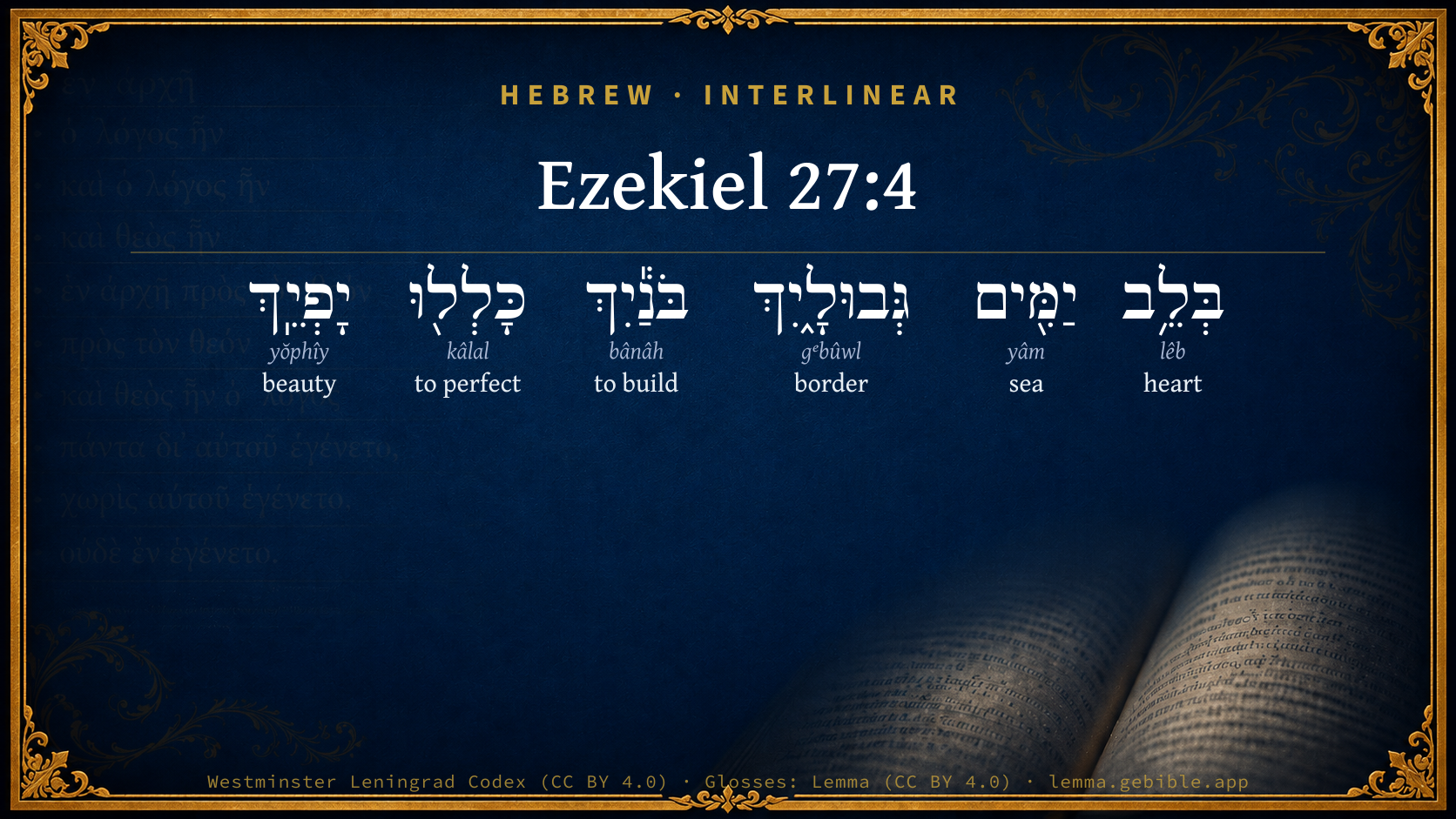
Hebrew (Westminster Leningrad Codex) Ezekiel 27:4 appears in the Hebrew Old Testament. The text above is from the Westminster Leningrad Codex. Each word links to its Strong’s number, a concise gloss, and parsing drawn from the Open Scriptures Hebrew Bible morphology. Click any word for its full Brown-Driver-Briggs (BDB) entry.
Download image
Cite this verse

Ezekiel 27:4 (World English Bible). Public Domain. Lemma interlinear Bible study tool, https://lemma.gebible.app/v/ezekiel/27/4.

Show BibTeX & RIS
BibTeX
RIS
English Translation
Your borders are in the heart of the seas; your builders have perfected your beauty.
World English Bible · Public Domain
Highlights
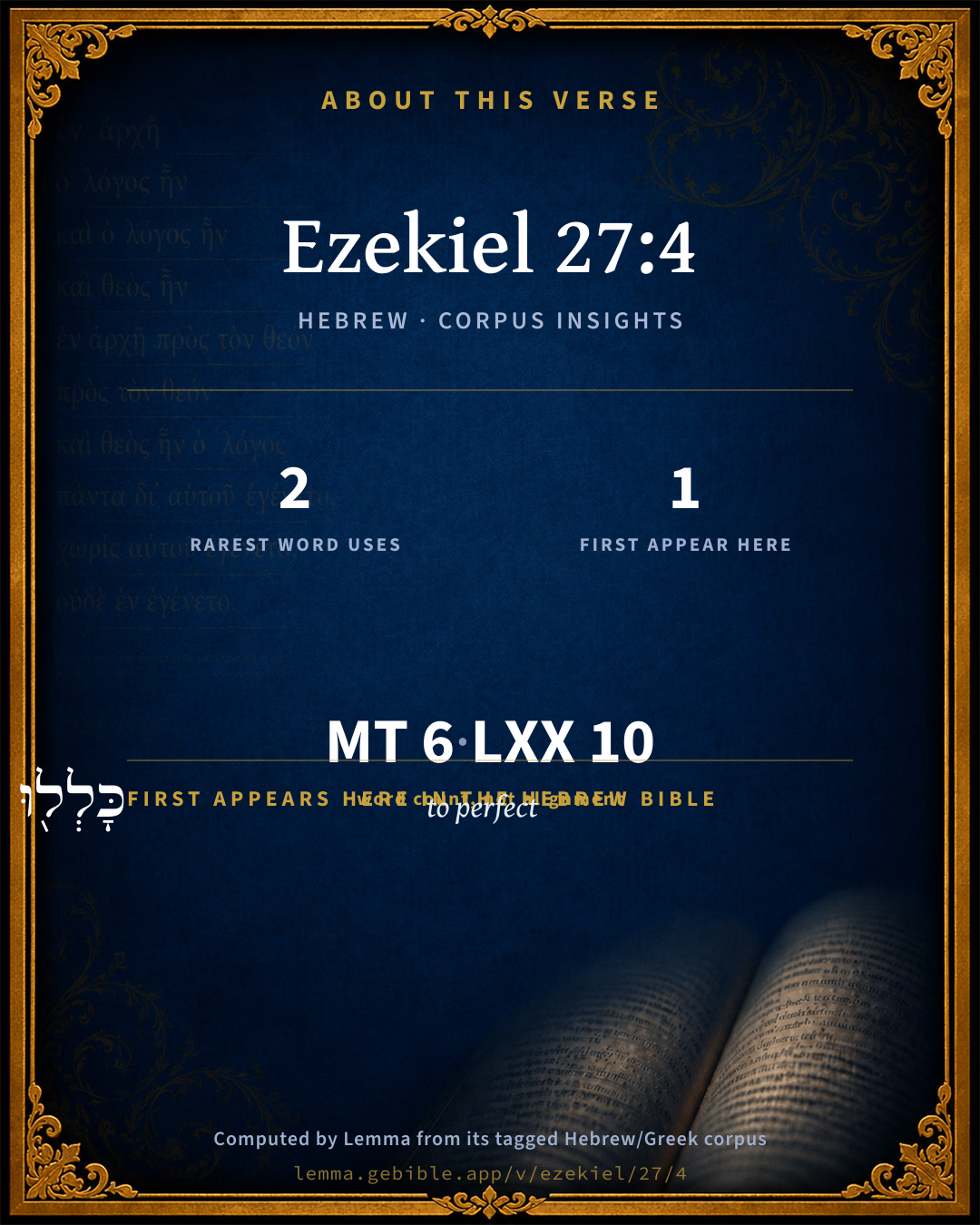
  • 1 first appearance in the Hebrew Bible
Full analysis ↓
Download a study sheet

One document with this verse’s original text, its word-by-word gloss line, the meaning frame, cross-references with their text, attributed commentary, and full source and license credits — printable, and it pastes into notes with its structure intact.

This verse Autodidact and up

Study sheet (.html) Plain text (.txt)

A passage Seminary Student

Up to 50 verses in one chapter. A passage sheet keeps up to 6 commentary sources and 12 cross-references per verse, in the order this page ranks them, and says so on the sheet whenever that leaves anything out. Ask for a single verse and you get the Autodidact verse sheet above.

Everything on this page stays free to read, with no account — the sheet is a download of what is already on screen, not access to it.

Want to remove ads? Support Godless Engineer
Compare translations 3

The same verse in 3 English versions, stacked beneath the original-language interlinear above. Click any original word for its lexicon entry.

Each is an independent rendering of the whole verse — the interlinear is not word-aligned to these translations.

Highlighted words mark where these versions differ — a whole-verse word diff, not a word-by-word alignment.

  • World English Bible Public Domain
    Your borders are in the heart of the seas; your builders have perfected your beauty.
  • King James Version Public Domain
    Thy borders are in the midst of the seas, thy builders have perfected thy beauty.
  • unfoldingWord Literal Text CC BY-SA 4.0
    Your borders are in the heart of the seas; your builders have perfected your beauty.

unfoldingWord Literal Text — © unfoldingWord, licensed CC BY-SA 4.0. Word-aligned USFM3 via Door43 (git.door43.org/unfoldingWord/en_ult).

Versions to compare (up to 4)

3 of 4 selected

Show all 18 translations

Every available English version of this verse, each an independent rendering of the whole verse.

  • World English Bible Public Domain
    Your borders are in the heart of the seas; your builders have perfected your beauty.
  • Berean Standard Bible Public Domain
    Your borders are in the heart of the seas; your builders perfected your beauty.
  • Majority Standard Bible Public Domain
    Your borders are in the heart of the seas; your builders perfected your beauty.
  • King James Version Public Domain
    Thy borders are in the midst of the seas, thy builders have perfected thy beauty.
  • American Standard Version (1901) Public Domain
    Thy borders are in the heart of the seas; thy builders have perfected thy beauty.
  • Revised Version (1885) Public Domain
    Thy borders are in the heart of the seas, thy builders have perfected thy beauty.
  • Geneva Bible (1599) Public Domain
    Thy borders are in the middes of the sea, and thy builders haue made thee of perfit beauty.
  • Douay-Rheims (1899) Public Domain
    And situate in the heart of the sea. Thy neighbours, that built thee, have perfected thy beauty:
  • Young's Literal Translation Public Domain
    In the heart of the seas `are' thy borders, Thy builders have perfected thy beauty.
  • Literal Standard Version CC BY-SA 4.0
    Your borders [are] in the heart of the seas, || Your builders have perfected your beauty.
  • Unlocked Literal Bible CC BY-SA 4.0
    Your borders are in the heart of the seas; your builders have perfected your beauty.
  • unfoldingWord Literal Text CC BY-SA 4.0
    Your borders are in the heart of the seas; your builders have perfected your beauty.
  • Darby Bible Public Domain
    Thy borders are in the heart of the seas, thy builders have perfected thy beauty.
  • World Messianic Bible Public Domain
    Your borders are in the heart of the seas. Your builders have perfected your beauty.
  • Webster's Bible Public Domain
    Thy borders are in the midst of the seas, thy builders have perfected thy beauty.
  • Free Bible Version CC BY-SA 4.0
    Your borders extend far across the sea. Your builders put you together perfectly like a beautiful ship.
  • Bible in Basic English Public Domain
    Your builders have made your outlines in the heart of the seas, they have made you completely beautiful.
  • JPS Tanakh (1917) Public Domain
    Thy borders are in the heart of the seas, thy builders have perfected thy beauty.

Literal Standard Version (2020), Covenant Press — licensed CC BY-SA 4.0. Text via the HelloAO Bible API (eBible.org). Unlocked Literal Bible (unfoldingWord) — licensed CC BY-SA 4.0. Text via the HelloAO Bible API (eBible.org). unfoldingWord Literal Text — © unfoldingWord, licensed CC BY-SA 4.0. Word-aligned USFM3 via Door43 (git.door43.org/unfoldingWord/en_ult). Free Bible Version, Dr. Jonathan Gallagher — licensed CC BY-SA 4.0. Text via the HelloAO Bible API (eBible.org).

Word by word

More ways to search: Search by grammar → Find every occurrence → Compare this word →

Practice this passage: Drill this verse → Learn its vocabulary →

About this verse

These counts appear in no published source. They are computed here, from the morphology-tagged text and Lemma’s own curated glosses. What Lemma adds →

6
words
6
distinct lemmas
Prophets
section

Notable vocabulary

The rarest word here is כָּלְל֖וּ to perfect H3634 — appearing just 2 times in the whole Hebrew Bible.

First appearance in Scripture

This word makes its first canonical appearance in the Hebrew Bible here:

  • כָּלְל֖וּ to perfect H3634

Shared distinctive vocabulary

כָּלְל֖וּ to perfect H3634 occurs in 2 verses of the Hebrew Bible. Also found in:

Grammatical profile

  • 2 verbs
  • 4 nouns

Verb forms

  • בֹּנַ֕יִךְ Qal · Participle Active
  • כָּלְל֖וּ Qal · Perfect

Hebrew & Septuagint length

In English translation the verse runs 15 words from the Hebrew and 15 from the Septuagint (LXX English) — the same length.

A rough comparison of the two English renderings, which tokenize alike — not a word-level alignment.

Word counts can differ between the Hebrew and the Greek without any difference in meaning — e.g. the Hebrew direct-object marker אֵת has no separate Greek word, and Greek often adds the article ὁ.

In the original languages it is 6 Hebrew tokens and 10 Greek tokens — but the two are counted differently (Hebrew bundles its prefixes and suffixes into one token; the Greek is in lemma form), so that isn’t a like-for-like length.

Cross-references

1

Topical passages linked to Ezekiel 27:4 in the Treasury of Scripture Knowledge — connected by theme and wording, ordered by reader-vote popularity; previews shown in the World English Bible.

  • Ezekiel 26:5 She shall be a place for the spreading of nets in the midst of the sea; for I have spoken it, says the Lord Yahweh; and she shall become a spoil to the nations.

Cross-references courtesy of OpenBible.info (CC BY 4.0).

Hebrew and Greek witnesses Masoretic Hebrew ↔ Greek Septuagint

The same verse in the two great witnesses to the Old Testament, shown verse-for-verse.

These are two independent witnesses, not word-aligned to each other, and the Septuagint is shown in lemma (dictionary) form.

Hebrew Ezekiel 27:4 Masoretic · Westminster Leningrad Codex

בְּלֵ֥ב יַמִּ֖ים גְּבוּלָ֑יִךְ בֹּנַ֕יִךְ כָּלְל֖וּ יָפְיֵֽךְ

Your borders are in the heart of the seas; your builders have perfected your beauty.

World English Bible · Public Domain

Greek LXX Ezekiel 27:4 Septuagint · lemma form

ἐν καρδία θάλασσα ὁ βεελιμ υἱός σύ περιτίθημι σύ κάλλος

In the heart of the sea your sons have put beauty upon you for Beelim.

LXX2012 (modern English Septuagint) · Public Domain

On this verse, Haydock's Catholic Bible Commentary discusses the Septuagint’s reading. Read the note in Commentary ↓

Hebrew: Westminster Leningrad Codex (CC BY 4.0). Greek: Septuagint (public domain); English from LXX2012 (modern English Septuagint) (Public Domain). How the Septuagint differs from the Hebrew →

Targum (Aramaic paraphrase)

1

The Targum is the ancient Jewish Aramaic paraphrase of the Hebrew Scriptures — an interpretive translation, not the Hebrew text itself. Onkelos (literal) and Pseudo-Jonathan (expansive) render the Torah, and Jonathan the Prophets. Coverage is partial: where no permissively-licensed English translation exists for a verse, only the Aramaic is shown. This is verse-level text, not a word-by-word alignment to the Hebrew.

  1. Targum Jonathan Prophets (Joshua–Malachi)
    בְּגוֹ יֵמַיָא תְּחוּמַיִךְ אַרְדִיכְלַיִךְ שַׁכְלִילוּ בִּנְיָנַיִךְ:

    (no public-domain English translation for this verse)

    Targum Jonathan — Aramaic: “Mikraot Gedolot” (public domain). English: “Sefaria Community Translation” (CC0 1.0 (public-domain dedication)); “London "Chaldee Paraphrase," 1871” (public domain). Text via Sefaria.

Commentary

Notes on Ezekiel 27:4 from classic Christian and Jewish commentators (each source and its license shown beneath its notes). The classic Christian expositions comment on the surrounding passage and are grouped to its opening verse, so a note may address several verses; the Jewish commentaries on the Tanakh (Rashi and others) are per-verse, so they appear only where the commentator wrote on this verse.

Lemma curates 59 commentaries, every one of them public domain or Creative Commons licensed, each selected and text-cleaned for this edition rather than reprinted as found. About our sources →

Trapp's Complete Commentary

John Trapp

Eze 27:4 Thy borders [are] in the midst of the seas, thy builders have perfected thy beauty.

Ver. 4. Thy borders are in the midst of the sea.] Wherewith thou art compassed and crowned, as it were, {Isa 23:8} being half a mile distant from the continent, till first Nebuchadnezzar, and then Alexander the Great, by casting earth, wood, and stones into the sea, made of it an island, a peninsula, &c.

Thy builders.] The Sidonians, saith Justin; {a} 240 years before Solomon’s temple was built, saith Josephus. {b}

{a} Lib. xviii., lib. viii.

{b} Ant., cap. 2.

John Trapp, A Commentary or Exposition upon All the Books of the Old and New Testament (1647–1656) — public domain. Text from a community e-Sword module.

Tyndale Open Study Notes

Tyndale Open Resources

27:4-7 Tyre’s past greatness is described in great detail under the metaphor of a mighty sailing ship created out of the very best resources from the surrounding nations.

Tyndale Open Study Notes — © Tyndale Open Resources, licensed CC BY-SA 4.0. Text via the HelloAO Bible API.

Geneva Bible (1599)

Geneva Bible translators

Hebrew, heart.

Geneva Bible (1599) marginal notes — public domain. Text via Bolls.life.

Jamieson, Fausset & Brown

Robert Jamieson, A. R. Fausset & David Brown

Tyre, in consonance with her seagirt position, separated by a strait of half a mile from the mainland, is described as a ship built of the best material, and manned with the best mariners and skilful pilots, but at last wrecked in tempestuous seas (Eze 27:26).

Jamieson, Fausset & Brown — Commentary Critical and Explanatory on the Whole Bible (1871) — public domain (CC PDM 1.0). Text via the HelloAO Bible API.

Adam Clarke's Commentary

Verse 4. Thy builders have perfected thy beauty.] Under the allegory of a beautiful ship, the prophet, here and in the following verses, paints the glory of this ancient city. Horace describes the commonwealth of Rome by the same allegory, and is as minute in his description, Carm. lib. i. Od. xiv: -

O navis, referent in mare te novi

Fluctus? O quid agis? Fortiter occupa

Portum. Nonne video, ut

Nudum remigio latus,

Et malus celeri saucius Africo,

Antennaeque gemant? ac sine funibus

Vix durare carinae

Possint imperiosius

AEquor! non tibi sunt integra lintea;

Non Di, quos iterum pressa votes malo:

Quamvis Pontica pinus,

Sylvae filia nobilis,

Jactes et genus, et nomen inutile

Nil pictis timidus navita puppibus

Fidit. Tu, nisi, ventis

Debes ludibrium, cave.

Unhappy vessel, shall the waves again

Tumultuous bear thee to the faithless main?

What, would thy madness thus with storms to sport?

Cast firm your anchor in the friendly port.

Behold thy naked decks, the wounded mast,

And sail-yards groan beneath the southern blast.

Nor, without ropes, thy keel can longer brave

The rushing fury of the imperious wave:

Torn are thy sails; thy guardian gods are lost,

Whom you might call, in future tempests tost.

What, though majestic in your pride you stood,

A noble daughter of the Pontic wood,

You now may vainly boast an empty name,

Of birth conspicuous in the rolls of fame.

The mariner, when storms around him rise,

No longer on a painted stern relies.

Ah! yet take heed, lest these new tempests sweep,

In sportive rage, thy glories to the deep.

FRANCIS.

I give this as a striking parallel to many passages in this chapter.

Adam Clarke's Commentary on the Bible (1810–1826) — public domain. Text from a community e-Sword/MySword module.

The Cambridge Bible for Schools and Colleges

gen. ed. J. J. S. Perowne

4. borders … midst of the seas] lit. heart of the seas, a phrase which appears to mean not “far out at sea,” but, in the deep waters of the sea, ch. Eze_28:2; Eze_28:8; Exo_15:8; Jon_2:3; Psa_46:2. The term “borders” seems to mean station, moorings (Eze_27:25). The proud ship was conscious of her beauty. The ship is a figure for the maritime city, the mistress of trade, built upon an ocean rock, as if moored in the sea. The city was without doubt beautiful (ch. Eze_28:12); a similar phrase is used of Jerusalem, Psa_50:2 (Psa_48:2); Lam_2:15.

Eze_27:5-6 the ship’s timbers.

made thy ship boards] built thy planks. The word is dual, referring to the two ribs of the ship, corresponding to one another.

fir trees of Senir] Or, cypresses. The tree is mentioned as furnishing, along with the cedar, the principal material for building the Temple, 1Ki_5:8. Senir was the Amorite name of Hermon, which the Sidonians called Sirion (Deu_3:9). According to Schrader (KAT. on Deu_3:9; 1Ki_5:13) both names were used by the Assyrians. The name Hermon possibly signifies “sacred” mountain, being due to its ancient sanctuary. Senir, and Sirion, is supposed to mean “coat of mail.”

On “mast” cf. Isa_33:23. Whether an actual cedar was ever used to be the mast of “some great ammiral” may be uncertain; the prophet, though more exact than most prophets, is also a poet.

The Cambridge Bible for Schools and Colleges (gen. ed. J. J. S. Perowne; Cambridge University Press, 1878–1918) — public domain. Text from a community e-Sword module.

John Gill's Exposition

They have made all thy ship boards of fir trees of Senir,.... The same with Sion and Hermon, which the Sidonians called Sirion, and the Amorites Shenir, Deu 3:9 here, it seems, grew the best of fir trees, of which the Tyrians made boards and planks for shipping; of these the two sides of the ship, as the word (r) here used in the dual number is thought to signify, or the fore and hind decks, were made. The Targum is,

"with fir trees of Senir they built for thee all thy bridges;''

the planks from which they went from one ship to another; but these are of too small consequence to be mentioned; rather the main of the ship is intended, which was built of fir planks; but ours made of oak are much preferable:

they have taken cedars from Lebanon, to make masts for thee; large poles for the yards and sails to be fastened to, for receiving the wind necessary in navigation; called the main mast, the foremast, the mizzenmast, and the boltsprit; all these are only in large vessels; whether the Tyrians had all of these is not certain; some they had, and which were made of the cedars of Lebanon; which, being large tall trees, were fit for this purpose. The Tyrians (s) are said to be the first inventors of navigation.

(r) "tabulata duplicia", Munster; "duas tabulas", Vatablus. (s) "Prima ratem ventis credere docta Tyros." Catullus.

John Gill's Exposition of the Whole Bible (1746–1763) — public domain (CC PDM 1.0). Text via the HelloAO Bible API.

Haydock's Catholic Bible Commentary

Neighbours of Sidon, Josue xix. 29. (Calmet) --- Septuagint, "thy children." Protestants, "thy builders." (Haydock) --- The description of the Tyrian grandeur, shews their more woeful ruin. (Worthington)

George Leo Haydock (1774–1849), Haydock's Catholic Family Bible and Commentary, 1859 edition — public domain. Excludes Psalms (Douay-Rheims chapter numbering differs from Protestant) and Deuterocanonical books (Catholic canon only).

Matthew Poole's English Annotations

Weak borders, which an enemy easily breaks through, are a great defect in a state; well, Tyre, thou art well secured here, thine are in the sea that surrounds and secureth thee.

Thy builders; thy first founders, whoever they were; Agenor king of Phoenice chose wisely to build a city in safety: or by builders may be meant those who in aftertimes did add to the first foundation: these were masters of their art, and added this to the natural strength and beauty of the place; thus thou art perfected at home.

Matthew Poole's English Annotations on the Holy Bible (1683–1685) — public domain. Text from a community e-Sword/MySword module.

Whedon's Commentary on the Bible

Daniel D. Whedon

4. Thy borders — Cornill reads, by a little change, the anchorage.

Thy builders have perfected thy beauty — Here begins a most beautiful picture of Tyre as a ship. Compare a very ancient description of a ship, written in Akkadian, which comes from Babylon: —

Its helm is of cedar (?) wood,

Its serpentlike oar has a handle of gold,

Its mast is pointed with turquoise,

Its side is of cedar from its forest,

Its awning is the palm (?) wood of Delvan, etc.

— Sayce, Hibbert Lectures.

Compare also Iliad, 2:484-770, and Horace, Lib. I, Ode 14.

Daniel D. Whedon (gen. ed.), Commentary on the Old and New Testaments (1874–1909) — public domain. Text from a community e-Sword module.

The Pulpit Commentary

In the midst of the seas; literally, in the heart (Revised Version). The words were true of the island-city, but Ezekiel has already present to his thoughts the idealized picture of the city under the figure of its stateliest ship. The builders are ship-builders, and in the verses that follow we have a picture of the Bucentaur of the Venice of the ancient world.

The Pulpit Commentary (1880–1919), ed. H.D.M. Spence-Jones & Joseph S. Exell — public domain. Text from a community e-Sword module.

unfoldingWord translationNotes

Door43 World Missions Community

Connecting Statement:

Yahweh continues giving Ezekiel his message to Tyre.

General Information:

"Your" and "you" in these verses refer to Tyre.

General Information:

The city of Tyre is described here and in the following verses as if it were a beautiful ship. (See: Metaphor)

Your borders

"Your boundaries"

heart of the seas

"middle of the seas"

planks

long, flat pieces of wood; thick boards

a mast

a large pole on a ship that holds up the sails of the ship

translationWords

fir

Mount Hermon

cypress

cedar

Lebanon

unfoldingWord translationNotes — © Distant Shores Media and the Door43 World Missions Community, licensed CC BY-SA 4.0. Source: git.door43.org/Door43/en_tn.

Rashi

Rabbi Shlomo Yitzchaki (Rashi)

your builders [Heb. בֹּנַיִךּ,] your architects, from the word בִּנְיָן, building.

Rashi on the Tanakh — English translations: “The Judaica Press complete Tanach with Rashi, translated by A. J. Rosenberg” (CC BY 4.0); “Pentateuch with Rashi's commentary by M. Rosenbaum and A.M. Silbermann, 1929-1934” (public domain); “The Metsudah Tanach series, Lakewood, N.J” (CC BY 4.0); and “The Book of Joshua, Metsudah Publications, 1997” (CC BY 4.0). Text via Sefaria.

Lesson kit

Teaching starters — assembled from the data on this page, not authored interpretation. Every prompt links to the verse data it draws on. Edit before teaching.

Ezekiel, in the Prophets, opens this verse with 6 words (6 distinct Hebrew lemmas). Its most distinctive word is kâlal (“to perfect”). A historical commentator’s framing appears above. Read the whole chapter for the surrounding context.

Discussion questions

  1. The word kâlal carries the sense “to perfect.” How does it shape the verse?
  2. The word “to perfect” first appears here in Scripture. What is being introduced at this debut?
  3. Ezekiel 27:11 shares the word «to perfect» with this verse. How do the two illuminate each other?
  4. The translations on this page render this verse differently — a whole-verse word diff, not a word-by-word alignment. What might account for the different wordings?
  5. The verb «בֹּנַ֕יִךְ» is Qal Participle Active. How does its form color the action?
  6. Reading how Trapp's Complete Commentary and Tyndale Open Study Notes read this verse, where do the two commentators agree and where do they part?

Things to notice

Reading settings

Reading text

Shown beneath each verse's original-language words.

Old Testament
Old Testament edition

Read the OT as the Masoretic Hebrew (MT) or the Greek Septuagint (LXX).

English shown for the Greek Septuagint (in the Hebrew ↔ Greek comparison).

Comparing translations? Open the Compare panel on any verse page to stack up to four side by side.