
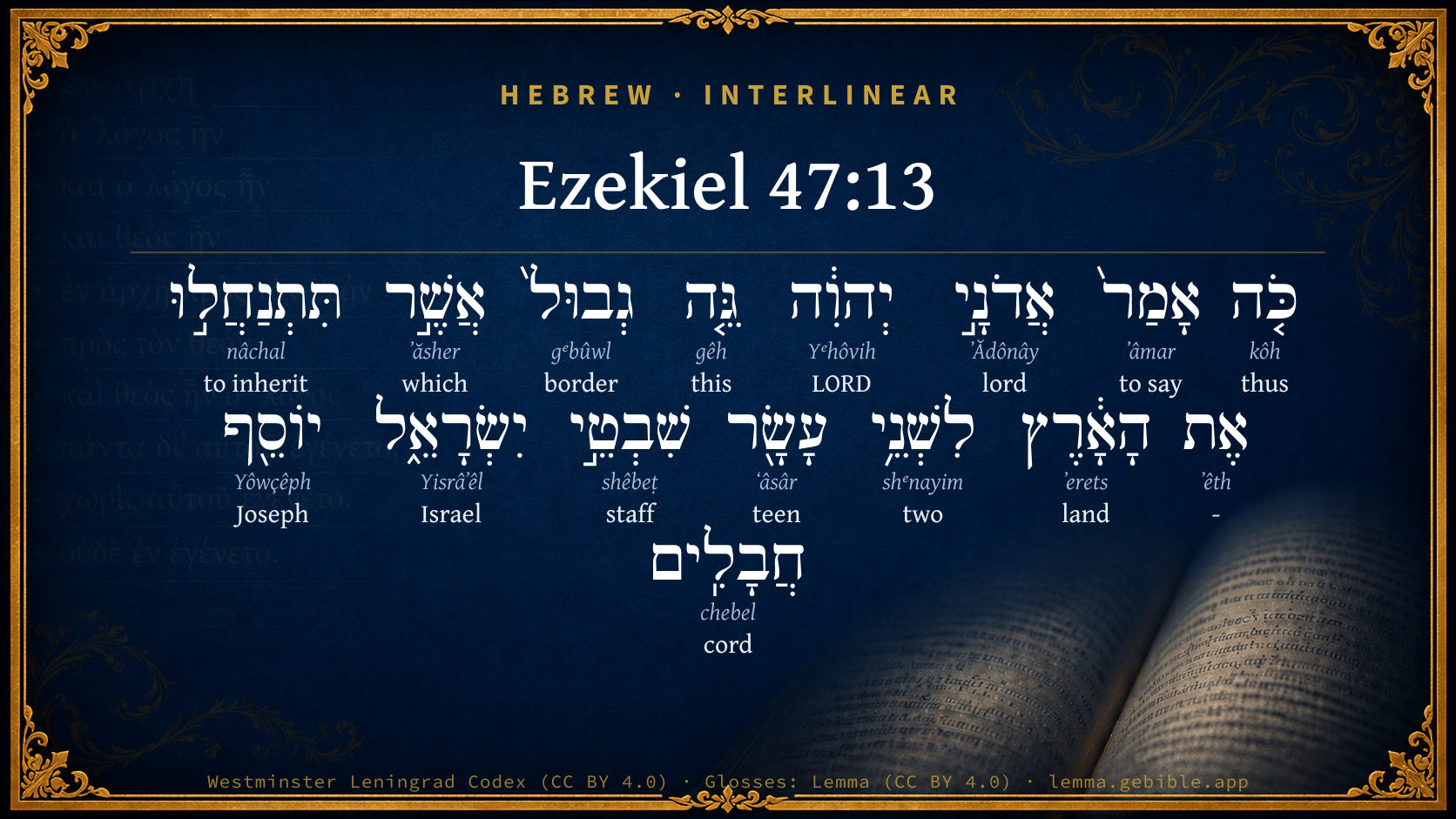
Ezekiel 47:13

Hebrew (Westminster Leningrad Codex) Ezekiel 47:13 appears in the Hebrew Old Testament. The text above is from the Westminster Leningrad Codex. Each word links to its Strong’s number, a concise gloss, and parsing drawn from the Open Scriptures Hebrew Bible morphology. Click any word for its full Brown-Driver-Briggs (BDB) entry.
Download image
Cite this verse

Ezekiel 47:13 (World English Bible). Public Domain. Lemma interlinear Bible study tool, https://lemma.gebible.app/v/ezekiel/47/13.

Show BibTeX & RIS
BibTeX
RIS
English Translation
Thus says the Lord Yahweh: This shall be the border, by which you shall divide the land for inheritance according to the twelve tribes of Israel: Joseph [shall have two] portions.
World English Bible · Public Domain
Highlights
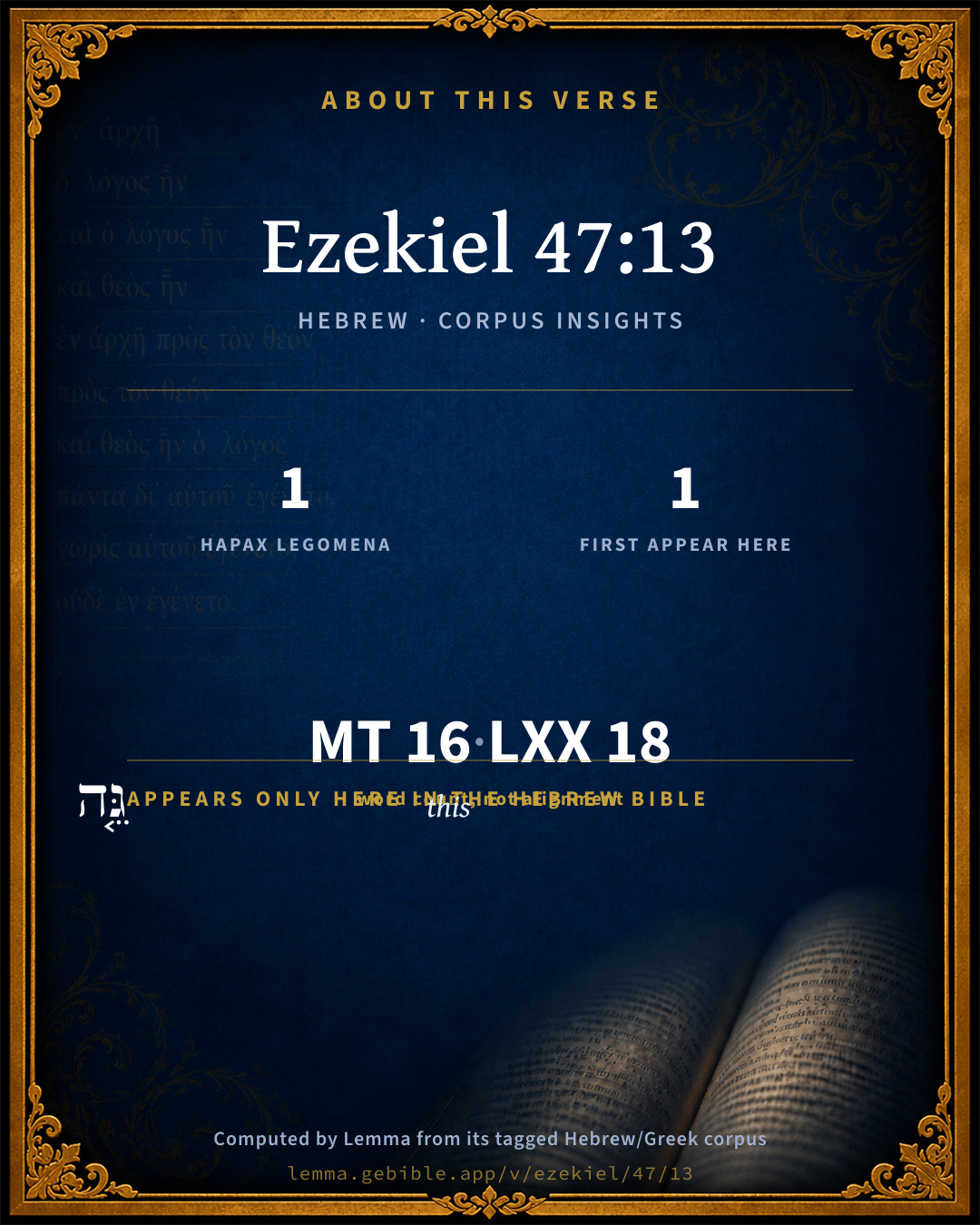
  • 1 hapax legomenon — only here in the Hebrew Bible
  • 1 first appearance in the Hebrew Bible
Full analysis ↓
Download a study sheet

One document with this verse’s original text, its word-by-word gloss line, the meaning frame, cross-references with their text, attributed commentary, and full source and license credits — printable, and it pastes into notes with its structure intact.

This verse Autodidact and up

Study sheet (.html) Plain text (.txt)

A passage Seminary Student

Up to 50 verses in one chapter. A passage sheet keeps up to 6 commentary sources and 12 cross-references per verse, in the order this page ranks them, and says so on the sheet whenever that leaves anything out. Ask for a single verse and you get the Autodidact verse sheet above.

Everything on this page stays free to read, with no account — the sheet is a download of what is already on screen, not access to it.

Want to remove ads? Support Godless Engineer
Compare translations 3

The same verse in 3 English versions, stacked beneath the original-language interlinear above. Click any original word for its lexicon entry.

Each is an independent rendering of the whole verse — the interlinear is not word-aligned to these translations.

Highlighted words mark where these versions differ — a whole-verse word diff, not a word-by-word alignment.

  • World English Bible Public Domain
    Thus says the Lord Yahweh: This shall be the border, by which you shall divide the land for inheritance according to the twelve tribes of Israel: Joseph [shall have two] portions.
  • King James Version Public Domain
    Thus saith the Lord GOD; This shall be the border, whereby ye shall inherit the land according to the twelve tribes of Israel: Joseph shall have two portions.
  • unfoldingWord Literal Text CC BY-SA 4.0
    The Lord Yahweh says this: This will be the way that you divide the land up for the twelve tribes of Israel: Joseph will have two portions.

unfoldingWord Literal Text — © unfoldingWord, licensed CC BY-SA 4.0. Word-aligned USFM3 via Door43 (git.door43.org/unfoldingWord/en_ult).

Versions to compare (up to 4)

3 of 4 selected

Show all 18 translations

Every available English version of this verse, each an independent rendering of the whole verse.

  • World English Bible Public Domain
    Thus says the Lord Yahweh: This shall be the border, by which you shall divide the land for inheritance according to the twelve tribes of Israel: Joseph [shall have two] portions.
  • Berean Standard Bible Public Domain
    This is what the Lord GOD says: “These are the boundaries by which you are to divide the land as an inheritance among the twelve tribes of Israel; Joseph shall receive two portions.
  • Majority Standard Bible Public Domain
    This is what the Lord GOD says: “These are the boundaries by which you are to divide the land as an inheritance among the twelve tribes of Israel; Joseph shall receive two portions.
  • King James Version Public Domain
    Thus saith the Lord GOD; This shall be the border, whereby ye shall inherit the land according to the twelve tribes of Israel: Joseph shall have two portions.
  • American Standard Version (1901) Public Domain
    Thus saith the Lord Jehovah: This shall be the border, whereby ye shall divide the land for inheritance according to the twelve tribes of Israel: Joseph `shall have two' portions.
  • Revised Version (1885) Public Domain
    Thus saith the Lord GOD: This shall be the border, whereby ye shall divide the land for inheritance according to the twelve tribes of Israel: Joseph shall have portions.
  • Geneva Bible (1599) Public Domain
    Thus saith the Lord God, This shall be the border, whereby ye shall inherite the lande according to the twelue tribes of Israel: Ioseph shall haue two portions.
  • Douay-Rheims (1899) Public Domain
    Thus saith the Lord God: This is the border, by which you shall possess the land according to the twelve tribes of Israel: for Joseph hath a double portion.
  • Young's Literal Translation Public Domain
    `Thus said the Lord Jehovah: This `is' the border whereby ye inherit the land, according to the twelve tribes of Israel; Joseph `hath' portions.
  • Literal Standard Version CC BY-SA 4.0
    Thus said Lord YHWH: “This [is] the border whereby you inherit the land, according to the twelve tribes of Israel; Joseph [has two] portions.
  • Unlocked Literal Bible CC BY-SA 4.0
    The Lord Yahweh says this: This will be the way that you divide the land up for the twelve tribes of Israel: Joseph will have two portions.
  • unfoldingWord Literal Text CC BY-SA 4.0
    The Lord Yahweh says this: This will be the way that you divide the land up for the twelve tribes of Israel: Joseph will have two portions.
  • Darby Bible Public Domain
    Thus saith the Lord Jehovah: This shall be the border whereby ye shall allot the land as inheritance according to the twelve tribes of Israel: Joseph [shall have two] portions.
  • World Messianic Bible Public Domain
    The Lord GOD says: “This shall be the border by which you shall divide the land for inheritance according to the twelve tribes of Israel. Joseph shall have two portions.
  • Webster's Bible Public Domain
    Thus saith the Lord GOD; This shall be the border, by which ye shall inherit the land according to the twelve tribes of Israel: Joseph shall have two portions.
  • Free Bible Version CC BY-SA 4.0
    This is what the Lord God says: “These are the boundaries you are to use when allocating ownership of the land to the twelve tribes of Israel (Joseph is to receive two allocations.)
  • Bible in Basic English Public Domain
    This is what the Lord has said: These are the limits by which you will take up your heritage in the land among the twelve tribes of Israel: Joseph is to have two parts.
  • JPS Tanakh (1917) Public Domain
    Thus saith the Lord GOD: 'This shall be the border, whereby ye shall divide the land for inheritance according to the twelve tribes of Israel, Joseph receiving two portions.

Literal Standard Version (2020), Covenant Press — licensed CC BY-SA 4.0. Text via the HelloAO Bible API (eBible.org). Unlocked Literal Bible (unfoldingWord) — licensed CC BY-SA 4.0. Text via the HelloAO Bible API (eBible.org). unfoldingWord Literal Text — © unfoldingWord, licensed CC BY-SA 4.0. Word-aligned USFM3 via Door43 (git.door43.org/unfoldingWord/en_ult). Free Bible Version, Dr. Jonathan Gallagher — licensed CC BY-SA 4.0. Text via the HelloAO Bible API (eBible.org).

Word by word

More ways to search: Search by grammar → Find every occurrence → Compare this word →

Practice this passage: Drill this verse → Learn its vocabulary →

גֵּ֤ה
gêh
H1454
“this”
Pronoun, Demonstrative, Masculine, Singular
Part of Speech
Pronoun
Type
Demonstrative
Gender
Masculine
Number
Singular
Full BDB Definition

Origin: probably a clerical error for H2088

TWOT: 528

this, such
  1. כֹּ֤ה kôh H3541 “thus” Adverb
  2. אָמַר֙ ʼâmar H559 “to say” Verb, Qal, Perfect, 3rd Person, Masculine, Singular
  3. אֲדֹנָ֣י ʼĂdônây H136 “Lord · my” Noun, Common, Masculine, Plural, Construct + Suffix, Personal, 1st Person, Common, Singular
  4. יְהוִ֔ה Yᵉhôvih H3069 “LORD” Noun, Proper
  5. גְבוּל֙ gᵉbûwl H1366 “border” Noun, Common, Masculine, Singular, Absolute
  6. אֲשֶׁ֣ר ʼăsher H834 “which” Particle, Relative
  7. תִּתְנַחֲל֣וּ nâchal H5157 “to inherit” Verb, Hithpael, Imperfect, 2nd Person, Masculine, Plural
  8. אֶת ʼêth H853 “-” Particle, Direct Object
  9. הָאָ֔רֶץ ʼerets H776 “the · land” Particle, Definite Article + Noun, Common, Both, Singular, Absolute
  10. לִשְׁנֵ֥י shᵉnayim H8147 “to/for · two” Preposition + Adjective, Cardinal number, Masculine, Dual, Construct
  11. עָשָׂ֖ר ʻâsâr H6240 “teen” Adjective, Cardinal number, Masculine, Singular, Absolute
  12. שִׁבְטֵ֣י shêbeṭ H7626 “staffs of” Noun, Common, Masculine, Plural, Construct
  13. יִשְׂרָאֵ֑ל Yisrâʼêl H3478 “Israel” Noun, Proper
  14. יוֹסֵ֖ף Yôwçêph H3130 “Joseph” Noun, Proper
  15. חֲבָלִֽים chebel H2256 “cords” Noun, Common, Both, Plural, Absolute

About this verse

These counts appear in no published source. They are computed here, from the morphology-tagged text and Lemma’s own curated glosses. What Lemma adds →

16
words
16
distinct lemmas
Prophets
section

Notable vocabulary

1 hapax legomenon — a word that appears only here in the entire Hebrew Bible:

First appearance in Scripture

This word makes its first canonical appearance in the Hebrew Bible here:

Shared distinctive vocabulary

תִּתְנַחֲל֣וּ to inherit H5157 occurs in 57 verses of the Hebrew Bible. Also found in:

Grammatical profile

  • 2 verbs
  • 8 nouns
  • 2 adjectives
  • 1 pronoun
  • 1 adverb
  • 2 particles

Verb forms

  • אָמַר֙ Qal · Perfect
  • תִּתְנַחֲל֣וּ Hithpael · Imperfect

Hebrew & Septuagint length

In English translation the verse runs 31 words from the Hebrew and 27 from the Septuagint (LXX English) — closely comparable.

A rough comparison of the two English renderings, which tokenize alike — not a word-level alignment.

Word counts can differ between the Hebrew and the Greek without any difference in meaning — e.g. the Hebrew direct-object marker אֵת has no separate Greek word, and Greek often adds the article ὁ.

In the original languages it is 16 Hebrew tokens and 18 Greek tokens — but the two are counted differently (Hebrew bundles its prefixes and suffixes into one token; the Greek is in lemma form), so that isn’t a like-for-like length.

Cross-references

7

Topical passages linked to Ezekiel 47:13 in the Treasury of Scripture Knowledge — connected by theme and wording, ordered by reader-vote popularity; previews shown in the World English Bible.

  • Genesis 48:5 Now your two sons, who were born to you in the land of Egypt before I came to you into Egypt, are mine; Ephraim and Manasseh, even as Reuben and Simeon, will be mine.
  • Numbers 34:2–12 Command the children of Israel, and tell them, When you come into the land of Canaan (this is the land that shall fall to you for an inheritance, even the land of Canaan according to the borders of it),
  • Jeremiah 3:18 In those days the house of Judah shall walk with the house of Israel, and they shall come together out of the land of the north to the land that I gave for an inheritance to your fathers.
  • Ezekiel 48:4–6 By the border of Naphtali, from the east side to the west side, Manasseh, one [portion].
  • 1 Chronicles 5:1 The sons of Reuben the firstborn of Israel (for he was the firstborn; but, because he defiled his father's couch, his birthright was given to the sons of Joseph the son of Israel; and the genealogy is not to be reckoned after the birthright.
  • Jeremiah 31:1 At that time, says Yahweh, will I be the God of all the families of Israel, and they shall be my people.
  • Genesis 49:26 The blessings of your father Have prevailed above the blessings of the ancient mountains, Above the bounty of the age-old hills. They will be on the head of Joseph, On the crown of the head of him who is separated from his brothers.

Cross-references courtesy of OpenBible.info (CC BY 4.0).

Hebrew and Greek witnesses Masoretic Hebrew ↔ Greek Septuagint

The same verse in the two great witnesses to the Old Testament, shown verse-for-verse.

These are two independent witnesses, not word-aligned to each other, and the Septuagint is shown in lemma (dictionary) form.

Hebrew Ezekiel 47:13 Masoretic · Westminster Leningrad Codex

כֹּ֤ה אָמַר֙ אֲדֹנָ֣י יְהוִ֔ה גֵּ֤ה גְבוּל֙ אֲשֶׁ֣ר תִּתְנַחֲל֣וּ אֶת הָאָ֔רֶץ לִשְׁנֵ֥י עָשָׂ֖ר שִׁבְטֵ֣י יִשְׂרָאֵ֑ל יוֹסֵ֖ף חֲבָלִֽים

Thus says the Lord Yahweh: This shall be the border, by which you shall divide the land for inheritance according to the twelve tribes of Israel: Joseph [shall have two] portions.

World English Bible · Public Domain

Greek LXX Ezekiel 47:13 Septuagint · lemma form

ὅδε λέγω κύριος θεός οὗτος ὁ ὅριον κατακληρονομέω ὁ γῆ ὁ δώδεκα φυλή ὁ υἱός ἰσραήλ πρόσθεσις σχοίνισμα

Thus says the Lord God; You⌃ shall inherit these borders of the land; they are given by lot to the twelve tribes of the children of Israel.

LXX2012 (modern English Septuagint) · Public Domain

On this verse, Fairbairn on Ezekiel, Jonah & the Pastoral Epistles discusses the Septuagint’s reading. Read the note in Commentary ↓

Hebrew: Westminster Leningrad Codex (CC BY 4.0). Greek: Septuagint (public domain); English from LXX2012 (modern English Septuagint) (Public Domain). How the Septuagint differs from the Hebrew →

Targum (Aramaic paraphrase)

1

The Targum is the ancient Jewish Aramaic paraphrase of the Hebrew Scriptures — an interpretive translation, not the Hebrew text itself. Onkelos (literal) and Pseudo-Jonathan (expansive) render the Torah, and Jonathan the Prophets. Coverage is partial: where no permissively-licensed English translation exists for a verse, only the Aramaic is shown. This is verse-level text, not a word-by-word alignment to the Hebrew.

  1. Targum Jonathan Prophets (Joshua–Malachi)
    כִּדְנַן אֲמַר יְיָ אֱלֹהִים דֵין תְּחוּמָא דְתַחְסְנוּן יַת אַרְעָא לִתְרֵי עֲסַר שִׁבְטֵי יִשְׂרָאֵל יוֹסֵף יִתְקַבֵּל תְּרֵין חוּלְקִין:

    (no public-domain English translation for this verse)

    Targum Jonathan — Aramaic: “Mikraot Gedolot” (public domain). English: “Sefaria Community Translation” (CC0 1.0 (public-domain dedication)); “London "Chaldee Paraphrase," 1871” (public domain). Text via Sefaria.

Commentary

Notes on Ezekiel 47:13 from classic Christian and Jewish commentators (each source and its license shown beneath its notes). The classic Christian expositions comment on the surrounding passage and are grouped to its opening verse, so a note may address several verses; the Jewish commentaries on the Tanakh (Rashi and others) are per-verse, so they appear only where the commentator wrote on this verse.

Lemma curates 59 commentaries, every one of them public domain or Creative Commons licensed, each selected and text-cleaned for this edition rather than reprinted as found. About our sources →

Matthew Henry's Commentary

We are now to pass from the affairs of the sanctuary to those of the state, from the city to the country. 1. The Land of Canaan is here secured to them for an inheritance (Eze 47:14): I lifted up my hand to give it unto your fathers, that is, promised it upon oath to them and their posterity. Though the possession had been a great while discontinued, yet God had not forgotten his oath which he swore to their fathers. Though God's providences may for a time seem to contradict his promises, yet the promise will certainly take place at last, for God will be ever mindful of his covenant. I lifted up my hand to give it, and therefore it shall without fail fall to you for an inheritance. Thus the heavenly Canaan is sure to all the seed, because it is what God, who cannot lie, has promised. 2. It is here circumscribed, and the bounds and limits of it are fixed, which they must not pass over to encroach upon their neighbours and which their neighbours shall not break through to encroach upon them. We had such a draught of the borders of Canaan when Joshua was to put the people in possession of it, Num 34:1, etc. That begins with the salt sea in the south, goes round and ends there. This begins with Hamath about Damascus in the north, and so goes round and ends there, Eze 47:20. Note, It is God that appoints the bounds of our habitation; and his Israel shall always have cause to say that the lines have fallen to them in pleasant places. The lake of Sodom is here called the east sea, for it, being healed by the waters of the sanctuary, it is no more to be called a salt sea, as it was in Numbers. 3. It is here ordered to be divided among the tribes of Israel, reckoning Joseph for two tribes, to make up the number of twelve, when Levi was taken out to attend the sanctuary, and had his lot adjoining to that (Eze 47:13, Eze 47:21): You shall inherit it, one as well as another, Eze 47:14. The tribes shall have an equal share, one as much as another. As the tribes returned out of Babylon, this seems unequal, because some tribes were much more numerous than the other, and indeed the most were of Judah and Benjamin and very few of the other ten tribes; but as the twelve tribes stand, in type and vision, for the gospel-church, the Israel of God, it was very equal, because we find in another vision an equal number of each of the twelve tribes sealed for the living God, just 12,000 of each, Rev 7:5, etc. And to those sealed ones these allotments did belong. It intimates likewise that all the subjects of Christ's kingdom have obtained like precious faith. Male and female, Jew and Gentile, bond and free, are all alike welcome to Christ and made partakers of him. 4. The strangers who sojourn among them, who shall beget children and be built up into families, and so help to people their country, shall have inheritance among the tribes, as if they had been native Israelites (Eze 47:22, Eze 47:23), which was by no means allowed in Joshua's division of the land. This is an act for a general naturalization, which would teach the Jews who was their neighbour, not those only of their own nation and religion, but those, whoever they were, that they had an opportunity of showing kindness to, because from them they would be willing to receive kindness. It would likewise invite strangers to come and settle among them, and put themselves under the wings of the divine Majesty. But it certainly looks at gospel-times, when the partition-wall between Jew and Gentile was taken down, and both one in Christ, in whom there is no difference, Rom 10:12. This land was a type of the heavenly Canaan, that better country (Heb 11:16), in which believing Gentiles shall have a blessed lot, as well as believing Jews, Isa 56:3.

Matthew Henry's Commentary on the Whole Bible (1708–1710) — public domain (CC PDM 1.0). Text via the HelloAO Bible API.

Trapp's Complete Commentary

John Trapp

Eze 47:13 Thus saith the Lord GOD; This [shall be] the border, whereby ye shall inherit the land according to the twelve tribes of Israel: Joseph [shall have two] portions.

Ver. 13. This shall be the border.] Here the prophet returneth again to the dividing of the land, begun Eze 45:1-2, &c., having hitherto interposed many most memorable matters, and of great use to the Church.

Joseph shall have two portions.] He had so by his father’s will, and for his two sons adopted by his father.

John Trapp, A Commentary or Exposition upon All the Books of the Old and New Testament (1647–1656) — public domain. Text from a community e-Sword module.

Albert Barnes' Notes on the Bible

The ideal reallotment of the land to the twelve tribes of Israel is found in Ezek. 47:13–48:14.

The special mention of Joseph’s portions was in order to express that the twelve portions were to be exclusive of Levi’s land, which was to be provided out of the “oblation.”

Albert Barnes' Notes on the Bible (1834–1885) — public domain. Text from a community e-Sword/MySword module.

Joseph Benson's Commentary

Eze 47:13. This shall be the border, &c. — The borders described in the following part of this chapter shall be the limits or boundaries of your country; whereby ye shall inherit the land according to the twelve tribes of Israel — By the several captivities both of Israel and Judah, the several limits or borders, belonging to the inheritance of each tribe, were obliterated and forgotten; whereupon a new boundary and division are here made of the holy land. “The allotment of the land,” says Grotius, “made here, and in the next chapter, would have taken place, had the ten tribes in general, as well as Judah and Benjamin, turned themselves to the worship of the true God: for if so, they, as well as Judah and Benjamin, would have obtained a restoration. But only some part of them returned with Judah and Benjamin, with whom they settled in common in the land of Judea.” This may, perhaps, be the literal sense of the following part of the prophecy; but, without question, a mystical sense is implied under this literal description, as well as in all the preceding parts of the vision. Joseph shall have two portions — Upon Reuben’s forfeiting his birthright, the double portion, belonging to the firstborn, accrued to Joseph and his two sons, Manasseh and Ephraim, according to Jacob’s own appointment.

Joseph Benson's Commentary on the Old and New Testaments (1811–1818) — public domain. Text from a community e-Sword module.

Dummelow's Commentary on the Holy Bible

J. R. Dummelow

The Boundaries of the Land

This passage may be compared with Num_34:1-12. The N. border started from a point on the Mediterranean, and ran eastward by Hamath and other places to Hazar-enon, between Damascus and the Hauran. The E. border ran southward from here, between Gilead and the land of Israel, and followed the Jordan, ending at Tamar, S. of the Dead Sea. From Tamar the S. border ran by Meriboth-kadesh to the brook of Egypt at the SE. corner of the Mediterranean. The W. border is formed by the Mediterranean (Eze_47:13-21). Strangers born in the land were to share it with the Israelites (Eze_47:22-23).

14. Lifted up mine hand] sware.

15, 16. Hethlon.. Zedad.. Berothah, Sibraim] are unknown localities. As men go to Zedad; Hamath] RV 'unto the entering in of Zedad, Hamath'. Hamath and Zedad have probably changed places. 'The entering in of Hamath 'was a well-known pass between Lebanon and Anti-Lebanon.

17. Hazar-enan, the border, etc.] RV 'Hazar-enon at the border'. Hazar-enon and Hazar-hatticon (Eze_47:16) are probably the same.

18. Ye shall measure] should 'possibly be 'from Hazar-enon' (see Eze_47:19). From Hauran, and from Damascus] must mean 'between Hauran and Damascus', where Hazar-enon lay (Eze_47:16-17). Hauran is a district E. of the Jordan and S. of Damascus. From Gilead, and from the land of Israel] means, 'between Gilead' (E. of the Jordan) 'and the land of Israel' (W. of it). The east sea] the Dead Sea.

19. Tamar] unknown, but probably near the S. end of the Dead Sea.

Strife in Kadesh] RV 'Meriboth-kadesh', Kadesh-barnea, in the wilderness on the S. of Palestine (Num_20:13). The river] RV 'the brook of Egypt', the Rhmocolura or Wady-el-Arish, which enters the Mediterranean at its SE. corner.

J. R. Dummelow, A Commentary on the Holy Bible (Macmillan, 1909) — public domain. Text from a community e-Sword module.

Fairbairn on Ezekiel, Jonah & the Pastoral Epistles

Patrick Fairbairn

CHAPTER 47:13-48:35

THE BOUNDARIES AND RE-DISTRIBUTION OF THE LAND.

As the whole of the representations contained in the preceding parts of the vision proceed on the basis of the old covenant, the series naturally closes with a re-occupation of the land of Canaan, which formed the great objective promise of the covenant. A people settled in the inheritance of their God is the proper result of the re-establishment of the covenant, and the renewal of their souls after its principles of righteousness. There is, of course, no more reason for understanding this portion according to the letter than those which went before. The whole vision is of a piece,—a pictorial representation of the future things of God’s kingdom under the image of the past, yet so altered and adjusted as to indicate the vast superiority of what was to come compared with what hitherto had been. To say, as many in effect do, that the part of the vision which refers to the temple and its worship is figurative, while this, which makes mention of a re-occupation of the land by the tribes of Israel, must be understood literally, is to bring complete arbitrariness and confusion into the interpretation of the prophecy. There is the very same reason for holding that the Old Testament ritual of worship, with all its carnal ordinances, and more than its carnal display of outward pomp, shall again be set up, as for holding that the natural Israel shall again be restored to the possession of Canaan, so as to form a peculiar commonwealth of believers. And if to maintain the one be to place the prophets of the Old Testament in palpable contrariety to the apostles of the New, to maintain the other by itself is not less evidently to mutilate the prophetic record, and place one part of the prophetic testimony in virtual opposition to another.

Eze 47:13. Thus saith the Lord Jehovah, This (The נֵּה here we take, with our translators, and the greater part of commentators, to be a corruption for זֶה; so also the Septuagint, Vulgate, and Chaldee.) shall be the boundary as to how ye shall inherit the land according to the twelve tribes of Israel: Joseph two portions.

Eze 47:14. And ye shall inherit it, one as well as another, since I lifted up my hand to give it to your fathers, and this land has fallen to you for an inheritance.

Eze 47:15. And this shall be the boundary of the land on the north side, from the great sea by the way of Hethlon, as one goes to Zedad:

Eze 47:16. Hamath, Berothah, Sibraim, which is between the border of Damascus and the border of Hamath; Hazar-hatticon, which is by the border of Hauran.

Eze 47:17. And from the sea the boundary shall be Hazar-enan, the border of Damascus, and the north northward, and the border of Hamath. And this is the north side.

Eze 47:18. And the east side ye shall measure from between Hauran and Damascus, and from between Gilead and the land of Israel, the Jordan, from the boundary even to the cast sea. And this is the east side.

Eze 47:19. And the south side southward, from Tamar to the waters of Meribah Kadesh, to the river on the great sea. And this is the south side southward.

Eze 47:20. And the west side, the great sea, from the boundary till one comes over against Hamath. This is the west side.

Eze 47:21. And ye shall divide this land to you according to the tribes of Israel.

Eze 47:22. And it shall be that ye divide it by lot for an inheritance to you, and to the strangers that sojourn among you who beget children among you: and they shall be to you as natives among the children of Israel; they shall have inheritance with you in the midst of the tribes of Israel.

Eze 47:23. And it shall be, that in whatsoever tribe the stranger sojourns, there shall ye give him his inheritance, saith the Lord Jehovah.

Eze 48:1. And these are the names of the tribes. From the north end by the way of Hethlon, as one goes to Hamath, Hazar-enan, the border of Damascus northward, to the boundary of Hamath; and it is for him the east and the west side: Dan one (viz. one portion).

Eze 48:2. And on Dan’s boundary, from the east side to the west side, As her one.

Eze 48:3. And by the boundary of Asher, from the east to the west side, Naphtali one.

Eze 48:4. And by the boundary of Naphtali, from the east to the west side, Manasseh one.

Eze 48:5. And by the boundary of Manasseh, from the east to the west side, Ephraim one.

Eze 48:6. And by the boundary of Ephraim, from the east to the west side, Reuben one.

Eze 48:7. And by the boundary of Reuben, from the east to the west side, Judah one.

Eze 48:8. And by the boundary of Judah, from the east to the west side, shall be the offering, which ye shall offer of five and twenty thousand (rods) in breadth, and in length as one of the portions, from the east side to the west side: and the sanctuary shall lie in the midst of it.

Eze 48:9. The oblation that ye shall offer to Jehovah, of five and twenty thousand in length, and of ten thousand in breadth.

Eze 48:10. And for these shall be the holy oblation: for the priests, on the north 25,000, toward the west 10,000 broad, and toward the east 10,000 broad, and toward the south 25,000 long; and the sanctuary of Jehovah shall be in the midst of it.

Eze 48:11. For the priests that are sanctified, of the sons of Zadok, who have kept my charge, who have not gone astray when the children of Israel went astray, as the Levites went astray.

Eze 48:12. And the oblation of the land that is offered shall be to them a holy of holies by the boundary of the Levites.

Eze 48:13. And over against the boundary of the priests, the Levites (shall have) 25,000 in length, and 10,000 in breadth; the whole length 25,000, and the breadth 10,000.

Eze 48:14. And they shall not sell of it, nor exchange, nor alienate the first-fruits of the land; for it is holy to Jehovah.

Eze 48:15. And the 5000 that are left in breadth over against the 25,000 shall be a profane place for the city, for dwelling, and for suburbs; and the city shall be in the midst of it.

Eze 48:16. And these shall be its measures: the north side 4500, and the south side 4500, and on the east side 4500, and the west side 4500.

Eze 48:17. And the suburbs of the city shall be toward the north 250, and toward the south 250, and toward the east 250, and toward the west 250.

Eze 48:18. And what is left in length over against the holy oblation, 10,000 eastward, and 10,000 westward: and it shall be over against the holy oblation, and its produce shall be for food to the servants of the city.

Eze 48:19. And for the service of the city, they shall serve it out of all the tribes of Israel.

Eze 48:20. The whole oblation shall be 25,000 by 25,000; ye shall offer the holy oblation four-square, together with the possession of the city.

Eze 48:21. And the residue shall belong to the prince, on the one side and on the other of the holy oblation, and of the possession of the city; over against the 25,000 of the oblation toward the east border; and westward over against the 25,000 toward the west border, over against the portions for the prince; and it shall be the holy oblation, and the sanctuary of the house in the midst of it.

Eze 48:22. And from the possession of the Levites, from the possession of the city, in the. midst of what is the prince s, between the boundary of Judah and the boundary of Benjamin to the prince shall it belong.

Eze 48:23. And for the rest of the tribes, from the east side to the west side, Benjamin one.

Eze 48:24. And by the boundary of Benjamin, from the east side to the west side, Simeon one.

Eze 48:25. And by the boundary of Simeon, from the east side to the west side, Issachar one.

Eze 48:26. And by the boundary of Issachar, from the east side to the west side, Zebulun one.

Eze 48:27. And by the boundary of Zebulun, from the east side to the west side, Gad one.

Eze 48:28. And by the boundary of Gad, at the south side southward, the boundary shall be—from Tamar, the waters of Meribah Kadesh, to the river upon the great sea.

Eze 48:29. This is the land which ye shall divide by lot to the tribes of Israel for an inheritance; and these are their portions, saith the Lord Jehovah.

Eze 48:30. And these are the goings out of the city on the north side, 4500 measures.

Eze 48:31. And the gates of the city shall be after the names of the tribes of Israel: three gates northward; the gate of Reuben, one; the gate of Judah, one; the gate of Levi, one.

Eze 48:32. And at the east side 4500 measures: and three gates; the gate of Joseph, one; the gate of Benjamin, one; the gate of Dan, one.

Eze 48:33. And at the south side 4500 measures: and three gates; the gate of Simeon, one; the gate of Issachar, one; the gate of Zebulun, one.

Eze 48:34. At the west side, 4500 (measures): their three gates; the gate of Gad, one; the gate of Asher, one; the gate of Naphtali, one.

Eze 48:35. The circumference 18,000; and the name of the city thenceforth Jehovah-shammah (Jehovah thither). (Not precisely “Jehovah there;” for the ה—cannot be sunk, as Hengstenberg has remarked on Hos. 3:17. The exact import is thither, or thereupon.)

The concluding portion of Ezekiel 47 is nearly all occupied with the boundaries of the land, which seem to be substantially the same with those originally given by Moses in Numbers 34, though the names mentioned to some extent differ. It is to be noted, however, that in the fair and natural construction of the words, it is only Canaan proper, exclusive of what was given to the two tribes and a half beyond Jordan, which forms here the inheritance to be divided. For the eastern boundary runs (Eze 47:18) “from between Hauran and Damascus, and from between Gilead and the land of Israel, the Jordan, from the border unto the east sea.” We can make no intelligible sense of this, unless it means that the boundary-line on the east was to be cut off by Hauran and Gilead, and go straight down to the Dead Sea by the valley of Jordan. And this is confirmed by comparing Num 34:11-12, where the border is also said to go down by Jordan and the Salt Sea; while immediately afterwards (Eze 47:13), it is stated that the land thus bounded is what was to be allotted to the nine tribes and a half. What the prophet here, therefore, describes as the land, is strictly and properly Canaan within Jordan, which was the original inheritance promised. We did not urge this point in our preliminary remarks on this last vision, lest we should seem to press the matter too far, but allowed that the prophet might include all that Israel ever occupied. There is really, however, no ground for supposing this; and if we abide by what seems the plain boundary-line of the prophet, the statement of Lightfoot becomes in both parts quite correct,—that the site of the prophet’s temple is larger than all ancient Jerusalem, and his central portion for the city, prince, and priesthood larger than all the land of Canaan as described by himself.

The territory to be divided being thus obviously viewed in an ideal light, the division itself is conducted in the same manner,—not as it ever could have taken place in the reality, but after rule and measure, in exact and regular portions running along side of each other the whole breadth from west to east, and standing in a common relation to the temple in the centre. Seven of the tribes have their portions on the north, on account of the greater stretch of the land in that direction with respect to the actual Jerusalem, and in the following order:—Dan, Asher, Naphtali, Manasseh, Ephraim, Reuben, Judah; the latter having its place close by the central portion on the north, as Benjamin had on its south. This honour appears to have been given to these two tribes in consideration of their relative historical superiority, having so long adhered to the temple and ordinances of God, when the others deserted them. Dan, on the contrary, was placed at the extreme north, on account of the low religious character of the tribe, precisely as John, in representing the whole elect Church by twelve thousand from the several tribes of Israel, leaves Dan out altogether (Revelation 7.). As there were actually thirteen tribes, he finds his 12 times 12 by omitting Dan, whose idolatrous and semi-heathen character made it border morally, as it did locally, on the Gentiles. Here the two tribes of Joseph are thrown into one, to admit of Dan’s having a place, but it is still the lowest place in the ideal territory of a blessed world. With these exceptions, we can discern no specific grounds for the particular places assigned to the tribes respectively. The order on the south side was, Benjamin, Simeon, Issachar, Zebulon, Gad. But the city, the temple, the prince, and priesthood, with their respective portions, being situated precisely in the middle, and not within the boundaries of any of the tribes, was intended to intimate that all were now to be regarded as having a common interest in them, and that the miserable and mischievous jealousies which had of old exercised so disastrous an influence, especially between Judah and Ephraim, should finally and for ever cease. All now should stand related as a united and compact brotherhood to the sanctuary of the Lord, from which, as a central fountainhead of life and blessing, there should continually stream forth manifestations of grace to all the people. (In Eze 47:22-23, provision is also made for the strangers who should come and join themselves to the Lord: these, it was ordered, should be treated as Israelites, and have an inheritance like the rest. It is merely a trait thrown in to show how the spiritual community of the Lord would now form a point of attraction to others, and how also, instead of repelling these, they were to give them free access to the highest privileges, as the provision to be made was to be large enough for all, and none need envy another. Easily understood on the spiritual interpretation, but quite inexplicable on the literal; for, as within the bounds mentioned it is impossible to understand how even the members of the different tribes could be accommodated, what room could be found for an influx of strangers? The notice is intelligible only if understood as intimating that the distinction of Jew and Gentile should be abolished, and that the whole believing world should be one, and their name one.)

The desire of giving due prominence to the sacred portions in the centre leads the prophet again to enter into some statements regarding the Terumah, or oblation, and its subdivisions. Nothing of importance is added to what was said before, except that the 5000 rods apportioned out of the 25,000 square to the city is here laid off in a square of 4500, with the 250 all round for suburbs. This space for the city was not strictly holy ground, in the sense that the sacerdotal portions were, and hence it is called profane or common. But being thus immediately connected with the sacred portions, and standing apart from the individual tribes, the city built on it formed a fit and proper centre to the whole land, in its position and its structure the beau-ideal of a theocratic capital, encompassed by the most hallowed influences, and fitted to exert a uniting and healthful effect upon the entire community. Hence the prophet closes the description by the mention of some things regarding the city which might serve more deeply to impress the feeling of its being the suitable representative and common centre of the community. Itself occupying a central position, and immediately in front of the house of God, it was also to have twelve gates, bearing the names of the twelve tribes of the children of Israel, in token that all the family of faith had their representation in it, and, as if they were actually resident in it, stood before the Lord for the enjoyment of his favour and blessing. He specifies, again, the entire circumference of the city, 18,000 rods (between twenty and thirty miles), as a symbol of the immense numbers of the covenant-people under the new and better dispensation of the future, immeasurably transcending what had existed under the old. And to exhibit the character of the city itself, as representative of the community at large and indicative of its own relative position, it was to bear from that day, namely, from the period of the beginning of this new and better order of things, the honourable name of “Jehovah-Shammah”—not, as has been already stated, Jehovah-there, but Jehovah-thither, or thereupon; for it was in the temple, rather than in the city, that the Lord was represented as having his peculiar dwelling-place. But his eyes were to be ever from the temple toward the city, and again from the city toward the whole land. The manifestations of his love and goodness were to radiate from the chosen seat of the kingdom through all its borders: he in all, and all united and blessed in him. So that the consummation of this vision substantially corresponds with the object prayed for by our Lord when he sought respecting his people that they might be where he was, and that they might be all one, as he and the Father are one,—he in them and they in him, that they might be made perfect in one.

Thus ends the marvellous vision of the prophet,—alike marvellous whether we look to the lofty pattern (true in the spirit, though unavoidably wearing the garb of imperfect forms and shadowy relations) which it embodied of better things to come in God’s kingdom, or to the time chosen for presenting this to the Church of God. The cause of Heaven was then at its lowest ebb. The temple that had been, together with the kingdom it symbolized and represented, were laid in ruins; they were to be seen only in broken fragments and mournful dilapidations, as if smitten with the powerful curse of an irrecoverable perdition. Yet from the midst of these howling desolations, as from the very “suburbs of hell,” the prophet ascends, with assured step, the mount of vision, and has there exhibited to his view, not, indeed, the very image of better things to come, but the ideal pattern after which the blessed and glorious future was to be fashioned. He even sees it as already present; and, with such imperfect materials of thought and utterance as then stood at his command, he gives it forth to the Church and the world as a thing which his own eyes had beheld, showing how God would certainly dwell with his people in a manner he had never done before, how he would at once immeasurably extend the sphere of his kingdom and greatly elevate the condition of those who belonged to it, and how, through the copious effusions of his life-giving Spirit, the former imperfections should be done away, the most remote regions of the Divine territory hallowed and blessed, and even the peculiar haunts of cursing and desolation made to rejoice and blossom like the rose.

“O scenes surpassing fable, and yet true!

Scenes of accomplished bliss! which who can see,

Though but in distant prospect, and not feel

His soul refreshed with foretaste of the joy?

That such scenes should have been described with such assured confidence, and at a time so deeply overspread with gloom, was indeed an ennobling triumph of faith over sight. It gave a most illustrious proof of the height in spiritual discernment and far-reaching insight into the purposes of Heaven which is sometimes imparted in the hour of greatest need, especially to the more select instruments of the Spirit’s working. And surely the children of the kingdom now must be chargeable with neglecting an important privilege, if they fail to profit by so inspiriting an example. Here the heart of faith is taught never to despair,—not even in the darkest seasons. And when it is seen how much of the scheme delineated in the prophetic vision has already been accomplished, should not believers feel encouraged to look and strive for its complete realization, assured that God is ready to hear their cry, and to second with the aid of his Spirit the efforts that are made to dispossess and drive out the hostile powers that continue to linger in his kingdom. It is theirs, if they feel thus, not only to contend in the best of causes, but also with the surest prospect of success; for the Lord himself is upon their side, and his word of promise must be established.

“Thus heavenward all things tend. For all were once

Perfect, and all must be at length restored.

So God has greatly purposed; who would else

In his dishonoured works himself endure

Dishonour, and be wronged without redress!

—Come, then, and, added to thy many crowns,

Receive yet one as radiant as the rest,

Due to thy last and most effectual work,

Thy word fulfilled, the conquest of a world.”

Patrick Fairbairn — An Exposition of Ezekiel (1851), Jonah (1849), and The Pastoral Epistles (1874) — public domain. Text from a community e-Sword module.

F. W. Grant's Numerical Bible

Section 7 (Eze 47:13-23).

The perfect Land, for "the Lord is there."

1. This final section begins with giving the boundaries of the land. These are essentially the same as those given in Num 34:1-15. There is the difference that in Numbers the southern boundary is given first, whereas here we begin with the north. In both cases the Jordan forms the eastern line, the settlement of the two and a half tribes east of the river being a departure from the original plan. This is not given any place in the final arrangement, all the tribes being given their inheritance west of the Jordan.

We may note that Joseph is given two portions -Manasseh and Ephraim. This fulfils Gen 48:5-6; and according to 1Ch 5:1, the birthright forfeited by Reuben was given to the sons of Joseph. Since he has two portions the number of the tribes remains twelve, although Levi is not counted, his inheritance being part of the heave-offering.

2. In addition to prescribing the division of the land to the tribes, the strangers who have settled themselves among them and begotten children among them are to receive inheritance with the tribes. The word for "stranger" here is different from that used in Eze 44:1-31 where the word signifies "sons of the alien," or "foreigner," really those brought in through Israel’s unholy mixture with the evil nations around. Here it is one who, though not naturally one of the tribes, has cast in his lot among them. Such are to be as the home-born, and have their inheritance by lot in the tribe in which they live.

3-5. We next have the order of the tribes, first those north of the heave-offering (1-7), then that offering itself is described (8-22), followed by the tribes to the south (23-28). It will be of interest to compare the relations of the tribes as first settled in the land, and this final disposition. Jos 13:1-33; Jos 14:1-15; Jos 15:1-63; Jos 16:1-10; Jos 17:1-18; Jos 18:1-28; Jos 19:1-51; Jos 20:1-9; Jos 21:1-45 give in detail the first allotment of the inheritance, and this has been fully considered in its place. Here it seems only needful to emphasize the relation of the tribes to one another.

First, in bringing Reuben, Gad, and the half tribe of Manasseh from the east side of Jordan* an element of division is removed which formerly existed in the nation, and a feature not originally a part of God’s order. Thus national unity and solidarity are established -divided interests and natural barriers overcome.

{*Compare the map of Canaan with that of the new arrangement. See Appendix.}

Reuben formerly separated from Judah by the expanse of the Dead Sea is now situated next to him. Benjamin who stood between Judah and Ephraim is removed to the south, bounding on that side the holy heave-offering. Manasseh, once divided, is now united and placed immediately north of his brother tribe, Ephraim. Asher, Naphtali, and Dan remain in the north, but Zebulun and Issachar are located in the south, and with them, Gad, who was formerly east of the Jordan. The division of Dan disappears. Simeon remains in the south.

It is noticeable that Judah and Benjamin, the tribes that remained faithful to David’s house, are honored by nearest relation to the glorious centre of the Messianic kingdom. "Them that honor Me will I honor, and they that despise Me shall be lightly esteemed."

Now let us see what spiritual instruction may be gathered from this new arrangement of the tribes. They are in two groups, one of seven and one of five. It seems evident that we must seek the lesson in this very division, and consider them in the order of a first and second to which the numbers seven and five apply respectively. Group one should yield us truth suited to that number, and also seven; group two, what suits that and five.

First, the whole number of the tribes, twelve, speaks of manifest divine government over all creation in realized mastery over evil. Since this is divided into two parts, we may think of a full witness being given to this in the perfection and completeness (7) of the position in which God sets His redeemed people -a position of righteousness and blessing in harmony with the divine attributes and sovereignty (1); and then in the fellowship, service, and relationship (2) in which they are placed in happy union with God, God and His creature reconciled (5 4 +1). With these general thoughts before us, let us see what lessons the first group of seven tribes may teach us. They are in order as given us from the north:

1. Dan 2:1-49. Asher. 3. Naphtali. 4. Manasseh. 5. Ephraim. 6. Reuben. 7. Judah.

In Jacob’s prophecy (Gen 49:1-33) we read in connection with Dan of Satanic character, the power of evil in manifestation. This can only be met and overcome by Jehovah’s salvation, and for this Jacob expresses earnest desire. But despite Dan’s evil character the prophetic assurance that he shall judge his people points to restoration and the realization of self-government, as far as the nation is concerned, when the day of the lawless one, the false Messiah, is over -a personage linked with Dan it would seem from this very prophecy. So in Dan’s blessing as pronounced by Moses we have suggested the power that overcomes the enemy. His name means "judge," or "judging," and he stands for the spirit of rule which must necessarily be realized through the lesson of self-rule, self-judgment, self-government, and this means the truth applied to the whole man. Little does Dan’s history express this, rather is it entirely in contrast to what his character should be. It is this which makes what Jacob yearns for in speaking of him such a necessity -Jehovah’s salvation. This alone can meet the condition in which man is found, unable to rule himself (or the creation over which he was set as head at the first), dominated by the evil of his own heart, carried about by every wind of Satanic influence, he shows a character and power like that of the serpent. Self-judgment, self-government alone become possible through submission to another will and power, that of God revealed in Christ. Thus man comes into his true place and dignity -the enemy overcome, mastery through grace secured, the dominion of sin broken as made free by the Son. This is the first step in the cycle of divine blessing and perfection.

It quite naturally leads to the second as expressed in Asher, "the happy," for this man becomes when once reconciled to God by the death of His Son. As thus turned from Satan unto God, he enters the kingdom of the Son of God’s love. There he enjoys fellowship with Him, finding in His shadow rapture and rest, His fruit sweet to our taste and His banner over us love (Son 2:3-4, New Trans.). Truly of such it can be said, as of Asher, "His bread shall be fat, and he shall yield royal dainties" (Gen 49:20) . Jehovah’s salvation brings us the bread of life, the food of the mighty. His blessing is that of living fruit, brotherly fellowship, spiritual power in walk, and divine strength, as we may learn from the blessing of Moses (Deu 33:24-25). "It is of immense importance that the people of God should be known as a ’happy’ people. If ’the joy of the Lord is your strength,’ then happiness must have for the soul a large spiritual value. As a testimony to God it can be no less. One of the characteristics of the true ’circumcision,’ as given by the apostle, is that they ’rejoice in Christ Jesus:’ and his exhortation to the same people is, ’Rejoice in the Lord; and again, I say, Rejoice’ (Php 3:3; Php 4:4). Such joy is one of the best signs that the knowledge of the gospel has reached the heart, and that the life will be governed by it. It is quite true that feelings may be put in a wrong place, as in the first quest of peace they are almost sure to be. There is plenty of need for insisting on the truth that we are not justified by feeling but by faith. Nay, it is certain that the reception of the gospel with immediate joy is made by the Lord Himself a sign rather of stony-ground hearing than of a fruitful reception of the Word (Mat 13:20). Plowing up must be before the seed can spring up aright; repentance before God will accompany ’faith in our Lord Jesus Christ’ where the latter is real and effective. This is all true; yet, on the other hand, it is no less true that the effect of the gospel -the ’glad tidings’ -is to produce gladness, and that the apostle prays for believers that ’the God of hope fill you with all joy and peace in believing’ (Rom 15:13). The third character of the ’kingdom of God’ he gives, after ’righteousness and peace,’ is ’joy in the Holy Ghost’ (ch. 14: 17) . ’The fruit of the Spirit is’ said to be ’love, joy, peace’ (Gal 5:22). ’And not only so, but we joy in God, through our Lord Jesus Christ, by whom we have now received the reconciliation’ (Rom 5:11). These passages, of course, define the happiness which they speak of, so that it is impossible to confound it with the mere play of animal spirits, or even the happiness derivable from the hope of salvation. One might have this last, and yet in fact be unsaved. ’Joy in God through Christ’ is something perfectly distinct and infinitely higher" (Joshua, Notes, pp. 145, 146). In this connection another lesson may be noticed in Asher following Dan. If Dan speaks of self-rule, self-judgment, we know this means exercise of heart and conscience, and these are essential to the maintenance of a happiness worthy of the name.

This brings us to Naphtali which means "my wrestling," not so much with the idea of this going on but as having reached a conclusion in victory, bringing freedom. It expresses the blessedness of that new place in which man finds himself, as Moses declares of Naphtali, "satisfied with favor, and full with the blessing of the Lord," so that he becomes as "a hind let loose," all fear removed, and the tongue loosed to give goodly words which are the sacrifices of the lips confessing His name (Heb 13:15). Is not this the first-fruits of the Spirit, the blessing and triumph of Rom 8:1-39? This fittingly fills the third place in the cycle of perfection and completeness.

Following on we come to Manasseh, "forgetting" -not in a mere negative sense, but after the manner of the apostle who was "forgetting the things behind," as absorbed with the glory opened through faith to the vision of his mind and the affections of his heart. Thus for him the rule became, "For me to live is Christ." Naphtali leads us to Manasseh, to that soleness of object and whole-heartedness of life which finds its portion in the things above, the high calling of God in Christ Jesus. This is the manner of walk that results from being in the sanctuary where, like Naphtali, we are made "full with the blessing of the Lord."

Is it any wonder that Ephraim, "fruitfulness," comes next? It must, it ever does, in. such a cycle of blessing as we are considering, and since Manasseh and Ephraim are the sons of Joseph we may turn to what is said of him to learn more fully what belongs to them (Gen 49:22-26; Deu 33:13-17). Plainly Christ is very much before us in Joseph, and what is the fruit-bearing of the divine life in man but the being conformed to His image, changed from glory to glory by the power and energy of the Spirit’s transforming work? The wealth of figure and expression used to tell the portion of Joseph, and so of Manasseh and Ephraim, witnesses to the greatness of the abiding power, grace, and blessing reached as we advance in the knowledge of God’s thoughts concerning the perfection and completeness of His redeemed people.

Our course brings us to Reuben with whom the excellency and dignity of sonship in its virgin freshness find expression. Such was man unfallen, fresh from the hand of God; but he showed himself unstable as water; like Reuben he fell. But Moses can say, "Let Reuben live and not die, and let not his men be few." Though worthy of death, the way of life has been opened to sinful man, and now by faith in Christ Jesus he receives that sonship which is of higher order and richer blessing than the dignity lost through sin. It is "according to the good pleasure of His will, to the praise of the glory of His grace, wherein He has taken us into favor in the Beloved: in whom we have redemption through His blood, the forgiveness of offences, according to the riches of His grace." This is victory indeed, so Reuben fitly fills the sixth place.

We end with Judah, "praise." "We find the spirit of praise is that of power -necessarily, because God is exalted in it. It is what the fiftieth psalm challenges on His part from His people: ’Offer unto God thanksgiving, and pay thy vows unto the Most High. . . whoso offereth praise glorifieth Me.’ It is this which marks the life that comes from God, that it turns back to God again; and the joy of the Lord is ever its principle of strength. A simple lesson, but, oh, that it were learnt! The ’wine’ in the portion of Judah is the sign of a joy in which there can be no excess; and the milk may show that here there is not merely stimulus, but nourishment as well, and that in the form in which the merest babe may find it" (Genesis, Notes, p. 129). Throughout Scripture praise is presented as a marked characteristic of God’s redeemed people; it brings us to the completeness of that salvation with which we began in Dan. Let us also remember that the spirit of praise is the spirit of obedience, for it is to be rendered with the understanding, with the soul, and with the whole heart in uprightness, the whole man is to be in the power of it, and this means to find God with us, for He delights to dwell amid the praises of His people. When the heart is thus fixed, and God fills it, it will be His throne; His judgments will be known and His Word kept. Then the place of our inheritance will be found in immediate connection with the Sanctuary as with Judah here, his border joins that of the holy heave-offering where the throne-house of Jehovah stands.

In this cycle of blessing we have traced precious truths of God’s great love and grace which apply to all who are His redeemed, to all to whom the new covenant is made good, as it is to us now and will be to Israel in that coming day to which Ezekiel’s vision refers.

But we must now see what instruction we may gather from the second and southerly group of tribes. There the order is: 1. Benjamin. 2. Simeon. 3. Issachar. 4. Zebulun. 5. Gad.

In the first group of seven we learn the glorious perfection of the position grace gives. It is God’s purposes and work whereby new creation is accomplished. This is a real bringing out of darkness into His own marvelous light, and thus we reach the Sanctuary as we move onward from Judah. Passing through its holy precincts we come to this second group which, as a second, we might expect to teach us, as already remarked, lessons of relationship and fellowship regarding the divine life. Being a series of five it should show how God (1) is found with His saved creature (4) for the control of its way, the strength of its life, and the enlargement of its capacity to know Himself through the union thus established in His grace. This of necessity brings into the meaning of this number creature-responsibility and the exercise occasioned by being under the government of God. So from the precincts of the Sanctuary we enter Benjamin, "son of the right hand." This suggests the place of power and privilege in known relationship. Moses declares his blessing, "The beloved of Jehovah shall dwell in safety by Him: He shall cover him all day long, and he shall dwell between His shoulders." Here is dearness, nearness, security, the overshadowing of Almighty power, and rest as borne up on the shoulders of infinite love. True as this is in a special way of the Church, it will be Israel’s special glory too in the coming age. But all of this for us is connected with the truth of Christ in us, for because we are sons God has sent forth the Spirit of His Son into our hearts, and in this is all our power on earth for the activities of the divine life in fellowship with God whom we now know as Father. It is thus we come to know Christ lives in us, and we not only glory in Him, but we accept Him for ourselves, God having accepted Him for us.

Easily enough we pass to Simeon, "hearing." This suggests communion, Mary’s place at the feet of Jesus hearing His word. "Blessed is the man that heareth Me, watching daily at My gates, waiting at the posts of My doors" (Pro 8:34). In this Wisdom speaks, but we know that Christ is the wisdom of God, and that He has been made wisdom unto us; and He is the Word. To thus hear is to delight ourselves in Him. It is truly the way of life, and this leads us into what is connected with Issachar.

From Jacob’s prophecy we see that Issachar stands for yoke-bearing, though evidently in a slavery that speaks of fleshly indulgence and the vain reward of sin’s pleasure for a season. Here, however, we are rather to think of deliverance through grace from such servitude, as coming to the One whose loving voice calls us to hear and find the true rest. Thus coming under His yoke and learning from Him (Mat 11:29, New Trans.) -the meek and lowly One who stooped to bear our burden and carry our sorrows, even unto death, the death of the cross -we enter a new service, sanctified by the word of truth we have heard and received, finding in this way the true reward, for "If any man will serve Me, him will My Father honor." Issachar means, "There is reward." Thus the blessing of Issachar is realized, for, as Moses declares, he sounds God’s call to the peoples to come to "the mountain," surely the mountain of the Lord’s house, there to offer the sacrifices of righteousness, a service, a yoke-bearing so different from that of the past, both for Issachar and those to whom he carries the invitation. And this is ever the order according to God, that communion (Simeon) should issue in such service. The heart that is full of the Word must overflow in ministry to others, calling them to the place where the fulness of God is found. Issachar, then in this third place may well speak of walking in the Spirit, sanctified by Him by means of the Word of truth so that we manifest in our walk His fruit. In this our true recompense, "reward," will be found both now and for eternity.

The Lord assures those who take His yoke and learn from Him that they will find rest unto their souls, and so we pass into Zebulun, ’dwelling with," a doing so in intimacy, as Leah’s words intimate when giving this name. "For where I am there will My servant be also. Is not this Joh 14:1-31? "If any one love Me, he will keep My word (this indeed is what the communion of Simeon and the service of Issachar involve), and My Father will love him, and We will come and make our abode with him." Because the apostle so well knew this "dwelling with," he could say out of the richness of his experience, "My God shall abundantly supply all your need according to His riches in glory in Christ Jesus. What a rich gathering of precious and priceless store this means, and so we end this series with Gad, "a gatherer:" a glorious fifth in which the need of the creature is supplied out of the exhaustless treasuries of the divine glory! Alongside the ever-abiding sufficiency of God we have the two governing principles for His people by which sufficiency is appropriated dependence and obedience. ’Be careful about nothing; but in everything, by prayer and supplication with thanksgiving, let your requests be made known to God; and the peace of God that surpasses every understanding, shall guard your hearts and your thoughts by Christ Jesus. . . What ye have both learned, and received, and heard, and seen in me, do; and the God of peace shall be with you" (Php 4:6-9).

Thus we reach Gad, the place of increase, for that thought is associated with the meaning of his name. Our truest and fullest enlargement must be found in being with God, who did not spare His own Son that with Him we might receive all things. It is of His fulness that we receive, and grace upon grace.

6. We are now told about the gates of the city.* They are named after the twelve tribes. It is a city in which all have their part and special interest. All ancient jealousies, all strife for place, are over; unity and concord prevail with each one in his ordered place. What we have just considered will help us to the understanding of the spiritual meaning.

{*See Diagram of the city gates in the Appendix.}

We may note that Manasseh and Ephraim have their gate in Joseph. This permits Levi to have a gate bearing his name. Here, too, the association of the tribal names is different from the order of succession in the land. The prominent lesson here would appear to be in connection with the side on which they occur -north, east, south, or west. In placing the names it seems clear that we are to begin at the west corner of the north side and proceed eastward, so passing around the entire city.

We have had occasion to consider the quarters of the heaven in the book of Numbers in connection with the encampment of the tribes around the Tabernacle (Vol. 1, pp. 388-393). The significance there given we may use here: "The north (tsaphon) means ’what is hidden,’ and the reason why the north is called so is because to those living in the northern hemisphere the sun travels through the southern heavens, and the north side of anything is the dark side. Naturally the north itself would be contemplated as the seat of darkness, the abode of gloom and mystery. . . And this mystery, how it assaults us! From the north come the most frequent attacks upon the land, and from it will come the final attack (Eze 38:1-23; Eze 39:1-29). In the sides of the north the Babylonian apostate makes his seat and utters his defiance of the Almighty (Isa 14:1-32). We must not imagine this to be without significance. Nothing in Scripture is; and it is by putting things together that we perceive a meaning which taken by themselves such things might seem to lack. Certainly in the place of mystery it is that apostasy and infidelity entrench themselves most securely; while upon the forehead of Babylon the Great there is also written ’Mystery.’" Thus the north tells of mystery, the power of evil, the judgment of God, His ways in providence too, which so often awaken exercise and leave man in his wisdom utterly baffled, and, as we have also seen, it is the place of slaying the sacrifice which speaks of the cross with all its horror of great darkness, but through which after all we come into the knowledge of the wisdom and power of God, so the dark shadow is lifted from His face and there is light from Him which "removes all guilty fear and love begets." In this quarter we get Reuben, the excellency of sonship, with which there is the blessed unfolding of the purposes of God, and Judah, for all of this is to the praise of His glory, yea, the glory of His grace, making His people an ever thankful and praising people. They have a triumph-song to sing in the face of the north, for God is for us, and who can separate us from His love which is in Christ Jesus our Lord? So we now have Levi, "joined." Forevermore it is Christ and those who are His, His companions, co-heirs, ever together with Him who is the Firstborn among many brethren, the Captain of salvation with His host of sons, all things with Him. Glorious truth! How it thrills the soul and fills the lips with praise "to Him who loves us, and has washed us from our sins in His blood, and made us a kingdom, priests to His God and Father: to Him be the glory and the might to the ages of ages. Amen!"

We turn to the east, which we have already seen is connected with the glory of God. There the sun rises, and this always suggests the idea of joy and blessing with the returning day. But the word for east is qedem, "what faces," or "confronts" you, and thus, as nearly as may be, resembles our word "adversity" from the. Latin, "what is toward" you, only in a hostile manner. The qadim, the "east wind," is the dry and parching wind from the desert, as the west wind is literally the sea-wind, bringing moisture and rain. These two contrary thoughts to us as Christians so suggest one another that there is no difficulty in their connection. He who faces in earnest the evil of the world will have proportionately before him that appearing of Christ which will bring its long disorder to an end forever. The night is far spent, and the day is at hand; blessed be God, we who believe in Him are children of the day; "therefore," says the apostle, "let us cast off the works of darkness, and let us put on the armor of light" (Rom 13:12). In this quarter we have Joseph, beautiful type of Christ in all the lowly grace of His humiliation, and then the surpassing glory of His place at the right hand of the Majesty on high -the sufferings of Him who was separated from His brethren, and the glories that followed. These two things are in their measure true of the redeemed, for they learn to suffer with Him and are glorified together, then shall they be conformed perfectly to His image: here the lessons of Manasseh and Ephraim combine, for in the light of the glory and as absorbed with it, pressing forward to it, we "forget" the adverse and evil world, with the result that the mind of Christ possesses us and we become "fruitful" in the power of the Spirit. Benjamin follows -"Christ in us the hope of glory," so there is present power to overcome: and lastly on this side, Dan who stands for the spirit of rule and judgment. Only do we form a right judgment of the world and of ourselves as we enter into what Joseph and Benjamin speak of, and so too learn how to rule, thereby gaining capacity to rule with Him in the day of glory when the Sun of Righteousness has arisen, bringing an end to all opposition. How good to be familiar with the gate-ways that enter eastward, as well as those of the north.

We have had occasion to speak of the south as indicative of relaxing influences, of the way of the world and the pleasures of sin by which men seek to escape from dependence upon and exercise under the hand of God. But this only brings spiritual drought, the soul is parched and barrenness results. In accord with this the word for south is negeb which means "to be parched," and is applied to the south because of its drought. In this connection we may well think of the discipline of God as exercised over His people, by which they come to know Him better and are made partakers of His holiness and serve Him in righteousness. The patriarchs in their wanderings southward learned these ways of God, and so do we. Here, then, we first have Simeon, "hearing," and we cannot help but think of that word, "Hear ye the rod, and who hath appointed it" (Mic 6:9). Submission leads into communion, of which Simeon speaks, and this to that obedient, willing service that brings reward (Issachar): then we find the green pastures and still waters whither our Shepherd leads by rod and staff where we rest with Him (Zebulun).

Turning westward we face the sea. "Westward in Hebrew means ’toward the sea.’ And the sea is preeminently in Scripture, as in nature, the type of trouble and unrest, which the word itself signifies in the original. We have seen it in the six days’ work the type of the evil within us, and which remains in us though regenerate, limited, however, by divine grace. It is the evil, moreover, in the negative rather than its positive aspect, and the west wind, as the sea-wind, differs from the east wind, the wind of the desert, in this way. It comes not to wither, but rather loaded with the moisture that revives and refreshes the earth. This is the answer of heaven to the appeal of man’s misery, even though that misery be in a certain sense identified with his sin. As the heaven draws from the bosom of the sea itself the vapors which it pours out again upon the land, so grace is that with which God in sovereign goodness has answered our sin, and the occasion of which has been the very sin itself; for only in a world of sinners could He show grace. How full and exact are these natural types when we come to analyze them." It is just out of this that we are able to gather our increase (Gad, "a gatherer"), and find our genuine happiness (Asher, "happy"), and in our wrestling overcome, finding victory over all the subtle influences of this world’s things, learn in fact not to love them, as John speaks, and that our faith is the victory that gets the victory over the world:

Perhaps we should not pass without notice the oft-repeated measurement of each side -4,500 (45 [5x9] x 10x10) . Here nine appears as an important factor. As being 3x3 it signifies the full manifestation. of what is divine, its complete display. It has been suggested that as the last of the digits it signifies the end or conclusion of a matter. This brings in the idea of perfection and completeness (7), to which competent testimony (2) is given in the display. This fits well with Ezekiel’s vision in which we have traced the summation of God’s thoughts as to man’s blessing in relation with Himself. So in another way it is all that five speaks of added to the four -the number of the creature and creation. This again is intensified by five, making the forty-five, and this whole is multiplied twice by ten -a full and competent witness to the accomplishment of divine order in all relations Godward and manward. This shows us the character of the Millennial metropolis, and the government of the kingdom; this agrees with the general testimony of Scripture. The same thoughts appear in the final measurement, "It shall be 18,000 round about" (18 [9x2] x 10 x 10 x 10).

7. The name of the city Jehovah Shammah -Jehovah is there.

F. W. Grant, The Numerical Bible (4th ed., 1903) — public domain. Text from a community e-Sword module.

Tyndale Open Study Notes

Tyndale Open Resources

47:13–48:35 The book of Ezekiel’s final section charts the boundaries and the distribution of the land. Theology is expressed here through geography; issues of space, access, and position relative to the Temple are of crucial significance.

Tyndale Open Study Notes — © Tyndale Open Resources, licensed CC BY-SA 4.0. Text via the HelloAO Bible API.

Jamieson, Fausset & Brown

Robert Jamieson, A. R. Fausset & David Brown

The redivision of the land: the boundaries. The latter are substantially the same as those given by Moses in Num. 34:1-29; they here begin with the north, but in Numbers they begin with the south (Num 34:3). It is only Canaan proper, exclusive of the possession of the two and a half tribes beyond Jordan, that is here divided.

Joseph . . . two portions--according to the original promise of Jacob (Gen 48:5, Gen 48:22). Joseph's sons were given the birthright forfeited by Reuben, the first-born (Ch1 5:1). Therefore the former is here put first. His two sons having distinct portions make up the whole number twelve portions, as he had just before specified "twelve tribes of Israel"; for Levi had no separate inheritance, so that he is not reckoned in the twelve.

Jamieson, Fausset & Brown — Commentary Critical and Explanatory on the Whole Bible (1871) — public domain (CC PDM 1.0). Text via the HelloAO Bible API.

Adam Clarke's Commentary

Verse 13. Joseph shall have two portions.] That is, In Ephraim and Manasseh, his two sons, who each had a separate inheritance.

Adam Clarke's Commentary on the Bible (1810–1826) — public domain. Text from a community e-Sword/MySword module.

Ellicott's Commentary for English Readers

(13) According to the twelve tribes of Israel.—In the ideal land of the restoration, not Judah and Benjamin only, but all the twelve tribes are to have their portions. Yet Levi is otherwise provided for in the “oblation,” and therefore Joseph, in accordance with Gen_48:5; Gen_48:22, and with the whole history of the nation, is to have two portions. The Hebrew is simply “Joseph portions” in the plural, but that these portions were to be two and no more was a matter of course, not needing to be specified.

A Bible Commentary for English Readers, edited by Charles John Ellicott (1878–1897) — public domain. Text from a community e-Sword module.

The Cambridge Bible for Schools and Colleges

gen. ed. J. J. S. Perowne

13. The tribe of Joseph, being composed of two great families, shall have “portions,” i.e. two lots (perhaps dual should be read). There still remained twelve tribes, therefore, even when Levi was provided for by the sacred Terumah or oblation.

13–21. The boundaries of the new holy land

On the east the boundary shall be the Jordan from Hazar Enon on the north to the salt sea on the south, for in the time of restitution the promised land shall be confined to Palestine west of the Jordan, according to the oath sworn by God unto the fathers (Gen_12:7; Gen_13:15; Gen_17:8; Gen_28:13). On the west the boundary shall be the Mediterranean sea. The boundaries on the N. and S. are particularly defined, the towns being mentioned by which they run, but the places named are mostly unknown. The boundaries are in the main the same as those laid down in Numbers 34.

The Cambridge Bible for Schools and Colleges (gen. ed. J. J. S. Perowne; Cambridge University Press, 1878–1918) — public domain. Text from a community e-Sword module.

John Gill's Exposition

Thus saith the Lord God, this shall be the border,.... Of the land of Israel, as described in the following verses; which being different from, and much larger, and more extensive, than it was in the times of Moses or Joshua, or than it was either before or after the captivity in Babylon, shows that this must be understood either of the land of Canaan, as it will be when possessed and inhabited by the Jews, upon their conversion in the latter day; or rather of the church of Christ, which is far greater than it was under the former dispensation; and especially it will be still more extensive hereafter, when Christ's kingdom will be from sea to sea, and his dominion from the river to the ends of the earth; and from the rising of the sun to the setting of the same, his name shall be great among the Gentiles. This subject is reassumed from Eze 45:1 after the insertion of various things of moment and importance there, a reserve upon the division of the land is made of a holy portion of it, for the sanctuary; for the priests, the ministers of it; for the Levites, the ministers of the house; and for a possession of the city, and of the prince; and the rest to be given to the house of Israel, the boundaries of which, are here fixed:

whereby ye shall inherit the land, according to the twelve tribes of Israel; by which are meant, not literal Israel, or according to the flesh, these being not all Israel, or the children of God, and so not heirs, and shall not inherit; but spiritual Israel, or the special people of God, that shall dwell in the church, and enjoy all the privileges of it; these are the sealed ones of all the tribes of Israel, an equal number out of each tribe; see Rev 7:4. Joseph shall have two "portions" for his two sons, Ephraim and Manasseh, and in virtue of the birthright which fell to him on the forfeiture of it by Reuben; he was an eminent type of Christ, with whom the saints are joint heirs; and who has two portions, one for himself as Mediator, and another for them.

John Gill's Exposition of the Whole Bible (1746–1763) — public domain (CC PDM 1.0). Text via the HelloAO Bible API.

Haydock's Catholic Bible Commentary

Double portion. Literally, "cord." (Haydock) --- His two sons would each have a share, as Levi was better provided for. (Worthington) --- He had no portion of the land assigned to him by Josue, but here one part is appointed (Calmet) for the sacred ministers and the prince, chap. xlv. 1.

George Leo Haydock (1774–1849), Haydock's Catholic Family Bible and Commentary, 1859 edition — public domain. Excludes Psalms (Douay-Rheims chapter numbering differs from Protestant) and Deuterocanonical books (Catholic canon only).

Matthew Poole's English Annotations

The border; the utmost bounds of the whole land.

Shall inherit; that is, shall divide for inheritance to the tribes of Israel.

According to the twelve tribes: as it was at first divided into twelve portions, so now again.

Joseph; that is, the two sons of Joseph, Ephraim and Manasseh, and this pursuant of their adoption by Jacob, as well as in fulfilling the will of Jacob, who gave Joseph a double share.

Matthew Poole's English Annotations on the Holy Bible (1683–1685) — public domain. Text from a community e-Sword/MySword module.

Whedon's Commentary on the Bible

Daniel D. Whedon

EZEKIEL NOW TRACES THE BOUNDARIES OF THE NEWLY ORGANIZED HOLY LAND. “THIS SHALL BE THE BORDER WHEREBY YE SHALL DIVIDE THE LAND FOR INHERITANCE ACCORDING TO THE TWELVE TRIBES OF ISRAEL” (R.V.).

13. Joseph — Representing the tribes of Manasseh and Ephraim (Gen_48:22; Jos_16:4; Jos_17:17), Joseph is given two portions.

Daniel D. Whedon (gen. ed.), Commentary on the Old and New Testaments (1874–1909) — public domain. Text from a community e-Sword module.

The Pulpit Commentary

Vers. 13-23 The boundaries of the land, and the manner of its division.

Thus saith the Lord. The usual formula introducing a new Divine enactment. (comp. Eze_43:18 Eze_44:9 Eze_45:9, 18 46:1, 16) This hge is obviously a copyist"s error for hz, which the LXX, the Vulgate, and the Targum have substituted for it; the change seems demanded by the complete untranslatability of hge, and by the fact that lWbG hzw recurs in ver. 15. The border, whereby ye shall inherit the land; or, divide the land for inheritance (Revised Version). The term lWbG applied in Eze_43:13, 17 to the border of the altar here signifies the boundary or limit of the land. (For the verb, comp. Num_32:18 Num_34:13; Isa_14:2) According to the twelve tribes . This presupposed that at least representatives of the twelve tribes would return from exile; but it is doubtful if this can be proved from Scripture to have taken place, which once more shows that a literal interpretation of this temple-vision cannot be consistently carried through. Smend observes that the word commonly employed in the priest-cede to denote "tribes" is twOFm, (Num_26:55 Num_30:1 Num_31:4 Num_33:54; Jos_14:1; Jos_21:1; Jos_22:14) which is never used by Ezekiel, who habitually selects, as here, the term (Eze_37:19 Eze_45:8 Eze_48:1) which also was not unknown to the priest-cede. (Exo_39:14; Num_18:2; Jos_13:29 Jos_21:16 Jos_22:9, Jos_22:10, Jos_22:11, Jos_22:13) That is to say, if the priest-cede existed before Ezekiel, he had the choice of both terms, and selected shebhet; whereas if Ezekiel existed before the priest-cede, and prepared the way for it, the author of the latter rejected Ezekiel"s word shebhet , and adopted another perfectly unknown to the prophet. This fact appears to point to a dependence of Ezekiel on the priest-cede rather than of the priest-cede on Ezekiel. Joseph shall have two portions; rather, Joseph portions , as is not dual. Yet that two were intended is undoubted. (Gen_48:22; Jos_17:14, Jos_17:17)

Joseph"s double portion.

When the land was divided the tribes did not all share alike. Some had larger territories than others, and the descendants of Joseph had two tribal portions, being divided into two tribes Ephraim and Manasseh.

I THE BLESSINGS OF THE FATHER DESCEND TO THE CHILDREN. Joseph had proved himself the best as well as the greatest of the sons of Jacob. He had returned good for evil to his cruel, murderous brothers, and had been the means of bringing blessing to all his father"s household. He was now blessed in the blessing of his children. There is no better way of rewarding good parents than by prospering their children. We may see God"s favor descending in line from generation to generation of them that fear him.

II JUSTICE IS NOT THE SAME AS EQUALITY. It might seem to be unjust to the rest of the tribes that Joseph"s descendants should be reckoned as two tribes. But it is not always right and fair to give exactly the same to every one. Equal partition may mean great wrong. Justice takes account of merit; some deserve more than others. It takes note of need; some require more than others. It has reference to capacity; some can use more than others. It is not just to reward the faithless as much as the faithful servant, nor to give to the giant as small a meal as to the dwarf, nor to entrust to the man of small mind as much responsibility as to one of large powers. Joseph"s tribes may have deserved, have needed, or have been capable of using, more territory than any of the other tribes. They were more numerous in population.

III THERE IS NO INJUSTICE WHERE NO ONE IS WRONGED. Provision was made for the double share of Joseph by giving to one of his tribes the portion that would have fallen to the lot of Levi, who was provided for out of the sacrificial offerings and the sacred cities whose inheritance was the Lord. Thus when it is granted that sacrifices should be made and tithes paid for religious purposes, we may conclude that there was a portion to spare. The ten tribes were not robbed to give to Ephraim or Manasseh, No injustice was done to those laborers of our Lord"s parable who had toiled all day when the eleventh-hour laborers received equal wages; for the former had had full pay, all they had agreed for, and the heavier rate of the payment given to the latter was dependent only on the generosity of the master, who, having satisfied all due claims, had a right to do as he would with his own. (Mat_20:15) Angels have no right to envy God"s grace to men, for angels have their due. We have no right to begrudge to any people whatever favor God may show them. He does not rob us.

IV GOD PROVIDES FOR INDIVIDUALS, AND NOT MERELY FOR COMMUNITIES. Ephraim and Manasseh, the two tribes of Joseph, were equal in population to the other tribes, if not more numerous. Therefore, the individual members of these two tribes received no more than their brethren in other tribes. Caring for man and not for communities, God was fair in giving most land to the most populous branch of the family of Jacob. His blessings now are for separate souls.

V GREAT TRUSTS BRING GREAT RESPONSIBILITIES. The man of five talents does his duty in getting five more, while he of two talents does his equally in getting but two more. With double territory the two tribes of Joseph were expected to furnish a proportionately large supply of men for the national defense. Much is expected of those to whom much has been given. Specially privileged Christian people may rest assured that specially important duties have been laid upon them.

Vers. 13-21The inheritance of the children.

The prophet was locking forward to the restoration of his fellow-countrymen to the land given by God to their fathers. The temple and all that concerns its services and ministrations having been described, Ezekiel naturally turns in the next place to picture the repossessed and apportioned inheritances. There are difficulties in interpreting this passage relating to the territories given to the several tribes; but there can be no doubt that the prophet foretold the renewed occupation of the soil by the descendants of Abraham. It seems probable that all the while Ezekiel had in his mind the spiritual Israel of which the chosen people were the type. There is an inheritance for the whole Israel of God.

I A DIVINELY APPOINTED INHERITANCE. Whatever are the possessions and privileges of God"s people, this is certain, that they are the gift of God"s goodness. What have we that we did not receive? All things are of God. If we as Christians have entered upon a heritage of knowledge, of liberty, of purity, of peace, this is because the Lord has dealt bountifully with us.

II AN ESPECIAL INHERITANCE FOR EACH. In the settlement of the tribes in the Holy Land nothing was left to accident or to ambition; the lot of each tribe was marked out by Divine appointment. All Christians may appropriate the language of the psalmist, "The lines have fallen unto me in pleasant places; yea, I have a goodly heritage." To one the great Head of the Church assigns an inheritance of conflict; to another, an inheritance of peace. One section of the Church is distinguished for its thinkers; another, for its workers. But each has his own ministry and responsibility, and it becomes each to be content and to refrain from envying the lot of another.

III A SUFFICIENT INHERITANCE FOR ALL. Palestine, though comparatively a small country, was large enough to contain all the tribes. In the Church of Christ there is abundant accommodation and provision for all the members of that Church. "All things are yours, and ye are Christ"s, and Christ is God"s." There is no limitation to the Divine resources or to the Divine liberality.

IV A PERPETUAL INHERITANCE. Israel retained possession of the laud of promise for generations, for centuries; but that possession, nevertheless, came to an end. In this respect, there is a contrast between the temporal and the spiritual inheritance. None of God"s people can ever be dispossessed from God"s favor, or deprived of the privileges which are secured to them by the faithful promises of God. Those promises have respect, not to time only, but to eternity. Theirs is an "inheritance incorruptible and undefiled, and that fadeth not away. T.

Vers. 13, 14, 22, 23Canaan a type of heaven.

To the Jews exiled in Chaldea restoration to Palestine seemed a lesser heaven. To regain their land, their ancestral estates, their temple, their priesthood, was the goal of present ambition, was a steppingstone to yet higher good. The prophetic pictures of Ezekiel were designed to tempt their thoughts to loftier soarings. A better thing than Canaan was in store for them, but as yet they could not appreciate it, therefore could not perceive it. So, by slow and patient steps, God leads us upward. We know but little as yet, realize little as yet, of our great inheritance. The soul is under bondage to the flesh. The eye is veiled with material things.

I HEAVEN IS ASSIGNED AS THE INHERITANCE OF THE TRUE ISRAEL. It is an undoubted fact that the natural Israel is the type of the faithful in every land. It is a fact that the earthly Canaan is described in the New Testament as the type of the heavenly. "If we are Christ"s, then are we Abraham"s seed, and heirs according to the promise." "We are come," says St. Paul, "to the heavenly Jerusalem." To the eye of the exiled John the architecture of the heavenly city was formed of materials borrowed from the earthly Jerusalem. Hence we still "seek a country, that is, a heavenly." It is provided for us by God; it is in course of preparation for our use. His house must be furnished with guests, and the guests are being prepared for the place. "The redeemed shall dwell there." "The tabernacle of God is with men, and he will dwell among them." "He is not ashamed to be called their God, for he has provided for them a city.

II THIS INHERITANCE GOD HAS SECURED BY OATH UNTO ALL THE HEIRS. The title-deed is signed and sealed. It is writ in lines of blood the blood of Christ.

Signed when our Redeemer died, Sealed when he was glorified.

To all other guarantees God has added this, viz. his solemn oath. "Concerning the which I lifted up mine hand to give it." As men will accept transference of property and testimony in general, done under the sanction of an oath, when they would not accept it as final and unalterable without the oath, so God has condescended to our infirmities condescends to act according to human customs. A single promise from him suffices; a single word is enough. When he created, a word was ample: "He spake, and it was done." He said, "Let light be and light was!" So, in securing to us the inheritance of heaven, a word from him is full security. His promise is as good as his performance. Yet he stoops to employ human methods and human expedients in order to quell our doubts and satisfy our faith. Not a loophole for doubt is left. As firmly established as Jehovah"s throne is the gift: "Ye shall inherit it, one as well as another." "Tis not a matter of purchase; it is his spontaneous gift. "I am Jehovah; therefore I change not.

III THIS INHERITANCE COMPRISES DISTINCT REWARDS FOR FAITHFUL SERVICE. "Joseph shall have two portions." It would be a serious mistake to suppose that heaven contained equal measures of honor and of joy for all. In all likelihood there is greater diversity in eminence and in joy than on earth. From the lips of the unerring Judge the verdicts fall, "Be thou ruler over ten cities Be thou ruler over five cities." The place of honor on Christ"s right hand shall be given to him "for whom it is prepared." In proportion to fidelity here shall be reward there. Even Jesus Christ himself tastes a richer joy as the result of his suffering. "For the joy that was set before him he endured the cross;" "Therefore cloth my Father love me, because I lay down my life for the sheep." For some there is in store "a far more exceeding and eternal weight of glory.

IV THE HEAVENLY INHERITANCE HAS A PLACE FOR SPIRITUAL AFFINITIES. The favored occupants still dwell according to their tribes. In St. John"s enumeration of the redeemed he reads the muster-roll of the tribes. Each tribe had its tale complete it numbered twelve thousand. To the same effect Jesus affirmed, "In my Father"s house are many mansions." The demarcations made by family and social lines on earth will be obliterated; but instead, new associations, new affinities, will appear. The denizens will be drawn closer together, or less close, according to spiritual tastes and proclivities. "He that doeth the will of my Father in heaven, the same is my brother, and sister, and mother." There will be emulation, and a measure of seemly rivalry, while envy and jealousy will be unknown.

V THE HEAVENLY INHERITANCE WILL BE COMPREHENSIVE IN CITIZENSHIP. "Ye shall divide it by lot for an inheritance unto you, and to the strangers that sojourn among you they shall be unto you as born in the country." The old spirit of exclusiveness shall cease. Earthly nationality is an accident, which possesses in itself no excellence. Concerning Greek, or Barbarian, or Hebrew, "God is no respecter of persons." In Christ Jesus "neither circumcision availeth anything, nor uncircumcision, but simply a new creature." The distinction in God"s kingdom is character. Demarcation is between the excellent and the vile. He who has in his breast the faith of Abraham will receive a welcome, while he who inherits only Abraham"s blood will be excluded. No matter in what clime a man is born, no matter what the color of his skin, if he chooses God to be his God and Sovereign and Friend, he shall find a place among the citizens; he shall obtain a lot among one of the tribes. "Wherefore," saith God, "separate yourselves from the evil, and be ye clean, and I will receive you:! will be a Father unto you, and ye shall be my sons and daughters, saith the Lord Almighty." The simple term of citizenship is a "new birth." Except ye be converted, and become as a little child such is the condition to Jew and Gentile alike cannot enter the kingdom of God." "Without holiness no man shall see the Lord." There is world-wide comprehensiveness, coupled with self-imposed exclusiveness. D.

Vers. 13, 14 (with Eze_44:28) The threefold inheritance.

shall divide the land for inheritance;" Ye shall inherit it, one as well as another;" I am their Inheritance I am their Possession." These passages speak of two kinds of inheritance, and there is a third which remained to be revealed, and still remains to be possessed.

I THE MATERIAL INHERITANCE. According to the prophetic vision the land of Israel was to be fairly divided among the different tribes. The prospect here held out is the possession of the soil that soil which has within it the power of great material enrichment. Land we call "real property," as distinguished from that about which there is a measure of insecurity or fluctuation. Those who own the soil own that which cannot be taken away, and which, though its market value may rise and fall, and though it may be greatly enriched by diligence or impoverished by recklessness, still has the possibility and the promise of produce and provision. Land, therefore, may well stand as the representation and type of all material inheritance. God gives to us here a certain heritage of this order; not, indeed, one as another" in the sense of equality, for there is very great inequality. The inequality cannot be said to be due to Divine arrangement; it is rather the bitter consequence of all forms of sin and folly. God has given us a large, ample, fruitful, beautiful world for our earthly home. And if we were but actuated by the spirit of justice and of kindness, though there might not be anything like the absolute equality of which some men dream, yet would there be a goodly heritage for every child of man enough for the comfort of every home, for the training of every mind; enough to satisfy, to beautify, to gladden. But there is a better heritage than this.

II THE SPIRITUAL INHERITANCE. The Levites were not to have any land for their share; God himself and his service this was to be their "Inheritance," this their "Possession". (Eze_44:28) What was true in their case is surely far more true in ours. To us to whom God has revealed himself in Jesus Christ a spiritual well-being is offered which does indeed constitute a noble heritage. "God has provided some better thing for us". (Heb_11:40) For us there is not the tangible mountain, the visible fire, the audible trumpet, but an inheritance which eye cannot see, nor car hear, nor could the heart of man conceive; (see Heb_12:18 with 1Co_2:9) for us there is a redeeming God, an Almighty Savior, a Divine Comforter, a holy and elevating service, a heavenly home. In this last particular we have a third heritage, compared with which any partition of the soil was small indeed.

III THE HEAVENLY INHERITANCE. There are those who pass through so great "a fight of afflictions" that even with all the boundless blessings and invaluable treasures which are "in Christ Jesus," life may seem of little worth; for these, as indeed for us all, there is the fair prospect of "an exceeding and eternal weight of glory of such glories that the sufferings of time are "not worthy to be compared" with them; the near presence of Christ; a home of perfect love and rest; reunion with the holy and the true; a sphere of untiring, elevating service; a life of growing blessedness. C.

The Pulpit Commentary (1880–1919), ed. H.D.M. Spence-Jones & Joseph S. Exell — public domain. Text from a community e-Sword module.

John Wesley's Explanatory Notes

The border - The utmost bounds of the whole land. Shall inherit - That is, shall divide for inheritance to the tribes of Israel. Joseph - That is, the two sons of Joseph, Ephraim, and Manasseh.

John Wesley, Explanatory Notes Upon the Whole Bible (1754–1765) — public domain. Text via the GEBible commentary corpus.

Kretzmann's Popular Commentary

Paul E. Kretzmann

The Boundaries of the New Canaan

v. 13. Thus saith the Lord God, This shall be the border, the boundary of Canaan proper, whereby ye shall inherit the land according to the twelve tribes of Israel: Joseph shall have two portions, as in the first division of the land. Cf Gen 48:5; 1Ch 5:1.

v. 14. And ye shall inherit it, one as well as another, every one an equal portion, concerning the which I lifted up Mine hand, in a solemn oath accompanying his promise, Gen 12:7; Gen 13:15; Gen 15:7; Gen 17:8; Gen 26:3, to give it unto your fathers; and this land shall fall unto you for inheritance.

v. 15. And this shall be the border of the land toward the north side, from the Great Sea, the Mediterranean Sea, the way of Hethlon, as men go to Zedad, these two towns being on the northwestern border:

v. 16. Hamath, the ancient northernmost point, Berothah, a city in Syria conquered by David, 2Sa 8:8, Sibraim, which is between the border of Damascus and the border of Hamath, on the caravan road toward Palmyra; Hazarhatticon, which is by the coast of Hauran, a province on the east side of Jordan, south of Syria.

v. 17. And the border from the sea, as one draws the northern border from the Mediterranean Sea to the beginning of its eastern boundary, shall be Hazar-enan, in the extreme northeastern corner, the border of Damascus, and the north northward, and the border of Hamath, the description indicating that this entire northeastern section was included. And this is the north side.

v. 18. And the east side ye shall measure from Hauran, from the extreme northeastern boundary of this section, and from Damascus, as indicating the limit of extent in that direction, and from Gilead, in the center east of Jordan, and from the land of Israel by Jordan, extending to the river along its whole length, from the border unto the East Sea, that is, the Dead Sea. And this is the east side, which therefore included Canaan proper only.

v. 19. And the south side southward, along the southern boundary, from Tamar, probably south of the Dead Sea, even to the waters of strife in Kadesh, Cf Numbers 20, near Kadesh-barnea, the river to the Great Sea, the Wady el Arish, whose brook flows into the Mediterranean Sea, the boundary toward the southwest being clearly defined. And this is the south side southward.

v. 20. The west side also shall be the Great Sea from the border, all along from the river of Egypt, till a man come over against Hamath, the Philistine coast thus being included in the Holy Land and the whole description being held along ideal lines. This is the west side.

v. 21. So shall ye divide this land unto you according to the tribes of Israel, this statement summarizing what has been said concerning the boundaries of Canaan.

v. 22. And it shall come to pass that ye shall divide it by lot for an inheritance unto you and to the strangers that sojourn among you, which shall beget children among you; for he who connects himself with the true Church may enjoy the privileges and blessings of the true Church; and they shall be unto you as born in the country among the children of Israel, as Hobab and his tribe did at the time of Moses; they shall have inheritance with you among the tribes of Israel.

v. 23. And it shall come to pass that in what tribe the stranger sojourneth, there shall ye give him his inheritance, saith the Lord God. In the New Testament the middle wall of partition between Jews and Gentiles has been fully removed, so that through Him they both have access by one Spirit unto the Father. Cf Eph 2:14-18.

Paul E. Kretzmann, Popular Commentary of the Bible (1921–1924) — public domain. Text from a community e-Sword module.

unfoldingWord translationNotes

Door43 World Missions Community

Joseph will have two portions

The person is a metonym for his descendants. AT: "the descendants of Joseph will receive two areas of land" (See: Metonymy)

I lifted up my hand and swore

In those days a person would raise his right hand to show that he realized that God would punish him if he did not do what he swore to do. (See: Symbolic Action)

translationWords

Lord Yahweh

tribe

Israel

Joseph (OT)

inherit

ancestor

unfoldingWord translationNotes — © Distant Shores Media and the Door43 World Missions Community, licensed CC BY-SA 4.0. Source: git.door43.org/Door43/en_tn.

Rashi

Rabbi Shlomo Yitzchaki (Rashi)

This is the border [Heb. גֵּה גְבוּל.] Jonathan renders: This is the border, just like זֶה גְבוּל; and so too (above 25:7): “and I have given you for plunder (לבג) to the nations,” is like לְבַז. It may also be interpreted as a form of the word for valley (גַיְא).

Joseph portions Joseph shall take two portions, one for Manasseh and one for Ephraim.

Rashi on the Tanakh — English translations: “The Judaica Press complete Tanach with Rashi, translated by A. J. Rosenberg” (CC BY 4.0); “Pentateuch with Rashi's commentary by M. Rosenbaum and A.M. Silbermann, 1929-1934” (public domain); “The Metsudah Tanach series, Lakewood, N.J” (CC BY 4.0); and “The Book of Joshua, Metsudah Publications, 1997” (CC BY 4.0). Text via Sefaria.

Lesson kit

Teaching starters — assembled from the data on this page, not authored interpretation. Every prompt links to the verse data it draws on. Edit before teaching.

Ezekiel, in the Prophets, opens this verse with 16 words (16 distinct Hebrew lemmas). Its most distinctive word is gêh (“this”). A historical commentator’s framing appears above. Read the whole chapter for the surrounding context.

Discussion questions

  1. The word gêh carries the sense “this.” How does it shape the verse?
  2. This verse holds 1 word here found nowhere else in the Hebrew Bible. What might the rare word draw attention to?
  3. The word “this” first appears here in Scripture. What is being introduced at this debut?
  4. Exodus 23:30 shares the word «to inherit» with this verse. How do the two illuminate each other?
  5. These translations render this verse differently. What is at stake in choosing one wording over another?
  6. The verb «אָמַר֙» is Qal Perfect. How does its form color the action?
  7. Reading how Matthew Henry's Commentary and Trapp's Complete Commentary read this verse, where do the two commentators agree and where do they part?

Things to notice

Reading settings

Reading text

Shown beneath each verse's original-language words.

Old Testament
Old Testament edition

Read the OT as the Masoretic Hebrew (MT) or the Greek Septuagint (LXX).

English shown for the Greek Septuagint (in the Hebrew ↔ Greek comparison).

Comparing translations? Open the Compare panel on any verse page to stack up to four side by side.