Ezekiel 47:20

Hebrew (Westminster Leningrad Codex) Ezekiel 47:20 appears in the Hebrew Old Testament. The text above is from the Westminster Leningrad Codex. Each word links to its Strong’s number, a concise gloss, and parsing drawn from the Open Scriptures Hebrew Bible morphology. Click any word for its full Brown-Driver-Briggs (BDB) entry.
Download image
Cite this verse

Ezekiel 47:20 (World English Bible). Public Domain. Lemma interlinear Bible study tool, https://lemma.gebible.app/v/ezekiel/47/20.

Show BibTeX & RIS
BibTeX
RIS
English Translation
The west side shall be the great sea, from the [south] border as far as over against the entrance of Hamath. This is the west side.
World English Bible · Public Domain
Download a study sheet

One document with this verse’s original text, its word-by-word gloss line, the meaning frame, cross-references with their text, attributed commentary, and full source and license credits — printable, and it pastes into notes with its structure intact.

This verse Autodidact and up

Study sheet (.html) Plain text (.txt)

A passage Seminary Student

Up to 50 verses in one chapter. A passage sheet keeps up to 6 commentary sources and 12 cross-references per verse, in the order this page ranks them, and says so on the sheet whenever that leaves anything out. Ask for a single verse and you get the Autodidact verse sheet above.

Everything on this page stays free to read, with no account — the sheet is a download of what is already on screen, not access to it.

Want to remove ads? Support Godless Engineer
Compare translations 3

The same verse in 3 English versions, stacked beneath the original-language interlinear above. Click any original word for its lexicon entry.

Each is an independent rendering of the whole verse — the interlinear is not word-aligned to these translations.

Highlighted words mark where these versions differ — a whole-verse word diff, not a word-by-word alignment.

  • World English Bible Public Domain
    The west side shall be the great sea, from the [south] border as far as over against the entrance of Hamath. This is the west side.
  • King James Version Public Domain
    The west side also shall be the great sea from the border, till a man come over against Hamath. This is the west side.
  • unfoldingWord Literal Text CC BY-SA 4.0
    Then the boundary on the west side will be the Great Sea to a point opposite Lebo Hamath. This will be the west side.

unfoldingWord Literal Text — © unfoldingWord, licensed CC BY-SA 4.0. Word-aligned USFM3 via Door43 (git.door43.org/unfoldingWord/en_ult).

Versions to compare (up to 4)

3 of 4 selected

Show all 18 translations

Every available English version of this verse, each an independent rendering of the whole verse.

  • World English Bible Public Domain
    The west side shall be the great sea, from the [south] border as far as over against the entrance of Hamath. This is the west side.
  • Berean Standard Bible Public Domain
    And on the west side, the Great Sea will be the boundary up to a point opposite Lebo-hamath. This will be the western boundary.
  • Majority Standard Bible Public Domain
    And on the west side, the Great Sea will be the boundary up to a point opposite Lebo-hamath. This will be the western boundary.
  • King James Version Public Domain
    The west side also shall be the great sea from the border, till a man come over against Hamath. This is the west side.
  • American Standard Version (1901) Public Domain
    And the west side shall be the great sea, from the `south' border as far as over against the entrance of Hamath. This is the west side.
  • Revised Version (1885) Public Domain
    And the west side shall be the great sea, from the south border as far as over against the entering in of Hamath. This is the west side.
  • Geneva Bible (1599) Public Domain
    The West parte also shalbe the great sea from the border, till a man come ouer against Hamath: this shalbe the West part.
  • Douay-Rheims (1899) Public Domain
    And the side toward the sea, is the great sea from the borders straight on, till thou come to Emath: this is the side of the sea.
  • Young's Literal Translation Public Domain
    `And the west quarter `is' the great sea, from the border till over-against the coming in to Hamath: this `is' the west quarter.
  • Literal Standard Version CC BY-SA 4.0
    And the west quarter [is] the Great Sea, from the border until opposite the coming in to Hamath: this [is] the west quarter.
  • Unlocked Literal Bible CC BY-SA 4.0
    Then the boundary on the west side will be the Great Sea to a point opposite Lebo Hamath. This will be the west side.
  • unfoldingWord Literal Text CC BY-SA 4.0
    Then the boundary on the west side will be the Great Sea to a point opposite Lebo Hamath. This will be the west side.
  • Darby Bible Public Domain
    -- And the west side shall be the great sea from the border, as far as over against the entering into Hamath: this is the west side.
  • World Messianic Bible Public Domain
    “The west side shall be the great sea, from the south border as far as opposite the entrance of Hamath. This is the west side.
  • Webster's Bible Public Domain
    The west side also shall be the great sea from the border, till a man cometh over against Hamath. This is the west side.
  • Free Bible Version CC BY-SA 4.0
    The Mediterranean Sea is the western boundary all the way up to a location opposite Lebo-hamath. This is the western boundary.
  • Bible in Basic English Public Domain
    And the west side will be the Great Sea, from the limit on the south to a point opposite the way into Hamath. This is the west side.
  • JPS Tanakh (1917) Public Domain
    And the west side shall be the Great Sea, from the border as far as over against the entrance of Hamath. This is the west side.

Literal Standard Version (2020), Covenant Press — licensed CC BY-SA 4.0. Text via the HelloAO Bible API (eBible.org). Unlocked Literal Bible (unfoldingWord) — licensed CC BY-SA 4.0. Text via the HelloAO Bible API (eBible.org). unfoldingWord Literal Text — © unfoldingWord, licensed CC BY-SA 4.0. Word-aligned USFM3 via Door43 (git.door43.org/unfoldingWord/en_ult). Free Bible Version, Dr. Jonathan Gallagher — licensed CC BY-SA 4.0. Text via the HelloAO Bible API (eBible.org).

Word by word

More ways to search: Search by grammar → Find every occurrence → Compare this word →

Practice this passage: Drill this verse → Learn its vocabulary →

נֹ֖כַח
nôkach
H5227
“opposite”
Preposition
Part of Speech
Preposition
Full BDB Definition

Origin: from the same as H5226

TWOT: 1365a

be in front of - in front of, opposite to, in the sight of, before, to the front, right on - towards the front of, in front of, on behalf of, as far as in front of
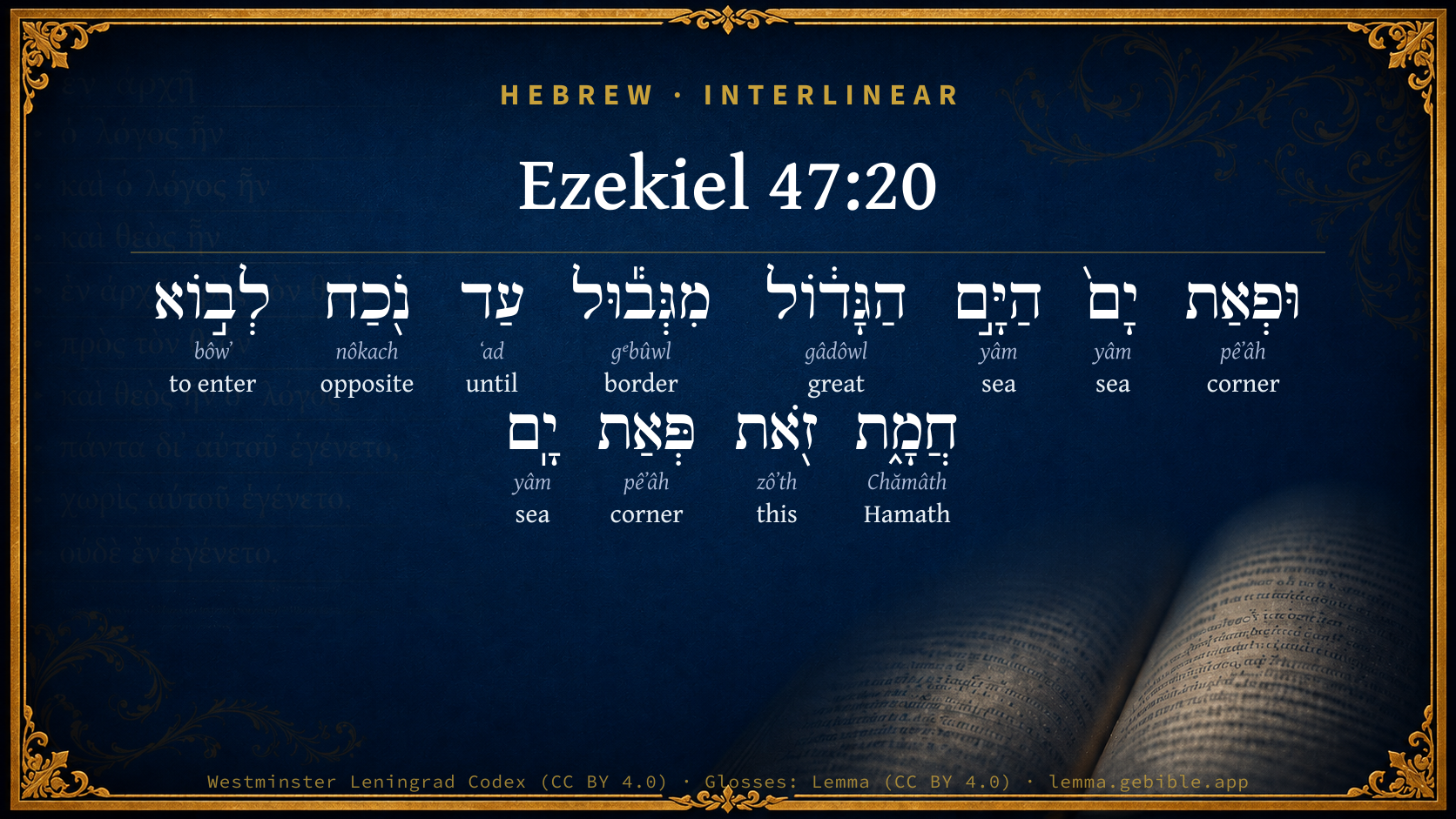
  1. וּפְאַת pêʼâh H6285 “and · corner of” Conjunction + Noun, Common, Feminine, Singular, Construct
  2. יָם֙ yâm H3220 “sea” Noun, Common, Masculine, Singular, Absolute
  3. הַיָּ֣ם yâm H3220 “the · sea” Particle, Definite Article + Noun, Common, Masculine, Singular, Absolute
  4. הַגָּד֔וֹל gâdôwl H1419 “the · great” Particle, Definite Article + Adjective, Adjective, Masculine, Singular, Absolute
  5. מִגְּב֕וּל gᵉbûwl H1366 “from · border” Preposition + Noun, Common, Masculine, Singular, Absolute
  6. עַד ʻad H5704 “until” Preposition
  7. לְב֣וֹא bôwʼ H935 “entrance” Noun, Proper
  8. חֲמָ֑ת Chămâth H2574 “Hamath” Noun, Proper
  9. זֹ֖את zôʼth H2063 “this” Pronoun, Demonstrative, Feminine, Singular
  10. פְּאַת pêʼâh H6285 “corner of” Noun, Common, Feminine, Singular, Construct
  11. יָֽם yâm H3220 “sea” Noun, Common, Masculine, Singular, Absolute

About this verse

These counts appear in no published source. They are computed here, from the morphology-tagged text and Lemma’s own curated glosses. What Lemma adds →

12
words
9
distinct lemmas
Prophets
section

Notable vocabulary

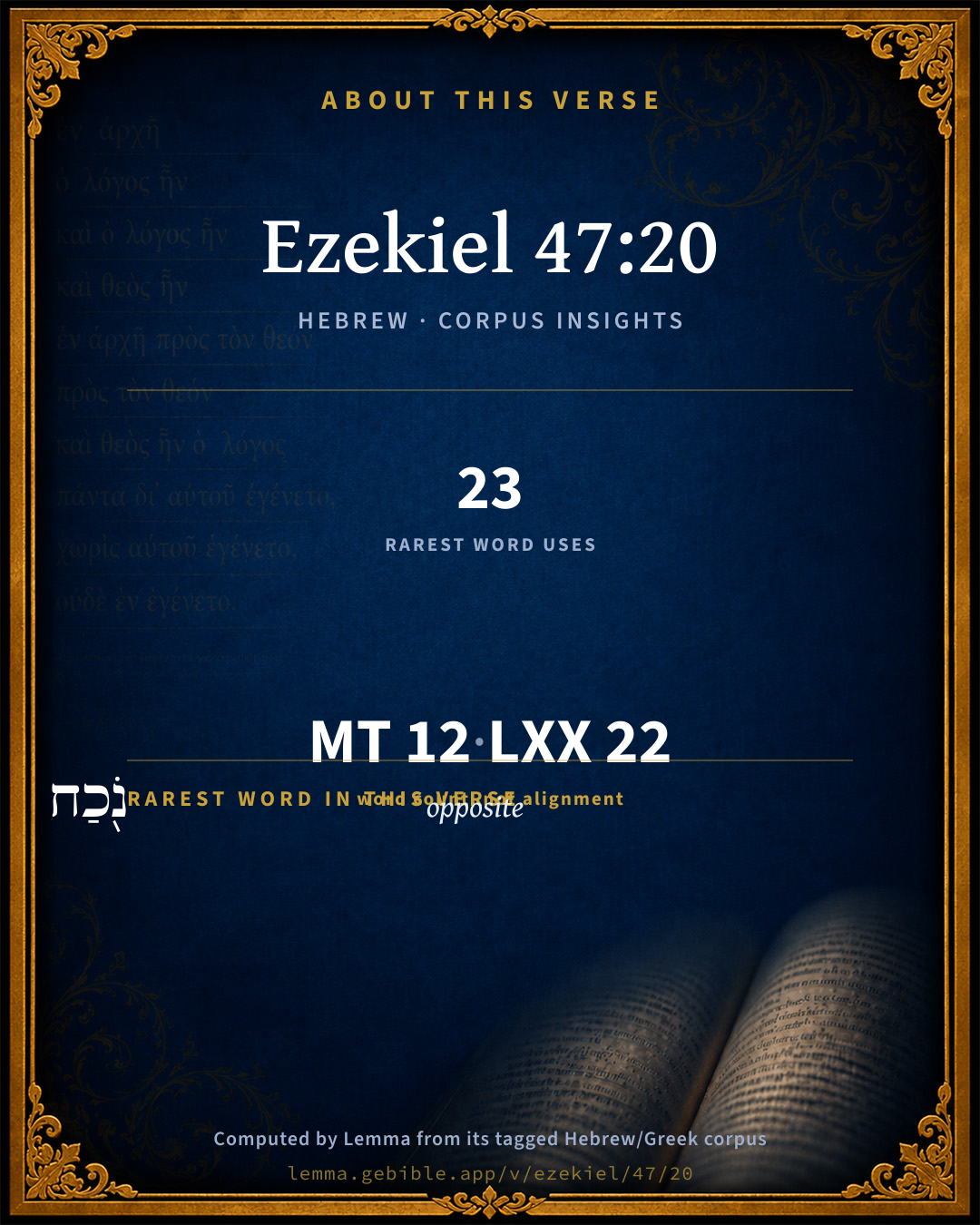
The rarest word here is נֹ֖כַח opposite H5227 — appearing just 23 times in the whole Hebrew Bible.

Shared distinctive vocabulary

נֹ֖כַח opposite H5227 occurs in 22 verses of the Hebrew Bible. Also found in:

Grammatical profile

  • 8 nouns
  • 1 adjective
  • 1 pronoun
  • 2 prepositions

Repetition

Words recur within this verse — often emphatic in Hebrew:

  • יָם֙ sea H3220 ×3
  • וּפְאַת corner H6285 ×2

Hebrew & Septuagint length

In English translation the verse runs 26 words from the Hebrew and 31 from the Septuagint (LXX English) — closely comparable.

A rough comparison of the two English renderings, which tokenize alike — not a word-level alignment.

Word counts can differ between the Hebrew and the Greek without any difference in meaning — e.g. the Hebrew direct-object marker אֵת has no separate Greek word, and Greek often adds the article ὁ.

In the original languages it is 12 Hebrew tokens and 22 Greek tokens — but the two are counted differently (Hebrew bundles its prefixes and suffixes into one token; the Greek is in lemma form), so that isn’t a like-for-like length.

Cross-references

2

Topical passages linked to Ezekiel 47:20 in the Treasury of Scripture Knowledge — connected by theme and wording, ordered by reader-vote popularity; previews shown in the World English Bible.

  • Numbers 34:6 For the western border, you shall have the great sea and the border [of it]: this shall be your west border.
  • Ezekiel 48:1 Now these are the names of the tribes: From the north end, beside the way of Hethlon to the entrance of Hamath, Hazar Enan at the border of Damascus, northward beside Hamath, (and they shall have their sides east [and] west), Dan, one [portion].

Cross-references courtesy of OpenBible.info (CC BY 4.0).

Hebrew and Greek witnesses Masoretic Hebrew ↔ Greek Septuagint

The same verse in the two great witnesses to the Old Testament, shown verse-for-verse.

These are two independent witnesses, not word-aligned to each other, and the Septuagint is shown in lemma (dictionary) form.

Hebrew Ezekiel 47:20 Masoretic · Westminster Leningrad Codex

וּפְאַת יָם֙ הַיָּ֣ם הַגָּד֔וֹל מִגְּב֕וּל עַד נֹ֖כַח לְב֣וֹא חֲמָ֑ת זֹ֖את פְּאַת יָֽם

The west side shall be the great sea, from the [south] border as far as over against the entrance of Hamath. This is the west side.

World English Bible · Public Domain

Greek LXX Ezekiel 47:20 Septuagint · lemma form

οὗτος ὁ μέρος ὁ θάλασσα ὁ μέγας ὁρίζω ἕως κατέναντι ὁ εἴσοδος ημαθ ἕως εἴσοδος αὐτός οὗτος εἰμί ὁ πρός θάλασσα ημαθ

This part of the great sea forms a border, till one comes opposite the entrance of Emath, even as far as the entrance thereof. These are the parts west of Emath.

LXX2012 (modern English Septuagint) · Public Domain

On this verse, Haydock's Catholic Bible Commentary discusses the Septuagint’s reading. Read the note in Commentary ↓

Hebrew: Westminster Leningrad Codex (CC BY 4.0). Greek: Septuagint (public domain); English from LXX2012 (modern English Septuagint) (Public Domain). How the Septuagint differs from the Hebrew →

Targum (Aramaic paraphrase)

1

The Targum is the ancient Jewish Aramaic paraphrase of the Hebrew Scriptures — an interpretive translation, not the Hebrew text itself. Onkelos (literal) and Pseudo-Jonathan (expansive) render the Torah, and Jonathan the Prophets. Coverage is partial: where no permissively-licensed English translation exists for a verse, only the Aramaic is shown. This is verse-level text, not a word-by-word alignment to the Hebrew.

  1. Targum Jonathan Prophets (Joshua–Malachi)
    וְרוּחַ מֵעַרְבָא יַמָא רַבָּא מִתְּחוּמָא עַד מִקֳבֵיל מַעֲלָנָא דַחֲמָת דָא רוּחַ מַעֲרָבָא:

    (no public-domain English translation for this verse)

    Targum Jonathan — Aramaic: “Mikraot Gedolot” (public domain). English: “Sefaria Community Translation” (CC0 1.0 (public-domain dedication)); “London "Chaldee Paraphrase," 1871” (public domain). Text via Sefaria.

Commentary

Notes on Ezekiel 47:20 from classic Christian and Jewish commentators (each source and its license shown beneath its notes). The classic Christian expositions comment on the surrounding passage and are grouped to its opening verse, so a note may address several verses; the Jewish commentaries on the Tanakh (Rashi and others) are per-verse, so they appear only where the commentator wrote on this verse.

Lemma curates 59 commentaries, every one of them public domain or Creative Commons licensed, each selected and text-cleaned for this edition rather than reprinted as found. About our sources →

Trapp's Complete Commentary

John Trapp

Eze 47:20 The west side also [shall be] the great sea from the border, till a man come over against Hamath. This [is] the west side.

Ver. 20. Till a man come over against Hamath.] To that place of the great sea, from which lieth a straight way from Hamath eastward.

John Trapp, A Commentary or Exposition upon All the Books of the Old and New Testament (1647–1656) — public domain. Text from a community e-Sword module.

Joseph Benson's Commentary

Eze 47:20. The west side shall be the great sea from the border — That is, from the southern border, mentioned in the foregoing verse. Till a man come over against Hamath — Or rather, till a man come to Hamath, the northern point toward the west frontier.

Joseph Benson's Commentary on the Old and New Testaments (1811–1818) — public domain. Text from a community e-Sword module.

Adam Clarke's Commentary

Verse 20. The great sea] The Mediterranean.

From the border] The southern border, mentioned Eze 47:19.

Adam Clarke's Commentary on the Bible (1810–1826) — public domain. Text from a community e-Sword/MySword module.

Ellicott's Commentary for English Readers

(20) Over against Hamath.—The western boundary, as in Num_34:6, is the Mediterranean, and continues to the starting-point, Hamath being here, as in Eze_47:16-17, the district of Hamath.

A Bible Commentary for English Readers, edited by Charles John Ellicott (1878–1897) — public domain. Text from a community e-Sword module.

The Cambridge Bible for Schools and Colleges

gen. ed. J. J. S. Perowne

20. The western boundary—“and the west side: the great sea, from the (south) border as far as over against where one goeth unto Hamath; this is the west side.”

The Cambridge Bible for Schools and Colleges (gen. ed. J. J. S. Perowne; Cambridge University Press, 1878–1918) — public domain. Text from a community e-Sword module.

John Gill's Exposition

The west side also shall be the great sea from the border,.... From the border of Egypt, and the river of it, to the Mediterranean sea, is the west side of the land, and the western border of it; hence the western point is often expressed in Scripture by the sea:

till a man come over against Hamath; Antioch in Syria; see Eze 47:16.

this is the west side; of the land, and of the western border of it.

John Gill's Exposition of the Whole Bible (1746–1763) — public domain (CC PDM 1.0). Text via the HelloAO Bible API.

Haydock's Catholic Bible Commentary

Emath, not that it was on the sea: but a line was to be drawn over against this city, eastward from the Mediterranean Sea. Septuagint, "to opposite the entrance of Emath, as far as its entrance." But the territory extended farther, Numbers xxxiv.

George Leo Haydock (1774–1849), Haydock's Catholic Family Bible and Commentary, 1859 edition — public domain. Excludes Psalms (Douay-Rheims chapter numbering differs from Protestant) and Deuterocanonical books (Catholic canon only).

Matthew Poole's English Annotations

This boundary begins where the river falls into the Mediterranean, a little south of Gaza; this the south point of the western boundary, and the line runs all along the seashore northward, till you come in a straight line to Hamath; and this is the northern point of the west frontier, over right Sidon, or little differing.

Matthew Poole's English Annotations on the Holy Bible (1683–1685) — public domain. Text from a community e-Sword/MySword module.

The Pulpit Commentary

The western boundary. This, as in Num_34:6, should be the great sea from the border, i.e. the southern boundary last mentioned (ver. 19), till a man come over against Hamath; literally, unto (the place which is) over against the coming to Hamath; i.e. till opposite the point (on the coast) at which one enters the territory of Hamath. (comp. Jud_1:19:10 20:43)

The Pulpit Commentary (1880–1919), ed. H.D.M. Spence-Jones & Joseph S. Exell — public domain. Text from a community e-Sword module.

Rashi

Rabbi Shlomo Yitzchaki (Rashi)

And the western side the western border.

the Great Sea from the border until opposite the road [leading] to Hamath from the southern corner, which is the stream of Egypt,

until opposite the way [leading] to Hamath, until the northwestern corner, which is Mount Hor, opposite the road [leading] to Hamath, for Hamath is in the northwest corner alongside Mount Hor, as is written (Num. 34:7f.): “From the Great Sea you shall draw a line extending to Mount Hor. From Mount Hor you shall draw a line extending to the road [leading] to Hamath.”

Rashi on the Tanakh — English translations: “The Judaica Press complete Tanach with Rashi, translated by A. J. Rosenberg” (CC BY 4.0); “Pentateuch with Rashi's commentary by M. Rosenbaum and A.M. Silbermann, 1929-1934” (public domain); “The Metsudah Tanach series, Lakewood, N.J” (CC BY 4.0); and “The Book of Joshua, Metsudah Publications, 1997” (CC BY 4.0). Text via Sefaria.

Lesson kit

Teaching starters — assembled from the data on this page, not authored interpretation. Every prompt links to the verse data it draws on. Edit before teaching.

Ezekiel, in the Prophets, opens this verse with 12 words (9 distinct Hebrew lemmas). Its most distinctive word is nôkach (“opposite”). A historical commentator’s framing appears above. Read the whole chapter for the surrounding context.

Discussion questions

  1. What does “opposite” (nôkach) contribute to the verse as a whole?
  2. Genesis 25:21 shares the word «opposite» with this verse. How do the two illuminate each other?
  3. “sea” occurs 3× in this one verse. What is the effect of the repetition?
  4. These translations render this verse differently. What is at stake in choosing one wording over another?
  5. Reading how Trapp's Complete Commentary and Joseph Benson's Commentary read this verse, where do the two commentators agree and where do they part?

Things to notice

Reading settings

Reading text

Shown beneath each verse's original-language words.

Old Testament
Old Testament edition

Read the OT as the Masoretic Hebrew (MT) or the Greek Septuagint (LXX).

English shown for the Greek Septuagint (in the Hebrew ↔ Greek comparison).

Comparing translations? Open the Compare panel on any verse page to stack up to four side by side.