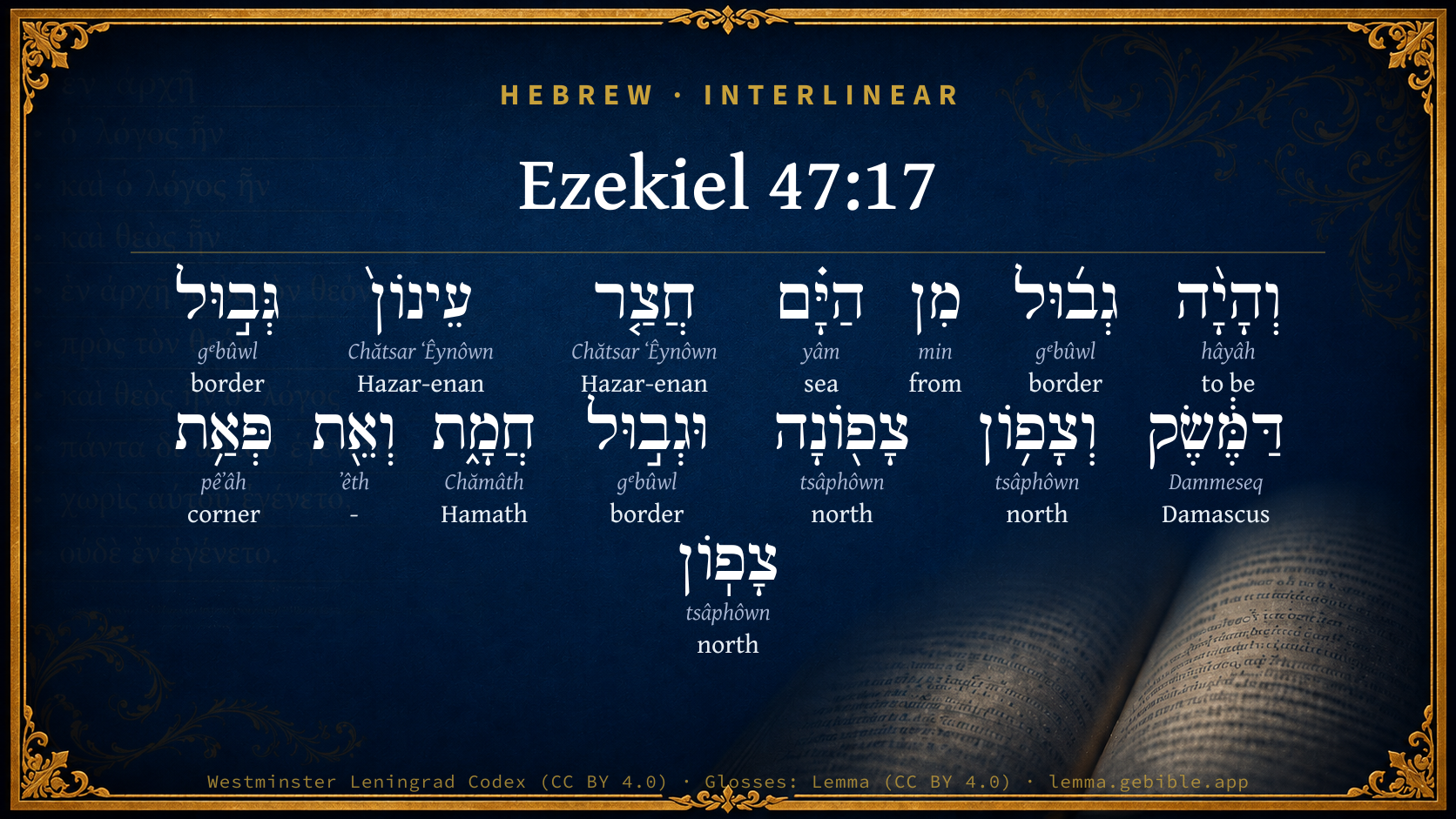
Ezekiel 47:17

Hebrew (Westminster Leningrad Codex) Ezekiel 47:17 appears in the Hebrew Old Testament. The text above is from the Westminster Leningrad Codex. Each word links to its Strong’s number, a concise gloss, and parsing drawn from the Open Scriptures Hebrew Bible morphology. Click any word for its full Brown-Driver-Briggs (BDB) entry.
Download image
Cite this verse

Ezekiel 47:17 (World English Bible). Public Domain. Lemma interlinear Bible study tool, https://lemma.gebible.app/v/ezekiel/47/17.

Show BibTeX & RIS
BibTeX
RIS
English Translation
The border from the sea, shall be Hazar Enon at the border of Damascus; and on the north northward is the border of Hamath. This is the north side.
World English Bible · Public Domain
Highlights Full analysis ↓
Download a study sheet

One document with this verse’s original text, its word-by-word gloss line, the meaning frame, cross-references with their text, attributed commentary, and full source and license credits — printable, and it pastes into notes with its structure intact.

This verse Autodidact and up

Study sheet (.html) Plain text (.txt)

A passage Seminary Student

Up to 50 verses in one chapter. A passage sheet keeps up to 6 commentary sources and 12 cross-references per verse, in the order this page ranks them, and says so on the sheet whenever that leaves anything out. Ask for a single verse and you get the Autodidact verse sheet above.

Everything on this page stays free to read, with no account — the sheet is a download of what is already on screen, not access to it.

Want to remove ads? Support Godless Engineer
Compare translations 3

The same verse in 3 English versions, stacked beneath the original-language interlinear above. Click any original word for its lexicon entry.

Each is an independent rendering of the whole verse — the interlinear is not word-aligned to these translations.

Highlighted words mark where these versions differ — a whole-verse word diff, not a word-by-word alignment.

  • World English Bible Public Domain
    The border from the sea, shall be Hazar Enon at the border of Damascus; and on the north northward is the border of Hamath. This is the north side.
  • King James Version Public Domain
    And the border from the sea shall be Hazarenan, the border of Damascus, and the north northward, and the border of Hamath. And this is the north side.
  • unfoldingWord Literal Text CC BY-SA 4.0
    So the boundary will go from the sea to Hazar Enan on the border with Damascus and Hamath to the north. This will be the north side.

unfoldingWord Literal Text — © unfoldingWord, licensed CC BY-SA 4.0. Word-aligned USFM3 via Door43 (git.door43.org/unfoldingWord/en_ult).

Versions to compare (up to 4)

3 of 4 selected

Show all 18 translations

Every available English version of this verse, each an independent rendering of the whole verse.

  • World English Bible Public Domain
    The border from the sea, shall be Hazar Enon at the border of Damascus; and on the north northward is the border of Hamath. This is the north side.
  • Berean Standard Bible Public Domain
    So the border will run from the Sea to Hazar-enan, along the northern border of Damascus, with the territory of Hamath to the north. This will be the northern boundary.
  • Majority Standard Bible Public Domain
    So the border will run from the Sea to Hazar-enan, along the northern border of Damascus, with the territory of Hamath to the north. This will be the northern boundary.
  • King James Version Public Domain
    And the border from the sea shall be Hazarenan, the border of Damascus, and the north northward, and the border of Hamath. And this is the north side.
  • American Standard Version (1901) Public Domain
    And the border from the sea, shall be Hazar-enon at the border of Damascus; and on the north northward is the border of Hamath. This is the north side.
  • Revised Version (1885) Public Domain
    And the border from the sea shall be Hazar-enon at the border of Damascus, and on the north northward is the border of Hamath. This is the north side.
  • Geneva Bible (1599) Public Domain
    And the border from the sea shalbe Hazar, Enan, and the border of Damascus, and the residue of the North, Northwarde, and the border of Hamath: so shalbe the North part.
  • Douay-Rheims (1899) Public Domain
    And the border from the sea even to the court of Enan, shall be the border of Damascus, and from the north to the north: the border of Emath, this is the north side.
  • Young's Literal Translation Public Domain
    And the border from the sea hath been Hazar-Enan, the border of Damascus, and Zaphon at the north, and the border of Hamath: and `this is' the north quarter.
  • Literal Standard Version CC BY-SA 4.0
    And the border from the sea has been Hazar-Enan, the border of Damascus, and Zaphon at the north, and the border of Hamath: and [this is] the north quarter.
  • Unlocked Literal Bible CC BY-SA 4.0
    So the boundary will go from the sea to Hazar Enan on the border with Damascus and Hamath to the north. This will be the north side.
  • unfoldingWord Literal Text CC BY-SA 4.0
    So the boundary will go from the sea to Hazar Enan on the border with Damascus and Hamath to the north. This will be the north side.
  • Darby Bible Public Domain
    And the border from the sea shall be Hazar-enan, the border of Damascus, and the north northward, and the border of Hamath: this is the north side.
  • World Messianic Bible Public Domain
    The border from the sea shall be Hazar Enon at the border of Damascus; and on the north northward is the border of Hamath. This is the north side.
  • Webster's Bible Public Domain
    And the border from the sea shall be Hazar-enan, the border of Damascus, and the north northward, and the border of Hamath. And this is the north side.
  • Free Bible Version CC BY-SA 4.0
    So the border is from the Mediterranean Sea to Hazar-enan, along the northern border with Damascus, with the border of Hamath to the north. This is the northern boundary.
  • Bible in Basic English Public Domain
    And this is the limit from the sea in the direction of Hazar-enon; and the limit of Damascus is to the north, and on the north is the limit of Hamath. This is the north side.
  • JPS Tanakh (1917) Public Domain
    And the border from the sea shall be Hazar-enon at the border of Damascus, and on the north northward is the border of Hamath. This is the north side.

Literal Standard Version (2020), Covenant Press — licensed CC BY-SA 4.0. Text via the HelloAO Bible API (eBible.org). Unlocked Literal Bible (unfoldingWord) — licensed CC BY-SA 4.0. Text via the HelloAO Bible API (eBible.org). unfoldingWord Literal Text — © unfoldingWord, licensed CC BY-SA 4.0. Word-aligned USFM3 via Door43 (git.door43.org/unfoldingWord/en_ult). Free Bible Version, Dr. Jonathan Gallagher — licensed CC BY-SA 4.0. Text via the HelloAO Bible API (eBible.org).

Word by word

More ways to search: Search by grammar → Find every occurrence → Compare this word →

Practice this passage: Drill this verse → Learn its vocabulary →

חֲצַ֤ר
Chătsar ʻÊynôwn
H2703
“Hazar-enan”
Noun, Proper
Part of Speech
Noun
Type
Proper
Full BDB Definition

Origin: from H2691 and a derivative of H5869

TWOT: None

Hazar-enan = "village of springs" - a city on the northeast border of Canaan; same as 2704
  1. וְהָיָ֨ה hâyâh H1961 “and · to be” Conjunction + Verb, Qal, Sequential Perfect, 3rd Person, Masculine, Singular
  2. גְב֜וּל gᵉbûwl H1366 “border” Noun, Common, Masculine, Singular, Absolute
  3. מִן min H4480 “from” Preposition
  4. הַיָּ֗ם yâm H3220 “the · sea” Particle, Definite Article + Noun, Common, Masculine, Singular, Absolute
  5. עֵינוֹן֙ Chătsar ʻÊynôwn H2703 “Hazar-enan” Noun, Proper
  6. גְּב֣וּל gᵉbûwl H1366 “border of” Noun, Common, Masculine, Singular, Construct
  7. דַּמֶּ֔שֶׂק Dammeseq H1834 “Damascus” Noun, Proper
  8. וְצָפ֥וֹן tsâphôwn H6828 “and · north” Conjunction + Noun, Common, Feminine, Singular, Absolute
  9. צָפ֖וֹנָה tsâphôwn H6828 “north · toward” Noun, Common, Feminine, Singular, Absolute + Suffix, Demonstrative
  10. וּגְב֣וּל gᵉbûwl H1366 “and · border of” Conjunction + Noun, Common, Masculine, Singular, Construct
  11. חֲמָ֑ת Chămâth H2574 “Hamath” Noun, Proper
  12. וְאֵ֖ת ʼêth H853 “and · -” Conjunction + Particle, Direct Object
  13. פְּאַ֥ת pêʼâh H6285 “corner of” Noun, Common, Feminine, Singular, Construct
  14. צָפֽוֹן tsâphôwn H6828 “north” Noun, Common, Feminine, Singular, Absolute

About this verse

These counts appear in no published source. They are computed here, from the morphology-tagged text and Lemma’s own curated glosses. What Lemma adds →

15
words
10
distinct lemmas
Prophets
section

Notable vocabulary

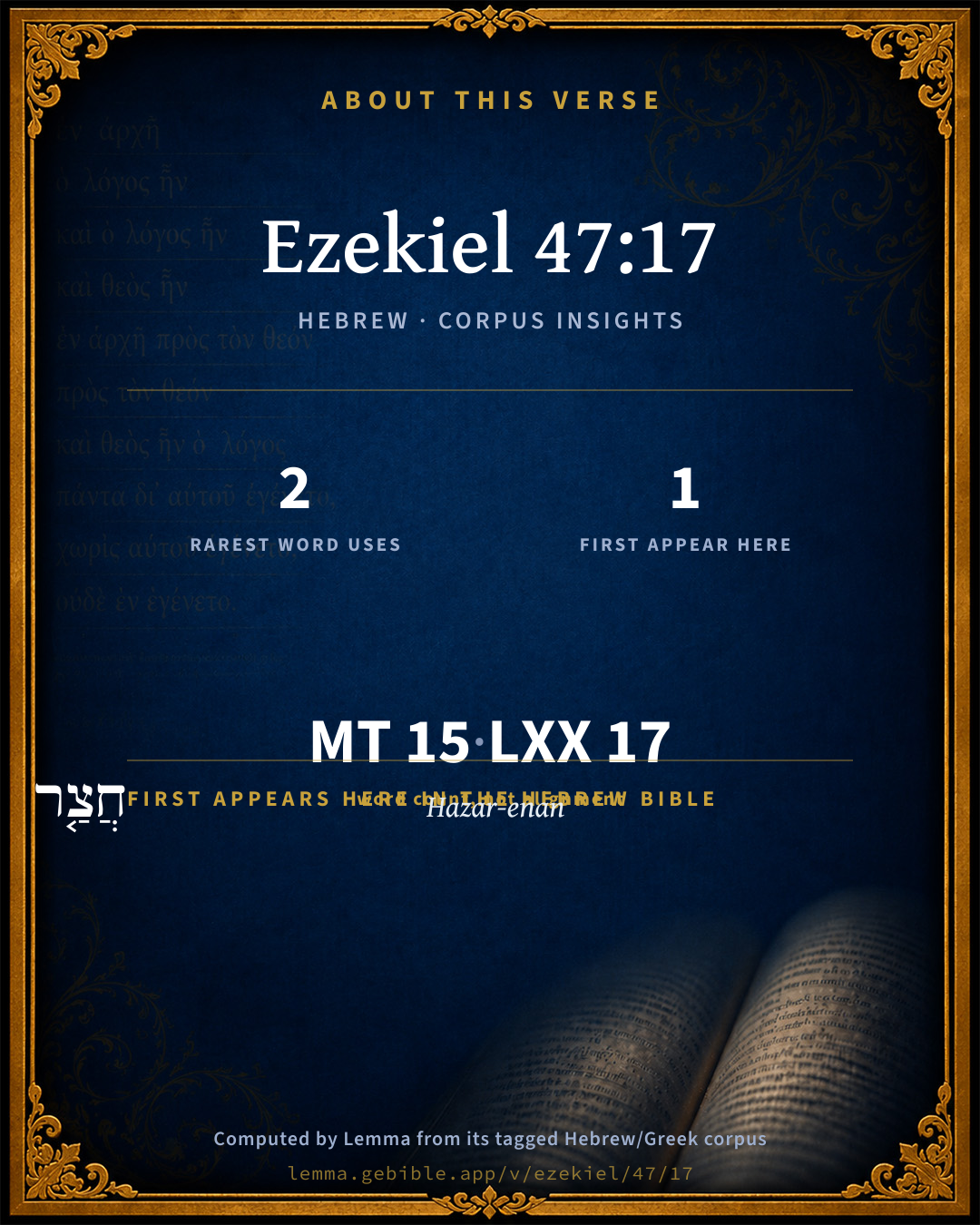
The rarest word here is חֲצַ֤ר Hazar-enan H2703 — appearing just 2 times in the whole Hebrew Bible.

First appearance in Scripture

This word makes its first canonical appearance in the Hebrew Bible here:

  • חֲצַ֤ר Hazar-enan H2703

Grammatical profile

  • 1 verb
  • 12 nouns
  • 1 preposition
  • 1 particle

Verb forms

  • וְהָיָ֨ה Qal · Sequential Perfect

Repetition

Words recur within this verse — often emphatic in Hebrew:

  • גְב֜וּל border H1366 ×3
  • וְצָפ֥וֹן north H6828 ×3
  • חֲצַ֤ר Hazar-enan H2703 ×2

Hebrew & Septuagint length

In English translation the verse runs 29 words from the Hebrew and 20 from the Septuagint (LXX English) — the Septuagint runs noticeably shorter here. See the side-by-side →

A rough comparison of the two English renderings, which tokenize alike — not a word-level alignment.

Word counts can differ between the Hebrew and the Greek without any difference in meaning — e.g. the Hebrew direct-object marker אֵת has no separate Greek word, and Greek often adds the article ὁ.

In the original languages it is 15 Hebrew tokens and 17 Greek tokens — but the two are counted differently (Hebrew bundles its prefixes and suffixes into one token; the Greek is in lemma form), so that isn’t a like-for-like length.

Cross-references

2

Topical passages linked to Ezekiel 47:17 in the Treasury of Scripture Knowledge — connected by theme and wording, ordered by reader-vote popularity; previews shown in the World English Bible.

  • Ezekiel 48:1 Now these are the names of the tribes: From the north end, beside the way of Hethlon to the entrance of Hamath, Hazar Enan at the border of Damascus, northward beside Hamath, (and they shall have their sides east [and] west), Dan, one [portion].
  • Numbers 34:9 and the border shall go forth to Ziphron, and the goings out of it shall be at Hazar Enan: this shall be your north border.

Cross-references courtesy of OpenBible.info (CC BY 4.0).

Hebrew and Greek witnesses Masoretic Hebrew ↔ Greek Septuagint

The same verse in the two great witnesses to the Old Testament, shown verse-for-verse.

Here the Septuagint runs noticeably shorter than the Hebrew — LXX2012 (modern English Septuagint) 20 words vs World English Bible 29. A rough length comparison of the two English translations, not a word-level alignment — read both below.

These are two independent witnesses, not word-aligned to each other, and the Septuagint is shown in lemma (dictionary) form.

Hebrew Ezekiel 47:17 Masoretic · Westminster Leningrad Codex

וְהָיָ֨ה גְב֜וּל מִן הַיָּ֗ם חֲצַ֤ר עֵינוֹן֙ גְּב֣וּל דַּמֶּ֔שֶׂק וְצָפ֥וֹן צָפ֖וֹנָה וּגְב֣וּל חֲמָ֑ת וְאֵ֖ת פְּאַ֥ת צָפֽוֹן

The border from the sea, shall be Hazar Enon at the border of Damascus; and on the north northward is the border of Hamath. This is the north side.

World English Bible · Public Domain

Greek LXX Ezekiel 47:17 Septuagint · lemma form

οὗτος ὁ ὅριον ἀπό ὁ θάλασσα ἀπό ὁ αὐλή ὁ αιναν ὅριον δαμασκός καί ὁ πρός βορέας

These are the borders from the sea, from the habitations of Aenan, the coasts of Damascus, and the northern coasts.

LXX2012 (modern English Septuagint) · Public Domain

On this verse, The Cambridge Bible for Schools and Colleges discusses the Septuagint’s reading. Read the note in Commentary ↓

Hebrew: Westminster Leningrad Codex (CC BY 4.0). Greek: Septuagint (public domain); English from LXX2012 (modern English Septuagint) (Public Domain). How the Septuagint differs from the Hebrew →

Targum (Aramaic paraphrase)

1

The Targum is the ancient Jewish Aramaic paraphrase of the Hebrew Scriptures — an interpretive translation, not the Hebrew text itself. Onkelos (literal) and Pseudo-Jonathan (expansive) render the Torah, and Jonathan the Prophets. Coverage is partial: where no permissively-licensed English translation exists for a verse, only the Aramaic is shown. This is verse-level text, not a word-by-word alignment to the Hebrew.

  1. Targum Jonathan Prophets (Joshua–Malachi)
    וִיהֵי תְחוּמָא מִן יַמָא חֲצַר עֵינוֹן תְּחוּם דַמֶשֶׂק וְצִפּוּנָא צִפּוּנָא וּתְחוּם חֲמָת וְיַת רוּחַ צִפּוּנָא:

    (no public-domain English translation for this verse)

    Targum Jonathan — Aramaic: “Mikraot Gedolot” (public domain). English: “Sefaria Community Translation” (CC0 1.0 (public-domain dedication)); “London "Chaldee Paraphrase," 1871” (public domain). Text via Sefaria.

Commentary

Notes on Ezekiel 47:17 from classic Christian and Jewish commentators (each source and its license shown beneath its notes). The classic Christian expositions comment on the surrounding passage and are grouped to its opening verse, so a note may address several verses; the Jewish commentaries on the Tanakh (Rashi and others) are per-verse, so they appear only where the commentator wrote on this verse.

Lemma curates 59 commentaries, every one of them public domain or Creative Commons licensed, each selected and text-cleaned for this edition rather than reprinted as found. About our sources →

The Cambridge Bible for Schools and Colleges

gen. ed. J. J. S. Perowne

17. The verse repeats and sums up Eze_47:15-16, with special reference to the countries lying on the N. of the northern border of Israel. In Eze_47:17 Hazar Enon is named as the extremity of the Northern boundary, in Eze_47:16 Hazar hattikon (the middle Hazar). The places must be identical, whether hattikon be a misreading or not. LXX. reads Saunan, Cod. Alex. Eunan, and in Eze_48:1, Num_34:9, Enon here is spelled Enan. In Eze_47:16 the place is said to be on the border of Hauran. Eze_47:17 may read: “and so the border shall be from the sea to Hazar Enon on the border of Damascus, and north northwards the border of Hamath: this is the north side” (reading this as Eze_47:20 and possibly with omission of and before “border of Hamath,” words wanting in LXX.). The boundary is first stated generally as going from the sea to Hazar Enan, and then in the contrary direction north, Hamath being the country to the N. It is not certain that Hauran is the district now so called, but it is probable. Wetzstein (Del. Psalms iii. 439, Eaton’s Trans.), identifies the village of Haḍar at the East foot of Hermon with Hazar Enan. In all likelihood the end of the boundary line is hereabouts; in Deu_3:8 Hermon is the northernmost point of conquest, and Ezek. would probably follow this. The northern boundary followed an easterly course from the sea, Hamath lying on the N., then a southerly course having Damascus on the E., till it terminated at Hazar Enon between Damascus and Hauran. But at what point of the sea it started, and in what latitude the line to the east ran is obscure. The identifications of Hethlon with Heitela and of Zedad with Sadad would give the latitude of Emesa (Homs), which is very far north; see Porter, Five Years in Damascus, 11. 354 seq. and map. More likely the prophet fancied the starting-point on the W. to be about Tyre.

The Cambridge Bible for Schools and Colleges (gen. ed. J. J. S. Perowne; Cambridge University Press, 1878–1918) — public domain. Text from a community e-Sword module.

Trapp's Complete Commentary

John Trapp

Eze 47:17 And the border from the sea shall be Hazarenan, the border of Damascus, and the north northward, and the border of Hamath. And [this is] the north side.

Ver. 17. And the border from the sea shall be Hazarenan.] Forasmuch as the borders in this description of the land are set to be such as never were in the Israelites’ possession, the Jewish doctors are, will they nill they, forced to confess that the land of Israel in the world to come shall be larger than ever it had been. Now gospel times are called "the world to come." {Heb 2:5}

John Trapp, A Commentary or Exposition upon All the Books of the Old and New Testament (1647–1656) — public domain. Text from a community e-Sword module.

Jamieson, Fausset & Brown

Robert Jamieson, A. R. Fausset & David Brown

Hazar-enan--a town in the north of Canaan, meaning "village of fountains."

Jamieson, Fausset & Brown — Commentary Critical and Explanatory on the Whole Bible (1871) — public domain (CC PDM 1.0). Text via the HelloAO Bible API.

Adam Clarke's Commentary

Verse 17. The border from the sea] The north border eastward is ascertained Eze 47:15-16; here it is shown how far it extends itself northward.

Hazar-enan] The village of Enan, Nu 34:9, placed to the north of Caesarea Philippi. Ziphron, see Nu 34:9, called Zaphion by the Syriac.

Adam Clarke's Commentary on the Bible (1810–1826) — public domain. Text from a community e-Sword/MySword module.

Ellicott's Commentary for English Readers

(17) The border from the sea shall be Hazarenan.—Comparing this with Num_34:9, it is plain that the sense is, “The (north) boundary which started from the sea shall terminate at Hazar-enan, where it meets the boundaries of Damascus.” Hazar-enan means “the village of springs,” and is mentioned in Eze_48:1, and in Num_34:9-10, as the end of the north and beginning of the east boundary of the land. For “and the border of Hamath,” read even the border—i.e., the northern boundary is the (south) boundary of Hamath. While it is impossible to locate precisely this northern boundary, either as given in Numbers or by Ezekiel, it is evident that the two are identical, and that the line stretched from the Mediterranean to the territory of Damascus. The whole width of the country at this point would therefore be somewhat over thirty miles.

A Bible Commentary for English Readers, edited by Charles John Ellicott (1878–1897) — public domain. Text from a community e-Sword module.

John Gill's Exposition

And the border from the sea shall be Hazarenan, the border of Damascus,.... Which was the furthermost part and end of the northern border, as fixed by Moses, Num 34:9,

and the north northward, and the border of Hamath; if this is carrying on the border further, it seems to be another Hamath, distinct from the former, Eze 47:16,

and this is the north side: of the land, and the description of the northern border of it, from the Mediterranean sea to Hazarenan.

John Gill's Exposition of the Whole Bible (1746–1763) — public domain (CC PDM 1.0). Text via the HelloAO Bible API.

Albert Barnes' Notes on the Bible

And the north ... - Or, “and on the north, the border on the north shall be” etc.

Albert Barnes' Notes on the Bible (1834–1885) — public domain. Text from a community e-Sword/MySword module.

Haydock's Catholic Bible Commentary

Emath was about the middle of the northern limits, between the Mediterranean Sea and the Euphrates River.

George Leo Haydock (1774–1849), Haydock's Catholic Family Bible and Commentary, 1859 edition — public domain. Excludes Psalms (Douay-Rheims chapter numbering differs from Protestant) and Deuterocanonical books (Catholic canon only).

Matthew Poole's English Annotations

The border; the utmost northern bounds.

From the sea: see Eze 47:15.

Hazar-enan; the village Enan, or Enon, near Sedada.

The north northward; a line drawn from west to east, that shall distinguish the most northern boundaries of Israel from the most southern of Syria Damascena.

Matthew Poole's English Annotations on the Holy Bible (1683–1685) — public domain. Text from a community e-Sword/MySword module.

The Pulpit Commentary

The northern boundary is further defined as extending from the sea, i.e. the Mediterranean on the west, to Hazar-enan, or the "Village of fountains," in the east, which village again is declared to have been the border, frontier city (Keil), at the border (Revised Version) of Damascus, and as having on the north northward the border or territory of Hamath. The final clause adds, And this is the north side, either understanding taew, with Gesenius, as equivalent to aujtov, ipse, "this same," or with Hitzig and Smend, after the Syriac, substituting for it here and in vers. 18, 19 taOw as in ver. 20; though Hengstenberg and Keil prefer to regard tae as the customary sign of the accusative, and to supply some such thought as "ye see" (Hengstenberg), or "ye shall measure" (Keil), which ver. 18 shows was in the prophet"s mind. Compared with the ancient north boundary of Canaan, (Num_34:7-9) this appointed by Ezekiel"s Torah for the new land shows a marked correspondence.

The Pulpit Commentary (1880–1919), ed. H.D.M. Spence-Jones & Joseph S. Exell — public domain. Text from a community e-Sword module.

Rashi

Rabbi Shlomo Yitzchaki (Rashi)

And the border shall be from the sea to Hazer-enon The northern border shall be from the sea until Hazer-enon.

the border of Damascus [i.e.,] which is on the border of Damascus, i.e., Hazer-enon is on the northeastern corner, as is explicated in the [description of] the boundaries which Moses, our master, may he rest in peace, wrote (Num. 34:9-10f.): “and its ends shall be Hazer -as your eastern border [the territory] from Hazer-enan, etc.” The border of Damascus is in the northeastern corner beside Hazer-enan, as is stated above: “Hazer-enan” and “the border of Damascus.” The border of Hamath is at the northwestern corner, as is stated (ibid. v. 7f.): “And this shall be your northern border: from the Great Sea you shall draw a line extending to the road [leading] to Hamath, and from there to Zedad.”

and in the north northward is the border of Hamath i.e., the entire northern border delineated in the Torah, and the border of Hamath-which is also on the northern border as is stated (ibid. verse 7f.): “And this shall be your northern border: from the Great Sea you shall draw a line extending to Mount Hor. From Mount Hor you shall draw a line extending to the road [leading] to Hamath, and the ends of the border shall be toward Zedad.” That is the Zedad mentioned here: “the way to Hethlon to the road [leading] to Zedad.”

this is the northern side [Lit. and the northern side.] And here you have the northern side.

Rashi on the Tanakh — English translations: “The Judaica Press complete Tanach with Rashi, translated by A. J. Rosenberg” (CC BY 4.0); “Pentateuch with Rashi's commentary by M. Rosenbaum and A.M. Silbermann, 1929-1934” (public domain); “The Metsudah Tanach series, Lakewood, N.J” (CC BY 4.0); and “The Book of Joshua, Metsudah Publications, 1997” (CC BY 4.0). Text via Sefaria.

Lesson kit

Teaching starters — assembled from the data on this page, not authored interpretation. Every prompt links to the verse data it draws on. Edit before teaching.

Ezekiel, in the Prophets, opens this verse with 15 words (10 distinct Hebrew lemmas). Its most distinctive word is Chătsar ʻÊynôwn (“Hazar-enan”). The Greek Septuagint runs shorter here. A historical commentator’s framing appears above. Read the whole chapter for the surrounding context.

Discussion questions

  1. What does “Hazar-enan” (Chătsar ʻÊynôwn) contribute to the verse as a whole?
  2. The word “Hazar-enan” first appears here in Scripture. What is being introduced at this debut?
  3. Ezekiel 48:1 shares this passage’s theme. How do the two illuminate each other?
  4. “border” occurs 3× in this one verse. What is the effect of the repetition?
  5. Compared with the Hebrew, the Septuagint runs shorter here. What questions does that raise?
  6. The translations on this page render this verse differently — a whole-verse word diff, not a word-by-word alignment. What might account for the different wordings?
  7. The verb «וְהָיָ֨ה» is Qal Sequential Perfect. How does its form color the action?
  8. Reading how The Cambridge Bible for Schools and Colleges and Trapp's Complete Commentary read this verse, where do the two commentators agree and where do they part?

Things to notice

Reading settings

Reading text

Shown beneath each verse's original-language words.

Old Testament
Old Testament edition

Read the OT as the Masoretic Hebrew (MT) or the Greek Septuagint (LXX).

English shown for the Greek Septuagint (in the Hebrew ↔ Greek comparison).

Comparing translations? Open the Compare panel on any verse page to stack up to four side by side.