
2 Chronicles 11:13

Hebrew (Westminster Leningrad Codex) 2 Chronicles 11:13 appears in the Hebrew Old Testament. The text above is from the Westminster Leningrad Codex. Each word links to its Strong’s number, a concise gloss, and parsing drawn from the Open Scriptures Hebrew Bible morphology. Click any word for its full Brown-Driver-Briggs (BDB) entry.
Download image
Cite this verse

2 Chronicles 11:13 (World English Bible). Public Domain. Lemma interlinear Bible study tool, https://lemma.gebible.app/v/2-chronicles/11/13.

Show BibTeX & RIS
BibTeX
RIS
English Translation
The priests and the Levites who were in all Israel resorted to him out of all their border.
World English Bible · Public Domain
Download a study sheet

One document with this verse’s original text, its word-by-word gloss line, the meaning frame, cross-references with their text, attributed commentary, and full source and license credits — printable, and it pastes into notes with its structure intact.

This verse Autodidact and up

Study sheet (.html) Plain text (.txt)

A passage Seminary Student

Up to 50 verses in one chapter. A passage sheet keeps up to 6 commentary sources and 12 cross-references per verse, in the order this page ranks them, and says so on the sheet whenever that leaves anything out. Ask for a single verse and you get the Autodidact verse sheet above.

Everything on this page stays free to read, with no account — the sheet is a download of what is already on screen, not access to it.

Want to remove ads? Support Godless Engineer
Compare translations 3

The same verse in 3 English versions, stacked beneath the original-language interlinear above. Click any original word for its lexicon entry.

Each is an independent rendering of the whole verse — the interlinear is not word-aligned to these translations.

Highlighted words mark where these versions differ — a whole-verse word diff, not a word-by-word alignment.

  • World English Bible Public Domain
    The priests and the Levites who were in all Israel resorted to him out of all their border.
  • King James Version Public Domain
    And the priests and the Levites that were in all Israel resorted to him out of all their coasts.
  • unfoldingWord Literal Text CC BY-SA 4.0
    And the priests and the Levites who were in all Israel presented themselves to him from all their territories.

unfoldingWord Literal Text — © unfoldingWord, licensed CC BY-SA 4.0. Word-aligned USFM3 via Door43 (git.door43.org/unfoldingWord/en_ult).

Versions to compare (up to 4)

3 of 4 selected

Show all 18 translations

Every available English version of this verse, each an independent rendering of the whole verse.

  • World English Bible Public Domain
    The priests and the Levites who were in all Israel resorted to him out of all their border.
  • Berean Standard Bible Public Domain
    Moreover, the priests and Levites from all their districts throughout Israel stood with Rehoboam.
  • Majority Standard Bible Public Domain
    Moreover, the priests and Levites from all their districts throughout Israel stood with Rehoboam.
  • King James Version Public Domain
    And the priests and the Levites that were in all Israel resorted to him out of all their coasts.
  • American Standard Version (1901) Public Domain
    And the priests and the Levites that were in all Israel resorted to him out of all their border.
  • Revised Version (1885) Public Domain
    And the priests and the Levites that were in all Israel resorted to him out of all their border.
  • Geneva Bible (1599) Public Domain
    And the Priests and the Leuites that were in all Israel, resorted vnto him out of all their coastes.
  • Douay-Rheims (1899) Public Domain
    And the priests and Levites, that were in all Israel, came to him out of all their seats,
  • Young's Literal Translation Public Domain
    And the priests, and the Levites, that `are' in all Israel, have stationed themselves by him, out of all their border,
  • Literal Standard Version CC BY-SA 4.0
    And the priests and the Levites that [are] in all Israel have stationed themselves by him, out of all their border,
  • Unlocked Literal Bible CC BY-SA 4.0
    The priests and the Levites who were in all Israel went over to him from within their borders.
  • unfoldingWord Literal Text CC BY-SA 4.0
    And the priests and the Levites who were in all Israel presented themselves to him from all their territories.
  • Darby Bible Public Domain
    And the priests and the Levites that were in all Israel resorted to him out of all their districts;
  • World Messianic Bible Public Domain
    The priests and the Levites who were in all Israel stood with him out of all their territory.
  • Webster's Bible Public Domain
    And the priests and the Levites that were in all Israel resorted to him from all their borders.
  • Free Bible Version CC BY-SA 4.0
    The priests and Levites throughout Israel chose to side with Rehoboam.
  • Bible in Basic English Public Domain
    And the priests and Levites who were in all Israel came together to him from every part of their country.
  • JPS Tanakh (1917) Public Domain
    And the priests and the Levites that were in all Israel presented themselves to him out of all their border.

Literal Standard Version (2020), Covenant Press — licensed CC BY-SA 4.0. Text via the HelloAO Bible API (eBible.org). Unlocked Literal Bible (unfoldingWord) — licensed CC BY-SA 4.0. Text via the HelloAO Bible API (eBible.org). unfoldingWord Literal Text — © unfoldingWord, licensed CC BY-SA 4.0. Word-aligned USFM3 via Door43 (git.door43.org/unfoldingWord/en_ult). Free Bible Version, Dr. Jonathan Gallagher — licensed CC BY-SA 4.0. Text via the HelloAO Bible API (eBible.org).

Word by word

More ways to search: Search by grammar → Find every occurrence → Compare this word →

Practice this passage: Drill this verse → Learn its vocabulary →

הִֽתְיַצְּב֥וּ
yâtsab
H3320
“to stand”
Verb, Hithpael, Perfect, 3rd Person, Common, Plural
Part of Speech
Verb
Stem
Hithpael
Form
Perfect
Person
3rd Person
Gender
Common
Number
Plural
Full BDB Definition

Origin: a primitive root

TWOT: 894

to place, set, stand, set or station oneself, present oneself - (Hithpael) to station oneself, take one's stand, stand, present oneself, stand with someone
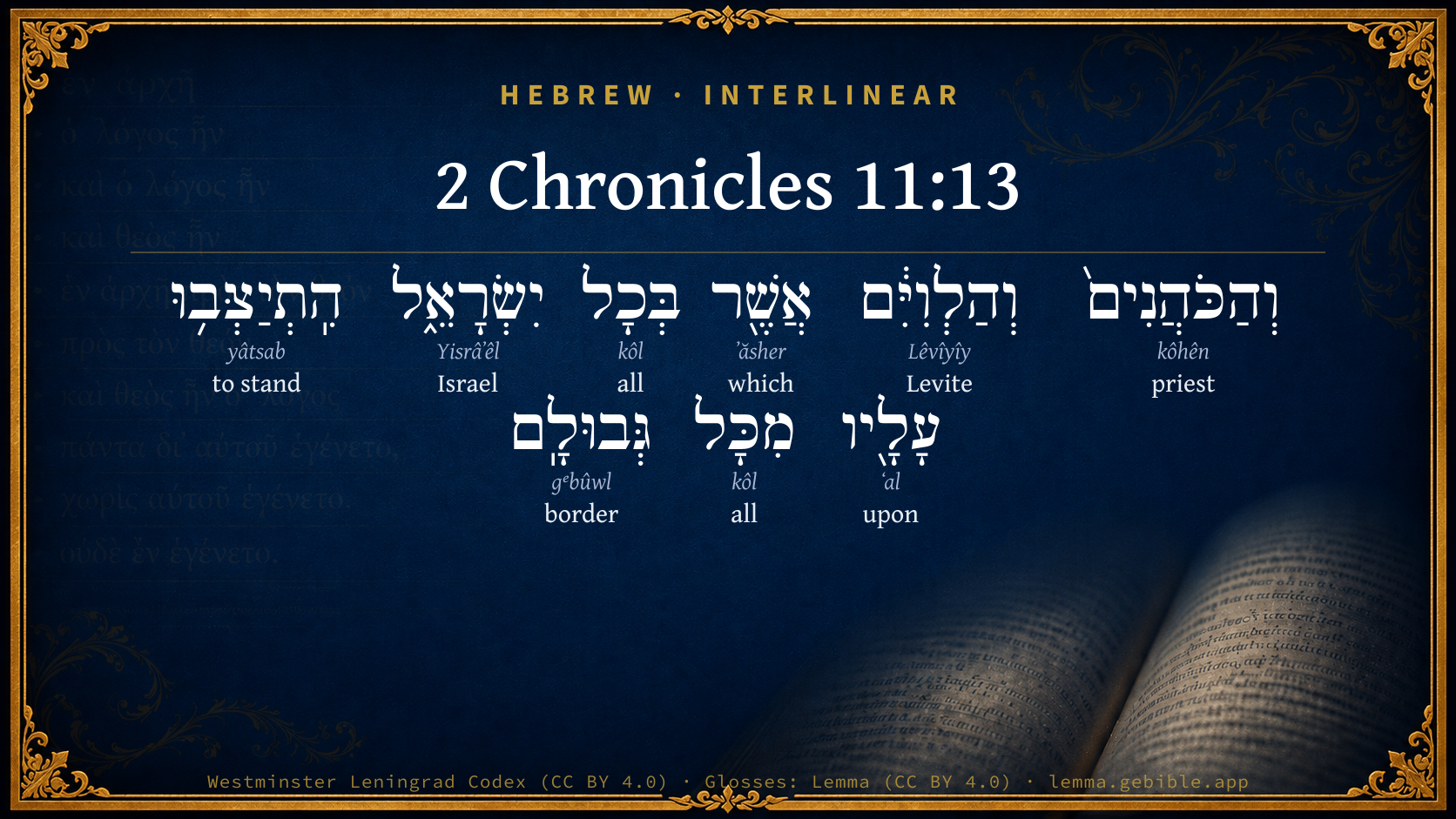
  1. וְהַכֹּהֲנִים֙ kôhên H3548 “and · the · priests” Conjunction + Particle, Definite Article + Noun, Common, Masculine, Plural, Absolute
  2. וְהַלְוִיִּ֔ם Lêvîyîy H3881 “and · the · Levites” Conjunction + Particle, Definite Article + Noun, Gentilic, Masculine, Plural, Absolute
  3. אֲשֶׁ֖ר ʼăsher H834 “which” Particle, Relative
  4. בְּכָל kôl H3605 “in/at · all of” Preposition + Noun, Common, Masculine, Singular, Construct
  5. יִשְׂרָאֵ֑ל Yisrâʼêl H3478 “Israel” Noun, Proper
  6. עָלָ֖יו ʻal H5921 “upon · him” Preposition + Suffix, Personal, 3rd Person, Masculine, Singular
  7. מִכָּל kôl H3605 “from · all of” Preposition + Noun, Common, Masculine, Singular, Construct
  8. גְּבוּלָֽם gᵉbûwl H1366 “border · their” Noun, Common, Masculine, Singular, Construct + Suffix, Personal, 3rd Person, Masculine, Plural

About this verse

These counts appear in no published source. They are computed here, from the morphology-tagged text and Lemma’s own curated glosses. What Lemma adds →

9
words
8
distinct lemmas
Historical
section

Shared distinctive vocabulary

הִֽתְיַצְּב֥וּ to stand H3320 occurs in 45 verses of the Hebrew Bible. Also found in:

Grammatical profile

  • 1 verb
  • 6 nouns
  • 1 preposition
  • 1 particle

Verb forms

  • הִֽתְיַצְּב֥וּ Hithpael · Perfect

Repetition

A word recurs within this verse — often emphatic in Hebrew:

  • בְּכָל all H3605 ×2

Hebrew & Septuagint length

In English translation the verse runs 18 words from the Hebrew and 20 from the Septuagint (LXX English) — closely comparable.

A rough comparison of the two English renderings, which tokenize alike — not a word-level alignment.

Word counts can differ between the Hebrew and the Greek without any difference in meaning — e.g. the Hebrew direct-object marker אֵת has no separate Greek word, and Greek often adds the article ὁ.

Hebrew and Greek witnesses Masoretic Hebrew ↔ Greek Septuagint

The same verse in the two great witnesses to the Old Testament, shown verse-for-verse.

These are two independent witnesses, not word-aligned to each other, and the Septuagint is shown in lemma (dictionary) form.

Hebrew 2 Chronicles 11:13 Masoretic · Westminster Leningrad Codex

וְהַכֹּהֲנִים֙ וְהַלְוִיִּ֔ם אֲשֶׁ֖ר בְּכָל יִשְׂרָאֵ֑ל הִֽתְיַצְּב֥וּ עָלָ֖יו מִכָּל גְּבוּלָֽם

The priests and the Levites who were in all Israel resorted to him out of all their border.

World English Bible · Public Domain

Greek LXX 2 Chronicles 11:13 Septuagint · lemma form

καί ὁ ἱερεύς καί ὁ λευείτης ὅς εἰμί ἐν πᾶς ἰσραήλ συνἄγω πρός αὐτός ἐκ πᾶς ὁ ὅριον

And the priests and the Levites who were in all Israel were gathered to him out of all the coasts.

LXX2012 (modern English Septuagint) · Public Domain

Hebrew: Westminster Leningrad Codex (CC BY 4.0). Greek: Septuagint (public domain); English from LXX2012 (modern English Septuagint) (Public Domain). How the Septuagint differs from the Hebrew →

Commentary

Notes on 2 Chronicles 11:13 from classic Christian and Jewish commentators (each source and its license shown beneath its notes). The classic Christian expositions comment on the surrounding passage and are grouped to its opening verse, so a note may address several verses; the Jewish commentaries on the Tanakh (Rashi and others) are per-verse, so they appear only where the commentator wrote on this verse.

Lemma curates 59 commentaries, every one of them public domain or Creative Commons licensed, each selected and text-cleaned for this edition rather than reprinted as found. About our sources →

Matthew Henry's Commentary

See here,

I. How Rehoboam was strengthened by the accession of the priests and Levites, and all the devout and pious Israelites, to him, even all that were true to their God and their religion.

1. Jeroboam cast them off, that is, he set up such a way of worship as he knew they could not in conscience comply with, which obliged them to withdraw from his altar, and at the same time he would not allow them to go up to Jerusalem to worship at the altar there; so that he totally cast them off from executing the priest's office, Ch2 11:14. And very willing he was that they should turn themselves out of their places, that room might be made for those mean and scandalous persons whom he ordained priests for the high places, Ch2 11:15. Compare Kg1 12:31. No marvel if he that cast off God cast off his ministers; they were not for his purpose, would not do whatever he might bid them do, would not serve his gods, nor worship the golden image which he had set up.

2. They thereupon left their suburbs and possessions, Ch2 11:14. Out of the lot of each tribe the Levites had cities allowed them, where they were comfortable provided for and had opportunity of doing much good. But now they were driven out of all their cities except those in Judah and Benjamin. One would think their maintenance well settled, and yet they lost it. It was a comfort to them that the law so often reminded them that the Lord was their inheritance, and so they should find him when they were turned out of their house and possessions. But why did they leave their possessions? (1.) Because they saw they could do no good among their neighbours, in whom (now that Jeroboam set up his calves) the old proneness to idolatry revived. (2.) Because they themselves would be in continual temptation to some base compliances, and in danger of being drawn insensibly to that which was evil. If we pray, in sincerity, not to be led into temptation, we shall get and keep as far as we can out of the way of it. (3.) Because, if they retained their integrity, they had reason to expect persecution from Jeroboam and his sons. The priests they made for the devils would not let the Lord's priests be long among them. No secular advantages whatsoever should draw us thither, or detain us there, where we are in danger of making shipwreck of faith and a good conscience.

3. They came to Judah and Jerusalem (Ch2 11:14) and presented themselves to Rehoboam, Ch2 11:13, margin. Where should God's priests and Levites be, but where his altar was? Thither they came because it was their business to attend at the times appointed. (1.) It was a mercy to them that they had a place of refuge to flee to, and that when Jeroboam cast them off there were those so near that would entertain them, and bid them welcome, and they were not forced into the lands of the heathen. (2.) It was an evidence that they loved their work better than their maintenance, in that they left their suburbs and possessions in the country (where they might have lived at ease upon their own), because they were restrained from serving God there, and cast themselves upon God's providence and the charity of their brethren in coming to a place where they might have the free enjoyment of God's ordinances, according to his institution. Poverty in the way of duty is to be chosen rather than plenty in the way of sin. Better live upon alms, or die in a prison, with a good conscience, than roll in wealth and pleasure with a prostituted one. (3.) It was the wisdom and praise of Rehoboam and his people that they bade them welcome, though they crowded themselves perhaps to make room for them. Conscientious refugees will bring a blessing along with them to the countries that entertain them, as they leave a curse behind them with those that expel them. Open the gates, that the righteous nation, which keepeth truth, may enter in; it will be good policy. See Isa 26:1, Isa 26:2.

4. When the priests and Levites came to Jerusalem all the devout pious Israelites of every tribe followed them. Such as set their hearts to seek the Lord God of Israel, that made conscience of their duty to God and were sincere and resolute in it, left the inheritance of their fathers and went and took houses in Jerusalem, that they might have free access to the altar of God and be out of the temptation to worship the calves, Ch2 11:16. Note, (1.) That is best for us which is best for our souls; and, in all our choices, advantages for religion must take place of all outward conveniences. (2.) Where God's faithful priests are his faithful people should be. If Jeroboam cast off God's ministers, every true-born Israelite will think himself obliged to own them and stand by them. Forsake not the Levite, the out-cast Levite, as long as thou livest. When the ark removes do you remove and go after it, Jos 3:3.

5. They strengthened the kingdom of Judah (Ch2 11:17), not only by the addition of so many persons to it, who, it is likely, brought what they could of their effects with them, but by their piety and their prayers they procured a blessing upon the kingdom which was a sanctuary to them. See Zac 12:5. It is the interest of a nation to protect and encourage religion and religious people, and adds more than any thing to its strength. They made him and his people strong three years; for so long they walked in the way of David and Solomon, their good way. But when they forsook that, and so threw themselves out of God's favour and protection, the best friends they had could no longer help to strengthen them. We retain our strength while we cleave to God and our duty, and no longer.

II. How Rehoboam was weakened by indulging himself in his pleasures. He desired many wives, as his father did (Ch2 11:23), yet, 1. In this he was more wise than his father, that he does not appear to have married strange wives. The wives mentioned here were not only daughters of Israel, but of the family of David; one was a descendant from Eliab, David's brother (Ch2 11:18), another from Absalom, probably that Absalom who was David's son (Ch2 11:20), another from Jerimoth, David's son. 2. In this he was more happy than his father, that he had many sons and daughters; whereas we read not of more than one son that his father had. One can scarcely imagine that he had no more; but, if he had, they were not worth mentioning; whereas several of Rehoboam's sons are here named (Ch2 11:19, Ch2 11:20) as men of note, and such active men that he thought it his wisdom to disperse them throughout the countries of Judah and Benjamin (Ch2 11:23), either, (1.) That they might not be rivals with his son Abijah, whom he designed for his successor, or rather, (2.) Because he could repose a confidence in them for the preserving of the public peace and safety, could trust them with fenced cities, which he took care to have well victualled, that they might stand him in stead in case of an invasion. After-wisdom is better than none at all; nay, they say, "Wit is never good till it is bought;" though he was dearly bought with the loss of a kingdom.

Matthew Henry's Commentary on the Whole Bible (1708–1710) — public domain (CC PDM 1.0). Text via the HelloAO Bible API.

Jamieson, Fausset & Brown

Robert Jamieson, A. R. Fausset & David Brown

the priests and the Levites . . . resorted to him out of all their coasts--This was an accession of moral power, for the maintenance of the true religion is the best support and safeguard of any nation; and as it was peculiarly the grand source of the strength and prosperity of the Hebrew monarchy, the great numbers of good and pious people who sought an asylum within the territories of Judah contributed greatly to consolidate the throne of Rehoboam. The cause of so extensive an emigration from the kingdom of Israel was the deep and daring policy of Jeroboam, who set himself to break the national unity by entirely abolishing, within his dominions, the religious institutions of Judaism. He dreaded an eventual reunion of the tribes if the people continued to repair thrice a year to worship in Jerusalem as they were obliged by law to do. Accordingly, on pretense that the distance of that city was too great for multitudes of his subjects, he fixed upon two more convenient places, where he established a new mode of worshipping God under gross and prohibited symbols [Kg1 12:26-33]. The priests and Levites, refusing to take part in the idolatrous ceremonies, were ejected from their living [Ch2 11:13-14]. Along with them a large body of the people who faithfully adhered to the instituted worship of God, offended and shocked by the impious innovations, departed from the kingdom.

Jamieson, Fausset & Brown — Commentary Critical and Explanatory on the Whole Bible (1871) — public domain (CC PDM 1.0). Text via the HelloAO Bible API.

Ellicott's Commentary for English Readers

(c) THE PRIESTS AND LEVITES, AND ALL WHO ARE FAITHFUL TO THE LEGITIMATE WORSHIP, DESERT THE NORTHERN KINGDOM (2Ch_11:13-17).

This section also is peculiar to the chronicler, though indirectly confirmed by the notices in 1Ki_12:31; 1Ki_13:33.

(13) Resorted to him.—Presented themselves before him (Job_1:6; Job_2:1).

Coasts.—Border, domain. The term “Lévites” is here used in the general sense as including the priests.

A Bible Commentary for English Readers, edited by Charles John Ellicott (1878–1897) — public domain. Text from a community e-Sword module.

Trapp's Complete Commentary

John Trapp

2Ch 11:13 And the priests and the Levites that [were] in all Israel resorted to him out of all their coasts.

Ver. 13. And the priests and the Levites.] This was to be like their worthy predecessors. {Exo 32:26}

For Jeroboam and his sons.] Who were as active against the truth as their father. See 1Ki 12:28. One main reason might be, to possess their cities and lands. The church bread is sweet bread, said William Rufus.

John Trapp, A Commentary or Exposition upon All the Books of the Old and New Testament (1647–1656) — public domain. Text from a community e-Sword module.

Joseph Benson's Commentary

2Ch 11:13. The priests and Levites resorted to him out of all their coasts — So the tribe of Levi was added to the tribe of Judah; though not the cities, in general, wherein they dwelt, which they were forced to leave when they would not conform to the idolatrous worship which Jeroboam had set up. The tribe of Simeon, likewise, was so intermixed with Judah, that, in all probability, many cities thereof, if not all, became one body with it, which made Judah a very powerful kingdom.

Joseph Benson's Commentary on the Old and New Testaments (1811–1818) — public domain. Text from a community e-Sword module.

Tyndale Open Study Notes

Tyndale Open Resources

11:13-17 The apostasy that Jeroboam initiated in the north (see 1 Kgs 12:26-33) led those who sincerely wanted to worship the Lord to emigrate to the south. Rehoboam followed the Lord faithfully for three years, but he was unfaithful in the fourth year of his reign (2 Chr 12:1). God then immediately punished Rehoboam by sending Shishak to invade from Egypt (12:2-5).

Tyndale Open Study Notes — © Tyndale Open Resources, licensed CC BY-SA 4.0. Text via the HelloAO Bible API.

Geneva Bible (1599)

Geneva Bible translators

Hebrew, stood.

Geneva Bible (1599) marginal notes — public domain. Text via Bolls.life.

The Cambridge Bible for Schools and Colleges

gen. ed. J. J. S. Perowne

13. resorted to him] Lit. took their stand by him.

all their coasts] R.V. all their border.

The Cambridge Bible for Schools and Colleges (gen. ed. J. J. S. Perowne; Cambridge University Press, 1878–1918) — public domain. Text from a community e-Sword module.

John Gill's Exposition

And he ordained him priests for the high places,.... Of such who were not of the tribe of Levi, and family of Aaron; see Kg1 12:31.

and for the devils; demons in the shape of goats, as this word signifies, in which form many of the Heathen deities were worshipped; idols of whatsoever kind are so called; for whosoever worships them worships not God, but devils, Co1 10:21 the images which Jeroboam set up may be meant, and the next clause may be rendered as explanative of them:

even for the calves which he had made; one of which he set up at Dan, and the other at Bethel, Kg1 12:28.

John Gill's Exposition of the Whole Bible (1746–1763) — public domain (CC PDM 1.0). Text via the HelloAO Bible API.

The Pulpit Commentary

The priests and the Levites that were in all Israel resorted to him out of all their coasts. The emphasis thrown into the contents of this verse is evident and agreeable; the ecclesiastical party acted worthily of itself. The priests and Levites could not bring themselves to offer sacrifice and service to the calves, or to forsake Jerusalem and the temple and the true altar. No doubt a stirring, throbbing history underlay the few hut suggestive words which point here the conduct of the priests and Levites. These would not content to stand shoulder to shoulder with priests made not from the tribe of Levi. (1Ki_12:31)

Vers. 13-18.

Fidelity to conscience.

This migration of priests and people from the other tribes of Israel to Judah and Jerusalem was a serious event in the history of the people of God, and it presents a striking and suggestive spectacle to all time. It is an early illustration of fidelity to conscience.

I THE SEVERITY OF THE STRUGGLE. These servants of Jehovah, priests and people, had to triumph over great obstacles in order to take the step on which they decided. They had:

1. To set at nought the commandments of the king. This was a moreserious thing then than it would be now; it meant more rebelliousness in action, and it involved more danger to the person.

2. To cut themselves adrift from old and sacred associations. They had toforsake their neighbours and (many of them, no doubt) their relatives; many had to leave their vocation or, at any rate, its exercise in familiar spots and among old and early acquaintances; they had to make little of those sentiments of which it is in our human heart to make much.

3. To sacrifice material advantages. Of the Levites we read that they "lefttheir suburbs and their possession" (ver. 14); and we may be sure that those who were not Levites, and who, consequently, would have a much greater interest in the occupancy and holding of the land, (Deu_10:9) made still greater sacrifices than they. The families must have gone forth "not knowing the things that would befall them," but knowing that they would encounter serious loss and discomfort, and would miss much which they had been accustomed to possess and to enjoy.

II THE WISDOM OF THEIR CHOICE.

1. They pleased God. God would accept and honour their fidelity, whichwas an act of faithfulness and obedience to himself.

2. They retained their self-respect. This they would not have done if theyhad conformed to the false rites which Jeroboam had instituted and on which he was insisting; in that case they would have sunk far and fast spiritually, and would soon have lost all hold upon the truth. For we cannot dishonour the truth in the eyes of men and retain our own appreciation of it.

3. They took a course which ennobled them a course by which they not only became entitled to the honour of their countrymen, but by which they committed themselves definitely to the service of God and confirmed their own faith in him. They did that for which their children and their children"s children would "call them blessed" and noble.

4. They added materially to the strength of the kingdom which borewitness to the truth (ver. 17), and helped to make durable its godly institutions.

5. They became located where they could take part in the worship of Godaccording to the requirements of their own conscience. Setting their hearts to seek the Lord God of Israel, they came where they could "sacrifice unto the Lord God of their fathers" (ver. 16). They lost much temporal, but they gained much spiritual advantage. They sowed "not to the flesh, but to the Spirit." They left houses of brick behind them, but they came where they could build up the house of a holy character, of a noble and useful life. There are those in Christian lands who do not likewise, but otherwise. For some temporal considerations they leave the home where there is everything to illumine the mind and enlarge the spirit and enrich the soul, and go where all this is absent. Doubtless the removal from one town to another is an action in which many motives may and should have their force, but let spiritual considerations have a great weight in the balance. C.

The Pulpit Commentary (1880–1919), ed. H.D.M. Spence-Jones & Joseph S. Exell — public domain. Text from a community e-Sword module.

Kretzmann's Popular Commentary

Paul E. Kretzmann

Rehoboam’s Worship, Idolatry, and Family

v. 13. And the priests and the Levites that were in all Israel resorted to him out of all their coasts, thus giving Rehoboam a great increase of moral power, for they placed themselves at his disposal.

v. 14. For the Levites left their suburbs, the commons or pasture-grounds assigned to them, and their possession, namely, those in the cities set apart for them in the various northern tribes, and came to Judah and Jerusalem; for Jeroboam and his sons had cast them off from executing the priest’s office unto the Lord, since he, for reasons of policy, wanted to keep the members of the northern tribes from journeying to Jerusalem, especially for the three great festivals, 1Ki 12:26-30;

v. 15. and he, Jeroboam, ordained him priests for the high places, such as were not of the tribe of Levi, 1Ki 12:31, and for the devils, a term sometimes used for idols in general, Lev 17:7, and for the calves which he had made, 1Ki 12:28, the abominable idols of Bethel and Dan which caused Israel to sin.

v. 16. And after them, namely, the priests and Levites who remained faithful to the true God, out of all the tribes of Israel such as set their hearts to seek the Lord God of Israel came to Jerusalem to sacrifice unto the Lord God of their fathers; being forbidden to do so in their own country, in the midst of their native tribe, they emigrated and settled in Jerusalem, where the true worship was still practiced until Rehoboam. too, forsook the Lord, 2Ch 12:1.

v. 17. So they, coming in considerable numbers, strengthened the kingdom of Judah, both numerically and morally, and made Rehoboam, the son of Solomon, strong three years; for three years they, all the people of the southern nation, including the newcomers, walked in the way of David and Solomon. Afterwards, when foreign and idolatrous customs were encouraged by Rehoboam, the accession of pious Israelites from the neighboring kingdom ceased.

v. 18. And Rehoboam took him Mahalath, the daughter of Jerimoth, the son of David, to wife, apparently the daughter of a concubine’s son, and Abihail, the daughter of Eliab, the son of Jesse, his cousin;

v. 19. which bare him children: Jeush and Shamariah and Zaham.

v. 20. And after her he took Maachah, the daughter of Absalom, in the wider sense, for she was Absalom’s granddaughter, by his daughter Tamar, 2Sa 14:27; which bare him Abijah and Attai, and Ziza, and Shelomith.

v. 21. And Rehoboam loved Maachah, the daughter of Absalom, above all his wives and his concubines (for he took eighteen wives and threescore concubines, having a full harem according to Oriental custom, and begat twenty and eight sons, and threescore daughters).

v. 22. And Rehoboam made Abijah, the son of Maachah, his most beloved wife, the chief, to be ruler among his brethren, he designated him as his successor; for he thought to make him king.

v. 23. And he dealt wisely, with prudent foresight, and dispersed of all his children throughout all the countries of Judah and Benjamin, unto every fenced city, making them officers of fortresses, laying responsibility upon them and keeping them out of mischief, into which they might have fallen If they had been idle in Jerusalem; and he gave them victual in abundance, thus providing for them also in this respect and obviating dissatisfaction. And he desired many wives, namely, for his sons, he arranged marriages for them with the daughters of the land, thus making them contented and establishing firmer connections between his house and the people of the country. In a way, at least, Rehoboam hereby redeemed the mistake made at the beginning of his reign.

Paul E. Kretzmann, Popular Commentary of the Bible (1921–1924) — public domain. Text from a community e-Sword module.

unfoldingWord translationNotes

Door43 World Missions Community

The priests and the Levites ... went over to him from within their borders

Possible meanings are 1) "The priests and Levites ... supported Rehoboam from within their borders" or 2) "The priests and Levites ... traveled from within their borders to join Rehoboam."

pasturelands

lands used for animals

Jeroboam and his sons had driven them away

To "drive away" is an idiom that means to forcefully cause someone to leave. AT: "Jeroboam and his sons had forced them to leave" (See: Idiom)

the goat and calf idols he had made

It might be best to translate so that the reader understands that other people helped Jeroboam make these idols. AT: "the goat idols and calf idols that he had his craftsmen make" (See: Metonymy)

translationWords

priest

Levi

Yahweh

appoint

high place

goat

cow

false god

unfoldingWord translationNotes — © Distant Shores Media and the Door43 World Missions Community, licensed CC BY-SA 4.0. Source: git.door43.org/Door43/en_tn.

Lesson kit

Teaching starters — assembled from the data on this page, not authored interpretation. Every prompt links to the verse data it draws on. Edit before teaching.

2 Chronicles, in the Historical, opens this verse with 9 words (8 distinct Hebrew lemmas). Its most distinctive word is yâtsab (“to stand”). A historical commentator’s framing appears above. Read the whole chapter for the surrounding context.

Discussion questions

  1. What does “to stand” (yâtsab) contribute to the verse as a whole?
  2. Exodus 2:4 shares the word «to stand» with this verse. How do the two illuminate each other?
  3. “all” occurs 2× in this one verse. What is the effect of the repetition?
  4. These translations render this verse differently; the difference is in the English rendering, not the original. What questions does that raise?
  5. The verb «הִֽתְיַצְּב֥וּ» is Hithpael Perfect. How does its form color the action?
  6. Reading how Matthew Henry's Commentary and Jamieson, Fausset & Brown read this verse, where do the two commentators agree and where do they part?

Things to notice

Reading settings

Reading text

Shown beneath each verse's original-language words.

Old Testament
Old Testament edition

Read the OT as the Masoretic Hebrew (MT) or the Greek Septuagint (LXX).

English shown for the Greek Septuagint (in the Hebrew ↔ Greek comparison).

Comparing translations? Open the Compare panel on any verse page to stack up to four side by side.