Joshua 15:6

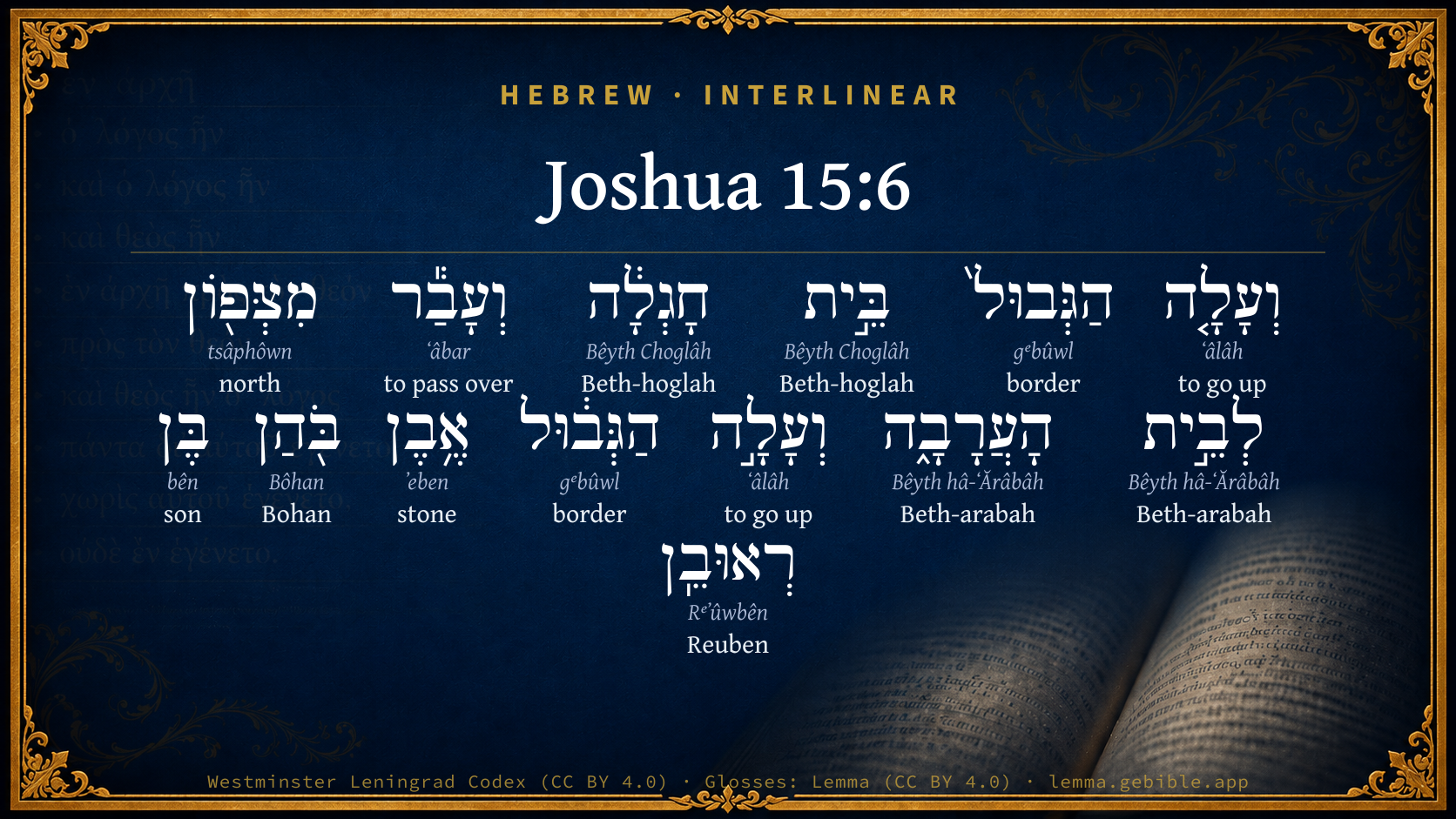
Hebrew (Westminster Leningrad Codex) Joshua 15:6 appears in the Hebrew Old Testament. The text above is from the Westminster Leningrad Codex. Each word links to its Strong’s number, a concise gloss, and parsing drawn from the Open Scriptures Hebrew Bible morphology. Click any word for its full Brown-Driver-Briggs (BDB) entry.
Download image
Cite this verse

Joshua 15:6 (World English Bible). Public Domain. Lemma interlinear Bible study tool, https://lemma.gebible.app/v/joshua/15/6.

Show BibTeX & RIS
BibTeX
RIS
English Translation
and the border went up to Beth Hoglah, and passed along by the north of Beth Arabah; and the border went up to the stone of Bohan the son of Reuben;
World English Bible · Public Domain
Highlights
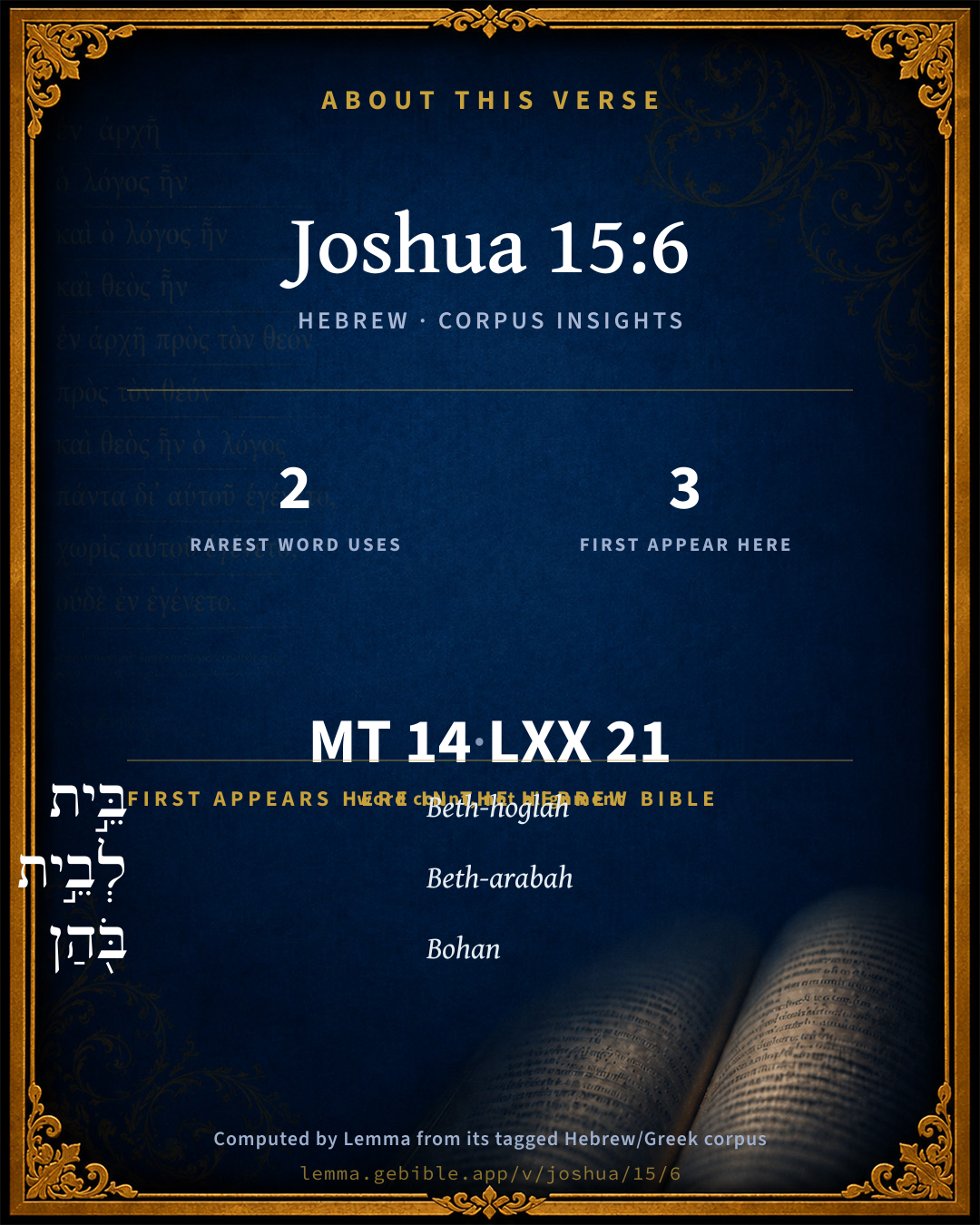
  • 3 first appearances in the Hebrew Bible
Full analysis ↓
Download a study sheet

One document with this verse’s original text, its word-by-word gloss line, the meaning frame, cross-references with their text, attributed commentary, and full source and license credits — printable, and it pastes into notes with its structure intact.

This verse Autodidact and up

Study sheet (.html) Plain text (.txt)

A passage Seminary Student

Up to 50 verses in one chapter. A passage sheet keeps up to 6 commentary sources and 12 cross-references per verse, in the order this page ranks them, and says so on the sheet whenever that leaves anything out. Ask for a single verse and you get the Autodidact verse sheet above.

Everything on this page stays free to read, with no account — the sheet is a download of what is already on screen, not access to it.

Want to remove ads? Support Godless Engineer
Compare translations 3

The same verse in 3 English versions, stacked beneath the original-language interlinear above. Click any original word for its lexicon entry.

Each is an independent rendering of the whole verse — the interlinear is not word-aligned to these translations.

Highlighted words mark where these versions differ — a whole-verse word diff, not a word-by-word alignment.

  • World English Bible Public Domain
    and the border went up to Beth Hoglah, and passed along by the north of Beth Arabah; and the border went up to the stone of Bohan the son of Reuben;
  • King James Version Public Domain
    And the border went up to Bethhogla, and passed along by the north of Betharabah; and the border went up to the stone of Bohan the son of Reuben:
  • unfoldingWord Literal Text CC BY-SA 4.0
    And the border went up to Beth Hoglah and passed over from the north to Beth Arabah. Then the border went up to the stone of Bohan, the son of Reuben.

unfoldingWord Literal Text — © unfoldingWord, licensed CC BY-SA 4.0. Word-aligned USFM3 via Door43 (git.door43.org/unfoldingWord/en_ult).

Versions to compare (up to 4)

3 of 4 selected

Show all 18 translations

Every available English version of this verse, each an independent rendering of the whole verse.

  • World English Bible Public Domain
    and the border went up to Beth Hoglah, and passed along by the north of Beth Arabah; and the border went up to the stone of Bohan the son of Reuben;
  • Berean Standard Bible Public Domain
    went up to Beth-hoglah, proceeded north of Beth-arabah, and went up to the Stone of Bohan son of Reuben.
  • Majority Standard Bible Public Domain
    went up to Beth-hoglah, proceeded north of Beth-arabah, and went up to the Stone of Bohan son of Reuben.
  • King James Version Public Domain
    And the border went up to Bethhogla, and passed along by the north of Betharabah; and the border went up to the stone of Bohan the son of Reuben:
  • American Standard Version (1901) Public Domain
    and the border went up to Beth-hoglah, and passed along by the north of Beth-arabah; and the border went up to the stone of Bohan the son of Reuben;
  • Revised Version (1885) Public Domain
    and the border went up to Beth-hoglah, and passed along by the north of Beth-arabah; and the border went up to the stone of Bohan the son of Reuben:
  • Geneva Bible (1599) Public Domain
    And this border goeth vp to Beth-hogla, and goeth along by ye Northside of Beth-arabah: so the border from thence goeth vp to the stone of Bohan the sonne of Reuben.
  • Douay-Rheims (1899) Public Domain
    And the border goeth up into Beth-Hagla, and passeth by the north into Beth-Araba: going up to the stone of Boen the son of Ruben.
  • Young's Literal Translation Public Domain
    and the border hath gone up `to' Beth-Hoglah, and passed over on the north of Beth-Arabah, and the border hath gone up `to' the stone of Bohan son of Reuben:
  • Literal Standard Version CC BY-SA 4.0
    and the border has gone up [to] Beth-Hoglah, and passed over on the north of Beth-Arabah, and the border has gone up [to] the stone of Bohan son of Reuben:
  • Unlocked Literal Bible CC BY-SA 4.0
    It went up to Beth Hoglah and passed along north of Beth Arabah. Then it went up to the Stone of Bohan the son of Reuben.
  • unfoldingWord Literal Text CC BY-SA 4.0
    And the border went up to Beth Hoglah and passed over from the north to Beth Arabah. Then the border went up to the stone of Bohan, the son of Reuben.
  • Darby Bible Public Domain
    and the border went up toward Beth-hoglah, and passed north of Beth-Arabah; and the border went up to the stone of Bohan, the son of Reuben;
  • World Messianic Bible Public Domain
    The border went up to Beth Hoglah, and passed along by the north of Beth Arabah; and the border went up to the stone of Bohan the son of Reuben.
  • Webster's Bible Public Domain
    And the border went up to Beth-hogla, and passed along by the north of Beth-arabah; and the border went up to the stone of Bohan the son of Reuben:
  • Free Bible Version CC BY-SA 4.0
    up to the border of Beth-hoglath, and then north of Beth-arabah to the Stone of Bohan (Reuben's son).
  • Bible in Basic English Public Domain
    Then the line goes up to Beth-hoglah, past the north of Beth-arabah, and up to the stone of Bohan, the son of Reuben;
  • JPS Tanakh (1917) Public Domain
    And the border went up to Beth-hoglah, and passed along by the north of Beth-arabah; and the border went up to the Stone of Bohan the son of Reuben.

Literal Standard Version (2020), Covenant Press — licensed CC BY-SA 4.0. Text via the HelloAO Bible API (eBible.org). Unlocked Literal Bible (unfoldingWord) — licensed CC BY-SA 4.0. Text via the HelloAO Bible API (eBible.org). unfoldingWord Literal Text — © unfoldingWord, licensed CC BY-SA 4.0. Word-aligned USFM3 via Door43 (git.door43.org/unfoldingWord/en_ult). Free Bible Version, Dr. Jonathan Gallagher — licensed CC BY-SA 4.0. Text via the HelloAO Bible API (eBible.org).

Word by word

More ways to search: Search by grammar → Find every occurrence → Compare this word →

Practice this passage: Drill this verse → Learn its vocabulary →

בֹּ֖הַן
Bôhan
H932
“Bohan”
Noun, Proper
Part of Speech
Noun
Type
Proper
Full BDB Definition

Origin: an orthographical variation of H931

TWOT: None

Bohan = "thumb" - a Reubenite who set a boundary stone between Judah and Benjamin - (BDB) a mark of division between Judah and Benjamin
  1. וְעָלָ֤ה ʻâlâh H5927 “and · to go up” Conjunction + Verb, Qal, Perfect, 3rd Person, Masculine, Singular
  2. הַגְּבוּל֙ gᵉbûwl H1366 “the · border” Particle, Definite Article + Noun, Common, Masculine, Singular, Absolute
  3. בֵּ֣ית Bêyth Choglâh H1031 “Beth-hoglah” Noun, Proper
  4. חָגְלָ֔ה Bêyth Choglâh H1031 “Beth-hoglah” Noun, Proper
  5. וְעָבַ֕ר ʻâbar H5674 “and · to pass over” Conjunction + Verb, Qal, Perfect, 3rd Person, Masculine, Singular
  6. מִצְּפ֖וֹן tsâphôwn H6828 “from · north of” Preposition + Noun, Common, Feminine, Singular, Construct
  7. לְבֵ֣ית Bêyth hâ-ʻĂrâbâh H1026 “to/for · Beth-arabah” Preposition + Noun, Proper
  8. הָעֲרָבָ֑ה Bêyth hâ-ʻĂrâbâh H1026 “Beth-arabah” Noun, Proper
  9. וְעָלָ֣ה ʻâlâh H5927 “and · to go up” Conjunction + Verb, Qal, Perfect, 3rd Person, Masculine, Singular
  10. הַגְּב֔וּל gᵉbûwl H1366 “the · border” Particle, Definite Article + Noun, Common, Masculine, Singular, Absolute
  11. אֶ֥בֶן ʼeben H68 “stone of” Noun, Common, Feminine, Singular, Construct
  12. בֶּן bên H1121 “son of” Noun, Common, Masculine, Singular, Construct
  13. רְאוּבֵֽן Rᵉʼûwbên H7205 “Reuben” Noun, Proper

About this verse

These counts appear in no published source. They are computed here, from the morphology-tagged text and Lemma’s own curated glosses. What Lemma adds →

14
words
10
distinct lemmas
Historical
section

Notable vocabulary

The rarest word here is בֹּ֖הַן Bohan H932 — appearing just 2 times in the whole Hebrew Bible.

First appearance in Scripture

These words make their first canonical appearance in the Hebrew Bible here:

  • בֵּ֣ית Beth-hoglah H1031
  • לְבֵ֣ית Beth-arabah H1026
  • בֹּ֖הַן Bohan H932

Shared distinctive vocabulary

בֹּ֖הַן Bohan H932 occurs in 2 verses of the Hebrew Bible. Also found in:

Grammatical profile

  • 3 verbs
  • 11 nouns

Verb forms

  • וְעָלָ֤ה Qal · Perfect
  • וְעָבַ֕ר Qal · Perfect
  • וְעָלָ֣ה Qal · Perfect

Repetition

Words recur within this verse — often emphatic in Hebrew:

  • וְעָלָ֤ה to go up H5927 ×2
  • הַגְּבוּל֙ border H1366 ×2
  • בֵּ֣ית Beth-hoglah H1031 ×2
  • לְבֵ֣ית Beth-arabah H1026 ×2

Hebrew & Septuagint length

In English translation the verse runs 31 words from the Hebrew and 30 from the Septuagint (LXX English) — closely comparable.

A rough comparison of the two English renderings, which tokenize alike — not a word-level alignment.

Word counts can differ between the Hebrew and the Greek without any difference in meaning — e.g. the Hebrew direct-object marker אֵת has no separate Greek word, and Greek often adds the article ὁ.

In the original languages it is 14 Hebrew tokens and 21 Greek tokens — but the two are counted differently (Hebrew bundles its prefixes and suffixes into one token; the Greek is in lemma form), so that isn’t a like-for-like length.

Cross-references

2

Topical passages linked to Joshua 15:6 in the Treasury of Scripture Knowledge — connected by theme and wording, ordered by reader-vote popularity; previews shown in the World English Bible.

  • Joshua 18:17 and it extended northward, and went out at En Shemesh, and went out to Geliloth, which is over against the ascent of Adummim; and it went down to the stone of Bohan the son of Reuben;
  • Joshua 18:19–21 and the border passed along to the side of Beth Hoglah northward; and the goings out of the border were at the north bay of the Salt Sea, at the south end of the Jordan: this was the south border.

Cross-references courtesy of OpenBible.info (CC BY 4.0).

Hebrew and Greek witnesses Masoretic Hebrew ↔ Greek Septuagint

The same verse in the two great witnesses to the Old Testament, shown verse-for-verse.

These are two independent witnesses, not word-aligned to each other, and the Septuagint is shown in lemma (dictionary) form.

Hebrew Joshua 15:6 Masoretic · Westminster Leningrad Codex

וְעָלָ֤ה הַגְּבוּל֙ בֵּ֣ית חָגְלָ֔ה וְעָבַ֕ר מִצְּפ֖וֹן לְבֵ֣ית הָעֲרָבָ֑ה וְעָלָ֣ה הַגְּב֔וּל אֶ֥בֶן בֹּ֖הַן בֶּן רְאוּבֵֽן

and the border went up to Beth Hoglah, and passed along by the north of Beth Arabah; and the border went up to the stone of Bohan the son of Reuben;

World English Bible · Public Domain

Greek LXX Joshua 15:6 Septuagint · lemma form

ἐπιβαίνω ὁ ὅριον ἐπί βαιθαγλα καί παραπορεύομαι ἀπό βορέας ἐπί βαιθαραβά καί προσ ἀναβαίνω ὁ ὅριον ἐπί λίθος βαιων υἱός ρουβην

the borders go up to Baethaglaam, and they go along from the north to Baetharaba, and the borders go on up to the stone of Baeon the son of Ruben.

LXX2012 (modern English Septuagint) · Public Domain

Hebrew: Westminster Leningrad Codex (CC BY 4.0). Greek: Septuagint (public domain); English from LXX2012 (modern English Septuagint) (Public Domain). How the Septuagint differs from the Hebrew →

Targum (Aramaic paraphrase)

1

The Targum is the ancient Jewish Aramaic paraphrase of the Hebrew Scriptures — an interpretive translation, not the Hebrew text itself. Onkelos (literal) and Pseudo-Jonathan (expansive) render the Torah, and Jonathan the Prophets. Coverage is partial: where no permissively-licensed English translation exists for a verse, only the Aramaic is shown. This is verse-level text, not a word-by-word alignment to the Hebrew.

  1. Targum Jonathan Prophets (Joshua–Malachi)
    וְסָלֵק תְּחוּמָא לְבֵית חָגְלָה וְעָבַר מִצִפּוּנָא לְבֵית מֵישְׁרָא וְסָלֵיק תְּחוּמָא לְאֶבֶן בּוֹהַן בַּר רְאוּבֵן:

    (no public-domain English translation for this verse)

    Targum Jonathan — Aramaic: “Mikraot Gedolot” (public domain). English: “Sefaria Community Translation” (CC0 1.0 (public-domain dedication)); “London "Chaldee Paraphrase," 1871” (public domain). Text via Sefaria.

Commentary

Notes on Joshua 15:6 from classic Christian and Jewish commentators (each source and its license shown beneath its notes). The classic Christian expositions comment on the surrounding passage and are grouped to its opening verse, so a note may address several verses; the Jewish commentaries on the Tanakh (Rashi and others) are per-verse, so they appear only where the commentator wrote on this verse.

Lemma curates 59 commentaries, every one of them public domain or Creative Commons licensed, each selected and text-cleaned for this edition rather than reprinted as found. About our sources →

Trapp's Complete Commentary

John Trapp

Jos 15:6 And the border went up to Bethhogla, and passed along by the north of Betharabah; and the border went up to the stone of Bohan the son of Reuben:

Ver. 6. To the stone of Bohan.] Which had its name for some unknown reason: so Migdalgad. {Jos 15:37}

John Trapp, A Commentary or Exposition upon All the Books of the Old and New Testament (1647–1656) — public domain. Text from a community e-Sword module.

Geneva Bible (1599)

Geneva Bible translators

Which was a mark to part their countries.

Geneva Bible (1599) marginal notes — public domain. Text via Bolls.life.

Jamieson, Fausset & Brown

Robert Jamieson, A. R. Fausset & David Brown

Beth-hogla--now Ain Hajla, a fine spring of clear and sweet water, at the northern extremity of the Dead Sea, about two miles from the Jordan [ROBINSON].

Beth-arabah--"the house," or "place of solitude," in the desert of Judah (Jos 15:61).

stone of Bohan the son of Reuben--the sepulchral monument of a Reubenite leader, who had been distinguished for his bravery, and had fallen in the Canaanite war.

Jamieson, Fausset & Brown — Commentary Critical and Explanatory on the Whole Bible (1871) — public domain (CC PDM 1.0). Text via the HelloAO Bible API.

Adam Clarke's Commentary

Verse 6. Beth-hogla] A place between Jericho and the Dead Sea, belonging to the tribe of Benjamin, Jos 18:21, though here serving as a frontier to the tribe of Judah.

Stone of Bohan] This must have been some remarkable place, probably like the stone of Jacob, which afterwards became Bethel; but where it was situated is uncertain.

Adam Clarke's Commentary on the Bible (1810–1826) — public domain. Text from a community e-Sword/MySword module.

The Cambridge Bible for Schools and Colleges

gen. ed. J. J. S. Perowne

6. and the border went up to Beth-hogla] A point between Judah and Benjamin (Jos_18:19). A magnificent spring and a ruin between Jericho and the Jordan still bear the names of Ain-hajla and Kŭsr Hajla, and are doubtless at or near the old site.

and passed along by the north of Beth-arabah] between Beth-hogla and the highland on the west of the Jordan valley. It is mentioned below (Jos_15:61) as one of the six cities of Judah in the sunken valley of the Jordan and the Dead Sea.

the stone of Bohan the son of Reuben] This “Stone” is only mentioned once more, in ch. Jos_18:17, and must have lain somewhere to the west or south-west of Beth-arabah.

The Cambridge Bible for Schools and Colleges (gen. ed. J. J. S. Perowne; Cambridge University Press, 1878–1918) — public domain. Text from a community e-Sword module.

John Gill's Exposition

And the border went up to Bethhoglah,.... A place in the tribe of Benjamin, mentioned along with Jericho, and probably near it, Jos 18:21; Jerom (a) speaks of a place called Betagla, in his time, which was three miles from Jericho, and two from Jordan, and perhaps is this same place:

and passed along by the north of Betharabah; another city belonged to Benjamin, Jos 18:22; and lay in a as its name shows; or in a plain, as the Targum:

and the border went up to the stone of Bohan the son of Reuben; by whom, or on whose account, it was placed, either as a sepulchral stone, he being buried there, or in memory of some famous exploit done by him there, he being one of those of the tribe of Reuben, that came with Joshua to assist in the war against the Canaanites; or it was set for a sign of the border, as Kimchi thinks, it being the boundary between Judah and Benjamin, Jos 18:17. Bunting says (b) it is near Bahurim, in the valley just in the king's way, and is of an extraordinary greatness, shining like marble.

(a) De loc. Heb. fol. 87. G. (b) Travels, &c. p. 144.

John Gill's Exposition of the Whole Bible (1746–1763) — public domain (CC PDM 1.0). Text via the HelloAO Bible API.

Albert Barnes' Notes on the Bible

The stone of Bohan - This stone perhaps commemorated some deed of valor belonging to the wars of Joshua (compare 1Sa 7:12). The stone was erected on the slope of a hill (see the marginal reference), no doubt one of the range which hounds the Jordan valley on the west. But its exact site is wholly uncertain.

Albert Barnes' Notes on the Bible (1834–1885) — public domain. Text from a community e-Sword/MySword module.

Haydock's Catholic Bible Commentary

Stone. It is not certain that this was a city.

George Leo Haydock (1774–1849), Haydock's Catholic Family Bible and Commentary, 1859 edition — public domain. Excludes Psalms (Douay-Rheims chapter numbering differs from Protestant) and Deuterocanonical books (Catholic canon only).

Matthew Poole's English Annotations

By the north of Beth-arabah, or, on the north, or northward to Beth-arabah; which place is attributed to Judah here, Jos 15:61; and to Benjamin, Jos 18:22; because it was a frontier town in the borders of Judah and Benjamin, and therefore promiscuously belonging to both; which also was the case of some other places: and this cohabitation was convenient to maintain brotherly love and union between the several tribes, especially in the borders, where differences oft arise.

The stone of Bohan; a place so called, not from Bohan’s dwelling there, (for the Reubenites had no portion on this side Jordan,) but from some notable exploit which he did there, though it be not recorded in Scripture.

Matthew Poole's English Annotations on the Holy Bible (1683–1685) — public domain. Text from a community e-Sword/MySword module.

Whedon's Commentary on the Bible

Daniel D. Whedon

6. Beth-hogla — The modern Ain Hadjla, a fine spring of beautiful sweet water at the north of the Dead Sea, about two miles west of the Jordan.

Beth-arabah — House of solitude: in the desert of Judah, and apparently not far from Beth-hogla. It is mentioned again in Jos_15:61 and Jos_18:22, and in Jos_18:18 is called simply Arabah; first allotted to Judah, then relinquished to Benjamin.

Stone of Bohan — This cannot be located. It was a memorial of a Reubenite warrior slain in the conquest of the land.

Daniel D. Whedon (gen. ed.), Commentary on the Old and New Testaments (1874–1909) — public domain. Text from a community e-Sword module.

The Pulpit Commentary

Beth-hogla. (see Jos_18:19) It is still known as Ain Hadjla or Hajla, where, says Keil, a beautiful spring of fresh and clear water is to be found. The place lies about two miles from Jordan. Bethhogla means "the house of the partridge." "Leaving the probable site of the ancient Gilgal and advancing southward along the pilgrims" route to the Jordan, an hour and a quarter brings us to the spring Kin Hajla, in a small and well-watered grove" (Ritter). He adds, "Robinson and Wilson both recognised in the name Hails the ancient Canaanitish city Beth-hogla." Beth-arabah. Or "the house of the Arabah" or desert. Its site is not known. (see ver. 61 and Jos_18:18, Jos_18:22) The Beth-arabah in ver. 61, however, must have been another place, since it was in the wilderness of Judaea, not far from the Dead Sea. The stone of Bohan the son of Reuben. All we know of this stone is that it was westward of Beth-arabah. The boundary of Benjamin in Jos 18, is mentioned in precisely reverse order, and since here the stone was on the ascent from Beth-araba, and there (ver. 17) it is described as on the descent from Geliloth, it must have been on the side of the declivity. Of Bohan nothing further is known. We must understand here, as in many other places of Scripture, descendant by "son". (cf. Jos_7:24)

The Pulpit Commentary (1880–1919), ed. H.D.M. Spence-Jones & Joseph S. Exell — public domain. Text from a community e-Sword module.

John Wesley's Explanatory Notes

The stone of Bohan - A place so called, not from Bohan's dwelling there, (for the Reubenites had no portion on this side Jordan) but from some notable exploit which he did there, though it is not recorded in scripture.

John Wesley, Explanatory Notes Upon the Whole Bible (1754–1765) — public domain. Text via the GEBible commentary corpus.

Rashi

Rabbi Shlomo Yitzchaki (Rashi)

The boundary went up to Even bohan. As the border line goes toward Yerushalayim, it becomes elevated the city was called Even, and the ruler of the city was a man by the name of Bohan, son of Reuvein. According to Metzudos Tzion, the city itself was called Even Bohan, and its ruler was a man called ben Reuvein.

Rashi on the Tanakh — English translations: “The Judaica Press complete Tanach with Rashi, translated by A. J. Rosenberg” (CC BY 4.0); “Pentateuch with Rashi's commentary by M. Rosenbaum and A.M. Silbermann, 1929-1934” (public domain); “The Metsudah Tanach series, Lakewood, N.J” (CC BY 4.0); and “The Book of Joshua, Metsudah Publications, 1997” (CC BY 4.0). Text via Sefaria.

Lesson kit

Teaching starters — assembled from the data on this page, not authored interpretation. Every prompt links to the verse data it draws on. Edit before teaching.

Joshua, in the Historical, opens this verse with 14 words (10 distinct Hebrew lemmas). Its most distinctive word is Bôhan (“Bohan”). A historical commentator’s framing appears above. Read the whole chapter for the surrounding context.

Discussion questions

  1. How does “Bohan” (Bôhan) shape what this verse is saying?
  2. 3 words here appear for the first time in Scripture. What is being introduced at this debut?
  3. Joshua 18:17 shares the word «Bohan» with this verse. How do the two illuminate each other?
  4. “to go up” occurs 2× in this one verse. What is the effect of the repetition?
  5. These translations render this verse differently. What is at stake in choosing one wording over another?
  6. The verb «וְעָלָ֤ה» is Qal Perfect. How does its form color the action?
  7. Reading how Trapp's Complete Commentary and Geneva Bible (1599) read this verse, where do the two commentators agree and where do they part?

Things to notice

Reading settings

Reading text

Shown beneath each verse's original-language words.

Old Testament
Old Testament edition

Read the OT as the Masoretic Hebrew (MT) or the Greek Septuagint (LXX).

English shown for the Greek Septuagint (in the Hebrew ↔ Greek comparison).

Comparing translations? Open the Compare panel on any verse page to stack up to four side by side.