
Judges 11:18

Hebrew (Westminster Leningrad Codex) Judges 11:18 appears in the Hebrew Old Testament. The text above is from the Westminster Leningrad Codex. Each word links to its Strong’s number, a concise gloss, and parsing drawn from the Open Scriptures Hebrew Bible morphology. Click any word for its full Brown-Driver-Briggs (BDB) entry.
Download image
Cite this verse

Judges 11:18 (World English Bible). Public Domain. Lemma interlinear Bible study tool, https://lemma.gebible.app/v/judges/11/18.

Show BibTeX & RIS
BibTeX
RIS
English Translation
Then they went through the wilderness, and went around the land of Edom, and the land of Moab, and came by the east side of the land of Moab, and they encamped on the other side of the Arnon; but they didn't come within the border of Moab, for the Arnon was the border of Moab.
World English Bible · Public Domain
Download a study sheet

One document with this verse’s original text, its word-by-word gloss line, the meaning frame, cross-references with their text, attributed commentary, and full source and license credits — printable, and it pastes into notes with its structure intact.

This verse Autodidact and up

Study sheet (.html) Plain text (.txt)

A passage Seminary Student

Up to 50 verses in one chapter. A passage sheet keeps up to 6 commentary sources and 12 cross-references per verse, in the order this page ranks them, and says so on the sheet whenever that leaves anything out. Ask for a single verse and you get the Autodidact verse sheet above.

Everything on this page stays free to read, with no account — the sheet is a download of what is already on screen, not access to it.

Want to remove ads? Support Godless Engineer
Compare translations 3

The same verse in 3 English versions, stacked beneath the original-language interlinear above. Click any original word for its lexicon entry.

Each is an independent rendering of the whole verse — the interlinear is not word-aligned to these translations.

Highlighted words mark where these versions differ — a whole-verse word diff, not a word-by-word alignment.

  • World English Bible Public Domain
    Then they went through the wilderness, and went around the land of Edom, and the land of Moab, and came by the east side of the land of Moab, and they encamped on the other side of the Arnon; but they didn't come within the border of Moab, for the Arnon was the border of Moab.
  • King James Version Public Domain
    Then they went along through the wilderness, and compassed the land of Edom, and the land of Moab, and came by the east side of the land of Moab, and pitched on the other side of Arnon, but came not within the border of Moab: for Arnon was the border of Moab.
  • unfoldingWord Literal Text CC BY-SA 4.0
    Then he went through the wilderness and circled the land of Edom and the land of Moab, and he went from the rising of the sun to the land of Moab. And they encamped on the other side of the Arnon, but they did not enter within the border of Moab, for the Arnon the border of Moab.

unfoldingWord Literal Text — © unfoldingWord, licensed CC BY-SA 4.0. Word-aligned USFM3 via Door43 (git.door43.org/unfoldingWord/en_ult).

Versions to compare (up to 4)

3 of 4 selected

Show all 18 translations

Every available English version of this verse, each an independent rendering of the whole verse.

  • World English Bible Public Domain
    Then they went through the wilderness, and went around the land of Edom, and the land of Moab, and came by the east side of the land of Moab, and they encamped on the other side of the Arnon; but they didn't come within the border of Moab, for the Arnon was the border of Moab.
  • Berean Standard Bible Public Domain
    Then Israel traveled through the wilderness and bypassed the lands of Edom and Moab. They came to the east side of the land of Moab and camped on the other side of the Arnon. But they did not enter the territory of Moab, since the Arnon was its border.
  • Majority Standard Bible Public Domain
    Then Israel traveled through the wilderness and bypassed the lands of Edom and Moab. They came to the east side of the land of Moab and camped on the other side of the Arnon. But they did not enter the territory of Moab, since the Arnon was its border.
  • King James Version Public Domain
    Then they went along through the wilderness, and compassed the land of Edom, and the land of Moab, and came by the east side of the land of Moab, and pitched on the other side of Arnon, but came not within the border of Moab: for Arnon was the border of Moab.
  • American Standard Version (1901) Public Domain
    Then they went through the wilderness, and went around the land of Edom, and the land of Moab, and came by the east side of the land of Moab, and they encamped on the other side of the Arnon; but they came not within the border of Moab, for the Arnon was the border of Moab.
  • Revised Version (1885) Public Domain
    Then he walked through the wilderness, and compassed the land of Edom, and the land of Moab, and came by the east side of the land of Moab, and they pitched on the other side of Arnon; but they came not within the border of Moab, for Arnon was the border of Moab.
  • Geneva Bible (1599) Public Domain
    Then they went through the wildernesse, and compassed the lande of Edom, and the lande of Moab, and came by the Eastside of the lande of Moab, and pitched on the other side of Arnon, and came not within the coast of Moab: for Arnon was the border of Moab.
  • Douay-Rheims (1899) Public Domain
    And went round the land of Edom at the side, and the land of Moab: and came over against the east coast of the land of Moab, and camped on the other side of the Arnon: and he would not enter the bounds of Moab.
  • Young's Literal Translation Public Domain
    and he goeth through the wilderness, and compasseth the land of Edom and the land of Moab, and cometh in at the rising of the sun of the land of Moab, and they encamp beyond Arnon, and have not come into the border of Moab, for Arnon `is' the border of Moab.
  • Literal Standard Version CC BY-SA 4.0
    and he goes through the wilderness, and goes around the land of Edom and the land of Moab, and comes in at the rising of the sun of the land of Moab, and they encamp beyond Arnon, and have not come into the border of Moab, for Arnon [is] the border of Moab.
  • Unlocked Literal Bible CC BY-SA 4.0
    Then they went through the wilderness and turned away from the land of Edom and the land of Moab, and they went along the east side of the land of Moab and they camped on the other side of the Arnon. But they did not go into the territory of Moab, for the Arnon was Moab's border.
  • unfoldingWord Literal Text CC BY-SA 4.0
    Then he went through the wilderness and circled the land of Edom and the land of Moab, and he went from the rising of the sun to the land of Moab. And they encamped on the other side of the Arnon, but they did not enter within the border of Moab, for the Arnon the border of Moab.
  • Darby Bible Public Domain
    Then they journeyed through the wilderness, and went around the land of Edom and the land of Moab, and arrived on the east side of the land of Moab, and camped on the other side of the Arnon; but they did not enter the territory of Moab, for the Arnon was the boundary of Moab.
  • World Messianic Bible Public Domain
    Then they went through the wilderness, and went around the land of Edom, and the land of Moab, and came by the east side of the land of Moab, and they encamped on the other side of the Arnon; but they didn’t come within the border of Moab, for the Arnon was the border of Moab.
  • Webster's Bible Public Domain
    Then they went along through the wilderness, and compassed the land of Edom, and the land of Moab, and came by the east side of the land of Moab, and pitched on the other side of Arnon, but came not within the border of Moab: for Arnon was the border of Moab.
  • Free Bible Version CC BY-SA 4.0
    Eventually the Israelites traveled through the desert, avoiding the lands of Edom and Moab. They arrived on the east side of the land of Moab and camped on the other side of the Arnon River. But they did not enter Moab territory, for the Arnon River was its border.
  • Bible in Basic English Public Domain
    Then he went on through the waste land and round the land of Edom and the land of Moab, and came by the east side of the land of Moab, and put up their tents on the other side of the Arnon; they did not come inside the limit of Moab, for the Arnon was the limit of Moab.
  • JPS Tanakh (1917) Public Domain
    Then he walked through the wilderness, and compassed the land of Edom, and the land of Moab, and came by the east side of the land of Moab, and they pitched on the other side of the Arnon; but they came not within the border of Moab, for the Arnon was the border of Moab.

Literal Standard Version (2020), Covenant Press — licensed CC BY-SA 4.0. Text via the HelloAO Bible API (eBible.org). Unlocked Literal Bible (unfoldingWord) — licensed CC BY-SA 4.0. Text via the HelloAO Bible API (eBible.org). unfoldingWord Literal Text — © unfoldingWord, licensed CC BY-SA 4.0. Word-aligned USFM3 via Door43 (git.door43.org/unfoldingWord/en_ult). Free Bible Version, Dr. Jonathan Gallagher — licensed CC BY-SA 4.0. Text via the HelloAO Bible API (eBible.org).

Word by word

More ways to search: Search by grammar → Find every occurrence → Compare this word →

Practice this passage: Drill this verse → Learn its vocabulary →

אַרְנ֑וֹן
ʼArnôwn
H769
“Arnon”
Noun, Proper
Part of Speech
Noun
Type
Proper
Full BDB Definition

Origin: from H7442

TWOT: None

Arnon = "rushing stream" - a river and surrounding valley in south Palestine, forms the border between Moab and the Amorites
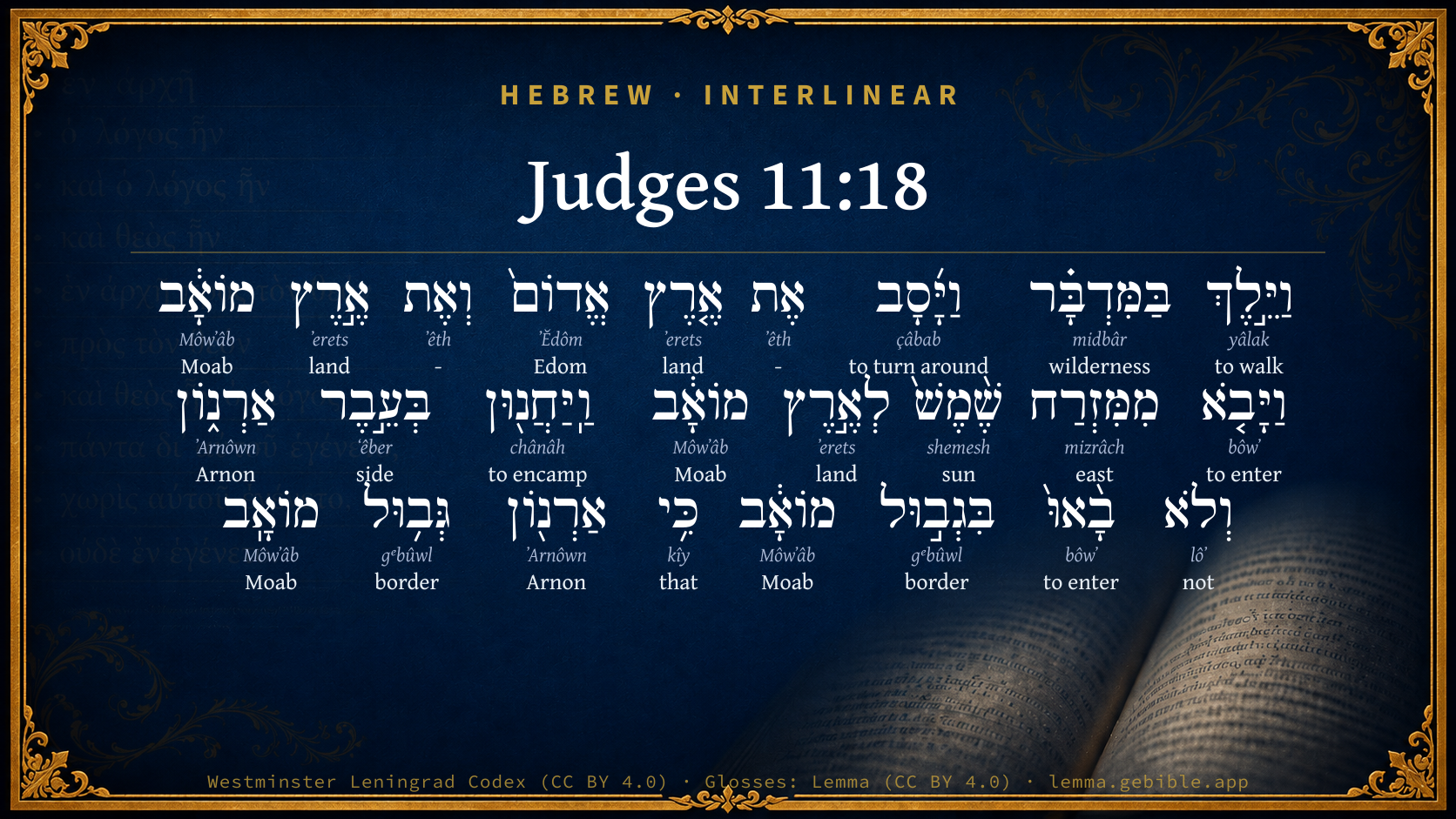
  1. וַיֵּ֣לֶךְ yâlak H3212 “and · to walk” Conjunction + Verb, Qal, Sequential Imperfect, 3rd Person, Masculine, Singular
  2. בַּמִּדְבָּ֗ר midbâr H4057 “in/at the · wilderness” Preposition, Determined + Noun, Common, Masculine, Singular, Absolute
  3. וַיָּ֜סָב çâbab H5437 “and · to turn around” Conjunction + Verb, Qal, Sequential Imperfect, 3rd Person, Masculine, Singular
  4. אֶת ʼêth H853 “-” Particle, Direct Object
  5. אֶ֤רֶץ ʼerets H776 “land of” Noun, Common, Both, Singular, Construct
  6. אֱדוֹם֙ ʼĔdôm H123 “Edom” Noun, Proper
  7. וְאֶת ʼêth H853 “and · -” Conjunction + Particle, Direct Object
  8. אֶ֣רֶץ ʼerets H776 “land of” Noun, Common, Both, Singular, Construct
  9. מוֹאָ֔ב Môwʼâb H4124 “Moab” Noun, Proper
  10. וַיָּבֹ֤א bôwʼ H935 “and · to enter” Conjunction + Verb, Qal, Sequential Imperfect, 3rd Person, Masculine, Singular
  11. מִמִּזְרַח mizrâch H4217 “from · east of” Preposition + Noun, Common, Masculine, Singular, Construct
  12. שֶׁ֨מֶשׁ֙ shemesh H8121 “sun” Noun, Common, Both, Singular, Absolute
  13. לְאֶ֣רֶץ ʼerets H776 “to/for · land of” Preposition + Noun, Common, Both, Singular, Construct
  14. מוֹאָ֔ב Môwʼâb H4124 “Moab” Noun, Proper
  15. וַֽיַּחֲנ֖וּן chânâh H2583 “and · to encamp” Conjunction + Verb, Qal, Sequential Imperfect, 3rd Person, Masculine, Plural + Suffix, n
  16. בְּעֵ֣בֶר ʻêber H5676 “in/at · side of” Preposition + Noun, Common, Masculine, Singular, Construct
  17. וְלֹא lôʼ H3808 “and · not” Conjunction + Particle, Negative
  18. בָ֨אוּ֙ bôwʼ H935 “to enter” Verb, Qal, Perfect, 3rd Person, Common, Plural
  19. בִּגְב֣וּל gᵉbûwl H1366 “in/at · border of” Preposition + Noun, Common, Masculine, Singular, Construct
  20. מוֹאָ֔ב Môwʼâb H4124 “Moab” Noun, Proper
  21. כִּ֥י kîy H3588 “that” Conjunction
  22. אַרְנ֖וֹן ʼArnôwn H769 “Arnon” Noun, Proper
  23. גְּב֥וּל gᵉbûwl H1366 “border of” Noun, Common, Masculine, Singular, Construct
  24. מוֹאָֽב Môwʼâb H4124 “Moab” Noun, Proper

About this verse

These counts appear in no published source. They are computed here, from the morphology-tagged text and Lemma’s own curated glosses. What Lemma adds →

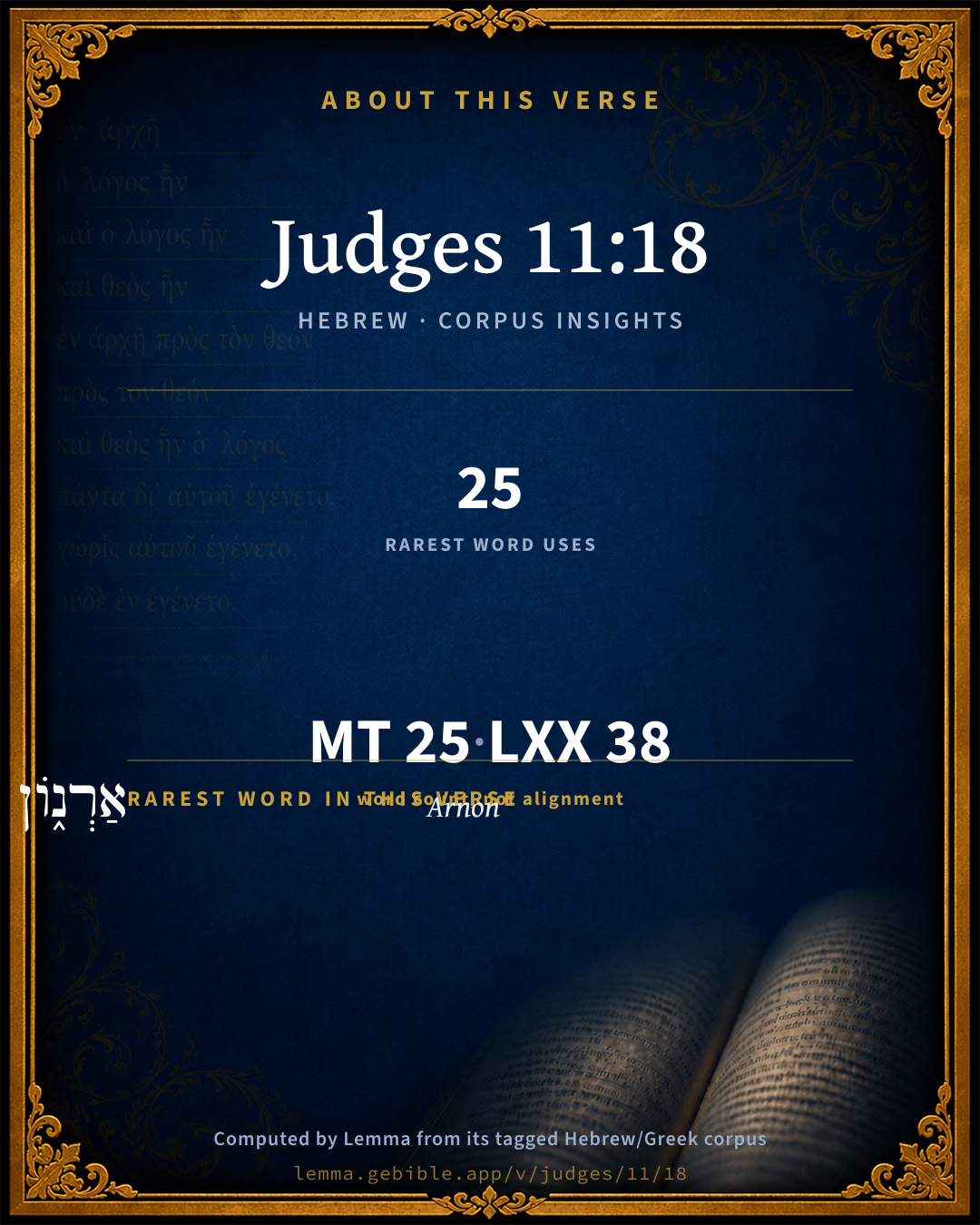
25
words
16
distinct lemmas
Historical
section

Notable vocabulary

The rarest word here is אַרְנ֑וֹן Arnon H769 — appearing just 25 times in the whole Hebrew Bible.

Shared distinctive vocabulary

אַרְנ֑וֹן Arnon H769 occurs in 23 verses of the Hebrew Bible. Also found in:

Grammatical profile

  • 5 verbs
  • 16 nouns
  • 1 conjunction
  • 3 particles

Verb forms

  • וַיֵּ֣לֶךְ Qal · Sequential Imperfect
  • וַיָּ֜סָב Qal · Sequential Imperfect
  • וַיָּבֹ֤א Qal · Sequential Imperfect
  • וַֽיַּחֲנ֖וּן Qal · Sequential Imperfect
  • בָ֨אוּ֙ Qal · Perfect

Repetition

Words recur within this verse — often emphatic in Hebrew:

  • מוֹאָ֔ב Moab H4124 ×4
  • אֶ֤רֶץ land H776 ×3
  • וַיָּבֹ֤א to enter H935 ×2
  • אַרְנ֑וֹן Arnon H769 ×2
  • בִּגְב֣וּל border H1366 ×2

Hebrew & Septuagint length

In English translation the verse runs 56 words from the Hebrew and 50 from the Septuagint (LXX English) — closely comparable.

A rough comparison of the two English renderings, which tokenize alike — not a word-level alignment.

Word counts can differ between the Hebrew and the Greek without any difference in meaning — e.g. the Hebrew direct-object marker אֵת has no separate Greek word, and Greek often adds the article ὁ.

In the original languages it is 25 Hebrew tokens and 38 Greek tokens — but the two are counted differently (Hebrew bundles its prefixes and suffixes into one token; the Greek is in lemma form), so that isn’t a like-for-like length.

Cross-references

5

Topical passages linked to Judges 11:18 in the Treasury of Scripture Knowledge — connected by theme and wording, ordered by reader-vote popularity; previews shown in the World English Bible.

  • Numbers 21:4–13 They traveled from Mount Hor by the way to the Red Sea, to compass the land of Edom: and the soul of the people was much discouraged because of the way.
  • Deuteronomy 2:1–8 Then we turned, and took our journey into the wilderness by the way to the Red Sea, as Yahweh spoke to me; and we compassed Mount Seir many days.
  • Numbers 22:36 When Balak heard that Balaam was come, he went out to meet him to the City of Moab, which is on the border of the Arnon, which is in the utmost part of the border.
  • Numbers 33:37–44 They traveled from Kadesh, and encamped in Mount Hor, in the edge of the land of Edom.
  • Numbers 20:22 They traveled from Kadesh: and the children of Israel, even the whole congregation, came to Mount Hor.

Cross-references courtesy of OpenBible.info (CC BY 4.0).

Hebrew and Greek witnesses Masoretic Hebrew ↔ Greek Septuagint

The same verse in the two great witnesses to the Old Testament, shown verse-for-verse.

These are two independent witnesses, not word-aligned to each other, and the Septuagint is shown in lemma (dictionary) form.

Hebrew Judges 11:18 Masoretic · Westminster Leningrad Codex

וַיֵּ֣לֶךְ בַּמִּדְבָּ֗ר וַיָּ֜סָב אֶת אֶ֤רֶץ אֱדוֹם֙ וְאֶת אֶ֣רֶץ מוֹאָ֔ב וַיָּבֹ֤א מִמִּזְרַח שֶׁ֨מֶשׁ֙ לְאֶ֣רֶץ מוֹאָ֔ב וַֽיַּחֲנ֖וּן בְּעֵ֣בֶר אַרְנ֑וֹן וְלֹא בָ֨אוּ֙ בִּגְב֣וּל מוֹאָ֔ב כִּ֥י אַרְנ֖וֹן גְּב֥וּל מוֹאָֽב

Then they went through the wilderness, and went around the land of Edom, and the land of Moab, and came by the east side of the land of Moab, and they encamped on the other side of the Arnon; but they didn't come within the border of Moab, for the Arnon was the border of Moab.

World English Bible · Public Domain

Greek LXX Judges 11:18 Septuagint · lemma form

καί πορεύομαι ἐν ὁ ἔρημος καί κυκλόω ὁ γῆ εδωμ καί ὁ γῆ μωαβ καί ἔρχομαι ἀπό ἀνατολή ἥλιος ὁ γῆ μωαβ καί παρα ἐνβάλλω ἐν πέραν αρνων καί οὐ εἰςἔρχομαι ἐν ὅριον μωαβ ὅτι αρνων ὅριον μωαβ

And they journeyed in the wilderness, and compassed the land of Edom and the land of Moab: and they came by the east of the land of Moab, and encamped in the country beyond Arnon, and came not within the borders of Moab, for Arnon is the border of Moab.

LXX2012 (modern English Septuagint) · Public Domain

Hebrew: Westminster Leningrad Codex (CC BY 4.0). Greek: Septuagint (public domain); English from LXX2012 (modern English Septuagint) (Public Domain). How the Septuagint differs from the Hebrew →

Targum (Aramaic paraphrase)

1

The Targum is the ancient Jewish Aramaic paraphrase of the Hebrew Scriptures — an interpretive translation, not the Hebrew text itself. Onkelos (literal) and Pseudo-Jonathan (expansive) render the Torah, and Jonathan the Prophets. Coverage is partial: where no permissively-licensed English translation exists for a verse, only the Aramaic is shown. This is verse-level text, not a word-by-word alignment to the Hebrew.

  1. Targum Jonathan Prophets (Joshua–Malachi)
    וַאֲזַל בְּמַדְבְּרָא וְאַקֵיף יַת אֲרַע אֱדוֹם וְיַת אֲרַע מוֹאָב וַאֲתוֹ מִמַדְנַח שִׁמְשָׁא לְאַרְעָא דְמוֹאָב וּשְׁרוֹ בְּעִיבְרָא דְאַרְנוֹן וְלָא עָלוּ בִּתְחוּם מוֹאָב אֲרֵי אַרְנוֹן תְּחוּם מוֹאָב:

    (no public-domain English translation for this verse)

    Targum Jonathan — Aramaic: “Mikraot Gedolot” (public domain). English: “Sefaria Community Translation” (CC0 1.0 (public-domain dedication)); “London "Chaldee Paraphrase," 1871” (public domain). Text via Sefaria.

Commentary

Notes on Judges 11:18 from classic Christian and Jewish commentators (each source and its license shown beneath its notes). The classic Christian expositions comment on the surrounding passage and are grouped to its opening verse, so a note may address several verses; the Jewish commentaries on the Tanakh (Rashi and others) are per-verse, so they appear only where the commentator wrote on this verse.

Lemma curates 59 commentaries, every one of them public domain or Creative Commons licensed, each selected and text-cleaned for this edition rather than reprinted as found. About our sources →

Trapp's Complete Commentary

John Trapp

Jdg 11:18 Then they went along through the wilderness, and compassed the land of Edom, and the land of Moab, and came by the east side of the land of Moab, and pitched on the other side of Arnon, but came not within the border of Moab: for Arnon [was] the border of Moab.

Ver. 18. Then they went along through the wilderness.] This was the naked truth of things. And truth, like our first parents, is most amiable when most naked.

John Trapp, A Commentary or Exposition upon All the Books of the Old and New Testament (1647–1656) — public domain. Text from a community e-Sword module.

The Cambridge Bible for Schools and Colleges

gen. ed. J. J. S. Perowne

18. compassed the land of Edom] Num_21:4 b; cf. Deu_2:1.

on the other side of Arnon] Clearly the country north of the Arnon, viewed from the march from the south; cf. Num_21:13.

The Cambridge Bible for Schools and Colleges (gen. ed. J. J. S. Perowne; Cambridge University Press, 1878–1918) — public domain. Text from a community e-Sword module.

John Gill's Exposition

And Israel sent messengers unto Sihon king of the Amorites, the king of Heshbon,.... Which was his royal city, where he had his palace, and kept his court, and is therefore particularly mentioned; and the rather, because he had taken it from the Moabites, and was part of that land now in dispute; and this Sihon was not only in possession of, when Israel sent messengers to him, but it was his royal seat, the metropolis of his kingdom, and he was called king of it:

and Israel said unto him, let us pass, we pray thee, through thy land unto my place; the land of Canaan, prepared and reserved for them when the Most High divided to the nations their inheritance, promised by the Lord to their ancestors and to them, and given unto them, who is sovereign Lord of all; and all that Israel desired of Sihon was only a passage through his land to that, promising the same as to the king of Edom; see the history of it in Num 21:21.

John Gill's Exposition of the Whole Bible (1746–1763) — public domain (CC PDM 1.0). Text via the HelloAO Bible API.

Haydock's Catholic Bible Commentary

CHAPTER XI.

George Leo Haydock (1774–1849), Haydock's Catholic Family Bible and Commentary, 1859 edition — public domain. Excludes Psalms (Douay-Rheims chapter numbering differs from Protestant) and Deuterocanonical books (Catholic canon only).

The Pulpit Commentary

Then they went along, etc. The narrative here follows Deu_2:1. For they compassed the land of Edom. Deu_2:1 has, we compassed Mount Seir;" but Num_21:4 has, "to compass the land of Edom." By the east side literally, by the sun-rising side, as in Num_21:11. They pitched on the other side of Arnon. The identical words occur in Num_21:13. For Arnon was the border of Moab. The identical words of Num_21:18, where it is added, between Moab and the Amorites. " South of the Amen belonged to Moab, and north to the Amorites. The route taken by the Israelites is carefully traced. (Num_21:11-20)

The Pulpit Commentary (1880–1919), ed. H.D.M. Spence-Jones & Joseph S. Exell — public domain. Text from a community e-Sword module.

Rashi

Rabbi Shlomo Yitzchaki (Rashi)

They then continued through the wilderness from west to east, along the southern borders of Edom and Moav.

Circumvented the land of Edom. All of its southern border.

And the land of Moav. All of its southern border. When they reached the southeastern corner, they angled northward along the periphery of the eastern border.

Arrived at the east of the land of Moav, and camped opposite Arnon. At the end of the eastern border of the land of Moav. This was the starting point of the lands of Sichon and Og. They conquered the trans-Yardeinian territory east of the land of Canaan, crossed the Yardein, and invaded the land of Canaan by the eastern route.

Rashi on the Tanakh — English translations: “The Judaica Press complete Tanach with Rashi, translated by A. J. Rosenberg” (CC BY 4.0); “Pentateuch with Rashi's commentary by M. Rosenbaum and A.M. Silbermann, 1929-1934” (public domain); “The Metsudah Tanach series, Lakewood, N.J” (CC BY 4.0); and “The Book of Joshua, Metsudah Publications, 1997” (CC BY 4.0). Text via Sefaria.

Lesson kit

Teaching starters — assembled from the data on this page, not authored interpretation. Every prompt links to the verse data it draws on. Edit before teaching.

Judges, in the Historical, opens this verse with 25 words (16 distinct Hebrew lemmas). Its most distinctive word is ʼArnôwn (“Arnon”). A historical commentator’s framing appears above. Read the whole chapter for the surrounding context.

Discussion questions

  1. What does “Arnon” (ʼArnôwn) contribute to the verse as a whole?
  2. How does Numbers 21:13, which shares the word «Arnon», read alongside this verse?
  3. What does the repetition of “Moab” (4× in this one verse) do in this verse?
  4. The translations on this page render this verse differently — a whole-verse word diff, not a word-by-word alignment. What might account for the different wordings?
  5. «וַיֵּ֣לֶךְ» is a Qal Sequential Imperfect verb. How does that grammatical form shape the action described?
  6. Compare how Trapp's Complete Commentary and The Cambridge Bible for Schools and Colleges read this verse. Where do they agree or differ?

Things to notice

Reading settings

Reading text

Shown beneath each verse's original-language words.

Old Testament
Old Testament edition

Read the OT as the Masoretic Hebrew (MT) or the Greek Septuagint (LXX).

English shown for the Greek Septuagint (in the Hebrew ↔ Greek comparison).

Comparing translations? Open the Compare panel on any verse page to stack up to four side by side.