
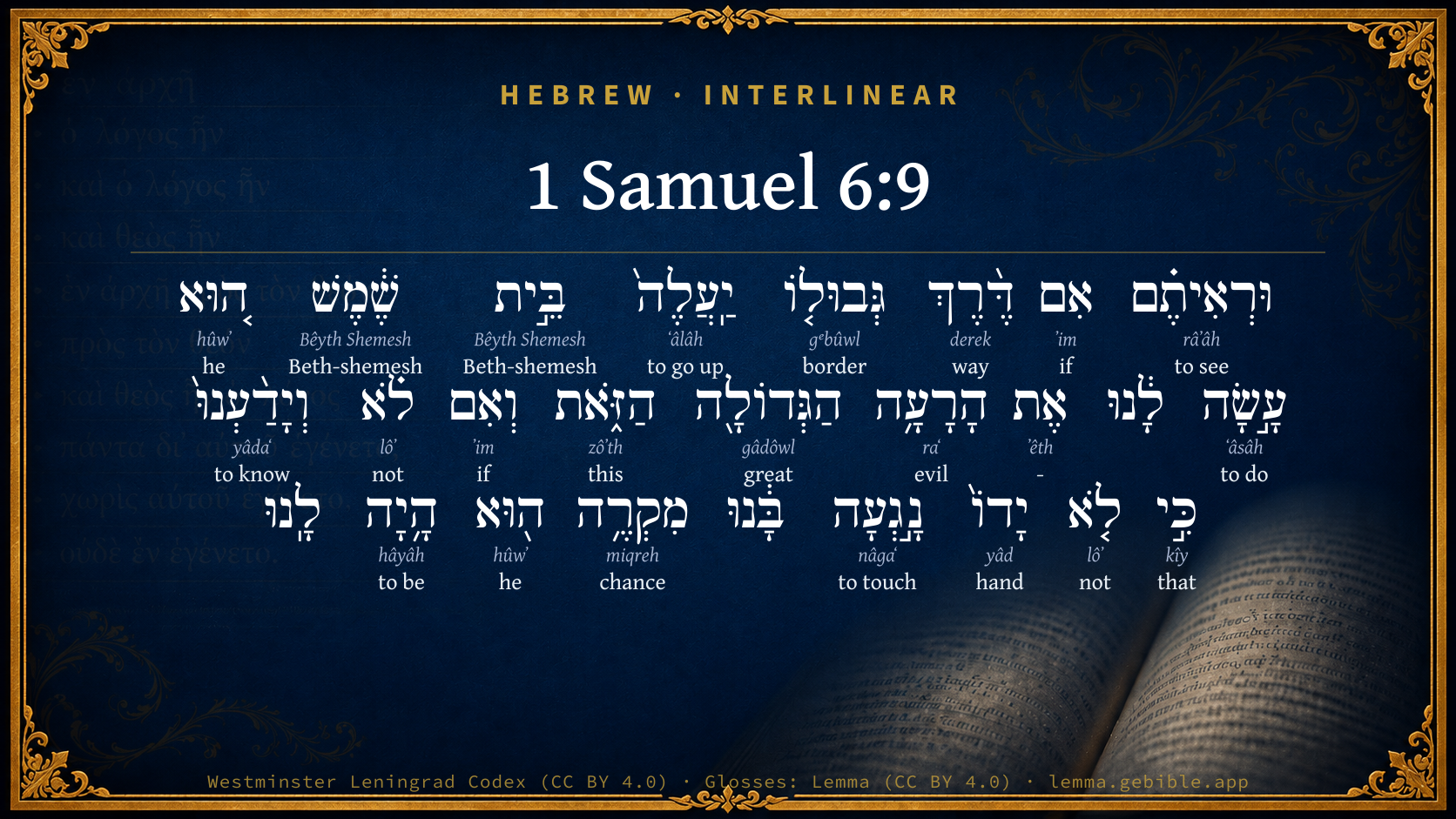
1 Samuel 6:9

Hebrew (Westminster Leningrad Codex) 1 Samuel 6:9 appears in the Hebrew Old Testament. The text above is from the Westminster Leningrad Codex. Each word links to its Strong’s number, a concise gloss, and parsing drawn from the Open Scriptures Hebrew Bible morphology. Click any word for its full Brown-Driver-Briggs (BDB) entry.
Download image
Cite this verse

1 Samuel 6:9 (World English Bible). Public Domain. Lemma interlinear Bible study tool, https://lemma.gebible.app/v/1-samuel/6/9.

Show BibTeX & RIS
BibTeX
RIS
English Translation
Behold; if it goes up by the way of its own border to Beth-shemesh, then he has done us this great evil: but if not, then we shall know that it is not his hand that struck us; it was a chance that happened to us."
World English Bible · Public Domain
Download a study sheet

One document with this verse’s original text, its word-by-word gloss line, the meaning frame, cross-references with their text, attributed commentary, and full source and license credits — printable, and it pastes into notes with its structure intact.

This verse Autodidact and up

Study sheet (.html) Plain text (.txt)

A passage Seminary Student

Up to 50 verses in one chapter. A passage sheet keeps up to 6 commentary sources and 12 cross-references per verse, in the order this page ranks them, and says so on the sheet whenever that leaves anything out. Ask for a single verse and you get the Autodidact verse sheet above.

Everything on this page stays free to read, with no account — the sheet is a download of what is already on screen, not access to it.

Want to remove ads? Support Godless Engineer
Compare translations 3

The same verse in 3 English versions, stacked beneath the original-language interlinear above. Click any original word for its lexicon entry.

Each is an independent rendering of the whole verse — the interlinear is not word-aligned to these translations.

Highlighted words mark where these versions differ — a whole-verse word diff, not a word-by-word alignment.

  • World English Bible Public Domain
    Behold; if it goes up by the way of its own border to Beth-shemesh, then he has done us this great evil: but if not, then we shall know that it is not his hand that struck us; it was a chance that happened to us."
  • King James Version Public Domain
    And see, if it goeth up by the way of his own coast to Bethshemesh, then he hath done us this great evil: but if not, then we shall know that it is not his hand that smote us: it was a chance that happened to us.
  • unfoldingWord Literal Text CC BY-SA 4.0
    And you shall look; if it goes up the way of its border, Beth Shemesh, he has done this great harm to us. But if not, then we will know that his hand has not touched us; it has happened to us chance.”

unfoldingWord Literal Text — © unfoldingWord, licensed CC BY-SA 4.0. Word-aligned USFM3 via Door43 (git.door43.org/unfoldingWord/en_ult).

Versions to compare (up to 4)

3 of 4 selected

Show all 18 translations

Every available English version of this verse, each an independent rendering of the whole verse.

  • World English Bible Public Domain
    Behold; if it goes up by the way of its own border to Beth-shemesh, then he has done us this great evil: but if not, then we shall know that it is not his hand that struck us; it was a chance that happened to us."
  • Berean Standard Bible Public Domain
    but keep watching it. If it goes up the road to its homeland, toward Beth-shemesh, it is the LORD who has brought on us this great disaster. But if it does not, then we will know that it was not His hand that punished us and that it happened by chance.”
  • Majority Standard Bible Public Domain
    but keep watching it. If it goes up the road to its homeland, toward Beth-shemesh, it is the LORD who has brought on us this great disaster. But if it does not, then we will know that it was not His hand that punished us and that it happened by chance.”
  • King James Version Public Domain
    And see, if it goeth up by the way of his own coast to Bethshemesh, then he hath done us this great evil: but if not, then we shall know that it is not his hand that smote us: it was a chance that happened to us.
  • American Standard Version (1901) Public Domain
    And see; if it goeth up by the way of its own border to Beth-shemesh, then he hath done us this great evil: but if not, then we shall know that it is not his hand that smote us; it was a chance that happened to us.
  • Revised Version (1885) Public Domain
    And see, if it goeth up by the way of its own border to Beth-shemesh, then he hath done us this great evil: but if not, then we shall know that it is not his hand that smote us; it was a chance that happened to us.
  • Geneva Bible (1599) Public Domain
    And take heede, if it goe vp by the way of his owne coast to Beth-shemesh, it is he that did vs this great euill: but if not, we shall know then, that it is not his hand that smote vs, but it was a chance that happened vs.
  • Douay-Rheims (1899) Public Domain
    And you shall look: and if it go up by the way of his own coasts towards Bethsames, then he hath done us this great evil: but if not, we shall know that it is not his hand hath touched us, but it hath happened by chance.
  • Young's Literal Translation Public Domain
    and ye have seen, if the way of its own border it goeth up to Beth-Shemesh -- He hath done to us this great evil; and if not, then we have known that His hand hath not come against us; an accident it hath been to us.'
  • Literal Standard Version CC BY-SA 4.0
    and you have seen if it goes up the way of its own border, to Beth-Shemesh—He has done this great evil to us; and if not, then we have known that His hand has not come against us; it has been an accident to us.”
  • Unlocked Literal Bible CC BY-SA 4.0
    Then watch; if it goes up on the way to its own land to Beth Shemesh, then it is Yahweh who has executed this great disaster. But if not, then we will know that it is not his hand that afflicted us; instead, we will know that it happened to us by chance.”
  • unfoldingWord Literal Text CC BY-SA 4.0
    And you shall look; if it goes up the way of its border, Beth Shemesh, he has done this great harm to us. But if not, then we will know that his hand has not touched us; it has happened to us chance.”
  • Darby Bible Public Domain
    And see, if it go up by the way of its own border to Beth-shemesh, it is he who has done us this great evil; if not, then we shall know that it is not his hand that touched us; it was a chance [that] happened to us.
  • World Messianic Bible Public Domain
    Behold, if it goes up by the way of its own border to Beth Shemesh, then he has done us this great evil; but if not, then we shall know that it is not his hand that struck us. It was a chance that happened to us.”
  • Webster's Bible Public Domain
    And see, if it goeth up by the way of his own coast to Beth-shemesh, then he hath done us this great evil: but if not, then we shall know, that it is not his hand that smote us; it was a chance that happened to us.
  • Free Bible Version CC BY-SA 4.0
    but keep watching it. If it goes up the road to its home country, to Beth-shemesh, then it is the Lord who caused all this terrible trouble for us. But if it doesn't, then we'll know that it wasn't him who punished us—it just happened to us by chance.”
  • Bible in Basic English Public Domain
    If it goes by the land of Israel to Beth-shemesh, then this great evil is his work; but if not, then we may be certain that the evil was not his doing, but was the working of chance.
  • JPS Tanakh (1917) Public Domain
    And see, if it goeth up by the way of its own border to Beth-shemesh, then He hath done us this great evil; but if not, then we shall know that it is not His hand that smote us; it was a chance that happened to us.'

Literal Standard Version (2020), Covenant Press — licensed CC BY-SA 4.0. Text via the HelloAO Bible API (eBible.org). Unlocked Literal Bible (unfoldingWord) — licensed CC BY-SA 4.0. Text via the HelloAO Bible API (eBible.org). unfoldingWord Literal Text — © unfoldingWord, licensed CC BY-SA 4.0. Word-aligned USFM3 via Door43 (git.door43.org/unfoldingWord/en_ult). Free Bible Version, Dr. Jonathan Gallagher — licensed CC BY-SA 4.0. Text via the HelloAO Bible API (eBible.org).

Word by word

More ways to search: Search by grammar → Find every occurrence → Compare this word →

Practice this passage: Drill this verse → Learn its vocabulary →

מִקְרֶ֥ה
miqreh
H4745
“chance”
Noun, Common, Masculine, Singular, Absolute
Part of Speech
Noun
Type
Common
Gender
Masculine
Number
Singular
State
Absolute
Full BDB Definition

Origin: from H7136

TWOT: 2068c

unforeseen meeting or event, accident, happening, chance, fortune - accident, chance - fortune, fate
  1. וּרְאִיתֶ֗ם râʼâh H7200 “and · to see” Conjunction + Verb, Qal, Sequential Perfect, 2nd Person, Masculine, Plural
  2. אִם ʼim H518 “if” Conjunction
  3. דֶּ֨רֶךְ derek H1870 “way of” Noun, Common, Both, Singular, Construct
  4. גְּבוּל֤וֹ gᵉbûwl H1366 “border · his” Noun, Common, Masculine, Singular, Construct + Suffix, Personal, 3rd Person, Masculine, Singular
  5. יַֽעֲלֶה֙ ʻâlâh H5927 “to go up” Verb, Qal, Imperfect, 3rd Person, Masculine, Singular
  6. בֵּ֣ית Bêyth Shemesh H1053 “Beth-shemesh” Noun, Proper
  7. שֶׁ֔מֶשׁ Bêyth Shemesh H1053 “Beth-shemesh” Noun, Proper
  8. ה֚וּא hûwʼ H1931 “he” Pronoun, Personal, 3rd Person, Masculine, Singular
  9. עָ֣שָׂה ʻâsâh H6213 “to do” Verb, Qal, Perfect, 3rd Person, Masculine, Singular
  10. אֶת ʼêth H853 “-” Particle, Direct Object
  11. הָרָעָ֥ה raʻ H7451 “the · evil” Particle, Definite Article + Noun, Common, Feminine, Singular, Absolute
  12. הַגְּדוֹלָ֖ה gâdôwl H1419 “the · great” Particle, Definite Article + Adjective, Adjective, Feminine, Singular, Absolute
  13. הַזֹּ֑את zôʼth H2063 “the · this” Particle, Definite Article + Pronoun, Demonstrative, Feminine, Singular
  14. וְאִם ʼim H518 “and · if” Conjunction + Conjunction
  15. לֹ֗א lôʼ H3808 “not” Particle, Negative
  16. וְיָדַ֨עְנוּ֙ yâdaʻ H3045 “and · to know” Conjunction + Verb, Qal, Sequential Perfect, 1st Person, Common, Plural
  17. כִּ֣י kîy H3588 “that” Conjunction
  18. לֹ֤א lôʼ H3808 “not” Particle, Negative
  19. יָדוֹ֙ yâd H3027 “hand · his” Noun, Common, Both, Singular, Construct + Suffix, Personal, 3rd Person, Masculine, Singular
  20. נָ֣גְעָה nâgaʻ H5060 “to touch” Verb, Qal, Perfect, 3rd Person, Feminine, Singular
  21. ה֖וּא hûwʼ H1931 “he” Pronoun, Personal, 3rd Person, Masculine, Singular
  22. הָ֥יָה hâyâh H1961 “to be” Verb, Qal, Perfect, 3rd Person, Masculine, Singular

About this verse

These counts appear in no published source. They are computed here, from the morphology-tagged text and Lemma’s own curated glosses. What Lemma adds →

26
words
19
distinct lemmas
Historical
section

Notable vocabulary

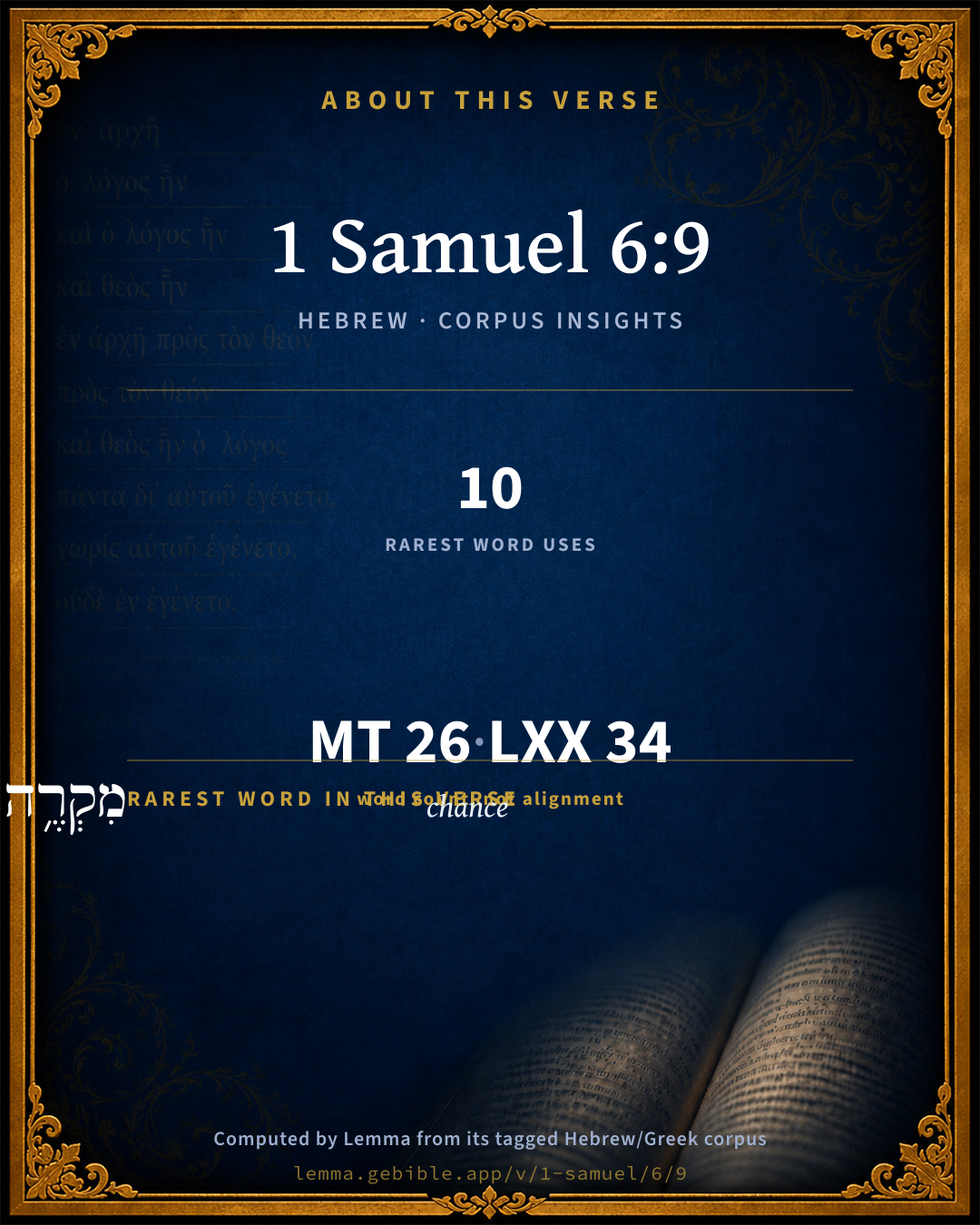
The rarest word here is מִקְרֶ֥ה chance H4745 — appearing just 10 times in the whole Hebrew Bible.

Shared distinctive vocabulary

מִקְרֶ֥ה chance H4745 occurs in 8 verses of the Hebrew Bible. Also found in:

Grammatical profile

  • 6 verbs
  • 7 nouns
  • 1 adjective
  • 3 pronouns
  • 3 prepositions
  • 3 conjunctions
  • 3 particles

Verb forms

  • וּרְאִיתֶ֗ם Qal · Sequential Perfect
  • יַֽעֲלֶה֙ Qal · Imperfect
  • עָ֣שָׂה Qal · Perfect
  • וְיָדַ֨עְנוּ֙ Qal · Sequential Perfect
  • נָ֣גְעָה Qal · Perfect
  • הָ֥יָה Qal · Perfect

Repetition

Words recur within this verse — often emphatic in Hebrew:

  • בֵּ֣ית Beth-shemesh H1053 ×2
  • אִם if H518 ×2
  • ה֚וּא he H1931 ×2
  • לֹ֗א not H3808 ×2

Hebrew & Septuagint length

In English translation the verse runs 46 words from the Hebrew and 48 from the Septuagint (LXX English) — closely comparable.

A rough comparison of the two English renderings, which tokenize alike — not a word-level alignment.

Word counts can differ between the Hebrew and the Greek without any difference in meaning — e.g. the Hebrew direct-object marker אֵת has no separate Greek word, and Greek often adds the article ὁ.

In the original languages it is 26 Hebrew tokens and 34 Greek tokens — but the two are counted differently (Hebrew bundles its prefixes and suffixes into one token; the Greek is in lemma form), so that isn’t a like-for-like length.

Cross-references

8

Topical passages linked to 1 Samuel 6:9 in the Treasury of Scripture Knowledge — connected by theme and wording, ordered by reader-vote popularity; previews shown in the World English Bible.

  • Joshua 15:10 and the border turned about from Baalah westward to Mount Seir, and passed along to the side of Mount Jearim on the north (the same is Chesalon), and went down to Beth-shemesh, and passed along by Timnah;
  • Joshua 21:16 and Ain with its suburbs, and Juttah with its suburbs, [and] Beth-shemesh with its suburbs; nine cities out of those two tribes.
  • 1 Samuel 6:3 They said, "If you send away the ark of the God of Israel, don't send it empty; but by all means return him a trespass-offering: then you shall be healed, and it shall be known to you why his hand is not removed from you."
  • 2 Samuel 1:6 The young man who told him said, As I happened by chance on Mount Gilboa, behold, Saul was leaning on his spear; and, behold, the chariots and the horsemen followed hard after him.
  • Ecclesiastes 9:11 I returned, and saw under the sun, that the race is not to the swift, nor the battle to the strong, neither yet bread to the wise, nor yet riches to men of understanding, nor yet favor to men of skill; but time and chance happen to them all.
  • Luke 10:31 By chance a certain priest was going down that way. When he saw him, he passed by on the other side.
  • Isaiah 26:11 Yahweh, your hand is lifted up, yet they don't see: but they shall see [your] zeal for the people, and be disappointed; yes, fire shall devour your adversaries.
  • Amos 3:6 Does the trumpet alarm sound in a city, Without the people being afraid? Does evil happen to a city, And Yahweh hasn't done it?

Cross-references courtesy of OpenBible.info (CC BY 4.0).

Hebrew and Greek witnesses Masoretic Hebrew ↔ Greek Septuagint

The same verse in the two great witnesses to the Old Testament, shown verse-for-verse.

These are two independent witnesses, not word-aligned to each other, and the Septuagint is shown in lemma (dictionary) form.

Hebrew 1 Samuel 6:9 Masoretic · Westminster Leningrad Codex

וּרְאִיתֶ֗ם אִם דֶּ֨רֶךְ גְּבוּל֤וֹ יַֽעֲלֶה֙ בֵּ֣ית שֶׁ֔מֶשׁ ה֚וּא עָ֣שָׂה לָ֔נוּ אֶת הָרָעָ֥ה הַגְּדוֹלָ֖ה הַזֹּ֑את וְאִם לֹ֗א וְיָדַ֨עְנוּ֙ כִּ֣י לֹ֤א יָדוֹ֙ נָ֣גְעָה בָּ֔נוּ מִקְרֶ֥ה ה֖וּא הָ֥יָה לָֽנוּ

Behold; if it goes up by the way of its own border to Beth-shemesh, then he has done us this great evil: but if not, then we shall know that it is not his hand that struck us; it was a chance that happened to us."

World English Bible · Public Domain

Greek LXX 1 Samuel 6:9 Septuagint · lemma form

καί ὁράω εἰ εἰς ὁδός ὅριον αὐτός πορεύομαι κατά βαιθσαμυς αὐτός ποιέω ἐγώ ὁ κακία οὗτος ὁ μέγας καί ἐάν μή καί γιγνώσκω ὅτι οὐ χείρ αὐτός ἅπτομαι ἐγώ ἀλλά σύμπτωμα οὗτος γίγνομαι ἐγώ

And you⌃ shall see, if it shall go the way of its coasts along by Baethsamys, he has brought upon us this great affliction; and if not, then shall we know that his hand has not touched us, but this is a chance which has happened to us.

LXX2012 (modern English Septuagint) · Public Domain

Hebrew: Westminster Leningrad Codex (CC BY 4.0). Greek: Septuagint (public domain); English from LXX2012 (modern English Septuagint) (Public Domain). How the Septuagint differs from the Hebrew →

Targum (Aramaic paraphrase)

1

The Targum is the ancient Jewish Aramaic paraphrase of the Hebrew Scriptures — an interpretive translation, not the Hebrew text itself. Onkelos (literal) and Pseudo-Jonathan (expansive) render the Torah, and Jonathan the Prophets. Coverage is partial: where no permissively-licensed English translation exists for a verse, only the Aramaic is shown. This is verse-level text, not a word-by-word alignment to the Hebrew.

  1. Targum Jonathan Prophets (Joshua–Malachi)
    וְתֶחֱזוּן אִם בְּאוֹרַח תְּחוּמֵיהּ יִסַק לְבֵית שֶׁמֶשׁ מִן קֳדָמוֹהִי אִתְעֲבִידַת לָנָא יַת בִּישְׁתָא רַבְּתָא הָדָא וְאִם לָא וְנִידַע אֲרֵי לָא מְחָתֵיהּ קְרִיבַת בָּנָא עֵירוּעַ הוּא דַהֲוָה לָנָא:

    (no public-domain English translation for this verse)

    Targum Jonathan — Aramaic: “Mikraot Gedolot” (public domain). English: “Sefaria Community Translation” (CC0 1.0 (public-domain dedication)); “London "Chaldee Paraphrase," 1871” (public domain). Text via Sefaria.

Commentary

Notes on 1 Samuel 6:9 from classic Christian and Jewish commentators (each source and its license shown beneath its notes). The classic Christian expositions comment on the surrounding passage and are grouped to its opening verse, so a note may address several verses; the Jewish commentaries on the Tanakh (Rashi and others) are per-verse, so they appear only where the commentator wrote on this verse.

Lemma curates 59 commentaries, every one of them public domain or Creative Commons licensed, each selected and text-cleaned for this edition rather than reprinted as found. About our sources →

Trapp's Complete Commentary

John Trapp

1Sa 6:9 And see, if it goeth up by the way of his own coast to Bethshemesh, [then] he hath done us this great evil: but if not, then we shall know that [it is] not his hand [that] smote us: it [was] a chance [that] happened to us.

Ver. 9. By the way of his own coast to Bethshemesh.] That is, The house of the sun, which, haply, had sometime been there worshipped, as at Heliopolis in Egypt, {Jer 43:13} called now Dameta. This Bethshemesh was in the tribe of Judah, and in the way to Shiloh, where the ark had formerly stood; but now and henceforward it was, "Go ye up to my place which was in Shiloh, where I set my name at the first, and see what I did to it for the wickedness of my people Israel." {Jer 7:12} God suffered the Philistines to lay it waste, as he did the Chaldees, Romans, and now the Turks to deal by that whole country; Ut ostenderet se non propter locum gentem, sod propter gentem locum elegisse, saith Theodoret. {a}

It was a chance that happened to us.] This was a string that the heathens much harped upon, denying, or at least doubting of, the divine providence, and ascribing events to fate and blind fortune. The Jews tell us, that when Jeroboam’s hand was dried up, the false prophets told him that this was but by chance: and so kept him from thinking of God that had smitten him. Still the devil is suggesting the same thing to the sons of men - viz., that their crosses are but common events, such as had a time to come in, and must have a time to go in, &c.; whereas nothing in the world cometh to pass without God’s providence and decree, as is excellently set forth in Eze 1:4. {See Trapp on "Eze 1:4"}

{a} Quest. 1, in Daniel.

John Trapp, A Commentary or Exposition upon All the Books of the Old and New Testament (1647–1656) — public domain. Text from a community e-Sword module.

The Biblical Illustrator

Joseph S. Exell

1Sa_6:9

It was a chance that happened to us.

The ministry of chance

The world believes in chance, and without doubt there is some ground for its belief, but whether that ground constitutes a real foundation we may doubt. What does chance mean? It means that it is something which happens, falls out, without being foreseen or intended. Nothing happens unforeseen by the Great Mind that rules over all. All chance is direction which thou canst not see; but though we do not see it the direction was not the less there.

1. The doctrine of chance has been applied to the formation of the world. It has been said that the world is the result of the interaction of the atoms through all the past Eternity, at last falling by chance into an orderly arrangement. Let us suppose an immense number of alphabets were thrown together--a sufficient number of them, for instance, to make up the Bible, say a million of letters or so--and that someone were to be appointed to throw them up every second through a hundred million of years, is there any likelihood that they would come down once in such an order as to make the Bible, or a single book of the Bible, or a single chapter of the Bible, or a single verse? Neverse Yet that is just what Lucretius supposed to happen with the making of the world from the interaction of the atoms. There must be intelligence; there must be design to elicit that which we call the world. The Greek word which we translate world signifies something arranged, something orderly, and hence beautiful.

2. Tendencies, that is, laws, are capable of being observed and provided for. And this is the great business of man, as Bacon observed, Man the minister and interpreter of nature, does and understands as much as his observations on the order of nature, either with regard to things or the mind, permit him, and neither knows nor is capable of more. That is, he is to find out just what order that is which God has given to nature, and guide himself accordingly. If things were only to fall out by chance it would be utterly impossible to foresee or to guide ourselves in view of any event. If we found that the hard brick of today was soft as its original clay tomorrow, and that without any perceptible reason; or the strong timber was attacked with a weakness at varying and uncertain intervals; or that the slate which threw oft the rain of yesterday was become a sieve to the torrent of today; or that the window which was translucent had suddenly become opaque; if we could assign no reason for these sudden changes, and all other things were alike in this, we should be utterly incapable of any useful work. If the human mind were powerful enough to take in and calculate all the various forces which enter into the movements of each, it would be able to show the reasons for the slightest change in the direction and force of the wind, of the smallest flock of the cloud, and of every flash of the aurora of the north sky, and of every variation in the health of the hypochondriac. It is yet possible that science may be able to predict what was, in former days, only possible to prophecy.

3. But it may be asked, What do you make of a miracle? Is not that such a breach of the order and continuity of nature as would be equivalent to the intrusion of chance? We say no, for a miracle is only the operation of a higher law--it is only the result of the influence of the Great Mechanic, who, surely, should not be left out of our calculation of what is possible in this complex world of ours. Science should modestly admit that there may be direction which she cannot see--that there is a Providence which shapes our ends, rough hew them as we will--that outside the framework of nature there is an intelligent Mind, and that there may be reasons for its interference just as strong as those which operate on the factory director to mend a broken wheel or to reduce a too violent motion. This sphere, called in our imperfect vocabulary that of miracle, is far removed from that of chance, where uncertainty, doubt, and incapacity ever reign. But it may be suggested here that we should enter into some inquiry about prayer, and about its power to resist the usual order of nature, and thus, as it were, to set aside the government of law. Now, here I would say that, in connection with prayer, we must bear in mind that with its answer, in the Scriptures, the ministry of angels is closely associated. Verily, it is a poor science which takes cognizance alone of the seen and tangible, the weighable and measurable, while there are around us in the ambient ether, or within us in the recesses of the mind, the ministering spirits, sent forth to minister to them who shall be heirs of salvation. But it is to be observed, that whatever is done by these ministering spirits, is done, not to the production of confusion in the world, but in entire accordance with the lower laws which science observes. To our thought there can be no disorder introduced, when the superior forces are taken into account. Let us take the case of the resurrection of Christ. Science, which took no account of the Spirit of holiness, no account of the Spirit of God with which He was filled above measure, said it was not possible that He should rise again; but the Apostle tells us, it was not possible that He should be holden of death. God was in Him with such presence and power that death was overcome, and life, violently taken away, was restored. Without the Divine power in Christ, the scientific men of the day were perfectly right in assuming the impossibility of the resurrection; but (and here is no chance, but the presence of mighty cause) they were all astral in thinking that there was no resurrection for Him. It was absolutely certain that He should rise again; there was a cause mightier than death operating to His restoration. All this is certainly according to law, as Paul says: The law of the spirit of life in Christ Jesus hath made me free from the law of sin and death. It may be observed that, at least, in those cases which have been dwelt upon by pious persons as answers to prayers, naturalists have invariably reasoned that the same results would have happened without the intervention of prayer at all--which means that they, at least, did not find that any disorder occurred by any power which prayer exercised. These interventions in answer to prayer, by angelic agency or otherwise, seem to give no reason to affirm that chance has any scope or play in the world. This being understood, we may also say a word regarding the frequency of such spiritual agencys operations. Are they of frequent, or only of casual and fitful occurrence? Were they confined to Palestine and prophetic periods, or are they in operation at all times and spheres of the world? It reply, we say, without doubt, they are always working as they are always living, and working according to law, that is, according to the direction of God. But we may surely affirm that they do not interfere with any law of nature, nor are they to be relied on in answer to any prayer offered up to guard us against calamities which we might have avoided, or which we have brought on ourselves by want of proper foresight.

4. There being no such thing, then, as chance, and no violation of the laws of matter by higher power, it is clearly our duty to know what those laws are--especially those which regulate the business, trade, profession, or calling of each. It may be that, after we have done our best, we shall still be ignorant of many things which it greatly concerns us to know, our ignorance of the same bringing to us loss, disaster, even death. But that we might, by exercising foresight, avoid great calamities is certain. One-half, two-thirds, three-fourths of the accidents that occur, destructive of life and limb, should have been avoided. Why should scaffolds be continually falling, dashing human beings to the earth shattered corpses, when a rope of sufficient thickness, or a pole of sufficient firmness, would have prevented the catastrophe? Why should the shop fall under its load, when a trifling bond would have hem its walls perpendicular? Why should a house be burned, when a little care would have cured a defective flue? Why should the ship sink in the ocean, when a good lookout would have avoided collision with the iceberg or the other ship crossing the course. Be it observed, not one of these nor similar accidents but might have been foreseen and prevented. In every case the material employed followed explicitly the laws of its own being. The falling scaffold, the sinking building, the burning city, all took place according to law. When any great disaster happens to a building, we cannot, on that account, say that Heaven is enraged against it, or that it is a judgment on it for the immoralities there nurtured. The judgment is against the folly, the perverseness, the sin of imprudence, carelessness, want of foresight, or wickedness implied in the faulty construction for the sake of gain. Say not that those on whom the tower of Siloam fell were greater sinners than the others in Jerusalem on whom no such judgment came. What we are concerned with is the vast importance of prudence and care in regard to every building where human lives might, with such provision, be imperilled.

5. But still there is one thought which it is important for us to impress upon you. Place yourselves in no peril to which duty does not call--nay, let us broaden the injunction, walk in no path to which duty does not beckon the way, though absolutely safe. We have no promise that we shall have safety save in the paths of right--nay, not even of bodily safety there. Though the outer man perish the inner man will live unhurt amid the war of elements, the wrack of matter, and the crash of worlds. (J. Bonnet, D. D.)

The Biblical Illustrator, edited by Joseph S. Exell (c. 1880s–1900s) — public domain. Text from a community e-Sword module.

Joseph Benson's Commentary

1Sa 6:9. And see if it goeth up by his own coast — Without any guide; to Beth-shemesh — A city in the tribe of Judah, in the confines of both countries. Then he hath done this great evil — Hath inflicted this sore calamity upon us. This they might well conclude, if such heifers should, contrary to their custom and natural instinct, go into a strange path, and regularly and constantly proceed in it, without being guided by any one.

Joseph Benson's Commentary on the Old and New Testaments (1811–1818) — public domain. Text from a community e-Sword module.

Tyndale Open Study Notes

Tyndale Open Resources

6:9 Beth-shemesh was the closest Israelite town to Ekron (5:10).

Tyndale Open Study Notes — © Tyndale Open Resources, licensed CC BY-SA 4.0. Text via the HelloAO Bible API.

Geneva Bible (1599)

Geneva Bible translators

The wicked attribute almost all things to fortune and chance, whereas indeed there is nothing done without God’s providence and decree.

The God of Israel.

Geneva Bible (1599) marginal notes — public domain. Text via Bolls.life.

Jamieson, Fausset & Brown

Robert Jamieson, A. R. Fausset & David Brown

Beth-shemesh--that is, "house of the sun," now Ain Shems [ROBINSON], a city of priests in Judah, in the southeast border of Dan, lying in a beautiful and extensive valley. JOSEPHUS says they were set a-going near a place where the road divided into two--the one leading back to Ekron, where were their calves, and the other to Beth-shemesh. Their frequent lowings attested their ardent longing for their young, and at the same time the supernatural influence that controlled their movements in a contrary direction.

Jamieson, Fausset & Brown — Commentary Critical and Explanatory on the Whole Bible (1871) — public domain (CC PDM 1.0). Text via the HelloAO Bible API.

Adam Clarke's Commentary

Verse 9. A chance that happened to us] The word מקרה mikreh, from קרה karah, to meet or coalesce, signifies an event that naturally arises from such concurring causes as, in the order and nature of things, must produce it.

Thus a bad state of the atmosphere, putrid exhalations, bad diet, occasioned by any general scarcity, might have produced the disease in question; and to something of this kind they would attribute it, if the other evidences did not concur. This gives us the proper notion of chance; and shows us that it is a matter as dependent upon the Divine providence, as any thing can be: in short, that these occurrences are parts of the Divine government.

The word chance, though often improperly used to signify such an occurrence as is not under the Divine government, is of itself, not only simple, but expressive; and has nearly the meaning of the Hebrew word: it comes from the French cheoir, or escheoir, to fall out, to occur, to fall to. Hence our law-term escheat, any lands that fall to the lord of the manor by forfeiture, or for want of heirs: i.e., these are the occurrences which naturally throw the lands into the hands of the lord.

Adam Clarke's Commentary on the Bible (1810–1826) — public domain. Text from a community e-Sword/MySword module.

Ellicott's Commentary for English Readers

(9) It was a chance that happened to us.—The priests and diviners were not certain whether the plague had been sent by the offended God of Israel or had visited Philistia in the ordinary course of nature. This strange experiment would satisfy the minds of the Philistine people. If the cows, contrary to their expectation, kept on the road to Bethshemesh, this would be a sign that they were driven and guided by a Divine power, and it would be clear to all that the Ark was a dangerous possession, and that they were well rid of it. They would be assured then that the scourge they were suffering from came from the angry Israelite Deity. If, on the other hand, the animals, left to themselves, returned to their own stalls, which, evidently, the diviners expected would be the case—then the Philistines might safely retain the Ark, being confident that their late sufferings were simply the results of natural causes. It will be remembered (1Sa_6:7) that these were milch cows, whose calves were shut up in the stall. The diviners felt quite sure that the cows, left to their own instincts, would, unless driven by some Divine power, come back to their young ones in the stall. What the priests and diviners advised was done, and the next two verses (10 and 11) relate how the restoration of the Ark was carried out in the way prescribed above.

A Bible Commentary for English Readers, edited by Charles John Ellicott (1878–1897) — public domain. Text from a community e-Sword module.

The Cambridge Bible for Schools and Colleges

gen. ed. J. J. S. Perowne

9. his own coast] His own border, as in 1Sa_6:12. See ch. 1Sa_5:6, note. “His” refers to the Ark. The neuter possessive pronoun “its” is not found in the original edition of the E. V. See The Bible Word-Book, p. 272.

to Beth-shemesh] = “House of the Sun,” probably the same as Irshemesh = “City of the Sun” (Jos_19:41). It was a priestly city (Jos_21:16) on the border of the tribe of Judah (Jos_15:10), about 12 miles S.E. of Ekron. Its position is identified by the modern village of Ain Shems (= “Fountain of the Sun”) in the Wady es Sŭrâr, and is described by Robinson as “a noble site for a city, a low plateau at the junction of two fine plains,” the “valley” in which the Beth-shemeshites were reaping their wheat (1Sa_6:13). “Here are vestiges of a former extensive city, consisting of many foundations and remains of ancient walls of hewn stone … Enough yet remains to make it one of the largest and most marked sites which we had anywhere seen.” Biblical Researches, II. 224.

Beth-shemesh was the scene of Amaziah’s defeat by Jehoash (2Ki_14:11-12): and with other towns was taken from Ahaz by the Philistines (2Ch_28:18). Its name, and that of Har-cheres = “Mount of the Sun” (Jdg_1:35), which was evidently in the neighbourhood, point to an ancient sun-worship in the country.

then he hath done us this great evil] Observe the completeness of the test. If cows unaccustomed to the yoke drew the cart quietly; if in spite of their natural instincts they deserted their calves; if without human guidance they went straight to the nearest Israelite town; the obvious conclusion must be that they were controlled by a supernatural power, and that that power was the God of Israel. Compare Gideon’s ‘signs,’ consisting of phenomena contrary to expectation (Jdg_6:37 ff.).

The Cambridge Bible for Schools and Colleges (gen. ed. J. J. S. Perowne; Cambridge University Press, 1878–1918) — public domain. Text from a community e-Sword module.

John Gill's Exposition

And see if it goeth up by the way of its own coast to Bethshemesh,.... The nearest city to the land of the Philistines, which lay on their borders, and the borders of the tribe of Judah; see Gill on Jos 15:10. Now the lords of the Philistines are directed by their priests to observe, whether these kine, that drew the cart on which the ark was, took the direct road to the borders of the land of Israel, and to Bethshemesh, the nearest city that lay on that coast: if so, they might conclude then,

he hath done us this great evil; that is, the God of Israel, whose ark this was; he had inflicted the disease of the emerods on them, and sent such numbers of mice into their fields, that had destroyed the increase of them:

but if not, then we shall know that it is not his hand that hath smote us; but that there is some other cause of it:

it was a chance that happened to us; and so might have been the case if the ark had never been taken or detained, and to be imputed to fate, or to the stars, or some secret causes they know not of.

John Gill's Exposition of the Whole Bible (1746–1763) — public domain (CC PDM 1.0). Text via the HelloAO Bible API.

Albert Barnes' Notes on the Bible

Bethshemesh was the first Israelite town they would come to, being on the border of Judah. (See the marginal reference.)

Albert Barnes' Notes on the Bible (1834–1885) — public domain. Text from a community e-Sword/MySword module.

Haydock's Catholic Bible Commentary

Way. Josephus observes, that they stationed the kine at three lane ends; (Haydock) and, as we may infer from the Hebrew (ver. 12,) rather with their heads turned from Bethsames. But, by this conduct, did they not tempt God? Some believe that He inspired them on this occasion, (Estius) that even his enemies might be convinced, (Haydock) the grace of prophecy being frequently granted to wicked men, like Balaam: others believe that He gave success to their plan, though it was dictated by superstition. Even the devil sometimes speaks the truth. (Mendoza) (Calmet) --- People frequently use to pitch upon signs, to which God often assented, Proverbs xvi. 33., (Menochius) and Genesis xxiv. 14. (Haydock)

George Leo Haydock (1774–1849), Haydock's Catholic Family Bible and Commentary, 1859 edition — public domain. Excludes Psalms (Douay-Rheims chapter numbering differs from Protestant) and Deuterocanonical books (Catholic canon only).

Matthew Poole's English Annotations

His own coast, or, border, i.e. the way that leadeth to his coast or border, viz. the country to which it belongs.

Then he hath done us this great evil; which they might well conclude, if such heifers should, against their common use and natural instinct, go into a strange path, and regularly and constantly proceed in it, without any man’s conduct.

It was a chance that happened to us: this evil came to us from some influences of the stars, or other unknown causes; which was a weak and foolish inference, depending upon a mere contingency, it being uncertain whether God would please to give them this sign, and probable that he would deny it, both to punish their superstition, and to harden their hearts to their further and utter destruction. But wicked men will sooner believe the most uncertain and ridiculous things, than own the visible demonstrations of God’s power and providence.

Matthew Poole's English Annotations on the Holy Bible (1683–1685) — public domain. Text from a community e-Sword/MySword module.

Whedon's Commentary on the Bible

Daniel D. Whedon

9. His own coast — The land of the ark, the same as his place, in 1Sa_6:2.

Beth-shemesh — Situated about seven miles southeast of Ekron; it was a border city of the tribe of Judah, (Jos_15:10.) and one allotted to the Levites. Jos_21:16. It was identified by Dr. Robinson, in 1838, with the modern Ain Shems.

A chance — An accident; a fortuitous event.

There still lingered in some minds the thought that possibly the ark was not the cause of their troubles.

Daniel D. Whedon (gen. ed.), Commentary on the Old and New Testaments (1874–1909) — public domain. Text from a community e-Sword module.

The Pulpit Commentary

His own coast, or "border." The ark throughout this verse is spoken of as if it were itself a deity. Beth-shemeshi.e. "the house of the sun," also called Irshemesh, "city of the sun" (Jos_19:41) had evidently been in the time of the Canaanites the seat of this popular idolatry. It was now a city of the priests, situated in the tribe of Judah, on its northeastern border, next the tribe of Dan, and was the nearest Israelite town to Ekron. If, then, the kine, albeit unused to the yoke, left their calves behind, and drew the cart by the most direct route unto the land of Judah, they would give the required proof that the Philistines were smitten by the hand of Jehovah, and that it was no chance that had happened unto them.

The Pulpit Commentary (1880–1919), ed. H.D.M. Spence-Jones & Joseph S. Exell — public domain. Text from a community e-Sword module.

John Wesley's Explanatory Notes

His own coast - Or Border, that is, the way that leadeth to his coast, or border, namely, the country to which it belongs. Then he, &c. - Which they might well conclude, if such heifers should against their common use, and natural instinct, go into a strange path, and regularly and constantly proceed in it, without any man's conduct.

John Wesley, Explanatory Notes Upon the Whole Bible (1754–1765) — public domain. Text via the GEBible commentary corpus.

Lesson kit

Teaching starters — assembled from the data on this page, not authored interpretation. Every prompt links to the verse data it draws on. Edit before teaching.

1 Samuel, in the Historical, opens this verse with 26 words (19 distinct Hebrew lemmas). Its most distinctive word is miqreh (“chance”). A historical commentator’s framing appears above. Read the whole chapter for the surrounding context.

Discussion questions

  1. How does “chance” (miqreh) shape what this verse is saying?
  2. How does Ruth 2:3, which shares the word «chance», read alongside this verse?
  3. What does the repetition of “Beth-shemesh” (2× in this one verse) do in this verse?
  4. The translations on this page render this verse differently — a whole-verse word diff, not a word-by-word alignment. What might account for the different wordings?
  5. «וּרְאִיתֶ֗ם» is a Qal Sequential Perfect verb. How does that grammatical form shape the action described?
  6. Compare how Trapp's Complete Commentary and The Biblical Illustrator read this verse. Where do they agree or differ?

Things to notice

Reading settings

Reading text

Shown beneath each verse's original-language words.

Old Testament
Old Testament edition

Read the OT as the Masoretic Hebrew (MT) or the Greek Septuagint (LXX).

English shown for the Greek Septuagint (in the Hebrew ↔ Greek comparison).

Comparing translations? Open the Compare panel on any verse page to stack up to four side by side.