
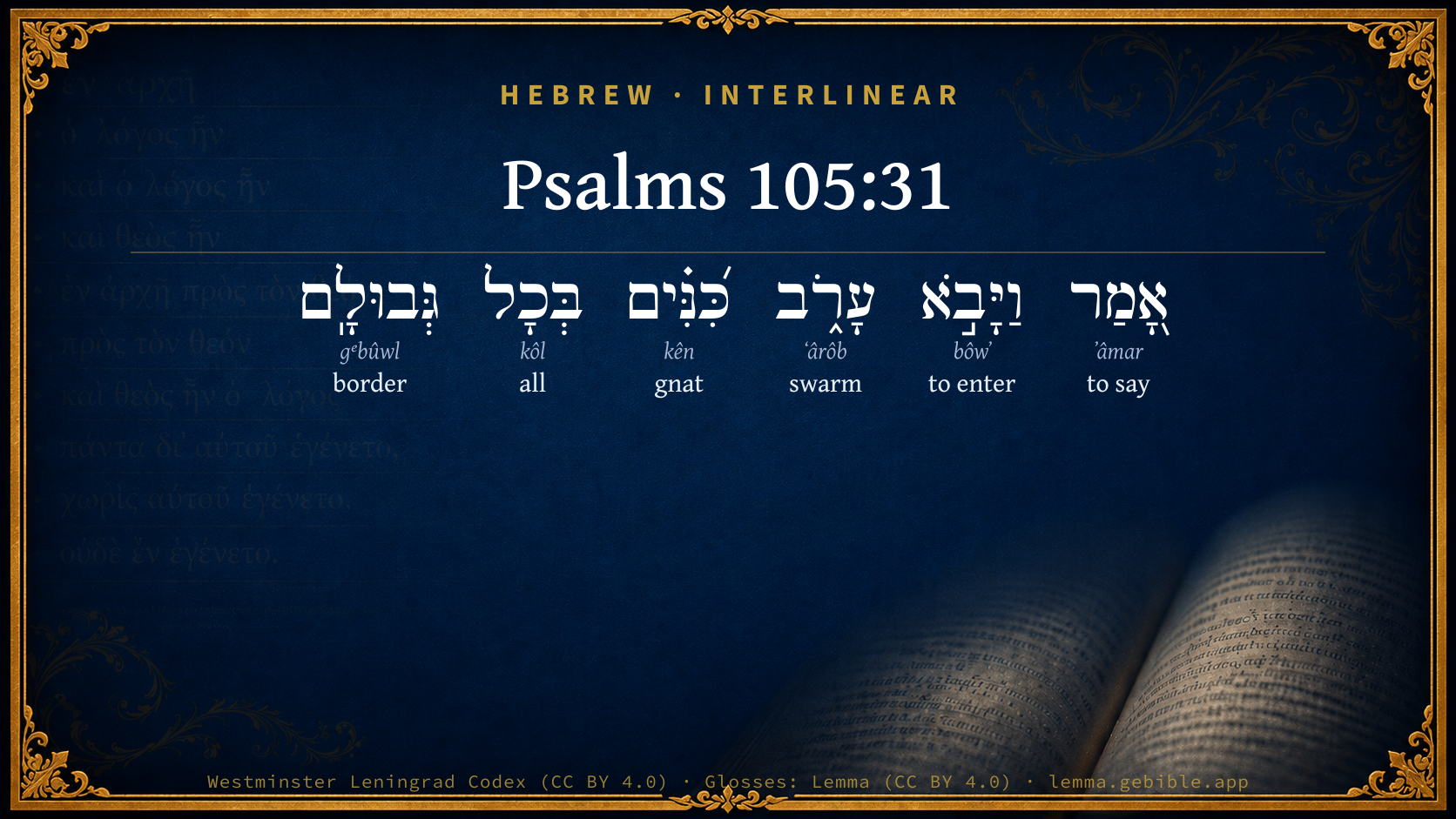
Psalms 105:31

Hebrew (Westminster Leningrad Codex) Psalms 105:31 appears in the Hebrew Old Testament. The text above is from the Westminster Leningrad Codex. Each word links to its Strong’s number, a concise gloss, and parsing drawn from the Open Scriptures Hebrew Bible morphology. Click any word for its full Brown-Driver-Briggs (BDB) entry.
Download image
Cite this verse

Psalms 105:31 (World English Bible). Public Domain. Lemma interlinear Bible study tool, https://lemma.gebible.app/v/psalms/105/31.

Show BibTeX & RIS
BibTeX
RIS
English Translation
He spoke, and swarms of flies came, And lice in all their borders.
World English Bible · Public Domain
Download a study sheet

One document with this verse’s original text, its word-by-word gloss line, the meaning frame, cross-references with their text, attributed commentary, and full source and license credits — printable, and it pastes into notes with its structure intact.

This verse Autodidact and up

Study sheet (.html) Plain text (.txt)

A passage Seminary Student

Up to 50 verses in one chapter. A passage sheet keeps up to 6 commentary sources and 12 cross-references per verse, in the order this page ranks them, and says so on the sheet whenever that leaves anything out. Ask for a single verse and you get the Autodidact verse sheet above.

Everything on this page stays free to read, with no account — the sheet is a download of what is already on screen, not access to it.

Want to remove ads? Support Godless Engineer
Compare translations 3

The same verse in 3 English versions, stacked beneath the original-language interlinear above. Click any original word for its lexicon entry.

Each is an independent rendering of the whole verse — the interlinear is not word-aligned to these translations.

Highlighted words mark where these versions differ — a whole-verse word diff, not a word-by-word alignment.

  • World English Bible Public Domain
    He spoke, and swarms of flies came, And lice in all their borders.
  • King James Version Public Domain
    He spake, and there came divers sorts of flies, and lice in all their coasts.
  • unfoldingWord Literal Text CC BY-SA 4.0
    He spoke, and flies came; gnats in all their territory.

unfoldingWord Literal Text — © unfoldingWord, licensed CC BY-SA 4.0. Word-aligned USFM3 via Door43 (git.door43.org/unfoldingWord/en_ult).

Versions to compare (up to 4)

3 of 4 selected

Show all 18 translations

Every available English version of this verse, each an independent rendering of the whole verse.

  • World English Bible Public Domain
    He spoke, and swarms of flies came, And lice in all their borders.
  • Berean Standard Bible Public Domain
    He spoke, and insects swarmed—gnats throughout their country.
  • Majority Standard Bible Public Domain
    He spoke, and insects swarmed—gnats throughout their country.
  • King James Version Public Domain
    He spake, and there came divers sorts of flies, and lice in all their coasts.
  • American Standard Version (1901) Public Domain
    He spake, and there came swarms of flies, And lice in all their borders.
  • Revised Version (1885) Public Domain
    He spake, and there came swarms of flies, and lice in all their borders.
  • Geneva Bible (1599) Public Domain
    He spake, and there came swarmes of flies and lice in all their quarters.
  • Douay-Rheims (1899) Public Domain
    He spoke, and there came divers sorts of flies and sciniphs in all their coasts.
  • Young's Literal Translation Public Domain
    He hath said, and the beetle cometh, Lice into all their border.
  • Literal Standard Version CC BY-SA 4.0
    He has commanded, and the beetle comes, || Lice into all their border.
  • Unlocked Literal Bible CC BY-SA 4.0
    He spoke, and swarms of flies and gnats came throughout their country.
  • unfoldingWord Literal Text CC BY-SA 4.0
    He spoke, and flies came; gnats in all their territory.
  • Darby Bible Public Domain
    He spoke, and there came dog-flies, [and] gnats in all their borders.
  • World Messianic Bible Public Domain
    He spoke, and swarms of flies came, and lice in all their borders.
  • Webster's Bible Public Domain
    He spoke, and there came divers sorts of flies, and lice in all their borders.
  • Free Bible Version CC BY-SA 4.0
    He gave the command, and flies spread throughout their land; mosquitoes were everywhere.
  • Bible in Basic English Public Domain
    He gave the word, and there came the dog-fly, and insects over all the land.
  • JPS Tanakh (1917) Public Domain
    He spoke, and there came swarms of flies, and gnats in all their borders.

Literal Standard Version (2020), Covenant Press — licensed CC BY-SA 4.0. Text via the HelloAO Bible API (eBible.org). Unlocked Literal Bible (unfoldingWord) — licensed CC BY-SA 4.0. Text via the HelloAO Bible API (eBible.org). unfoldingWord Literal Text — © unfoldingWord, licensed CC BY-SA 4.0. Word-aligned USFM3 via Door43 (git.door43.org/unfoldingWord/en_ult). Free Bible Version, Dr. Jonathan Gallagher — licensed CC BY-SA 4.0. Text via the HelloAO Bible API (eBible.org).

Word by word

More ways to search: Search by grammar → Find every occurrence → Compare this word →

Practice this passage: Drill this verse → Learn its vocabulary →

About this verse

These counts appear in no published source. They are computed here, from the morphology-tagged text and Lemma’s own curated glosses. What Lemma adds →

6
words
6
distinct lemmas
Wisdom
section

Notable vocabulary

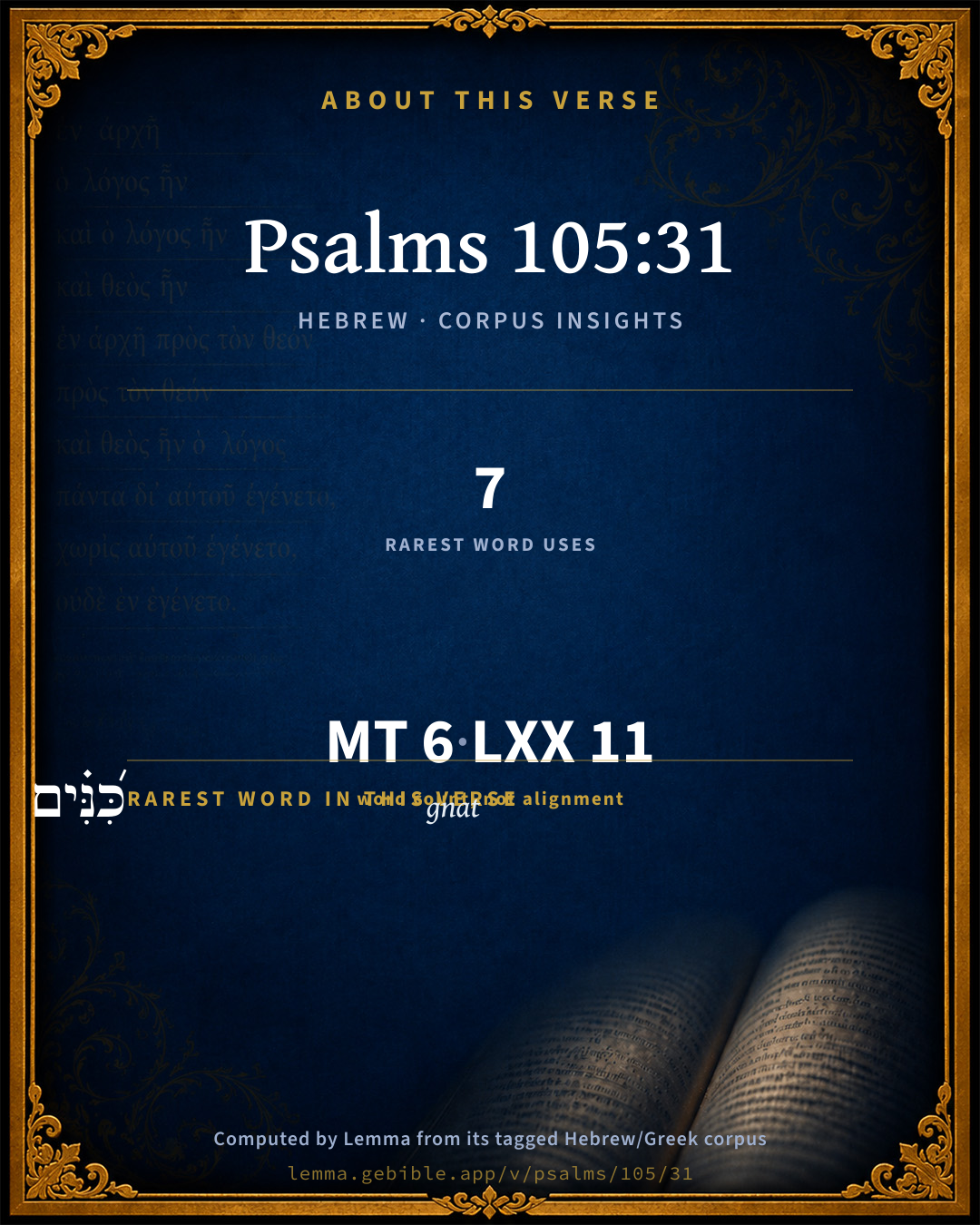
The rarest word here is כִּ֝נִּ֗ים gnat H3654 — appearing just 7 times in the whole Hebrew Bible.

Shared distinctive vocabulary

כִּ֝נִּ֗ים gnat H3654 occurs in 5 verses of the Hebrew Bible. Also found in:

Grammatical profile

  • 2 verbs
  • 4 nouns

Verb forms

  • אָ֭מַר Qal · Perfect
  • וַיָּבֹ֣א Qal · Sequential Imperfect

Hebrew & Septuagint length

In English translation the verse runs 13 words from the Hebrew and 12 from the Septuagint (LXX English) — closely comparable.

A rough comparison of the two English renderings, which tokenize alike — not a word-level alignment.

Word counts can differ between the Hebrew and the Greek without any difference in meaning — e.g. the Hebrew direct-object marker אֵת has no separate Greek word, and Greek often adds the article ὁ.

In the original languages it is 6 Hebrew tokens and 11 Greek tokens — but the two are counted differently (Hebrew bundles its prefixes and suffixes into one token; the Greek is in lemma form), so that isn’t a like-for-like length.

Cross-references

4

Topical passages linked to Psalms 105:31 in the Treasury of Scripture Knowledge — connected by theme and wording, ordered by reader-vote popularity; previews shown in the World English Bible.

  • Exodus 8:21–24 Else, if you will not let my people go, behold, I will send swarms of flies on you, and on your servants, and on your people, and into your houses: and the houses of the Egyptians shall be full of swarms of flies, and also the ground whereon they are.
  • Exodus 8:16–18 Yahweh said to Moses, "Tell Aaron, 'Stretch out your rod, and strike the dust of the earth, that it may become lice throughout all the land of Egypt.'"
  • Psalms 78:45 He sent among them swarms of flies, which devoured them; And frogs, which destroyed them.
  • Isaiah 7:18 It will happen in that day that Yahweh will whistle for the fly that is in the uttermost part of the rivers of Egypt, and for the bee that is in the land of Assyria.

Cross-references courtesy of OpenBible.info (CC BY 4.0).

Hebrew and Greek witnesses Masoretic Hebrew ↔ Greek Septuagint

The same verse in the two great witnesses to the Old Testament, shown verse-for-verse.

You’re reading Greek Psalm 104 (Hebrew Psalm 105). The Septuagint counts the superscription, so verse numbers can differ from the Hebrew — chapter-level alignment, not verse-by-verse. Numbering follows Rahlfs.

These are two independent witnesses, not word-aligned to each other, and the Septuagint is shown in lemma (dictionary) form.

Hebrew Psalms 105:31 Masoretic · Westminster Leningrad Codex

אָ֭מַר וַיָּבֹ֣א עָרֹ֑ב כִּ֝נִּ֗ים בְּכָל גְּבוּלָֽם

He spoke, and swarms of flies came, And lice in all their borders.

World English Bible · Public Domain

Greek LXX Greek Psalm 104:31 Septuagint · lemma form

εἶπον καί ἔρχομαι κυνόμυια καί σκνίψ ἐν πᾶς ὁ ὅριον αὐτός

He spoke, and the dog-fly came, and lice in all their coasts.

LXX2012 (modern English Septuagint) · Public Domain

On this verse, John Gill's Exposition discusses the Septuagint’s reading. Read the note in Commentary ↓

Hebrew: Westminster Leningrad Codex (CC BY 4.0). Greek: Septuagint (public domain); English from LXX2012 (modern English Septuagint) (Public Domain). How the Septuagint differs from the Hebrew →

Commentary

Notes on Psalms 105:31 from classic Christian and Jewish commentators (each source and its license shown beneath its notes). The classic Christian expositions comment on the surrounding passage and are grouped to its opening verse, so a note may address several verses; the Jewish commentaries on the Tanakh (Rashi and others) are per-verse, so they appear only where the commentator wrote on this verse.

Lemma curates 59 commentaries, every one of them public domain or Creative Commons licensed, each selected and text-cleaned for this edition rather than reprinted as found. About our sources →

Trapp's Complete Commentary

John Trapp

Psa 105:31 He spake, and there came divers sorts of flies, [and] lice in all their coasts.

Ver. 31. He stake, and there came divers sorts of flies] Heb. a mixture, sc. of wasps, hornets, dog flies (the most troublesome of all other κυνομυιαι), all sorts of insects.

And lice in all their coasts] This the magicians could not do, Quid ciniphe vilius, &c.? saith Philo, What is baser than a louse? yet hereby God can tame the sturdiest of his rebels. Some kings and other nobles have died of the lousy disease; as Herod, Philip of Spain, &c.

John Trapp, A Commentary or Exposition upon All the Books of the Old and New Testament (1647–1656) — public domain. Text from a community e-Sword module.

J. A. Alexander on Psalms

Joseph Addison Alexander

31. (Psa 105:31) He said, and the fly came and gnats (or lice) in all their border. See above, on Psa 78:45, where the gnats or lice are omitted, and the flies precede the frogs. So here, the flies, precede the lice, a.slight departure from the order of the history. See Exo 8:5; Exo 8:16. He said, i.e. he said so, which is tantamount to saying, he commanded. In all their border, i.e. every where within it, throughout the land. This expression. is borrowed from the history. See Exo 8:2.

Joseph Addison Alexander, The Psalms Translated and Explained (1850) — public domain. Text from a community e-Sword module.

Geneva Bible (1599)

Geneva Bible translators

So that this vermin came not by fortune, but as God had appointed, and his prophet Moses spake.

Geneva Bible (1599) marginal notes — public domain. Text via Bolls.life.

John Calvin's Commentaries

31. He spake, and there came a swarm of flies By the word spake the Psalmist intimates that the flies and lice came not forth by chance. The command, we know, was uttered by the mouth of Moses; for although God could have given the command himself, he interposed Moses as his herald. God, however, gave no less efficacy to his word, when he commanded it to be uttered by a man, than if he himself had thundered from heaven. When the minister executes his commission faithfully, by speaking only what God puts into his mouth, the inward power of the Holy Spirit is joined with his outward voice. Here again it is to be observed, that the Egyptians were afflicted with the plague of the flies and lice, that God, with the greater ignominy, might subdue their rebellion and obstinacy. When it is said, that he gave them hail for rain, it denotes a hail of such appalling violence, that it could not be attributed to natural causes. It is probable that Egypt is not so subject to this annoyance as other countries, and it is very seldom visited even with rain, being watered with the Nile. This made it appear to the Egyptians the more wonderful that their country was stricken with hail. To render this calamity the more dreadful, God also mingled with it fire. The hail, then, was accompanied with a tempestuous whirlwind, that the Egyptians who had hardened themselves against the other miracles, inspired with terror, might know that they had to deal with God.

John Calvin's Commentaries (1540-1563) — public domain. Text from the Calvin Translation Society English edition (1840s-50s) via the Christian Classics Ethereal Library (ccel.org). Calvin's coverage is partial (roughly two-thirds of the Bible); uncommented books and verses are honest gaps, never fabricated. The 19th-century editor's footnotes and remarks are omitted so the notes are faithfully Calvin's own voice.

The Cambridge Bible for Schools and Colleges

gen. ed. J. J. S. Perowne

31. He spake, and there came swarms of flies (R.V.): the fourth plague, Exo_8:20 ff., cp. Psa_78:45 : and lice (or sand-flies or fleas) in all their borders: the third plague, Exo_8:16 ff., not mentioned in Psalms 78.

their coasts] I.e. their borders.

The Cambridge Bible for Schools and Colleges (gen. ed. J. J. S. Perowne; Cambridge University Press, 1878–1918) — public domain. Text from a community e-Sword module.

John Gill's Exposition

He spake, and there came divers sorts of flies,.... Or a "mixture" (z) of various insects, and, as some interpret it, of wild beasts; and so Kimchi says evil beasts are meant, which were raised up to go into all their borders; the Arabic version renders it "dogflies", after the Septuagint; See Gill on Psa 78:45, this was the fourth plague, Exo 8:24.

And lice in all their coasts; this is the third plague, and what the magicians could not imitate, but were obliged to own the finger of God was in it, Exo 8:16. God can make use of mean and despicable instruments to do his work; the weakness of God is stronger than men.

(z) "mixtura insectarum", Pagninus, Montanus; "colluvies insectarum", Piscator, Gejerus, Michaelis; "mista bestiarum", Vatablus; "colluvies animalium", Junius & Tremellius.

John Gill's Exposition of the Whole Bible (1746–1763) — public domain (CC PDM 1.0). Text via the HelloAO Bible API.

Matthew Poole's English Annotations

Or, borders, i.e. in all their land, even to the utmost ends or borders of it.

Matthew Poole's English Annotations on the Holy Bible (1683–1685) — public domain. Text from a community e-Sword/MySword module.

The Treasury of David

Charles H. Spurgeon

Ver. 31. He spake. See the power of the divine word. He had only to say it and it was done:

and there came divers sorts of flies. Insects of various annoying kinds came up in infinite hordes, a mixture of biting, stinging, buzzing gnats, mosquitos, files, beetles, and other vermin such as make men's flesh their prey, the place of deposit for their eggs, and the seat of peculiar torments.

And lice in all their coasts. These unutterably loathsome forms of life were as the dust of the ground, and covered their persons, their garments, and all they ate. Nothing is too small to master man when God commands it to assail him. The sons of Ham had despised the Israelites and now they were made to loathe themselves. The meanest beggars were more approachable than the proud Egyptians; they were reduced to the meanest condition of filthiness, and the most painful state of irritation. What armies the Lord can send forth when once his right arm is bared for war! And what scorn he pours on proud nations when he fights them, not with angels, but with lice! Pharaoh had little left to be proud of when his own person was invaded by filthy parasites. It was a slap in the face which ought to have humbled his heart, but, alas, man, when he is altogether polluted, still maintains his self conceit, and when he is the most disgusting object in the universe he still vaunts himself. Surely pride is moral madness.

Ver. 31. Flies. This term serves to denote a kind of insect that alights on the skin or leaves of plants, by its bite inflicting pain in tfe one case, and causing destruction in the other. The swarms of flies in Egypt are usually numerous, and excessively annoying. They alight on the moist part of the eyelids and nostrils, and inflict wounds that produce great pain, swelling and inflammation. They are also ruinous to the plants in which they lay their eggs. Philo (vit. Mos. 2 pg 110) describes the dog fly or gad fly as a grievous pest of Egypt. Gnats and mosquitoes are also abundant and virulent. A plague of such creatures would cause immense suffering and desolation. James G. Murphy.

Ver. 31. As an illustration of the power of flies we give an extract from Charles Marshall's "Canadian Dominion." "I have been told by men of unquestioned veracity, that at midday the clouds of mosquitoes on the plains would sometimes hide the leaders in a team of four horses from the sight of the driver. Cattle could only be recognised by their shape; all alike becoming black with an impenetrable crust of mosquitoes. The line of the route over the Red River plains would be marked by the carcases of oxen stung to death by this insignificant foe."

Ver. 31. Lice in all their coasts. The priests, being polluted by this horrible infection, could not stand to minister before their deities. The people could not, in their uncleanness, be admitted within the precincts of their temples. If they would offer sacrifice, there were no victims fit for the purpose. Even the gods, the oxen, and goats, and cats, were defiled with the vermin. The Egyptians not only writhed under the loathsome scourge, but felt themselves humbled and disgraced by it. Josephus notices this: "Pharaoh, "he says, "was so confounded at this new plague, that, what with the danger, the scandal, and the nastiness of it, he was half sorry for what he had done" (b. it. c. 14). The plague assumed the form of a disease, being "in the people." Ex 8:17. As Josephus says again, "The bodies of the people bred them, and they were all covered over with them, gnawing and tearing intolerably, and no remedy, for baths and ointments did no good." But, however distressing to their bodies, the foul and disgraceful character of the plague, and the offence brought upon their religion by the defilement of their deities and the interruption of all their religious ceremonies, was its most offensive feature. Thomas S. Millington.

Ver. 31. Lice. Vermin of the kind is one of the common annoyances of Egypt. Herodotus tells us (Ps 2:37) that the priests shave their whole body every other day, that no lice or other impure thing may adhere to them when they are engaged in the service of the gods. It is manifest that this species of vermin was particularly disgusting to the Egyptians. James G. Murphy.

Psalms 105:32*

Charles H. Spurgeon's The Treasury of David (1869–1885) — public domain. Psalms only. Text from a community e-Sword/MySword module.

The Pulpit Commentary

He spake, and there came divers sorts of flies. The arob is now generally thought to be either the dog fly (kunomuia , LXX) or some sort of beetle. (see the comment on Exo_8:21) And lice in all their coasts; rather, gnats. (see on Exo_8:17)

The Pulpit Commentary (1880–1919), ed. H.D.M. Spence-Jones & Joseph S. Exell — public domain. Text from a community e-Sword module.

John Wesley's Explanatory Notes

Coasts - In all their land, even to the utmost borders of it.

John Wesley, Explanatory Notes Upon the Whole Bible (1754–1765) — public domain. Text via the GEBible commentary corpus.

unfoldingWord translationNotes

Door43 World Missions Community

Connecting Statement:

The psalmist continues to describe Yahweh's judgment on Egypt.

swarms

large flying groups

gnats

small flying insects like flies but smaller

hail

ice that falls from the sky like rain

He destroyed ... he broke

God caused the hail, rain, and lightning to ruin the vines and trees. AT: "He caused it to destroy ... and to break" (See: Metonymy)

translationWords

send

vine

fig

unfoldingWord translationNotes — © Distant Shores Media and the Door43 World Missions Community, licensed CC BY-SA 4.0. Source: git.door43.org/Door43/en_tn.

Lesson kit

Teaching starters — assembled from the data on this page, not authored interpretation. Every prompt links to the verse data it draws on. Edit before teaching.

Psalms, in the Wisdom, opens this verse with 6 words (6 distinct Hebrew lemmas). Its most distinctive word is kên (“gnat”). A historical commentator’s framing appears above. Read the whole chapter for the surrounding context.

Discussion questions

  1. How does “gnat” (kên) shape what this verse is saying?
  2. Exodus 8:16 shares the word «gnat» with this verse. How do the two illuminate each other?
  3. These translations render this verse differently; the difference is in the English rendering, not the original. What questions does that raise?
  4. The verb «אָ֭מַר» is Qal Perfect. How does its form color the action?
  5. Reading how Trapp's Complete Commentary and J. A. Alexander on Psalms read this verse, where do the two commentators agree and where do they part?

Things to notice

Reading settings

Reading text

Shown beneath each verse's original-language words.

Old Testament
Old Testament edition

Read the OT as the Masoretic Hebrew (MT) or the Greek Septuagint (LXX).

English shown for the Greek Septuagint (in the Hebrew ↔ Greek comparison).

Comparing translations? Open the Compare panel on any verse page to stack up to four side by side.