
Ezekiel 40:12

Hebrew (Westminster Leningrad Codex) Ezekiel 40:12 appears in the Hebrew Old Testament. The text above is from the Westminster Leningrad Codex. Each word links to its Strong’s number, a concise gloss, and parsing drawn from the Open Scriptures Hebrew Bible morphology. Click any word for its full Brown-Driver-Briggs (BDB) entry.
Download image
Cite this verse

Ezekiel 40:12 (World English Bible). Public Domain. Lemma interlinear Bible study tool, https://lemma.gebible.app/v/ezekiel/40/12.

Show BibTeX & RIS
BibTeX
RIS
English Translation
and a border before the lodges, one cubit [on this side], and a border, one cubit on that side; and the lodges, six cubits on this side, and six cubits on that side.
World English Bible · Public Domain
Download a study sheet

One document with this verse’s original text, its word-by-word gloss line, the meaning frame, cross-references with their text, attributed commentary, and full source and license credits — printable, and it pastes into notes with its structure intact.

This verse Autodidact and up

Study sheet (.html) Plain text (.txt)

A passage Seminary Student

Up to 50 verses in one chapter. A passage sheet keeps up to 6 commentary sources and 12 cross-references per verse, in the order this page ranks them, and says so on the sheet whenever that leaves anything out. Ask for a single verse and you get the Autodidact verse sheet above.

Everything on this page stays free to read, with no account — the sheet is a download of what is already on screen, not access to it.

Want to remove ads? Support Godless Engineer
Compare translations 3

The same verse in 3 English versions, stacked beneath the original-language interlinear above. Click any original word for its lexicon entry.

Each is an independent rendering of the whole verse — the interlinear is not word-aligned to these translations.

Highlighted words mark where these versions differ — a whole-verse word diff, not a word-by-word alignment.

  • World English Bible Public Domain
    and a border before the lodges, one cubit [on this side], and a border, one cubit on that side; and the lodges, six cubits on this side, and six cubits on that side.
  • King James Version Public Domain
    The space also before the little chambers was one cubit on this side, and the space was one cubit on that side: and the little chambers were six cubits on this side, and six cubits on that side.
  • unfoldingWord Literal Text CC BY-SA 4.0
    He measured the wall that was bordering the front of the chambers—one cubit high. The chambers measured six cubits on each side.

unfoldingWord Literal Text — © unfoldingWord, licensed CC BY-SA 4.0. Word-aligned USFM3 via Door43 (git.door43.org/unfoldingWord/en_ult).

Versions to compare (up to 4)

3 of 4 selected

Show all 18 translations

Every available English version of this verse, each an independent rendering of the whole verse.

  • World English Bible Public Domain
    and a border before the lodges, one cubit [on this side], and a border, one cubit on that side; and the lodges, six cubits on this side, and six cubits on that side.
  • Berean Standard Bible Public Domain
    In front of each gate chamber was a wall one cubit high, and the gate chambers were six cubits square.
  • Majority Standard Bible Public Domain
    In front of each gate chamber was a wall one cubit high, and the gate chambers were six cubits square.
  • King James Version Public Domain
    The space also before the little chambers was one cubit on this side, and the space was one cubit on that side: and the little chambers were six cubits on this side, and six cubits on that side.
  • American Standard Version (1901) Public Domain
    and a border before the lodges, one cubit `on this side', and a border, one cubit on that side; and the lodges, six cubits on this side, and six cubits on that side.
  • Revised Version (1885) Public Domain
    and a border before the lodges one cubit on this side, and a border, one cubit on that side; and the lodges six cubits on this side, and six cubit on that side.
  • Geneva Bible (1599) Public Domain
    The space also before the chambers was one cubite on this side, and the space was one cubite on that side, and the chambers were sixe cubites on this side and sixe cubites on that side.
  • Douay-Rheims (1899) Public Domain
    And the border before the little chambers one cubit: and one cubit was the border on both sides: and the little chambers were six cubits on this side and that side.
  • Young's Literal Translation Public Domain
    and a border before the little chambers, one cubit, and one cubit `is' the border on this side, and the little chamber `is' six cubits on this side, and six cubits on that side.
  • Literal Standard Version CC BY-SA 4.0
    and a border before the little chambers—one cubit, and one cubit [is] the border on this side, and the little chamber—six cubits on this side, and six cubits on that side.
  • Unlocked Literal Bible CC BY-SA 4.0
    He measured the wall that was bordering the front of the chambers—one cubit high. The chambers measured six cubits on each side.
  • unfoldingWord Literal Text CC BY-SA 4.0
    He measured the wall that was bordering the front of the chambers—one cubit high. The chambers measured six cubits on each side.
  • Darby Bible Public Domain
    And there was a border before the chambers of one cubit, and a border of one cubit on the other side; and the chambers were six cubits on this side, and six cubits on that side.
  • World Messianic Bible Public Domain
    and a border before the lodges, one cubit on this side, and a border, one cubit on that side; and the side rooms, six cubits on this side, and six cubits on that side.
  • Webster's Bible Public Domain
    The space also before the little chambers was one cubit on this side, and the space was one cubit on that side: and the little chambers were six cubits on this side, and six cubits on that side.
  • Free Bible Version CC BY-SA 4.0
    A wall one cubit high was in front of alcove, and the alcoves measured six cubits by six cubits.
  • Bible in Basic English Public Domain
    And the space in front of the rooms, a cubit on this side and a cubit on that side; and the rooms six cubits on this side and six cubits on that.
  • JPS Tanakh (1917) Public Domain
    and a border before the cells, one cubit on this side, and a border, one cubit on that side; and the cells, six cubits on this side, and six cubits on that side.

Literal Standard Version (2020), Covenant Press — licensed CC BY-SA 4.0. Text via the HelloAO Bible API (eBible.org). Unlocked Literal Bible (unfoldingWord) — licensed CC BY-SA 4.0. Text via the HelloAO Bible API (eBible.org). unfoldingWord Literal Text — © unfoldingWord, licensed CC BY-SA 4.0. Word-aligned USFM3 via Door43 (git.door43.org/unfoldingWord/en_ult). Free Bible Version, Dr. Jonathan Gallagher — licensed CC BY-SA 4.0. Text via the HelloAO Bible API (eBible.org).

Word by word

More ways to search: Search by grammar → Find every occurrence → Compare this word →

Practice this passage: Drill this verse → Learn its vocabulary →

הַתָּאוֹת֙
tâʼ
H8372
“the · chambers”
Particle, Definite Article + Noun, Common, Masculine, Plural, Absolute
Part of Speech
Particle + Noun
Type
Common
Gender
Masculine
Number
Plural
State
Absolute
Full BDB Definition

Origin: from (the base of) H8376

TWOT: 2484

chamber, guardroom
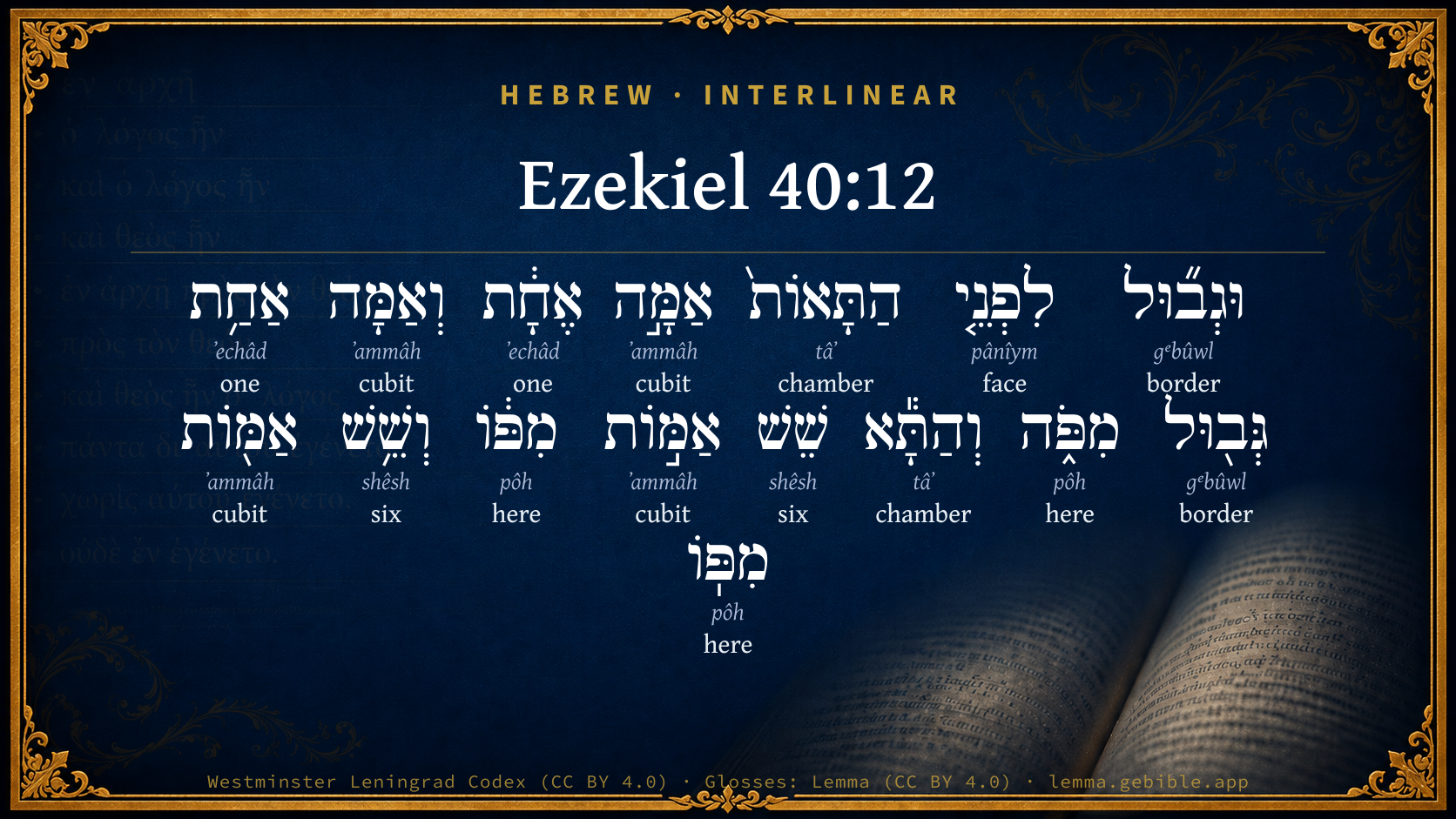
  1. וּגְב֞וּל gᵉbûwl H1366 “and · border” Conjunction + Noun, Common, Masculine, Singular, Absolute
  2. לִפְנֵ֤י pânîym H6440 “to/for · face(s) of” Preposition + Noun, Common, Both, Plural, Construct
  3. אַמָּ֣ה ʼammâh H520 “cubit” Noun, Common, Feminine, Singular, Absolute
  4. אֶחָ֔ת ʼechâd H259 “one” Adjective, Cardinal number, Feminine, Singular, Absolute
  5. וְאַמָּה ʼammâh H520 “and · cubit” Conjunction + Noun, Common, Feminine, Singular, Absolute
  6. אַחַ֥ת ʼechâd H259 “one” Adjective, Cardinal number, Feminine, Singular, Absolute
  7. גְּב֖וּל gᵉbûwl H1366 “border” Noun, Common, Masculine, Singular, Absolute
  8. מִפֹּ֑ה pôh H6311 “from · here” Preposition + Adverb
  9. וְהַתָּ֕א tâʼ H8372 “and · the · chamber” Conjunction + Particle, Definite Article + Noun, Common, Masculine, Singular, Absolute
  10. שֵׁשׁ shêsh H8337 “six” Adjective, Cardinal number, Feminine, Singular, Absolute
  11. אַמּ֣וֹת ʼammâh H520 “cubits” Noun, Common, Feminine, Plural, Absolute
  12. מִפּ֔וֹ pôh H6311 “from · here” Preposition + Adverb
  13. וְשֵׁ֥שׁ shêsh H8337 “and · six” Conjunction + Adjective, Cardinal number, Feminine, Singular, Absolute
  14. אַמּ֖וֹת ʼammâh H520 “cubits” Noun, Common, Feminine, Plural, Absolute
  15. מִפּֽוֹ pôh H6311 “from · here” Preposition + Adverb

About this verse

These counts appear in no published source. They are computed here, from the morphology-tagged text and Lemma’s own curated glosses. What Lemma adds →

16
words
7
distinct lemmas
Prophets
section

Notable vocabulary

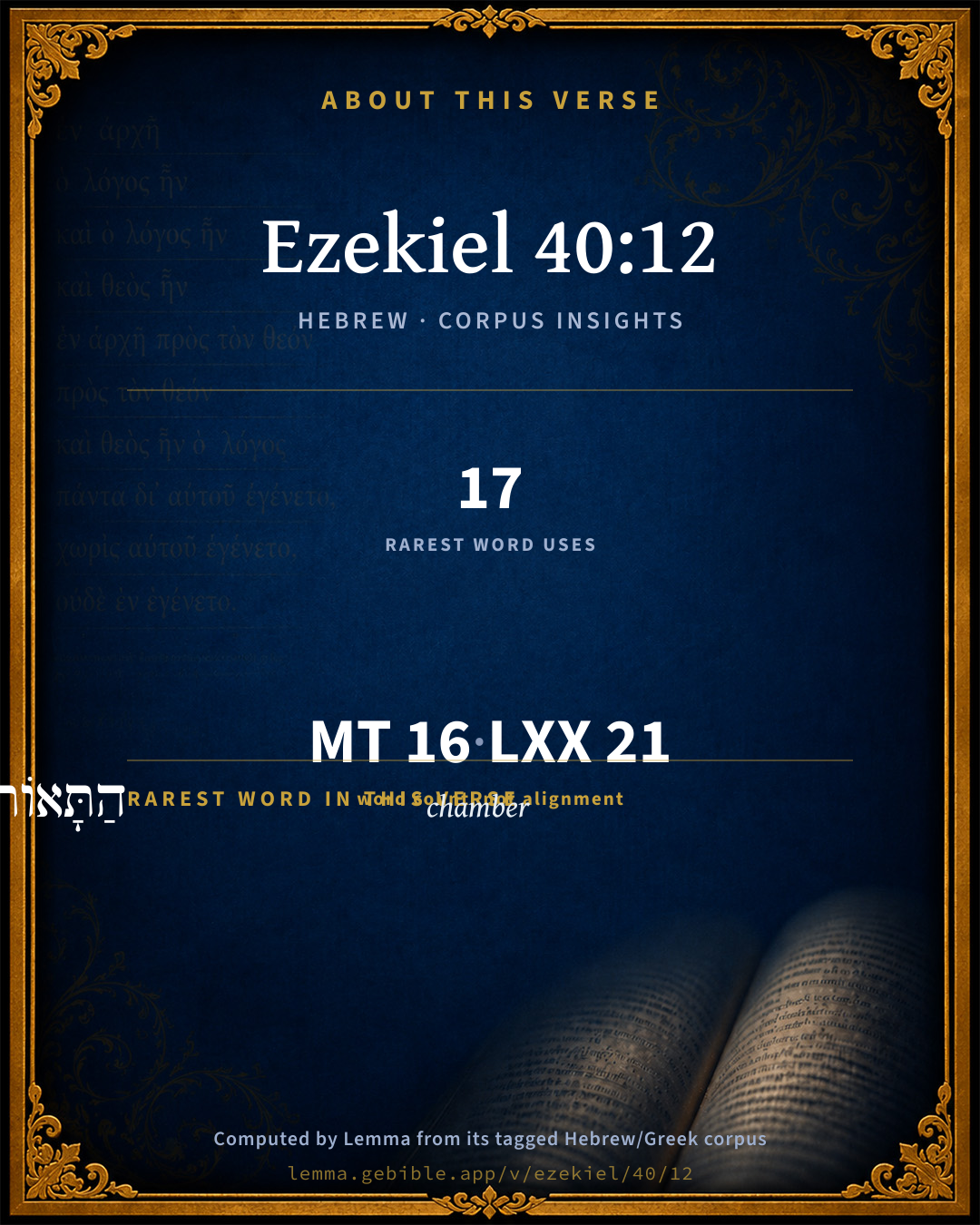
The rarest word here is הַתָּאוֹת֙ chamber H8372 — appearing just 17 times in the whole Hebrew Bible.

Shared distinctive vocabulary

הַתָּאוֹת֙ chamber H8372 occurs in 11 verses of the Hebrew Bible. Also found in:

Grammatical profile

  • 9 nouns
  • 4 adjectives
  • 3 adverbs

Repetition

Words recur within this verse — often emphatic in Hebrew:

  • אַמָּ֣ה cubit H520 ×4
  • מִפֹּ֑ה here H6311 ×3
  • וּגְב֞וּל border H1366 ×2
  • הַתָּאוֹת֙ chamber H8372 ×2
  • אֶחָ֔ת one H259 ×2
  • שֵׁשׁ six H8337 ×2

Hebrew & Septuagint length

In English translation the verse runs 33 words from the Hebrew and 36 from the Septuagint (LXX English) — closely comparable.

A rough comparison of the two English renderings, which tokenize alike — not a word-level alignment.

Word counts can differ between the Hebrew and the Greek without any difference in meaning — e.g. the Hebrew direct-object marker אֵת has no separate Greek word, and Greek often adds the article ὁ.

In the original languages it is 16 Hebrew tokens and 21 Greek tokens — but the two are counted differently (Hebrew bundles its prefixes and suffixes into one token; the Greek is in lemma form), so that isn’t a like-for-like length.

Hebrew and Greek witnesses Masoretic Hebrew ↔ Greek Septuagint

The same verse in the two great witnesses to the Old Testament, shown verse-for-verse.

These are two independent witnesses, not word-aligned to each other, and the Septuagint is shown in lemma (dictionary) form.

Hebrew Ezekiel 40:12 Masoretic · Westminster Leningrad Codex

וּגְב֞וּל לִפְנֵ֤י הַתָּאוֹת֙ אַמָּ֣ה אֶחָ֔ת וְאַמָּה אַחַ֥ת גְּב֖וּל מִפֹּ֑ה וְהַתָּ֕א שֵׁשׁ אַמּ֣וֹת מִפּ֔וֹ וְשֵׁ֥שׁ אַמּ֖וֹת מִפּֽוֹ

and a border before the lodges, one cubit [on this side], and a border, one cubit on that side; and the lodges, six cubits on this side, and six cubits on that side.

World English Bible · Public Domain

Greek LXX Ezekiel 40:12 Septuagint · lemma form

καί πῆχυς ἐπι συνἄγω ἐπί πρόσωπον ὁ θείμ ἔνθεν καί ἔνθεν καί ὁ θεε πηχύς ἕξ ἔνθεν καί πηχύς ἕξ ἔνθεν

And the space before the chambers was narrowed to a cubit in front of the chambers on this side and on that side: and the chamber was six cubits this way, and six cubits that way.

LXX2012 (modern English Septuagint) · Public Domain

Hebrew: Westminster Leningrad Codex (CC BY 4.0). Greek: Septuagint (public domain); English from LXX2012 (modern English Septuagint) (Public Domain). How the Septuagint differs from the Hebrew →

Targum (Aramaic paraphrase)

1

The Targum is the ancient Jewish Aramaic paraphrase of the Hebrew Scriptures — an interpretive translation, not the Hebrew text itself. Onkelos (literal) and Pseudo-Jonathan (expansive) render the Torah, and Jonathan the Prophets. Coverage is partial: where no permissively-licensed English translation exists for a verse, only the Aramaic is shown. This is verse-level text, not a word-by-word alignment to the Hebrew.

  1. Targum Jonathan Prophets (Joshua–Malachi)
    וּתְחוּמָא דִי קֳדָם תְּוַיָא אַמְתָא חֲדָא וְאַמְתָא חֲדָא תְחוּמָא מִכָּא וּתְוָא שִׁית אַמִין מִכָּא וְשִׁית אַמִין מִכָּא:

    (no public-domain English translation for this verse)

    Targum Jonathan — Aramaic: “Mikraot Gedolot” (public domain). English: “Sefaria Community Translation” (CC0 1.0 (public-domain dedication)); “London "Chaldee Paraphrase," 1871” (public domain). Text via Sefaria.

Commentary

Notes on Ezekiel 40:12 from classic Christian and Jewish commentators (each source and its license shown beneath its notes). The classic Christian expositions comment on the surrounding passage and are grouped to its opening verse, so a note may address several verses; the Jewish commentaries on the Tanakh (Rashi and others) are per-verse, so they appear only where the commentator wrote on this verse.

Lemma curates 59 commentaries, every one of them public domain or Creative Commons licensed, each selected and text-cleaned for this edition rather than reprinted as found. About our sources →

Trapp's Complete Commentary

John Trapp

Eze 40:12 The space also before the little chambers [was] one cubit [on this side], and the space [was] one cubit on that side: and the little chambers [were] six cubits on this side, and six cubits on that side.

Ver. 12. The space also before the little chambers.] Which space served either for seats, walks, or eaves rather at either end.

John Trapp, A Commentary or Exposition upon All the Books of the Old and New Testament (1647–1656) — public domain. Text from a community e-Sword module.

Jamieson, Fausset & Brown

Robert Jamieson, A. R. Fausset & David Brown

space--rather, "the boundary."

Jamieson, Fausset & Brown — Commentary Critical and Explanatory on the Whole Bible (1871) — public domain (CC PDM 1.0). Text via the HelloAO Bible API.

The Cambridge Bible for Schools and Colleges

gen. ed. J. J. S. Perowne

12. space … before the little chambers] A barrier before the guardrooms, one cubit, Fig. 1, fg, hi, kl. The meaning appears to be that the barrier took away a cubit on each side from the passage, reducing it from 10 to 8 cubits opposite the guard chambers. The height of the barrier would probably not be very great. The measure of “a cubit” can hardly be the height, as all the measurements refer here to breadth.

The Cambridge Bible for Schools and Colleges (gen. ed. J. J. S. Perowne; Cambridge University Press, 1878–1918) — public domain. Text from a community e-Sword module.

John Gill's Exposition

The space also before the little chambers was one cubit on this side,.... Or, "a border" (a) of half a yard and three inches to the front of the chambers; where those that belonged to them might walk, or have seats to sit on; such a space there was before the three little chambers on the north side of the porch:

and the space was one cubit on that side: a space or border of the same measure was to the front of the three little chambers on the south side of the porch: this may denote the Christian liberty of the members of Gospel churches; which they may use without any breach of piety towards God, or of charity one to another:

and the little chambers were six cubits on this side, and six cubits on that side; they were of the same measure, those on one side, as those of the other, even six cubits square; or one reed, which is the same; see Eze 40:7; see Gill on Eze 40:7.

(a) "terminus", Munster, Pagninus, Montanus, Junius & Tremellius, Piscator.

John Gill's Exposition of the Whole Bible (1746–1763) — public domain (CC PDM 1.0). Text via the HelloAO Bible API.

Matthew Poole's English Annotations

The space; the bound, limit, or rails, as some think, which were set up at a cubit distance from the front of these little chambers, and gave a beauty to them; or else the space of a cubit on the outside for convenient placing of benches for the priests to sit on, while they observed who came in and went out of the gate.

The little chambers: see Eze 40:7.

The space between the rails, or balusters, and the chambers on each side, north and south. There was no difference in the dimensions of these little chambers, they were all alike on each side.

Matthew Poole's English Annotations on the Holy Bible (1683–1685) — public domain. Text from a community e-Sword/MySword module.

Whedon's Commentary on the Bible

Daniel D. Whedon

12. R.V. reads, “and a border before the lodges, one cubit on this side, and a border, one cubit on that side.” (Compare Eze_27:4; Eze_43:13; Eze_43:17.) Plumptre supposes this border formed a pathway for the guards at the gate, who could thus observe what was going on in the gate without being interrupted by the traffic.

Daniel D. Whedon (gen. ed.), Commentary on the Old and New Testaments (1874–1909) — public domain. Text from a community e-Sword module.

The Pulpit Commentary

The space also before the little chambers; more correctly, and a border be fore the ledges. Though the construction of this border, fence, or barrier (comp. Eze_27:4 Eze_43:13, Eze_43:17; Exo_19:12) is not described, its design most likely was to enable the guardsman, by stepping beyond his coil, to observe what was going on in the gate without either interrupting or being interrupted by the passengers. As the barrier projected one cubit on each side of the ten-cubit way, only eight cubits remained for persons going in or out.

The Pulpit Commentary (1880–1919), ed. H.D.M. Spence-Jones & Joseph S. Exell — public domain. Text from a community e-Sword module.

John Wesley's Explanatory Notes

The space - The rails, which were set up at a cubit distance from the front of these little chambers, on the outside for convenient placing of benches for the priests to sit on. The space - Between the rails, and the chambers.

John Wesley, Explanatory Notes Upon the Whole Bible (1754–1765) — public domain. Text via the GEBible commentary corpus.

Rashi

Rabbi Shlomo Yitzchaki (Rashi)

And a border [area] was before the cells of one cubit, etc. The cells on either side of the gate were inset [away] from being in line with the area of the inward-going hall, a cubit to the north and a cubit to the south. For he already made it clear that on the inside, it [the space] was extended beyond from the [the area] facing the space of the gate, a cubit and a half to the north and likewise to the south. Now he explains that the cells which were on the outside were recessed to the north, one cubit more than the hall, and likewise one cubit to the south. As a result, they were recessed from the area of the [gate’s] entrance’s width, two and a half cubits to this side and two and a half cubits to this side. This is [the meaning of] the word וּגְבוּל, somayl in Old French, border, limit, an empty place. The wall of the cell was five cubits thick, resulting in the thickness of the northern wall of the northern cell, and the thickness of the northern wall of the hall, ending opposite each other. For the wall of the hall was six cubits thick and the wall of the cell was five, and it was extended one cubit inward opposite the thickness of the wall of the hall, and likewise, to the south.

Rashi on the Tanakh — English translations: “The Judaica Press complete Tanach with Rashi, translated by A. J. Rosenberg” (CC BY 4.0); “Pentateuch with Rashi's commentary by M. Rosenbaum and A.M. Silbermann, 1929-1934” (public domain); “The Metsudah Tanach series, Lakewood, N.J” (CC BY 4.0); and “The Book of Joshua, Metsudah Publications, 1997” (CC BY 4.0). Text via Sefaria.

Lesson kit

Teaching starters — assembled from the data on this page, not authored interpretation. Every prompt links to the verse data it draws on. Edit before teaching.

Ezekiel, in the Prophets, opens this verse with 16 words (7 distinct Hebrew lemmas). Its most distinctive word is tâʼ (“chamber”). A historical commentator’s framing appears above. Read the whole chapter for the surrounding context.

Discussion questions

  1. How does “chamber” (tâʼ) shape what this verse is saying?
  2. 1 Kings 14:28 shares the word «chamber» with this verse. How do the two illuminate each other?
  3. “cubit” occurs 4× in this one verse. What is the effect of the repetition?
  4. The translations on this page render this verse differently — a whole-verse word diff, not a word-by-word alignment. What might account for the different wordings?
  5. Reading how Trapp's Complete Commentary and Jamieson, Fausset & Brown read this verse, where do the two commentators agree and where do they part?

Things to notice

Reading settings

Reading text

Shown beneath each verse's original-language words.

Old Testament
Old Testament edition

Read the OT as the Masoretic Hebrew (MT) or the Greek Septuagint (LXX).

English shown for the Greek Septuagint (in the Hebrew ↔ Greek comparison).

Comparing translations? Open the Compare panel on any verse page to stack up to four side by side.