
1 Chronicles 6:54

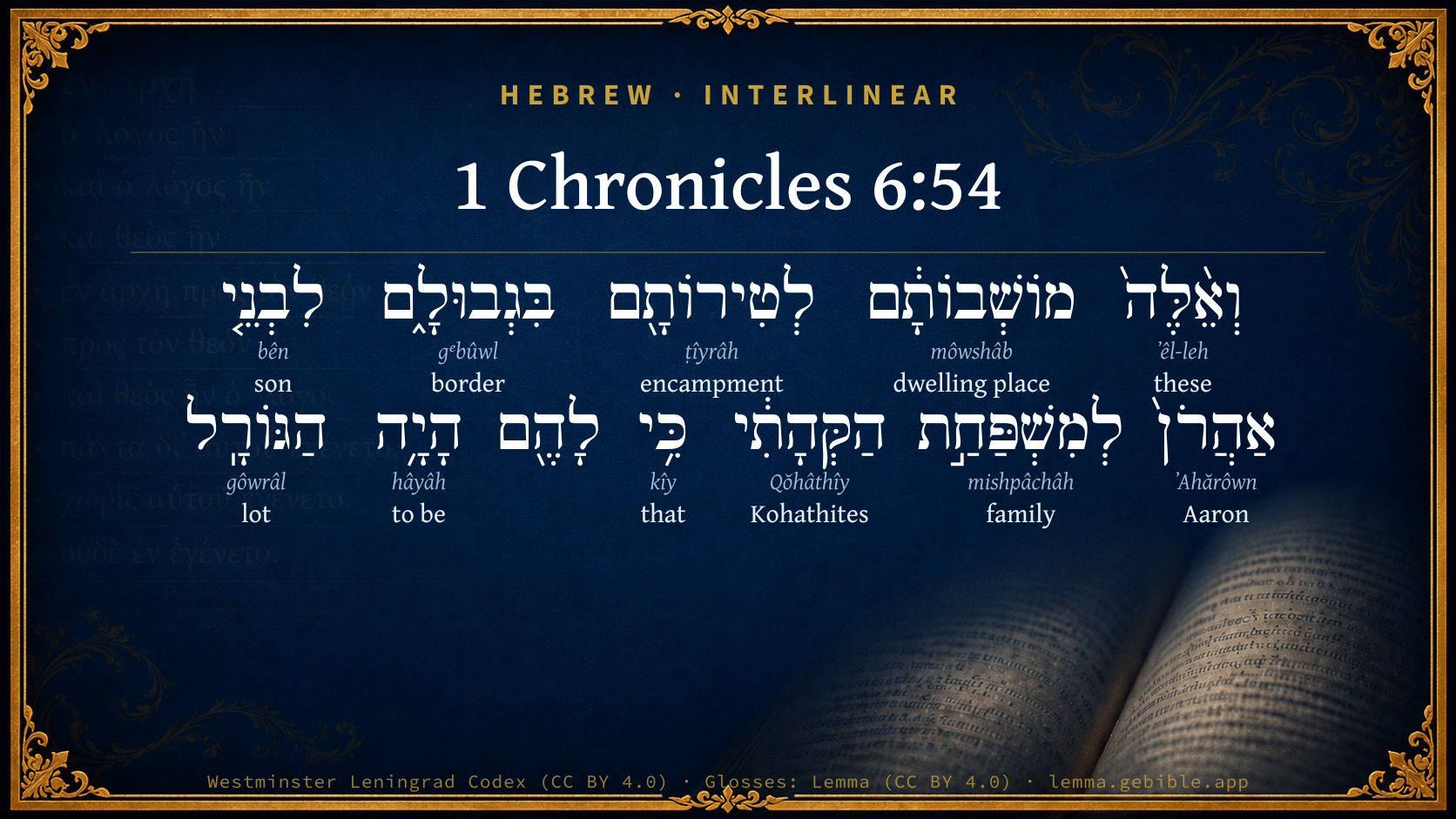
Hebrew (Westminster Leningrad Codex) 1 Chronicles 6:54 appears in the Hebrew Old Testament. The text above is from the Westminster Leningrad Codex. Each word links to its Strong’s number, a concise gloss, and parsing drawn from the Open Scriptures Hebrew Bible morphology. Click any word for its full Brown-Driver-Briggs (BDB) entry.
Download image
Cite this verse

1 Chronicles 6:54 (World English Bible). Public Domain. Lemma interlinear Bible study tool, https://lemma.gebible.app/v/1-chronicles/6/54.

Show BibTeX & RIS
BibTeX
RIS
English Translation
Now these are their dwelling-places according to their encampments in their borders: to the sons of Aaron, of the families of the Kohathites (for theirs was the [first] lot),
World English Bible · Public Domain
Download a study sheet

One document with this verse’s original text, its word-by-word gloss line, the meaning frame, cross-references with their text, attributed commentary, and full source and license credits — printable, and it pastes into notes with its structure intact.

This verse Autodidact and up

Study sheet (.html) Plain text (.txt)

A passage Seminary Student

Up to 50 verses in one chapter. A passage sheet keeps up to 6 commentary sources and 12 cross-references per verse, in the order this page ranks them, and says so on the sheet whenever that leaves anything out. Ask for a single verse and you get the Autodidact verse sheet above.

Everything on this page stays free to read, with no account — the sheet is a download of what is already on screen, not access to it.

Want to remove ads? Support Godless Engineer
Compare translations 3

The same verse in 3 English versions, stacked beneath the original-language interlinear above. Click any original word for its lexicon entry.

Each is an independent rendering of the whole verse — the interlinear is not word-aligned to these translations.

Highlighted words mark where these versions differ — a whole-verse word diff, not a word-by-word alignment.

  • World English Bible Public Domain
    Now these are their dwelling-places according to their encampments in their borders: to the sons of Aaron, of the families of the Kohathites (for theirs was the [first] lot),
  • King James Version Public Domain
    Now these are their dwelling places throughout their castles in their coasts, of the sons of Aaron, of the families of the Kohathites: for theirs was the lot.
  • unfoldingWord Literal Text CC BY-SA 4.0
    And these their dwellings according to their habitations in their border. To the sons of Aaron, to the clan of the Kohathite (for to them was the lot),

unfoldingWord Literal Text — © unfoldingWord, licensed CC BY-SA 4.0. Word-aligned USFM3 via Door43 (git.door43.org/unfoldingWord/en_ult).

Versions to compare (up to 4)

3 of 4 selected

Show all 18 translations

Every available English version of this verse, each an independent rendering of the whole verse.

  • World English Bible Public Domain
    Now these are their dwelling-places according to their encampments in their borders: to the sons of Aaron, of the families of the Kohathites (for theirs was the [first] lot),
  • Berean Standard Bible Public Domain
    Now these were the territories assigned to the descendants of Aaron from the Kohathite clan for their settlements, because the first lot fell to them:
  • Majority Standard Bible Public Domain
    Now these were the territories assigned to the descendants of Aaron from the Kohathite clan for their settlements, because the first lot fell to them:
  • King James Version Public Domain
    Now these are their dwelling places throughout their castles in their coasts, of the sons of Aaron, of the families of the Kohathites: for theirs was the lot.
  • American Standard Version (1901) Public Domain
    Now these are their dwelling-places according to their encampments in their borders: to the sons of Aaron, of the families of the Kohathites (for theirs was the `first' lot),
  • Revised Version (1885) Public Domain
    Now these are their dwelling places according to their encampments in their borders: to the sons of Aaron, of the families of the Kohathites, for theirs was the first lot,
  • Geneva Bible (1599) Public Domain
    And these are the dwelling places of them throughout their townes and coastes, euen of the sonnes of Aaron for the familie of the Kohathites, for the lot was theirs.
  • Douay-Rheims (1899) Public Domain
    And these are their dwelling places by the towns and confines, to wit, of the sons of Aaron, of the families of the Caathites: for they fell to them by lot.
  • Young's Literal Translation Public Domain
    And these `are' their dwellings, throughout their towers, in their borders, of the sons of Aaron, of the family of the Kohathite, for theirs was the lot;
  • Literal Standard Version CC BY-SA 4.0
    And these [are] their dwellings, throughout their towers, in their borders, of the sons of Aaron, of the family of the Kohathite, for the lot was theirs;
  • Unlocked Literal Bible CC BY-SA 4.0
    These are the locations where Aaron's descendants were assigned to live, that is, for the descendants of Aaron who were from the clans of the Kohathites (the first lot was theirs).
  • unfoldingWord Literal Text CC BY-SA 4.0
    And these their dwellings according to their habitations in their border. To the sons of Aaron, to the clan of the Kohathite (for to them was the lot),
  • Darby Bible Public Domain
    And these are their dwelling-places according to their encampments, within their borders. For the sons of Aaron, of the family of the Kohathites, for theirs was the lot;
  • World Messianic Bible Public Domain
    Now these are their dwelling places according to their encampments in their borders: to the sons of Aaron, of the families of the Kohathites (for theirs was the first lot),
  • Webster's Bible Public Domain
    Now these are their dwelling-places throughout their castles in their limits, of the sons of Aaron, of the families of the Kohathites: for theirs was the lot.
  • Free Bible Version CC BY-SA 4.0
    These were the places they were given to live as their territory allotted to descendants of Aaron, beginning with the Kohathite clan, because theirs was the first lot:
  • Bible in Basic English Public Domain
    Now these are their living-places, the limits inside which they were to put up their tents: to the sons of Aaron, of the families of the Kohathites, because they had the first selection,
  • JPS Tanakh (1917) Public Domain
    (6-39) Now these are their dwelling-places according to their encampments in their borders: to the sons of Aaron, of the families of the Kohathites, for theirs was the first lot,

Literal Standard Version (2020), Covenant Press — licensed CC BY-SA 4.0. Text via the HelloAO Bible API (eBible.org). Unlocked Literal Bible (unfoldingWord) — licensed CC BY-SA 4.0. Text via the HelloAO Bible API (eBible.org). unfoldingWord Literal Text — © unfoldingWord, licensed CC BY-SA 4.0. Word-aligned USFM3 via Door43 (git.door43.org/unfoldingWord/en_ult). Free Bible Version, Dr. Jonathan Gallagher — licensed CC BY-SA 4.0. Text via the HelloAO Bible API (eBible.org).

Word by word

More ways to search: Search by grammar → Find every occurrence → Compare this word →

Practice this passage: Drill this verse → Learn its vocabulary →

לְטִירוֹתָ֖ם
ṭîyrâh
H2918
“to/for · encampments · their”
Preposition + Noun, Common, Feminine, Plural, Construct + Suffix, Personal, 3rd Person, Masculine, Plural
Part of Speech
Preposition + Noun
Type
Common
Gender
Feminine
Number
Plural
State
Construct
Full BDB Definition

Origin: from (an equivalent to) H2905

TWOT: 798b

encampment, battlement - encampment, tent camp - walled dwelling places, battlement (metaphorically) - row (of stones)
  1. וְאֵ֨לֶּה֙ ʼêl-leh H428 “and · these” Conjunction + Pronoun, Demonstrative, Common, Plural
  2. מוֹשְׁבוֹתָ֔ם môwshâb H4186 “dwelling places · their” Noun, Common, Masculine, Plural, Construct + Suffix, Personal, 3rd Person, Masculine, Plural
  3. בִּגְבוּלָ֑ם gᵉbûwl H1366 “in/at · border · their” Preposition + Noun, Common, Masculine, Singular, Construct + Suffix, Personal, 3rd Person, Masculine, Plural
  4. לִבְנֵ֤י bên H1121 “to/for · sons of” Preposition + Noun, Common, Masculine, Plural, Construct
  5. אַהֲרֹן֙ ʼAhărôwn H175 “Aaron” Noun, Proper
  6. לְמִשְׁפַּחַ֣ת mishpâchâh H4940 “to/for · family of” Preposition + Noun, Common, Feminine, Singular, Construct
  7. הַקְּהָתִ֔י Qŏhâthîy H6956 “the · Kohathites” Particle, Definite Article + Noun, Gentilic, Masculine, Singular, Absolute
  8. כִּ֥י kîy H3588 “that” Conjunction
  9. הָיָ֥ה hâyâh H1961 “to be” Verb, Qal, Perfect, 3rd Person, Masculine, Singular
  10. הַגּוֹרָֽל gôwrâl H1486 “the · lot” Particle, Definite Article + Noun, Common, Masculine, Singular, Absolute

About this verse

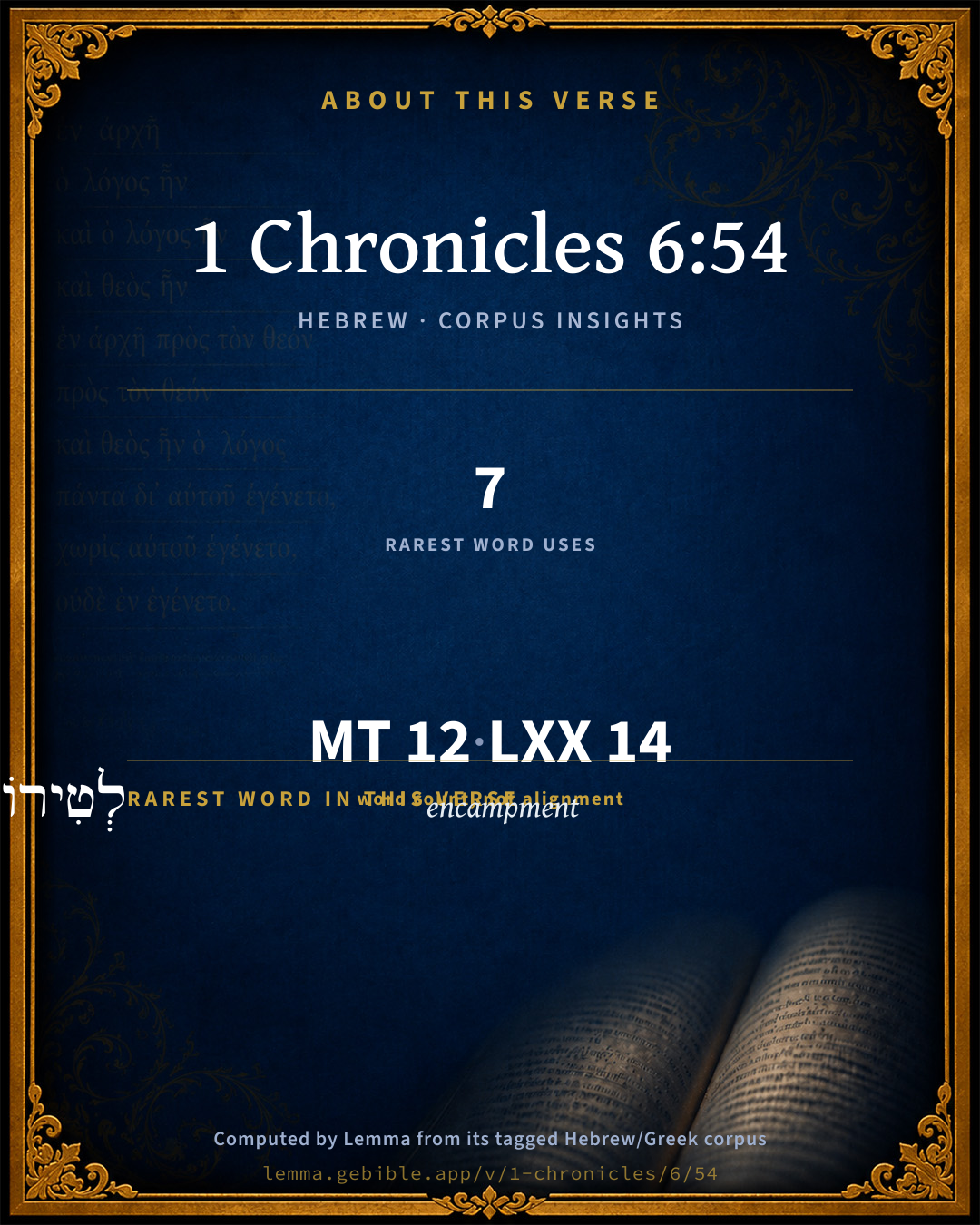
These counts appear in no published source. They are computed here, from the morphology-tagged text and Lemma’s own curated glosses. What Lemma adds →

12
words
11
distinct lemmas
Historical
section

Notable vocabulary

The rarest word here is לְטִירוֹתָ֖ם encampment H2918 — appearing just 7 times in the whole Hebrew Bible.

Shared distinctive vocabulary

לְטִירוֹתָ֖ם encampment H2918 occurs in 7 verses of the Hebrew Bible. Also found in:

Grammatical profile

  • 1 verb
  • 8 nouns
  • 1 pronoun
  • 1 preposition
  • 1 conjunction

Verb forms

  • הָיָ֥ה Qal · Perfect

Hebrew & Septuagint length

In English translation the verse runs 29 words from the Hebrew and 26 from the Septuagint (LXX English) — closely comparable.

A rough comparison of the two English renderings, which tokenize alike — not a word-level alignment.

Word counts can differ between the Hebrew and the Greek without any difference in meaning — e.g. the Hebrew direct-object marker אֵת has no separate Greek word, and Greek often adds the article ὁ.

In the original languages it is 12 Hebrew tokens and 14 Greek tokens — but the two are counted differently (Hebrew bundles its prefixes and suffixes into one token; the Greek is in lemma form), so that isn’t a like-for-like length.

Cross-references

5

Topical passages linked to 1 Chronicles 6:54 in the Treasury of Scripture Knowledge — connected by theme and wording, ordered by reader-vote popularity; previews shown in the World English Bible.

  • Genesis 25:16 These are the sons of Ishmael, and these are their names, by their villages, and by their encampments: twelve princes, according to their nations.
  • Numbers 31:10 All their cities in the places in which they lived, and all their encampments, they burnt with fire.
  • Numbers 35:1–8 Yahweh spoke to Moses in the plains of Moab by the Jordan at Jericho, saying,
  • Joshua 21:3–8 The children of Israel gave to the Levites out of their inheritance, according to the commandment of Yahweh, these cities with their suburbs.
  • Joshua 21:10 and they were for the children of Aaron, of the families of the Kohathites, who were of the children of Levi; for theirs was the first lot.

Cross-references courtesy of OpenBible.info (CC BY 4.0).

Hebrew and Greek witnesses Masoretic Hebrew ↔ Greek Septuagint

The same verse in the two great witnesses to the Old Testament, shown verse-for-verse.

These are two independent witnesses, not word-aligned to each other, and the Septuagint is shown in lemma (dictionary) form.

Hebrew 1 Chronicles 6:54 Masoretic · Westminster Leningrad Codex

וְאֵ֨לֶּה֙ מוֹשְׁבוֹתָ֔ם לְטִירוֹתָ֖ם בִּגְבוּלָ֑ם לִבְנֵ֤י אַהֲרֹן֙ לְמִשְׁפַּחַ֣ת הַקְּהָתִ֔י כִּ֥י לָהֶ֖ם הָיָ֥ה הַגּוֹרָֽל

Now these are their dwelling-places according to their encampments in their borders: to the sons of Aaron, of the families of the Kohathites (for theirs was the [first] lot),

World English Bible · Public Domain

Greek LXX 1 Chronicles 6:54 Septuagint · lemma form

καί ὁ εγλαμ καί ὁ περισπόριον αὐτός καί ὁ γεθρεμμων καί ὁ περισπόριον αὐτός

And these are their residences in their villages, in their coasts, to the sons of Aaron, to their family the Caathites: for they had the lot.

LXX2012 (modern English Septuagint) · Public Domain

Hebrew: Westminster Leningrad Codex (CC BY 4.0). Greek: Septuagint (public domain); English from LXX2012 (modern English Septuagint) (Public Domain). How the Septuagint differs from the Hebrew →

Commentary

Notes on 1 Chronicles 6:54 from classic Christian and Jewish commentators (each source and its license shown beneath its notes). The classic Christian expositions comment on the surrounding passage and are grouped to its opening verse, so a note may address several verses; the Jewish commentaries on the Tanakh (Rashi and others) are per-verse, so they appear only where the commentator wrote on this verse.

Lemma curates 59 commentaries, every one of them public domain or Creative Commons licensed, each selected and text-cleaned for this edition rather than reprinted as found. About our sources →

Matthew Henry's Commentary

We have here an account of the Levites' cities. They are here called their castles (Ch1 6:54), not only because walled and fortified, and well guarded by the country (for it is the interest of every nation to protect its ministers), but because they and their possessions were, in a particular manner, the care of the divine providence: as God was their portion, so God was their protection; and a cottage will be a castle to those that abide under the shadow of the Almighty. This account is much the same with that which we had, Jos. 21. We need not be critical in comparing them (what good will it do us?) nor will it do any hurt to the credit of the holy scripture if the names of some of the places be not spelt just the same here as they were there. We know it is common for cities to have several names. Sarum and Salisbury, Salop and Shrewsbury, are more unlike than Hilen (Ch1 6:58) and Holon (Jos 21:15), Ashan (Ch1 6:59) and Ain (Jos 21:16), Alemeth (Ch1 6:60) and Almon (Jos 21:18); and time changes names. We are only to observe that in this appointment of cities for the Levites God took care, 1. For the accomplishment of dying Jacob's prediction concerning this tribe, that it should be scattered in Israel, Gen 49:7. 2. For the diffusing of the knowledge of himself and his law to all parts of the land of Israel. Every tribe had Levites' cities in it; and so every room was furnished with a candle, so that none could be ignorant of his duty but it was either his own fault or the Levites'. 3. For a comfortable maintenance for those that ministered in holy things. Besides their tithes and offerings, they had glebe-lands and cities of their own to dwell in. Some of the most considerable cities of Israel fell to the Levites' lot. Every tribe had benefit by the Levites, and therefore every tribe must contribute to their support. Let him that is taught in the word communicate to him that teacheth, and do it cheerfully.

Matthew Henry's Commentary on the Whole Bible (1708–1710) — public domain (CC PDM 1.0). Text via the HelloAO Bible API.

Ellicott's Commentary for English Readers

(54) Render, “And these were their seats according to their encampments within their border.” This, as the heading to all that follows, should be stopped off therefrom. It does not occur in Joshua 21, and may indicate an intermediate source used by the chronicler. The variant spellings of proper names, many of which are not mere copyists’ blunders, point in the same direction.

Of the sons of Aaron.—Rather, “to the sons of Aaron, of the clan of the Kohathites—for to them had fallen the lot—they gave to them Hebron,” &c. Jos_21:10 has, “for to them the lot had fallen first.”

(54-81) The Levitical cities, beginning with those of the Aavonites, the principal branch of the Kohathite clan. This list deals with the same topic as Jos_21:3-40, with which, upon the whole, it is in substantial agreement. 1Ch_6:54-60 are parallel to Jos_21:10-19.

A Bible Commentary for English Readers, edited by Charles John Ellicott (1878–1897) — public domain. Text from a community e-Sword module.

Trapp's Complete Commentary

John Trapp

1Ch 6:54 Now these [are] their dwelling places throughout their castles in their coasts, of the sons of Aaron, of the families of the Kohathites: for theirs was the lot.

Ver. 54. Throughout their castles.] Or, Palaces. The priests dwelt not in poor cottages, but in fair and fitting houses.

John Trapp, A Commentary or Exposition upon All the Books of the Old and New Testament (1647–1656) — public domain. Text from a community e-Sword module.

Joseph Benson's Commentary

1Ch 6:54. Throughout their castles — So called, not only because walled and well guarded by the country, but because they and their possessions were in a particular manner the care of Divine Providence. As God was their portion, so God was their protector. And a cottage will be a castle to those that abide under the shadow of the Almighty. Theirs was the lot — Or, the first lot.

Joseph Benson's Commentary on the Old and New Testaments (1811–1818) — public domain. Text from a community e-Sword module.

Tyndale Open Study Notes

Tyndale Open Resources

6:54-81 The list of Levitical cities is derived from Josh 21, following a geographical logic, with families grouped in defined geographical districts. To show the unity and completeness of Israel, the territorial list presents the Levites as settled in the land to the same extent as the other tribes.

Tyndale Open Study Notes — © Tyndale Open Resources, licensed CC BY-SA 4.0. Text via the HelloAO Bible API.

Geneva Bible (1599)

Geneva Bible translators

They were first appointed, and prepared for.

Or, cities which were given to the Levites.

Geneva Bible (1599) marginal notes — public domain. Text via Bolls.life.

Adam Clarke's Commentary

Verse 54. Theirs was the lot.] All the tribes and families obtained their respective inheritances by lot, but to the sons of Aaron was the first lot; and so the Syriac and Arabic have understood this place. The first lot, says Jarchi, fell to Judah, that they might give to the priests and the Levites the cities marked below. See an account of the possessions of the priests and Levites, Josh. 20, 21.

Adam Clarke's Commentary on the Bible (1810–1826) — public domain. Text from a community e-Sword/MySword module.

The Cambridge Bible for Schools and Colleges

gen. ed. J. J. S. Perowne

54–60 (= Jos_21:10-19). The [thirteen] cities of the Aaronites

54. throughout their castles] R.V. according to their encampments. The Heb. word is used of the circular encampments of nomads.

their coasts] R.V. their borders.

the lot] R.V. the first lot (cp. Jos_21:4; Jos_21:10).

54–81 (= 39–66 according to the Heb. division). The forty-eight Levitic cities

This section has been adopted with some rearrangement from the parallel passage in Joshua. In Joshua the number of cities taken from each group of tribes and given to its respective division of the Levites is first stated, no city being named; and next the names of the cities are given under each division of the Levites and under the name of the tribe from which the cities were taken. In Chron. the cities given to the Aaronites are first mentioned by name and reckoned to be thirteen In number (1Ch_6:55-60); next the cities given to each remaining division of the Levites are reckoned shortly by number only (1Ch_6:61-63); lastly, these cities are separately reckoned at length by name only (1Ch_6:66-81). This rearrangement is not happy; perhaps the Chronicler originally intended to give the Aaronite cities only by name as well as number, and so 1Ch_6:66-81 (containing the names of the non-Aaronite cities) may be a supplement to the original text. Notice that no names of cities taken from Simeon are given; cp. 1Ch_6:65; Jos_21:9.

(Critical Note on 54–81.)

The text of the passage has suffered in transcription. In 1Ch_6:55-60 eleven names are given, but thirteen are reckoned (1Ch_6:60), the explanation being that the names Juttah and Gibeon (Jos_21:16-17) have fallen out. In 1Ch_6:61, after or before Manasseh the names of Ephraim and Dan have fallen out (cp. 1Ch_6:66 and Jos_21:5); Manasseh contributed only two out of the ten cities. Before 1Ch_6:69 we must restore from Jos_21:23 the words, And out of the tribe of Dan, Eltekeh with her suburbs, Gibbethon with her suburbs. In 1Ch_6:77 or immediately before 1Ch_6:78 two names of cities of Zebulun have fallen out; cp. 1Ch_6:63 (“twelve cities”) with 1Ch_6:77-81 (ten cities only are named).

The Cambridge Bible for Schools and Colleges (gen. ed. J. J. S. Perowne; Cambridge University Press, 1878–1918) — public domain. Text from a community e-Sword module.

Albert Barnes' Notes on the Bible

Their’s was the lot - i. e. “the first lot.” The Kohathites had the first lot among the Levitical families, as being the family whereto the high priesthood was attached (compare Jos 21:10).

Albert Barnes' Notes on the Bible (1834–1885) — public domain. Text from a community e-Sword/MySword module.

Matthew Poole's English Annotations

Or, this lot or portion which here follows. Or, the first lot, as appears by the sequel.

Matthew Poole's English Annotations on the Holy Bible (1683–1685) — public domain. Text from a community e-Sword/MySword module.

Whedon's Commentary on the Bible

Daniel D. Whedon

54. Throughout their castles — Rather, according to their castles, or encampments. These “castles” are thought by some to have been some kind of watchtower, from which the trumpets were sounded — a use similar to that made by the Moslems of their minarets. But most expositors, as Gesenius, Furst, Keil, Zochler, take the word in the sense of hamlet, district, or circle of dwellings, such as were assigned to the Levites among the several tribes.

Daniel D. Whedon (gen. ed.), Commentary on the Old and New Testaments (1874–1909) — public domain. Text from a community e-Sword module.

The Pulpit Commentary

Vers. 54-81. The writer returns upon his steps to give the cities and dwelling-places of the Levites, beginning with the priestly members of the Kohathite line (vers. 54-61), then taking those of the Gershomite (ver. 62) and Merarite lines (vers. 63-65) in order; and again in the same order disposing of the members not priestly (vers. 66-70; 71-76; 77-81) of the same three branches.

Vers. 54-61, 64-70. And these are their dwellings according to their enclosures in their territories, wOryfi means the settlements of whatever people in question, surrounded and protected by whatever fence or defence customary. For theirs was the lot is more intelligible with the addition of the word "first," supplied in Nu 31, i.e. theirs was the first lot. The whole drift of the present passage, with the remainder of the chapter, is made entirely plain by Num_35:1-8 and Jos_21:1-10. But the omission and the alteration of individual names of placesoccasion some delay. Our ver. 55 is given somewhat more fully in Jos_21:11; our ver. 56 is identical with Jos_21:12; and our vers. 57-60 correspond substantially with Jos_21:13-19, but fromthis latter source we are glad to supply the two names Juttah and Gibeon, without which we cannot add up correctly the thirteen cities of ver. 60. Also in Joshua, our Hilen, Ashan, and Alemsth appear as Holon, Ain, and Almon respectively, although in regard to the intermediate name of these three the places cannot be accepted as identical, for they are mentioned side by side in Jos_19:7 and in 1Ch_4:32, but we must admit an error involved. Ver. 56. (see Jos_14:14 Jos_21:12) Ver. 61 seems to be an anticipation of vers. 66-70, with which verses, if we incorporate it, we shall obtain substantially the same results as are found in Jos_21:5, Jos_21:20-26; but again we are glad of the latter source to supply for us the two places, Eltekeh and Gibbethon, necessary to enable us to count up the ten cities of our ver. 61, while our Jokmeam, Aner, and Bileam appear as probably the corrected readings of Kibzaim, Tanach, and Gath-rimmon respectively in Joshua. The sons of Kohath.., left (ver. 61), the residue (Authorized Version, ver. 66), the remnant (ver. 70), point (as above) to the non-priestly descendants in the Kohath line. Summing up, we see that the Kohathite priests had thirteen cities from the allotments of Judah and Simeon and Benjamin, and the Ko-hathite non-priests had ten, from Ephraim, Dan, and West Manasseh. One might detect in all this some germ of the more modern parochial system, so far at least as regards the distributed residence of a clerical and ministerial order, though not with sacred buildings similarly distributed.

Carnal provisions for spiritual men.

The references here made to the provisions for the support of the priests, and the allotment of cities for their residence, are designed to confirm their claim for reinstatement in their properties on the return from the Captivity. Priests and Levites had a right to this independent support by the appointment of God and the good will of the people they served. Levi had no proper tribal allotment. This tribe was separated for the religious service of the whole nation. Its material sustenance was made dependent on the people it served, and each tribe gave up certain of its towns for the habitation of Levitical families, and certain lands to provide them with necessary food. So we have introduced for consideration, the dependence of religious teachers on those they serve in spiritual things for the due supply of their material wants a subject to which St. Paul gives careful consideration, urging that they who "preach the gospel" may reasonably expect to "live of the gospel." Those engaged in spiritual ministrations properly expect to receive carnal ministrations,

I THE DIVINE DESIGNATION OF MEN TO SPIRITUAL WORK. Seen in Aaron and his descendants, in the prophets, in the Lord Jesus Christ himself, in apostles, and equally in the Christian Church. A designation recognized in

(1) the demand for such work;

(2) the Divine endowment of men for such work; and

(3) the call of men to undertake such work,

by the inward impulses of the Holy Spirit, by the leadings of Divine providence, and by the recognition of fitness on the part of our fellow-men. Spiritual work has in every age formed a sphere of its own, and those engaged in it have been wisely separated from common business responsibilities. Good reasons are found in

(1) the absorbing character of spiritual duties;

(2) the prolonged and continuous preparations which such duties demand;

(3) the relation of efficient spiritual work to personal soul-culture;

(4) the exigencies of human life making demands on spiritual men at all hours and seasons;

(5) and the tendency of thorough occupation with spiritual things to unfit men for the stress and toil necessary to achieve success in business life. Some forms of spiritual work (as Sunday school, visiting, etc.) are found compatible with a life amid ordinary carnal scenes; but it is well that some should leave "serving tables," and give themselves "to the Word and prayer.

II SUCH DESIGNATION TO SPIRITUAL WORK DOES NOT RELIEVE MEN FROM CARNAL NECESSITIES. The whole circle of personal and family needs remains; and God has never seen fit to employ any miraculous means for the supply of such needs for Levites, prophets, or apostles. The exception seems to be Elijah. But even God"s own Son, the world"s spiritual Redeemer, might not make stones bread, though he felt hunger, thirst, weariness, and want.

III THE RESPONSIBILITY RESTS ON MEN TO ARRANGE THE CARNAL PROVISIONS. God sends us back on two principles:

(1) brotherhood;

(2) gratitude for blessing received.

Each should find for the other what that other lacked. Those who are constantly receiving spiritual blessings are bound to acknowledge them by kindly and thoughtful gifts and provisions. Such should ever be arranged on liberal and generous scales, and such provision is sure to prove a means of grace to those who provide. St. Paul"s teaching and example on this matter are opposed. He distinctly claimed full temporal support for all Christian teachers; and he refused such aid in his own case for such sufficient reasons as make his case an exception that proves the rule.

Show wherein lies the distinction between the spiritual and the carnal, and carefully urge that it must not be unduly pressed, or the spiritual man will exaggerate his separateness, and the carnal man will feel freed from all claim to be spiritual. The carnal man is to become spiritual, learning how to be "in the world, and not of it;" and aid in attaining this the spiritual man is called to provide. So there is to be mutual helpfulness. R.T.

The Pulpit Commentary (1880–1919), ed. H.D.M. Spence-Jones & Joseph S. Exell — public domain. Text from a community e-Sword module.

John Wesley's Explanatory Notes

Castles - So called, not only because, walled and well guarded by the country; but because they and their possessions were in a particular manner the care of divine providence. As God was their portion, so God was their protector. And a cottage will be a castle to those that abide under the shadow of the Almighty. The lot - Or, the first lot.

John Wesley, Explanatory Notes Upon the Whole Bible (1754–1765) — public domain. Text via the GEBible commentary corpus.

Kretzmann's Popular Commentary

Paul E. Kretzmann

The Cities of the Levites

v. 54. Now, these are their dwelling-places throughout their castles in their coasts, literally, "by their districts in their border," of the sons of Aaron, of the families of the Kohathites; for theirs was the lot. Cf Joshua 21.

v. 55. And they gave them Hebron, in the land of Judah, and the suburbs thereof, that is, the pasture-land, round about it.

v. 56. But the fields of the city, the land under cultivation, and the villages thereof, they gave to Caleb, the son of Jephunneh, Jos 14:13; Jos 15:13.

v. 57. And to the sons of Aaron they gave the cities of Judah, namely, Hebron, the city of refuge, for those guilty of involuntary manslaughter, and Libnah with her suburbs, and Jattir, and Eshtemoa with their suburbs,

v. 58. and Hilen (or Holon) with her suburbs, Debir with her suburbs,

v. 59. and Ashan (or Ain) with her suburbs, and Beth-shemesh with her suburbs;

v. 60. and out of the tribe of Benjamin: Geba with her suburbs, and Alemeth with her suburbs, and Anathoth with her suburbs. All their cities throughout their families were thirteen cities, the names of the remaining two being given Jos 21:16-17.

v. 61. And unto the sons of Kohath, which were left of the family of that tribe, were cities given out of the half-tribe, namely, out of the half-tribe of Manasseh, by lot, ten cities, Jos 21:26.

v. 62. And to the sons of Gershom throughout their families out of the tribe of Issachar, and out of the tribe of Asher, and out of the tribe of Naphtali, and out of the tribe of Manasseh in Bashan, east of the Jordan, thirteen cities.

v. 63. Unto the sons of Merari were given by lot, throughout their families, out of the tribe of Reuben, and out of the tribe of Gad, in the southern section of the country east of Jordan, and out of the tribe of Zebulun, twelve cities, Jos 21:7.

v. 64. And the children of Israel gave to the Levites, both the priests and the three families into which they were divided, these cities with their suburbs.

v. 65. And they gave by lot out of the tribe of the children of Judah, and out of the tribe of the children of Simeon, included within that of Judah, and out of the tribe of the children of Benjamin, these cities, which are called by their names.

v. 66. And the residue of the families of the sons of Kohath, so far as the remaining Kohathites were concerned, they had cities of their coasts out of the tribe of Ephraim.

v. 67. And they gave unto them, of the cities of refuge, whose total number was six, Shechem, in Mount Ephraim, with her suburbs; they gave also Gezer with her suburbs,

v. 68. and Jokmeam with her suburbs, and Bethhoron with her suburbs,

v. 69. and Aijalon with her suburbs, and Gath-rimmon with her suburbs;

v. 70. and out of the half tribe of Manasseh, the part west of Jordan: Aner with her suburbs and Bileam with her suburbs, for the family of the remnant of the sons of Kohath. Cf Jos 21:22-35.

v. 71. Unto the sons of Gershom were given out of the family of the half tribe of Manasseh, east of Jordan, Golan, in Bashan, with her suburbs, and Ashtaroth with her suburbs;

v. 72. and out of the tribe of Issachar: Kedesh with her suburbs, Daberath with her suburbs,

v. 73. and Ramoth with her suburbs, and Anem with her suburbs;

v. 74. and out of the tribe of Asher: Mashal with her suburbs, and Abdon with her suburbs,

v. 75. and Hukok with her suburbs, and Rehob with her suburbs;

v. 76. and out of the tribe of Naphtali: Kedesh, in Galilee, with her suburbs, and Hammon with her suburbs, and Kirjathaim with her suburbs.

v. 77. Unto the rest of the children of Merari were given out of the tribe of Zebulun: Rimmon with her suburbs, Tabor with her suburbs;

v. 78. and on the other side Jordan by Jericho, on the east side of Jordan, were given them out of the tribe of Reuben: Bezer, in the wilderness, with her suburbs, and Jahzah with her suburbs,

v. 79. Kedemoth also with her suburbs, and Mephaath with her suburbs;

v. 80. and out of the tribe of Gad: Ramoth, in Gilead, with her suburbs, and Mahanaim with her suburbs,

v. 81. and Heshbon with her suburbs, and Jazer with her suburbs. "As to these cities that were assigned to the Levites, they were widely remote and separated partly in fulfilment of Jacob’s prophecy, Gen 49:7, and partly that the various districts of the country might obtain a competent supply of teachers, who might instruct the people in the knowledge and animate them to the observance of a law which had so important a bearing on the promotion both of their private happiness and their national prosperity. "

Paul E. Kretzmann, Popular Commentary of the Bible (1921–1924) — public domain. Text from a community e-Sword module.

unfoldingWord translationNotes

Door43 World Missions Community

General Information:

See: How to Translate Names

These are the locations where Aaron's descendants were assigned to live

This can be translated in active form. AT: "These are the places where God assigned Aaron's descendants to live" (See: Active or Passive)

for the descendants of Aaron ... Kohathites

"where the descendants of Aaron ... Kohathites were to live"

Kohathites (the first lot was theirs)

The Israelites drew lots to decide where people would live. AT: "Kohathites. The first lot that they drew was theirs" (See: Assumed Knowledge and Implicit Information)

Kohathites

This is the name of a people group, the descendants of Kohath (1 Chronicles 6:1). See how you translated this in 1 Chronicles 6:33.

To them they gave Hebron

"They gave Hebron to the Kohathites"

its pasturelands

the land with grass for animals to eat. See how you translated this in 1 Chronicles 5:16.

translationWords

clan

lots

Hebron

kingdom of Judah

Caleb

unfoldingWord translationNotes — © Distant Shores Media and the Door43 World Missions Community, licensed CC BY-SA 4.0. Source: git.door43.org/Door43/en_tn.

Lesson kit

Teaching starters — assembled from the data on this page, not authored interpretation. Every prompt links to the verse data it draws on. Edit before teaching.

1 Chronicles, in the Historical, opens this verse with 12 words (11 distinct Hebrew lemmas). Its most distinctive word is ṭîyrâh (“encampment”). A historical commentator’s framing appears above. Read the whole chapter for the surrounding context.

Discussion questions

  1. How does “encampment” (ṭîyrâh) shape what this verse is saying?
  2. Genesis 25:16 shares the word «encampment» with this verse. How do the two illuminate each other?
  3. These translations render this verse differently. What is at stake in choosing one wording over another?
  4. The verb «הָיָ֥ה» is Qal Perfect. How does its form color the action?
  5. Reading how Matthew Henry's Commentary and Ellicott's Commentary for English Readers read this verse, where do the two commentators agree and where do they part?

Things to notice

Reading settings

Reading text

Shown beneath each verse's original-language words.

Old Testament
Old Testament edition

Read the OT as the Masoretic Hebrew (MT) or the Greek Septuagint (LXX).

English shown for the Greek Septuagint (in the Hebrew ↔ Greek comparison).

Comparing translations? Open the Compare panel on any verse page to stack up to four side by side.