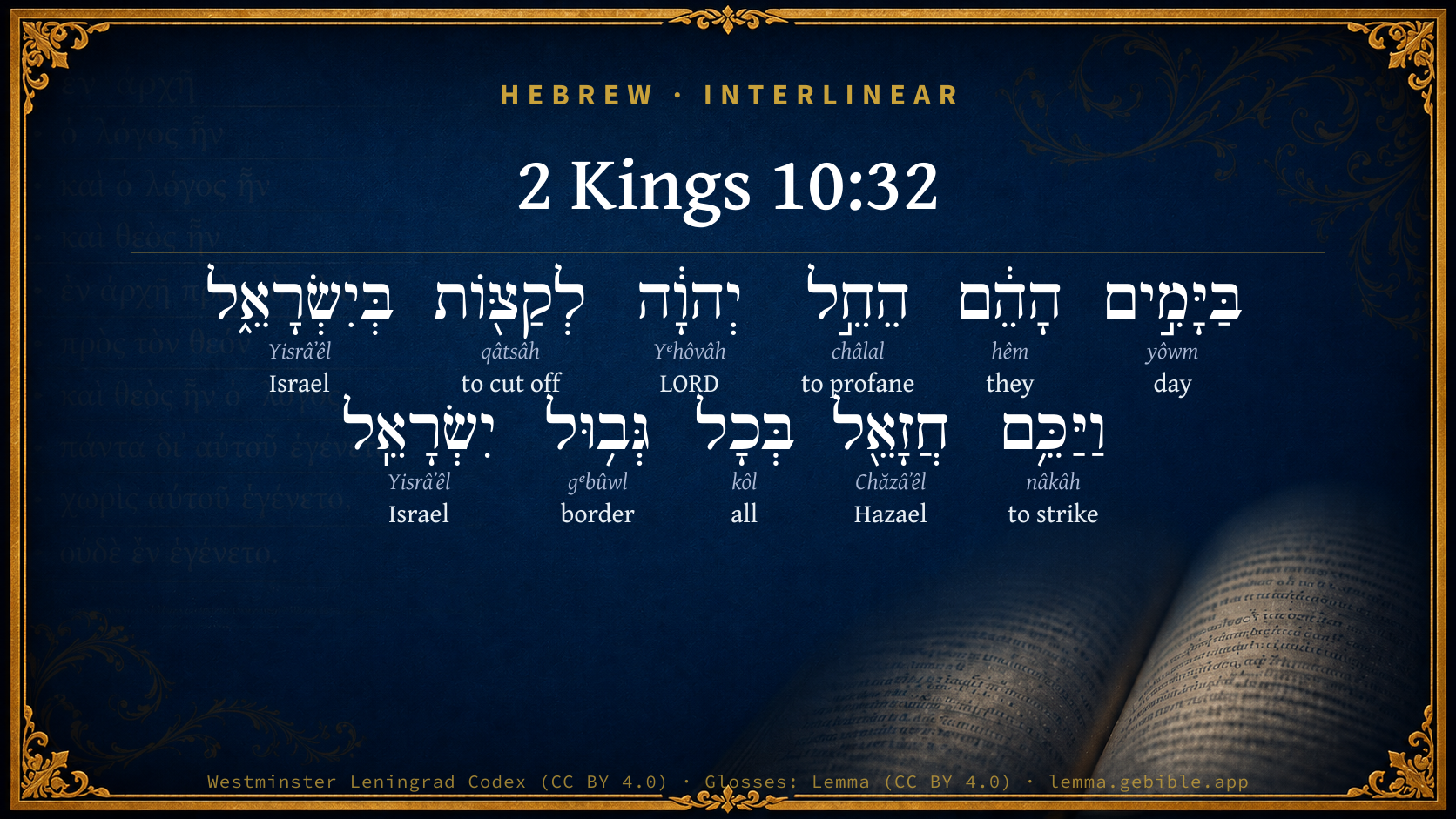
2 Kings 10:32

Hebrew (Westminster Leningrad Codex) 2 Kings 10:32 appears in the Hebrew Old Testament. The text above is from the Westminster Leningrad Codex. Each word links to its Strong’s number, a concise gloss, and parsing drawn from the Open Scriptures Hebrew Bible morphology. Click any word for its full Brown-Driver-Briggs (BDB) entry.
Download image
Cite this verse

2 Kings 10:32 (World English Bible). Public Domain. Lemma interlinear Bible study tool, https://lemma.gebible.app/v/2-kings/10/32.

Show BibTeX & RIS
BibTeX
RIS
English Translation
In those days Yahweh began to cut off from Israel: and Hazael struck them in all the borders of Israel;
World English Bible · Public Domain
Download a study sheet

One document with this verse’s original text, its word-by-word gloss line, the meaning frame, cross-references with their text, attributed commentary, and full source and license credits — printable, and it pastes into notes with its structure intact.

This verse Autodidact and up

Study sheet (.html) Plain text (.txt)

A passage Seminary Student

Up to 50 verses in one chapter. A passage sheet keeps up to 6 commentary sources and 12 cross-references per verse, in the order this page ranks them, and says so on the sheet whenever that leaves anything out. Ask for a single verse and you get the Autodidact verse sheet above.

Everything on this page stays free to read, with no account — the sheet is a download of what is already on screen, not access to it.

Want to remove ads? Support Godless Engineer
Compare translations 3

The same verse in 3 English versions, stacked beneath the original-language interlinear above. Click any original word for its lexicon entry.

Each is an independent rendering of the whole verse — the interlinear is not word-aligned to these translations.

Highlighted words mark where these versions differ — a whole-verse word diff, not a word-by-word alignment.

  • World English Bible Public Domain
    In those days Yahweh began to cut off from Israel: and Hazael struck them in all the borders of Israel;
  • King James Version Public Domain
    In those days the LORD began to cut Israel short: and Hazael smote them in all the coasts of Israel;
  • unfoldingWord Literal Text CC BY-SA 4.0
    In those days, Yahweh began to cut off Israel. And Hazael struck them in every border of Israel

unfoldingWord Literal Text — © unfoldingWord, licensed CC BY-SA 4.0. Word-aligned USFM3 via Door43 (git.door43.org/unfoldingWord/en_ult).

Versions to compare (up to 4)

3 of 4 selected

Show all 18 translations

Every available English version of this verse, each an independent rendering of the whole verse.

  • World English Bible Public Domain
    In those days Yahweh began to cut off from Israel: and Hazael struck them in all the borders of Israel;
  • Berean Standard Bible Public Domain
    In those days the LORD began to reduce the size of Israel. Hazael defeated the Israelites throughout their territory
  • Majority Standard Bible Public Domain
    In those days the LORD began to reduce the size of Israel. Hazael defeated the Israelites throughout their territory
  • King James Version Public Domain
    In those days the LORD began to cut Israel short: and Hazael smote them in all the coasts of Israel;
  • American Standard Version (1901) Public Domain
    In those days Jehovah began to cut off from Israel: and Hazael smote them in all the borders of Israel;
  • Revised Version (1885) Public Domain
    In those days the LORD began to cut Israel short: and Hazael smote them in all the coasts of Israel;
  • Geneva Bible (1599) Public Domain
    In those dayes the Lord began to lothe Israel, and Hazael smote them in all the coastes of Israel,
  • Douay-Rheims (1899) Public Domain
    In those days the Lord began to he weary of Israel: and Hazael ravaged them in all the coasts of Israel,
  • Young's Literal Translation Public Domain
    In those days hath Jehovah begun to cut off `some' in Israel, and Hazael smiteth them in all the border of Israel,
  • Literal Standard Version CC BY-SA 4.0
    In those days YHWH has begun to cut off [some] in Israel, and Hazael strikes them in all the border of Israel,
  • Unlocked Literal Bible CC BY-SA 4.0
    In those days Yahweh began to cut off regions from Israel, and Hazael defeated the Israelites at the borders of Israel,
  • unfoldingWord Literal Text CC BY-SA 4.0
    In those days, Yahweh began to cut off Israel. And Hazael struck them in every border of Israel
  • Darby Bible Public Domain
    In those days Jehovah began to cut Israel short; and Hazael smote them in all the borders of Israel;
  • World Messianic Bible Public Domain
    In those days the LORD began to cut away parts of Israel; and Hazael struck them in all the borders of Israel
  • Webster's Bible Public Domain
    In those days the LORD began to cut Israel short: and Hazael smote them in all the borders of Israel;
  • Free Bible Version CC BY-SA 4.0
    At that time the Lord began to reduce the extent of Israel. Hazael defeated the Israelites throughout their territory
  • Bible in Basic English Public Domain
    In those days the Lord was angry first with Israel; and Hazael made attacks on all the land of Israel,
  • JPS Tanakh (1917) Public Domain
    In those days the LORD began to cut Israel short; and Hazael smote them in all the borders of Israel:

Literal Standard Version (2020), Covenant Press — licensed CC BY-SA 4.0. Text via the HelloAO Bible API (eBible.org). Unlocked Literal Bible (unfoldingWord) — licensed CC BY-SA 4.0. Text via the HelloAO Bible API (eBible.org). unfoldingWord Literal Text — © unfoldingWord, licensed CC BY-SA 4.0. Word-aligned USFM3 via Door43 (git.door43.org/unfoldingWord/en_ult). Free Bible Version, Dr. Jonathan Gallagher — licensed CC BY-SA 4.0. Text via the HelloAO Bible API (eBible.org).

Word by word

More ways to search: Search by grammar → Find every occurrence → Compare this word →

Practice this passage: Drill this verse → Learn its vocabulary →

לְקַצּ֖וֹת
qâtsâh
H7096
“to cut off”
Preposition + Verb, Piel, Infinitive Construct
Part of Speech
Preposition + Verb
Stem
Piel
Form
Infinitive Construct
Full BDB Definition

Origin: a primitive root

TWOT: 2053

to cut off - (Qal) to cut off - (Piel) to cut off - (Hiphil) to scrape, scrape off
  1. בַּיָּמִ֣ים yôwm H3117 “in/at the · days” Preposition, Determined + Noun, Common, Masculine, Plural, Absolute
  2. הָהֵ֔ם hêm H1992 “the · they” Particle, Definite Article + Pronoun, Personal, 3rd Person, Masculine, Plural
  3. הֵחֵ֣ל châlal H2490 “to profane” Verb, Hiphil, Perfect, 3rd Person, Masculine, Singular
  4. יְהוָ֔ה Yᵉhôvâh H3068 “LORD” Noun, Proper
  5. בְּיִשְׂרָאֵ֑ל Yisrâʼêl H3478 “in/at · Israel” Preposition + Noun, Proper
  6. וַיַּכֵּ֥ם nâkâh H5221 “and · to strike · them” Conjunction + Verb, Hiphil, Sequential Imperfect, 3rd Person, Masculine, Singular + Suffix, Personal, 3rd Person, Masculine, Plural
  7. חֲזָאֵ֖ל Chăzâʼêl H2371 “Hazael” Noun, Proper
  8. בְּכָל kôl H3605 “in/at · all of” Preposition + Noun, Common, Masculine, Singular, Construct
  9. גְּב֥וּל gᵉbûwl H1366 “border of” Noun, Common, Masculine, Singular, Construct
  10. יִשְׂרָאֵֽל Yisrâʼêl H3478 “Israel” Noun, Proper

About this verse

These counts appear in no published source. They are computed here, from the morphology-tagged text and Lemma’s own curated glosses. What Lemma adds →

11
words
10
distinct lemmas
Historical
section

Notable vocabulary

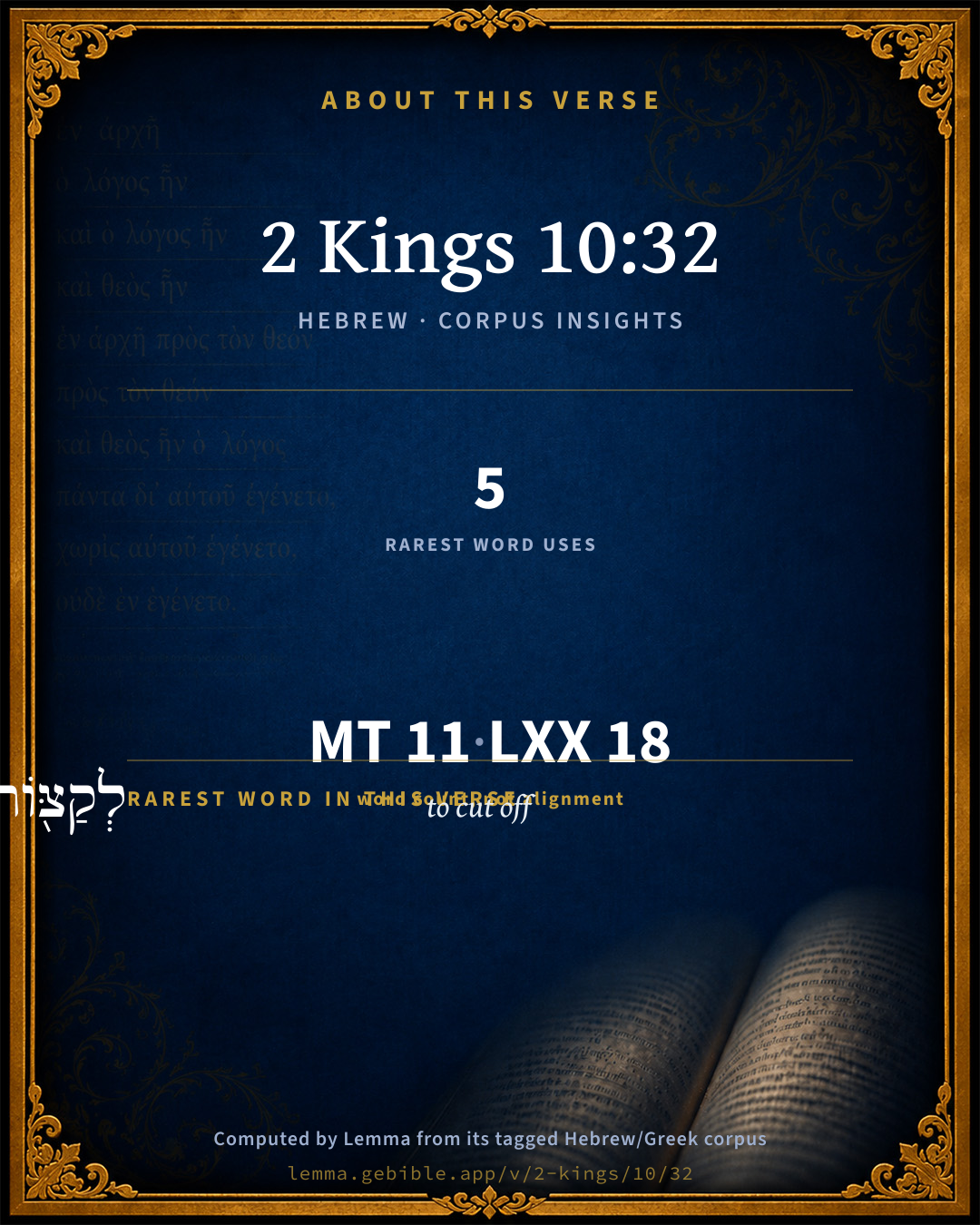
The rarest word here is לְקַצּ֖וֹת to cut off H7096 — appearing just 5 times in the whole Hebrew Bible.

Shared distinctive vocabulary

לְקַצּ֖וֹת to cut off H7096 occurs in 5 verses of the Hebrew Bible. Also found in:

Grammatical profile

  • 3 verbs
  • 7 nouns
  • 1 pronoun

Verb forms

  • הֵחֵ֣ל Hiphil · Perfect
  • לְקַצּ֖וֹת Piel · Infinitive Construct
  • וַיַּכֵּ֥ם Hiphil · Sequential Imperfect

Repetition

A word recurs within this verse — often emphatic in Hebrew:

  • בְּיִשְׂרָאֵ֑ל Israel H3478 ×2

Hebrew & Septuagint length

In English translation the verse runs 20 words from the Hebrew and 19 from the Septuagint (LXX English) — closely comparable.

A rough comparison of the two English renderings, which tokenize alike — not a word-level alignment.

Word counts can differ between the Hebrew and the Greek without any difference in meaning — e.g. the Hebrew direct-object marker אֵת has no separate Greek word, and Greek often adds the article ὁ.

In the original languages it is 11 Hebrew tokens and 18 Greek tokens — but the two are counted differently (Hebrew bundles its prefixes and suffixes into one token; the Greek is in lemma form), so that isn’t a like-for-like length.

Cross-references

5

Topical passages linked to 2 Kings 10:32 in the Treasury of Scripture Knowledge — connected by theme and wording, ordered by reader-vote popularity; previews shown in the World English Bible.

  • 1 Kings 19:17 It shall happen, that he who escapes from the sword of Hazael shall Jehu kill; and he who escapes from the sword of Jehu shall Elisha kill.
  • 2 Kings 8:12 Hazael said, Why weeps my lord? He answered, Because I know the evil that you will do to the children of Israel: their strongholds will you set on fire, and their young men will you kill with the sword, and will dash in pieces their little ones, and rip up their women with child.
  • 2 Kings 13:22 Hazael king of Syria oppressed Israel all the days of Jehoahaz.
  • 2 Kings 13:25 Jehoash the son of Jehoahaz took again out of the hand of Benhadad the son of Hazael the cities which he had taken out of the hand of Jehoahaz his father by war. Three times did Joash strike him, and recovered the cities of Israel.
  • 2 Kings 14:25 He restored the border of Israel from the entrance of Hamath to the sea of the Arabah, according to the word of Yahweh, the God of Israel, which he spoke by his servant Jonah the son of Amittai, the prophet, who was of Gath Hepher.

Cross-references courtesy of OpenBible.info (CC BY 4.0).

Hebrew and Greek witnesses Masoretic Hebrew ↔ Greek Septuagint

The same verse in the two great witnesses to the Old Testament, shown verse-for-verse.

These are two independent witnesses, not word-aligned to each other, and the Septuagint is shown in lemma (dictionary) form.

Hebrew 2 Kings 10:32 Masoretic · Westminster Leningrad Codex

בַּיָּמִ֣ים הָהֵ֔ם הֵחֵ֣ל יְהוָ֔ה לְקַצּ֖וֹת בְּיִשְׂרָאֵ֑ל וַיַּכֵּ֥ם חֲזָאֵ֖ל בְּכָל גְּב֥וּל יִשְׂרָאֵֽל

In those days Yahweh began to cut off from Israel: and Hazael struck them in all the borders of Israel;

World English Bible · Public Domain

Greek LXX 2 Kings 10:32 Septuagint · lemma form

ἐν ὁ ἡμέρα ἐκεῖνος ἄρχω κύριος συνκόπτω ἐν ὁ ἰσραήλ καί πατάσσω αὐτός αζαηλ ἐν πᾶς ὅριον ἰσραήλ

In those days the Lord began to cut Israel short; and Azael struck them in every coast of Israel;

LXX2012 (modern English Septuagint) · Public Domain

Hebrew: Westminster Leningrad Codex (CC BY 4.0). Greek: Septuagint (public domain); English from LXX2012 (modern English Septuagint) (Public Domain). How the Septuagint differs from the Hebrew →

Targum (Aramaic paraphrase)

1

The Targum is the ancient Jewish Aramaic paraphrase of the Hebrew Scriptures — an interpretive translation, not the Hebrew text itself. Onkelos (literal) and Pseudo-Jonathan (expansive) render the Torah, and Jonathan the Prophets. Coverage is partial: where no permissively-licensed English translation exists for a verse, only the Aramaic is shown. This is verse-level text, not a word-by-word alignment to the Hebrew.

  1. Targum Jonathan Prophets (Joshua–Malachi)
    בְּיוֹמַיָא הָאִינוּן שָׁרֵי רוּגְזָא דַייָ לְמִתְקַף בְּיִשְׂרָאֵל וּמְחָנוּן חֲזָאֵל בְּכָל תְּחוּם אַרְעָא דְיִשְׂרָאֵל:

    (no public-domain English translation for this verse)

    Targum Jonathan — Aramaic: “Mikraot Gedolot” (public domain). English: “Sefaria Community Translation” (CC0 1.0 (public-domain dedication)); “London "Chaldee Paraphrase," 1871” (public domain). Text via Sefaria.

Commentary

Notes on 2 Kings 10:32 from classic Christian and Jewish commentators (each source and its license shown beneath its notes). The classic Christian expositions comment on the surrounding passage and are grouped to its opening verse, so a note may address several verses; the Jewish commentaries on the Tanakh (Rashi and others) are per-verse, so they appear only where the commentator wrote on this verse.

Lemma curates 59 commentaries, every one of them public domain or Creative Commons licensed, each selected and text-cleaned for this edition rather than reprinted as found. About our sources →

Trapp's Complete Commentary

John Trapp

2Ki 10:32 In those days the LORD began to cut Israel short: and Hazael smote them in all the coasts of Israel;

Ver. 32. The Lord began to cut Israel short.] By turning in the Syrians upon them, to waste their country.

And Hazael smote them.] Exercising those inhuman cruelties upon them foretold by Elisha, {2Ki 8:12} and that in Jehu’s lifetime, res Israelis fuerunt accisae, notwithstanding all his might. {2Ki 10:34} For his calf worship, his puissance was turned into pusillanimity, and his glory into shame. The like befell Henry IV of France, after that he turned Papist.

John Trapp, A Commentary or Exposition upon All the Books of the Old and New Testament (1647–1656) — public domain. Text from a community e-Sword module.

Joseph Benson's Commentary

2Ki 10:32. In those days — In the time of Jehu’s life and reign, 2Ki 10:34. The Lord began to cut Israel short — Either to diminish the number of the people by cutting them off, or to straiten their borders. Hazael smote them in all the coasts of Israel — In their borders, or the outermost part of their land, beyond Jordan, as it is explained 2Ki 10:33; and at this time, probably, he executed the cruelties predicted by Elisha, 2Ki 8:12.

Joseph Benson's Commentary on the Old and New Testaments (1811–1818) — public domain. Text from a community e-Sword module.

Geneva Bible (1599)

Geneva Bible translators

Or, to cut them off.

Geneva Bible (1599) marginal notes — public domain. Text via Bolls.life.

Adam Clarke's Commentary

Verse 32. The Lord began to cut Israel short] The marginal reading is best: The Lord cut off the ends; and this he did by permitting Hazael to seize on the coasts, to conquer and occupy the frontier towns. This was the commencement of those miserable ravages which Elisha predicted; see 2Kg 8:12. And we find from the next verse that he seized on all the land of Gilead, and that of Reuben and Gad, and the half tribe of Manasseh; in a word, whatever Israel possessed on the east side of Jordan.

Adam Clarke's Commentary on the Bible (1810–1826) — public domain. Text from a community e-Sword/MySword module.

Ellicott's Commentary for English Readers

(32) In those days.—As a vassal and ally of Assyria (see Notes on 2Ki_9:2), Jehu drew upon himself the active hostility of Hazael. (See Note on 2Ki_8:15.) Schröder remarks that it was quite natural for the Israelite sovereign to “throw himself into the arms of distant Assyria, in order to get protection against his immediate neighbour Syria, Israel’s hereditary foe.” Comp. the similar conduct of Ahaz as against Pekah and Rezin (2Ki_16:7). From the point of view of the sacred writer, this verse states the consequence of Jehu’s neglect of “walking in Jehovah’s instruction with all his heart” (2Ki_10:31).

The Lord began.—Through Hazael and the Syrians. (Comp. Isa_7:17; Isa_7:20; Isa_10:5-6.)

To cut Israel short.—Literally, to cut off in Israel—i.e., to cut off part after part of Israelite territory. (The verb means to cut off the extremities, Pro_26:6.) This refers to the conquests of Hazael. The Targum explains, “The wrath of the Lord began to be strong against Israel;” and the Vulg. has, “tædere super Israel.” Thenius conjectures from this that we should read, “to be wrathful with Israel;” but the construction would not then be usual.

In all the coasts.—Rather, on the whole border—scil., conterminous with Syria.

A Bible Commentary for English Readers, edited by Charles John Ellicott (1878–1897) — public domain. Text from a community e-Sword module.

The Cambridge Bible for Schools and Colleges

gen. ed. J. J. S. Perowne

32–36. Cutting short of Israel. Jehu’s death, his successor and the duration of his reign (Not in Chronicles)

32. to cut Israel short] Literally ‘to cut off in Israel’. The meaning is ‘to give over some parts of their land into the enemy’s hand’. This, it is said, should rather be expressed by ‘to cut off from Israel’. But, as it stands, the context makes all clear enough. What had been part of Israel’s possessions, was severed from it, and passed into the power of Hazael and the Syrians.

in all the coasts of Israel] In the days when the A.V. was made, ‘coast’ meant ‘any border land’ and had no necessary relation to the sea. The ‘coasts’ described in the next verse are all on the east of Jordan, and entirely away from the Mediterranean. Hazael must have thoroughly overrun and taken possession of the trans-Jordanic part of Israel.

The Cambridge Bible for Schools and Colleges (gen. ed. J. J. S. Perowne; Cambridge University Press, 1878–1918) — public domain. Text from a community e-Sword module.

John Gill's Exposition

Now the rest of the acts of Jehu, and all that he did, and all his might, are they not written in the book of the chronicles of the kings of Israel? Of the preceding kings from the times of Jeroboam, in which their several acts were recorded, and his also.

Now the rest of the acts of Jehu, and all that he did, and all his might, are they not written in the book of the chronicles of the kings of Israel? Of the preceding kings from the times of Jeroboam, in which their several acts were recorded, and his also.

2 Kings 10:35

kg2 10:35

kg2 10:35

kg2 10:35And Jehu slept with his fathers,.... Died as they did:

and they buried him in Samaria; where Omri and Ahab, his predecessors, were buried, Kg1 16:28.

and Jehoahaz his son reigned in his stead; who reigned seventeen years, Kg2 13:1.

John Gill's Exposition of the Whole Bible (1746–1763) — public domain (CC PDM 1.0). Text via the HelloAO Bible API.

Albert Barnes' Notes on the Bible

To cut Israel short - literally, “to cut off in Israel,” i. e., to take away from Israel portions of its territory (see the marginal reference).

Albert Barnes' Notes on the Bible (1834–1885) — public domain. Text from a community e-Sword/MySword module.

Haydock's Catholic Bible Commentary

Weary. Hebrew, "to retrench or destroy." Hazael took occasion, from the absence of Jehu (Calmet) from Galaad, and the disturbances on the west of the Jordan, to dismember the provinces on the east, and to commit the horrid ravages foretold by Eliseus, chap. viii. 12. (Haydock)

George Leo Haydock (1774–1849), Haydock's Catholic Family Bible and Commentary, 1859 edition — public domain. Excludes Psalms (Douay-Rheims chapter numbering differs from Protestant) and Deuterocanonical books (Catholic canon only).

Matthew Poole's English Annotations

In those days; in the time of Jehu’s life and reign, as may be gathered by comparing 2Ki 10:31.

To cut Israel short; either to diminish the number of the people, by cutting them off; or to straiten their borders.

In all the coasts of Israel, i.e. in their borders, or the uttermost part of their land beyond Jordan, as it is explained, 2Ki 10:33. And at this time possibly he executed those cruelties mentioned 2Ki 8:12.

Matthew Poole's English Annotations on the Holy Bible (1683–1685) — public domain. Text from a community e-Sword/MySword module.

Whedon's Commentary on the Bible

Daniel D. Whedon

32. Began to cut Israel short — That is, in the latter part of Jehu’s reign Israel began to suffer those fearful punishments of invasion and conquest from the north and northeast, which finally ended in the total captivity of the land. Jehu’s name occurs on the Assyrian monuments among others who paid tribute to the king of Assyria, and Rawlinson (Historical Evidences, page 113) inclines to the opinion “that from this date both the Jewish and the Israelitish kings held their crowns as fiefs, dependent on the will of the Assyrian monarch, with whom it formally lay to ‘confirm’ each new prince ‘in his kingdom.’” See 2Ki_14:5, note.

Daniel D. Whedon (gen. ed.), Commentary on the Old and New Testaments (1874–1909) — public domain. Text from a community e-Sword module.

The Pulpit Commentary

Ver. 32-36. Jehu"s wars, length of reign, and successor.

In those days the Lord began to out Israel short. It is certainly not stated in direct terms that the ill success of Jehu"s foreign wars was a punishment on him for his continued maintenance of the calf-idolatry; but the juxtaposition of vers. 31 and 32 naturally raises the idea, and constitutes a strong presumption that it was in the writer"s mind. The "theocracy" under the kings was carried on mainly, as the writer of Chronicles clearly saw, by the bestowal of worldly prosperity and military success on good kings, and the accumulation of misfortunes and military disasters on bad ones. (see 2Ch_12:5-12 2Ch_13:4-18 2Ch_14:2-15 2Ch_15:2-15 2Ch_17:3-5. etc.) By "cutting Israel short literally, "cutting off in Israel is probably meant the conquest of certain portions of the territory. Hazael resumed the war which Benhadad had so long waged, and gained numerous successes. And Hazael smote them in all the coasts of Israel; or, along their whole frontier (Bahr). The frontier intended is, of course, that on the north and east, where the Israelite territory was conterminous with that of Syria.

The Pulpit Commentary (1880–1919), ed. H.D.M. Spence-Jones & Joseph S. Exell — public domain. Text from a community e-Sword module.

Keil & Delitzsch

C. F. Keil & F. Delitzsch

Therefore (this link of connection follows from the actual fact, though it is not distinctly mentioned in the text) Hazael had now to inflict chastisement upon faithless Israel. In Jehu's days Jehovah began "to cut off in Israel," i.e., to rend away certain portions from the kingdom. "Hazael smote them (the Israelites) on the whole of the border of Israel," i.e., of the kingdom, "from Jordan to the sun-rising (i.e., on the eastern side of the Jordan), the whole of the land of Gilead (כּל־ארץ את is dependent upon יכּה which must be supplied from יכּם), namely, the territory of the tribes of Gad, Reuben, and Half-Manasseh, from Aroer on the brook Arnon (now Araayr, a ruin on the northern border of the Mojeb (Arnon) valley; see at Num 32:34), the southern border of the Israelitish land to the east of the Jordan (Deu 2:36; Deu 3:12), both Gilead and Bashan," the two countries into which Gilead in the broader sense was divided (see at Deu 3:8-17). - These conquests took place during the twenty-eight years' reign of Jehu, since Hazael began to reign before Jehu, viz., while Joram was king, and had already fought successfully against the Israelites at Ramoth in Joram's reign (Kg2 8:28-29), but not in the later part of Jehu's reign, as Thenius supposes.

Keil & Delitzsch — Biblical Commentary on the Old Testament (1861–1891) — public domain (CC PDM 1.0). Text via the HelloAO Bible API. (Old Testament only.)

unfoldingWord translationNotes

Door43 World Missions Community

began to cut off regions from Israel

"began to cause the territory controlled by Israel to become smaller"

regions

areas of land

Hazael defeated

Here "Hazael" refers to himself and his army. AT: "Hazael and his army" or "King Hazael's Aramean army" (See: Synecdoche)

Hazael

See how you translated this king's name in 2 Kings 8:8. (See: How to Translate Names)

from the Jordan eastward

"from the land east of the Jordan"

Aroer ... Bashan

These are all names of places. (See: How to Translate Names)

the Arnon

"the Arnon River" This is the name of a river. (See: How to Translate Names)

translationWords

cut off

Jordan River

Gilead

Gad

Reuben

Manasseh

Bashan

unfoldingWord translationNotes — © Distant Shores Media and the Door43 World Missions Community, licensed CC BY-SA 4.0. Source: git.door43.org/Door43/en_tn.

Rashi

Rabbi Shlomo Yitzchaki (Rashi)

To show His disgust. As in, “קַצְתִּי בְּחַיָּי [=I am disgusted with my life].”

Rashi on the Tanakh — English translations: “The Judaica Press complete Tanach with Rashi, translated by A. J. Rosenberg” (CC BY 4.0); “Pentateuch with Rashi's commentary by M. Rosenbaum and A.M. Silbermann, 1929-1934” (public domain); “The Metsudah Tanach series, Lakewood, N.J” (CC BY 4.0); and “The Book of Joshua, Metsudah Publications, 1997” (CC BY 4.0). Text via Sefaria.

Lesson kit

Teaching starters — assembled from the data on this page, not authored interpretation. Every prompt links to the verse data it draws on. Edit before teaching.

2 Kings, in the Historical, opens this verse with 11 words (10 distinct Hebrew lemmas). Its most distinctive word is qâtsâh (“to cut off”). A historical commentator’s framing appears above. Read the whole chapter for the surrounding context.

Discussion questions

  1. The word qâtsâh carries the sense “to cut off.” How does it shape the verse?
  2. Leviticus 14:41 shares the word «to cut off» with this verse. How do the two illuminate each other?
  3. “Israel” occurs 2× in this one verse. What is the effect of the repetition?
  4. The translations on this page render this verse differently — a whole-verse word diff, not a word-by-word alignment. What might account for the different wordings?
  5. The verb «הֵחֵ֣ל» is Hiphil Perfect. How does its form color the action?
  6. Reading how Trapp's Complete Commentary and Joseph Benson's Commentary read this verse, where do the two commentators agree and where do they part?

Things to notice

Reading settings

Reading text

Shown beneath each verse's original-language words.

Old Testament
Old Testament edition

Read the OT as the Masoretic Hebrew (MT) or the Greek Septuagint (LXX).

English shown for the Greek Septuagint (in the Hebrew ↔ Greek comparison).

Comparing translations? Open the Compare panel on any verse page to stack up to four side by side.