
Proverbs 23:10

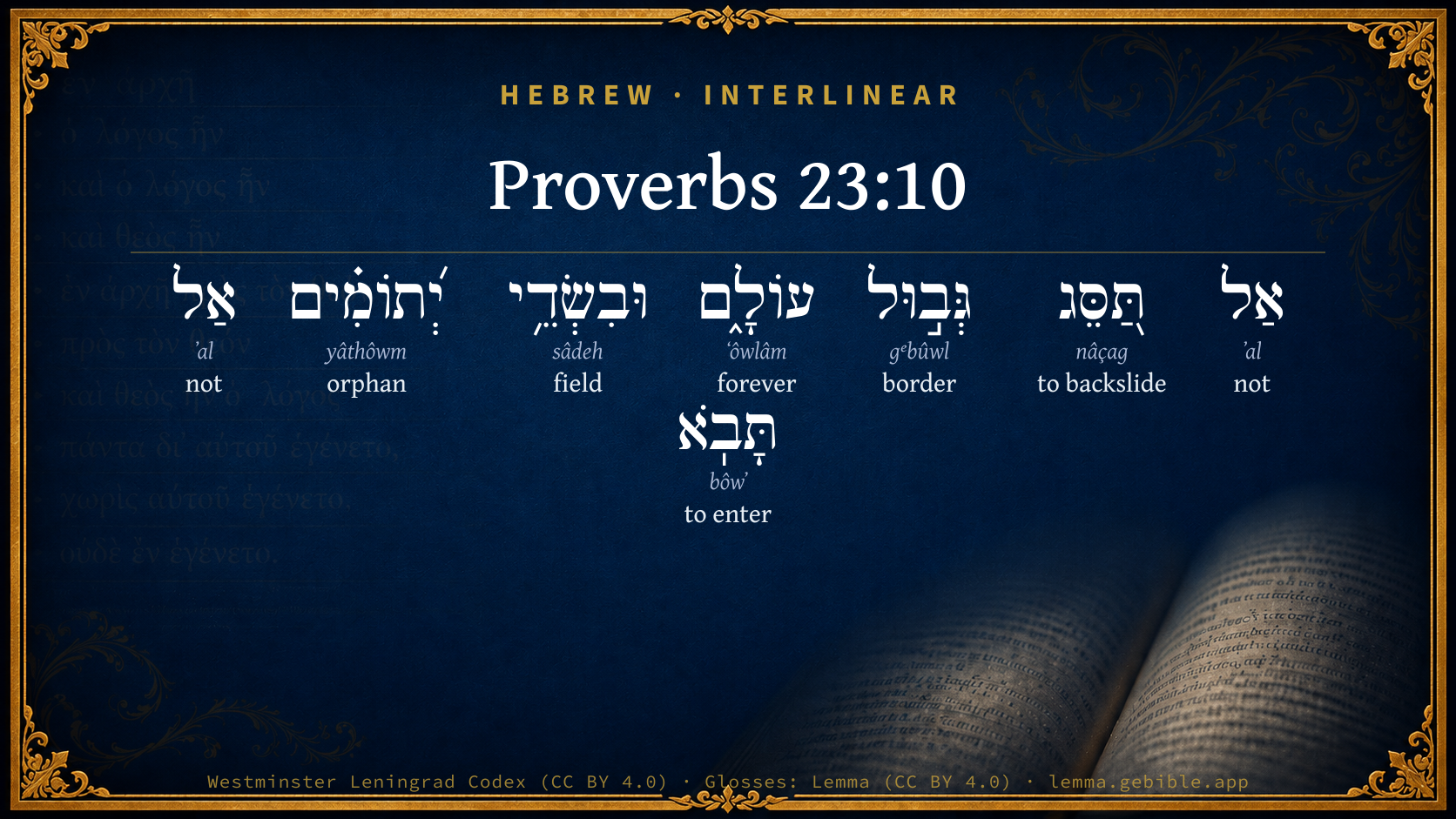
Hebrew (Westminster Leningrad Codex) Proverbs 23:10 appears in the Hebrew Old Testament. The text above is from the Westminster Leningrad Codex. Each word links to its Strong’s number, a concise gloss, and parsing drawn from the Open Scriptures Hebrew Bible morphology. Click any word for its full Brown-Driver-Briggs (BDB) entry.
Download image
Cite this verse

Proverbs 23:10 (World English Bible). Public Domain. Lemma interlinear Bible study tool, https://lemma.gebible.app/v/proverbs/23/10.

Show BibTeX & RIS
BibTeX
RIS
English Translation
Don't move the ancient boundary stone. Don't encroach on the fields of the fatherless:
World English Bible · Public Domain
Download a study sheet

One document with this verse’s original text, its word-by-word gloss line, the meaning frame, cross-references with their text, attributed commentary, and full source and license credits — printable, and it pastes into notes with its structure intact.

This verse Autodidact and up

Study sheet (.html) Plain text (.txt)

A passage Seminary Student

Up to 50 verses in one chapter. A passage sheet keeps up to 6 commentary sources and 12 cross-references per verse, in the order this page ranks them, and says so on the sheet whenever that leaves anything out. Ask for a single verse and you get the Autodidact verse sheet above.

Everything on this page stays free to read, with no account — the sheet is a download of what is already on screen, not access to it.

Want to remove ads? Support Godless Engineer
Compare translations 3

The same verse in 3 English versions, stacked beneath the original-language interlinear above. Click any original word for its lexicon entry.

Each is an independent rendering of the whole verse — the interlinear is not word-aligned to these translations.

Highlighted words mark where these versions differ — a whole-verse word diff, not a word-by-word alignment.

  • World English Bible Public Domain
    Don't move the ancient boundary stone. Don't encroach on the fields of the fatherless:
  • King James Version Public Domain
    Remove not the old landmark; and enter not into the fields of the fatherless:
  • unfoldingWord Literal Text CC BY-SA 4.0
    Do not move an ancient boundary, and do not enter into the fields of fatherless ones,

unfoldingWord Literal Text — © unfoldingWord, licensed CC BY-SA 4.0. Word-aligned USFM3 via Door43 (git.door43.org/unfoldingWord/en_ult).

Versions to compare (up to 4)

3 of 4 selected

Show all 18 translations

Every available English version of this verse, each an independent rendering of the whole verse.

  • World English Bible Public Domain
    Don't move the ancient boundary stone. Don't encroach on the fields of the fatherless:
  • Berean Standard Bible Public Domain
    Do not move an ancient boundary stone or encroach on the fields of the fatherless,
  • Majority Standard Bible Public Domain
    Do not move an ancient boundary stone or encroach on the fields of the fatherless,
  • King James Version Public Domain
    Remove not the old landmark; and enter not into the fields of the fatherless:
  • American Standard Version (1901) Public Domain
    Remove not the ancient landmark; And enter not into the fields of the fatherless:
  • Revised Version (1885) Public Domain
    Remove not the ancient landmark; and enter not into the fields of the fatherless:
  • Geneva Bible (1599) Public Domain
    Remooue not the ancient boundes, and enter not into the fieldes of the fatherlesse.
  • Douay-Rheims (1899) Public Domain
    Touch not the bounds of little ones: and enter not into the field of the fatherless:
  • Young's Literal Translation Public Domain
    Remove not a border of olden times, And into fields of the fatherless enter not,
  • Literal Standard Version CC BY-SA 4.0
    Do not remove a border of ancient times, || And do not enter into fields of the fatherless,
  • Unlocked Literal Bible CC BY-SA 4.0
    Do not move an ancient boundary stone or encroach on the fields of orphans,
  • unfoldingWord Literal Text CC BY-SA 4.0
    Do not move an ancient boundary, and do not enter into the fields of fatherless ones,
  • Darby Bible Public Domain
    Remove not the ancient landmark; and enter not into the fields of the fatherless:
  • World Messianic Bible Public Domain
    Don’t move the ancient boundary stone. Don’t encroach on the fields of the fatherless,
  • Webster's Bible Public Domain
    Remove not the old landmark; and enter not into the fields of the fatherless:
  • Free Bible Version CC BY-SA 4.0
    Don't move ancient boundary markers, and don't encroach on fields belonging to orphans,
  • Bible in Basic English Public Domain
    Do not let the landmark of the widow be moved, and do not go into the fields of those who have no father;
  • JPS Tanakh (1917) Public Domain
    Remove not the ancient landmark; and enter not into the fields of the fatherless;

Literal Standard Version (2020), Covenant Press — licensed CC BY-SA 4.0. Text via the HelloAO Bible API (eBible.org). Unlocked Literal Bible (unfoldingWord) — licensed CC BY-SA 4.0. Text via the HelloAO Bible API (eBible.org). unfoldingWord Literal Text — © unfoldingWord, licensed CC BY-SA 4.0. Word-aligned USFM3 via Door43 (git.door43.org/unfoldingWord/en_ult). Free Bible Version, Dr. Jonathan Gallagher — licensed CC BY-SA 4.0. Text via the HelloAO Bible API (eBible.org).

Word by word

More ways to search: Search by grammar → Find every occurrence → Compare this word →

Practice this passage: Drill this verse → Learn its vocabulary →

About this verse

These counts appear in no published source. They are computed here, from the morphology-tagged text and Lemma’s own curated glosses. What Lemma adds →

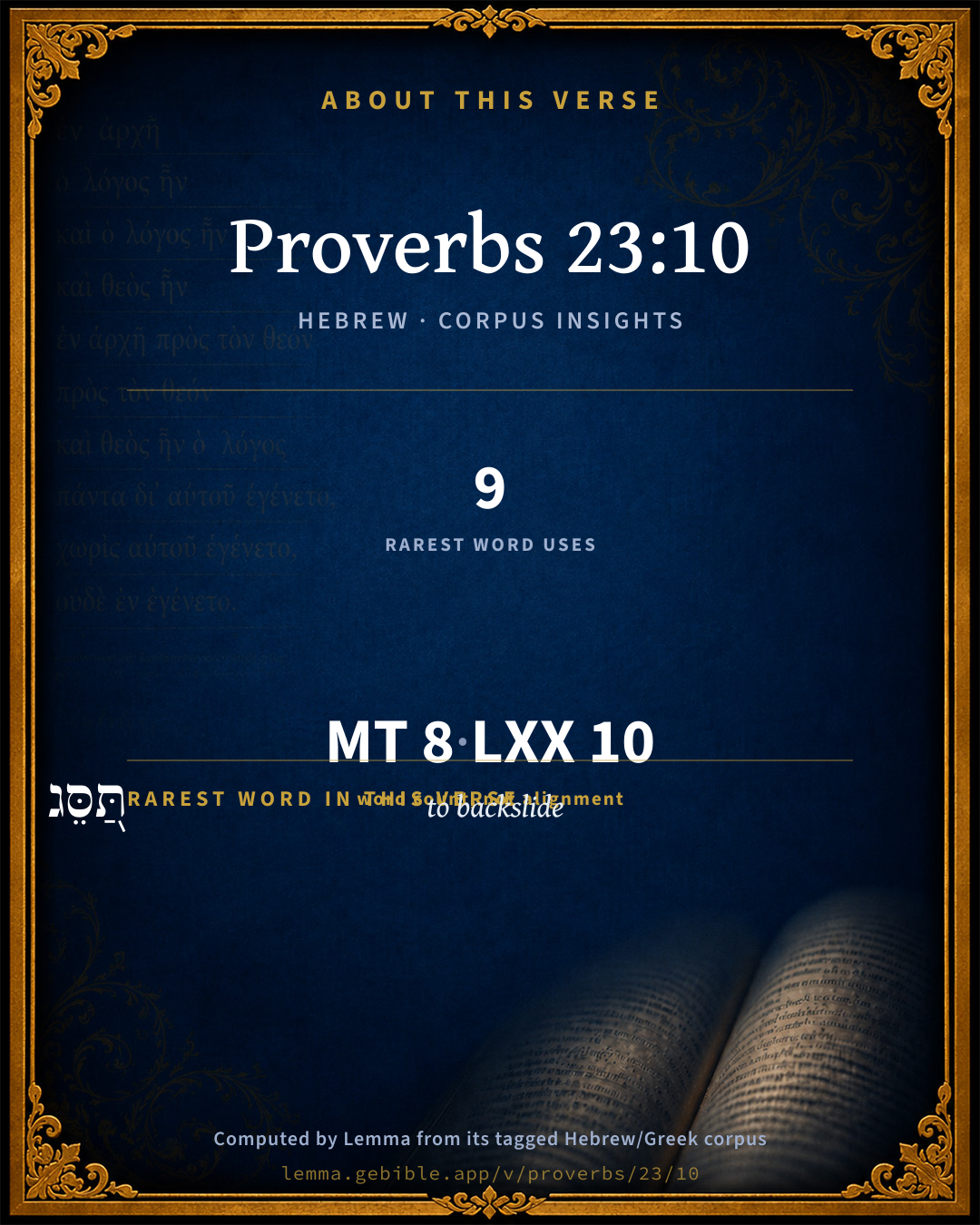
8
words
7
distinct lemmas
Wisdom
section

Notable vocabulary

The rarest word here is תַּ֭סֵּג to backslide H5253 — appearing just 9 times in the whole Hebrew Bible.

Shared distinctive vocabulary

תַּ֭סֵּג to backslide H5253 occurs in 9 verses of the Hebrew Bible. Also found in:

Grammatical profile

  • 2 verbs
  • 4 nouns
  • 2 particles

Verb forms

  • תַּ֭סֵּג Hiphil · Jussive
  • תָּבֹֽא Qal · Jussive

Repetition

A word recurs within this verse — often emphatic in Hebrew:

  • אַל not H408 ×2

Hebrew & Septuagint length

In English translation the verse runs 14 words from the Hebrew and 14 from the Septuagint (LXX English) — the same length.

A rough comparison of the two English renderings, which tokenize alike — not a word-level alignment.

Word counts can differ between the Hebrew and the Greek without any difference in meaning — e.g. the Hebrew direct-object marker אֵת has no separate Greek word, and Greek often adds the article ὁ.

In the original languages it is 8 Hebrew tokens and 10 Greek tokens — but the two are counted differently (Hebrew bundles its prefixes and suffixes into one token; the Greek is in lemma form), so that isn’t a like-for-like length.

Cross-references

14

Topical passages linked to Proverbs 23:10 in the Treasury of Scripture Knowledge — connected by theme and wording, ordered by reader-vote popularity; previews shown in the World English Bible.

  • Proverbs 22:28 Don't move the ancient boundary stone, Which your fathers have set up.
  • Zechariah 7:10 Don't oppress the widow, nor the fatherless, the foreigner, nor the poor; and let none of you devise evil against his brother in your heart.'
  • Deuteronomy 27:17 Cursed be he who removes his neighbor's landmark. All the people shall say, Amen.
  • Jeremiah 22:3 Thus says Yahweh: Execute you justice and righteousness, and deliver him who is robbed out of the hand of the oppressor: and do no wrong, do no violence, to the foreigner, the fatherless, nor the widow; neither shed innocent blood in this place.
  • James 1:27 Pure religion and undefiled before our God and Father is this: to visit the fatherless and widows in their affliction, and to keep oneself unstained by the world.
  • Deuteronomy 19:14 You shall not remove your neighbor's landmark, which they of old time have set, in your inheritance which you shall inherit, in the land that Yahweh your God gives you to possess it.
  • Job 24:2–3 There are people who remove the landmarks. They violently take away flocks, and feed them.
  • Job 6:27 Yes, you would even cast lots for the fatherless, And make merchandise of your friend.
  • Job 22:9 You have sent widows away empty, And the arms of the fatherless have been broken.
  • Job 31:21–23 If I have lifted up my hand against the fatherless, Because I saw my help in the gate:
  • Psalms 94:6 They kill the widow and the alien, And murder the fatherless.
  • Jeremiah 7:5 For if you thoroughly amend your ways and your doings; if you thoroughly execute justice between a man and his neighbor;
  • Malachi 3:5 I will come near to you to judgment; and I will be a swift witness against the sorcerers, and against the adulterers, and against the perjurers, and against those who oppress the hireling in his wages, the widow, and the fatherless, and who deprive the foreigner of justice, and don't fear me," says Yahweh of Hosts.
  • Job 24:9 There are those who pluck the fatherless from the breast, And take a pledge of the poor,

Cross-references courtesy of OpenBible.info (CC BY 4.0).

Hebrew and Greek witnesses Masoretic Hebrew ↔ Greek Septuagint

The same verse in the two great witnesses to the Old Testament, shown verse-for-verse.

These are two independent witnesses, not word-aligned to each other, and the Septuagint is shown in lemma (dictionary) form.

Hebrew Proverbs 23:10 Masoretic · Westminster Leningrad Codex

אַל תַּ֭סֵּג גְּב֣וּל עוֹלָ֑ם וּבִשְׂדֵ֥י יְ֝תוֹמִ֗ים אַל תָּבֹֽא

Don't move the ancient boundary stone. Don't encroach on the fields of the fatherless:

World English Bible · Public Domain

Greek LXX Proverbs 23:10 Septuagint · lemma form

μή μετατίθημι ὅριον αἰώνιος εἰς δέ κτῆμα ὀρφανός μή εἰςἔρχομαι

Remove not the ancient landmarks; and enter not upon the possession of the fatherless:

LXX2012 (modern English Septuagint) · Public Domain

On this verse, Haydock's Catholic Bible Commentary discusses the Septuagint’s reading. Read the note in Commentary ↓

Hebrew: Westminster Leningrad Codex (CC BY 4.0). Greek: Septuagint (public domain); English from LXX2012 (modern English Septuagint) (Public Domain). How the Septuagint differs from the Hebrew →

Commentary

Notes on Proverbs 23:10 from classic Christian and Jewish commentators (each source and its license shown beneath its notes). The classic Christian expositions comment on the surrounding passage and are grouped to its opening verse, so a note may address several verses; the Jewish commentaries on the Tanakh (Rashi and others) are per-verse, so they appear only where the commentator wrote on this verse.

Lemma curates 59 commentaries, every one of them public domain or Creative Commons licensed, each selected and text-cleaned for this edition rather than reprinted as found. About our sources →

Trapp's Complete Commentary

John Trapp

Pro 23:10 Remove not the old landmark; and enter not into the fields of the fatherless:

Ver. 10. Remove not the ancient landmark.] {See Trapp on "Pro 22:28"}

John Trapp, A Commentary or Exposition upon All the Books of the Old and New Testament (1647–1656) — public domain. Text from a community e-Sword module.

The Biblical Illustrator

Joseph S. Exell

Pro_23:10-11

Their Redeemer is mighty.

Social injustice

I. Social injustice indicated. Remove not the old landmarks. What are the landmarks? The rights of man as man.

1. Every man has a right to personal freedom.

2. To the produce of his own labour.

3. To freedom in religion.

II. Social injustice perpetrated on the helpless. Enter not into the fields of the fatherless. Orphans have their rights. There are villains in society who perpetrate outrages on orphans.

1. This is cowardly.

2. This is cruel.

3. This is common.

III. Social injustice judicially regarded by God. Their Redeemer is mighty. Redeemer here means next of kin. The mighty God is the protector of the helpless. (D. Thomas, D.D.)

The fatherless

These are taken under Gods special protection; with Him they not only find mercy shown to them, but justice done for them. He is their Redeemer, their God, their near kinsman, that will take their part, and stand up for them with jealousy, as taking Himself affront in the injuries done to them. He is mighty--almighty; His omnipotence is engaged and employed for their protection, and their proudest and most powerful oppressors will not only find themselves an unequal match for this, but will find that it is at their peril to contend with it. Every man must be careful not to injure the fatherless in anything, or to invade their rights. Being fatherless, they have none to redress their wrongs, and, being in their childhood, they do not so much as apprehend the wrong that is done them. Sense of honour, and much more the fear of God, would restrain men from offering any injury to children, especially fatherless children. (Matthew Henry.)

The Biblical Illustrator, edited by Joseph S. Exell (c. 1880s–1900s) — public domain. Text from a community e-Sword module.

Joseph Benson's Commentary

Pro 23:10-11. Enter not into the fields of the fatherless — Either to take away their goods, or rather, to possess their lands, as this phrase is used, 2Sa 5:6. For their Redeemer is mighty — Hebrew, גאלם, their near kinsman, to whom it belongs to avenge their wrongs, and to recover and maintain their rights: see on Lev 25:25; Num 35:12; Job 19:25. God is pleased to call himself the kinsman of the fatherless, to show how much he concerns himself for the relief of oppressed and helpless persons.

Joseph Benson's Commentary on the Old and New Testaments (1811–1818) — public domain. Text from a community e-Sword module.

The Preacher's Complete Homiletical Commentary

Joseph S. Exell (gen. ed.)

CRITICAL NOTES.—

Pro_23:11. Their Redeemer. Their Goel, or Avenger. In the Hebrew law this word is applied to the nearest kinsman. (See Rth_3:12.)

MAIN HOMILETICS OF Pro_23:10-11

THE RIGHTS OF PRIVATE PROPERTY

I. In the community formed under Divine direction there was a possession of personal and private property. When the land of Canaan was first divided among the tribes, it is evident that each family had its respective allotment, the boundaries of which were clearly defined. (See Deu_19:14, etc.) Each head of a family became, therefore, a possessor of property, to which no other person, not even the king in the days of the monarchy, had any right. (See 1Ki_21:1-3.) This kingdom, therefore, formed under direct Divine supervision, was not governed on communistic principles; each man had his own inheritance, which became more or less valuable according to the industry and skill expended upon it. Social inequalities must have resulted from this arrangement, which were prevented from becoming too great by the arrangements connected with the year of jubilee, but which within certain limits were evidently not regarded by God as opposed to the welfare of His chosen people. We may infer, then, that the idea that it would be better for mankind if all things were possessed in common—if no man had anything which he could call his own—is not a Divine idea, and is a mistaken one.

II. Those who are too helpless to protect their own rights are especially under the protection of God. The depravity of human nature is seen in the almost universal tendency displayed by the strong to forget the claims of the weak; but when this tendency is carried to the length of wronging the widow and the fatherless, it seems as if a man had sunk to the lowest depths of moral degradation. Yet there were such specimens of fallen humanity in the commonwealth established and governed by God Himself, as there are in nominally Christian England. But, from the earliest days of Jewish history, God declared Himself to be the Guardian of the widow and the fatherless, and the field which was their inheritance might have been well called God’s Acre, from which all intruders were warned off by Divine command and threatening. This is a truth which it may be well for all those to lay to heart who hold property in trust for such dependent ones, or who have any other responsibility in relation to them. It is surely a comforting thought for the fatherless themselves that the place of the earthly parent is taken by One whose power as much exceeds all human power as His love goes beyond all human love.

ILLUSTRATION

The state of Palestine with regard to enclosures is very much the same now as it has always been. Though gardens and vineyards are surrounded by dry stone walls or hedges of prickly pear, the boundaries of arable fields are marked by nothing but a little trench, a small cairn, or a single erect stone placed at certain intervals. It is manifest that a dishonest person could easily fill the gutter with earth, or remove these stones a few feet without much risk of detection and thus enlarge his own field by a stealthy encroachment on his neighbour’s.—Dr. Jamieson.

OUTLINES AND SUGGESTIVE COMMENTS

The words in the first clause of the verse have been sometimes applied in a very different department—even to the danger and the criminality of intermeddling with old and long established articles of doctrine in religion, and principles and statutes of civil polity.… It is clear, however, that there can be no period of prescription for truth,—or rather for falsehood,—no length of time, that is, by which error that has passed for truth can become anything else than error. No time can transmute wrong into right. Changes, no doubt, should be made with caution. The longer anything has been received as a truth, the improbability of its being found an error becomes ever the greater. But if any dogma in any human system of Christian doctrine is proved, from a full and careful investigation of the word of God, to have been set down and held as a truth by mistake,—it would be a most strange and mischievous attachment to antiquity for its own sake, that would resist its being expunged and the truth discovered substituted in its room. Never must we forget, that the most ancient landmarks of truth and duty are those which have been fixed here—in the Bible—by the hands of prophets, apostles, and evangelists, under the immediate direction of the “Spirit of the Lord.” There are none so old as these. From the Bible human standards have been formed. Their landmarks profess to be in agreement, in the bounding lines of truth and error marked out by them, with those which are set down there. But when, on a careful survey, any of them are found to have been misplaced, and to bring any part of the region of error within the boundary of the territory of truth,—their removal becomes a duty of imperative obligation.—Wardlaw.

The word for redeemer signifies the man who was “next of kin,” the kinsman on whom, by the law of Moses, it was incumbent as a matter of duty, and with whom too it was a matter of interest, to look after the concerns of his poor relations; with whom lay indeed the avenging of their blood, if in any case their life should, in cruel selfishness, be taken away. It was on the principle of that statute that Boaz called upon the next of kin to come forward and redeem the inheritance of Elimelech at the hand of Naomi, and that, upon his hearing the conditions and declining, he did it himself. Now he who happened to be the redeeming kinsman might himself be poor, and powerless, and without either means or influence. But they should not, on that account, be unprotected and unbefriended. Jehovah himself would take the place of their kinsman—would “plead their cause,” would maintain their rights, would redress their wrongs, would bring His power to bear against their oppressors. He would fulfil for them the part of their near relation: and he is “mighty.” Hear his words:—“Ye shall not afflict any widow, or fatherless child. If thou afflict them in any wise, and they cry at all unto me, I will surely hear their cry; and my wrath shall wax hot, and I will kill you with the sword; and your wives shall be widows, and your children fatherless.” (Exo_22:22-24.) These, you may think, are Old Testament threatenings, belonging to a judicial law that has passed away; or, more properly, they belong to the special theocracy, being strictly no part of the judicial law, inasmuch as they do not prescribe any punishment to be inflicted by the hand of man, but announce what Jehovah himself would, by his own interposition, execute. Be it so. But think you that the character of God has changed? Such assurances and threatenings are not mere warnings of punishment; they are expressions of character.—Wardlaw.

Adored be the unsearchable pity, grace, and condescension of Emmanuel! When He could not redeem as God, He became our kinsman, that He might be our Redeemer! (Heb_2:14-16.)—Bridges.

The Preacher's Complete Homiletical Commentary (gen. ed. Joseph S. Exell; Funk & Wagnalls, c. 1892) — public domain (pre-1929). A full-Bible homiletical/sermon-outline anthology covering 65 of 66 books (2 John is absent from the source module). Text from a community e-Sword module.

Tyndale Open Study Notes

Tyndale Open Resources

23:10-11 Saying 10: The wise avoid unfair business practices and illegitimate gains (see 22:28), knowing that the Lord will judge wrongdoing. • Redeemer: The NLT is probably correct in capitalizing the word Redeemer and identifying him with God, although a human redeemer might be intended.

Tyndale Open Study Notes — © Tyndale Open Resources, licensed CC BY-SA 4.0. Text via the HelloAO Bible API.

Matthew Henry's Commentary

Note, 1. The fatherless are taken under God's special protection; with him they not only find mercy shown to them (Hos 14:3) but justice done for them. He is their Redeemer, their Goel, their near kinsman, that will take their part and stand up for them with jealousy, as taking himself affronted in the injuries done to them. As their Redeemer he will plead their cause against those that do them any injury, and, one way or other, will not only defend their right, and recover it for them, but avenge the wrongs done to them. And he is mighty, almighty; his omnipotence is engaged and employed for their protection, and their proudest and most powerful oppressors will not only find themselves an unequal match for this, but will find that it is at their peril to contend with it. 2. Every man therefore must be careful not to injure them in any thing, or to invade their rights, either by a clandestine removal of the old land-marks or by a forcible entry into their fields. Being fatherless, they have none to redress their wrongs, and, being in their childhood, they do not so much as apprehend the wrong that is done them. Sense of honour, and much more the fear of God, would restrain men from offering injury to children, especially fatherless children.

Matthew Henry's Commentary on the Whole Bible (1708–1710) — public domain (CC PDM 1.0). Text via the HelloAO Bible API.

Jamieson, Fausset & Brown

Robert Jamieson, A. R. Fausset & David Brown

(Compare Pro 22:22-23).

Jamieson, Fausset & Brown — Commentary Critical and Explanatory on the Whole Bible (1871) — public domain (CC PDM 1.0). Text via the HelloAO Bible API.

Adam Clarke's Commentary

Verse 10. Remove not the old landmark] See the preceding chapter, Pr 22:28.

Enter not into the fields of the fatherless] Take nothing that belongs to an orphan. The heaviest curse of God will fall upon them that do so.

Adam Clarke's Commentary on the Bible (1810–1826) — public domain. Text from a community e-Sword/MySword module.

Ellicott's Commentary for English Readers

(10) Remove not the old landmark.—See above, on Pro_22:28.

A Bible Commentary for English Readers, edited by Charles John Ellicott (1878–1897) — public domain. Text from a community e-Sword module.

The Cambridge Bible for Schools and Colleges

gen. ed. J. J. S. Perowne

10. See Pro_22:28.

enter not into] to do him wrong as the parallelism implies.

The Cambridge Bible for Schools and Colleges (gen. ed. J. J. S. Perowne; Cambridge University Press, 1878–1918) — public domain. Text from a community e-Sword module.

John Gill's Exposition

Remove not the old landmark,.... See Gill on Pro 22:28;

and enter not into the fields of the fatherless; to carry off the increase of them, to reap their wheat, or mow their grass, or turn in cattle to eat it; or to encroach upon them, take in any part of them, or join the whole to their own; for if there is a woe to them that lay field to field, much more to them that enter into and take the fields of the fatherless, and join them to their own, Isa 5:8.

John Gill's Exposition of the Whole Bible (1746–1763) — public domain (CC PDM 1.0). Text via the HelloAO Bible API.

Haydock's Catholic Bible Commentary

Ones. Hebrew and Septuagint, "ancient boundaries."

George Leo Haydock (1774–1849), Haydock's Catholic Family Bible and Commentary, 1859 edition — public domain. Excludes Psalms (Douay-Rheims chapter numbering differs from Protestant) and Deuterocanonical books (Catholic canon only).

Matthew Poole's English Annotations

Either to take away their goods; or rather, to possess their lands, as this phrase is used, 2Sa 5:6.

Matthew Poole's English Annotations on the Holy Bible (1683–1685) — public domain. Text from a community e-Sword/MySword module.

Whedon's Commentary on the Bible

Daniel D. Whedon

10, 11. Remove not… landmark — That which marked the border of the field. Encroach not upon the rights of others, especially of the orphan or other defenceless person. See Pro_22:28. For their redeemer —גאלם, (goal-am,) their kinsman, patron, defender, avenger, is strong, etc. Jehovah is expressed in the Septuagint.

He shall plead their cause with thee — That is, against thee. Our Authorized Version does not give the full force of the original: He will defend their suit against thee; or, he himself will take their case. Deu_19:14; Deu_27:17; Pro_22:28; Job_31:21.

Daniel D. Whedon (gen. ed.), Commentary on the Old and New Testaments (1874–1909) — public domain. Text from a community e-Sword module.

The Pulpit Commentary

Vers. 10, 11. An enlargement of Pro_22:28 combined with Pro_22:22, Pro_22:28.

Enter not into the fields of the fatherless. Do not think to appropriate the fields of orphans, as if there were no our to defend their rights. (comp. Pro_15:25)

See homily on Pro_22:28. C.

The Pulpit Commentary (1880–1919), ed. H.D.M. Spence-Jones & Joseph S. Exell — public domain. Text from a community e-Sword module.

John Wesley's Explanatory Notes

Enter not - To possess their lands.

John Wesley, Explanatory Notes Upon the Whole Bible (1754–1765) — public domain. Text via the GEBible commentary corpus.

Keil & Delitzsch

C. F. Keil & F. Delitzsch

The following proverb forms a new whole from component parts of Pro 22:28 and Pro 22:22.:

10 Remove not ancient landmarks;

And into the fields of orphans enter thou not.

11 For their Saviour is a mighty one;

He will conduct their cause against thee.

בּוא ב separates itself here to the meaning of injuste invadere et occupare; French, empiter sur son voisin, advance not into the ground belonging to thy neighbour (Fleischer). If orphans have also no goel among their kindred (Aquila, Symmachus, Theodotion, ἀγχιστεύς) to redeem by purchase (Lev 25:25) their inheritance that has passed over into the possession of another, they have another, and that a mighty Saviour, Redemptor, who will restore to them that which they have lost - viz. God (Jer 50:34) - who will adopt their cause against any one who has unjustly taken from them.

Keil & Delitzsch — Biblical Commentary on the Old Testament (1861–1891) — public domain (CC PDM 1.0). Text via the HelloAO Bible API. (Old Testament only.)

Bridges on Proverbs

Charles Bridges

The general prohibition to remove the old landmark has been before given. (Pro 22:28 .) A special warning, and a powerful reason are here added. Many would not dare to touch the rich, while they oppress the poor at their will. But the fields of the fatherless are under Almighty protection. Not indeed that there is any license to trespass upon the rich man’s field. But the fatherless having no might, God will plead with the invader for the wrong done to them, as for a wrong done to himself, because done to those, whom he undertook to protect. Beware therefore of arming against yourself the divine vengeance by entering into it. Helpless they may seem to be. But their Redeemer is mighty; he shall plead their cause with thee.†1 Was the nearest of kin bound to be the Redeemer of his kinsman’s wrongs?†2 Adored be the unsearchable pity, grace, and condescension of Emmanuel! When he could not redeem as God, he became our kinsman, that he might be our Redeemer!†3 And he now bears the endearing title of "the Father of the fatherless."†4 His moral government shews, that "in him they find" not "mercy"†5 only but justice also. (Psa 103:6 .) Here is their strong confidence, when human help is gone. — "The poor committeth himself unto thee; thou art the helper of the fatherless." (Psa 10:14, Psa 10:17-18 .) "Pure and undefiled religion is" therefore to follow his heavenly pattern — "to visit the fatherless and widows in their affliction." (Jas 1:27 .) Special provision was made in the Apostolical ministration for these friendless objects of Christian help.†6 The gospel reflects the image of Christ, when native selfishness is thus melted away in sympathizing love.

Footnotes:

†1 Pro 22:22-23. Jer 50:33-34 . Compare Exo 22:22-24 . Job 22:9-10 ; Job 31:21-23 ; Job 34:28 . Isa 10:1-3 .

†2 Lev 25:25. Num 35:12 . Rth 3:12 .

†3 Heb 2:14-16.

†4 Psa 68:5, with Psa 68:18 .

†5 Hos 14:3. Psa 146:9 .

†6 Act 6:1. 1Ti 5:3-5, 1Ti 5:9-10 .

Charles Bridges, An Exposition of the Book of Proverbs (1846) — public domain. Text from a community e-Sword module.

Kretzmann's Popular Commentary

Paul E. Kretzmann

v. 10. Remove not the old landmark, the boundary which was placed when the land was first divided to the several families, and enter not into the fields of the fatherless, for the purpose of changing the boundary marks or committing other acts of violence;

Paul E. Kretzmann, Popular Commentary of the Bible (1921–1924) — public domain. Text from a community e-Sword module.

Rashi

Rabbi Shlomo Yitzchaki (Rashi)

and...the fields of the orphans The gleanings, the forgotten sheaves, and the corner that is due them.

Rashi on the Tanakh — English translations: “The Judaica Press complete Tanach with Rashi, translated by A. J. Rosenberg” (CC BY 4.0); “Pentateuch with Rashi's commentary by M. Rosenbaum and A.M. Silbermann, 1929-1934” (public domain); “The Metsudah Tanach series, Lakewood, N.J” (CC BY 4.0); and “The Book of Joshua, Metsudah Publications, 1997” (CC BY 4.0). Text via Sefaria.

Lesson kit

Teaching starters — assembled from the data on this page, not authored interpretation. Every prompt links to the verse data it draws on. Edit before teaching.

Proverbs, in the Wisdom, opens this verse with 8 words (7 distinct Hebrew lemmas). Its most distinctive word is nâçag (“to backslide”). A historical commentator’s framing appears above. Read the whole chapter for the surrounding context.

Discussion questions

  1. The word nâçag carries the sense “to backslide.” How does it shape the verse?
  2. How does Deuteronomy 19:14, which shares the word «to backslide», read alongside this verse?
  3. What does the repetition of “not” (2× in this one verse) do in this verse?
  4. The translations on this page render this verse differently — a whole-verse word diff, not a word-by-word alignment. What might account for the different wordings?
  5. «תַּ֭סֵּג» is a Hiphil Jussive verb. How does that grammatical form shape the action described?
  6. Compare how Trapp's Complete Commentary and The Biblical Illustrator read this verse. Where do they agree or differ?

Things to notice

Reading settings

Reading text

Shown beneath each verse's original-language words.

Old Testament
Old Testament edition

Read the OT as the Masoretic Hebrew (MT) or the Greek Septuagint (LXX).

English shown for the Greek Septuagint (in the Hebrew ↔ Greek comparison).

Comparing translations? Open the Compare panel on any verse page to stack up to four side by side.