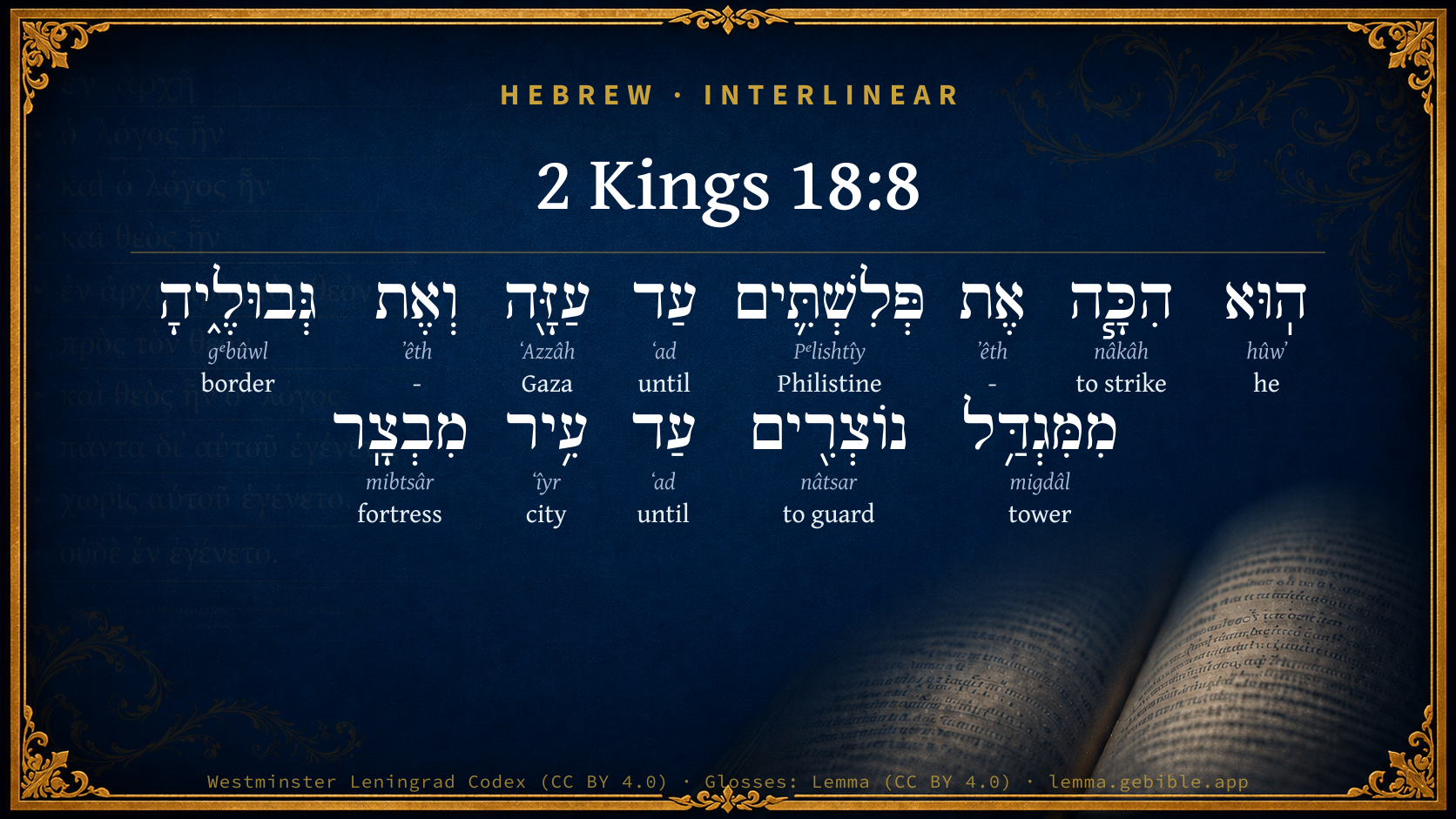
2 Kings 18:8

Hebrew (Westminster Leningrad Codex) 2 Kings 18:8 appears in the Hebrew Old Testament. The text above is from the Westminster Leningrad Codex. Each word links to its Strong’s number, a concise gloss, and parsing drawn from the Open Scriptures Hebrew Bible morphology. Click any word for its full Brown-Driver-Briggs (BDB) entry.
Download image
Cite this verse

2 Kings 18:8 (World English Bible). Public Domain. Lemma interlinear Bible study tool, https://lemma.gebible.app/v/2-kings/18/8.

Show BibTeX & RIS
BibTeX
RIS
English Translation
He struck the Philistines to Gaza and the borders of it, from the tower of the watchmen to the fortified city.
World English Bible · Public Domain
Download a study sheet

One document with this verse’s original text, its word-by-word gloss line, the meaning frame, cross-references with their text, attributed commentary, and full source and license credits — printable, and it pastes into notes with its structure intact.

This verse Autodidact and up

Study sheet (.html) Plain text (.txt)

A passage Seminary Student

Up to 50 verses in one chapter. A passage sheet keeps up to 6 commentary sources and 12 cross-references per verse, in the order this page ranks them, and says so on the sheet whenever that leaves anything out. Ask for a single verse and you get the Autodidact verse sheet above.

Everything on this page stays free to read, with no account — the sheet is a download of what is already on screen, not access to it.

Want to remove ads? Support Godless Engineer
Compare translations 3

The same verse in 3 English versions, stacked beneath the original-language interlinear above. Click any original word for its lexicon entry.

Each is an independent rendering of the whole verse — the interlinear is not word-aligned to these translations.

Highlighted words mark where these versions differ — a whole-verse word diff, not a word-by-word alignment.

  • World English Bible Public Domain
    He struck the Philistines to Gaza and the borders of it, from the tower of the watchmen to the fortified city.
  • King James Version Public Domain
    He smote the Philistines, even unto Gaza, and the borders thereof, from the tower of the watchmen to the fenced city.
  • unfoldingWord Literal Text CC BY-SA 4.0
    He, he struck the Philistines to Gaza and its borders, from a tower of watchmen to a fortified city.

unfoldingWord Literal Text — © unfoldingWord, licensed CC BY-SA 4.0. Word-aligned USFM3 via Door43 (git.door43.org/unfoldingWord/en_ult).

Versions to compare (up to 4)

3 of 4 selected

Show all 18 translations

Every available English version of this verse, each an independent rendering of the whole verse.

  • World English Bible Public Domain
    He struck the Philistines to Gaza and the borders of it, from the tower of the watchmen to the fortified city.
  • Berean Standard Bible Public Domain
    He defeated the Philistines as far as Gaza and its borders, from watchtower to fortified city.
  • Majority Standard Bible Public Domain
    He defeated the Philistines as far as Gaza and its borders, from watchtower to fortified city.
  • King James Version Public Domain
    He smote the Philistines, even unto Gaza, and the borders thereof, from the tower of the watchmen to the fenced city.
  • American Standard Version (1901) Public Domain
    He smote the Philistines unto Gaza and the borders thereof, from the tower of the watchmen to the fortified city.
  • Revised Version (1885) Public Domain
    He smote the Philistines unto Gaza and the borders thereof, from the tower of the watchmen to the fenced city.
  • Geneva Bible (1599) Public Domain
    He smote the Philistims vnto Azzah, and the coastes thereof, from the watch towre vnto the defensed citie.
  • Douay-Rheims (1899) Public Domain
    He smote the Philistines as far as Gaza, and all their borders, from the tower of the watchmen to the fenced city.
  • Young's Literal Translation Public Domain
    he hath smitten the Philistines unto Gaza, and its borders, from a tower of watchers unto the fenced city.
  • Literal Standard Version CC BY-SA 4.0
    he has struck the Philistines, even to Gaza and its borders, from a tower of watchers to the fortified city.
  • Unlocked Literal Bible CC BY-SA 4.0
    He attacked the Philistines to Gaza and the borders around, from the tower of the watchmen to the fortified city.
  • unfoldingWord Literal Text CC BY-SA 4.0
    He, he struck the Philistines to Gaza and its borders, from a tower of watchmen to a fortified city.
  • Darby Bible Public Domain
    He smote the Philistines unto Gazah and its borders, from the watchmen's tower to the fortified city.
  • World Messianic Bible Public Domain
    He struck the Philistines to Gaza and its borders, from the tower of the watchmen to the fortified city.
  • Webster's Bible Public Domain
    He smote the Philistines, even to Gaza, and its borders, from the tower of the watchmen to the fortified city.
  • Free Bible Version CC BY-SA 4.0
    He defeated the Philistines all the way to Gaza and the surrounding area, from watchtower to fortified town.
  • Bible in Basic English Public Domain
    He overcame the Philistines as far as Gaza and its limits, from the tower of the watchman to the walled town.
  • JPS Tanakh (1917) Public Domain
    He smote the Philistines unto Gaza and the borders thereof, from the tower of the watchmen to the fortified city.

Literal Standard Version (2020), Covenant Press — licensed CC BY-SA 4.0. Text via the HelloAO Bible API (eBible.org). Unlocked Literal Bible (unfoldingWord) — licensed CC BY-SA 4.0. Text via the HelloAO Bible API (eBible.org). unfoldingWord Literal Text — © unfoldingWord, licensed CC BY-SA 4.0. Word-aligned USFM3 via Door43 (git.door43.org/unfoldingWord/en_ult). Free Bible Version, Dr. Jonathan Gallagher — licensed CC BY-SA 4.0. Text via the HelloAO Bible API (eBible.org).

Word by word

More ways to search: Search by grammar → Find every occurrence → Compare this word →

Practice this passage: Drill this verse → Learn its vocabulary →

עַזָּ֖ה
ʻAzzâh
H5804
“Gaza”
Noun, Proper
Part of Speech
Noun
Type
Proper
Full BDB Definition

Origin: from H5794

TWOT: None

Azzah = "the strong" - another name for 'Gaza', a city of the Philistines located in the extreme southwest of Palestine close to the Mediterranean
  1. הֽוּא hûwʼ H1931 “he” Pronoun, Personal, 3rd Person, Masculine, Singular
  2. הִכָּ֧ה nâkâh H5221 “to strike” Verb, Hiphil, Perfect, 3rd Person, Masculine, Singular
  3. אֶת ʼêth H853 “-” Particle, Direct Object
  4. פְּלִשְׁתִּ֛ים Pᵉlishtîy H6430 “Philistines” Noun, Gentilic, Masculine, Plural, Absolute
  5. עַד ʻad H5704 “until” Preposition
  6. וְאֶת ʼêth H853 “and · -” Conjunction + Particle, Direct Object
  7. גְּבוּלֶ֑יהָ gᵉbûwl H1366 “borders · her” Noun, Common, Masculine, Plural, Construct + Suffix, Personal, 3rd Person, Feminine, Singular
  8. מִמִּגְדַּ֥ל migdâl H4026 “from · tower of” Preposition + Noun, Common, Both, Singular, Construct
  9. נוֹצְרִ֖ים nâtsar H5341 “guarding” Verb, Qal, Participle Active, Masculine, Plural, Absolute
  10. עַד ʻad H5704 “until” Preposition
  11. עִ֥יר ʻîyr H5892 “city of” Noun, Common, Feminine, Singular, Construct
  12. מִבְצָֽר mibtsâr H4013 “fortress” Noun, Common, Masculine, Singular, Absolute

About this verse

These counts appear in no published source. They are computed here, from the morphology-tagged text and Lemma’s own curated glosses. What Lemma adds →

13
words
11
distinct lemmas
Historical
section

Notable vocabulary

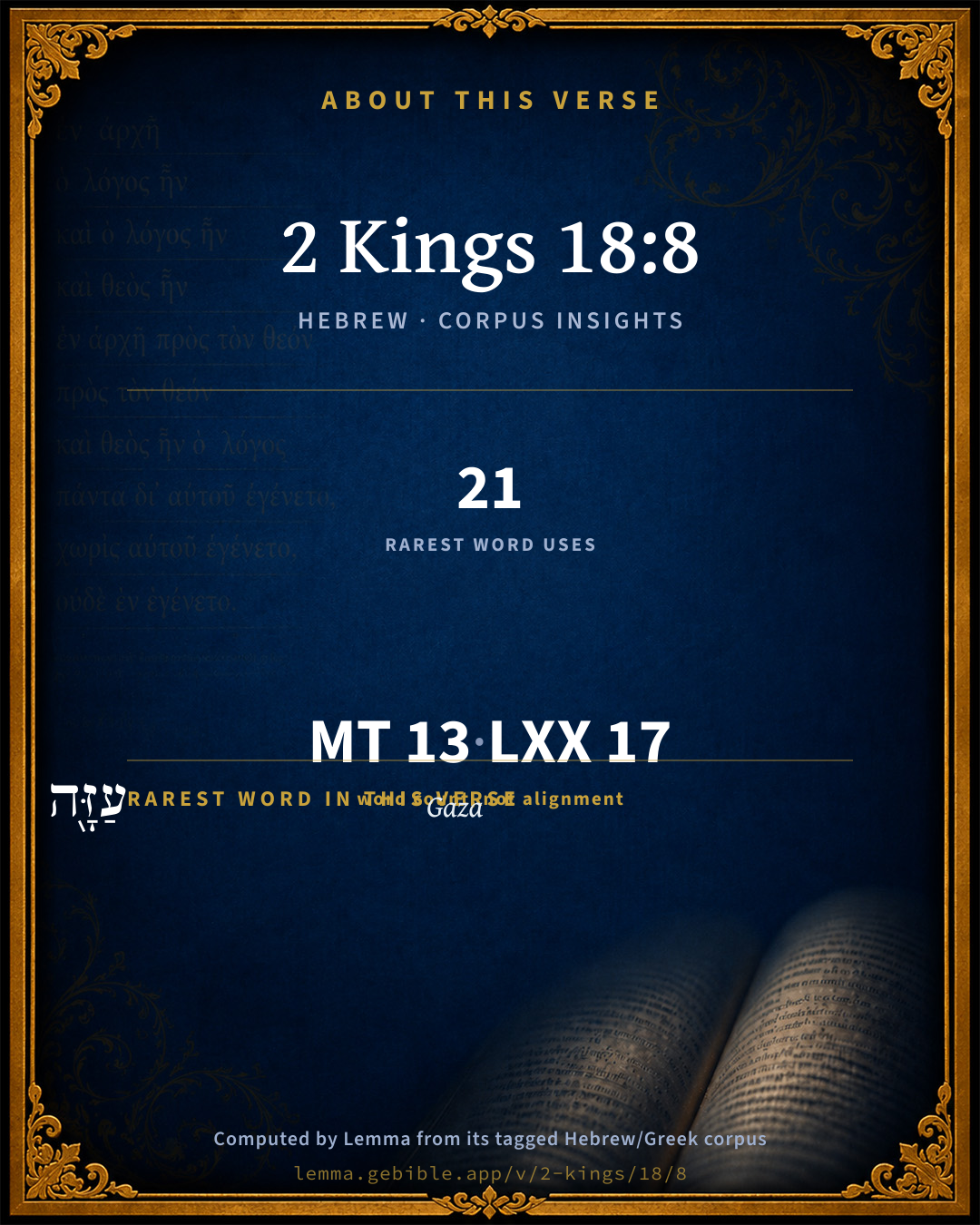
The rarest word here is עַזָּ֖ה Gaza H5804 — appearing just 21 times in the whole Hebrew Bible.

Shared distinctive vocabulary

עַזָּ֖ה Gaza H5804 occurs in 20 verses of the Hebrew Bible. Also found in:

Grammatical profile

  • 2 verbs
  • 6 nouns
  • 1 pronoun
  • 2 prepositions
  • 2 particles

Verb forms

  • הִכָּ֧ה Hiphil · Perfect
  • נוֹצְרִ֖ים Qal · Participle Active

Repetition

A word recurs within this verse — often emphatic in Hebrew:

Hebrew & Septuagint length

In English translation the verse runs 21 words from the Hebrew and 24 from the Septuagint (LXX English) — closely comparable.

A rough comparison of the two English renderings, which tokenize alike — not a word-level alignment.

Word counts can differ between the Hebrew and the Greek without any difference in meaning — e.g. the Hebrew direct-object marker אֵת has no separate Greek word, and Greek often adds the article ὁ.

In the original languages it is 13 Hebrew tokens and 17 Greek tokens — but the two are counted differently (Hebrew bundles its prefixes and suffixes into one token; the Greek is in lemma form), so that isn’t a like-for-like length.

Cross-references

6

Topical passages linked to 2 Kings 18:8 in the Treasury of Scripture Knowledge — connected by theme and wording, ordered by reader-vote popularity; previews shown in the World English Bible.

  • 2 Kings 17:9 The children of Israel did secretly things that were not right against Yahweh their God: and they built them high places in all their cities, from the tower of the watchmen to the fortified city;
  • Isaiah 14:29 Don't rejoice, O Philistia, all of you, because the rod that struck you is broken; for out of the serpent's root shall come forth an adder, and his fruit shall be a fiery flying serpent.
  • 2 Chronicles 28:18 The Philistines also had invaded the cities of the lowland, and of the South of Judah, and had taken Beth-shemesh, and Aijalon, and Gederoth, and Soco with the towns of it, and Timnah with the towns of it, Gimzo also and the towns of it: and they lived there.
  • 1 Chronicles 4:41 These written by name came in the days of Hezekiah king of Judah, and struck their tents, and the Meunim who were found there, and destroyed them utterly to this day, and lived in their place; because there was pasture there for their flocks.
  • 2 Chronicles 26:10 He built towers in the wilderness, and hewed out many cisterns, for he had much cattle; in the lowland also, and in the plain: [and he had] farmers and vineyard keepers in the mountains and in the fruitful fields; for he loved farming.
  • Isaiah 5:2 He dug it up, Gathered out its stones, Planted it with the choicest vine, Built a tower in its midst, And also cut out a winepress therein. He looked for it to yield grapes, But it yielded wild grapes.

Cross-references courtesy of OpenBible.info (CC BY 4.0).

Hebrew and Greek witnesses Masoretic Hebrew ↔ Greek Septuagint

The same verse in the two great witnesses to the Old Testament, shown verse-for-verse.

These are two independent witnesses, not word-aligned to each other, and the Septuagint is shown in lemma (dictionary) form.

Hebrew 2 Kings 18:8 Masoretic · Westminster Leningrad Codex

הֽוּא הִכָּ֧ה אֶת פְּלִשְׁתִּ֛ים עַד עַזָּ֖ה וְאֶת גְּבוּלֶ֑יהָ מִמִּגְדַּ֥ל נוֹצְרִ֖ים עַד עִ֥יר מִבְצָֽר

He struck the Philistines to Gaza and the borders of it, from the tower of the watchmen to the fortified city.

World English Bible · Public Domain

Greek LXX 2 Kings 18:8 Septuagint · lemma form

αὐτός πατάσσω ὁ ἀλλόφυλος ἕως γάζα καί ἕως ὅριον αὐτός ἀπό πύργος φυλάσσω καί ἕως πόλις ὀχυρός

He struck the Philistines even to Gaza, and to the border of it, from the tower of the watchmen even to the strong city.

LXX2012 (modern English Septuagint) · Public Domain

Hebrew: Westminster Leningrad Codex (CC BY 4.0). Greek: Septuagint (public domain); English from LXX2012 (modern English Septuagint) (Public Domain). How the Septuagint differs from the Hebrew →

Targum (Aramaic paraphrase)

1

The Targum is the ancient Jewish Aramaic paraphrase of the Hebrew Scriptures — an interpretive translation, not the Hebrew text itself. Onkelos (literal) and Pseudo-Jonathan (expansive) render the Torah, and Jonathan the Prophets. Coverage is partial: where no permissively-licensed English translation exists for a verse, only the Aramaic is shown. This is verse-level text, not a word-by-word alignment to the Hebrew.

  1. Targum Jonathan Prophets (Joshua–Malachi)
    הוּא קְטַל יַת פְּלִשְׁתָּאֵי עַד עַזָה וְיַת תְּחוּמָהָא מִמִגְדַל תְּקוֹף עַד קִירְוִין כְּרִיכָן:

    (no public-domain English translation for this verse)

    Targum Jonathan — Aramaic: “Mikraot Gedolot” (public domain). English: “Sefaria Community Translation” (CC0 1.0 (public-domain dedication)); “London "Chaldee Paraphrase," 1871” (public domain). Text via Sefaria.

Commentary

Notes on 2 Kings 18:8 from classic Christian and Jewish commentators (each source and its license shown beneath its notes). The classic Christian expositions comment on the surrounding passage and are grouped to its opening verse, so a note may address several verses; the Jewish commentaries on the Tanakh (Rashi and others) are per-verse, so they appear only where the commentator wrote on this verse.

Lemma curates 59 commentaries, every one of them public domain or Creative Commons licensed, each selected and text-cleaned for this edition rather than reprinted as found. About our sources →

Trapp's Complete Commentary

John Trapp

2Ki 18:8 He smote the Philistines, [even] unto Gaza, and the borders thereof, from the tower of the watchmen to the fenced city.

Ver. 8. He smote the Philistines.] A warlike people, and therefore his glory was the greater: as Plutarch praiseth the Romans above Alexander, because he subdued Asiatics that were pusillanimous and effeminate; but these, the Germans, Spaniards, Britons, hardy and headstrong nations.

From the tower of the watchmen.] See 2Ki 17:9.

John Trapp, A Commentary or Exposition upon All the Books of the Old and New Testament (1647–1656) — public domain. Text from a community e-Sword module.

Joseph Benson's Commentary

2Ki 18:8. He smote the Philistines even unto Gaza — And recovered from them what his father had lost, and more, 2Ch 28:18. From the tower of the watchmen to the fenced city — That is, all the country over, both the country villages and fortified towns. When he had purged out the corruptions which his father had brought in, he might expect to recover the possessions which his father had lost. These his victories over the Philistines had been foretold by Isa 14:28.

Joseph Benson's Commentary on the Old and New Testaments (1811–1818) — public domain. Text from a community e-Sword module.

Geneva Bible (1599)

Geneva Bible translators

Read 2 Kings 17:9.

Geneva Bible (1599) marginal notes — public domain. Text via Bolls.life.

Adam Clarke's Commentary

Verse 8. From the tower of the watchmen] See the same words, 2Kg 17:9. It seems a proverbial mode of expression: he reduced every kind of fortification; nothing was able to stand before him.

Adam Clarke's Commentary on the Bible (1810–1826) — public domain. Text from a community e-Sword/MySword module.

Ellicott's Commentary for English Readers

(8) He smote.—He it was who smote. The reduction of the Philistines was probably subsequent to the retreat of Sennacherib. (Comp. 2Ch_32:22; Isa_11:14.)

Unto Gaza.—The southernmost part of the Philistine territory.

From the tower of the watchmen . . . city.—See Note on 2Ki_17:9. The entire land of Philistia was ravaged by the Judean forces.

A Bible Commentary for English Readers, edited by Charles John Ellicott (1878–1897) — public domain. Text from a community e-Sword module.

The Cambridge Bible for Schools and Colleges

gen. ed. J. J. S. Perowne

8. he smote the Philistines, even unto Gaza] Gaza was the most southern of the five great towns of the Philistines, so that it is intimated that the whole land of Philistia was overrun by the king of Judah.

from the tower of the watchmen, &c.] See above on 2Ki_17:9 note.

The Cambridge Bible for Schools and Colleges (gen. ed. J. J. S. Perowne; Cambridge University Press, 1878–1918) — public domain. Text from a community e-Sword module.

John Gill's Exposition

And it came to pass in the fourth year of King Hezekiah,.... In the beginning of it:

which was the seventh year of Hoshea son of Elah king of Israel: the beginning of his seventh:

that Shalmaneser king of Assyria came up against Samaria, and besieged it; see Kg2 17:5.

John Gill's Exposition of the Whole Bible (1746–1763) — public domain (CC PDM 1.0). Text via the HelloAO Bible API.

Albert Barnes' Notes on the Bible

Sargon had established the complete dominion of Assyria over the Philistines. Hence, the object of Hezekiah’s Philistine campaign was not so much conquest as opposition to the Assyrian power. How successful it was is indicated in the Assyrian records by the number of towns in this quarter which Sennacherib recovered before he proceeded against Jerusalem.

Albert Barnes' Notes on the Bible (1834–1885) — public domain. Text from a community e-Sword/MySword module.

Haydock's Catholic Bible Commentary

City. Thus he punished them for their late invasion, 2 Paralipomenon xxviii. 18.

George Leo Haydock (1774–1849), Haydock's Catholic Family Bible and Commentary, 1859 edition — public domain. Excludes Psalms (Douay-Rheims chapter numbering differs from Protestant) and Deuterocanonical books (Catholic canon only).

Matthew Poole's English Annotations

He smote the Philistines, and recovered from them what his father had lost, 2Ch 28:18, and more.

From the tower of the watchmen to the fenced city; of which phrase See Poole "2Ki 17:9".

Matthew Poole's English Annotations on the Holy Bible (1683–1685) — public domain. Text from a community e-Sword/MySword module.

Whedon's Commentary on the Bible

Daniel D. Whedon

8. Smote the Philistines — Who in the reign of Ahaz “had invaded the cities of the low country, and of the south of Judah.” 2Ch_28:18.

Unto Gaza — In the southern part of the great Philistine plain, (see on Jos_10:41,) so that he probably recovered all the cities that the Philistines had taken from Judah.

From the tower of the watchmen to the fenced city — That is, from the more exposed districts to the fortified towns. See note on 2Ki_17:9. Keil is of opinion that this war against the Philistines occurred after the defeat of Sennacherib.

Daniel D. Whedon (gen. ed.), Commentary on the Old and New Testaments (1874–1909) — public domain. Text from a community e-Sword module.

The Pulpit Commentary

He smote the Philistines. Hezekiah"s Philistine war seems to have followed on an attempt which Sargon made to bring the whole country under the Assyrian dominion. Sargon attacked Philistia in B.C. 720, made Gaza and the other towns subject, and committed the custody of them to tributary kings, in whom he had confidence. But opposition soon manifested itself. Sargon"s creatures were expelled Akhimiti from Ash-clod, Padi from Ekron. Hezekiah assisted in this war of independence, attacked Sargon"s viceroys, and helped the cities to free themselves. About the year B.C. 711 Sargon speaks of a league against Assyria, to which the parties were Philistia, Judaea, Edom, and Moab ("Eponym Canon," p. 130). The Philistines, whom Hezekiah "smote," must be regarded as Assyrian partisans, whom he chastised in the interests of the national party. He did not seek conquests in Philistia for himself. Even unto Gaza. Gaza seems to have remained faithful to Assyria from its capture in B.C. 720. And the borders thereof, from the tower of the watchmen unto the fenced city. (On this expression, see the comment upon 2Ki_17:9)

The Pulpit Commentary (1880–1919), ed. H.D.M. Spence-Jones & Joseph S. Exell — public domain. Text from a community e-Sword module.

Lesson kit

Teaching starters — assembled from the data on this page, not authored interpretation. Every prompt links to the verse data it draws on. Edit before teaching.

2 Kings, in the Historical, opens this verse with 13 words (11 distinct Hebrew lemmas). Its most distinctive word is ʻAzzâh (“Gaza”). A historical commentator’s framing appears above. Read the whole chapter for the surrounding context.

Discussion questions

  1. What does “Gaza” (ʻAzzâh) contribute to the verse as a whole?
  2. How does Genesis 10:19, which shares the word «Gaza», read alongside this verse?
  3. What does the repetition of “until” (2× in this one verse) do in this verse?
  4. These translations render this verse differently. What is at stake in choosing one wording over another?
  5. «הִכָּ֧ה» is a Hiphil Perfect verb. How does that grammatical form shape the action described?
  6. Compare how Trapp's Complete Commentary and Joseph Benson's Commentary read this verse. Where do they agree or differ?

Things to notice

Reading settings

Reading text

Shown beneath each verse's original-language words.

Old Testament
Old Testament edition

Read the OT as the Masoretic Hebrew (MT) or the Greek Septuagint (LXX).

English shown for the Greek Septuagint (in the Hebrew ↔ Greek comparison).

Comparing translations? Open the Compare panel on any verse page to stack up to four side by side.