
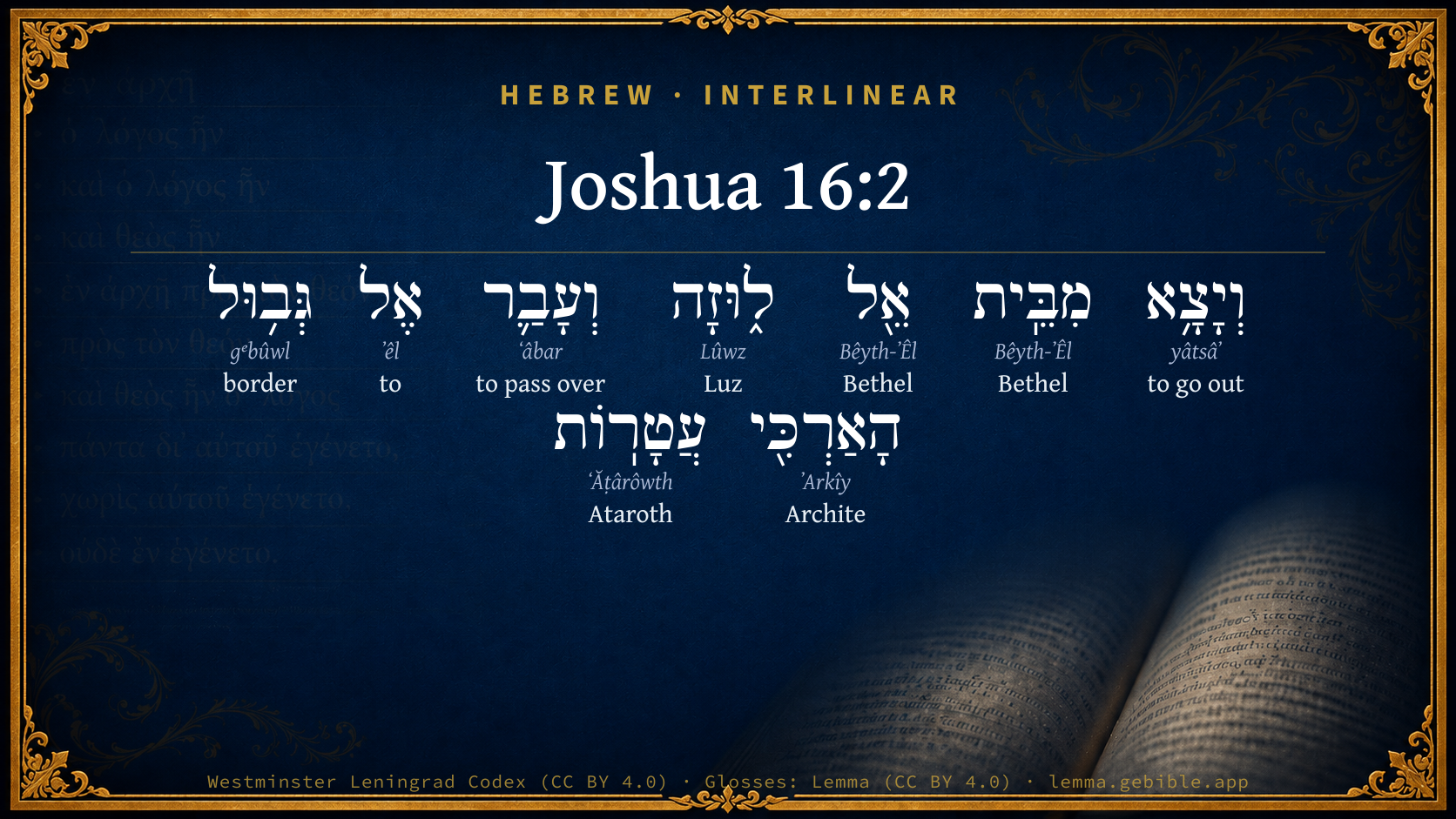
Joshua 16:2

Hebrew (Westminster Leningrad Codex) Joshua 16:2 appears in the Hebrew Old Testament. The text above is from the Westminster Leningrad Codex. Each word links to its Strong’s number, a concise gloss, and parsing drawn from the Open Scriptures Hebrew Bible morphology. Click any word for its full Brown-Driver-Briggs (BDB) entry.
Download image
Cite this verse

Joshua 16:2 (World English Bible). Public Domain. Lemma interlinear Bible study tool, https://lemma.gebible.app/v/joshua/16/2.

Show BibTeX & RIS
BibTeX
RIS
English Translation
and it went out from Bethel to Luz, and passed along to the border of the Archites to Ataroth;
World English Bible · Public Domain
Highlights
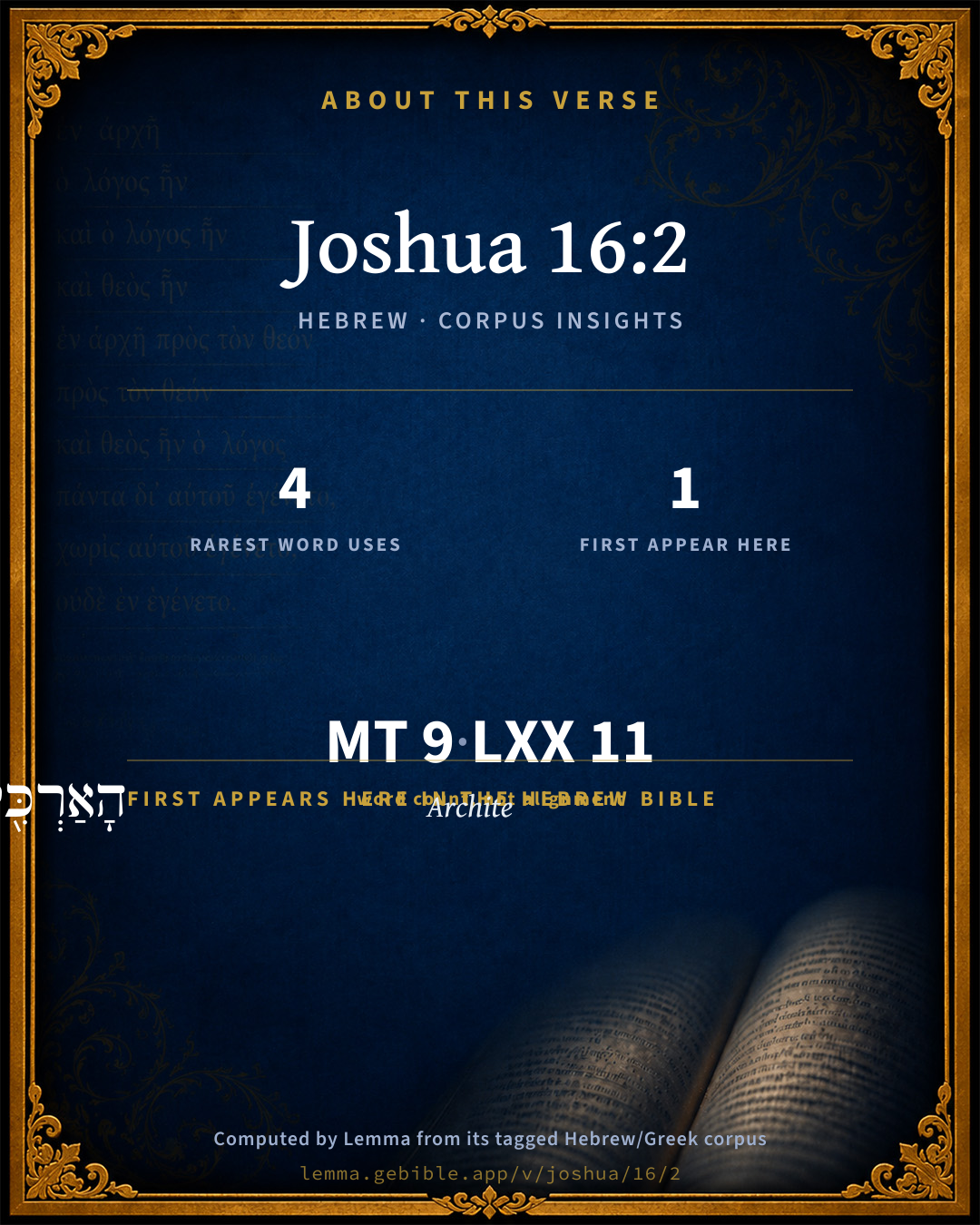
  • 1 first appearance in the Hebrew Bible
Full analysis ↓
Download a study sheet

One document with this verse’s original text, its word-by-word gloss line, the meaning frame, cross-references with their text, attributed commentary, and full source and license credits — printable, and it pastes into notes with its structure intact.

This verse Autodidact and up

Study sheet (.html) Plain text (.txt)

A passage Seminary Student

Up to 50 verses in one chapter. A passage sheet keeps up to 6 commentary sources and 12 cross-references per verse, in the order this page ranks them, and says so on the sheet whenever that leaves anything out. Ask for a single verse and you get the Autodidact verse sheet above.

Everything on this page stays free to read, with no account — the sheet is a download of what is already on screen, not access to it.

Want to remove ads? Support Godless Engineer
Compare translations 3

The same verse in 3 English versions, stacked beneath the original-language interlinear above. Click any original word for its lexicon entry.

Each is an independent rendering of the whole verse — the interlinear is not word-aligned to these translations.

Highlighted words mark where these versions differ — a whole-verse word diff, not a word-by-word alignment.

  • World English Bible Public Domain
    and it went out from Bethel to Luz, and passed along to the border of the Archites to Ataroth;
  • King James Version Public Domain
    And goeth out from Bethel to Luz, and passeth along unto the borders of Archi to Ataroth,
  • unfoldingWord Literal Text CC BY-SA 4.0
    And it went out from Bethel to Luz and passed over to the border of the Arkites at Ataroth.

unfoldingWord Literal Text — © unfoldingWord, licensed CC BY-SA 4.0. Word-aligned USFM3 via Door43 (git.door43.org/unfoldingWord/en_ult).

Versions to compare (up to 4)

3 of 4 selected

Show all 18 translations

Every available English version of this verse, each an independent rendering of the whole verse.

  • World English Bible Public Domain
    and it went out from Bethel to Luz, and passed along to the border of the Archites to Ataroth;
  • Berean Standard Bible Public Domain
    It went on from Bethel (that is, Luz) and proceeded to the border of the Archites in Ataroth.
  • Majority Standard Bible Public Domain
    It went on from Bethel (that is, Luz) and proceeded to the border of the Archites in Ataroth.
  • King James Version Public Domain
    And goeth out from Bethel to Luz, and passeth along unto the borders of Archi to Ataroth,
  • American Standard Version (1901) Public Domain
    and it went out from Beth-el to Luz, and passed along unto the border of the Archites to Ataroth;
  • Revised Version (1885) Public Domain
    and it went out from Beth-el to Luz, and passed along unto the border of the Archites to Ataroth;
  • Geneva Bible (1599) Public Domain
    And goeth out from Beth-el to Luz, and runneth along vnto the borders of Archiataroth,
  • Douay-Rheims (1899) Public Domain
    And goeth out from Bethel to Luza: and passeth the border of Archi, to Ataroth,
  • Young's Literal Translation Public Domain
    and hath gone out from Beth-El to Luz, and passed over unto the border of Archi `to' Ataroth,
  • Literal Standard Version CC BY-SA 4.0
    and has gone out from Beth-El to Luz, and passed over to the border of Archi [to] Ataroth,
  • Unlocked Literal Bible CC BY-SA 4.0
    Then it went from Bethel to Luz and passed along to Ataroth, the territory of the Arkites.
  • unfoldingWord Literal Text CC BY-SA 4.0
    And it went out from Bethel to Luz and passed over to the border of the Arkites at Ataroth.
  • Darby Bible Public Domain
    And [the border] went from Bethel to Luz, and passed to the border of the Archites to Ataroth,
  • World Messianic Bible Public Domain
    It went out from Bethel to Luz, and passed along to the border of the Archites to Ataroth;
  • Webster's Bible Public Domain
    And goeth out from Beth-el to Luz, and passeth along to the borders of Archi to Ataroth,
  • Free Bible Version CC BY-SA 4.0
    From Bethel (or Luz) it continued to the border of Ataroth the Archite.
  • Bible in Basic English Public Domain
    And it goes out from Beth-el to Luz, and on as far as the limit of the Archites to Ataroth;
  • JPS Tanakh (1917) Public Domain
    And it went out from Beth-el-luz, and passed along unto the border of the Archites to Ataroth.

Literal Standard Version (2020), Covenant Press — licensed CC BY-SA 4.0. Text via the HelloAO Bible API (eBible.org). Unlocked Literal Bible (unfoldingWord) — licensed CC BY-SA 4.0. Text via the HelloAO Bible API (eBible.org). unfoldingWord Literal Text — © unfoldingWord, licensed CC BY-SA 4.0. Word-aligned USFM3 via Door43 (git.door43.org/unfoldingWord/en_ult). Free Bible Version, Dr. Jonathan Gallagher — licensed CC BY-SA 4.0. Text via the HelloAO Bible API (eBible.org).

Word by word

More ways to search: Search by grammar → Find every occurrence → Compare this word →

Practice this passage: Drill this verse → Learn its vocabulary →

About this verse

These counts appear in no published source. They are computed here, from the morphology-tagged text and Lemma’s own curated glosses. What Lemma adds →

9
words
8
distinct lemmas
Historical
section

Notable vocabulary

The rarest word here is עֲטָרֽוֹת Ataroth H5852 — appearing just 4 times in the whole Hebrew Bible.

First appearance in Scripture

This word makes its first canonical appearance in the Hebrew Bible here:

  • הָאַרְכִּ֖י Archite H757

Shared distinctive vocabulary

עֲטָרֽוֹת Ataroth H5852 occurs in 4 verses of the Hebrew Bible. Also found in:

Grammatical profile

  • 2 verbs
  • 6 nouns
  • 1 preposition

Verb forms

  • וְיָצָ֥א Qal · Sequential Perfect
  • וְעָבַ֛ר Qal · Sequential Perfect

Repetition

A word recurs within this verse — often emphatic in Hebrew:

  • מִבֵּֽית Bethel H1008 ×2

Hebrew & Septuagint length

In English translation the verse runs 19 words from the Hebrew and 15 from the Septuagint (LXX English) — closely comparable.

A rough comparison of the two English renderings, which tokenize alike — not a word-level alignment.

Word counts can differ between the Hebrew and the Greek without any difference in meaning — e.g. the Hebrew direct-object marker אֵת has no separate Greek word, and Greek often adds the article ὁ.

In the original languages it is 9 Hebrew tokens and 11 Greek tokens — but the two are counted differently (Hebrew bundles its prefixes and suffixes into one token; the Greek is in lemma form), so that isn’t a like-for-like length.

Cross-references

5

Topical passages linked to Joshua 16:2 in the Treasury of Scripture Knowledge — connected by theme and wording, ordered by reader-vote popularity; previews shown in the World English Bible.

  • Joshua 18:13 The border passed along from there to Luz, to the side of Luz (the same is Bethel), southward; and the border went down to Ataroth Addar, by the mountain that lies on the south of Beth Horon the lower.
  • Genesis 28:19 He called the name of that place Bethel, but the name of the city was Luz at the first.
  • Judges 1:22–26 The house of Joseph, they also went up against Bethel; and Yahweh was with them.
  • 2 Samuel 16:16 It happened, when Hushai the Archite, David's friend, was come to Absalom, that Hushai said to Absalom, [Long] live the king, [Long] live the king.
  • 1 Chronicles 27:33 Ahithophel was the king's counselor: and Hushai the Archite was the king's friend:

Cross-references courtesy of OpenBible.info (CC BY 4.0).

Hebrew and Greek witnesses Masoretic Hebrew ↔ Greek Septuagint

The same verse in the two great witnesses to the Old Testament, shown verse-for-verse.

These are two independent witnesses, not word-aligned to each other, and the Septuagint is shown in lemma (dictionary) form.

Hebrew Joshua 16:2 Masoretic · Westminster Leningrad Codex

וְיָצָ֥א מִבֵּֽית אֵ֖ל ל֑וּזָה וְעָבַ֛ר אֶל גְּב֥וּל הָאַרְכִּ֖י עֲטָרֽוֹת

and it went out from Bethel to Luz, and passed along to the border of the Archites to Ataroth;

World English Bible · Public Domain

Greek LXX Joshua 16:2 Septuagint · lemma form

καί ἐκἔρχομαι εἰς βαιθηλ καί παραἔρχομαι ἐπί ὁ ὅριον ὁ χαταρωθι

And they will go out to Baethel, and will proceed to the borders of Achatarothi.

LXX2012 (modern English Septuagint) · Public Domain

On this verse, Matthew Poole's English Annotations discusses the Septuagint’s reading. Read the note in Commentary ↓

Hebrew: Westminster Leningrad Codex (CC BY 4.0). Greek: Septuagint (public domain); English from LXX2012 (modern English Septuagint) (Public Domain). How the Septuagint differs from the Hebrew →

Targum (Aramaic paraphrase)

1

The Targum is the ancient Jewish Aramaic paraphrase of the Hebrew Scriptures — an interpretive translation, not the Hebrew text itself. Onkelos (literal) and Pseudo-Jonathan (expansive) render the Torah, and Jonathan the Prophets. Coverage is partial: where no permissively-licensed English translation exists for a verse, only the Aramaic is shown. This is verse-level text, not a word-by-word alignment to the Hebrew.

  1. Targum Jonathan Prophets (Joshua–Malachi)
    וְנָפֵק מִבֵּית אֵל לְלוּז וַעֲבַר לִתְּחוּם אַרְכִּי לַעֲטָרוֹת:

    (no public-domain English translation for this verse)

    Targum Jonathan — Aramaic: “Mikraot Gedolot” (public domain). English: “Sefaria Community Translation” (CC0 1.0 (public-domain dedication)); “London "Chaldee Paraphrase," 1871” (public domain). Text via Sefaria.

Commentary

Notes on Joshua 16:2 from classic Christian and Jewish commentators (each source and its license shown beneath its notes). The classic Christian expositions comment on the surrounding passage and are grouped to its opening verse, so a note may address several verses; the Jewish commentaries on the Tanakh (Rashi and others) are per-verse, so they appear only where the commentator wrote on this verse.

Lemma curates 59 commentaries, every one of them public domain or Creative Commons licensed, each selected and text-cleaned for this edition rather than reprinted as found. About our sources →

Trapp's Complete Commentary

John Trapp

Jos 16:2 And goeth out from Bethel to Luz, and passeth along unto the borders of Archi to Ataroth,

Ver. 2. Unto the borders of Archi.] Hushai’s country, {2Sa 16:16} ennobled by his name, as Co was to Hippocrates, and little Hippo by great Augustine.

John Trapp, A Commentary or Exposition upon All the Books of the Old and New Testament (1647–1656) — public domain. Text from a community e-Sword module.

Joseph Benson's Commentary

Jos 16:2. From Bethel to Luz — Dupin translates this Bethel-Luz, and Dr. Waterland, Bethel, which is Luz; for we sometimes find them mentioned as one and the same place, as Jos 18:13; Jdg 1:23; and it is probable that in a length of time they were united, and the inhabitants of the former went to the latter. The borders of Archi to Ataroth — Or rather, the borders of Archi-Ataroth, as both the Seventy and the Vulgate render it, and as the words are in the Hebrew, this being the same city which is afterward called Ataroth, Jos 16:7.

Joseph Benson's Commentary on the Old and New Testaments (1811–1818) — public domain. Text from a community e-Sword module.

Adam Clarke's Commentary

Verse 2. From Bethel to Luz] From Ge 28:19 it appears that the place which Jacob called Beth-el was formerly called Luz; see the note there: but here they seem to be two distinct places. It is very likely that the place where Jacob had the vision was not in Luz, but in some place within a small distance of that city or village, (see the note on Ge 28:12), and that sometimes the whole place was called Beth-el, at other times Luz, and sometimes, as in the case above, the two places were distinguished. As we find the term London comprises, not only London, but also the city of Westminster and the borough of Southwark; though at other times all three are distinctly mentioned.

Archi to Ataroth] Archi was the country of Hushai, the friend of David, 2Sa 15:32, who is called Hushai the Archite. Ataroth, called Ataroth-addar, Ataroth the illustrious, Jos 16:5, and simply Ataroth, Jos 16:7, is supposed to have been about fifteen miles from Jerusalem.

Adam Clarke's Commentary on the Bible (1810–1826) — public domain. Text from a community e-Sword/MySword module.

The Cambridge Bible for Schools and Colleges

gen. ed. J. J. S. Perowne

2. and goeth out] Thence it passed on to Luz. It seems impossible to determine exactly whether Bethel and Luz were the same town, Luz being the Canaanite and Bethel the Hebrew name, or whether they were distinct places close to one another.

(a) This verse, Jos_18:13, and Gen_28:19, seem to favour the last interpretation.

(b) Gen_35:6, Jdg_1:23, favour the former.

The conclusion of Mr Grove is “that the two places were distinct during the times preceding the conquest, Luz being the city, and Bethel the pillar and altar of Jacob; but after the destruction of Luz by the tribe of Ephraim the town of Bethel arose.” See his Article in Smith’s Bibl. Dict.

unto the borders of Archi] Comp. 2Sa_16:16, 1Ch_27:33, where we read of Hushai the Archite. The precise locality is unknown.

to Ataroth] See below Jos_16:5, and comp. Jos_18:13.

The Cambridge Bible for Schools and Colleges (gen. ed. J. J. S. Perowne; Cambridge University Press, 1878–1918) — public domain. Text from a community e-Sword module.

John Gill's Exposition

And goeth out from Bethel to Luz,.... For though these two places in time became one, yet they were originally distinct. Bethel, at which Jacob stopped, and who gave it its name, was a field adjacent to the city of Luz, Gen 38:11; and therefore with propriety may be, as they here are, distinguished:

and passeth along unto the borders Archi to Ataroth; or to Archiataroth; these two words being the name of one and the same place, and to be joined as they are, in the Greek version, and others; and is the same with Atarothaddar, Jos 16:5. Ataroth was its proper name, but it had these additional epithets to distinguish it from another Ataroth; see Jos 16:7; Jerom (b) makes mention of Atharoth by Ramma, in the tribe of Joseph, and of another in the tribe of Ephraim, now a village at the north of Sebaste, or Samaria, four miles from it, called Atharus; the former is here meant.

(b) De loc. Heb. fol. 88. G.

John Gill's Exposition of the Whole Bible (1746–1763) — public domain (CC PDM 1.0). Text via the HelloAO Bible API.

Albert Barnes' Notes on the Bible

Of Archi - (Read “of the Archite,” also a designation of David’s friend Hushai (2Sa 15:32; 2Sa 16:16, etc.). The word is derived from Erech Gen 10:10. But whether there was in the neighborhood of Bethel a place bearing this Babylonian name, or whether a colony from the East had settled in this spot and brought the name with them, is unknown.

Ataroth - Called Jos 16:5; Jos 18:13 Ataroth-adar (= “crowns of fame or greatness”) perhaps to distinguish it from two other places bearing the same name but, situated on the other side of Jordan, in the territory of Gad Num 32:34. It is identified with Atara, near the road from Jerusalem to Nablous.

Albert Barnes' Notes on the Bible (1834–1885) — public domain. Text from a community e-Sword/MySword module.

Haydock's Catholic Bible Commentary

To Luza. The Vulgate reads Bethel Luza, which may be supposed to be two names, (chap. xviii. 13.; Haydock) for the same city. (Menochius) (Genesis xxviii. 29.) --- Bethel was probably the country, (Calmet) or mountain, (Haydock) to the east of Luza, on the frontiers of Benjamin and of Ephraim; for which reason it is sometimes attributed to both. --- To Atharoth. This city, and Archi, are supposed by some to be the same city. Archi seems, however, to have been a distinct place, where Chusai ws born, 2 Kings xv. 32. Atharoth is styled Addar, "the illustrious," ver. 5. It was 15 miles from Jericho.

George Leo Haydock (1774–1849), Haydock's Catholic Family Bible and Commentary, 1859 edition — public domain. Excludes Psalms (Douay-Rheims chapter numbering differs from Protestant) and Deuterocanonical books (Catholic canon only).

Matthew Poole's English Annotations

From Beth-el to Luz, or, from Bethel-luzah, as the LXX. here join the words; for Beth-el was anciently called Luz, Gen 28:19; 48:3; though some think this was another Luz, spoken of Jdg 1:26. Others make Beth-el and Luz two neighbouring towns, which afterwards being more built and inhabited, became one, as oft hath happened.

Matthew Poole's English Annotations on the Holy Bible (1683–1685) — public domain. Text from a community e-Sword/MySword module.

Whedon's Commentary on the Bible

Daniel D. Whedon

2. From Beth-el to Luz — Beth-el and Luz were the same city. See note on Jos_7:2. The Beth-el of the text is to be understood of the Mount Bethel named in the preceding verse.

Borders of Archi — Or, of the Archite. No trace of this name is found in the vicinity of Beth-el. Perhaps in this name we have the last faint trace of one of the original Canaanitish tribes. Ataroth is supposed by Dr. Robinson to be identical with a large village called Atara, on the summit of a hill about six miles northwest of Beth-el; [but this verse and Jos_18:13 seem rather to place it between Beth-el and Beth-horon, so that we may rather identify it with the Atara which lies some three miles south of Beth-el. Here Robinson noticed considerable ruins of an ancient town. At Ataroth the border turned westward toward Beth-horon.]

Daniel D. Whedon (gen. ed.), Commentary on the Old and New Testaments (1874–1909) — public domain. Text from a community e-Sword module.

The Pulpit Commentary

From Bethel to Luz. Like Jerusalem and Aelia Capitolina, or old and new Carthage, the new city did not coincide precisely in its site with the old one. (see Jos_18:13; also Gen_28:19 Gen_35:6 Jud_1:23) Bethel was probably built, as far as could be ascertained, on the spot near the Canaanitish city where the wanderer Jacob spent the night in which the famous vision appeared to him. (see Gen_28:11) Knobel, however, renders literally, Bethel-Luzah, as though the older and later names had been here conjoined. The borders of Archi. Rather, the borders of the Archite. (cf. 2Sa_15:32 2Sa_16:16 1Ch_27:33) This is the only clue we have to the residence or tribe of Hushai.

The Pulpit Commentary (1880–1919), ed. H.D.M. Spence-Jones & Joseph S. Exell — public domain. Text from a community e-Sword module.

Lesson kit

Teaching starters — assembled from the data on this page, not authored interpretation. Every prompt links to the verse data it draws on. Edit before teaching.

Joshua, in the Historical, opens this verse with 9 words (8 distinct Hebrew lemmas). Its most distinctive word is ʻĂṭârôwth (“Ataroth”). A historical commentator’s framing appears above. Read the whole chapter for the surrounding context.

Discussion questions

  1. The word ʻĂṭârôwth carries the sense “Ataroth.” How does it shape the verse?
  2. This is the first place “Archite” appears in Scripture (first appears here). What does its debut here establish?
  3. How does Numbers 32:3, which shares the word «Ataroth», read alongside this verse?
  4. What does the repetition of “Bethel” (2× in this one verse) do in this verse?
  5. These translations render this verse differently; the difference is in the English rendering, not the original. What questions does that raise?
  6. «וְיָצָ֥א» is a Qal Sequential Perfect verb. How does that grammatical form shape the action described?
  7. Compare how Trapp's Complete Commentary and Joseph Benson's Commentary read this verse. Where do they agree or differ?

Things to notice

Reading settings

Reading text

Shown beneath each verse's original-language words.

Old Testament
Old Testament edition

Read the OT as the Masoretic Hebrew (MT) or the Greek Septuagint (LXX).

English shown for the Greek Septuagint (in the Hebrew ↔ Greek comparison).

Comparing translations? Open the Compare panel on any verse page to stack up to four side by side.