
Joshua 16:5

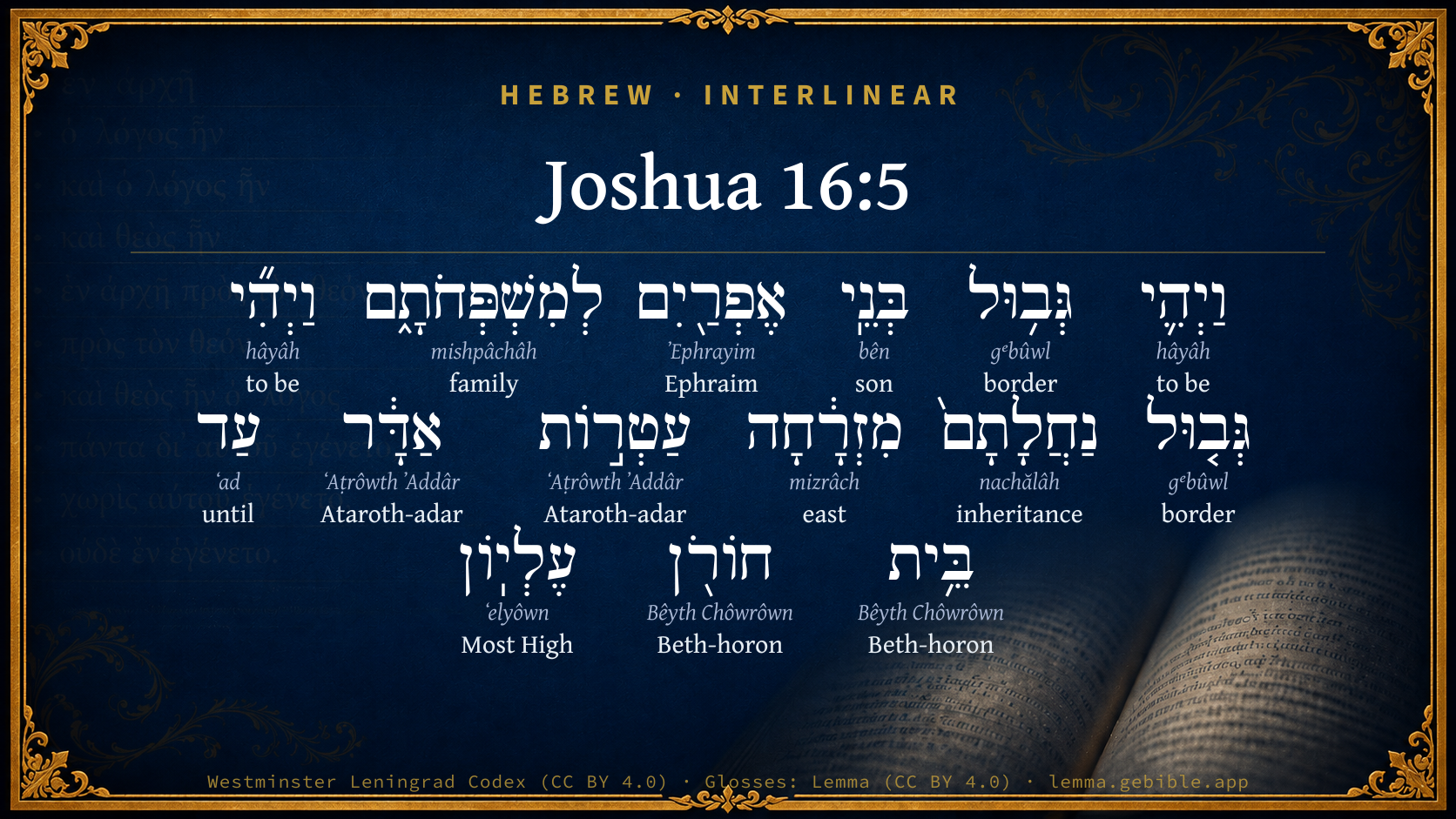
Hebrew (Westminster Leningrad Codex) Joshua 16:5 appears in the Hebrew Old Testament. The text above is from the Westminster Leningrad Codex. Each word links to its Strong’s number, a concise gloss, and parsing drawn from the Open Scriptures Hebrew Bible morphology. Click any word for its full Brown-Driver-Briggs (BDB) entry.
Download image
Cite this verse

Joshua 16:5 (World English Bible). Public Domain. Lemma interlinear Bible study tool, https://lemma.gebible.app/v/joshua/16/5.

Show BibTeX & RIS
BibTeX
RIS
English Translation
The border of the children of Ephraim according to their families was [thus]: the border of their inheritance eastward was Ataroth Addar, to Beth Horon the upper;
World English Bible · Public Domain
Highlights
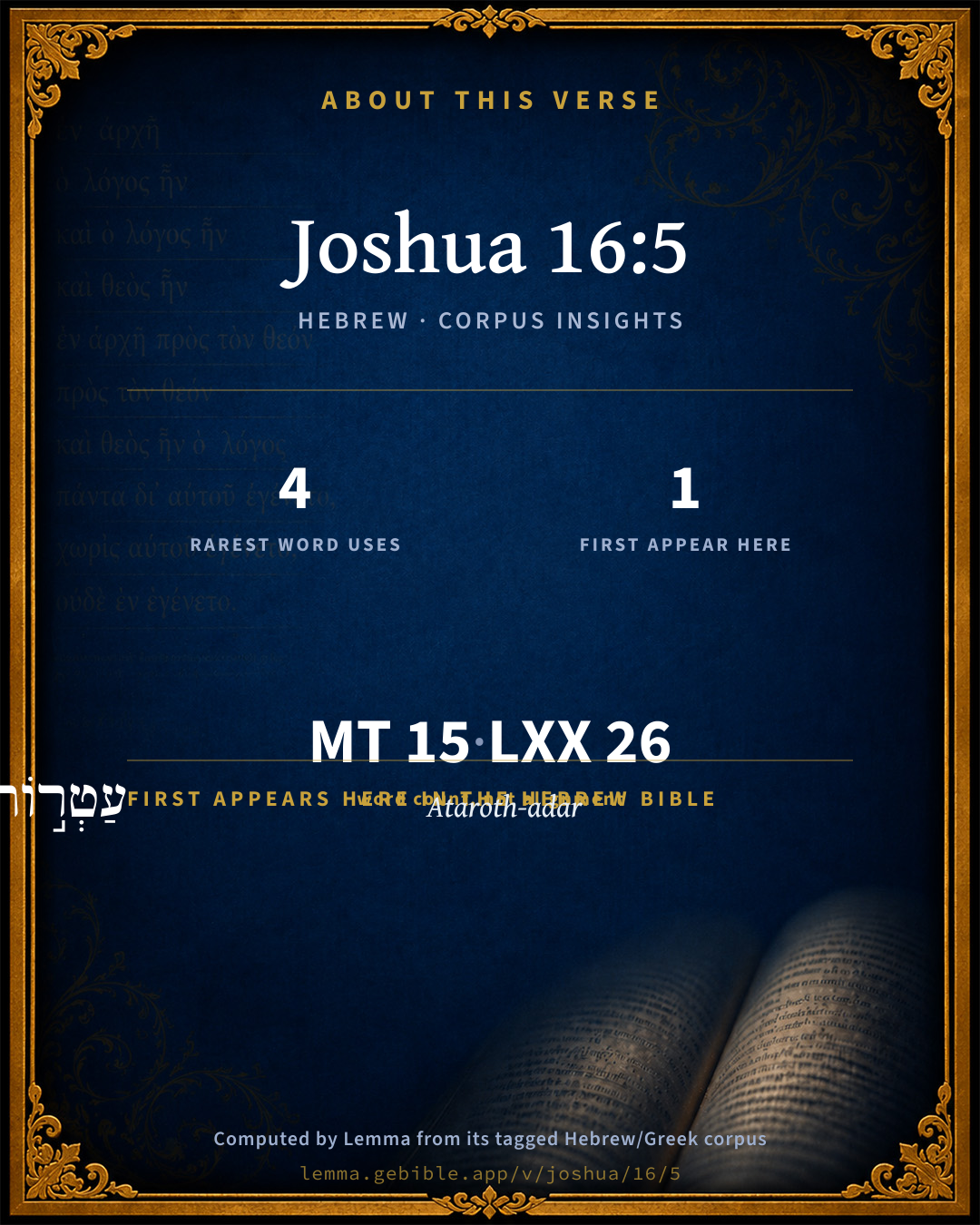
  • 1 first appearance in the Hebrew Bible
Full analysis ↓
Download a study sheet

One document with this verse’s original text, its word-by-word gloss line, the meaning frame, cross-references with their text, attributed commentary, and full source and license credits — printable, and it pastes into notes with its structure intact.

This verse Autodidact and up

Study sheet (.html) Plain text (.txt)

A passage Seminary Student

Up to 50 verses in one chapter. A passage sheet keeps up to 6 commentary sources and 12 cross-references per verse, in the order this page ranks them, and says so on the sheet whenever that leaves anything out. Ask for a single verse and you get the Autodidact verse sheet above.

Everything on this page stays free to read, with no account — the sheet is a download of what is already on screen, not access to it.

Want to remove ads? Support Godless Engineer
Compare translations 3

The same verse in 3 English versions, stacked beneath the original-language interlinear above. Click any original word for its lexicon entry.

Each is an independent rendering of the whole verse — the interlinear is not word-aligned to these translations.

Highlighted words mark where these versions differ — a whole-verse word diff, not a word-by-word alignment.

  • World English Bible Public Domain
    The border of the children of Ephraim according to their families was [thus]: the border of their inheritance eastward was Ataroth Addar, to Beth Horon the upper;
  • King James Version Public Domain
    And the border of the children of Ephraim according to their families was thus: even the border of their inheritance on the east side was Atarothaddar, unto Bethhoron the upper;
  • unfoldingWord Literal Text CC BY-SA 4.0
    Now this was the border of the sons of Ephraim according to their clans. And the border of their inheritance from the sunrise was Ataroth Addar unto Upper Beth Horon,

unfoldingWord Literal Text — © unfoldingWord, licensed CC BY-SA 4.0. Word-aligned USFM3 via Door43 (git.door43.org/unfoldingWord/en_ult).

Versions to compare (up to 4)

3 of 4 selected

Show all 18 translations

Every available English version of this verse, each an independent rendering of the whole verse.

  • World English Bible Public Domain
    The border of the children of Ephraim according to their families was [thus]: the border of their inheritance eastward was Ataroth Addar, to Beth Horon the upper;
  • Berean Standard Bible Public Domain
    This was the territory of the descendants of Ephraim by their clans: The border of their inheritance went from Ataroth-addar in the east to Upper Beth-horon
  • Majority Standard Bible Public Domain
    This was the territory of the descendants of Ephraim by their clans: The border of their inheritance went from Ataroth-addar in the east to Upper Beth-horon
  • King James Version Public Domain
    And the border of the children of Ephraim according to their families was thus: even the border of their inheritance on the east side was Atarothaddar, unto Bethhoron the upper;
  • American Standard Version (1901) Public Domain
    And the border of the children of Ephraim according to their families was `thus': the border of their inheritance eastward was Ataroth-addar, unto Beth-horon the upper;
  • Revised Version (1885) Public Domain
    And the border of the children of Ephraim according to their families was thus: even the border of their inheritance eastward was Ataroth-addar, unto Beth-horon the upper;
  • Geneva Bible (1599) Public Domain
    Also the borders of the children of Ephraim according to their families, euen the borders of their inheritance on the Eastside were Atroth-addar, vnto Beth-horon the vpper.
  • Douay-Rheims (1899) Public Domain
    And the border of the children of Ephraim was according to their kindreds: and their possession towards the east was Ataroth-addar unto Beth-horon the upper.
  • Young's Literal Translation Public Domain
    And the border of the sons of Ephraim is by their families; and the border of their inheritance is on the east, Atroth-Addar unto Beth-Horon the upper;
  • Literal Standard Version CC BY-SA 4.0
    And the border of the sons of Ephraim is by their families; and the border of their inheritance is on the east, Atroth-Addar to the upper Beth-Horon;
  • Unlocked Literal Bible CC BY-SA 4.0
    The territory of the tribe of Ephraim, clan by clan: The border of their inheritance on the east went from Ataroth Addar as far as Upper Beth Horon,
  • unfoldingWord Literal Text CC BY-SA 4.0
    Now this was the border of the sons of Ephraim according to their clans. And the border of their inheritance from the sunrise was Ataroth Addar unto Upper Beth Horon,
  • Darby Bible Public Domain
    And the border of the children of Ephraim was according to their families; the border of their inheritance eastwards was Ataroth-Addar as far as the upper Beth-horon;
  • World Messianic Bible Public Domain
    This was the border of the children of Ephraim according to their families. The border of their inheritance eastward was Ataroth Addar, to Beth Horon the upper.
  • Webster's Bible Public Domain
    And the border of the children of Ephraim according to their families was thus: even the border of their inheritance on the east side was Ataroth-adar, to Beth-horon the upper:
  • Free Bible Version CC BY-SA 4.0
    This was the territory allocated to the tribe of Ephraim, by families. The boundary of their allocation ran from Ataroth-addar in the east to Upper Beth-horon
  • Bible in Basic English Public Domain
    And the limit of the land of the children of Ephraim by their families was marked out in this way: the limit of their heritage to the east was Ataroth-addar, to Beth-horon the higher;
  • JPS Tanakh (1917) Public Domain
    And the border of the children of Ephraim according to their families was thus; even the border of their inheritance eastward was Atroth-addar, unto Beth-horon the upper.

Literal Standard Version (2020), Covenant Press — licensed CC BY-SA 4.0. Text via the HelloAO Bible API (eBible.org). Unlocked Literal Bible (unfoldingWord) — licensed CC BY-SA 4.0. Text via the HelloAO Bible API (eBible.org). unfoldingWord Literal Text — © unfoldingWord, licensed CC BY-SA 4.0. Word-aligned USFM3 via Door43 (git.door43.org/unfoldingWord/en_ult). Free Bible Version, Dr. Jonathan Gallagher — licensed CC BY-SA 4.0. Text via the HelloAO Bible API (eBible.org).

Word by word

More ways to search: Search by grammar → Find every occurrence → Compare this word →

Practice this passage: Drill this verse → Learn its vocabulary →

עַטְר֣וֹת
ʻAṭrôwth ʼAddâr
H5853
“Ataroth-adar”
Noun, Proper
Part of Speech
Noun
Type
Proper
Full BDB Definition

Origin: from the same as H5852 and H146

TWOT: None

Ataroth-adar or Ataroth-addar = "crowns of glory" - a Gadite town on the west border of Benjamin
  1. וַיְהִ֛י hâyâh H1961 “and · to be” Conjunction + Verb, Qal, Sequential Imperfect, 3rd Person, Masculine, Singular
  2. גְּב֥וּל gᵉbûwl H1366 “border of” Noun, Common, Masculine, Singular, Construct
  3. בְּנֵֽי bên H1121 “sons of” Noun, Common, Masculine, Plural, Construct
  4. אֶפְרַ֖יִם ʼEphrayim H669 “Ephraim” Noun, Proper
  5. לְמִשְׁפְּחֹתָ֑ם mishpâchâh H4940 “to/for · families · their” Preposition + Noun, Common, Feminine, Plural, Construct + Suffix, Personal, 3rd Person, Masculine, Plural
  6. וַיְהִ֞י hâyâh H1961 “and · to be” Conjunction + Verb, Qal, Sequential Imperfect, 3rd Person, Masculine, Singular
  7. גְּב֤וּל gᵉbûwl H1366 “border of” Noun, Common, Masculine, Singular, Construct
  8. נַחֲלָתָם֙ nachălâh H5159 “inheritance · their” Noun, Common, Feminine, Singular, Construct + Suffix, Personal, 3rd Person, Masculine, Plural
  9. מִזְרָ֔חָה mizrâch H4217 “east · toward” Noun, Common, Masculine, Singular, Absolute + Suffix, Demonstrative
  10. אַדָּ֔ר ʻAṭrôwth ʼAddâr H5853 “Ataroth-adar” Noun, Proper
  11. עַד ʻad H5704 “until” Preposition
  12. בֵּ֥ית Bêyth Chôwrôwn H1032 “Beth-horon” Noun, Proper
  13. חוֹרֹ֖ן Bêyth Chôwrôwn H1032 “Beth-horon” Noun, Proper
  14. עֶלְיֽוֹן ʻelyôwn H5945 “Most High” Adjective, Adjective, Masculine, Singular, Absolute

About this verse

These counts appear in no published source. They are computed here, from the morphology-tagged text and Lemma’s own curated glosses. What Lemma adds →

15
words
11
distinct lemmas
Historical
section

Notable vocabulary

The rarest word here is עַטְר֣וֹת Ataroth-adar H5853 — appearing just 4 times in the whole Hebrew Bible.

First appearance in Scripture

This word makes its first canonical appearance in the Hebrew Bible here:

  • עַטְר֣וֹת Ataroth-adar H5853

Shared distinctive vocabulary

עַטְר֣וֹת Ataroth-adar H5853 occurs in 2 verses of the Hebrew Bible. Also found in:

Grammatical profile

  • 2 verbs
  • 11 nouns
  • 1 adjective
  • 1 preposition

Verb forms

  • וַיְהִ֛י Qal · Sequential Imperfect
  • וַיְהִ֞י Qal · Sequential Imperfect

Repetition

Words recur within this verse — often emphatic in Hebrew:

  • וַיְהִ֛י to be H1961 ×2
  • גְּב֥וּל border H1366 ×2
  • עַטְר֣וֹת Ataroth-adar H5853 ×2
  • בֵּ֥ית Beth-horon H1032 ×2

Hebrew & Septuagint length

In English translation the verse runs 27 words from the Hebrew and 33 from the Septuagint (LXX English) — closely comparable.

A rough comparison of the two English renderings, which tokenize alike — not a word-level alignment.

Word counts can differ between the Hebrew and the Greek without any difference in meaning — e.g. the Hebrew direct-object marker אֵת has no separate Greek word, and Greek often adds the article ὁ.

In the original languages it is 15 Hebrew tokens and 26 Greek tokens — but the two are counted differently (Hebrew bundles its prefixes and suffixes into one token; the Greek is in lemma form), so that isn’t a like-for-like length.

Cross-references

2

Topical passages linked to Joshua 16:5 in the Treasury of Scripture Knowledge — connected by theme and wording, ordered by reader-vote popularity; previews shown in the World English Bible.

  • Joshua 18:13 The border passed along from there to Luz, to the side of Luz (the same is Bethel), southward; and the border went down to Ataroth Addar, by the mountain that lies on the south of Beth Horon the lower.
  • Joshua 16:2 and it went out from Bethel to Luz, and passed along to the border of the Archites to Ataroth;

Cross-references courtesy of OpenBible.info (CC BY 4.0).

Hebrew and Greek witnesses Masoretic Hebrew ↔ Greek Septuagint

The same verse in the two great witnesses to the Old Testament, shown verse-for-verse.

These are two independent witnesses, not word-aligned to each other, and the Septuagint is shown in lemma (dictionary) form.

Hebrew Joshua 16:5 Masoretic · Westminster Leningrad Codex

וַיְהִ֛י גְּב֥וּל בְּנֵֽי אֶפְרַ֖יִם לְמִשְׁפְּחֹתָ֑ם וַיְהִ֞י גְּב֤וּל נַחֲלָתָם֙ מִזְרָ֔חָה עַטְר֣וֹת אַדָּ֔ר עַד בֵּ֥ית חוֹרֹ֖ן עֶלְיֽוֹן

The border of the children of Ephraim according to their families was [thus]: the border of their inheritance eastward was Ataroth Addar, to Beth Horon the upper;

World English Bible · Public Domain

Greek LXX Joshua 16:5 Septuagint · lemma form

καί γίγνομαι ὅριον υἱός ἐφράιμ κατά δῆμος αὐτός καί γίγνομαι ὁ ὅριον ὁ κληρονομία αὐτός ἀπό ἀνατολή αταρωθ καί εροκ ἕως βαιθωρων ὁ ἄνω καί γαζαρα

And the borders of the children of Ephraim were according to their families, and the borders of their inheritance were eastward to Ataroth, and Eroc as far as Baethoron the upper, and Gazara.

LXX2012 (modern English Septuagint) · Public Domain

On this verse, Keil & Delitzsch discusses the Septuagint’s reading. Read the note in Commentary ↓

Hebrew: Westminster Leningrad Codex (CC BY 4.0). Greek: Septuagint (public domain); English from LXX2012 (modern English Septuagint) (Public Domain). How the Septuagint differs from the Hebrew →

Targum (Aramaic paraphrase)

1

The Targum is the ancient Jewish Aramaic paraphrase of the Hebrew Scriptures — an interpretive translation, not the Hebrew text itself. Onkelos (literal) and Pseudo-Jonathan (expansive) render the Torah, and Jonathan the Prophets. Coverage is partial: where no permissively-licensed English translation exists for a verse, only the Aramaic is shown. This is verse-level text, not a word-by-word alignment to the Hebrew.

  1. Targum Jonathan Prophets (Joshua–Malachi)
    וַהֲוָה תְחוּם בְּנֵי אֶפְרַיִם לְזַרְעֲיַתְהוֹן וַהֲוָה תְחוּם אַחְסַנְתְּהוֹן מַדִינְחָא עַטְרוֹת אֲדָר עַד בֵּית חוֹרוֹן עִילָאָה:

    (no public-domain English translation for this verse)

    Targum Jonathan — Aramaic: “Mikraot Gedolot” (public domain). English: “Sefaria Community Translation” (CC0 1.0 (public-domain dedication)); “London "Chaldee Paraphrase," 1871” (public domain). Text via Sefaria.

Commentary

Notes on Joshua 16:5 from classic Christian and Jewish commentators (each source and its license shown beneath its notes). The classic Christian expositions comment on the surrounding passage and are grouped to its opening verse, so a note may address several verses; the Jewish commentaries on the Tanakh (Rashi and others) are per-verse, so they appear only where the commentator wrote on this verse.

Lemma curates 59 commentaries, every one of them public domain or Creative Commons licensed, each selected and text-cleaned for this edition rather than reprinted as found. About our sources →

Jamieson, Fausset & Brown

Robert Jamieson, A. R. Fausset & David Brown

THE BORDERS OF THE INHERITANCE OF EPHRAIM. (Jos 16:5-9)

the border of their inheritance . . . was Ataroth-addar--Ataroth-addar (now Atara), four miles south of Jetta [ROBINSON], is fixed on as a center, through which a line is drawn from Upper Beth-horon to Michmethah, showing the western limit of their actual possessions. The tract beyond that to the sea was still unconquered.

Jamieson, Fausset & Brown — Commentary Critical and Explanatory on the Whole Bible (1871) — public domain (CC PDM 1.0). Text via the HelloAO Bible API.

Trapp's Complete Commentary

John Trapp

Jos 16:5 And the border of the children of Ephraim according to their families was [thus]: even the border of their inheritance on the east side was Atarothaddar, unto Bethhoron the upper;

Ver. 5. Was Atarothaddar unto Bethhoron the upper.] As there were two Bethhorons, so Eusebius telleth us that there were two Ataroths: one near Rama; the other, four miles distant from Samaria.

John Trapp, A Commentary or Exposition upon All the Books of the Old and New Testament (1647–1656) — public domain. Text from a community e-Sword module.

Joseph Benson's Commentary

Jos 16:5. East side — That is, the north-east side. It is no wonder if some of these descriptions are dark to us at this distance of time; there having been so many alterations made in places, and so many circumstances being now altogether undiscoverable. But this is certain, that all the descriptions here mentioned were then evident to the Israelites, because these were the foundation of all the possessions which then they took, and peaceably possessed in succeeding ages.

Joseph Benson's Commentary on the Old and New Testaments (1811–1818) — public domain. Text from a community e-Sword module.

Whedon's Commentary on the Bible

Daniel D. Whedon

EPHRAIM’S BORDERS, Jos_16:5-10.

[This outline of Ephraim’s borders has evidences of being merely a fragment, and much corrupted at that. All scholars have acknowledged the difficulty of reconciling its different statements, and all attempts at emendation are at best conjectural.

5. The border… on the east side was Ataroth-addar — We understand Ataroth-addar to be identical with the Ataroth of Jos_16:2; Jos_16:7. At this point the border between Ephraim and Benjamin went northward towards Bethel, and westward towards Beth-horon, so that it was regarded as a prominent point in Ephraim’s eastern border, where it joined the western border of Benjamin.

Unto Beth-horon the upper — Before these words something seems to have fallen out of the text. The words themselves evidently belong to the southern border, for the upper Beth-horon was about five miles directly west of Ataroth.

Daniel D. Whedon (gen. ed.), Commentary on the Old and New Testaments (1874–1909) — public domain. Text from a community e-Sword module.

Keil & Delitzsch

C. F. Keil & F. Delitzsch

Territory of the tribe of Ephraim, according to its families. - Jos 16:5. "The border of their inheritance was from the east Atroth-addar and (along the line) to Upper Beth-horon," - a brief description of the southern boundary, which is more minutely described in Jos 16:1-3. Upper Beth-horon is mentioned here instead of Lower Beth-horon (Jos 16:3). This makes no difference, however, as the two places stood quite close to one another (see at Jos 10:10). In Jos 16:6-8 the northern boundary of Ephraim is given, namely, from the middle, or from "a central point near the watershed" (Knobel), first towards the east (Jos 16:6 and Jos 16:7), and then towards the west (Jos 16:8). The eastern half of the northern boundary went ימּה, i.e., when regarded from the west, or looked at towards the west, to the north side of Michmethah. According to Jos 17:7, this place was before Shechem, and therefore in any case it was not far from it, though it has not been discovered yet. Knobel supposes it to have been on the site of the present Kabate (Seetzen, ii. p. 166), Kubatiyeh, an hour and a half to the south of Jenin (Rob. iii. 154), assuming that Michmethah might also have been pronounced Chemathah, and that ב may have been substituted for מ. But Kabate is six hours to the north of Shechem, and therefore was certainly not "before Shechem" (Jos 17:7). It then turned "eastward to Taanath-shiloh" (Τηαν̀θ Σηλώ, lxx), according to the Onom. (s. v. Thenath) ten Roman miles from Neapolis (Sichem), on the way to the Jordan, most probably the Thena of Ptol. (v. 16, 5), the present Tana, Ain Tana, a heap of ruins on the south-east of Nabulus, where there are large cisterns to be found (see Rob. Bibl. Res. p. 295; Ritter, Erdk. xv. p. 471). And "then went by on the east to Janoah" (i.e., Jano in Acrabittena regione, twelve Roman miles from Neapolis: Onom.), the present ruins of Jann, a miserable village, with extensive ruins of great antiquity, about three hours to the south-east of Nabulus, three-quarters of an hour to the north-east of Akrabeh (Rob. Bibl. Res. p. 297; Van de Velde, R. ii. p. 268).

Keil & Delitzsch — Biblical Commentary on the Old Testament (1861–1891) — public domain (CC PDM 1.0). Text via the HelloAO Bible API. (Old Testament only.)

Tyndale Open Study Notes

Tyndale Open Resources

16:5-8 This description of Ephraim’s northern boundary with Manasseh is general and incomplete. Because Shechem belonged to Manasseh, the border between the two tribes ran south of that town.

Tyndale Open Study Notes — © Tyndale Open Resources, licensed CC BY-SA 4.0. Text via the HelloAO Bible API.

Matthew Henry's Commentary

Here, 1. The border of the lot of Ephraim is set down, by which it was divided on the south from Benjamin and Dan, who lay between it and Judah, and on the north from Manasseh; for east and west it reached from Jordan to the great sea. The learned, who aim to be exact in drawing the line according to the directions here, find themselves very much at a loss, the description being short and intricate. The report of those who in these latter ages have travelled those countries will not serve to clear the difficulties, so vastly unlike is it now to what it was then; not only cities have been so destroyed as that no mark nor footstep of them remains, but brooks are dried up, rivers alter their courses, and even the mountain falling cometh to nought, and the rock is removed out of his place, Job 14:18. Unless I could hope to solve the doubts that arise upon this draught of the border of Ephraim, it is to no purpose to mention them: no doubt it was then perfectly understood, so as that the first intention of recording it was effectually answered, which was to notify the ancient landmarks, which posterity must by no means remove. 2. Some separate cities are spoken of, that lay not within these borders, at least not if the line was drawn direct, but lay within the lot of Manasseh (Jos 16:9), which might better be read, and there were separate cities for the children of Ephraim among the inheritance of the children of Manasseh, because it proved that Manasseh could spare them, and Ephraim had need of them, and it might be hoped that no inconvenience would arise from this mixture of these two tribes together, who were both the sons of Joseph, and should love as brethren. And by this it appears that though, when the tribes were numbered in the plains of Moab, Manasseh had got the start of Ephraim in number, for Manasseh was then 52,000, and Ephraim but 32,000 (Num 26:34, Num 26:37), yet by the time they were well settled in Canaan the hands were crossed again, and the blessing of Moses was verified, Deu 33:17, They are the ten thousands of Ephraim and they are the thousands of Manasseh. Families and kingdoms are diminished and increased, increased and diminished again, as God pleases. 3. A brand is put upon the Ephraimites, that they did not drive out the Canaanites from Gezer (Jos 16:10), either through carelessness or cowardice, either for want of faith in the promise of God, that he would give them success if they would make a vigorous effort, or for want of zeal for the command of God, which obliged them utterly to drive out the Canaanites, and to make no peace with them. And, though they hoped to satisfy the law by putting them under tribute, yet (as Calvin thinks) this made the matter worse, for it shows that they spared them out of covetousness, that they might be profited by their labours, and by dealing with them for their tribute they were in danger of being infected with their idolatry; yet some think that, when they brought them under tribute, they obliged them to renounce their idols, and to observe the seven precepts of the sons of Noah; and I should think so, but that we find in the sequel of the story that the Israelites were so far from restraining idolatry in others that they soon fell into it themselves. Many famous places were within this lot of the tribe of Ephraim, though not mentioned here. In it were Ramah, Samuel's city (called in the New Testament Arimathea, of which Joseph was, that took care of our Saviour's burial), and Shiloh, where the tabernacle was first set up. Tirzah also, the royal city of Jeroboam and his successors, and Deborah's palm-tree, under which she judged Israel, were in this tribe. Samaria, built by Omri after the burning of the royal palace of Tirzah, was in this tribe, and was long the royal city of the kingdom of the ten tribes; not far from it were Shechem, and the mountains Ebal and Gerizim, and Sychar, near which was Jacob's well, where Christ talked with the woman of Samaria. We read much of Mount Ephraim in the story of the Judges, and of a city called Ephraim, it is probable in this tribe, to which Christ retired, Joh 11:54. The whole kingdom of the ten tribes is often, in the prophets, especially in Hosea, called Ephraim.

Matthew Henry's Commentary on the Whole Bible (1708–1710) — public domain (CC PDM 1.0). Text via the HelloAO Bible API.

Adam Clarke's Commentary

Verse 5. Ataroth-addar] See Clarke on Jos 16:2.

Beth-horon the upper] The situation of this town is little known. It was eastward of Beth-horon the nether, and consequently not far from it.

Adam Clarke's Commentary on the Bible (1810–1826) — public domain. Text from a community e-Sword/MySword module.

Ellicott's Commentary for English Readers

(5-8) The border (of Ephraim’s inheritance) on the east side.—The words “on the east side” are not easy to understand. If Ataroth-addar is rightly identified as Ed-Dârieh, and Mickmethah as the plain of Mukhnah, then the line from Ataroth-addar and Beth-horon to Michmethah is a line running due north, and separating the territory of Ephraim on the east from that of Dan on the west. The line from Michmethah to Taanath-shiloh (Tana, sheet 12) and Janohah (Yânûn, south of T’ana, sheet 15), and so to Jordan, is a line running from north-west to south-east. The brook Kanah is (roughly) continuous with this line, but in a westerly direction, and leads us towards the sea. We thus obtain for the territory of Ephraim four boundary-lines—viz.: (a) the plain of Jordan on the east; (b) the line of hills bordering the Shephelah on the west; (c) the brook Kanah, and the line passing through Taanath-shiloh and Janohah to Jordan on the north; and (d) the north border of Benjamin (Jos_16:1-3, and Jos_18:12-14) on the south.

A Bible Commentary for English Readers, edited by Charles John Ellicott (1878–1897) — public domain. Text from a community e-Sword module.

The Cambridge Bible for Schools and Colleges

gen. ed. J. J. S. Perowne

5–10. The Inheritance of the Tribe of Ephraim

5. And the border] The border given is not traced out with the same completeness as that given above of the tribe of Judah. No mention, it will be observed, is made of the northern boundary line of the tribes descended from Joseph, although the eastern and western boundaries are implied, viz. the Jordan and the Mediterranean.

on the east side] It is to be borne in mind that the border traced above in Jos_16:1-3 is here presupposed. The boundary is not drawn de novo, but is based upon the other.

Ataroth-addar] Comp. ch. Jos_18:13. It is a little remarkable that the “Upper Beth-horon” is mentioned in this verse instead of Lower Beth-horon, as in Jos_16:3. But both places were situated close to each other.

The Cambridge Bible for Schools and Colleges (gen. ed. J. J. S. Perowne; Cambridge University Press, 1878–1918) — public domain. Text from a community e-Sword module.

John Gill's Exposition

And the border went out towards the sea,.... The Mediterranean sea:

to Michmethah on the north side; of the border, the same on which Bethhoron was, from whence the border proceeded on to this place, of which we have no other account but in Jos 17:7; by which it appears to have been near Shechem, and in sight of it:

and the border went about eastward unto Taanathshiloh; this seems to be the same Jerom (e) calls Thenath in the tribe of Joseph; and who observes there was in his day a village of this name ten miles from Neapolis (or Shechem) to the east, as you go down to Jordan:

and passed by it on the east to Janohah: which the above writer (f) wrongly calls Janon, and says, that in his time a village of this name was shown in the country of Acrabatena, twelve miles to the east from Neapolis or Shechem; the border passed by Taanath on the east of it, and went on this place.

(e) De loc. Heb. fol. 95. C. (f) Ibid. fol. 92. I.

John Gill's Exposition of the Whole Bible (1746–1763) — public domain (CC PDM 1.0). Text via the HelloAO Bible API.

Albert Barnes' Notes on the Bible

From the abrupt manner in which the statements are introduced, as well as from their imperfect character, there is probability in the conjecture that some words have, in these verses, fallen out of the text. Few of the places are known for certain.

Albert Barnes' Notes on the Bible (1834–1885) — public domain. Text from a community e-Sword/MySword module.

Matthew Poole's English Annotations

On the east side, i.e. the north-east side. It is no wonder, if some of these descriptions are dark and doubtful to us at this distance of time and place; there having been so many alterations made in places, and so many circumstances being now altogether undiscoverable. But this is evident to every man of common sense, that this and all the descriptions here mentioned were then certain and evident to the Israelites, because these were the foundation of their present practice, and of all the possessions which then they took and peaceably possessed in succeeding ages.

Matthew Poole's English Annotations on the Holy Bible (1683–1685) — public domain. Text from a community e-Sword/MySword module.

The Pulpit Commentary

The border of the children of Ephraim. The Hebrew word is translated indifferently by coast and border in our translation. The border of Joseph is very slightly traced out by the historian. It is difficult to give a reason for this fact, when we remember that Joseph, consisting as it did of the preponderating tribe of Ephraim, together with half the tribe of Manasseh, constituted by far the most important portion of Jewish territory. See, however, Introduction for the bearing of this fact on the authorship of the book. It is by no means easy to define the boundaries of the tribes; but, with the utmost deference to the authority of one so long engaged in the actual survey of the Holy Land as Mr. Conder, I feel unable to accept the maps he has given us in his "Handbook" as an accurate account of them. Sometimes, perhaps, an eager attempt at the identification of certain places may lead astray those who are most familiar with their subject. But there are certain plain statements of the Book of Joshua which cannot be lightly set aside. Thus the extremity (taoxto) of the border of Ephraim is distinctly stated in ver. 8 to be the sea. To translate "westward" would rob the expression taoxto of all meaning, even if hmy had not the article. Thus Dan can only have approached towards Joppa, but cannot have reached it. And it will be observed in Jos_19:46, in accordance with this view, that the outgoings of the Danite border are not said to have been the sea. Next, it would seem that the Ataroth of ver. 2 (not of ver. 7) and Ataroth-addar are either the same place or close together, and that the present verse gives a small portion of the southeastern boundary as far as Beth-horon. Why the boundary is not traced out further ("the author only gives the western part of the southern border, and leaves out the eastern," Knobel) we cannot tell, but the natural translation of ver. 6 is, "and the western border ran to Michmethah on the north" (so Knobel). There was so small a portion of Ephraim on the sea that the line of the Wady Kanah in a northeasterly direction to Michmethah, near Shechem, might be called a western, as it certainly was a northwestern, border. Then the border deflected (bsn) and ran in a southwesterly direction to Jericho. Manasseh seems to have been bounded by Asher on the north and Issachar on the east, from the borders of Asher to Michmethah, and its western boundary the sea from the Wady Kanah to the neighbourhood of Dor. It seems impossible, with the distinct statement that Dor was in Asher (Jos_17:11) it could hardly have been in Issachar and that Carmel was part of its western border, (Jos_19:26) to thrust a wedge of Zehulun between Manasseh and Asher, as Mr. Conder has done. The invention of an Asherham-Michmethah must not be allowed to set aside the plain statement (Jos_17:10) that Manasseh impinged (gp) upon Asher in a northerly direction that is, was bounded on the north by that tribe. Then, as Asher was the northern, so it would seem from the passage just cited that Issachar was, as has been suggested, the eastern boundary, and that Issachar was bounded by the Jordan eastward, Manasseh westward, and by Ephraim to the southwest, and some distance further south than is usually supposed. Yet Jos_17:11 must not he forgotten in fixing the boundary of Issachar. (see note on Jos_19:17-23) Its northern border, comprehending Jezreel, and bounded by Tabor, was thrust in between Zebulun and Naphtali. Tabor was evidently the border of these three tribes. It is with much diffidence that I venture to offer these suggestions, hut they appear to have the sanction of the plain statements of the sacred writer. It would seem as though the comparative smallness of the territory assigned to Joseph led to the cession of some of the towns northward of the Wady Kanah by Manasseh to Ephraim, Manasseh receiving compensation by receiving Beth-shean, Ibleam, Dor, Endor, Taanach, and Megiddo from Issachar and Asher. The possession of Bethshean by Manasseh may be due to the fact that the boundary of Manasseh ran along the chain of mountains bordering the great plain of Esdraelon, until it almost reached the Jordan. Additional reasons for entertaining these opinions will be given in the following notes. On the east side was Ataroth-addar. It is hardly possible to avoid the conclusion that a passage has been omitted here by the transcriber. If so, it must have been at a very early period, since the LXX shows no sign of it, save that some copies add "and Gezer." But this is probably added from ver. 3, and is in no sense an eastern border.

The Pulpit Commentary (1880–1919), ed. H.D.M. Spence-Jones & Joseph S. Exell — public domain. Text from a community e-Sword module.

John Wesley's Explanatory Notes

East-side - That is, the northeast side. It is no wonder, if some of these descriptions are dark to us at this distance of time; there having been so many alterations made in places, and so many circumstances, being now altogether undiscoverable. But this is certain, that all the descriptions here mentioned, were then evident to the Israelites, because these were the foundations of all the possessions which then they took, and peaceably possessed in succeeding ages.

John Wesley, Explanatory Notes Upon the Whole Bible (1754–1765) — public domain. Text via the GEBible commentary corpus.

Kretzmann's Popular Commentary

Paul E. Kretzmann

The Special Borders of Ephraim

v. 5. And the border of the children of Ephraim according to their families was thus: even the border of their inheritance on the east side, from the east, beginning where the detailed description of

v. 3. ended, was Atarothaddar, unto Beth-horon the upper, and thence onward to the west as in v. 3.

v. 6. And the (northern) border, reckoning from some central point or watershed, went out toward the sea, the Mediterranean Sea, to Michmethah on the north side, not far from Shechem; and the border, from that same central point, went about eastward unto Taanath-shiloh, southeast of Shechem, and passed by it on the east to Janohah, still farther to the southeast;

v. 7. and it went down from Janohah to Ataroth, probably on the edge of the Jordan Valley, and to Naarath, two hours northwest of Jericho, and came to Jericho, the territory of this city, and went out at Jordan, just about east of Jericho.

v. 8. The border, the western half of the northern boundary, went out from Tappuah, north or northwest of Shechem, westward unto the river Kanah (reed-brook); and the goings out thereof were at the sea. This is the inheritance of the tribe of the children of Ephraim by their families.

v. 9. And the separate cities for the children of Ephraim, certain cities set apart for Ephraimites within the province of the Manassitea, were among the inheritance of the children of Manasseh, all the cities with their villages. To these cities Tappuah belonged, Jos 17:8.

v. 10. And they drave not out the Canaanites that dwelt in Gezer, in the Plain of Sharon; but the Canaanites dwell among the Ephraimites unto this day, to the time that this book was written, and serve under tribute, being subject to tributary service. This foolish indulgence later proved disastrous to the Israelites, for the heathen seduced the people of God to idolatry. Christians who love the world and enter into friendships with unbelievers are in danger of accepting the wrong views of the enemies of God, to the detriment of their souls.

Paul E. Kretzmann, Popular Commentary of the Bible (1921–1924) — public domain. Text from a community e-Sword module.

unfoldingWord translationNotes

Door43 World Missions Community

The territory of the tribe of Ephraim, clan by clan

This can be stated in active form. AT: "The territory ... that Joshua assigned to their clans" (See: Active or Passive)

Ataroth Addar ... Upper Beth Horon ... Mikmethath ... Taanath Shiloh ... Janoah ... Naarah

These are the names of places. (See: How to Translate Names)

translationWords

Ephraim

clan

the sea

Jericho

Jordan River

unfoldingWord translationNotes — © Distant Shores Media and the Door43 World Missions Community, licensed CC BY-SA 4.0. Source: git.door43.org/Door43/en_tn.

Rashi

Rabbi Shlomo Yitzchaki (Rashi)

On the east was Atros-addor. The eastern boundary starts from Atros-Addor and from there the border widens to Beis-choron. This is its width.

Rashi on the Tanakh — English translations: “The Judaica Press complete Tanach with Rashi, translated by A. J. Rosenberg” (CC BY 4.0); “Pentateuch with Rashi's commentary by M. Rosenbaum and A.M. Silbermann, 1929-1934” (public domain); “The Metsudah Tanach series, Lakewood, N.J” (CC BY 4.0); and “The Book of Joshua, Metsudah Publications, 1997” (CC BY 4.0). Text via Sefaria.

Lesson kit

Teaching starters — assembled from the data on this page, not authored interpretation. Every prompt links to the verse data it draws on. Edit before teaching.

Joshua, in the Historical, opens this verse with 15 words (11 distinct Hebrew lemmas). Its most distinctive word is ʻAṭrôwth ʼAddâr (“Ataroth-adar”). A historical commentator’s framing appears above. Read the whole chapter for the surrounding context.

Discussion questions

  1. The word ʻAṭrôwth ʼAddâr carries the sense “Ataroth-adar.” How does it shape the verse?
  2. The word “Ataroth-adar” first appears here in Scripture. What is being introduced at this debut?
  3. Joshua 18:13 shares the word «Ataroth-adar» with this verse. How do the two illuminate each other?
  4. “to be” occurs 2× in this one verse. What is the effect of the repetition?
  5. These translations render this verse differently; the difference is in the English rendering, not the original. What questions does that raise?
  6. The verb «וַיְהִ֛י» is Qal Sequential Imperfect. How does its form color the action?
  7. Reading how Jamieson, Fausset & Brown and Trapp's Complete Commentary read this verse, where do the two commentators agree and where do they part?

Things to notice

Reading settings

Reading text

Shown beneath each verse's original-language words.

Old Testament
Old Testament edition

Read the OT as the Masoretic Hebrew (MT) or the Greek Septuagint (LXX).

English shown for the Greek Septuagint (in the Hebrew ↔ Greek comparison).

Comparing translations? Open the Compare panel on any verse page to stack up to four side by side.