
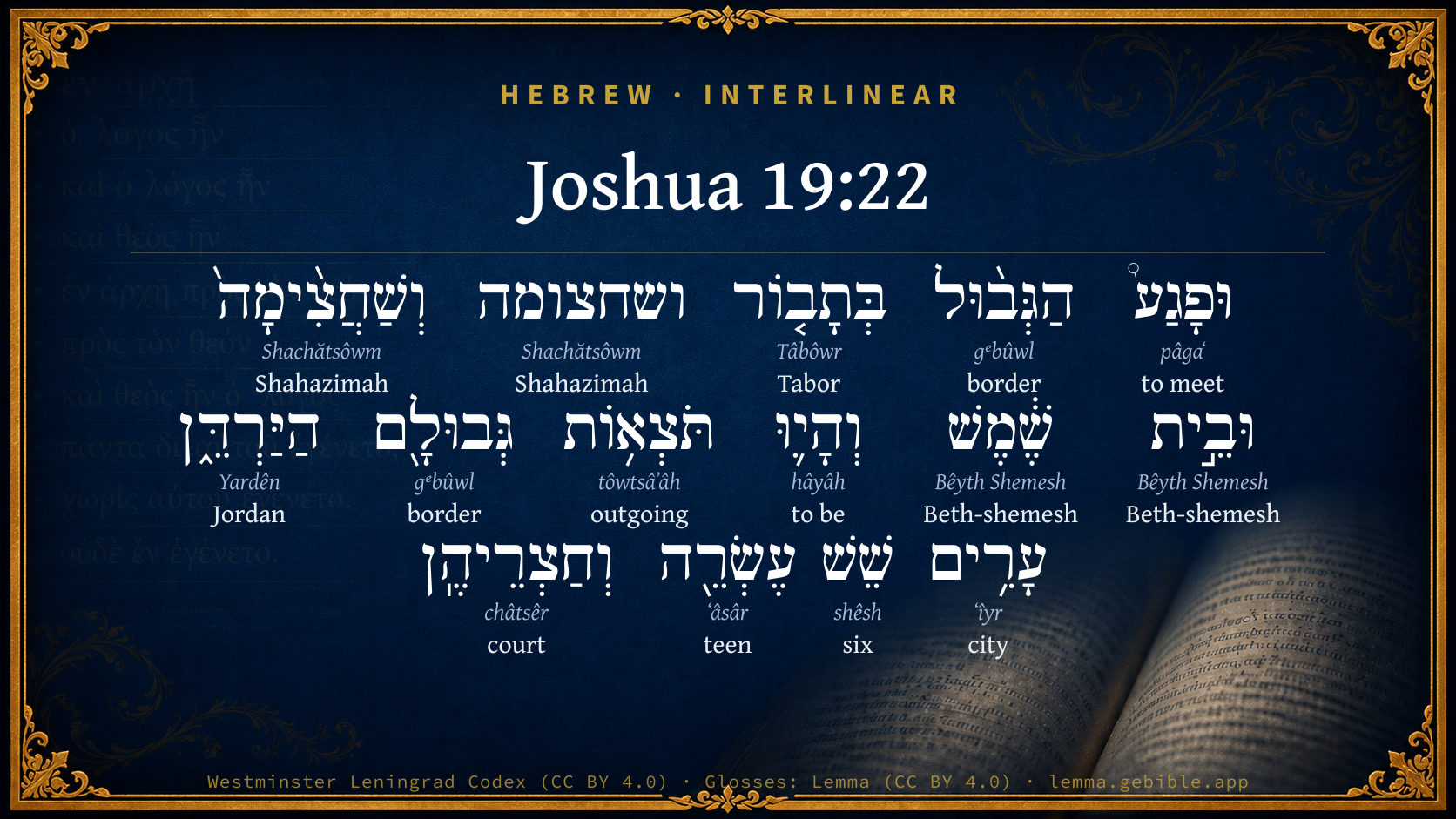
Joshua 19:22

Hebrew (Westminster Leningrad Codex) Joshua 19:22 appears in the Hebrew Old Testament. The text above is from the Westminster Leningrad Codex. Each word links to its Strong’s number, a concise gloss, and parsing drawn from the Open Scriptures Hebrew Bible morphology. Click any word for its full Brown-Driver-Briggs (BDB) entry.
Download image
Cite this verse

Joshua 19:22 (World English Bible). Public Domain. Lemma interlinear Bible study tool, https://lemma.gebible.app/v/joshua/19/22.

Show BibTeX & RIS
BibTeX
RIS
English Translation
and the border reached to Tabor, and Shahazumah, and Beth-shemesh; and the goings out of their border were at the Jordan: sixteen cities with their villages.
World English Bible · Public Domain
Highlights
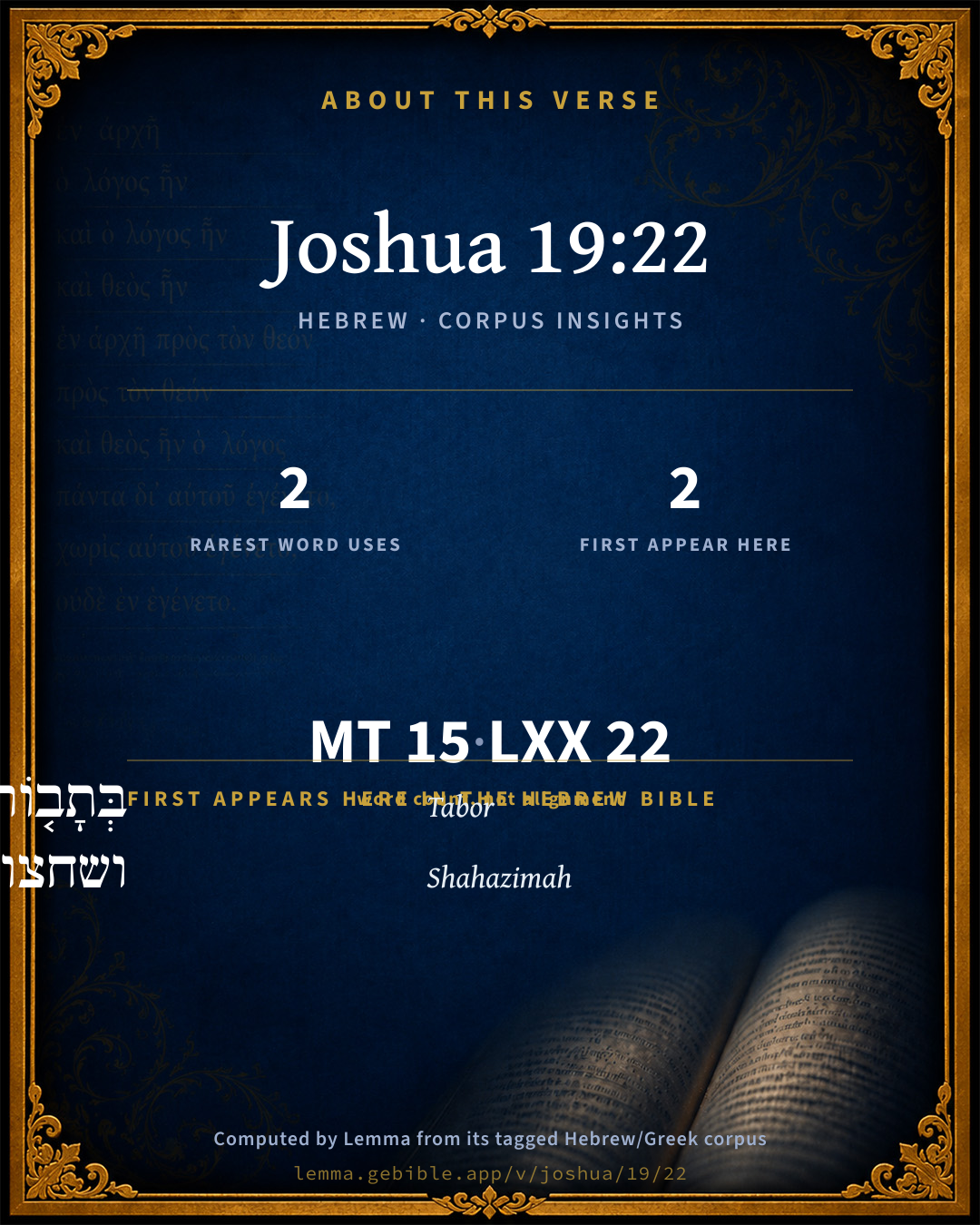
  • 2 first appearances in the Hebrew Bible
Full analysis ↓
Download a study sheet

One document with this verse’s original text, its word-by-word gloss line, the meaning frame, cross-references with their text, attributed commentary, and full source and license credits — printable, and it pastes into notes with its structure intact.

This verse Autodidact and up

Study sheet (.html) Plain text (.txt)

A passage Seminary Student

Up to 50 verses in one chapter. A passage sheet keeps up to 6 commentary sources and 12 cross-references per verse, in the order this page ranks them, and says so on the sheet whenever that leaves anything out. Ask for a single verse and you get the Autodidact verse sheet above.

Everything on this page stays free to read, with no account — the sheet is a download of what is already on screen, not access to it.

Want to remove ads? Support Godless Engineer
Compare translations 3

The same verse in 3 English versions, stacked beneath the original-language interlinear above. Click any original word for its lexicon entry.

Each is an independent rendering of the whole verse — the interlinear is not word-aligned to these translations.

Highlighted words mark where these versions differ — a whole-verse word diff, not a word-by-word alignment.

  • World English Bible Public Domain
    and the border reached to Tabor, and Shahazumah, and Beth-shemesh; and the goings out of their border were at the Jordan: sixteen cities with their villages.
  • King James Version Public Domain
    And the coast reacheth to Tabor, and Shahazimah, and Bethshemesh; and the outgoings of their border were at Jordan: sixteen cities with their villages.
  • unfoldingWord Literal Text CC BY-SA 4.0
    And the border met with Tabor and Shahazumah and Beth Shemesh. And the goings out of their border were the Jordan: 16 cities and their villages.

unfoldingWord Literal Text — © unfoldingWord, licensed CC BY-SA 4.0. Word-aligned USFM3 via Door43 (git.door43.org/unfoldingWord/en_ult).

Versions to compare (up to 4)

3 of 4 selected

Show all 18 translations

Every available English version of this verse, each an independent rendering of the whole verse.

  • World English Bible Public Domain
    and the border reached to Tabor, and Shahazumah, and Beth-shemesh; and the goings out of their border were at the Jordan: sixteen cities with their villages.
  • Berean Standard Bible Public Domain
    The border reached Tabor, Shahazumah, and Beth-shemesh, and ended at the Jordan. There were sixteen cities, along with their villages.
  • Majority Standard Bible Public Domain
    The border reached Tabor, Shahazumah, and Beth-shemesh, and ended at the Jordan. There were sixteen cities, along with their villages.
  • King James Version Public Domain
    And the coast reacheth to Tabor, and Shahazimah, and Bethshemesh; and the outgoings of their border were at Jordan: sixteen cities with their villages.
  • American Standard Version (1901) Public Domain
    and the border reached to Tabor, and Shahazumah, and Beth-shemesh; and the goings out of their border were at the Jordan: sixteen cities with their villages.
  • Revised Version (1885) Public Domain
    and the border reached to Tabor, and Shahazumah, and Beth-shemesh; and the goings out of their border were at Jordan: sixteen cities with their villages.
  • Geneva Bible (1599) Public Domain
    And this coast reacheth to Tabor, and Shahazimath, and Beth-shemesh, and the endes of their coast reach to Iorden: sixteene cities with their villages.
  • Douay-Rheims (1899) Public Domain
    And the border thereof cometh to Thabor and Sehesima and Bethsames: and the outgoings thereof shall be at the Jordan: sixteen cities, and their villages.
  • Young's Literal Translation Public Domain
    and the border hath touched against Tabor, and Shahazimah, and Beth-Shemesh, and the outgoings of their border have been `at' the Jordan; sixteen cities and their villages.
  • Literal Standard Version CC BY-SA 4.0
    and the border has touched against Tabor, and Shahazimah, and Beth-Shemesh, and the outgoings of their border have been [at] the Jordan; sixteen cities and their villages.
  • Unlocked Literal Bible CC BY-SA 4.0
    Their border also touched Tabor, Shahazumah, and Beth Shemesh, and ended at the Jordan. There were sixteen cities, including their villages.
  • unfoldingWord Literal Text CC BY-SA 4.0
    And the border met with Tabor and Shahazumah and Beth Shemesh. And the goings out of their border were the Jordan: 16 cities and their villages.
  • Darby Bible Public Domain
    and the border reached to Tabor, and Shahazimah, and Beth-shemesh; and their border ended at the Jordan: sixteen cities and their hamlets.
  • World Messianic Bible Public Domain
    The border reached to Tabor, Shahazumah, and Beth Shemesh. Their border ended at the Jordan: sixteen cities with their villages.
  • Webster's Bible Public Domain
    And the border reacheth to Tabor, and Shahazimah, and Beth-shemesh, and the limits of their border were at Jordan: sixteen cities with their villages.
  • Free Bible Version CC BY-SA 4.0
    The boundary also reached the towns of Tabor, Shahazumah, and Beth-shemesh, and ended at the Jordan River—sixteen towns with their associated villages.
  • Bible in Basic English Public Domain
    And their limit goes as far as Tabor and Shahazimah and Beth-shemesh, ending at Jordan; sixteen towns with their unwalled places.
  • JPS Tanakh (1917) Public Domain
    and the border reached to Tabor, and Shahazim, and Beth-shemesh; and the goings out of their border were at the Jordan; sixteen cities with their villages.

Literal Standard Version (2020), Covenant Press — licensed CC BY-SA 4.0. Text via the HelloAO Bible API (eBible.org). Unlocked Literal Bible (unfoldingWord) — licensed CC BY-SA 4.0. Text via the HelloAO Bible API (eBible.org). unfoldingWord Literal Text — © unfoldingWord, licensed CC BY-SA 4.0. Word-aligned USFM3 via Door43 (git.door43.org/unfoldingWord/en_ult). Free Bible Version, Dr. Jonathan Gallagher — licensed CC BY-SA 4.0. Text via the HelloAO Bible API (eBible.org).

Word by word

More ways to search: Search by grammar → Find every occurrence → Compare this word →

Practice this passage: Drill this verse → Learn its vocabulary →

ושחצומה
Shachătsôwm
H7831
“and · Shahazimah · toward”
Conjunction + Noun, Proper + Suffix, Demonstrative
Part of Speech
Conjunction + Noun
Type
Proper
Full BDB Definition

Origin: from the same as H7830

TWOT: None

Shahazimah = "toward the heights" - a town in Issachar
  1. וּפָגַע֩ pâgaʻ H6293 “and · to meet” Conjunction + Verb, Qal, Perfect, 3rd Person, Masculine, Singular
  2. הַגְּב֨וּל gᵉbûwl H1366 “the · border” Particle, Definite Article + Noun, Common, Masculine, Singular, Absolute
  3. בְּתָב֤וֹר Tâbôwr H8396 “in/at · Tabor” Preposition + Noun, Proper
  4. וְשַׁחֲצִ֨ימָה֙ Shachătsôwm H7831 “and · Shahazimah · toward” Conjunction + Noun, Proper + Suffix, Demonstrative
  5. וּבֵ֣ית Bêyth Shemesh H1053 “and · Beth-shemesh” Conjunction + Noun, Proper
  6. שֶׁ֔מֶשׁ Bêyth Shemesh H1053 “Beth-shemesh” Noun, Proper
  7. וְהָי֛וּ hâyâh H1961 “and · to be” Conjunction + Verb, Qal, Perfect, 3rd Person, Common, Plural
  8. תֹּצְא֥וֹת tôwtsâʼâh H8444 “outgoings of” Noun, Common, Feminine, Plural, Construct
  9. גְּבוּלָ֖ם gᵉbûwl H1366 “border · their” Noun, Common, Masculine, Singular, Construct + Suffix, Personal, 3rd Person, Masculine, Plural
  10. הַיַּרְדֵּ֑ן Yardên H3383 “the · Jordan” Particle, Definite Article + Noun, Proper
  11. עָרִ֥ים ʻîyr H5892 “cities” Noun, Common, Feminine, Plural, Absolute
  12. שֵׁשׁ shêsh H8337 “six” Adjective, Cardinal number, Feminine, Singular, Absolute
  13. עֶשְׂרֵ֖ה ʻâsâr H6240 “teen” Adjective, Cardinal number, Feminine, Singular, Absolute
  14. וְחַצְרֵיהֶֽן châtsêr H2691 “and · courts · their” Conjunction + Noun, Common, Both, Plural, Construct + Suffix, Personal, 3rd Person, Feminine, Plural

About this verse

These counts appear in no published source. They are computed here, from the morphology-tagged text and Lemma’s own curated glosses. What Lemma adds →

15
words
12
distinct lemmas
Historical
section

Notable vocabulary

The rarest word here is ושחצומה Shahazimah H7831 — appearing just 2 times in the whole Hebrew Bible.

First appearance in Scripture

These words make their first canonical appearance in the Hebrew Bible here:

  • בְּתָב֤וֹר Tabor H8396
  • ושחצומה Shahazimah H7831

Grammatical profile

  • 2 verbs
  • 11 nouns
  • 2 adjectives

Verb forms

  • וּפָגַע֩ Qal · Perfect
  • וְהָי֛וּ Qal · Perfect

Repetition

Words recur within this verse — often emphatic in Hebrew:

  • הַגְּב֨וּל border H1366 ×2
  • ושחצומה Shahazimah H7831 ×2
  • וּבֵ֣ית Beth-shemesh H1053 ×2

Hebrew & Septuagint length

In English translation the verse runs 26 words from the Hebrew and 22 from the Septuagint (LXX English) — closely comparable.

A rough comparison of the two English renderings, which tokenize alike — not a word-level alignment.

Word counts can differ between the Hebrew and the Greek without any difference in meaning — e.g. the Hebrew direct-object marker אֵת has no separate Greek word, and Greek often adds the article ὁ.

In the original languages it is 15 Hebrew tokens and 22 Greek tokens — but the two are counted differently (Hebrew bundles its prefixes and suffixes into one token; the Greek is in lemma form), so that isn’t a like-for-like length.

Cross-references

10

Topical passages linked to Joshua 19:22 in the Treasury of Scripture Knowledge — connected by theme and wording, ordered by reader-vote popularity; previews shown in the World English Bible.

  • Judges 4:6 She sent and called Barak the son of Abinoam out of Kedesh-naphtali, and said to him, Hasn't Yahweh, the God of Israel, commanded, [saying], Go and draw to Mount Tabor, and take with you ten thousand men of the children of Naphtali and of the children of Zebulun?
  • Joshua 19:12 and it turned from Sarid eastward toward the sunrise to the border of Chisloth Tabor; and it went out to Daberath, and went up to Japhia;
  • Joshua 19:38 Iron, and Migdal-el, Horem, and Beth Anath, and Beth-shemesh; nineteen cities with their villages.
  • Joshua 21:16 and Ain with its suburbs, and Juttah with its suburbs, [and] Beth-shemesh with its suburbs; nine cities out of those two tribes.
  • 1 Samuel 6:9–19 Behold; if it goes up by the way of its own border to Beth-shemesh, then he has done us this great evil: but if not, then we shall know that it is not his hand that struck us; it was a chance that happened to us."
  • 1 Kings 4:9 Ben Deker, in Makaz, and in Shaalbim, and Beth-shemesh, and Elon Beth Hanan;
  • 2 Kings 14:11–13 But Amaziah would not hear. So Jehoash king of Israel went up; and he and Amaziah king of Judah looked one another in the face at Beth-shemesh, which belongs to Judah.
  • 1 Chronicles 6:77 To the rest of [the Levites], the sons of Merari, [were given], out of the tribe of Zebulun, Rimmono with its suburbs, Tabor with its suburbs;
  • Psalms 89:12 The north and the south, you have created them. Tabor and Hermon rejoice in your name.
  • Jeremiah 46:18 As I live, says the King, whose name is Yahweh of Hosts, surely like Tabor among the mountains, and like Carmel by the sea, so shall he come.

Cross-references courtesy of OpenBible.info (CC BY 4.0).

Hebrew and Greek witnesses Masoretic Hebrew ↔ Greek Septuagint

The same verse in the two great witnesses to the Old Testament, shown verse-for-verse.

These are two independent witnesses, not word-aligned to each other, and the Septuagint is shown in lemma (dictionary) form.

Hebrew Joshua 19:22 Masoretic · Westminster Leningrad Codex

וּפָגַע֩ הַגְּב֨וּל בְּתָב֤וֹר ושחצומה וְשַׁחֲצִ֨ימָה֙ וּבֵ֣ית שֶׁ֔מֶשׁ וְהָי֛וּ תֹּצְא֥וֹת גְּבוּלָ֖ם הַיַּרְדֵּ֑ן עָרִ֥ים שֵׁשׁ עֶשְׂרֵ֖ה וְחַצְרֵיהֶֽן

and the border reached to Tabor, and Shahazumah, and Beth-shemesh; and the goings out of their border were at the Jordan: sixteen cities with their villages.

World English Bible · Public Domain

Greek LXX Joshua 19:22 Septuagint · lemma form

καί συνἅπτω ὁ ὅριον ἐπί γαιθβωρ καί ἐπί σαλιμ κατά θάλασσα καί βαιθσαμυς καί εἰμί αὐτός ὁ διέξοδος ὁ ὅριον ὁ ἰορδάνης

And the boundaries shall border upon Gaethbor, and upon Salim westward, and Baethsamys; and the extremity of his bounds shall be Jordan.

LXX2012 (modern English Septuagint) · Public Domain

Hebrew: Westminster Leningrad Codex (CC BY 4.0). Greek: Septuagint (public domain); English from LXX2012 (modern English Septuagint) (Public Domain). How the Septuagint differs from the Hebrew →

Targum (Aramaic paraphrase)

1

The Targum is the ancient Jewish Aramaic paraphrase of the Hebrew Scriptures — an interpretive translation, not the Hebrew text itself. Onkelos (literal) and Pseudo-Jonathan (expansive) render the Torah, and Jonathan the Prophets. Coverage is partial: where no permissively-licensed English translation exists for a verse, only the Aramaic is shown. This is verse-level text, not a word-by-word alignment to the Hebrew.

  1. Targum Jonathan Prophets (Joshua–Malachi)
    וּמְעָרַע תְּחוּמָא בְּתָבוֹר וְשַׁחֲצִימָה וּבֵית שֶׁמֶשׁ וַהֲווֹן מַפְקָנוֹהִי דִתְחוּמְהוֹן לְיַרְדְנָא קִרְוִין שִׁית עַסְרֵי וּפַצְחֵיהֶן:

    (no public-domain English translation for this verse)

    Targum Jonathan — Aramaic: “Mikraot Gedolot” (public domain). English: “Sefaria Community Translation” (CC0 1.0 (public-domain dedication)); “London "Chaldee Paraphrase," 1871” (public domain). Text via Sefaria.

Commentary

Notes on Joshua 19:22 from classic Christian and Jewish commentators (each source and its license shown beneath its notes). The classic Christian expositions comment on the surrounding passage and are grouped to its opening verse, so a note may address several verses; the Jewish commentaries on the Tanakh (Rashi and others) are per-verse, so they appear only where the commentator wrote on this verse.

Lemma curates 59 commentaries, every one of them public domain or Creative Commons licensed, each selected and text-cleaned for this edition rather than reprinted as found. About our sources →

Adam Clarke's Commentary

Verse 22. Beth-shemesh] The house or temple of the sun; there were several cities or towns of this name in Palestine; an ample proof that the worship of this celestial luminary had generally prevailed in that idolatrous country.

Adam Clarke's Commentary on the Bible (1810–1826) — public domain. Text from a community e-Sword/MySword module.

Ellicott's Commentary for English Readers

(22) Tabor (? Deburieh, sheet 6). Beth-shemesh (‘Ain Esh-shemsiyeh, near Beth-shean). The rest are not identified. Of these places, Shunem and Jezreel are famous in later history: Shunem especially in the story of Elisha (2 Kings 4).

A Bible Commentary for English Readers, edited by Charles John Ellicott (1878–1897) — public domain. Text from a community e-Sword module.

The Cambridge Bible for Schools and Colleges

gen. ed. J. J. S. Perowne

22. and the coast reacheth to Tabor] Not the mountain, but a town upon the mountain, given to the Levites (1Ch_6:77), and to Shahazimah and Beth-shemesh. The site of neither of these places is known, for the Beth-shemesh here mentioned is not the town of that name in the tribe of Judah (ch. Jos_15:10)

the outgoings of their border] The Jordan formed the eastern boundary of the tribe, but how far its territory extended down into the Jordan Valley is not stated.

sixteen cities] Which number is correct, if Tabor is taken as a city. Being a border town, it is not remarkable that here it is reckoned to Issachar, and in 1Ch_6:77 to Zebulun.

The Cambridge Bible for Schools and Colleges (gen. ed. J. J. S. Perowne; Cambridge University Press, 1878–1918) — public domain. Text from a community e-Sword module.

John Gill's Exposition

This is the inheritance of the tribe of the children of Issachar,.... Which fell to them by lot, as before described:

according to their families; was divided among them, according to the number of them:

the cities and their villages; the cities before enumerated, and the villages adjacent to them.

John Gill's Exposition of the Whole Bible (1746–1763) — public domain (CC PDM 1.0). Text via the HelloAO Bible API.

Whedon's Commentary on the Bible

Daniel D. Whedon

22. Coast reacheth — This probably means the northern coast or border, where it joined on Zebulun. Tabor is here generally supposed to mean not the mountain, but a town on it afterwards given to the Levites. 1Ch_6:77.

Sixteen cities — This is exactly the number given above, if Tabor be taken as a city.

Daniel D. Whedon (gen. ed.), Commentary on the Old and New Testaments (1874–1909) — public domain. Text from a community e-Sword module.

The Pulpit Commentary

The coast reacheth. Literally, the border skirteth, as in ver. 11. Tabor. Perhaps the same as Chisloth-Tabor in ver. 12. (cf. 1Ch_6:77) It would therefore be, as Mount Tabor certainly was, on the boundary between the tribes of Issachar and Zebulun. Beth-shemesh. Not the well known town in the tribe of Judah. (Jos_15:10) The repetition of this name is a proof of the extent to which sun worship prevailed in Palestine before the Israelite invasion.

The Pulpit Commentary (1880–1919), ed. H.D.M. Spence-Jones & Joseph S. Exell — public domain. Text from a community e-Sword module.

Lesson kit

Teaching starters — assembled from the data on this page, not authored interpretation. Every prompt links to the verse data it draws on. Edit before teaching.

Joshua, in the Historical, opens this verse with 15 words (12 distinct Hebrew lemmas). Its most distinctive word is Shachătsôwm (“Shahazimah”). A historical commentator’s framing appears above. Read the whole chapter for the surrounding context.

Discussion questions

  1. What does “Shahazimah” (Shachătsôwm) contribute to the verse as a whole?
  2. 2 words here appear for the first time in Scripture. What is being introduced at this debut?
  3. Judges 4:6 shares this passage’s theme. How do the two illuminate each other?
  4. “border” occurs 2× in this one verse. What is the effect of the repetition?
  5. The translations on this page render this verse differently — a whole-verse word diff, not a word-by-word alignment. What might account for the different wordings?
  6. The verb «וּפָגַע֩» is Qal Perfect. How does its form color the action?
  7. Reading how Adam Clarke's Commentary and Ellicott's Commentary for English Readers read this verse, where do the two commentators agree and where do they part?

Things to notice

Reading settings

Reading text

Shown beneath each verse's original-language words.

Old Testament
Old Testament edition

Read the OT as the Masoretic Hebrew (MT) or the Greek Septuagint (LXX).

English shown for the Greek Septuagint (in the Hebrew ↔ Greek comparison).

Comparing translations? Open the Compare panel on any verse page to stack up to four side by side.