
Psalms 104:9

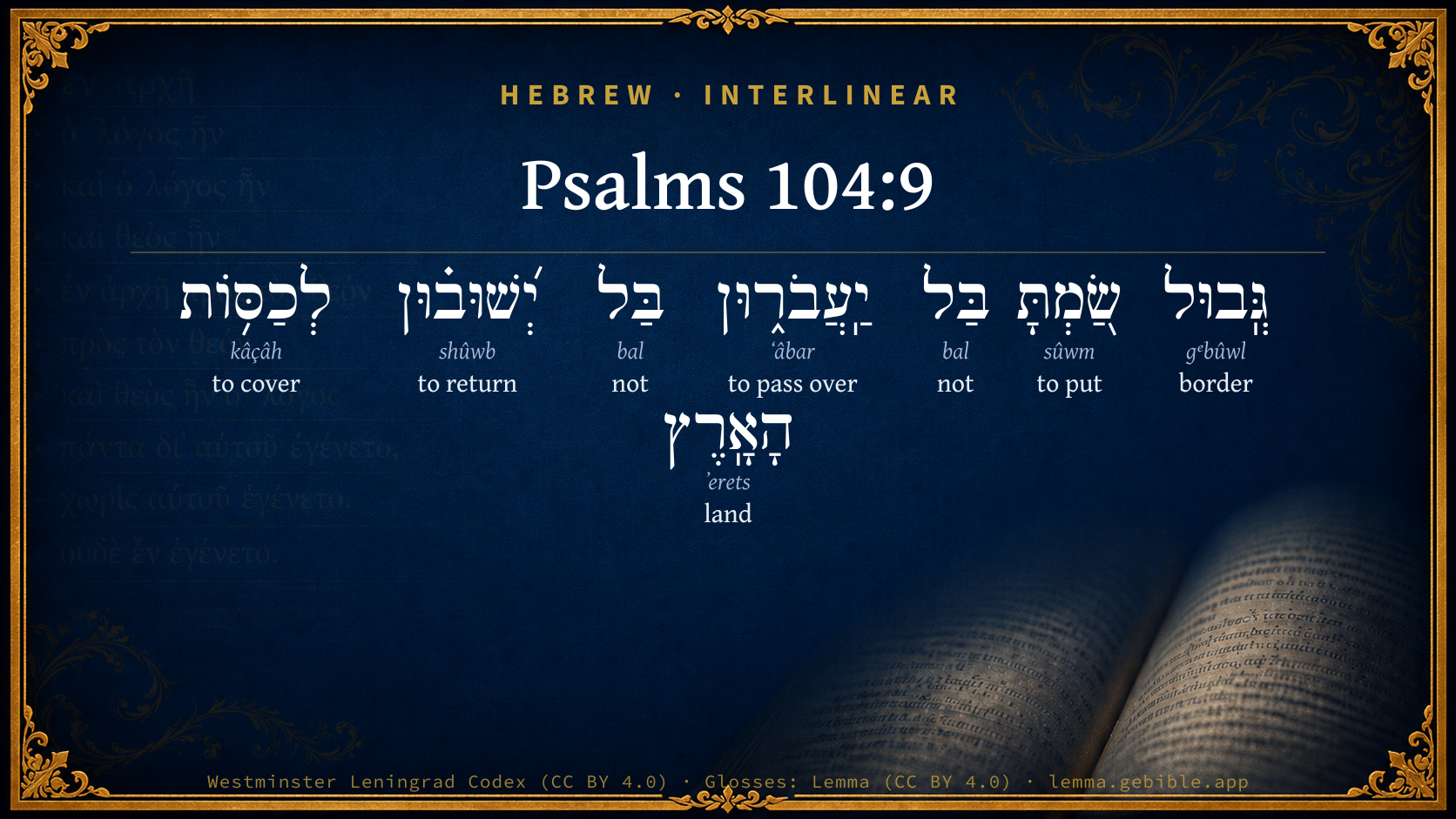
Hebrew (Westminster Leningrad Codex) Psalms 104:9 appears in the Hebrew Old Testament. The text above is from the Westminster Leningrad Codex. Each word links to its Strong’s number, a concise gloss, and parsing drawn from the Open Scriptures Hebrew Bible morphology. Click any word for its full Brown-Driver-Briggs (BDB) entry.
Download image
Cite this verse

Psalms 104:9 (World English Bible). Public Domain. Lemma interlinear Bible study tool, https://lemma.gebible.app/v/psalms/104/9.

Show BibTeX & RIS
BibTeX
RIS
English Translation
You have set a boundary that they may not pass over; That they don't turn again to cover the earth.
World English Bible · Public Domain
Download a study sheet

One document with this verse’s original text, its word-by-word gloss line, the meaning frame, cross-references with their text, attributed commentary, and full source and license credits — printable, and it pastes into notes with its structure intact.

This verse Autodidact and up

Study sheet (.html) Plain text (.txt)

A passage Seminary Student

Up to 50 verses in one chapter. A passage sheet keeps up to 6 commentary sources and 12 cross-references per verse, in the order this page ranks them, and says so on the sheet whenever that leaves anything out. Ask for a single verse and you get the Autodidact verse sheet above.

Everything on this page stays free to read, with no account — the sheet is a download of what is already on screen, not access to it.

Want to remove ads? Support Godless Engineer
Compare translations 3

The same verse in 3 English versions, stacked beneath the original-language interlinear above. Click any original word for its lexicon entry.

Each is an independent rendering of the whole verse — the interlinear is not word-aligned to these translations.

Highlighted words mark where these versions differ — a whole-verse word diff, not a word-by-word alignment.

  • World English Bible Public Domain
    You have set a boundary that they may not pass over; That they don't turn again to cover the earth.
  • King James Version Public Domain
    Thou hast set a bound that they may not pass over; that they turn not again to cover the earth.
  • unfoldingWord Literal Text CC BY-SA 4.0
    You set a boundary they cannot pass; they will not return to cover the earth.

unfoldingWord Literal Text — © unfoldingWord, licensed CC BY-SA 4.0. Word-aligned USFM3 via Door43 (git.door43.org/unfoldingWord/en_ult).

Versions to compare (up to 4)

3 of 4 selected

Show all 18 translations

Every available English version of this verse, each an independent rendering of the whole verse.

  • World English Bible Public Domain
    You have set a boundary that they may not pass over; That they don't turn again to cover the earth.
  • Berean Standard Bible Public Domain
    You set a boundary they cannot cross, that they may never again cover the earth.
  • Majority Standard Bible Public Domain
    You set a boundary they cannot cross, that they may never again cover the earth.
  • King James Version Public Domain
    Thou hast set a bound that they may not pass over; that they turn not again to cover the earth.
  • American Standard Version (1901) Public Domain
    Thou hast set a bound that they may not pass over; That they turn not again to cover the earth.
  • Revised Version (1885) Public Domain
    Thou hast set a bound that they may not pass over; that they turn not again to cover the earth.
  • Geneva Bible (1599) Public Domain
    But thou hast set them a bounde, which they shall not passe: they shall not returne to couer the earth.
  • Douay-Rheims (1899) Public Domain
    Thou hast set a bound which they shall not pass over; neither shall they return to cover the earth.
  • Young's Literal Translation Public Domain
    A border Thou hast set, they pass not over, They turn not back to cover the earth.
  • Literal Standard Version CC BY-SA 4.0
    You have set a border, they do not pass over, || They do not turn back to cover the earth.
  • Unlocked Literal Bible CC BY-SA 4.0
    You have set a boundary for them that they will not cross; they will not cover the earth again.
  • unfoldingWord Literal Text CC BY-SA 4.0
    You set a boundary they cannot pass; they will not return to cover the earth.
  • Darby Bible Public Domain
    Thou hast set a bound which they may not pass over, that they turn not again to cover the earth.
  • World Messianic Bible Public Domain
    You have set a boundary that they may not pass over, that they don’t turn again to cover the earth.
  • Webster's Bible Public Domain
    Thou hast set a bound that they may not pass over; that they turn not again to cover the earth.
  • Free Bible Version CC BY-SA 4.0
    You set a boundary for the oceans so they would not come back and cover the earth.
  • Bible in Basic English Public Domain
    You made a limit over which they might not go, so that the earth would never again be covered by them.
  • JPS Tanakh (1917) Public Domain
    Thou didst set a bound which they should not pass over, that they might not return to cover the earth.

Literal Standard Version (2020), Covenant Press — licensed CC BY-SA 4.0. Text via the HelloAO Bible API (eBible.org). Unlocked Literal Bible (unfoldingWord) — licensed CC BY-SA 4.0. Text via the HelloAO Bible API (eBible.org). unfoldingWord Literal Text — © unfoldingWord, licensed CC BY-SA 4.0. Word-aligned USFM3 via Door43 (git.door43.org/unfoldingWord/en_ult). Free Bible Version, Dr. Jonathan Gallagher — licensed CC BY-SA 4.0. Text via the HelloAO Bible API (eBible.org).

Word by word

More ways to search: Search by grammar → Find every occurrence → Compare this word →

Practice this passage: Drill this verse → Learn its vocabulary →

About this verse

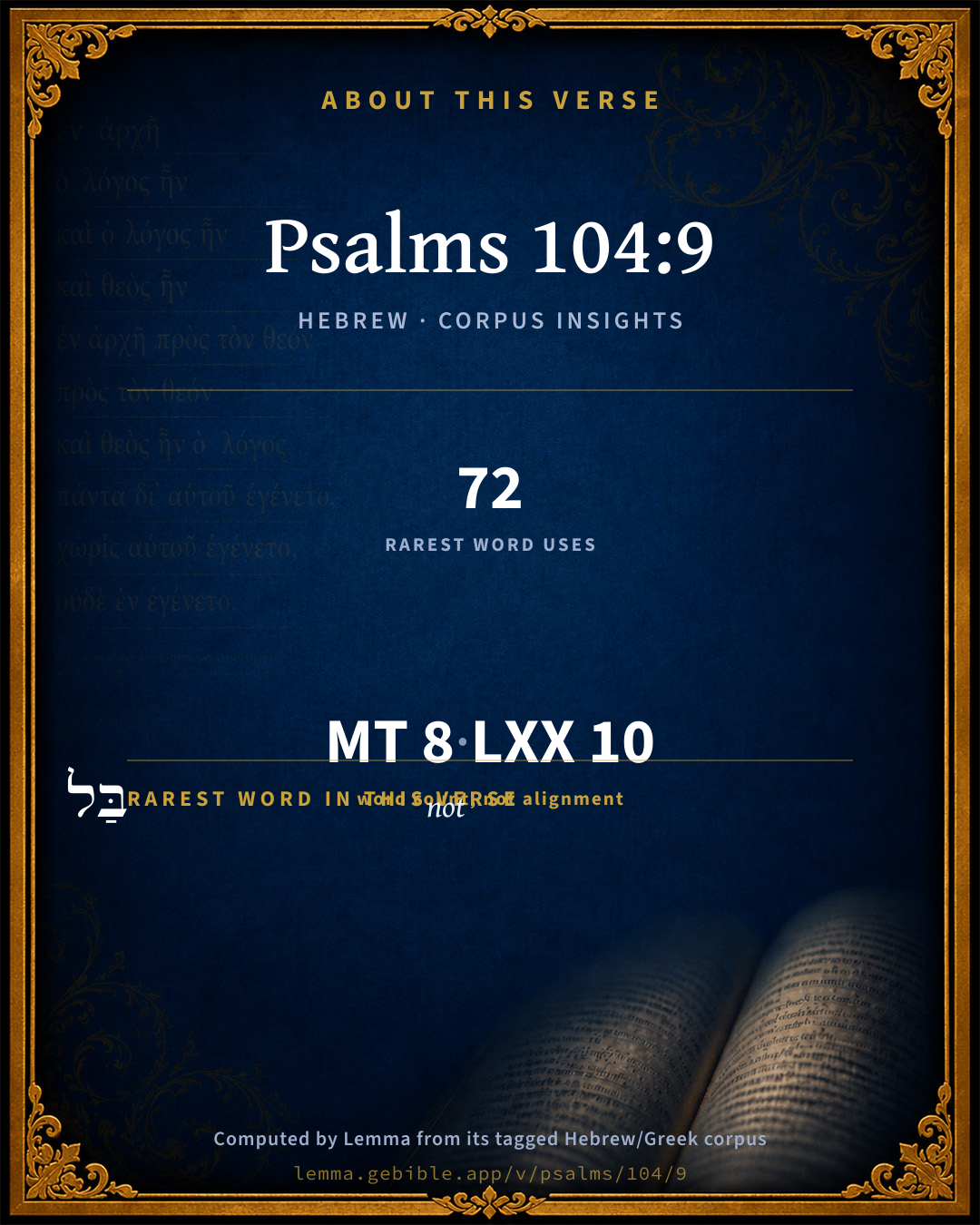
These counts appear in no published source. They are computed here, from the morphology-tagged text and Lemma’s own curated glosses. What Lemma adds →

8
words
7
distinct lemmas
Wisdom
section

Grammatical profile

  • 4 verbs
  • 2 nouns
  • 2 particles

Verb forms

  • שַׂ֭מְתָּ Qal · Perfect
  • יַֽעֲבֹר֑וּן Qal · Imperfect
  • יְ֝שׁוּב֗וּן Qal · Imperfect
  • לְכַסּ֥וֹת Piel · Infinitive Construct

Repetition

A word recurs within this verse — often emphatic in Hebrew:

Hebrew & Septuagint length

In English translation the verse runs 20 words from the Hebrew and 19 from the Septuagint (LXX English) — closely comparable.

A rough comparison of the two English renderings, which tokenize alike — not a word-level alignment.

Word counts can differ between the Hebrew and the Greek without any difference in meaning — e.g. the Hebrew direct-object marker אֵת has no separate Greek word, and Greek often adds the article ὁ.

In the original languages it is 8 Hebrew tokens and 10 Greek tokens — but the two are counted differently (Hebrew bundles its prefixes and suffixes into one token; the Greek is in lemma form), so that isn’t a like-for-like length.

Cross-references

6

Topical passages linked to Psalms 104:9 in the Treasury of Scripture Knowledge — connected by theme and wording, ordered by reader-vote popularity; previews shown in the World English Bible.

  • Job 38:10–11 Marked out for it my bound, Set bars and doors,
  • Genesis 9:11–15 I will establish my covenant with you; neither will all flesh be cut off any more by the waters of the flood; neither will there any more be a flood to destroy the earth."
  • Job 26:10 He has described a boundary on the surface of the waters, And to the confines of light and darkness.
  • Isaiah 54:9 For this is [as] the waters of Noah to me; for as I have sworn that the waters of Noah shall no more go over the earth, so have I sworn that I will not be angry with you, nor rebuke you.
  • Jeremiah 5:22 Don't you fear me? says Yahweh: won't you tremble at my presence, who have placed the sand for the bound of the sea, by a perpetual decree, that it can't pass it? and though the waves of it toss themselves, yet they can't prevail; though they roar, yet they can't pass over it.
  • Psalms 33:7 He gathers the waters of the sea together as a heap. He lays up the deeps in storehouses.

Cross-references courtesy of OpenBible.info (CC BY 4.0).

Hebrew and Greek witnesses Masoretic Hebrew ↔ Greek Septuagint

The same verse in the two great witnesses to the Old Testament, shown verse-for-verse.

You’re reading Greek Psalm 103 (Hebrew Psalm 104). The Septuagint counts the superscription, so verse numbers can differ from the Hebrew — chapter-level alignment, not verse-by-verse. Numbering follows Rahlfs.

These are two independent witnesses, not word-aligned to each other, and the Septuagint is shown in lemma (dictionary) form.

Hebrew Psalms 104:9 Masoretic · Westminster Leningrad Codex

גְּֽבוּל שַׂ֭מְתָּ בַּל יַֽעֲבֹר֑וּן בַּל יְ֝שׁוּב֗וּן לְכַסּ֥וֹת הָאָֽרֶץ

You have set a boundary that they may not pass over; That they don't turn again to cover the earth.

World English Bible · Public Domain

Greek LXX Greek Psalm 103:9 Septuagint · lemma form

ὅριον τίθημι ὅς οὐ παραἔρχομαι οὐδέ ἐπιστρέφω καλύπτω ὁ γῆ

You have set a bound which they shall not pass, neither shall they turn again to cover the earth.

LXX2012 (modern English Septuagint) · Public Domain

Hebrew: Westminster Leningrad Codex (CC BY 4.0). Greek: Septuagint (public domain); English from LXX2012 (modern English Septuagint) (Public Domain). How the Septuagint differs from the Hebrew →

Commentary

Notes on Psalms 104:9 from classic Christian and Jewish commentators (each source and its license shown beneath its notes). The classic Christian expositions comment on the surrounding passage and are grouped to its opening verse, so a note may address several verses; the Jewish commentaries on the Tanakh (Rashi and others) are per-verse, so they appear only where the commentator wrote on this verse.

Lemma curates 59 commentaries, every one of them public domain or Creative Commons licensed, each selected and text-cleaned for this edition rather than reprinted as found. About our sources →

Trapp's Complete Commentary

John Trapp

Psa 104:9 Thou hast set a bound that they may not pass over; that they turn not again to cover the earth.

Ver. 9. Thou hast set a bound, &c.] A certain compass and course; an argument of God’s singular and sweet power and providence. See Job 38:10-11, {See Trapp on "Job 38:10"} {See Trapp on "Job 38:11"}

John Trapp, A Commentary or Exposition upon All the Books of the Old and New Testament (1647–1656) — public domain. Text from a community e-Sword module.

Joseph Benson's Commentary

Psa 104:9. Thou hast set a bound — Even the sand of the sea-shore, as is expressed Jer 5:22. Which, though in itself contemptible, and a very poor defence to the earth against that swelling and raging element, yet, by God’s almighty power and gracious providence, is made sufficient for that purpose, as the experience of five thousand years hath taught us. That they turn not again to cover the earth — Once indeed they did, namely, in Noah’s flood, because God commanded them so to do; but not since, because he prohibits them, having promised not to drown the world again. God himself glories in this instance of his power, and uses it as an argument with us to fear him, Job 38:8, &c.; Jer 5:22. And surely this, if duly considered, would keep the world in awe of God and his goodness, that the waters of the sea would soon cover the earth if God did not restrain them.

Joseph Benson's Commentary on the Old and New Testaments (1811–1818) — public domain. Text from a community e-Sword module.

J. A. Alexander on Psalms

Joseph Addison Alexander

9. (Psa 104:9) A bound thou didst set, they shall not pass over, they shall not return to cover the earth. This grand exception to the law which governs the relations between land and water is the only one to be permitted or expected. The limits broken were renewed with an assurance that henceforth they should be inviolable. See Gen 9:15. Besides the immediate reference to the flood, the verse contains the statement of a general fact in the economy of nature, and thus furnishes a natural transition to the similar statements of the next verse.

Joseph Addison Alexander, The Psalms Translated and Explained (1850) — public domain. Text from a community e-Sword module.

Tyndale Open Study Notes

Tyndale Open Resources

104:9-10 The Lord reigns over all bodies of water, including those on land. He replaced chaotic waters with order and abundance, and the earth became a splendid place for animals and humans, with water refreshing the ground, the birds, and the animals.

104:9 The Lord set a firm boundary for the seas to protect the land. God’s sovereignty over sea and land was an argument against the existence of Baal, whom the Canaanites celebrated as victorious over the waters (see Ps 29).

Tyndale Open Study Notes — © Tyndale Open Resources, licensed CC BY-SA 4.0. Text via the HelloAO Bible API.

Adam Clarke's Commentary

Verse 9. Thou hast set a bound that they may not pass] And what is this bound? The flux and reflux of the sea, occasioned by the solar and lunar attraction, the rotation of the earth on its own axis, and the gravitation of the waters to the centre of the earth. And what is the cause of all these? The will and energy of God. Thus the sea is prevented from drowning the earth equally where there are flat shores as where the sea seems hemmed in by huge mounds of land and mountains. The above, not these, are the bounds which it cannot pass, so that they cannot turn again to cover the earth.

Adam Clarke's Commentary on the Bible (1810–1826) — public domain. Text from a community e-Sword/MySword module.

John Calvin's Commentaries

9. Thou hast set a bound which they shall not pass The miracle spoken of is in this verse amplified, from its perpetuity. Natural philosophers are compelled to admit, and it is even one of their first principles, that the water is circular, and occupies the region intermediate between the earth and the air. It is entirely owing to the providence of God, that part of the earth remains dry and fit for the habitation of men. This is a fact of which mariners have the most satisfactory evidence. Yea, were even the rudest and most stupid of our race only to open their eyes, they would behold in the sea mountains of water elevated far above the level of the land. Certainly no banks, and even no iron gates, could make the waters, which in their own nature are fluid and unstable, keep together and in one place, as we see to be the case. I have just now said that earthquakes, which bring destruction upon some places, leave the globe, upon the whole, as it was before; and in like manner, although the sea, in some parts of the world, overpasses its boundaries, yet the law, which confines it; within certain limits, stands fast, that the earth may be a fit habitation for men. The Baltic Sea, in our own time, inundated large tracts of land, and did great damage to the Flemish people and other neighboring nations. By an instance of this kind we are warned what would be the consequence, were the restraint imposed upon the sea, by the hand of God, removed. How is it that we have not thereby been swallowed up together, but because God has held in that outrageous element by his word? In short, although the natural tendency of the waters is to cover the earth, yet this will not happen, because God has established, by his word, a counteracting law, and as his truth is eternal, this law must remain steadfast.

John Calvin's Commentaries (1540-1563) — public domain. Text from the Calvin Translation Society English edition (1840s-50s) via the Christian Classics Ethereal Library (ccel.org). Calvin's coverage is partial (roughly two-thirds of the Bible); uncommented books and verses are honest gaps, never fabricated. The 19th-century editor's footnotes and remarks are omitted so the notes are faithfully Calvin's own voice.

Ellicott's Commentary for English Readers

(9) A bound.—It is striking to observe what a deep impression their little line of coast, the barrier which beat off the waves of the Mediterranean, made on the Hebrew mind. The sea was an object of dread. Or if dread passes into reverent wonder, as in Psa_104:25-26, it ends there; the Jew never took delight in the sea. Hence, the coast has for him only one purpose and suggestion. It is not for enjoyment or recreation, or even for uses of commerce. It is simply the defence set by God against the hostile waters.

A Bible Commentary for English Readers, edited by Charles John Ellicott (1878–1897) — public domain. Text from a community e-Sword module.

The Cambridge Bible for Schools and Colleges

gen. ed. J. J. S. Perowne

9. The reference is not to the Flood, but to the original separation of land and water confirmed after the Flood (Gen_9:9 ff.). Cp. Job_38:10-11; Pro_8:29.

The Cambridge Bible for Schools and Colleges (gen. ed. J. J. S. Perowne; Cambridge University Press, 1878–1918) — public domain. Text from a community e-Sword module.

John Gill's Exposition

Thou hast set a bound, that they may not pass over,.... The Targum adds,

"to the rolling waves of the sea.''

Set doors with bolts and bars, cliffs, rocks, and shores: and, what is more surprising, sand, which is penetrable, flexible, and moveable, is set as a perpetual bound to the raging ocean and its waves, which they cannot pass over: see Job 38:8. So the Lord has set a bound to the proud waters of afflictions, and says, Thus far shall ye go, and no farther; and to the life of man, which he cannot exceed, Job 14:5. But he has given man a law, as a rule to walk by, as the boundary of his conversation, and this he transgresses; in which he is less tractable than the raging sea and its waves. That they turn not again to cover the earth; as they did when it was first made, Psa 104:6 that is, not without the divine leave and power; for they did turn again and cover the earth, at the time of the flood; but never shall more. Some think there is no need to make this exception; since this was written after the flood, and when God had swore that the waters should no more go over the earth, Isa 54:9.

John Gill's Exposition of the Whole Bible (1746–1763) — public domain (CC PDM 1.0). Text via the HelloAO Bible API.

Albert Barnes' Notes on the Bible

Thou hast set a bound that they may not pass over - See Job 26:10, note; Job 38:10-11, note.

That they turn not again to cover the earth - As it was before the dry land appeared; or as the earth was when “darkness was upon the face of the deep” Gen 1:2, and when all was mingled earth and water. It is “possible” that in connection with this, the psalmist may also have had his eye on the facts connected with the deluge in the time of Noah, and the promise then made that the world should no more be destroyed by a flood, Gen 9:11, Gen 9:15.

Albert Barnes' Notes on the Bible (1834–1885) — public domain. Text from a community e-Sword/MySword module.

Matthew Poole's English Annotations

A bound; even the sand of the sea-shore, as it is expressed, Jer 5:22, which, though in itself contemptible, and a very poor defence to the earth against that swelling and raging element, yet by God’s almighty power and gracious providence is made sufficient for that purpose; which is noted as a wonderful work of God, Job 38:8, &c.

The earth, to wit, the whole earth, as it did in the beginning of the creation. This was God’s appointment, and the course of nature settled by him. But when men transgressed their bounds, all the laws of God and men, it is not strange if the waters also transgressed their bounds, and once again overwhelmed the earth in the general deluge.

Matthew Poole's English Annotations on the Holy Bible (1683–1685) — public domain. Text from a community e-Sword/MySword module.

The Treasury of David

Charles H. Spurgeon

Ver. 9. Thou hast set a bound that they may not pass over; that they turn not again to cover the earth. That bound has once been passed, but it shall never be so again. The deluge was caused by the suspension of the divine mandate which held the floods in check: they knew their old supremacy, and hastened to reassert it, but now the covenant promise for ever prevents a return of that carnival of waters, that revolt of the waves: ought we not rather to call it that impetuous rush of the indignant floods to avenge the injured honour of their King, whom men had offended? Jehovah's word bounds the ocean, using only a narrow belt of sand to confine it to its own limits: that apparently feeble restraint answers every purpose, for the sea is obedient as a little child to the bidding of its Maker. Destruction lies asleep in the bed of the ocean, and though our sins might well arouse it, yet are its bands made strong by covenant mercy, so that it cannot break loose again upon the guilty sons of men.

Ver. 9. Thou hast set a bound, etc. The Baltic Sea, in our own time, inundated large tracts of land, and did great damage to the Flemish people and other neighbouring nations. By an instance of this kind we are warned what would be the consequence, were the restraint imposed upon the sea, by the hand of God, removed. How is it that we have not thereby been swallowed up together, but because God has held in that outrageous element by his word? In short, although the natural tendency of the waters is to cover the earth, yet this will not happen, because God has established, by his word, a counteracting law, and as his truth is eternal, this law must remain stedfast. John Calvin.

Ver. 9. Thou hast set a bound, etc. In these words the psalmist gives us three things clearly concerning the waters. First, that once (he means it not of the deluge, but of the chaos), the waters did cover the whole earth, till God by a word of command sent them into their proper channels, that the dry land might appear. Secondly, that the waters have a natural propensity to return back and cover the earth again. Thirdly, that the only reason why they do not return back and cover the whole earth is, because God hath "set a bound, that they cannot pass." They would be boundless and know no limits, did not God bound and limit them. Wisdom giveth us the like eulogium of the power of God in this, Pr 8:29 "He gave to the sea his decree, that the waters should not pass his commandment." What cannot he command, who sendeth his commandment to the sea and is obeyed? Some great princes, heated with rage and drunken with pride, have cast shackles into the sea, as threatening it with imprisonment and bondage if it would not be quiet; but the sea would not be bound by them; they have also awarded so many strokes to be given the sea as a punishment of its contumacy and rebellion against either their commands or their designs. How ridiculously ambitious have they been, who would needs pretend to such a dominion! Many princes have had great power at and upon the sea, but there was never any prince had any power over the sea; that's a flower belonging to no crown but the crown of heaven. Joseph Caryl.

Ver. 9. Thou hast set a bound, etc. A few feet of increase in the ocean wave that pursues its tidal circuit round the globe, would desolate cities and provinces innumerable... But with what immutable and safe control God has marked its limits! You shall observe a shrub or a flower on a bank of verdure that covers a sea cliff, or hangs down in some hollow; nay, you shall mark a pebble on the beach, you shall lay a shred of gossamer upon it; and this vast, ungovernable, unwieldy, tempestuous element shall know how to draw a line of moisture by its beating spray at the very edge, or on the very point of your demarcation, and then draw off its forces, not having passed one inch or hand's breadth across the appointed margin. And all this exact restraint and measurement in the motion of the sea, by that mysterious power shot beyond unfathomable depths of space, from orbs rolling in ether! a power itself how prodigious, how irresistible, yet how invisible, how gentle, how with minutest exactness measured and exerted. George B. Cheever, in "Voices of Nature to her Foster Child, the soul of Man, "1852.

Ver. 9. A bound that they may not pass over.

Now stretch your eye off shore, over waters made To cleanse the air, and bear the world's great trade, To rise and wet the mountains near the sun, Then back into themselves in rivers run, Fulfilling mighty uses, far and wide, Through earth, in air, or here, as ocean tide.

Ho! how the giant heaves himself, and strains And flings to break his strong and viewless chains; Foams in his wrath; and at his prison doors, Hark! hear him! how he beats, and tugs, and roars, As if he would break forth again, and sweep Each living thing within his lowest deep.

Richard Henry Dana (1787).

Ver. 9.

1. All things have their appointed bounds.

2. To pass those bounds without special permission by God is transgression. "Thou hast set a bound that they may not pass."

3. Extraordinary cases should be followed by a return to ordinary duties. "That they turn not again, "etc. G.R.

Psalms 104:10*

Charles H. Spurgeon's The Treasury of David (1869–1885) — public domain. Psalms only. Text from a community e-Sword/MySword module.

Whedon's Commentary on the Bible

Daniel D. Whedon

9. Thou hast set a bound—This impassable boundary of the ocean was a perpetual wonder to the Hebrew mind as a mark of infinite power, wisdom, and goodness; (Job_26:10; Job_38:10-11; Jer_5:22;) and fitly so, for the area of the ocean, as compared with the dry land, is as eight to three, and the security of the dry land, with its inhabitants, is wholly due to the depression of the ocean bed and the corresponding elevation of the land above the ocean level. This elevation of the continents above the sea is estimated to average one thousand feet. If all the dry land above the present ocean level were cast into the ocean it would raise the water only about three hundred and seventy-five feet, and “it would take forty times this amount to fill the oceanic depressions.”—Dana. How wonderfully, then, has God “shut up the sea,” and said, “Hitherto shall thou come, but no further.” Job_38:8; Job_38:11. The slow and local changes of the lines of sea shore, of which geology takes notice, is no contradiction of the text, for it is of the passing its boundary to again cover the earth that the text speaks.

That they turn not again to cover the earth—This language supposes that the recent prevalence of the ocean was lawless, not its proper state—not consistent with the ultimate designs of the Creator in regard to animal and vegetable life. This is the bearing of Psa_104:7-9, and is a remarkable coincidence with geological statements. If ever geology shall reach a demonstration of the causes which have produced the phenomena of the post-tertiary formations, particularly of the drift and erratic block period, these verses, together with passages from the book of Job and the first chapter of Genesis, may receive a clearer explanation than can now be given. Where Scripture refers to objects or phenomena of nature, or of archaeology, the things themselves must be understood before the language can be fully interpreted. We wait the demonstrations of science.

Daniel D. Whedon (gen. ed.), Commentary on the Old and New Testaments (1874–1909) — public domain. Text from a community e-Sword module.

The Pulpit Commentary

Thou hast set (or, didst set) a bound that they may not (rather, might not) pass over. (comp. Job_38:10, 11 Jer_5:22) The Deluge is for the time beyond the ken of the poet, who is singing God"s greatness in nature, and in the general laws under which he has placed it. Neither turn again to cover the earth. This law, once Broken by the miracle of the Deluge, was thenceforth made absolute and inviolable. (Gen_9:15)

The Pulpit Commentary (1880–1919), ed. H.D.M. Spence-Jones & Joseph S. Exell — public domain. Text from a community e-Sword module.

John Wesley's Explanatory Notes

A bound - Even the sand of the sea-shore.

John Wesley, Explanatory Notes Upon the Whole Bible (1754–1765) — public domain. Text via the GEBible commentary corpus.

Rashi

Rabbi Shlomo Yitzchaki (Rashi)

You set a boundary for them, viz. the sand that is around its shore.

Rashi on the Tanakh — English translations: “The Judaica Press complete Tanach with Rashi, translated by A. J. Rosenberg” (CC BY 4.0); “Pentateuch with Rashi's commentary by M. Rosenbaum and A.M. Silbermann, 1929-1934” (public domain); “The Metsudah Tanach series, Lakewood, N.J” (CC BY 4.0); and “The Book of Joshua, Metsudah Publications, 1997” (CC BY 4.0). Text via Sefaria.

Lesson kit

Teaching starters — assembled from the data on this page, not authored interpretation. Every prompt links to the verse data it draws on. Edit before teaching.

Psalms, in the Wisdom, opens this verse with 8 words (7 distinct Hebrew lemmas). Its most distinctive word is bal (“not”). A historical commentator’s framing appears above. Read the whole chapter for the surrounding context.

Discussion questions

  1. How does “not” (bal) shape what this verse is saying?
  2. Job 38:10–11 shares this passage’s theme. How do the two illuminate each other?
  3. “not” occurs 2× in this one verse. What is the effect of the repetition?
  4. These translations render this verse differently; the difference is in the English rendering, not the original. What questions does that raise?
  5. The verb «שַׂ֭מְתָּ» is Qal Perfect. How does its form color the action?
  6. Reading how Trapp's Complete Commentary and Joseph Benson's Commentary read this verse, where do the two commentators agree and where do they part?

Things to notice

Reading settings

Reading text

Shown beneath each verse's original-language words.

Old Testament
Old Testament edition

Read the OT as the Masoretic Hebrew (MT) or the Greek Septuagint (LXX).

English shown for the Greek Septuagint (in the Hebrew ↔ Greek comparison).

Comparing translations? Open the Compare panel on any verse page to stack up to four side by side.