
Jeremiah 31:17

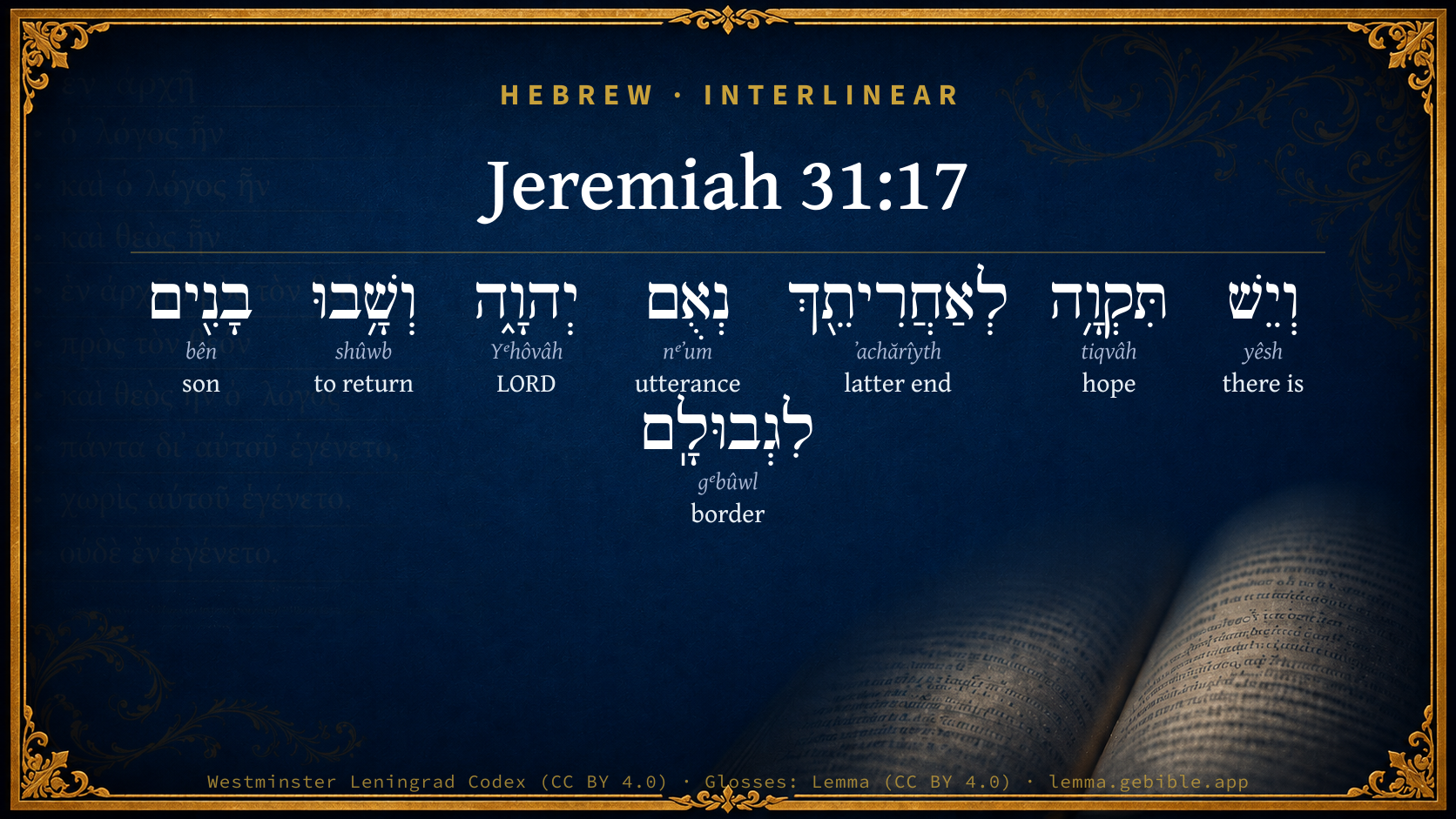
Hebrew (Westminster Leningrad Codex) Jeremiah 31:17 appears in the Hebrew Old Testament. The text above is from the Westminster Leningrad Codex. Each word links to its Strong’s number, a concise gloss, and parsing drawn from the Open Scriptures Hebrew Bible morphology. Click any word for its full Brown-Driver-Briggs (BDB) entry.
Download image
Cite this verse

Jeremiah 31:17 (World English Bible). Public Domain. Lemma interlinear Bible study tool, https://lemma.gebible.app/v/jeremiah/31/17.

Show BibTeX & RIS
BibTeX
RIS
English Translation
There is hope for your latter end, says Yahweh; and [your] children shall come again to their own border.
World English Bible · Public Domain
Download a study sheet

One document with this verse’s original text, its word-by-word gloss line, the meaning frame, cross-references with their text, attributed commentary, and full source and license credits — printable, and it pastes into notes with its structure intact.

This verse Autodidact and up

Study sheet (.html) Plain text (.txt)

A passage Seminary Student

Up to 50 verses in one chapter. A passage sheet keeps up to 6 commentary sources and 12 cross-references per verse, in the order this page ranks them, and says so on the sheet whenever that leaves anything out. Ask for a single verse and you get the Autodidact verse sheet above.

Everything on this page stays free to read, with no account — the sheet is a download of what is already on screen, not access to it.

Want to remove ads? Support Godless Engineer
Compare translations 3

The same verse in 3 English versions, stacked beneath the original-language interlinear above. Click any original word for its lexicon entry.

Each is an independent rendering of the whole verse — the interlinear is not word-aligned to these translations.

Highlighted words mark where these versions differ — a whole-verse word diff, not a word-by-word alignment.

  • World English Bible Public Domain
    There is hope for your latter end, says Yahweh; and [your] children shall come again to their own border.
  • King James Version Public Domain
    And there is hope in thine end, saith the LORD, that thy children shall come again to their own border.
  • unfoldingWord Literal Text CC BY-SA 4.0
    There is hope for your future—this is Yahweh’s declaration—your descendants will return inside their borders.”

unfoldingWord Literal Text — © unfoldingWord, licensed CC BY-SA 4.0. Word-aligned USFM3 via Door43 (git.door43.org/unfoldingWord/en_ult).

Versions to compare (up to 4)

3 of 4 selected

Show all 18 translations

Every available English version of this verse, each an independent rendering of the whole verse.

  • World English Bible Public Domain
    There is hope for your latter end, says Yahweh; and [your] children shall come again to their own border.
  • Berean Standard Bible Public Domain
    So there is hope for your future, declares the LORD, and your children will return to their own land.
  • Majority Standard Bible Public Domain
    So there is hope for your future, declares the LORD, and your children will return to their own land.
  • King James Version Public Domain
    And there is hope in thine end, saith the LORD, that thy children shall come again to their own border.
  • American Standard Version (1901) Public Domain
    And there is hope for thy latter end, saith Jehovah; and `thy' children shall come again to their own border.
  • Revised Version (1885) Public Domain
    And there is hope for thy latter end, saith the LORD; and thy children shall come again to their own border.
  • Geneva Bible (1599) Public Domain
    And there is hope in thine ende, saith the Lord, that thy children shall come againe to their owne borders.
  • Douay-Rheims (1899) Public Domain
    And here is hope for thy last end, saith the Lord: and the children shall return to their own borders.
  • Young's Literal Translation Public Domain
    And there is hope for thy latter end, An affirmation of Jehovah, And the sons have turned back `to' their border.
  • Literal Standard Version CC BY-SA 4.0
    And there is hope for your latter end,” || A declaration of YHWH, || “And the sons have turned back [to] their border.
  • Unlocked Literal Bible CC BY-SA 4.0
    There is hope for your future—this is Yahweh's declaration—your descendants will return inside their borders.”
  • unfoldingWord Literal Text CC BY-SA 4.0
    There is hope for your future—this is Yahweh’s declaration—your descendants will return inside their borders.”
  • Darby Bible Public Domain
    And there is hope for thy latter end, saith Jehovah, and thy children shall come again to their own border.
  • World Messianic Bible Public Domain
    There is hope for your latter end,” says the LORD. “Your children will come again to their own territory.
  • Webster's Bible Public Domain
    And there is hope in thy end, saith the LORD, that thy children shall come again to their own border.
  • Free Bible Version CC BY-SA 4.0
    So you can have hope for the future, declares the Lord. Your children will return to their own country.
  • Bible in Basic English Public Domain
    And there is hope for the future, says the Lord; and your children will come back to the land which is theirs.
  • JPS Tanakh (1917) Public Domain
    And there is hope for thy future, saith the LORD; and thy children shall return to their own border.

Literal Standard Version (2020), Covenant Press — licensed CC BY-SA 4.0. Text via the HelloAO Bible API (eBible.org). Unlocked Literal Bible (unfoldingWord) — licensed CC BY-SA 4.0. Text via the HelloAO Bible API (eBible.org). unfoldingWord Literal Text — © unfoldingWord, licensed CC BY-SA 4.0. Word-aligned USFM3 via Door43 (git.door43.org/unfoldingWord/en_ult). Free Bible Version, Dr. Jonathan Gallagher — licensed CC BY-SA 4.0. Text via the HelloAO Bible API (eBible.org).

Word by word

More ways to search: Search by grammar → Find every occurrence → Compare this word →

Practice this passage: Drill this verse → Learn its vocabulary →

About this verse

These counts appear in no published source. They are computed here, from the morphology-tagged text and Lemma’s own curated glosses. What Lemma adds →

8
words
8
distinct lemmas
Prophets
section

Shared distinctive vocabulary

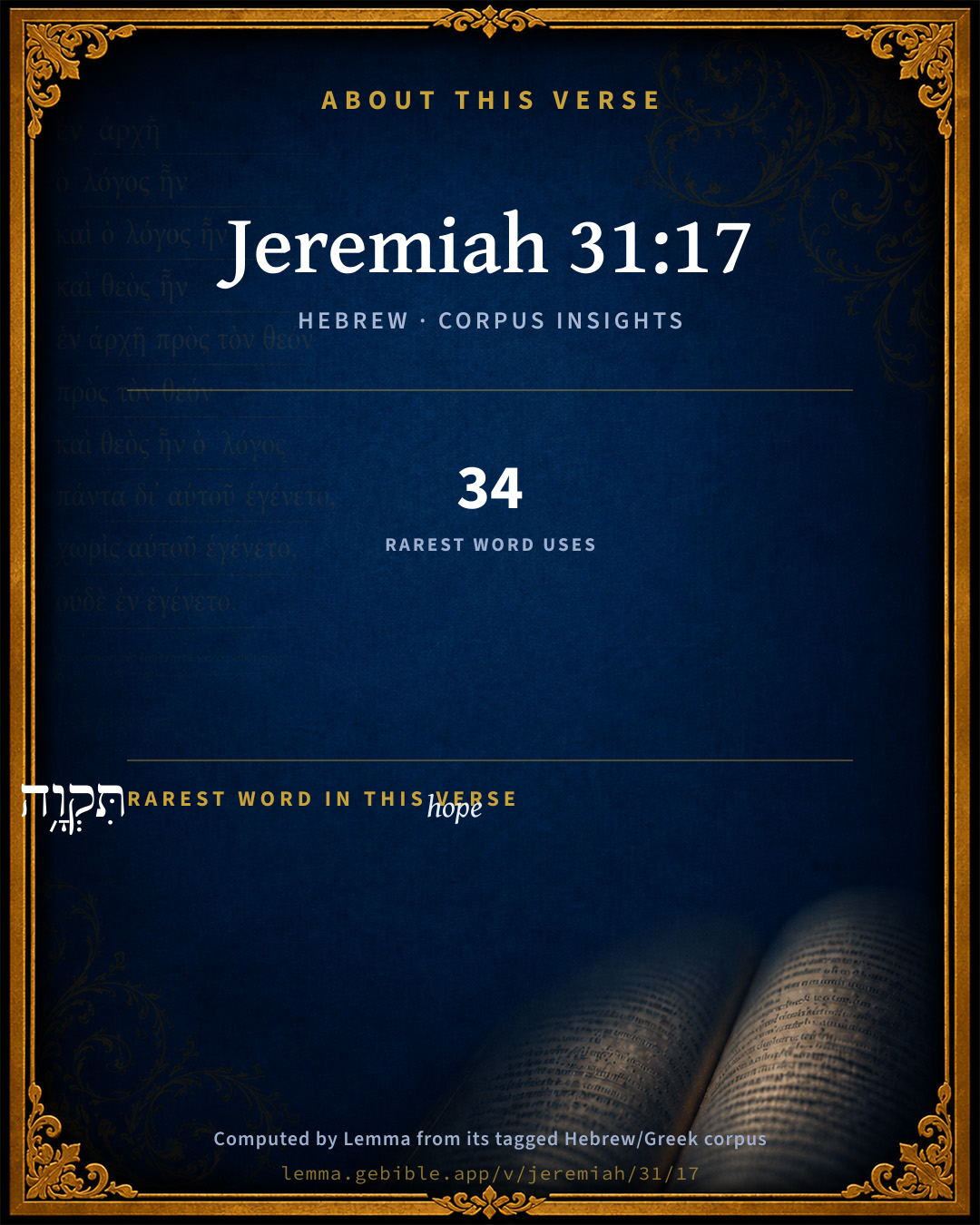
תִּקְוָ֥ה hope H8615 occurs in 33 verses of the Hebrew Bible. Also found in:

Grammatical profile

  • 1 verb
  • 6 nouns
  • 1 particle

Verb forms

  • וְשָׁ֥בוּ Qal · Sequential Perfect

Cross-references

16

Topical passages linked to Jeremiah 31:17 in the Treasury of Scripture Knowledge — connected by theme and wording, ordered by reader-vote popularity; previews shown in the World English Bible.

  • Lamentations 3:21 This I recall to my mind; therefore have I hope.
  • Hosea 3:5 Afterward the children of Israel shall return, and seek Yahweh their God, and David their king, and shall come with trembling to Yahweh and to his blessings in the last days.
  • Jeremiah 29:11–16 For I know the thoughts that I think toward you, says Yahweh, thoughts of peace, and not of evil, to give you hope in your latter end.
  • Lamentations 3:18 I said, My strength is perished, and my expectation from Yahweh.
  • Lamentations 3:26 It is good that a man should hope and quietly wait for the salvation of Yahweh.
  • Hosea 2:15 I will give her vineyards from there, And the valley of Achor for a door of hope; And she will respond there, As in the days of her youth, And as in the day when she came up out of the land of Egypt.
  • Romans 11:23–26 They also, if they don't continue in their unbelief, will be grafted in, for God is able to graft them in again.
  • Isaiah 11:11–16 It shall happen in that day, that the Lord will set his hand again the second time to recover the remnant of his people, who shall remain, from Assyria, and from Egypt, and from Pathros, and from Cush, and from Elam, and from Shinar, and from Hamath, and from the islands of the sea.
  • Ezekiel 37:25 They shall dwell in the land that I have given to Jacob my servant, in which your fathers lived; and they shall dwell therein, they, and their children, and their children's children, forever: and David my servant shall be their prince for ever.
  • Matthew 24:22 Unless those days had been shortened, no flesh would have been saved. But for the sake of the chosen ones, those days will be shortened.
  • Psalms 102:13–14 You will arise and have mercy on Zion; For it is time to have pity on her. Yes, the set time has come.
  • Isaiah 6:13 If there are yet a tenth in it, It also shall in turn be eaten up: As a terebinth, and as an oak, whose stock remains, when they are felled; So the holy seed is its stock."
  • Jeremiah 46:27–28 But don't be afraid you, Jacob my servant, neither be dismayed, Israel: for, behold, I will save you from afar, and your seed from the land of their captivity; and Jacob shall return, and shall be quiet and at ease, and none shall make him afraid.
  • Ezekiel 37:11–14 Then he said to me, Son of man, these bones are the whole house of Israel: behold, they say, Our bones are dried up, and our hope is lost; we are clean cut off.
  • Amos 9:8–9 Behold, the eyes of the Lord Yahweh are on the sinful kingdom, and I will destroy it from off the surface of the earth; except that I will not utterly destroy the house of Jacob," says Yahweh.
  • Ezekiel 39:28 They shall know that I am Yahweh their God, in that I caused them to go into captivity among the nations, and have gathered them to their own land; and I will leave none of them any more there;

Cross-references courtesy of OpenBible.info (CC BY 4.0).

Hebrew and Greek witnesses Masoretic Hebrew ↔ Greek Septuagint

The same verse in the two great witnesses to the Old Testament, shown verse-for-verse.

These are two independent witnesses, not word-aligned to each other, and the Septuagint is shown in lemma (dictionary) form.

Hebrew Jeremiah 31:17 Masoretic · Westminster Leningrad Codex

וְיֵשׁ תִּקְוָ֥ה לְאַחֲרִיתֵ֖ךְ נְאֻם יְהוָ֑ה וְשָׁ֥בוּ בָנִ֖ים לִגְבוּלָֽם

There is hope for your latter end, says Yahweh; and [your] children shall come again to their own border.

World English Bible · Public Domain

Greek LXX Structure differs

In the Septuagint, Jeremiah is about an eighth shorter than the Hebrew and arranges its material differently — the Oracles Against the Nations (Hebrew chapters 46–51) appear in the middle of the Greek book, after 25:13. Because the chapter and verse boundaries do not line up, a verse-for-verse comparison with the Hebrew is not shown.

A verse-for-verse comparison isn’t shown here because the chapters and verses don’t line up. Switch to the LXX edition with the MT / LXX toggle above to read the Greek directly.

On this verse, The Pulpit Commentary discusses the Septuagint’s reading. Read the note in Commentary ↓

Hebrew: Westminster Leningrad Codex (CC BY 4.0). Greek: Septuagint (public domain); English from a public-domain English Septuagint. How the Septuagint differs from the Hebrew →

Targum (Aramaic paraphrase)

1

The Targum is the ancient Jewish Aramaic paraphrase of the Hebrew Scriptures — an interpretive translation, not the Hebrew text itself. Onkelos (literal) and Pseudo-Jonathan (expansive) render the Torah, and Jonathan the Prophets. Coverage is partial: where no permissively-licensed English translation exists for a verse, only the Aramaic is shown. This is verse-level text, not a word-by-word alignment to the Hebrew.

  1. Targum Jonathan Prophets (Joshua–Malachi)
    וְאִית סִבוּר לְסוֹפִיךְ אֲמַר יְיָ וִיתוּבוּן בָּנַיָא לִתְחוּמְהוֹן:

    "And I have a plan for your end, says the Lord, and your children will return to their borders."

    Targum Jonathan — Aramaic: “Mikraot Gedolot” (public domain). English: “Sefaria Community Translation” (CC0 1.0 (public-domain dedication)); “London "Chaldee Paraphrase," 1871” (public domain). Text via Sefaria.

Commentary

Notes on Jeremiah 31:17 from classic Christian and Jewish commentators (each source and its license shown beneath its notes). The classic Christian expositions comment on the surrounding passage and are grouped to its opening verse, so a note may address several verses; the Jewish commentaries on the Tanakh (Rashi and others) are per-verse, so they appear only where the commentator wrote on this verse.

Lemma curates 59 commentaries, every one of them public domain or Creative Commons licensed, each selected and text-cleaned for this edition rather than reprinted as found. About our sources →

Trapp's Complete Commentary

John Trapp

Jer 31:17 And there is hope in thine end, saith the LORD, that thy children shall come again to their own border.

Ver. 17. And there is hope in the end.] Or, For thy posterity. Tribulation causeth patience, and patience experience, and experience hope; lively hope, such as maketh not ashamed, is not disappointed, Spes in fundo. Hope in the depths. God can recompense his people’s patience and obedience, in their heirs and executors.

John Trapp, A Commentary or Exposition upon All the Books of the Old and New Testament (1647–1656) — public domain. Text from a community e-Sword module.

Jamieson, Fausset & Brown

Robert Jamieson, A. R. Fausset & David Brown

hope in . . . end--All thy calamities shall have a prosperous issue.

Jamieson, Fausset & Brown — Commentary Critical and Explanatory on the Whole Bible (1871) — public domain (CC PDM 1.0). Text via the HelloAO Bible API.

John Calvin's Commentaries

He indeed explains in a few words, but with sufficient plainness, what he had said. We must always bear in mind the order which I have pointed out, — that he first placed before the Jews their calamity, that they might humble themselves before God; and then he gave them the hope of return, that they might feel assured that God would be propitious to them. He now includes both in these few words, there shall be hope in thine end; for they embrace the two clauses, — that the whole country would lament for a time, and then that their tears would be turned to laughter and their sorrow to joy: for had the happiness of the people flowed in one unbroken stream, the word, “end,” would not have been suitable; for it refers to what terminates. There is then to be understood a contrast between the end and the beginning. In short, Jeremiah teaches here, that the grievous time, during which God would afflict his people, was to be borne patiently. But after having bidden them to continue in a state of suspense, he sets before them a happy issue.

Now this passage contains a useful doctrine, — that we are not to measure God’s favor by present appearances, but learn to keep our minds and thoughts in suspense, while the Lord seems to be angry with us, and only disheartening terrors meet us, so that we may cherish in our hearts the hope which the Prophet exhorts us to entertain, and distinguish between our present state and the end. And on this account it is that the Apostle, in his Epistle to the Hebrews, while exhorting the faithful to patience, says that the rod is always at the time grievous to children, but that correction appears useful, when the end is regarded. (Hebrews 12:11) So when we perceive that God is displeased with us, we cannot but feel a dread, and we desire at the same time to escape from his chastening hand; but, as I have just said, we ought to direct our thoughts to the end or the issue, according to what we are taught here: there shall then be hope in thine end

But a question may be here moved, Was there no hope for the intermediate time, while God was punishing the Jews? the answer is obvious, — the Prophet takes hope here for hope accomplished. If any one calls it actual hope or hope effected, I do not object. But he doubtless intimates that all the calamities which the Jews would have to endure would at last end in their deliverance, and would be for their good. We thus see that hope here, as we have said, is to be taken for hope accomplished. And the Prophet explains himself, they shall return to their own border Here by stating a part for the whole he mentions border for the whole country, as though he had said, “Ye are now far off from your country, but you shall again return to that land which has been marked out by certain limits, even by Euphrates, Egypt, the sea and Arabia;” for these were the four borders. It afterwards follows, —

John Calvin's Commentaries (1540-1563) — public domain. Text from the Calvin Translation Society English edition (1840s-50s) via the Christian Classics Ethereal Library (ccel.org). Calvin's coverage is partial (roughly two-thirds of the Bible); uncommented books and verses are honest gaps, never fabricated. The 19th-century editor's footnotes and remarks are omitted so the notes are faithfully Calvin's own voice.

Ellicott's Commentary for English Readers

(17) And there is hope in thine end . . .—Better, There is hope for thy future. The words are the same as in Jer_29:11, where the English version has “an expected end.” The hope here is defined as that of the return of Rachel’s children to their own border—the return, that is, of the Ten Tribes from their captivity.

A Bible Commentary for English Readers, edited by Charles John Ellicott (1878–1897) — public domain. Text from a community e-Sword module.

John Gill's Exposition

And there is hope in thine end, saith the Lord,.... Or, "hope for thy posterity" (r); for their children that had been massacred, that these should rise again, and enjoy a blessed immortality, as the next clause seems to explain and confirm it:

that thy children shall come again to their own border: either to the border of the land of Israel, as Joseph, Mary, and Jesus did, Mat 2:21; or rather to the borders of the tribes of Judah and Benjamin, where this cruel murder was committed; and so the intimation is, that they shall rise again, and stand upon that very spot of ground where their blood was split; and not only so, but enter into and dwell upon the new earth in the Jerusalem state; and also enter into the heavenly Canaan, and dwell with Christ for evermore, on whose account their lives were taken away.

(r) "posteris tuis", Gataker; "posteritati tuae", Schmidt.

John Gill's Exposition of the Whole Bible (1746–1763) — public domain (CC PDM 1.0). Text via the HelloAO Bible API.

Matthew Poole's English Annotations

And again here, where, by

end, is meant the end of the seventy years, and the words are but a repetition of the promise of the return of the Jews out of the captivity of Babylon, of which the prophet had often before assured them, and here only repeats it as an argument why they should not be immoderately afflicted; for their affliction was not endless, nor their captivity for ever; they should return again into their own land.

Matthew Poole's English Annotations on the Holy Bible (1683–1685) — public domain. Text from a community e-Sword/MySword module.

The Pulpit Commentary

Hope in thine end; rather, hope for thy future. (comp. on Jer_29:11) There is no occasion to render, with the Septuagint and Rosenmuller, "for thy posterity"; (comp. Psa_119:13, Hebrew) for Rachel identifies herself by sympathy with her descendants.

The Pulpit Commentary (1880–1919), ed. H.D.M. Spence-Jones & Joseph S. Exell — public domain. Text from a community e-Sword module.

Lesson kit

Teaching starters — assembled from the data on this page, not authored interpretation. Every prompt links to the verse data it draws on. Edit before teaching.

Jeremiah, in the Prophets, opens this verse with 8 words (8 distinct Hebrew lemmas). Its most distinctive word is tiqvâh (“hope”). A historical commentator’s framing appears above. Read the whole chapter for the surrounding context.

Discussion questions

  1. How does “hope” (tiqvâh) shape what this verse is saying?
  2. How does Joshua 2:18, which shares the word «hope», read alongside this verse?
  3. The translations on this page render this verse differently — a whole-verse word diff, not a word-by-word alignment. What might account for the different wordings?
  4. «וְשָׁ֥בוּ» is a Qal Sequential Perfect verb. How does that grammatical form shape the action described?
  5. Compare how Trapp's Complete Commentary and Jamieson, Fausset & Brown read this verse. Where do they agree or differ?

Things to notice

Reading settings

Reading text

Shown beneath each verse's original-language words.

Old Testament
Old Testament edition

Read the OT as the Masoretic Hebrew (MT) or the Greek Septuagint (LXX).

English shown for the Greek Septuagint (in the Hebrew ↔ Greek comparison).

Comparing translations? Open the Compare panel on any verse page to stack up to four side by side.