
Joshua 18:16

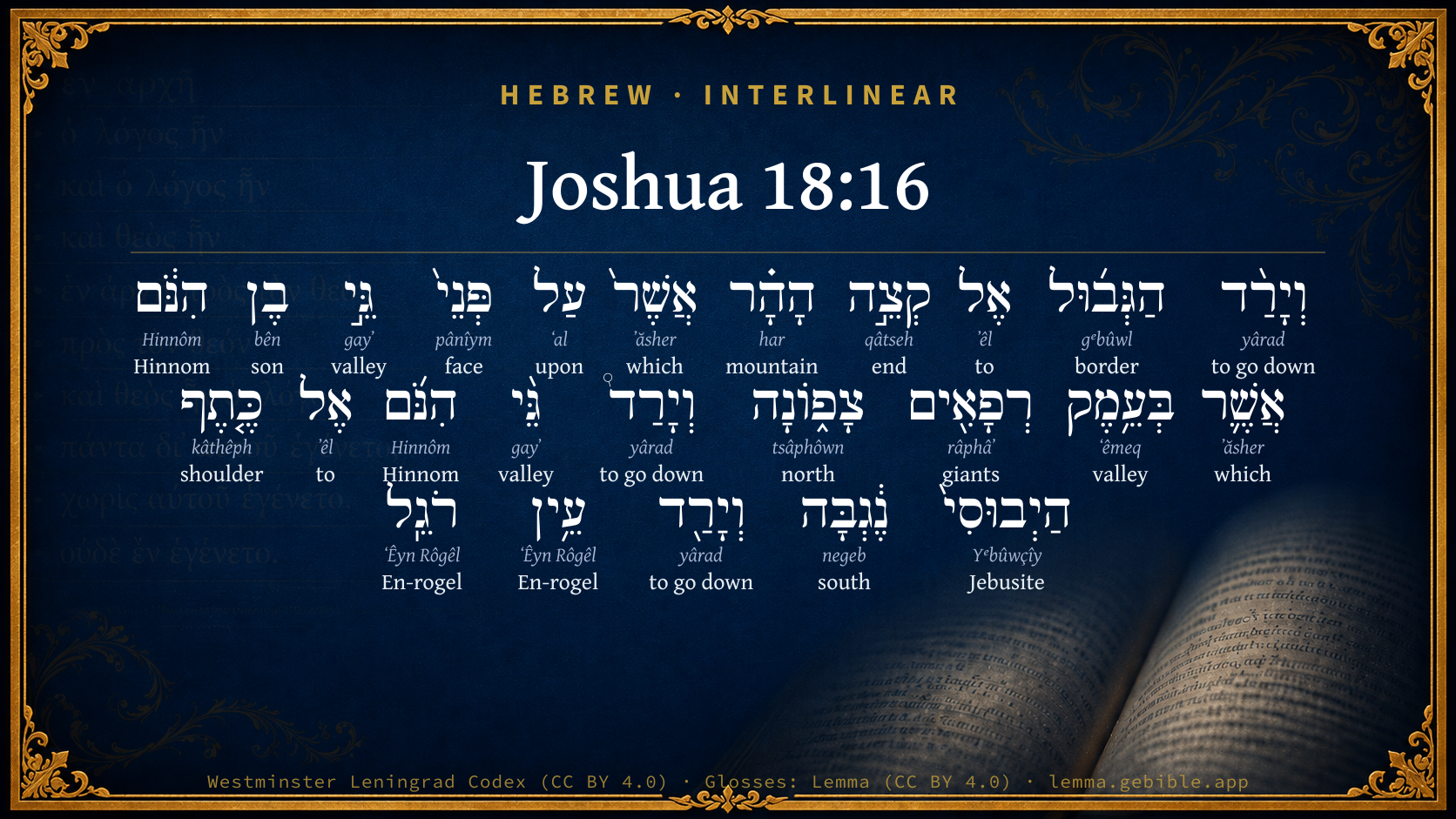
Hebrew (Westminster Leningrad Codex) Joshua 18:16 appears in the Hebrew Old Testament. The text above is from the Westminster Leningrad Codex. Each word links to its Strong’s number, a concise gloss, and parsing drawn from the Open Scriptures Hebrew Bible morphology. Click any word for its full Brown-Driver-Briggs (BDB) entry.
Download image
Cite this verse

Joshua 18:16 (World English Bible). Public Domain. Lemma interlinear Bible study tool, https://lemma.gebible.app/v/joshua/18/16.

Show BibTeX & RIS
BibTeX
RIS
English Translation
and the border went down to the uttermost part of the mountain that lies before the valley of the son of Hinnom, which is in the valley of Rephaim northward; and it went down to the valley of Hinnom, to the side of the Jebusite southward, and went down to En Rogel;
World English Bible · Public Domain
Download a study sheet

One document with this verse’s original text, its word-by-word gloss line, the meaning frame, cross-references with their text, attributed commentary, and full source and license credits — printable, and it pastes into notes with its structure intact.

This verse Autodidact and up

Study sheet (.html) Plain text (.txt)

A passage Seminary Student

Up to 50 verses in one chapter. A passage sheet keeps up to 6 commentary sources and 12 cross-references per verse, in the order this page ranks them, and says so on the sheet whenever that leaves anything out. Ask for a single verse and you get the Autodidact verse sheet above.

Everything on this page stays free to read, with no account — the sheet is a download of what is already on screen, not access to it.

Want to remove ads? Support Godless Engineer
Compare translations 3

The same verse in 3 English versions, stacked beneath the original-language interlinear above. Click any original word for its lexicon entry.

Each is an independent rendering of the whole verse — the interlinear is not word-aligned to these translations.

Highlighted words mark where these versions differ — a whole-verse word diff, not a word-by-word alignment.

  • World English Bible Public Domain
    and the border went down to the uttermost part of the mountain that lies before the valley of the son of Hinnom, which is in the valley of Rephaim northward; and it went down to the valley of Hinnom, to the side of the Jebusite southward, and went down to En Rogel;
  • King James Version Public Domain
    And the border came down to the end of the mountain that lieth before the valley of the son of Hinnom, and which is in the valley of the giants on the north, and descended to the valley of Hinnom, to the side of Jebusi on the south, and descended to Enrogel,
  • unfoldingWord Literal Text CC BY-SA 4.0
    And the border went down to the end of the mountain that on the face of the Valley of Ben Hinnom, which in the valley of the Raphaites northward. And it went down the Valley of Hinnom to the shoulder of the Jebusite southward, then it went down En Rogel.

unfoldingWord Literal Text — © unfoldingWord, licensed CC BY-SA 4.0. Word-aligned USFM3 via Door43 (git.door43.org/unfoldingWord/en_ult).

Versions to compare (up to 4)

3 of 4 selected

Show all 18 translations

Every available English version of this verse, each an independent rendering of the whole verse.

  • World English Bible Public Domain
    and the border went down to the uttermost part of the mountain that lies before the valley of the son of Hinnom, which is in the valley of Rephaim northward; and it went down to the valley of Hinnom, to the side of the Jebusite southward, and went down to En Rogel;
  • Berean Standard Bible Public Domain
    Then it went down to the foot of the hill that faces the Valley of Hinnom at the northern end of the Valley of Rephaim and ran down the Valley of Hinnom toward the southern slope of the Jebusites and downward to En-rogel.
  • Majority Standard Bible Public Domain
    Then it went down to the foot of the hill that faces the Valley of Ben-hinnom at the northern end of the Valley of Rephaim and ran down the Valley of Hinnom toward the southern slope of the Jebusites and downward to En-rogel.
  • King James Version Public Domain
    And the border came down to the end of the mountain that lieth before the valley of the son of Hinnom, and which is in the valley of the giants on the north, and descended to the valley of Hinnom, to the side of Jebusi on the south, and descended to Enrogel,
  • American Standard Version (1901) Public Domain
    and the border went down to the uttermost part of the mountain that lieth before the valley of the son of Hinnom, which is in the vale of Rephaim northward; and it went down to the valley of Hinnom, to the side of the Jebusite southward, and went down to En-rogel;
  • Revised Version (1885) Public Domain
    and the border went down to the uttermost part of the mountain that lieth before the valley of the son of Hinnom, which is in the vale of Rephaim northward; and it went down to the valley of Hinnom, to the side of the Jebusite southward, and went down to En-rogel;
  • Geneva Bible (1599) Public Domain
    And this border descendeth at the ende of the mountaine, that lyeth before the valley of Ben-hinnom, which is in the valley of the gyants Northward, and descendeth into the valley of Hinnom by the side of Iebusi Southwarde, and goeth downe to En-rogel,
  • Douay-Rheims (1899) Public Domain
    But on the south side the border goeth out from part of Cariathiarim towards the sea, and cometh to the fountain of the waters of Nephtoa.
  • Young's Literal Translation Public Domain
    and the border hath come down unto the extremity of the hill which `is' on the front of the valley of the son of Hinnom, which `is' in the valley of the Rephaim northward, and hath gone down the valley of Hinnom unto the side of Jebusi southward, and gone down `to' En-Rogel,
  • Literal Standard Version CC BY-SA 4.0
    and the border has come down to the extremity of the hill which [is] on the front of the Valley of the Son of Hinnom, which [is] in the Valley of the Rephaim northward, and has gone down the Valley of Hinnom to the side of Jebusi southward, and gone down [to] En-Rogel,
  • Unlocked Literal Bible CC BY-SA 4.0
    The boundary then went down to the border of the mountain which was opposite the Valley of Ben Hinnom, which was at the northern end of the Valley of Rephaim. It then went down to the Valley of Hinnom, south of the slope of the Jebusites, and continued down to En Rogel.
  • unfoldingWord Literal Text CC BY-SA 4.0
    And the border went down to the end of the mountain that on the face of the Valley of Ben Hinnom, which in the valley of the Raphaites northward. And it went down the Valley of Hinnom to the shoulder of the Jebusite southward, then it went down En Rogel.
  • Darby Bible Public Domain
    And the border went down to the end of the mountain that is before the valley of the son of Hinnom, which is in the valley of Rephaim on the north, and went down the valley of Hinnom, to the side of the Jebusite on the south, and went down to En-rogel;
  • World Messianic Bible Public Domain
    The border went down to the farthest part of the mountain that lies before the valley of the son of Hinnom, which is in the valley of Rephaim northward. It went down to the valley of Hinnom, to the side of the Jebusite southward, and went down to En Rogel.
  • Webster's Bible Public Domain
    And the border came down to the end of the mountain that lieth before the valley of the son of Hinnom, and which is in the valley of the giants on the north, and descended to the valley of Hinnom, to the side of Jebusi on the south, and descended to En-rogel,
  • Free Bible Version CC BY-SA 4.0
    and then down to the foot of the mountain that faces the valley of Ben-hinnom, at the north end of the valley of Rephaim. Then it went down the valley of Hinnom, along the slope near the Jebusite town, south towards En-rogel.
  • Bible in Basic English Public Domain
    And the line goes down to the farthest part of the mountain facing the valley of the son of Hinnom, which is on the north of the valley of Rephaim: from there it goes down to the valley of Hinnom, to the side of the Jebusite on the south as far as En-rogel;
  • JPS Tanakh (1917) Public Domain
    And the border went down to the uttermost part of the mountain that lieth before the Valley of the son of Hinnom, which is in the vale of Rephaim northward; and it went down to the Valley of Hinnom, to the side of the Jebusite southward, and went down to En-rogel.

Literal Standard Version (2020), Covenant Press — licensed CC BY-SA 4.0. Text via the HelloAO Bible API (eBible.org). Unlocked Literal Bible (unfoldingWord) — licensed CC BY-SA 4.0. Text via the HelloAO Bible API (eBible.org). unfoldingWord Literal Text — © unfoldingWord, licensed CC BY-SA 4.0. Word-aligned USFM3 via Door43 (git.door43.org/unfoldingWord/en_ult). Free Bible Version, Dr. Jonathan Gallagher — licensed CC BY-SA 4.0. Text via the HelloAO Bible API (eBible.org).

Word by word

More ways to search: Search by grammar → Find every occurrence → Compare this word →

Practice this passage: Drill this verse → Learn its vocabulary →

עֵ֥ין
ʻÊyn Rôgêl
H5883
“En-rogel”
Noun, Proper
Part of Speech
Noun
Type
Proper
Full BDB Definition

Origin: from H5869 and the act. part. of H7270

TWOT: None

En-rogel = "fount of the fuller" - a place near Jerusalem on the border between Judah and Benjamin and from which the permanent source of the pool of Siloam comes
  1. וְיָרַ֨ד yârad H3381 “and · to go down” Conjunction + Verb, Qal, Sequential Perfect, 3rd Person, Masculine, Singular
  2. הַגְּב֜וּל gᵉbûwl H1366 “the · border” Particle, Definite Article + Noun, Common, Masculine, Singular, Absolute
  3. אֶל ʼêl H413 “to” Preposition
  4. קְצֵ֣ה qâtseh H7097 “end of” Noun, Common, Both, Singular, Construct
  5. הָהָ֗ר har H2022 “the · mountain” Particle, Definite Article + Noun, Common, Masculine, Singular, Absolute
  6. אֲשֶׁר֙ ʼăsher H834 “which” Particle, Relative
  7. עַל ʻal H5921 “upon” Preposition
  8. פְּנֵי֙ pânîym H6440 “face(s) of” Noun, Common, Both, Plural, Construct
  9. גֵּ֣י gayʼ H1516 “valley of” Noun, Common, Both, Singular, Construct
  10. בֶן bên H1121 “son of” Noun, Common, Masculine, Singular, Construct
  11. הִנֹּ֔ם Hinnôm H2011 “Hinnom” Noun, Proper
  12. אֲשֶׁ֛ר ʼăsher H834 “which” Particle, Relative
  13. בְּעֵ֥מֶק ʻêmeq H6010 “in/at · valley of” Preposition + Noun, Common, Masculine, Singular, Construct
  14. רְפָאִ֖ים râphâʼ H7497 “giants” Noun, Proper
  15. צָפ֑וֹנָה tsâphôwn H6828 “north · toward” Noun, Common, Feminine, Singular, Absolute + Suffix, Demonstrative
  16. וְיָרַד֩ yârad H3381 “and · to go down” Conjunction + Verb, Qal, Sequential Perfect, 3rd Person, Masculine, Singular
  17. גֵּ֨י gayʼ H1516 “valley of” Noun, Common, Both, Singular, Construct
  18. הִנֹּ֜ם Hinnôm H2011 “Hinnom” Noun, Proper
  19. אֶל ʼêl H413 “to” Preposition
  20. כֶּ֤תֶף kâthêph H3802 “shoulder of” Noun, Common, Feminine, Singular, Construct
  21. הַיְבוּסִי֙ Yᵉbûwçîy H2983 “the · Jebusite” Particle, Definite Article + Noun, Gentilic, Masculine, Singular, Absolute
  22. נֶ֔גְבָּה negeb H5045 “south · toward” Noun, Common, Masculine, Singular, Absolute + Suffix, Demonstrative
  23. וְיָרַ֖ד yârad H3381 “and · to go down” Conjunction + Verb, Qal, Sequential Perfect, 3rd Person, Masculine, Singular
  24. רֹגֵֽל ʻÊyn Rôgêl H5883 “En-rogel” Noun, Proper

About this verse

These counts appear in no published source. They are computed here, from the morphology-tagged text and Lemma’s own curated glosses. What Lemma adds →

25
words
18
distinct lemmas
Historical
section

Notable vocabulary

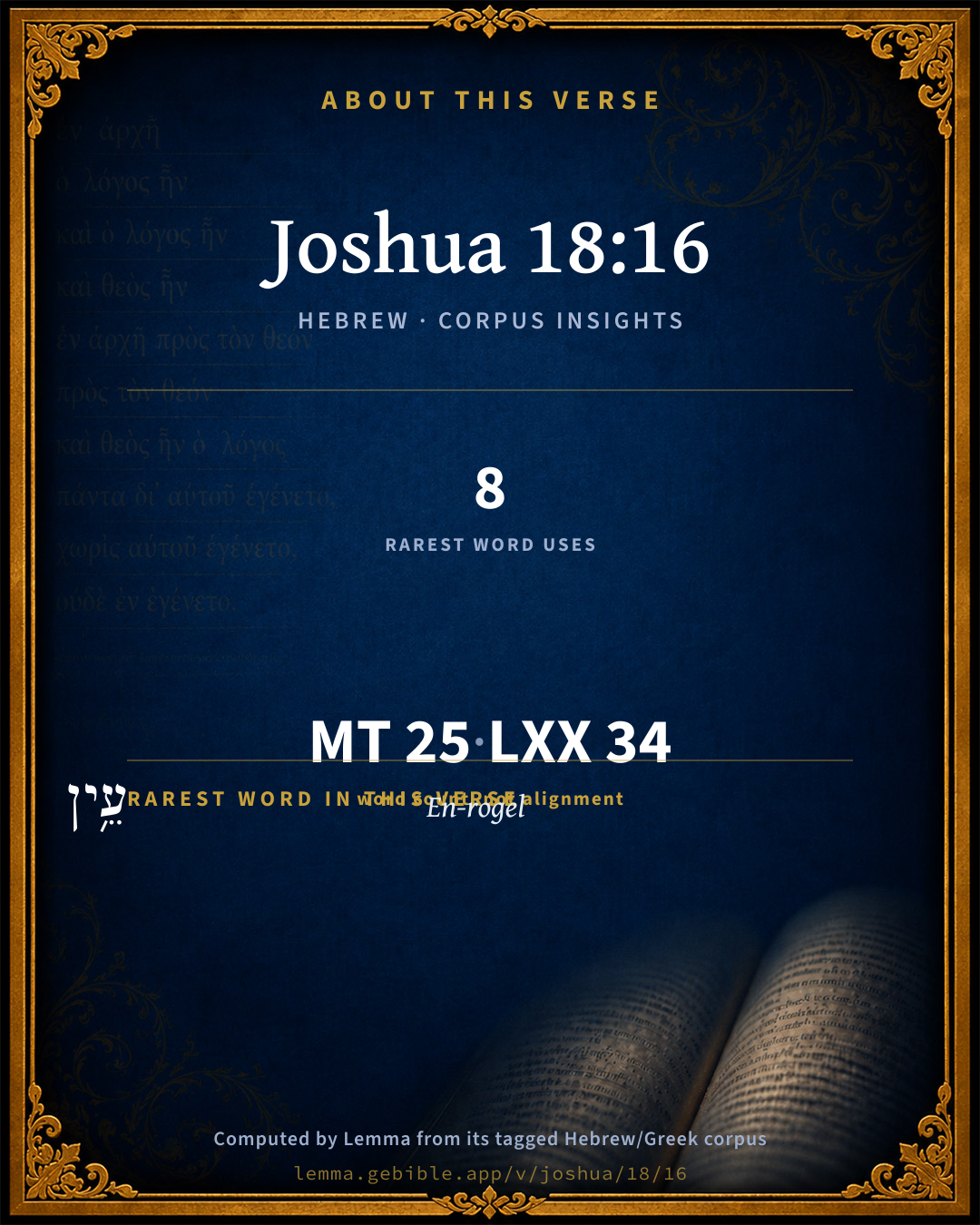
The rarest word here is עֵ֥ין En-rogel H5883 — appearing just 8 times in the whole Hebrew Bible.

Shared distinctive vocabulary

עֵ֥ין En-rogel H5883 occurs in 4 verses of the Hebrew Bible. Also found in:

Grammatical profile

  • 3 verbs
  • 17 nouns
  • 3 prepositions
  • 2 particles

Verb forms

  • וְיָרַ֨ד Qal · Sequential Perfect
  • וְיָרַד֩ Qal · Sequential Perfect
  • וְיָרַ֖ד Qal · Sequential Perfect

Repetition

Words recur within this verse — often emphatic in Hebrew:

  • וְיָרַ֨ד to go down H3381 ×3
  • גֵּ֣י valley H1516 ×2
  • הִנֹּ֔ם Hinnom H2011 ×2
  • עֵ֥ין En-rogel H5883 ×2
  • אֶל to H413 ×2
  • אֲשֶׁר֙ which H834 ×2

Hebrew & Septuagint length

In English translation the verse runs 52 words from the Hebrew and 46 from the Septuagint (LXX English) — closely comparable.

A rough comparison of the two English renderings, which tokenize alike — not a word-level alignment.

Word counts can differ between the Hebrew and the Greek without any difference in meaning — e.g. the Hebrew direct-object marker אֵת has no separate Greek word, and Greek often adds the article ὁ.

In the original languages it is 25 Hebrew tokens and 34 Greek tokens — but the two are counted differently (Hebrew bundles its prefixes and suffixes into one token; the Greek is in lemma form), so that isn’t a like-for-like length.

Cross-references

18

Topical passages linked to Joshua 18:16 in the Treasury of Scripture Knowledge — connected by theme and wording, ordered by reader-vote popularity; previews shown in the World English Bible.

  • 2 Kings 23:10 He defiled Topheth, which is in the valley of the children of Hinnom, that no man might make his son or his daughter to pass through the fire to Molech.
  • Joshua 15:7–8 and the border went up to Debir from the valley of Achor, and so northward, looking toward Gilgal, that is over against the ascent of Adummim, which is on the south side of the river; and the border passed along to the waters of En Shemesh, and the goings out of it were at En Rogel;
  • Isaiah 30:33 For a Topheth is prepared of old; yes, for the king it is made ready; he has made it deep and large; the pile of it is fire and much wood; the breath of Yahweh, like a stream of sulfur, does kindle it.
  • Joshua 15:63 As for the Jebusites, the inhabitants of Jerusalem, the children of Judah couldn't drive them out: but the Jebusites dwell with the children of Judah at Jerusalem to this day.
  • Joshua 18:28 and Zelah, Eleph, and the Jebusite (the same is Jerusalem), Gibeath, [and] Kiriath; fourteen cities with their villages. This is the inheritance of the children of Benjamin according to their families.
  • Judges 1:8 The children of Judah fought against Jerusalem, and took it, and struck it with the edge of the sword, and set the city on fire.
  • Judges 1:21 The children of Benjamin did not drive out the Jebusites who inhabited Jerusalem; but the Jebusites dwell with the children of Benjamin in Jerusalem to this day.
  • Judges 19:10 But the man wouldn't stay that night, but he rose up and departed, and came over against Jebus (the same is Jerusalem): and there were with him a couple of donkeys saddled; his concubine also was with him.
  • 2 Samuel 17:17 Now Jonathan and Ahimaaz were staying by En Rogel; and a maid-servant used to go and tell them; and they went and told king David: for they might not be seen to come into the city.
  • 1 Kings 1:9 Adonijah killed sheep and oxen and fatlings by the stone of Zoheleth, which is beside En Rogel; and he called all his brothers, the king's sons, and all the men of Judah, the king's servants:
  • 1 Chronicles 14:9 Now the Philistines had come and made a raid in the valley of Rephaim.
  • 2 Chronicles 28:3 Moreover he burnt incense in the valley of the son of Hinnom, and burnt his children in the fire, according to the abominations of the nations whom Yahweh cast out before the children of Israel.
  • 2 Chronicles 33:6 He also made his children to pass through the fire in the valley of the son of Hinnom; and he practiced sorcery, and used enchantments, and practiced sorcery, and dealt with those who had familiar spirits, and with wizards: he worked much evil in the sight of Yahweh, to provoke him to anger.
  • Jeremiah 7:31–32 They have built the high places of Topheth, which is in the valley of the son of Hinnom, to burn their sons and their daughters in the fire; which I didn't command, neither came it into my mind.
  • Jeremiah 19:2 and go forth to the valley of the son of Hinnom, which is by the entry of the gate Harsith, and proclaim there the words that I shall tell you;
  • Jeremiah 19:6 therefore, behold, the days come, says Yahweh, that this place shall no more be called Topheth, nor The valley of the son of Hinnom, but The valley of Slaughter.
  • Jeremiah 19:11 and shall tell them, Thus says Yahweh of Hosts: Even so will I break this people and this city, as one breaks a potter's vessel, that can't be made whole again; and they shall bury in Topheth, until there be no place to bury.
  • Jeremiah 32:35 They built the high places of Baal, which are in the valley of the son of Hinnom, to cause their sons and their daughters to pass through [the fire] to Molech; which I didn't command them, neither did it come into my mind, that they should do this abomination, to cause Judah to sin.

Cross-references courtesy of OpenBible.info (CC BY 4.0).

Hebrew and Greek witnesses Masoretic Hebrew ↔ Greek Septuagint

The same verse in the two great witnesses to the Old Testament, shown verse-for-verse.

These are two independent witnesses, not word-aligned to each other, and the Septuagint is shown in lemma (dictionary) form.

Hebrew Joshua 18:16 Masoretic · Westminster Leningrad Codex

וְיָרַ֨ד הַגְּב֜וּל אֶל קְצֵ֣ה הָהָ֗ר אֲשֶׁר֙ עַל פְּנֵי֙ גֵּ֣י בֶן הִנֹּ֔ם אֲשֶׁ֛ר בְּעֵ֥מֶק רְפָאִ֖ים צָפ֑וֹנָה וְיָרַד֩ גֵּ֨י הִנֹּ֜ם אֶל כֶּ֤תֶף הַיְבוּסִי֙ נֶ֔גְבָּה וְיָרַ֖ד עֵ֥ין רֹגֵֽל

and the border went down to the uttermost part of the mountain that lies before the valley of the son of Hinnom, which is in the valley of Rephaim northward; and it went down to the valley of Hinnom, to the side of the Jebusite southward, and went down to En Rogel;

World English Bible · Public Domain

Greek LXX Joshua 18:16 Septuagint · lemma form

καί καταβαίνω ὁ ὅριον ἐπί μέρος ὁ ὄρος ὅς εἰμί κατά πρόσωπον νάπη ονναμ ὅς εἰμί ἐκ μέρος εμεκραφαϊν ἀπό βορέας καί καταβαίνω γαιεννα ἐπί νῶτον ιεβουσαι ἀπό λίψ καί καταβαίνω ἐπί πηγή ρωγηλ

And the borders shall extend down on one side, this is in front of the forest of Sonnam, which is on the side of Emec Raphain northward, and it shall come down to Gaeenna behind Jebusai southward: it shall come down to the fountain of Rogel.

LXX2012 (modern English Septuagint) · Public Domain

Hebrew: Westminster Leningrad Codex (CC BY 4.0). Greek: Septuagint (public domain); English from LXX2012 (modern English Septuagint) (Public Domain). How the Septuagint differs from the Hebrew →

Targum (Aramaic paraphrase)

1

The Targum is the ancient Jewish Aramaic paraphrase of the Hebrew Scriptures — an interpretive translation, not the Hebrew text itself. Onkelos (literal) and Pseudo-Jonathan (expansive) render the Torah, and Jonathan the Prophets. Coverage is partial: where no permissively-licensed English translation exists for a verse, only the Aramaic is shown. This is verse-level text, not a word-by-word alignment to the Hebrew.

  1. Targum Jonathan Prophets (Joshua–Malachi)
    וְנָחִית תְּחוּמָא לִסְטַר טוּרָא דִי עַל אַפֵּי חֵילַת בַּר הִנֹם דִי בְּמֵישַׁר גִבָּרַיָא צִפוּנָא וְנָחִית לְחֵילַת בַּר הִנֹם לְעִיבַר יְבוּס דָרוֹמָא וְנָחִית לְעֵין קַצְרָא:

    (no public-domain English translation for this verse)

    Targum Jonathan — Aramaic: “Mikraot Gedolot” (public domain). English: “Sefaria Community Translation” (CC0 1.0 (public-domain dedication)); “London "Chaldee Paraphrase," 1871” (public domain). Text via Sefaria.

Commentary

Notes on Joshua 18:16 from classic Christian and Jewish commentators (each source and its license shown beneath its notes). The classic Christian expositions comment on the surrounding passage and are grouped to its opening verse, so a note may address several verses; the Jewish commentaries on the Tanakh (Rashi and others) are per-verse, so they appear only where the commentator wrote on this verse.

Lemma curates 59 commentaries, every one of them public domain or Creative Commons licensed, each selected and text-cleaned for this edition rather than reprinted as found. About our sources →

Geneva Bible (1599)

Geneva Bible translators

Or, Jerusalem.

Or, Rephaim.

Geneva Bible (1599) marginal notes — public domain. Text via Bolls.life.

Adam Clarke's Commentary

Verse 16. To the side of Jebusi] The mountain of Zion, that was near Jerusalem; for Jebusi, or Jebus, was the ancient name of this city.

Adam Clarke's Commentary on the Bible (1810–1826) — public domain. Text from a community e-Sword/MySword module.

John Gill's Exposition

And the border came down,.... In the description of the border of Judah, hereabout, it is said to go up, Jos 15:5; because there, as Jarchi observes, the measure was from east to west, but here from west to east:

to the end of the mountain that lieth before the valley of the son of Hinnom; this south border of Benjamin is the same with the north border of Judah; and the same places are mentioned in the description of the one as of the other, see Jos 15:8. The mountain is Mount Moriah,

and which is in the valley of the giants on the north; on the north of the valley of Rephaim:

and descended to the valley of Hinnom; the border from the end of Mount Moriah to that valley:

to the side of Jebusi on the south; to the south side of Jerusalem, having that city on the south:

and descended to Enrogel; of which See Gill on Jos 15:7.

John Gill's Exposition of the Whole Bible (1746–1763) — public domain (CC PDM 1.0). Text via the HelloAO Bible API.

Haydock's Catholic Bible Commentary

Part. Hebrew, "end, or summit." (Calmet) --- That is, &c., and explication added by St. Jerome. Some say this dreadful vale (Haydock) was on the south of Jerusalem. (Button.)

George Leo Haydock (1774–1849), Haydock's Catholic Family Bible and Commentary, 1859 edition — public domain. Excludes Psalms (Douay-Rheims chapter numbering differs from Protestant) and Deuterocanonical books (Catholic canon only).

Matthew Poole's English Annotations

To the end of the mountain, i.e. the place where the mountain ends, and the valley begins.

Before the valley of the son of Hinnom, i.e. in the prospect of that valley; or, that reacheth to that valley on the south.

In the valley of the giants on the north; which extends to this other valley on the north side of it.

To the side of Jebusi; to that part where the Jebusites lived, which was in and near Jerusalem.

Matthew Poole's English Annotations on the Holy Bible (1683–1685) — public domain. Text from a community e-Sword/MySword module.

John Wesley's Explanatory Notes

The end of the mountain - The place where the mountain ends, and the valley begins. Before the valley - That is, in the prospect of that valley. In the valley on the north - Which extends unto this other valley on the north-side of it. Of Jebusi - To that part where the Jebusites lived, which was in and near Jerusalem.

John Wesley, Explanatory Notes Upon the Whole Bible (1754–1765) — public domain. Text via the GEBible commentary corpus.

Lesson kit

Teaching starters — assembled from the data on this page, not authored interpretation. Every prompt links to the verse data it draws on. Edit before teaching.

Joshua, in the Historical, opens this verse with 25 words (18 distinct Hebrew lemmas). Its most distinctive word is ʻÊyn Rôgêl (“En-rogel”). A historical commentator’s framing appears above. Read the whole chapter for the surrounding context.

Discussion questions

  1. How does “En-rogel” (ʻÊyn Rôgêl) shape what this verse is saying?
  2. Joshua 15:7 shares the word «En-rogel» with this verse. How do the two illuminate each other?
  3. “to go down” occurs 3× in this one verse. What is the effect of the repetition?
  4. These translations render this verse differently. What is at stake in choosing one wording over another?
  5. The verb «וְיָרַ֨ד» is Qal Sequential Perfect. How does its form color the action?
  6. Reading how Geneva Bible (1599) and Adam Clarke's Commentary read this verse, where do the two commentators agree and where do they part?

Things to notice

Reading settings

Reading text

Shown beneath each verse's original-language words.

Old Testament
Old Testament edition

Read the OT as the Masoretic Hebrew (MT) or the Greek Septuagint (LXX).

English shown for the Greek Septuagint (in the Hebrew ↔ Greek comparison).

Comparing translations? Open the Compare panel on any verse page to stack up to four side by side.