
Proverbs 15:25

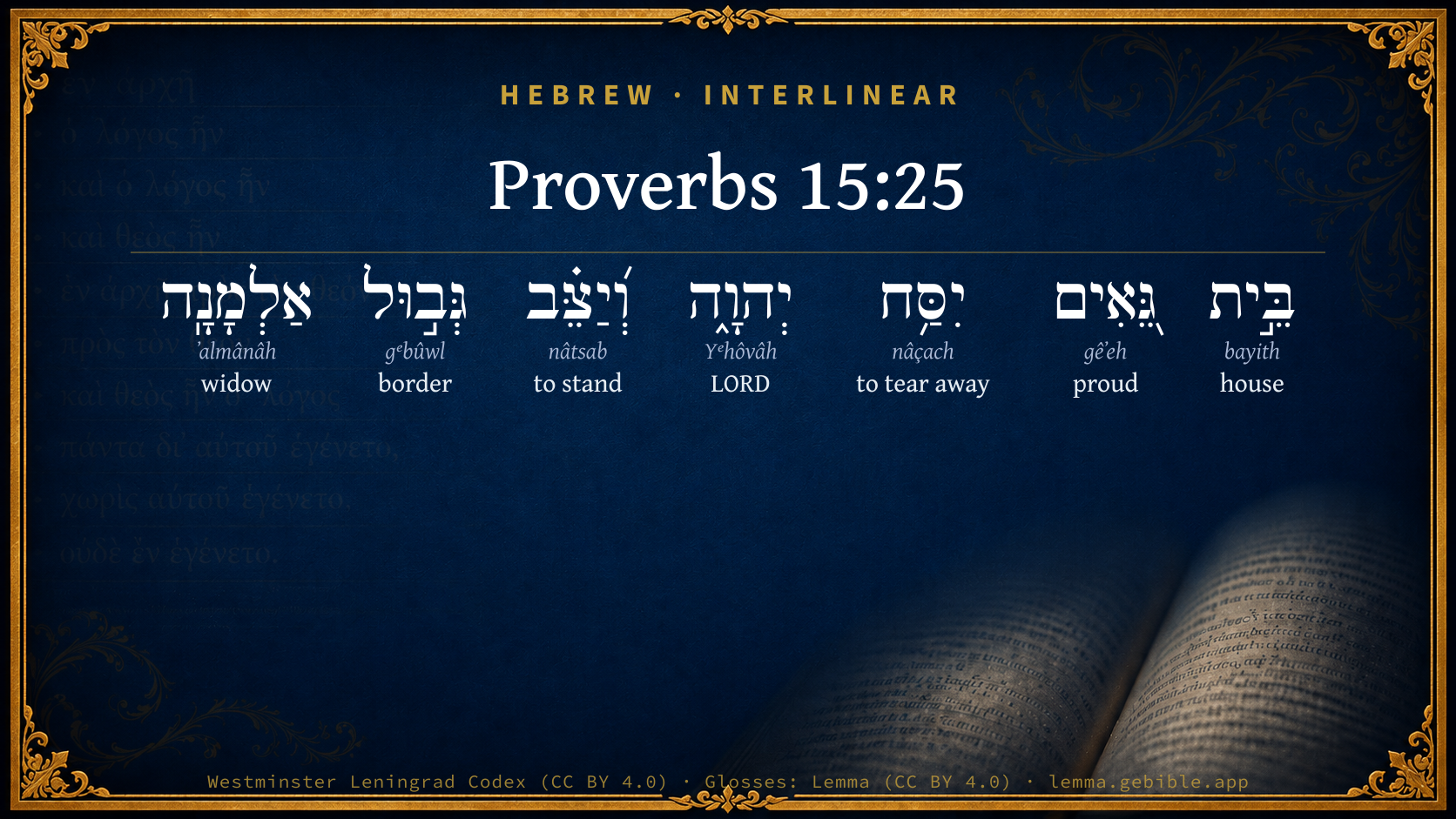
Hebrew (Westminster Leningrad Codex) Proverbs 15:25 appears in the Hebrew Old Testament. The text above is from the Westminster Leningrad Codex. Each word links to its Strong’s number, a concise gloss, and parsing drawn from the Open Scriptures Hebrew Bible morphology. Click any word for its full Brown-Driver-Briggs (BDB) entry.
Download image
Cite this verse

Proverbs 15:25 (World English Bible). Public Domain. Lemma interlinear Bible study tool, https://lemma.gebible.app/v/proverbs/15/25.

Show BibTeX & RIS
BibTeX
RIS
English Translation
Yahweh will uproot the house of the proud, But he will keep the widow's borders intact.
World English Bible · Public Domain
Download a study sheet

One document with this verse’s original text, its word-by-word gloss line, the meaning frame, cross-references with their text, attributed commentary, and full source and license credits — printable, and it pastes into notes with its structure intact.

This verse Autodidact and up

Study sheet (.html) Plain text (.txt)

A passage Seminary Student

Up to 50 verses in one chapter. A passage sheet keeps up to 6 commentary sources and 12 cross-references per verse, in the order this page ranks them, and says so on the sheet whenever that leaves anything out. Ask for a single verse and you get the Autodidact verse sheet above.

Everything on this page stays free to read, with no account — the sheet is a download of what is already on screen, not access to it.

Want to remove ads? Support Godless Engineer
Compare translations 3

The same verse in 3 English versions, stacked beneath the original-language interlinear above. Click any original word for its lexicon entry.

Each is an independent rendering of the whole verse — the interlinear is not word-aligned to these translations.

Highlighted words mark where these versions differ — a whole-verse word diff, not a word-by-word alignment.

  • World English Bible Public Domain
    Yahweh will uproot the house of the proud, But he will keep the widow's borders intact.
  • King James Version Public Domain
    The LORD will destroy the house of the proud: but he will establish the border of the widow.
  • unfoldingWord Literal Text CC BY-SA 4.0
    Yahweh will tear down the house of the proud, but he will set up the boundary of the widow.

unfoldingWord Literal Text — © unfoldingWord, licensed CC BY-SA 4.0. Word-aligned USFM3 via Door43 (git.door43.org/unfoldingWord/en_ult).

Versions to compare (up to 4)

3 of 4 selected

Show all 18 translations

Every available English version of this verse, each an independent rendering of the whole verse.

  • World English Bible Public Domain
    Yahweh will uproot the house of the proud, But he will keep the widow's borders intact.
  • Berean Standard Bible Public Domain
    The LORD tears down the house of the proud, but He protects the boundaries of the widow.
  • Majority Standard Bible Public Domain
    The LORD tears down the house of the proud, but He protects the boundaries of the widow.
  • King James Version Public Domain
    The LORD will destroy the house of the proud: but he will establish the border of the widow.
  • American Standard Version (1901) Public Domain
    Jehovah will root up the house of the proud; But he will establish the border of the widow.
  • Revised Version (1885) Public Domain
    The LORD will root up the house of the proud: but he will establish the border of the widow.
  • Geneva Bible (1599) Public Domain
    The Lord will destroye the house of the proude men: but hee will stablish the borders of the widowe.
  • Douay-Rheims (1899) Public Domain
    The Lord will destroy the house of the proud: and will strengthen the borders of the widow.
  • Young's Literal Translation Public Domain
    The house of the proud Jehovah pulleth down, And He setteth up the border of the widow.
  • Literal Standard Version CC BY-SA 4.0
    YHWH pulls down the house of the proud, || And He sets up the border of the widow.
  • Unlocked Literal Bible CC BY-SA 4.0
    Yahweh tears down the house of the proud, but he protects the property of the widow.
  • unfoldingWord Literal Text CC BY-SA 4.0
    Yahweh will tear down the house of the proud, but he will set up the boundary of the widow.
  • Darby Bible Public Domain
    Jehovah plucketh up the house of the proud; but he establisheth the boundary of the widow.
  • World Messianic Bible Public Domain
    The LORD will uproot the house of the proud, but he will keep the widow’s borders intact.
  • Webster's Bible Public Domain
    The LORD will destroy the house of the proud: but he will establish the border of the widow.
  • Free Bible Version CC BY-SA 4.0
    The Lord pulls down the house of the proud, but he protects the boundaries of the widow's property.
  • Bible in Basic English Public Domain
    The house of the man of pride will be uprooted by the Lord, but he will make safe the heritage of the widow.
  • JPS Tanakh (1917) Public Domain
    The LORD will pluck up the house of the proud; but He will establish the border of the widow.

Literal Standard Version (2020), Covenant Press — licensed CC BY-SA 4.0. Text via the HelloAO Bible API (eBible.org). Unlocked Literal Bible (unfoldingWord) — licensed CC BY-SA 4.0. Text via the HelloAO Bible API (eBible.org). unfoldingWord Literal Text — © unfoldingWord, licensed CC BY-SA 4.0. Word-aligned USFM3 via Door43 (git.door43.org/unfoldingWord/en_ult). Free Bible Version, Dr. Jonathan Gallagher — licensed CC BY-SA 4.0. Text via the HelloAO Bible API (eBible.org).

Word by word

More ways to search: Search by grammar → Find every occurrence → Compare this word →

Practice this passage: Drill this verse → Learn its vocabulary →

About this verse

These counts appear in no published source. They are computed here, from the morphology-tagged text and Lemma’s own curated glosses. What Lemma adds →

7
words
7
distinct lemmas
Wisdom
section

Notable vocabulary

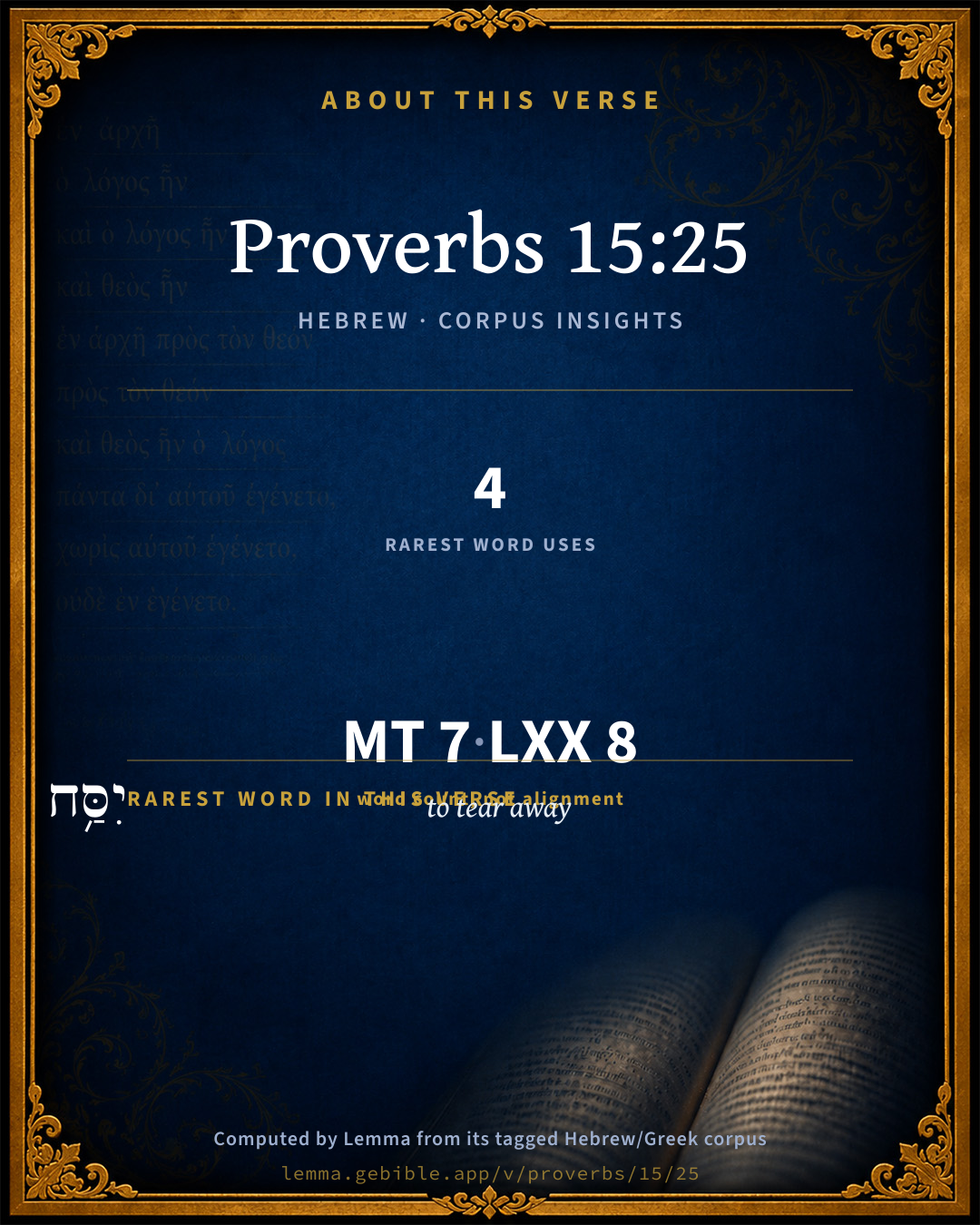
The rarest word here is יִסַּ֥ח to tear away H5255 — appearing just 4 times in the whole Hebrew Bible.

Shared distinctive vocabulary

יִסַּ֥ח to tear away H5255 occurs in 4 verses of the Hebrew Bible. Also found in:

Grammatical profile

  • 2 verbs
  • 4 nouns
  • 1 adjective

Verb forms

  • יִסַּ֥ח Qal · Imperfect
  • וְ֝יַצֵּ֗ב Hiphil · Imperfect

Hebrew & Septuagint length

In English translation the verse runs 16 words from the Hebrew and 16 from the Septuagint (LXX English) — the same length.

A rough comparison of the two English renderings, which tokenize alike — not a word-level alignment.

Word counts can differ between the Hebrew and the Greek without any difference in meaning — e.g. the Hebrew direct-object marker אֵת has no separate Greek word, and Greek often adds the article ὁ.

In the original languages it is 7 Hebrew tokens and 8 Greek tokens — but the two are counted differently (Hebrew bundles its prefixes and suffixes into one token; the Greek is in lemma form), so that isn’t a like-for-like length.

Cross-references

14

Topical passages linked to Proverbs 15:25 in the Treasury of Scripture Knowledge — connected by theme and wording, ordered by reader-vote popularity; previews shown in the World English Bible.

  • Psalms 146:9 Yahweh preserves the foreigners. He upholds the fatherless and widow, But the way of the wicked he turns upside down.
  • Psalms 68:5–6 A father of the fatherless, and a defender of the widows, Is God in his holy habitation.
  • Deuteronomy 10:17–18 For Yahweh your God, he is God of gods, and Lord of lords, the great God, the mighty, and the awesome, who doesn't regard persons, nor takes reward.
  • Proverbs 12:7 The wicked are overthrown, and are no more, But the house of the righteous shall stand.
  • Proverbs 14:11 The house of the wicked will be overthrown, But the tent of the upright will flourish.
  • Proverbs 23:10 Don't move the ancient boundary stone. Don't encroach on the fields of the fatherless:
  • Isaiah 2:12 For there will be a day of Yahweh of Hosts for all that is proud and haughty, And for all that is lifted up; And it shall be brought low:
  • Daniel 5:20 But when his heart was lifted up, and his spirit was hardened so that he dealt proudly, he was deposed from his kingly throne, and they took his glory from him:
  • James 1:27 Pure religion and undefiled before our God and Father is this: to visit the fatherless and widows in their affliction, and to keep oneself unstained by the world.
  • Job 40:11–13 Pour forth the fury of your anger. Look on everyone who is proud, and bring him low.
  • Psalms 138:6 For though Yahweh is high, yet he looks after the lowly; But the proud, he knows from afar.
  • 1 Peter 5:5 Likewise, you younger ones, be subject to the elder. Yes, all of you gird yourselves with humility, to subject yourselves to one another; for "God resists the proud, but gives grace to the humble."
  • Psalms 52:5 God will likewise destroy you forever. He will take you up, and pluck you out of your tent, And root you out of the land of the living. Selah.
  • Deuteronomy 19:14 You shall not remove your neighbor's landmark, which they of old time have set, in your inheritance which you shall inherit, in the land that Yahweh your God gives you to possess it.

Cross-references courtesy of OpenBible.info (CC BY 4.0).

Hebrew and Greek witnesses Masoretic Hebrew ↔ Greek Septuagint

The same verse in the two great witnesses to the Old Testament, shown verse-for-verse.

These are two independent witnesses, not word-aligned to each other, and the Septuagint is shown in lemma (dictionary) form.

Hebrew Proverbs 15:25 Masoretic · Westminster Leningrad Codex

בֵּ֣ית גֵּ֭אִים יִסַּ֥ח יְהוָ֑ה וְ֝יַצֵּ֗ב גְּב֣וּל אַלְמָנָֽה

Yahweh will uproot the house of the proud, But he will keep the widow's borders intact.

World English Bible · Public Domain

Greek LXX Proverbs 15:25 Septuagint · lemma form

οἶκος ὑβριστής κατασπάω κύριος στηρίζω δέ ὅριον χήρα

The Lord pulls down the houses of scorners; but he establishes the border of the widow.

LXX2012 (modern English Septuagint) · Public Domain

On this verse, Keil & Delitzsch discusses the Septuagint’s reading. Read the note in Commentary ↓

Hebrew: Westminster Leningrad Codex (CC BY 4.0). Greek: Septuagint (public domain); English from LXX2012 (modern English Septuagint) (Public Domain). How the Septuagint differs from the Hebrew →

Commentary

Notes on Proverbs 15:25 from classic Christian and Jewish commentators (each source and its license shown beneath its notes). The classic Christian expositions comment on the surrounding passage and are grouped to its opening verse, so a note may address several verses; the Jewish commentaries on the Tanakh (Rashi and others) are per-verse, so they appear only where the commentator wrote on this verse.

Lemma curates 59 commentaries, every one of them public domain or Creative Commons licensed, each selected and text-cleaned for this edition rather than reprinted as found. About our sources →

Trapp's Complete Commentary

John Trapp

Pro 15:25 The LORD will destroy the house of the proud: but he will establish the border of the widow.

Ver. 25. The Lord will destroy the house of the proud.] Where he thinks himself most safe, God will pull him, as it were, by the ears out of his tabernacle. He will surely unroost him, unnest him, yea, though he hath set his nest among the stars, as he did proud Lucifer, who "kept not his first estate, but left his habitation," {Jdg 1:6} which indeed he could hold no longer; for it spewed him out into hell, that infernus ab inferendo dictus. {See Trapp on "Pro 12:7"} {See Trapp on "Pro 14:11"}

But he will establish the border of the widow.] Not the rest of her goods only, but the very utmost borders of her small possession. She hath commonly no great matters to be proud of, nor any patrons to stick to her, and stickle for her. She hath her name in Hebrew {a} of dumbness, because either she cannot speak for herself - death having cut off her head, her husband, who was wont to speak for her - or if she do speak, her tale cannot be heard. {Luk 18:4} God therefore will speak for her in the hearts of her greatest opponents and oppressors. He also will do for her, and defend her borders, as he did for the Shunammite, and for the Sareptan, and for the poor prophet’s widow, whose debts he paid for her, and for the widow of Nain, whose son he raised unrequested; {Luk 7:13} especially if she be a "widow indeed," {1Ti 5:5} such as Anna was. {Luk 2:37} A vine whose root is uncovered thrives not; a widow whose covering of eyes is taken away, joys not. But in God "the fatherless findeth mercy," {Hos 14:3} and he will "cause the widow’s heart to sing for joy." {Job 29:13}

{a} אלמכה

John Trapp, A Commentary or Exposition upon All the Books of the Old and New Testament (1647–1656) — public domain. Text from a community e-Sword module.

Joseph Benson's Commentary

Pro 15:25. The Lord will destroy the house of the proud — Of the most mighty oppressors, who suppose themselves to be immoveably fixed; or the family of haughty men, who, forgetting him, trample upon their inferiors; but he will establish the border of the widow — The estate, the border being often used for the land within the borders: he will preserve her in her right, who hath no helper, even though such insolent and powerful persons invade it. Trust not, therefore, in riches and power, but in the great Lord of the world, who possesses and disposes of all things.

Joseph Benson's Commentary on the Old and New Testaments (1811–1818) — public domain. Text from a community e-Sword module.

The Preacher's Complete Homiletical Commentary

Joseph S. Exell (gen. ed.)

CRITICAL NOTES.—

Pro_15:25. Establish the border, or “Keep fixed the landmark.”

MAIN HOMILETICS OF Pro_15:25

DESTRUCTION AND ESTABLISHMENT

I. The character of those doomed to destruction. In looking at the trees of a vast forest, the eye of the beholder is drawn to some which, towering far above their fellows, form the most prominent features in the landscape. Yet these trees, although they look as if they would stand for ages, may be doomed to a much shorter standing than others which look more frail and are less attractive to the eye. The tree which is admired so much for its girth and breadth of foliage may contain within itself elements of destruction, and it may only need to be left to itself for a little while to come to the ground by its own weight. Every increase in its spreading foliage only renders its overthrow more certain, because the rottenness of the trunk is less able to bear the mass of branch and leaf. Or the woodman may not wait for the inevitable result—he may deem it necessary for the health of the surrounding trees that the axe should interpose and so prevent the fall. He may see that such a tree is absorbing nourishment to minister to its own decay, that trees around would utilise to sustain their healthy life. And so to prevent the soil from being impoverished by a mere cumberer of the ground, the sound of the axe and the crash of falling timber may resound through the forest. Such a tree is an emblem of the man described in our text. To him may be addressed the words spoken to the proud King of Babylon: “The tree that thou sawest, which grew and was strong, whose height reached unto the heaven, and the sight thereof to all the earth, whose leaves were fair and the fruit thereof much, and in it was meat for all, under which the beasts of the field dwelt and the fowls of the heaven had their habitation: it is thou that art grown and become strong, for thy greatness is grown and become strong, and reacheth unto heaven,” etc. (Dan_4:20-22). He has attained to a position of power and influence in the world, but, like Nebuchadnezzar, his greatness has only revealed a radical moral defect in his character. Like him he refuses to acknowledge that “the Most High ruleth in the kingdom of men,” and that it is by His favour alone that he has attained to such a height of prosperity. He holds within him the elements of his own destruction, and time will bring about his fall without any special interposition of the Divine hand. Pride grows upon what it feeds, and such a man will presume more and more upon his fancied security, until he falls by the working out of the ordinary laws which govern the moral universe. But God does not always wait for this issue. To prevent his continuing to rob humanity of their rights, the Almighty Governor of men may anticipate the natural result by applying the axe of a special judgment, and a “watcher and a holy one” from heaven may be heard saying, “Hew the tree down and destroy it” (Dan_4:23), “Cut it down, why cumbereth it the ground?” (Luk_13:7.) All despots and tyrants must sooner or later succumb to the operation of natural social law; those whom they have wronged, goaded to desperation by their injustice, will rise up against them and overturn them. The King of all the earth often takes the work into His own hands, as he did in the case of Nebuchadnezzar.

II. Those who are special objects of the Divine care. “He will establish the border (or landmark) of the widow.” The widow is a type of all the needy and the sorrowful of the human race. Deprived of her natural provider and protector, and her dearest earthly relative, she, more than any other, is at the mercy of the proud and selfish, and stands in need of a helper and consoler. God by the very goodness of His nature is drawn to take sides with such a one. He makes Himself known, again and again, as the judge of widows” (Psa_68:5). The Bible contains many laws for their protection and reproaches against those who wrong them (Deu_24:17; Deu_24:19-21; Isa_1:23; Mat_23:14). One of the main features of moral beauty in the Divine character is that He “delivereth the needy when he crieth,” the poor also, and him that hath no helper (Psa_72:12), and the widow is here a type of all such. The sorrow of her who is “a widow indeed” is very deep and overwhelming, and sorrow takes away physical and mental strength. The strong and mighty God charges Himself with the care of all such spirits weakened by sorrow, and warns all the world who would take advantage of their weakness that in so doing they enter the lists against Him.

III. Because of such dealing God’s kingdom will increase and strengthen. The champions of the weak, and the opposers of the tyrants, always gain the most influence in the end. Love is the strongest influence in the world, and those who can gain men’s hearts are the real and mighty kings. While they live they wield a mighty power, and their influence is felt sometimes even more powerfully after they have left the world. Those who never saw them in the flesh, but who are enjoying the liberties which they gained for them, yield them a silent homage. And in the song which foretells the universal dominion of the All-Righteous King this is given as a reason why His kingdom shall grow and be established. “He shall have dominion from sea to sea, and from the rivers unto the ends of the earth. The kings of Tarshish and of the isles shall bring presents; the kings of Seba and Sheba shall offer gifts. Yea, all kings shall fall down before Him; all nations shall serve Him. FOR He shall deliver the needy when He crieth; the poor also, and him that hath no helper. He shall spare the poor and needy, and shall save the souls of the needy. He shall redeem their souls from deceit and violence, and precious shall their blood be in His sight” (Psa_72:8-14).

OUTLINES AND SUGGESTIVE COMMENTS

From the style of the antithesis we are naturally led to conceive a special allusion to the haughty oppressor of the desolate and unprotected—to the overbearing worldling, who insolently abuses his power in lording it over his poor dependents.… We may well tremble to think of promoting our own advantage in any way, or in any degree, at the expense of the widow or the fatherless. Woe to the man who does so! God will see to it. What is so acquired cannot be enjoyed with either a quiet conscience or the smile of heaven. It is an accursed thing. It is the wedge of gold and the Babylonish garment, by which the blessing of righteousness and mercy is turned away.—Wardlaw.

“The house” i.e., every interest (chap. Pro_14:1). “Destroy,” or pull down; because even worldly men have noticed the precariousness of pride. “The widow:” even worldly eyes have noticed that these are wards of the Almighty. But Solomon adopts each proverb spiritually. “The proud” is the man too well satisfied in his own mind (chap. Pro_21:24) to utter the good word, and have joy (Pro_15:23); and the “widow” is the poor in heart, who is ready with the availing answer, “Lord, I believe.”—Miller.

God abhors pride even in them whom He dearly loves, and shows His resentment of it by humbling providences, that remove man from his purpose, and hide pride from man. David was proud of the vast numbers of his subjects, but God soon showed him that great hosts save not a king, and that three days may greatly lessen the numbers of a people. Hezekiah’s heart was lifted up, but he was soon obliged to humble himself, being assured that the treasures which he had so ostentatiously showed to the Babylonish ambassadors should be carried with his posterity to their own land.—Lawson.

Did He not provide for sorrowing Naomi a staff in her faithful daughter, and ultimately establish her borders in Israel? Did He not supply the pressing need of the minister’s widow (2Ki_4:1-7), and take up the Shunamite’s oppression, and again establish her border? (2Ki_8:1-6). And shall we forget how He teaches the returning penitent to plead the gracious manifestation, “In Thee the fatherless findest mercy?” (Psa_14:2-3).—Bridges.

The Lord will destroy the house of the proud. He will surely unroost him, unnest him, yea, though he hath set his nest among the stars, as he did proud Lucifer, who “kept not his first estate but left his habitation” (Jud_1:6), which, indeed, he could hold no longer.… But He will establish the border of the widow. Not the rest of her goods only, but the very utmost border of her small possession. She hath commonly no great matters to be proud of, nor any patrons to stick to her. She hath her name in Hebrew of dumbness, because either she cannot speak for herself, or, if she do speak, her tale cannot be heard (Luk_18:4).—Trapp.

A young body is too often the house of the proud, where strength being the pillars of it, beauty the trimming, vanity the roof, fond conceit imagineth itself to be married to a long life, never minding the mud walls whereof it consisteth. But God, who was the builder of it, seeing so ill an inmate as pride received into it, pulleth down His own work to destroy the devil’s work, and cutting the thread of life dissolveth the marriage knot, when expectation thought it to be strongest tied. On the other hand, where affliction hath humbled the heart of the widow, and may seem to have brought her to the border of her days, then doth God establish length of days, lifting up the light of His countenance upon her when lowliness of spirit hath virtuously cast her down.—Jermin.

The Preacher's Complete Homiletical Commentary (gen. ed. Joseph S. Exell; Funk & Wagnalls, c. 1892) — public domain (pre-1929). A full-Bible homiletical/sermon-outline anthology covering 65 of 66 books (2 John is absent from the source module). Text from a community e-Sword module.

Tyndale Open Study Notes

Tyndale Open Resources

15:25 The proud think that they are self-sufficient. Widows in the ancient Near East were just the opposite—completely vulnerable and without means of support or protection.

Tyndale Open Study Notes — © Tyndale Open Resources, licensed CC BY-SA 4.0. Text via the HelloAO Bible API.

Matthew Henry's Commentary

Note, 1. Those that are elevated God delights to abase, and commonly does it in the course of his providence: The proud, that magnify themselves, bid defiance to the God above them and trample on all about them, are such as God resists and will destroy, not them only, but their houses, which they are proud of and are confident of the continuance and perpetuity of. Pride is the ruin of multitudes. 2. Those that are dejected God delights to support, and often does it remarkably: He will establish the border of the poor widow, which proud injurious men break in upon, and which the poor widow is not herself able to defend and make good. It is the honour of God to protect the weak and appear for those that are oppressed.

Matthew Henry's Commentary on the Whole Bible (1708–1710) — public domain (CC PDM 1.0). Text via the HelloAO Bible API.

Jamieson, Fausset & Brown

Robert Jamieson, A. R. Fausset & David Brown

The most desolate who have God's aid have more permanent good than the self-reliant sinner (Pro 2:22; Pro 12:7).

border--or, "boundary for possessions" (Psa 78:54).

Jamieson, Fausset & Brown — Commentary Critical and Explanatory on the Whole Bible (1871) — public domain (CC PDM 1.0). Text via the HelloAO Bible API.

Adam Clarke's Commentary

Verse 25. The house of the proud] Families of this description are seldom continued long. The Lord hates pride; and those that will not be humble he will destroy.

Adam Clarke's Commentary on the Bible (1810–1826) — public domain. Text from a community e-Sword/MySword module.

Ellicott's Commentary for English Readers

(25) The proud—who trust in their own strength; while He will “establish the border,” or landmark, of the helpless widow, who has none to cry to but Him. The frequently threatened punishment against one who removes his neighbour’s landmark, shews the offence to have been a common form of oppression. (Comp. Deu_19:14; Deu_27:17; Pro_22:28; Job_24:2; Hos_5:10.)

A Bible Commentary for English Readers, edited by Charles John Ellicott (1878–1897) — public domain. Text from a community e-Sword module.

The Cambridge Bible for Schools and Colleges

gen. ed. J. J. S. Perowne

25. destroy] Rather, root up, R.V., in contrast with establish in the next clause.

widow] As typical of the humble and poor. Comp. Psa_68:5, and for the sentiment 1Pe_5:5.

The Cambridge Bible for Schools and Colleges (gen. ed. J. J. S. Perowne; Cambridge University Press, 1878–1918) — public domain. Text from a community e-Sword module.

John Gill's Exposition

The Lord will destroy the house of the proud,.... To whom he has the utmost aversion; he sets himself against them and resists them, and will not only destroy them, but their stately houses too, which their have fancied shall continue for ever; and also their families, their children and posterity; these shall be as stubble, and shall be burnt up in his wrath, and neither root nor branch left. Moreover, the man of sin, the son of perdition, may be more especially intended, that exalts himself above all that is called God, with all the sons of pride supported by him; his house, which is the house of the foolish and adulterous woman, the idolatrous church of Rome, shall be rooted up; the city of Rome, the seat of the beast itself, where his house or palace is, shall be destroyed, and all that belong unto him, even all they that have destroyed the earth, Rev 11:18;

but he will establish the border of the widow; whose advocate, judge, and defender he is; when men, rich, proud, and oppressive, attempt to remove the landmark of the widow's border, and so lessen her land and enlarge their own, God will not suffer it to be done, but will establish it in its place; that is, such who are weak and helpless, as widows are, and cannot defend themselves and their property, he will protect them and secure it for them. So the church of Christ, during the reign of antichrist, being obliged to flee into the wilderness, looks like a widow deprived of her husband, and has but "little strength" to support and defend herself, as is said of the church of Philadelphia, Rev 3:8; yet the Lord will secure and preserve her, and firmly settle and establish her, yea, enlarge her borders, and make them of pleasant stones; spread the kingdom of Christ from sea to sea, and from the river to the ends of the earth. Frequent mention is made of the establishing of the church in the latter day, Psa 48:8, Isa 2:2.

John Gill's Exposition of the Whole Bible (1746–1763) — public domain (CC PDM 1.0). Text via the HelloAO Bible API.

Albert Barnes' Notes on the Bible

The widow - Here, as elsewhere Deu 10:18; Psa 68:5, the widow, as the most extreme type of desolation, stands as the representative of a class safer in their poverty under the protection of the Lord, than the proud in the haughtiness of their strength.

Albert Barnes' Notes on the Bible (1834–1885) — public domain. Text from a community e-Sword/MySword module.

Matthew Poole's English Annotations

Of the proud; of the most mighty oppressors, who conceit themselves to be unmovably fixed.

The border; either,

1. The estate, the border being oft used for the land within the borders, as Psa 105:31,33, and elsewhere. Or,

2. The border by which lands were then bounded and distinguished, which those proud persons endeavoured to remove contrary to God’s law, Deu 19:14; 27:17.

Matthew Poole's English Annotations on the Holy Bible (1683–1685) — public domain. Text from a community e-Sword/MySword module.

Whedon's Commentary on the Bible

Daniel D. Whedon

25. The Lord will destroy — Pluck up, root out.

The house (family) of the proud — Insolent one.

But he will establish the border — Settle the boundary landmark of the widow. The word גאים, (geim,) proud, haughty; generally includes the super-added idea of wickedness, iniquity.

Comp. Deu_10:18; Psa_48:5.

Daniel D. Whedon (gen. ed.), Commentary on the Old and New Testaments (1874–1909) — public domain. Text from a community e-Sword module.

The Pulpit Commentary

The Lord will destroy the house of the proud. (Pro_12:7 Pro_14:11 Pro_16:18) The proud, self-confident man, with his family and household and wealth, shall be rooted up. The heathen saw how retribution overtook the arrogant. Thus Euripides says ("Heracl.," 387) Twn fronhmatwn O Zeunwn. "Zeus, the chastiser of too haughty thoughts.

But he will establish the border of the widow. He will take the widow under his protection, and see that her landmark is not removed, and that her little portion is secured to her. The widow is taken as the type of weakness and desolation, as often in Scripture. (comp. Deu_10:18 Psa_146:9) In a country where property was defined by landmarks stones or some such objects nothing was easier than to remove these altogether, or to alter their position. That this was a common form of fraud and oppression we gather from the stringency of the enactments against the offence. (see Deu_19:14 Deu_27:17; and Job_24:2 Pro_22:28) In the Babylonian and Assyrian inscriptions which have been preserved, there are many invoking curses, curious and multifarious, against the disturbers of boundaries. Such marks were considered sacred and inviolable by the Greeks and Romans (see Plato, "De Leg.," 8:842, 843; Ovid, "Fast.," 2:639, etc.).

The Pulpit Commentary (1880–1919), ed. H.D.M. Spence-Jones & Joseph S. Exell — public domain. Text from a community e-Sword module.

John Wesley's Explanatory Notes

The proud - Of the mighty oppressors. The border - The estate, the border being often used, for the land within the borders.

John Wesley, Explanatory Notes Upon the Whole Bible (1754–1765) — public domain. Text via the GEBible commentary corpus.

Keil & Delitzsch

C. F. Keil & F. Delitzsch

25 The house of the proud Jahve rooteth out,

And He establisheth the landmark of the widow.

The power unnamed in יסּחוּ, Pro 2:22 (cf. Pro 14:11), is here named יסּח יהוה (thus to be pointed with Mercha and Pasek following). יצּב is the abbreviated fut. form which the elevated style, e.g., Deu 32:8, uses also as indic. - a syntactical circumstance which renders Hitzig's correction ויּצּב superfluous. It is the border of the land-possession of the widows, removed by the גּאים (lxx ὑβριστῶν), that is here meant. The possession of land in Israel was secured by severe punishment inflicted in him who removed the "landmark" (Deu 19:14; Deu 27:17), and the Chokma (Pro 22:28; Pro 24:2) as well as the prophets (e.g., Hos 5:10) inculcate the inviolability of the borders of the possession, as the guardian of which Jahve here Himself appears.

Keil & Delitzsch — Biblical Commentary on the Old Testament (1861–1891) — public domain (CC PDM 1.0). Text via the HelloAO Bible API. (Old Testament only.)

Bridges on Proverbs

Charles Bridges

The administration of the Divine Government is to humble the proud, and to exalt the humble. (Luk 1:51-52 .) The contrast marks the proud oppressor, an usurper of God’s rights. Therefore as a traitor, he destroys not only his person, but his house.†1 And who can but acknowledge the retributive vengeance of the Judge of the earth?†2

But the widow, whom many care not for, many are ready to trample on — what a Friend and Protector has she!†3 "Let thy widows trust in me."†4 God condescends to link himself with them in a special relation; concentrating all his care and tenderness on their bereaved condition.†5 Did not he provide for sorrowing Naomi a staff in her faithful daughter, and ultimately establish her borders in Israel?†6 Did he not supply the pressing need of the Minister’s widow†7 (a cheering warrant of faith in similar affliction), and take up the Shunamite’s oppression, and again establish her border?†8 And shall we forget how he teaches the returning penitent to plead the gracious manifestation — "In thee the fatherless findeth mercy"? (Hos 14:2-3 .)

Footnotes:

†1 Est 7:10; Est 9:10 . Jer 22:13-30 .

†2 Psa 10:14, Psa 10:18 ; Psa 12:5 ; Psa 58:11 .

†3 Pro 23:10-11.

†4 Jer 49:11. Compare 1Ti 5:5 .

†5 Psa 68:5. Psa 146:9 . Deu 10:17-18 .

†6 Rth 1:7-18; Rth 4:14-17 .

†7 2Ki 4:1-7 .

†8 2Ki 8:1-6 .

Charles Bridges, An Exposition of the Book of Proverbs (1846) — public domain. Text from a community e-Sword module.

Kretzmann's Popular Commentary

Paul E. Kretzmann

v. 25. The Lord will destroy the house of the proud, visiting him, his family, and all his possessions with punishment; but He will establish the border of the widow, not permit the boundary line of her property to be moved, that is, safeguard her possessions.

Paul E. Kretzmann, Popular Commentary of the Bible (1921–1924) — public domain. Text from a community e-Sword module.

unfoldingWord translationNotes

Door43 World Missions Community

house

This is a synecdoche for the person's household, property, and wealth.

the words of kindness are pure

"kind words are pure" or "pleasant words are pure"

translationWords

Yahweh

proud

evil

word

unfoldingWord translationNotes — © Distant Shores Media and the Door43 World Missions Community, licensed CC BY-SA 4.0. Source: git.door43.org/Door43/en_tn.

Lesson kit

Teaching starters — assembled from the data on this page, not authored interpretation. Every prompt links to the verse data it draws on. Edit before teaching.

Proverbs, in the Wisdom, opens this verse with 7 words (7 distinct Hebrew lemmas). Its most distinctive word is nâçach (“to tear away”). A historical commentator’s framing appears above. Read the whole chapter for the surrounding context.

Discussion questions

  1. What does “to tear away” (nâçach) contribute to the verse as a whole?
  2. Deuteronomy 28:63 shares the word «to tear away» with this verse. How do the two illuminate each other?
  3. The translations on this page render this verse differently — a whole-verse word diff, not a word-by-word alignment. What might account for the different wordings?
  4. The verb «יִסַּ֥ח» is Qal Imperfect. How does its form color the action?
  5. Reading how Trapp's Complete Commentary and Joseph Benson's Commentary read this verse, where do the two commentators agree and where do they part?

Things to notice

Reading settings

Reading text

Shown beneath each verse's original-language words.

Old Testament
Old Testament edition

Read the OT as the Masoretic Hebrew (MT) or the Greek Septuagint (LXX).

English shown for the Greek Septuagint (in the Hebrew ↔ Greek comparison).

Comparing translations? Open the Compare panel on any verse page to stack up to four side by side.