
Joshua 18:13

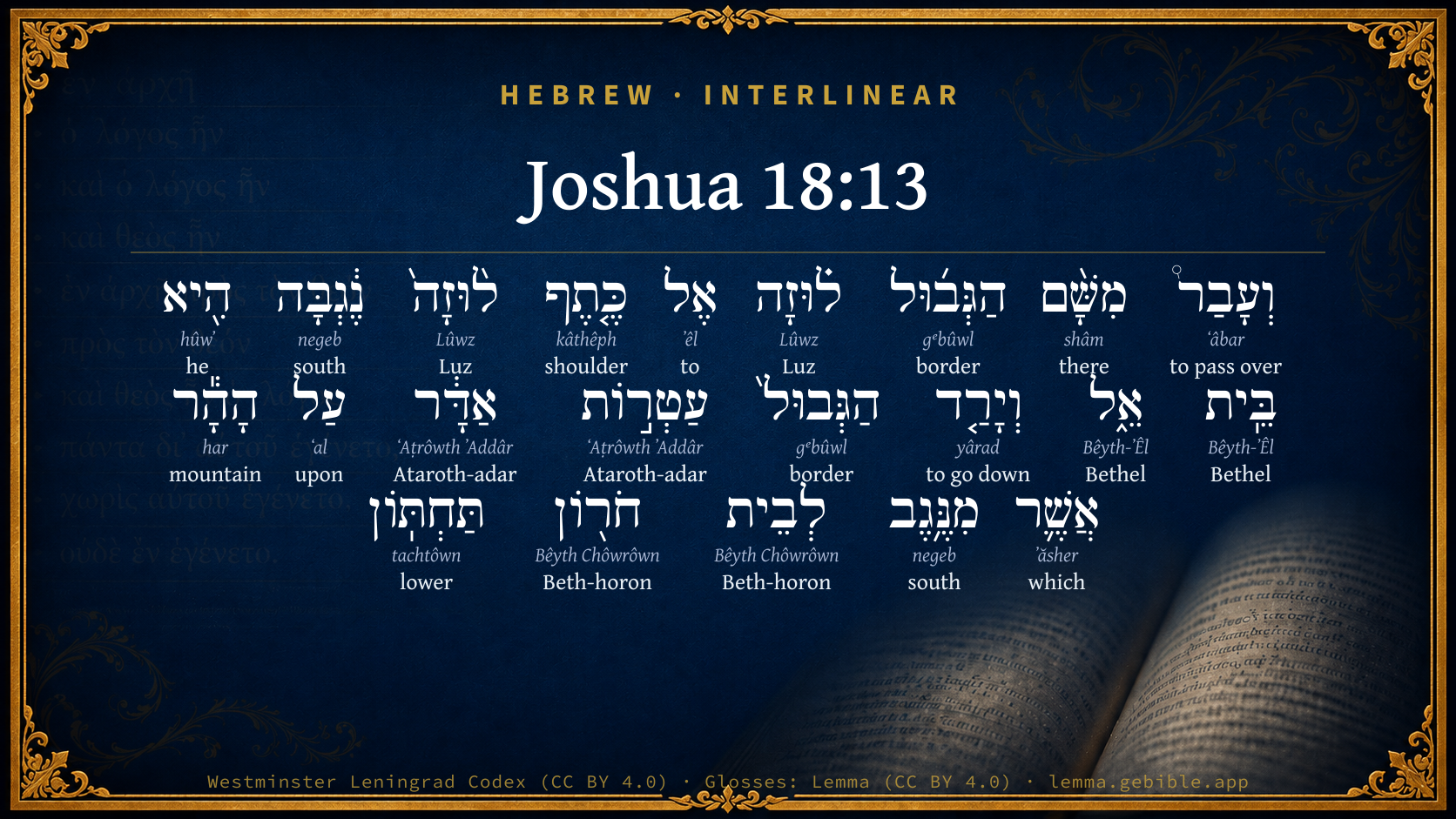
Hebrew (Westminster Leningrad Codex) Joshua 18:13 appears in the Hebrew Old Testament. The text above is from the Westminster Leningrad Codex. Each word links to its Strong’s number, a concise gloss, and parsing drawn from the Open Scriptures Hebrew Bible morphology. Click any word for its full Brown-Driver-Briggs (BDB) entry.
Download image
Cite this verse

Joshua 18:13 (World English Bible). Public Domain. Lemma interlinear Bible study tool, https://lemma.gebible.app/v/joshua/18/13.

Show BibTeX & RIS
BibTeX
RIS
English Translation
The border passed along from there to Luz, to the side of Luz (the same is Bethel), southward; and the border went down to Ataroth Addar, by the mountain that lies on the south of Beth Horon the lower.
World English Bible · Public Domain
Download a study sheet

One document with this verse’s original text, its word-by-word gloss line, the meaning frame, cross-references with their text, attributed commentary, and full source and license credits — printable, and it pastes into notes with its structure intact.

This verse Autodidact and up

Study sheet (.html) Plain text (.txt)

A passage Seminary Student

Up to 50 verses in one chapter. A passage sheet keeps up to 6 commentary sources and 12 cross-references per verse, in the order this page ranks them, and says so on the sheet whenever that leaves anything out. Ask for a single verse and you get the Autodidact verse sheet above.

Everything on this page stays free to read, with no account — the sheet is a download of what is already on screen, not access to it.

Want to remove ads? Support Godless Engineer
Compare translations 3

The same verse in 3 English versions, stacked beneath the original-language interlinear above. Click any original word for its lexicon entry.

Each is an independent rendering of the whole verse — the interlinear is not word-aligned to these translations.

Highlighted words mark where these versions differ — a whole-verse word diff, not a word-by-word alignment.

  • World English Bible Public Domain
    The border passed along from there to Luz, to the side of Luz (the same is Bethel), southward; and the border went down to Ataroth Addar, by the mountain that lies on the south of Beth Horon the lower.
  • King James Version Public Domain
    And the border went over from thence toward Luz, to the side of Luz, which is Bethel, southward; and the border descended to Atarothadar, near the hill that lieth on the south side of the nether Bethhoron.
  • unfoldingWord Literal Text CC BY-SA 4.0
    And the border passed over from there toward Luz, to the shoulder of Luz southward (it Bethel). And the border went down Ataroth Addar, beside the mountain that from the south to Lower Beth Horon.

unfoldingWord Literal Text — © unfoldingWord, licensed CC BY-SA 4.0. Word-aligned USFM3 via Door43 (git.door43.org/unfoldingWord/en_ult).

Versions to compare (up to 4)

3 of 4 selected

Show all 18 translations

Every available English version of this verse, each an independent rendering of the whole verse.

  • World English Bible Public Domain
    The border passed along from there to Luz, to the side of Luz (the same is Bethel), southward; and the border went down to Ataroth Addar, by the mountain that lies on the south of Beth Horon the lower.
  • Berean Standard Bible Public Domain
    From there the border crossed over to the southern slope of Luz (that is, Bethel) and went down to Ataroth-addar on the hill south of Lower Beth-horon.
  • Majority Standard Bible Public Domain
    From there the border crossed over to the southern slope of Luz (that is, Bethel) and went down to Ataroth-addar on the hill south of Lower Beth-horon.
  • King James Version Public Domain
    And the border went over from thence toward Luz, to the side of Luz, which is Bethel, southward; and the border descended to Atarothadar, near the hill that lieth on the south side of the nether Bethhoron.
  • American Standard Version (1901) Public Domain
    And the border passed along from thence to Luz, to the side of Luz (the same is Beth-el), southward; and the border went down to Ataroth-addar, by the mountain that lieth on the south of Beth-horon the nether.
  • Revised Version (1885) Public Domain
    And the border passed along from thence to Luz, to the side of Luz (the same is Beth-el), southward; and the border went down to Ataroth-addar, by the mountain that lieth on the south of Beth-horon the nether.
  • Geneva Bible (1599) Public Domain
    And this border goeth along from thence to Luz, euen to the Southside of Luz (the same is Beth-el) and this border descendeth to Atroth-addar, neere the mount, that lyeth on the Southside of Beth-horon the nether.
  • Douay-Rheims (1899) Public Domain
    And their border northward was from the Jordan: going along by the side of Jericho on the north side, and thence going up westward to the mountains, and reaching to the wilderness of Bethaven,
  • Young's Literal Translation Public Domain
    and the border hath gone over thence to Luz, unto the side of Luz (it `is' Beth-El) southward, and the border hath gone down `to' Atroth-Addar, by the hill that `is' on the south of the lower Beth-Horon;
  • Literal Standard Version CC BY-SA 4.0
    and the border has gone over there to Luz, to the side of Luz (it [is] Beth-El) southward, and the border has gone down [to] Atroth-Addar, by the hill that [is] on the south of the lower Beth-Horon;
  • Unlocked Literal Bible CC BY-SA 4.0
    From there the border passed along south in the direction of Luz (the same place as Bethel). Then the border went down to Ataroth Addar, by the mountain that lies south of Beth Horon.
  • unfoldingWord Literal Text CC BY-SA 4.0
    And the border passed over from there toward Luz, to the shoulder of Luz southward (it Bethel). And the border went down Ataroth Addar, beside the mountain that from the south to Lower Beth Horon.
  • Darby Bible Public Domain
    and the border passed on from thence toward Luz, to the south side of Luz, which is Bethel: and the border went down to Ataroth-Addar, near the hill that is on the south of the lower Beth-horon.
  • World Messianic Bible Public Domain
    The border passed along from there to Luz, to the side of Luz (also called Bethel), southward. The border went down to Ataroth Addar, by the mountain that lies on the south of Beth Horon the lower.
  • Webster's Bible Public Domain
    And the border went over from thence towards Luz, to the side of Luz (which is Beth-el) southward; and the border descended to Ataroth-adar, near the hill that lieth on the south side of the nether Beth-horon.
  • Free Bible Version CC BY-SA 4.0
    Then the boundary went south to Luz (or Bethel) and on down to Ataroth-addar on the mountain south of Lower Beth-horon.
  • Bible in Basic English Public Domain
    And from there the line goes south to Luz, to the side of Luz (which is Beth-el), then down to Ataroth-addar, by the mountain to the south of Beth-horon the lower.
  • JPS Tanakh (1917) Public Domain
    And the border passed along from thence to Luz, to the side of Luz — the same is Beth-el — southward; and the border went down to Atroth-addar, by the mountain that lieth on the south of Beth-horon the nether.

Literal Standard Version (2020), Covenant Press — licensed CC BY-SA 4.0. Text via the HelloAO Bible API (eBible.org). Unlocked Literal Bible (unfoldingWord) — licensed CC BY-SA 4.0. Text via the HelloAO Bible API (eBible.org). unfoldingWord Literal Text — © unfoldingWord, licensed CC BY-SA 4.0. Word-aligned USFM3 via Door43 (git.door43.org/unfoldingWord/en_ult). Free Bible Version, Dr. Jonathan Gallagher — licensed CC BY-SA 4.0. Text via the HelloAO Bible API (eBible.org).

Word by word

More ways to search: Search by grammar → Find every occurrence → Compare this word →

Practice this passage: Drill this verse → Learn its vocabulary →

עַטְר֣וֹת
ʻAṭrôwth ʼAddâr
H5853
“Ataroth-adar”
Noun, Proper
Part of Speech
Noun
Type
Proper
Full BDB Definition

Origin: from the same as H5852 and H146

TWOT: None

Ataroth-adar or Ataroth-addar = "crowns of glory" - a Gadite town on the west border of Benjamin
  1. וְעָבַר֩ ʻâbar H5674 “and · to pass over” Conjunction + Verb, Qal, Sequential Perfect, 3rd Person, Masculine, Singular
  2. מִשָּׁ֨ם shâm H8033 “from · there” Preposition + Adverb
  3. הַגְּב֜וּל gᵉbûwl H1366 “the · border” Particle, Definite Article + Noun, Common, Masculine, Singular, Absolute
  4. ל֗וּזָה Lûwz H3870 “Luz · toward” Noun, Proper + Suffix, Demonstrative
  5. אֶל ʼêl H413 “to” Preposition
  6. כֶּ֤תֶף kâthêph H3802 “shoulder of” Noun, Common, Feminine, Singular, Construct
  7. ל֨וּזָה֙ Lûwz H3870 “Luz · toward” Noun, Proper + Suffix, Demonstrative
  8. נֶ֔גְבָּה negeb H5045 “south · toward” Noun, Common, Masculine, Singular, Absolute + Suffix, Demonstrative
  9. הִ֖יא hûwʼ H1931 “he” Pronoun, Personal, 3rd Person, Feminine, Singular
  10. בֵּֽית Bêyth-ʼÊl H1008 “Bethel” Noun, Proper
  11. אֵ֑ל Bêyth-ʼÊl H1008 “Bethel” Noun, Proper
  12. וְיָרַ֤ד yârad H3381 “and · to go down” Conjunction + Verb, Qal, Sequential Perfect, 3rd Person, Masculine, Singular
  13. הַגְּבוּל֙ gᵉbûwl H1366 “the · border” Particle, Definite Article + Noun, Common, Masculine, Singular, Absolute
  14. אַדָּ֔ר ʻAṭrôwth ʼAddâr H5853 “Ataroth-adar” Noun, Proper
  15. עַל ʻal H5921 “upon” Preposition
  16. הָהָ֕ר har H2022 “the · mountain” Particle, Definite Article + Noun, Common, Masculine, Singular, Absolute
  17. אֲשֶׁ֛ר ʼăsher H834 “which” Particle, Relative
  18. מִנֶּ֥גֶב negeb H5045 “from · south” Preposition + Noun, Common, Masculine, Singular, Absolute
  19. לְבֵית Bêyth Chôwrôwn H1032 “to/for · Beth-horon” Preposition + Noun, Proper
  20. חֹר֖וֹן Bêyth Chôwrôwn H1032 “Beth-horon” Noun, Proper
  21. תַּחְתּֽוֹן tachtôwn H8481 “lower” Adjective, Adjective, Masculine, Singular, Absolute

About this verse

These counts appear in no published source. They are computed here, from the morphology-tagged text and Lemma’s own curated glosses. What Lemma adds →

22
words
16
distinct lemmas
Historical
section

Notable vocabulary

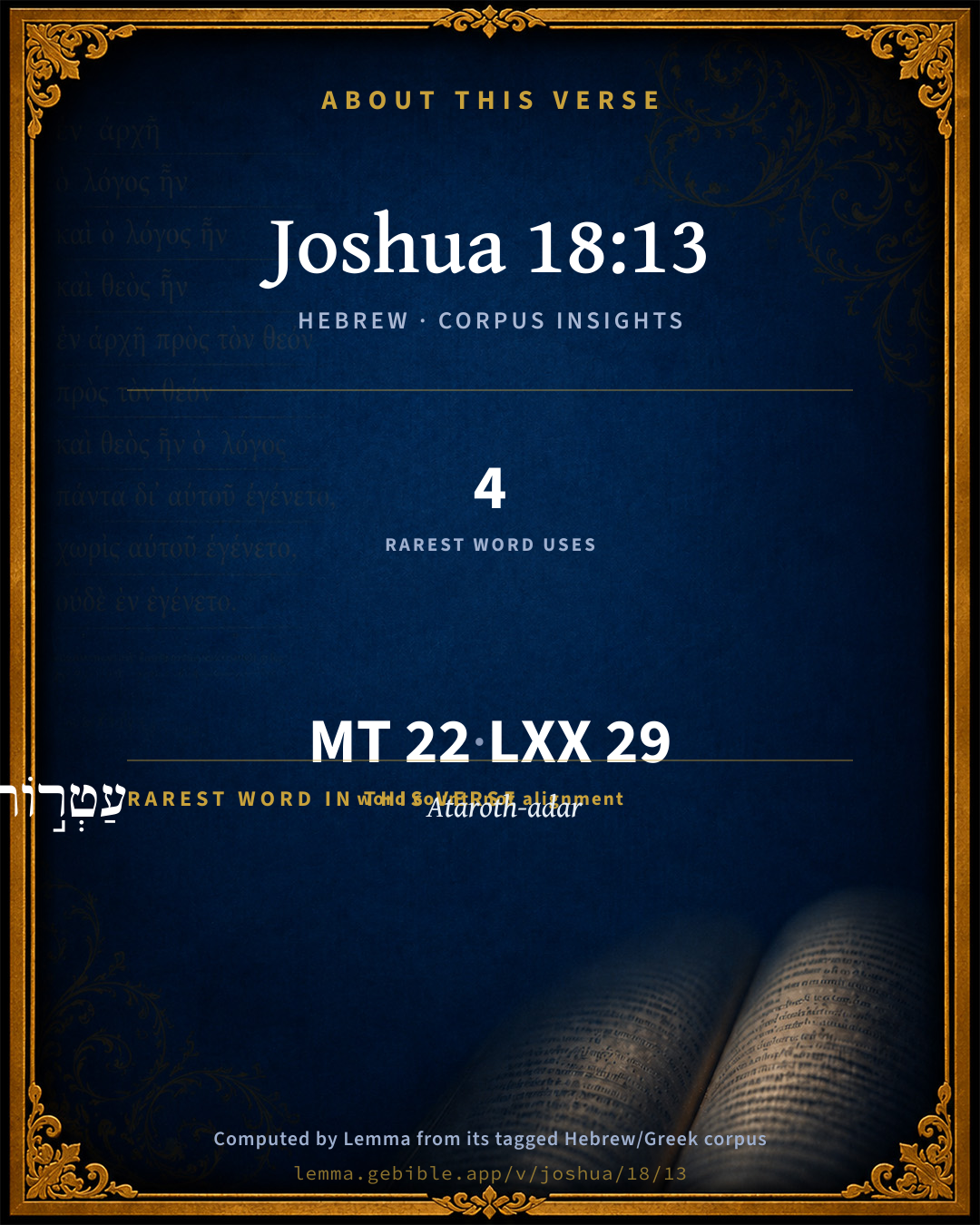
The rarest word here is עַטְר֣וֹת Ataroth-adar H5853 — appearing just 4 times in the whole Hebrew Bible.

Shared distinctive vocabulary

עַטְר֣וֹת Ataroth-adar H5853 occurs in 2 verses of the Hebrew Bible. Also found in:

Grammatical profile

  • 2 verbs
  • 14 nouns
  • 1 adjective
  • 1 pronoun
  • 2 prepositions
  • 1 adverb
  • 1 particle

Verb forms

  • וְעָבַר֩ Qal · Sequential Perfect
  • וְיָרַ֤ד Qal · Sequential Perfect

Repetition

Words recur within this verse — often emphatic in Hebrew:

  • הַגְּב֜וּל border H1366 ×2
  • ל֗וּזָה Luz H3870 ×2
  • נֶ֔גְבָּה south H5045 ×2
  • בֵּֽית Bethel H1008 ×2
  • עַטְר֣וֹת Ataroth-adar H5853 ×2
  • לְבֵית Beth-horon H1032 ×2

Hebrew & Septuagint length

In English translation the verse runs 39 words from the Hebrew and 39 from the Septuagint (LXX English) — the same length.

A rough comparison of the two English renderings, which tokenize alike — not a word-level alignment.

Word counts can differ between the Hebrew and the Greek without any difference in meaning — e.g. the Hebrew direct-object marker אֵת has no separate Greek word, and Greek often adds the article ὁ.

In the original languages it is 22 Hebrew tokens and 29 Greek tokens — but the two are counted differently (Hebrew bundles its prefixes and suffixes into one token; the Greek is in lemma form), so that isn’t a like-for-like length.

Cross-references

6

Topical passages linked to Joshua 18:13 in the Treasury of Scripture Knowledge — connected by theme and wording, ordered by reader-vote popularity; previews shown in the World English Bible.

  • Genesis 28:19 He called the name of that place Bethel, but the name of the city was Luz at the first.
  • Joshua 16:2–3 and it went out from Bethel to Luz, and passed along to the border of the Archites to Ataroth;
  • Joshua 10:11 It happened, as they fled from before Israel, while they were at the descent of Beth Horon, that Yahweh cast down great stones from the sky on them to Azekah, and they died: they were more who died with the hailstones than they whom the children of Israel killed with the sword.
  • Joshua 16:5 The border of the children of Ephraim according to their families was [thus]: the border of their inheritance eastward was Ataroth Addar, to Beth Horon the upper;
  • Joshua 21:22 and Kibzaim with its suburbs, and Beth Horon with its suburbs; four cities.
  • Judges 1:22–26 The house of Joseph, they also went up against Bethel; and Yahweh was with them.

Cross-references courtesy of OpenBible.info (CC BY 4.0).

Hebrew and Greek witnesses Masoretic Hebrew ↔ Greek Septuagint

The same verse in the two great witnesses to the Old Testament, shown verse-for-verse.

These are two independent witnesses, not word-aligned to each other, and the Septuagint is shown in lemma (dictionary) form.

Hebrew Joshua 18:13 Masoretic · Westminster Leningrad Codex

וְעָבַר֩ מִשָּׁ֨ם הַגְּב֜וּל ל֗וּזָה אֶל כֶּ֤תֶף ל֨וּזָה֙ נֶ֔גְבָּה הִ֖יא בֵּֽית אֵ֑ל וְיָרַ֤ד הַגְּבוּל֙ עַטְר֣וֹת אַדָּ֔ר עַל הָהָ֕ר אֲשֶׁ֛ר מִנֶּ֥גֶב לְבֵית חֹר֖וֹן תַּחְתּֽוֹן

The border passed along from there to Luz, to the side of Luz (the same is Bethel), southward; and the border went down to Ataroth Addar, by the mountain that lies on the south of Beth Horon the lower.

World English Bible · Public Domain

Greek LXX Joshua 18:13 Septuagint · lemma form

καί διαἔρχομαι ἐκεῖθεν ὁ ὅριον λουζα ἐπί νῶτον λουζα ἀπό λίψ οὗτος εἰμί βαιθηλ καί καταβαίνω ὁ ὅριον μααταρωθορεχ ἐπί ὁ ὀρεινή ὅς εἰμί πρός λίψ βαιθωρων ὁ κάτω

And the borders will go forth thence to Luz, behind Luz, from the south of it; this is Baethel: and the borders shall go down to Maatarob Orech, to the hill country, which is southward of Baethoron the lower.

LXX2012 (modern English Septuagint) · Public Domain

Hebrew: Westminster Leningrad Codex (CC BY 4.0). Greek: Septuagint (public domain); English from LXX2012 (modern English Septuagint) (Public Domain). How the Septuagint differs from the Hebrew →

Targum (Aramaic paraphrase)

1

The Targum is the ancient Jewish Aramaic paraphrase of the Hebrew Scriptures — an interpretive translation, not the Hebrew text itself. Onkelos (literal) and Pseudo-Jonathan (expansive) render the Torah, and Jonathan the Prophets. Coverage is partial: where no permissively-licensed English translation exists for a verse, only the Aramaic is shown. This is verse-level text, not a word-by-word alignment to the Hebrew.

  1. Targum Jonathan Prophets (Joshua–Malachi)
    וַעֲבַר מִתַּמָן תְּחוּמָא לְלוּז דִלְעִבַּר דְלוּז דָרוֹמָא הִיא בֵּית אֵל וְנָחִית תְּחוּמָא עַטְרוֹת אַדָר עַל טוּרָא דִמִדָרוֹם לְבֵית חוֹרוֹן אַרְעָאָה:

    (no public-domain English translation for this verse)

    Targum Jonathan — Aramaic: “Mikraot Gedolot” (public domain). English: “Sefaria Community Translation” (CC0 1.0 (public-domain dedication)); “London "Chaldee Paraphrase," 1871” (public domain). Text via Sefaria.

Commentary

Notes on Joshua 18:13 from classic Christian and Jewish commentators (each source and its license shown beneath its notes). The classic Christian expositions comment on the surrounding passage and are grouped to its opening verse, so a note may address several verses; the Jewish commentaries on the Tanakh (Rashi and others) are per-verse, so they appear only where the commentator wrote on this verse.

Lemma curates 59 commentaries, every one of them public domain or Creative Commons licensed, each selected and text-cleaned for this edition rather than reprinted as found. About our sources →

Geneva Bible (1599)

Geneva Bible translators

Which was in the tribe of Ephraim: another Bethel was in the tribe of Benjamin.

Geneva Bible (1599) marginal notes — public domain. Text via Bolls.life.

The Cambridge Bible for Schools and Colleges

gen. ed. J. J. S. Perowne

13. toward Luz] See above, ch. Jos_16:2. The border next went to the south of the ridge of Bethel, and thence descended, in a northwesterly direction, toward Ataroth-adar.

descended] We understand the appropriateness of this word when we remember that Bethel lay 3000 feet above the level of the Mediterranean Sea.

Ataroth-adar] See above, ch. Jos_16:5.

near the hill] Or, over the mountain that lieth on the south side of the nether Beth-horon. Thus the north border of Benjamin, as far as lower Beth-horon, coincides with the southern border of Ephraim.

Beth-horon] See above (a) Jos_10:11; (b) Jos_16:3-5. An upper and a lower Beth-horon are still recognised. The upper is now called Beit-’ûr El-Fôka, the lower Beit-’ûr El-Tahta. The pass between the two places was called the ascent and the descent of Beth-horon. Comp. 1Ma_3:15-24. “The ascent,” remarks Robinson, “is very rocky and rough; but the rock has been cut away in many places and the path formed into steps, shewing that this is an ancient road.” Bibl. Res. iii:58.

The Cambridge Bible for Schools and Colleges (gen. ed. J. J. S. Perowne; Cambridge University Press, 1878–1918) — public domain. Text from a community e-Sword module.

John Gill's Exposition

And the border went over from thence towards Luz,.... From Bethaven, where the northern border ended, the western began, and went on to Luz:

to the side of Luz, which is Bethel, southward; that is, passed along, leaving that city to the south, which formerly was called Luz, but now Bethel, which though distinct places formerly, yet being very near, might in process of time be joined; See Gill on Jos 16:2,

and the border descended to Atarothadar, the same with Archiataroth; see Gill on Jos 16:2, and See Gill on Jos 16:5,

near the hill that lieth on the south side of the nether Bethhoron; so called to distinguish it from Bethhoron the upper, situated on an hill or mountain, Jos 16:5; this was rebuilt by Solomon, Kg1 9:17.

John Gill's Exposition of the Whole Bible (1746–1763) — public domain (CC PDM 1.0). Text via the HelloAO Bible API.

Whedon's Commentary on the Bible

Daniel D. Whedon

13. [Went over from thence — According to our note on Jos_16:1, this border turned off north of Jericho, and ran up so as to take in Zemaraim, (Jos_18:22;) thence it passed westward to Ophni, (Jos_18:24,) where it curved to the south so as to run down near Beth-el.

To the side of Luz… southward — Literally, to the shoulder of Luz, that is, some eminence in the vicinity. Southward here does not mean that the border ran on the south side of Beth-el, but it designates the general course of the border as it passed near Beth-el.

Descended to Ataroth-addar — That is, the border ran southward by the side of Luz as far as Ataroth.] See notes on Jos_16:5-6. The nether Beth-horon still exists in the modern Beit-Ur-el-Tahta, situated on the top of a low ridge, which is separated by a narrow valley from the mountain on which the Upper Beth-horon stands.

See note on Jos_10:10. South of this rises an eminence which is doubtless the hill here referred to.

[14. Compassed the corner of the sea southward — Rather, turned toward the side of the sea southward. The meaning is simply that from the Lower Beth-horon Benjamin’s western border turned southward towards the sea. It did not run unto the sea, as some have thought, nor is the reference here to Ephraim’s border, which ran off from this point unto the Mediterranean. Dr. Thomson needlessly supposes that the pool of Gibeon is the sea here intended. But in giving these boundaries the word sea is so constantly used of the Mediterranean that it is very arbitrary to take it in this single instance in so limited a sense. The goings out of Benjamin’s western border were not at the sea, but at Kirjath-baal which is Kirjath-jearim. On this city see note at Jos_9:17. It lay almost directly south of Beth-horon, so that we must understand Benjamin’s western border to have formed a curve turning from Beth-horon first seaward and then winding gradually round to Kirjath-jearim on the southern border.

This was the west quarter — Literally, the side of the sea; that is, towards the sea.

Daniel D. Whedon (gen. ed.), Commentary on the Old and New Testaments (1874–1909) — public domain. Text from a community e-Sword module.

unfoldingWord translationNotes

Door43 World Missions Community

the border ... The boundary

These refer to the same thing.

Luz ... Ataroth Addar ... Beth Horon ... Kiriath Baal ... Kiriath Jearim

These are the names of places. (See: How to Translate Names)

translationWords

Bethel

Baal

unfoldingWord translationNotes — © Distant Shores Media and the Door43 World Missions Community, licensed CC BY-SA 4.0. Source: git.door43.org/Door43/en_tn.

Rashi

Rabbi Shlomo Yitzchaki (Rashi)

From there the boundary passed—westward.

To Luz, the southside of Luz which is Beis El. [This is the city] that Yaakov called [Beis-el.] It is not the Beis-el which is near Ai, for it is said about the boundary of Yoseif: ‘And it extended from Beis-el to Luz.’ Thus we learn that there were two [Beis-els]. Luz was not in the portion of Binyomin; for the boundary line was from Luz and within; as it is said: ‘To the southside of Luz.’ the boundary line goes south of Luz, thus Luz is outside the boundary line, and is within the inheritance of the Bnei Yoseif. Beis-el is in the portion of Binyomin; as it said later in this section.

Rashi on the Tanakh — English translations: “The Judaica Press complete Tanach with Rashi, translated by A. J. Rosenberg” (CC BY 4.0); “Pentateuch with Rashi's commentary by M. Rosenbaum and A.M. Silbermann, 1929-1934” (public domain); “The Metsudah Tanach series, Lakewood, N.J” (CC BY 4.0); and “The Book of Joshua, Metsudah Publications, 1997” (CC BY 4.0). Text via Sefaria.

Lesson kit

Teaching starters — assembled from the data on this page, not authored interpretation. Every prompt links to the verse data it draws on. Edit before teaching.

Joshua, in the Historical, opens this verse with 22 words (16 distinct Hebrew lemmas). Its most distinctive word is ʻAṭrôwth ʼAddâr (“Ataroth-adar”). A historical commentator’s framing appears above. Read the whole chapter for the surrounding context.

Discussion questions

  1. How does “Ataroth-adar” (ʻAṭrôwth ʼAddâr) shape what this verse is saying?
  2. How does Joshua 16:5, which shares the word «Ataroth-adar», read alongside this verse?
  3. What does the repetition of “border” (2× in this one verse) do in this verse?
  4. These translations render this verse differently. What is at stake in choosing one wording over another?
  5. «וְעָבַר֩» is a Qal Sequential Perfect verb. How does that grammatical form shape the action described?
  6. Compare how Geneva Bible (1599) and The Cambridge Bible for Schools and Colleges read this verse. Where do they agree or differ?

Things to notice

Reading settings

Reading text

Shown beneath each verse's original-language words.

Old Testament
Old Testament edition

Read the OT as the Masoretic Hebrew (MT) or the Greek Septuagint (LXX).

English shown for the Greek Septuagint (in the Hebrew ↔ Greek comparison).

Comparing translations? Open the Compare panel on any verse page to stack up to four side by side.