Joshua 19:10

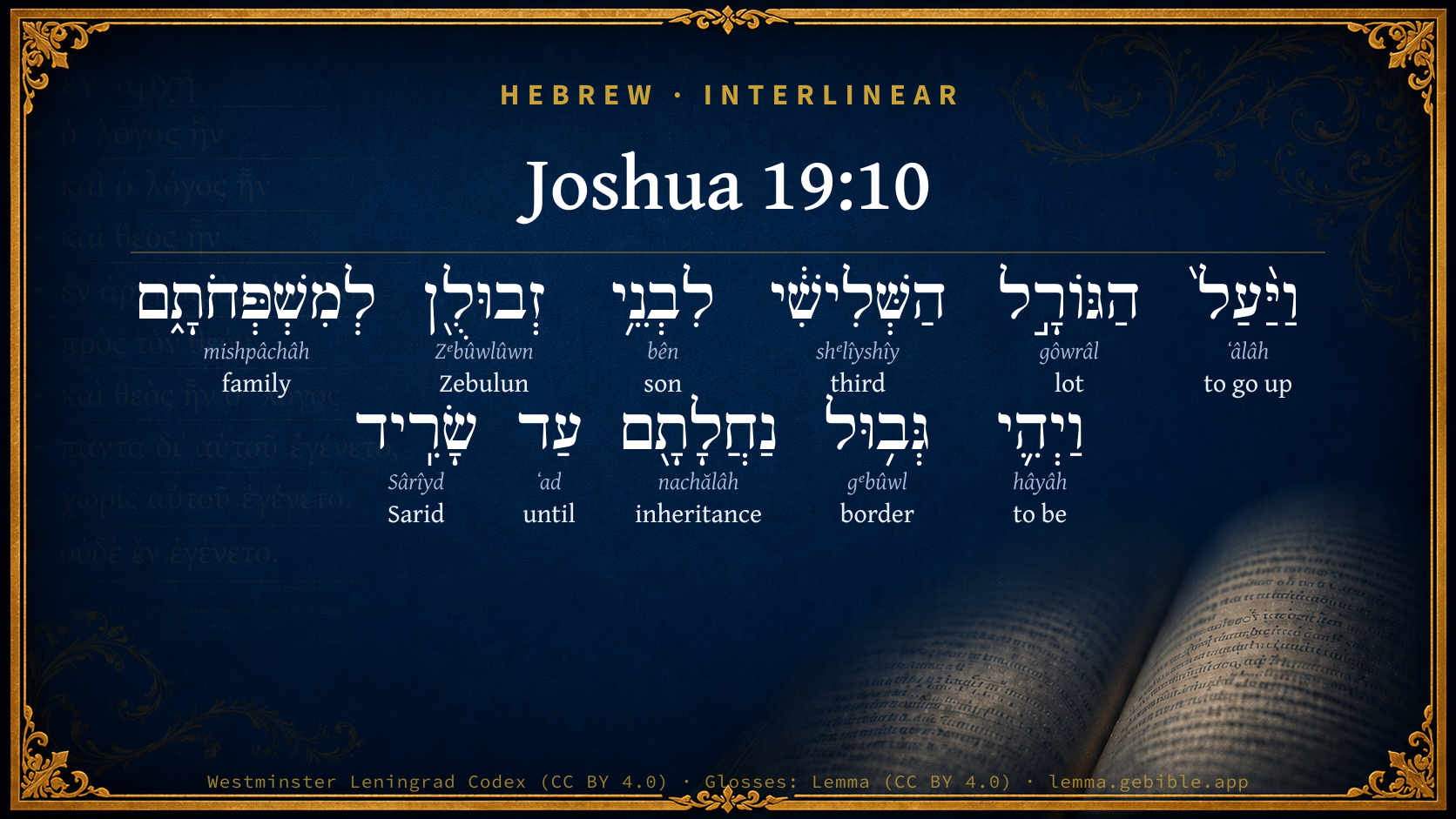
Hebrew (Westminster Leningrad Codex) Joshua 19:10 appears in the Hebrew Old Testament. The text above is from the Westminster Leningrad Codex. Each word links to its Strong’s number, a concise gloss, and parsing drawn from the Open Scriptures Hebrew Bible morphology. Click any word for its full Brown-Driver-Briggs (BDB) entry.
Download image
Cite this verse

Joshua 19:10 (World English Bible). Public Domain. Lemma interlinear Bible study tool, https://lemma.gebible.app/v/joshua/19/10.

Show BibTeX & RIS
BibTeX
RIS
English Translation
The third lot came up for the children of Zebulun according to their families; and the border of their inheritance was to Sarid;
World English Bible · Public Domain
Highlights
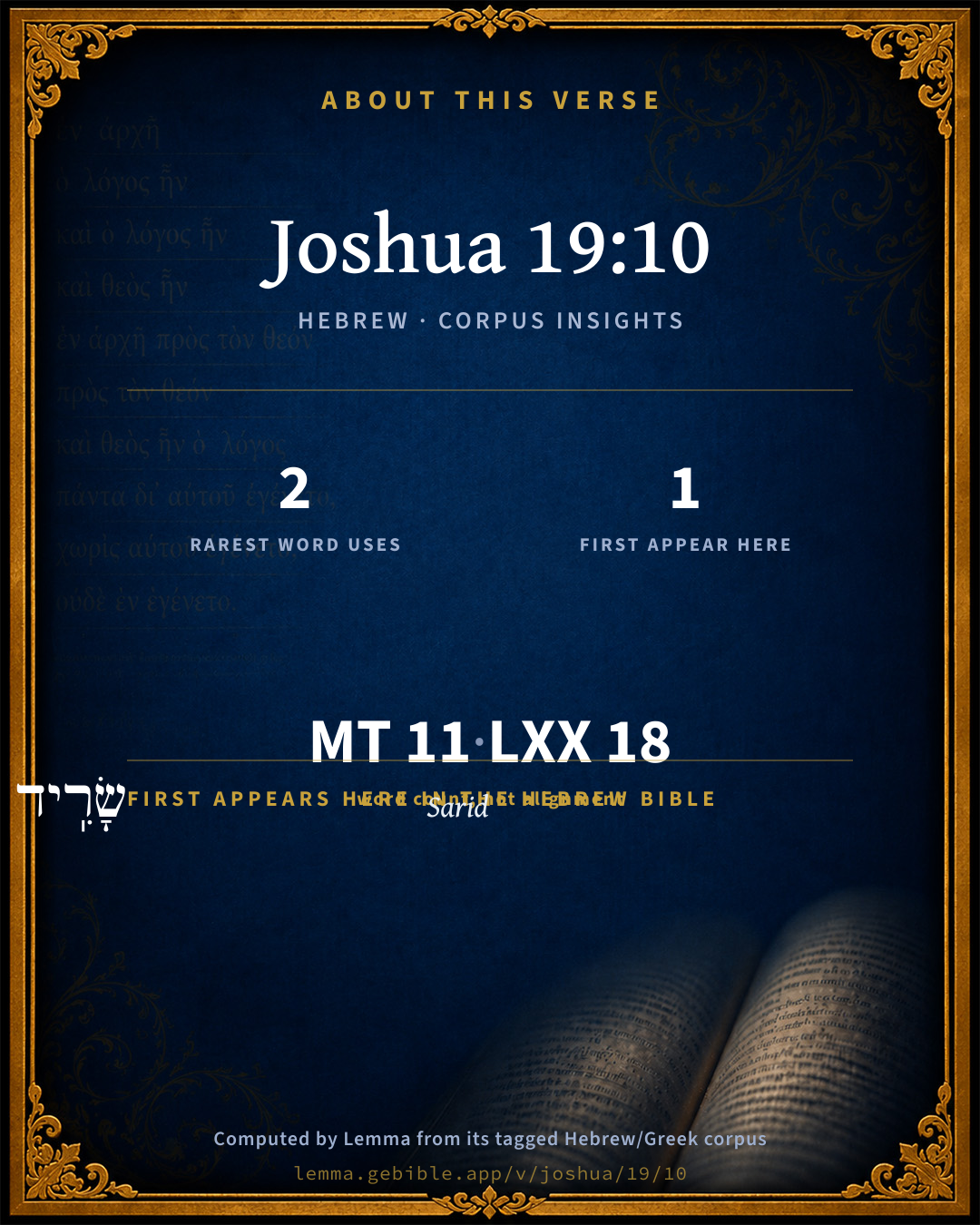
  • 1 first appearance in the Hebrew Bible
Full analysis ↓
Download a study sheet

One document with this verse’s original text, its word-by-word gloss line, the meaning frame, cross-references with their text, attributed commentary, and full source and license credits — printable, and it pastes into notes with its structure intact.

This verse Autodidact and up

Study sheet (.html) Plain text (.txt)

A passage Seminary Student

Up to 50 verses in one chapter. A passage sheet keeps up to 6 commentary sources and 12 cross-references per verse, in the order this page ranks them, and says so on the sheet whenever that leaves anything out. Ask for a single verse and you get the Autodidact verse sheet above.

Everything on this page stays free to read, with no account — the sheet is a download of what is already on screen, not access to it.

Want to remove ads? Support Godless Engineer
Compare translations 3

The same verse in 3 English versions, stacked beneath the original-language interlinear above. Click any original word for its lexicon entry.

Each is an independent rendering of the whole verse — the interlinear is not word-aligned to these translations.

Highlighted words mark where these versions differ — a whole-verse word diff, not a word-by-word alignment.

  • World English Bible Public Domain
    The third lot came up for the children of Zebulun according to their families; and the border of their inheritance was to Sarid;
  • King James Version Public Domain
    And the third lot came up for the children of Zebulun according to their families: and the border of their inheritance was unto Sarid:
  • unfoldingWord Literal Text CC BY-SA 4.0
    And the third lot came up for the sons of Zebulun according to their clans. And the border of their inheritance was unto Sarid.

unfoldingWord Literal Text — © unfoldingWord, licensed CC BY-SA 4.0. Word-aligned USFM3 via Door43 (git.door43.org/unfoldingWord/en_ult).

Versions to compare (up to 4)

3 of 4 selected

Show all 18 translations

Every available English version of this verse, each an independent rendering of the whole verse.

  • World English Bible Public Domain
    The third lot came up for the children of Zebulun according to their families; and the border of their inheritance was to Sarid;
  • Berean Standard Bible Public Domain
    The third lot came up for the clans of the tribe of Zebulun: The border of their inheritance stretched as far as Sarid.
  • Majority Standard Bible Public Domain
    The third lot came up for the clans of the tribe of Zebulun: The border of their inheritance stretched as far as Sarid.
  • King James Version Public Domain
    And the third lot came up for the children of Zebulun according to their families: and the border of their inheritance was unto Sarid:
  • American Standard Version (1901) Public Domain
    And the third lot came up for the children of Zebulun according to their families; and the border of their inheritance was unto Sarid;
  • Revised Version (1885) Public Domain
    And the third lot came up for the children of Zebulun according to their families: and the border of their inheritance was unto Sarid:
  • Geneva Bible (1599) Public Domain
    Also the third lot arose for the children of Zebulun according to their families: and the coastes of their inheritance came to Sarid,
  • Douay-Rheims (1899) Public Domain
    And the third lot fell to the children of Zabulon by their kindreds: and the border of their possession was unto Sarid.
  • Young's Literal Translation Public Domain
    And the third lot goeth up for the sons of Zebulun, for their families; and the border of their inheritance is unto Sarid,
  • Literal Standard Version CC BY-SA 4.0
    And the third lot goes up for the sons of Zebulun, for their families; and the border of their inheritance is to Sarid,
  • Unlocked Literal Bible CC BY-SA 4.0
    The third casting of lots fell to the tribe of Zebulun, clan by clan. The border of their inheritance began at Sarid.
  • unfoldingWord Literal Text CC BY-SA 4.0
    And the third lot came up for the sons of Zebulun according to their clans. And the border of their inheritance was unto Sarid.
  • Darby Bible Public Domain
    And the third lot came up for the children of Zebulun according to their families. And the border of their inheritance was unto Sarid;
  • World Messianic Bible Public Domain
    The third lot came up for the children of Zebulun according to their families. The border of their inheritance was to Sarid.
  • Webster's Bible Public Domain
    And the third lot came up for the children of Zebulun according to their families: and the border of their inheritance was to Sarid:
  • Free Bible Version CC BY-SA 4.0
    The third lot cast went to the tribe of Zebulun, by families. The boundary of their allocation began at Sarid,
  • Bible in Basic English Public Domain
    And the third heritage came out for Zebulun by their families; the limit of their heritage was as far as Sarid;
  • JPS Tanakh (1917) Public Domain
    And the third lot came up for the children of Zebulun according to their families; and the border of their inheritance was unto Sarid.

Literal Standard Version (2020), Covenant Press — licensed CC BY-SA 4.0. Text via the HelloAO Bible API (eBible.org). Unlocked Literal Bible (unfoldingWord) — licensed CC BY-SA 4.0. Text via the HelloAO Bible API (eBible.org). unfoldingWord Literal Text — © unfoldingWord, licensed CC BY-SA 4.0. Word-aligned USFM3 via Door43 (git.door43.org/unfoldingWord/en_ult). Free Bible Version, Dr. Jonathan Gallagher — licensed CC BY-SA 4.0. Text via the HelloAO Bible API (eBible.org).

Word by word

More ways to search: Search by grammar → Find every occurrence → Compare this word →

Practice this passage: Drill this verse → Learn its vocabulary →

שָׂרִֽיד
Sârîyd
H8301
“Sarid”
Noun, Proper
Part of Speech
Noun
Type
Proper
Full BDB Definition

Origin: the same as H8300

TWOT: None

Sarid = "survivor" - a place or landmark on the border of Zebulun
  1. וַיַּ֨עַל֙ ʻâlâh H5927 “and · to go up” Conjunction + Verb, Qal, Sequential Imperfect, 3rd Person, Masculine, Singular
  2. הַגּוֹרָ֣ל gôwrâl H1486 “the · lot” Particle, Definite Article + Noun, Common, Masculine, Singular, Absolute
  3. הַשְּׁלִישִׁ֔י shᵉlîyshîy H7992 “the · third” Particle, Definite Article + Adjective, Ordinal number, Masculine, Singular, Absolute
  4. לִבְנֵ֥י bên H1121 “to/for · sons of” Preposition + Noun, Common, Masculine, Plural, Construct
  5. זְבוּלֻ֖ן Zᵉbûwlûwn H2074 “Zebulun” Noun, Proper
  6. לְמִשְׁפְּחֹתָ֑ם mishpâchâh H4940 “to/for · families · their” Preposition + Noun, Common, Feminine, Plural, Construct + Suffix, Personal, 3rd Person, Masculine, Plural
  7. וַיְהִ֛י hâyâh H1961 “and · to be” Conjunction + Verb, Qal, Sequential Imperfect, 3rd Person, Masculine, Singular
  8. גְּב֥וּל gᵉbûwl H1366 “border of” Noun, Common, Masculine, Singular, Construct
  9. נַחֲלָתָ֖ם nachălâh H5159 “inheritance · their” Noun, Common, Feminine, Singular, Construct + Suffix, Personal, 3rd Person, Masculine, Plural
  10. עַד ʻad H5704 “until” Preposition

About this verse

These counts appear in no published source. They are computed here, from the morphology-tagged text and Lemma’s own curated glosses. What Lemma adds →

11
words
11
distinct lemmas
Historical
section

Notable vocabulary

The rarest word here is שָׂרִֽיד Sarid H8301 — appearing just 2 times in the whole Hebrew Bible.

First appearance in Scripture

This word makes its first canonical appearance in the Hebrew Bible here:

  • שָׂרִֽיד Sarid H8301

Shared distinctive vocabulary

שָׂרִֽיד Sarid H8301 occurs in 2 verses of the Hebrew Bible. Also found in:

Grammatical profile

  • 2 verbs
  • 7 nouns
  • 1 adjective
  • 1 preposition

Verb forms

  • וַיַּ֨עַל֙ Qal · Sequential Imperfect
  • וַיְהִ֛י Qal · Sequential Imperfect

Hebrew & Septuagint length

In English translation the verse runs 23 words from the Hebrew and 23 from the Septuagint (LXX English) — the same length.

A rough comparison of the two English renderings, which tokenize alike — not a word-level alignment.

Word counts can differ between the Hebrew and the Greek without any difference in meaning — e.g. the Hebrew direct-object marker אֵת has no separate Greek word, and Greek often adds the article ὁ.

In the original languages it is 11 Hebrew tokens and 18 Greek tokens — but the two are counted differently (Hebrew bundles its prefixes and suffixes into one token; the Greek is in lemma form), so that isn’t a like-for-like length.

Cross-references

4

Topical passages linked to Joshua 19:10 in the Treasury of Scripture Knowledge — connected by theme and wording, ordered by reader-vote popularity; previews shown in the World English Bible.

  • Genesis 49:13 "Zebulun will dwell at the haven of the sea. He will be for a haven of ships. His border will be on Sidon.
  • Deuteronomy 33:18–19 Of Zebulun he said, Rejoice, Zebulun, in your going out; Issachar, in your tents.
  • Joshua 18:6 You shall describe the land into seven portions, and bring [the description] here to me; and I will cast lots for you here before Yahweh our God.
  • Joshua 18:11 The lot of the tribe of the children of Benjamin came up according to their families: and the border of their lot went out between the children of Judah and the children of Joseph.

Cross-references courtesy of OpenBible.info (CC BY 4.0).

Hebrew and Greek witnesses Masoretic Hebrew ↔ Greek Septuagint

The same verse in the two great witnesses to the Old Testament, shown verse-for-verse.

These are two independent witnesses, not word-aligned to each other, and the Septuagint is shown in lemma (dictionary) form.

Hebrew Joshua 19:10 Masoretic · Westminster Leningrad Codex

וַיַּ֨עַל֙ הַגּוֹרָ֣ל הַשְּׁלִישִׁ֔י לִבְנֵ֥י זְבוּלֻ֖ן לְמִשְׁפְּחֹתָ֑ם וַיְהִ֛י גְּב֥וּל נַחֲלָתָ֖ם עַד שָׂרִֽיד

The third lot came up for the children of Zebulun according to their families; and the border of their inheritance was to Sarid;

World English Bible · Public Domain

Greek LXX Joshua 19:10 Septuagint · lemma form

καί ἐκἔρχομαι ὁ κλῆρος ὁ τρίτος ὁ ζαβουλων κατά δῆμος αὐτός εἰμί ὁ ὅριον ὁ κληρονομία αὐτός εσεδεκ

And the third lot came out to Zabulon according to their families: the bounds of their inheritance shall be—Esedekgola shall be their border,

LXX2012 (modern English Septuagint) · Public Domain

On this verse, Keil & Delitzsch discusses the Septuagint’s reading. Read the note in Commentary ↓

Hebrew: Westminster Leningrad Codex (CC BY 4.0). Greek: Septuagint (public domain); English from LXX2012 (modern English Septuagint) (Public Domain). How the Septuagint differs from the Hebrew →

Targum (Aramaic paraphrase)

1

The Targum is the ancient Jewish Aramaic paraphrase of the Hebrew Scriptures — an interpretive translation, not the Hebrew text itself. Onkelos (literal) and Pseudo-Jonathan (expansive) render the Torah, and Jonathan the Prophets. Coverage is partial: where no permissively-licensed English translation exists for a verse, only the Aramaic is shown. This is verse-level text, not a word-by-word alignment to the Hebrew.

  1. Targum Jonathan Prophets (Joshua–Malachi)
    וּסְלֵיק עַדְבָא תְלִיתָאָה לִבְנֵי זְבוּלֻן לְזַרְעֲיַתְהוֹן וַהֲוָה תְּחוּם אַחְסַנְתְּהוֹן עַד שָׂרִיד:

    (no public-domain English translation for this verse)

    Targum Jonathan — Aramaic: “Mikraot Gedolot” (public domain). English: “Sefaria Community Translation” (CC0 1.0 (public-domain dedication)); “London "Chaldee Paraphrase," 1871” (public domain). Text via Sefaria.

Commentary

Notes on Joshua 19:10 from classic Christian and Jewish commentators (each source and its license shown beneath its notes). The classic Christian expositions comment on the surrounding passage and are grouped to its opening verse, so a note may address several verses; the Jewish commentaries on the Tanakh (Rashi and others) are per-verse, so they appear only where the commentator wrote on this verse.

Lemma curates 59 commentaries, every one of them public domain or Creative Commons licensed, each selected and text-cleaned for this edition rather than reprinted as found. About our sources →

Jamieson, Fausset & Brown

Robert Jamieson, A. R. Fausset & David Brown

OF ZEBULUN. (Jos 19:10-16)

the third lot came up for the children of Zebulun--The boundaries of the possession assigned to them extended from the Lake of Chinnereth (Sea of Galilee) on the east, to the Mediterranean on the west. Although they do not seem at first to have touched on the western shore--a part of Manasseh running north into Asher (Jos 17:10) --they afterwards did, according to the prediction of Moses (Deu 33:19). The extent from north to south cannot be very exactly traced; the sites of many of the places through which the boundary line is drawn being unknown. Some of the cities were of note.

Jamieson, Fausset & Brown — Commentary Critical and Explanatory on the Whole Bible (1871) — public domain (CC PDM 1.0). Text via the HelloAO Bible API.

Whedon's Commentary on the Bible

Daniel D. Whedon

ZEBULUN’S LOT, Jos_19:10-16.

10. Zebulun — “The four tribes of Zebulun, Issachar, Asher, and Naphtali obtain contiguous portions in the north of Palestine, as they were allied in birth, and as they marched through the desert. They formed, as it were, a state by themselves. A common sanctuary seems to have been intended for them in Mount Tabor.” — Stanley. As Zebulun preceded his elder brother Issachar in the blessing of the patriarch Jacob and the lawgiver Moses, so he precedes him in the allotment. [Jacob predicted that Zebulun should “dwell at the haven of seas,” (Gen_49:13,) and Josephus well explains that his “lot included the land which lay as far as the lake of Gennesaret, and that which belonged to Carmel and the sea.” It thus lay between two seas, and had, perhaps, fishermen on the Sea of Galilee, and merchants navigating the Mediterranean along with the Phenicians. Moses also said prophetically of this tribe, “They shall suck of the abundance of the seas and of treasures hid in the sand. Deu_30:19. These prophecies do not necessarily imply that Zebulun’s territory would border on these seas.

10. The border… unto Sarid — This southern border of Zebulun, like the north border of Ephraim, (Jos_16:6,) seems to start from a central point in the line, and go first westward and then eastward. Jos_19:12. The position of Sarid was probably not far from Mount Tabor, but its site is unknown, and therefore the exact line of this border cannot now be traced.

Daniel D. Whedon (gen. ed.), Commentary on the Old and New Testaments (1874–1909) — public domain. Text from a community e-Sword module.

Keil & Delitzsch

C. F. Keil & F. Delitzsch

The Inheritance of Zebulun fell above the plain of Jezreel, between this plain and the mountains of Naphtali, so that it was bounded by Asher on the west and north-west (Jos 19:27), by Naphtali on the north and north-east (Jos 19:34), and by Issachar on the south-east and south, and touched neither the Mediterranean Sea nor the Jordan. It embraced a very fertile country, however, with the fine broad plain of el Buttauf, the μέγα πεδίον above Nazareth called Asochis in Joseph. vita, 41, 45 (see Rob. iii. p. 189, Bibl. Res. pp. 105ff.; Ritter, Erdk. xvi. pp. 742, 758-9).

Jos 19:10

"And the boundary (the territory) of their inheritance was (went) to Sarid." This is no doubt the centre of the southern boundary, from which it is traced in a westerly direction in Jos 19:11, and in an easterly direction in Jos 19:12, in the same manner as in Jos 16:6. Unfortunately, Sarid cannot be determined with certainty. Knobel's opinion, is, that the name, which signifies "hole" or "incision," after the analogy of שׂרד, perforavit, and שׂרט, incidit, does not refer to a town, but to some other locality, probably the southern opening of the deep and narrow wady which comes down from the basin of Nazareth, and is about an hour to the south-east of Nazareth, between two steep mountains (Seetzen, ii. pp. 151-2; Rob. iii. p. 183). This locality appears suitable enough. But it is also possible that Sarid may be found in one of the two heaps of ruins on the south side of the Mons praecipitii upon V. de Velde's map (so called from Luk 4:29).

Jos 19:11

From this point "the border went up westwards, namely to Mar'ala, and touched Dabbasheth, and still farther to the brook of Jokneam." If Jokneam of Carmel has been preserved in the Tell Kaimn (see at Jos 12:22), the brook before Jokneam is probably the Wady el Milh, on the eastern side of which, near the point where it opens into the plain, stands Kaimn, and through which the road runs from Acca to Ramleh, as this wady separates Carmel from the small round hills which run to the south-east (see Rob. Bibl. Res. p. 114, and V. de Velde, i. p. 249). Here the boundaries of Zebulun and Asher met (Jos 19:27). Mar'ala and Dabbasheth are to be sought for between Kaimn and Sarid. The Cod. Vat. has Μαγελδά instead of Μαριλά. Now, however, little importance we can attach to the readings of the lxx on account of the senseless way in which its renderings are made-as, for example, in this very passage, where ועלה עד־שׂריד׃ is rendered Ἐσεδεκγώλα, - the name Magelda might suggest a Hebrew reading Magedlah or Mageldah, and thus lead one to connect the place with the village of Mejeidil (Rob. Bibl. Res. p. 114), or Mshedil (Seetzen, ii. p. 143), on the west of Mons praecipitii, though neither of these travellers visited the place, or has given us any minute description of it. Its situation upon a mountain would suit Mar'ala, to which the boundary went up from Sarid. In the case of Dabbasheth, the name, which signifies "lump" (see Isa 30:6), points to a mountain. Upon this Knobel has founded the conjecture that Gibeah or Gibeath took the place of this uncommon word, and that this is connected with the Gabathon of the Onom. (juxta campum Legionis), the present Jebta between Mejeidil and Kaimn, upon an isolated height on the edge of the mountains which skirt the plain of Jezreel, where there are signs of a remote antiquity (Rob. iii. p. 201, and Bibl. Res. p. 113; Ritter, Erdk. xvi. p. 700); although Tell Thureh (i.e., mountain) might be intended, a village upon a low and isolated hill a little farther south (see Rob. Bibl. Res. p. 116, and Ritter, ut sup.).

Jos 19:12

"And from Sarid the boundary turned eastwards toward the sun-rising to the territory of Chisloth-tabor, and went out to Dabrath, and went up to Japhia." Chisloth-tabor, i.e., according to Kimchi's explanation lumbi Taboris (French, les flancs), was at any rate a place on the side of Tabor, possibly the same as Kesulloth in Jos 19:18, as Masius and others suppose, and probably the same place as the Xaloth of Josephus (Bell. Jud. iii. 3, 1), which was situated in the "great plain," and the vicus Chasalus of the Onom. (juxta montem Thabor in campestribus), i.e., the present village of Iksl or Ksl, upon a rocky height on the west of Thabor, with many tombs in the rocks (Rob. iii. p. 182). Dabrath, a place in the tribe of Issachar that was given up to the Levites (Jos 21:28; Ch1 6:57), called Dabaritta in Josephus (Bell. Jud. ii. 21, 3) and Dabira in the Onom. (villula in monte Thabor), the present Deburieh, an insignificant village which stands in a very picturesque manner upon a stratum of rock at the western foot of Tabor (Rob. iii. p. 210; V. de Velde, R. ii. p. 324). Japhia certainly cannot be the present Hepha or Haifa (Khaifa) on the Mediterranean, and near to Carmel (Rel. Pal. p. 826, and Ges. Thes. s. v.); but it is just as certain that it cannot be the present Jafa, a place half an hour to the south-west of Nazareth, as Robinson (Pal. iii. p. 200) and Knobel suppose, since the boundary was running eastwards, and cannot possibly have turned back again towards the west, and run from Deburieh beyond Sarid. If the positions assigned to Chisloth-tabor and Dabrath are correct, Japhia must be sought for on the east of Deburieh.

Jos 19:13

"From thence it went over towards the east to the sun-rising to Gath-hepher, to Eth-kazin, and went out to Rimmon, which is marked off to Neah." Gath-hepher, the home of the prophet Jonah (Kg2 14:25), was "haud grandis viculus Geth" in the time of Jerome (see prol. ad Jon.). It was about two miles from Sephoris on the road to Tiberias, and the tomb of the prophet was shown there. It is the present village of Meshed, a place about an hour and a quarter to the north of Nazareth (Rob. iii. p. 209; V. de Velde, Mem. p. 312). Eth-kazin is unknown. Rimmon, a Levitical town (Jos 21:35; Ch1 6:62), has probably been preserved in the village of Rummaneh, about two hours and a half to the north of Nazareth (Rob. iii. p. 195). Ham-methoar is not a proper name, but the participle of תּאר, with the article in the place of the relative pronoun, "bounded off," or pricked off. Neah is unknown; it is possibly the same place as Neiel in the tribe of Asher (Jos 19:27), as Knobel supposes.

Jos 19:14

"And the boundary turned round it (round Rimmon), on the north to Channathon, and the outgoings thereof were the valley of Jiphtah-el." Judging from the words נסב and מצּפון, this verse apparently gives the north-west boundary, since the last definition in Jos 19:13, "to Gath-hepher," etc., points to the eastern boundary. Jiphtah-el answers no doubt to the present Jeft, two hours and a half to the north of Sefurieh, and is the Jotapata which was obstinately defended by Josephus (Bell. Jud. iii. 7, 9: see Rob. Bibl. Res. pp. 104ff.). Consequently the valley of Jiphtah-el, at which Zebulun touched Asher (Jos 19:27), is probably "no other than the large Wady Abiln, which takes its rise in the hills in the neighbourhood of Jeft" (Rob. Bibl. Res. p. 107). And if this be correct, Channathon (lxx Ἐνναθώθ) is probably Cana of Galilee, the home of Nathanael (Joh 2:1, Joh 2:11; Joh 4:46; Joh 21:2), the present Kana el Jelil, between Rummaneh and Yeft, on the northern edge of the plain of Buttauf, upon a Tell, from which you overlook the plain, fully two hours and a half in a straight line from Nazareth, and directly north of that place, where there are many ruins found (see Rob. iii. p. 204; Bibl. Res. p. 108).

Jos 19:15-16

The towns of Zebulun were the following. Kattath, probably the same as Kitron, which is mentioned in Jdg 1:30 in connection with Nahalol, but which is still unknown. Nehalal, or Nahalol (Jdg 1:30), is supposed by V. de Velde (Mem. p. 335), who follows Rabbi Schwartz, to be the present village of Maalul, a place with ruins on the south-west of Nazareth (see Seetzen, ii. p. 143; Rob. iii. App.; and Ritter, Erdk. xvi. p. 700). Simron is supposed by Knobel to be the village of Semunieh (see at Jos 11:1). But neither of these is very probable. Idalah is supposed by V. de Velde to be the village of Jeda or Jeida, on the west of Semunieh, where are a few relics of antiquity, though Robinson (Bibl. Res. p. 113) states the very opposite. Bethlehem (of Zebulun), which many regard as the home of the judge Ibzan (Jdg 12:8), has been preserved under the old name in a miserable village on the north of Jeida and Semunieh (see Seetzen, ii. p. 139; Rob. Bibl. Res. p. 113). The number of the towns is given as twelve, though only five are mentioned by name. It is true that some commentators have found the missing names in the border places mentioned in Jos 19:11-14, as, after deducting Chisloth-tabor and Dabrath, which belonged to Issachar, the names Sarid, Maralah, Dabbasheth, Japhia, Gittah-hepher, Eth-kazin, and Channathon give just seven towns. Nevertheless there is very little probability in this conjecture. For, in the first place, not only would it be a surprising thing to find the places mentioned as boundaries included among the towns of the territory belonging to the tribe, especially as some of the places so mentioned did not belong to Zebulun at all; but the copula vav, with which the enumeration of the towns commences, is equally surprising, since this is introduced in other cases with הארים והיוּ (ויּהיוּ), e.g., Jos 18:21; Jos 15:21. And, in the second place, it is not a probable thing in itself, that, with the exception of the five towns mentioned in Jos 19:15, the other towns of Zebulun should all be situated upon the border. And lastly, the towns of Kartah and Dimnah, which Zebulun gave up to the Levites (Jos 21:34), are actually wanting. Under these circumstances, it is a natural conclusion that there is a gap in the text here, just as in Jos 15:59 and Jos 21:36.

Keil & Delitzsch — Biblical Commentary on the Old Testament (1861–1891) — public domain (CC PDM 1.0). Text via the HelloAO Bible API. (Old Testament only.)

Tyndale Open Study Notes

Tyndale Open Resources

19:10-48 The five small remaining tribes received land on the edges of the Israelite territory and had little national influence.

19:10-23 The lands given to the tribes of Zebulun and Issachar were strategically located; the major international trading route from Egypt to Mesopotamia ran through their territories. When Israel was strong, this position brought prosperity. However, when Israel was weak, these tribes were vulnerable both to the armies of Egypt and to the successive Mesopotamian powers that fought for control of the ancient Near East.

19:10-16 The tribe of Zebulun received land partly in the valley of Jezreel and partly in the hills of Lower Galilee.

Tyndale Open Study Notes — © Tyndale Open Resources, licensed CC BY-SA 4.0. Text via the HelloAO Bible API.

Matthew Henry's Commentary

This is the lot of Zebulun, who, though born of Leah after Issachar, yet was blessed by Jacob and Moses before him; and therefore it was so ordered that his lot was drawn before that of Issachar, north of which it lay and south of Asher. 1. The lot of this tribe was washed by the great sea on the west, and by the sea of Tiberias on the east, answering Jacob's prophecy (Gen 49:13), Zebulun shall be a haven of ships, trading ships on the great sea and fishing ships on the sea of Galilee. 2. Though there were some places in this tribe which were made famous in the Old Testament, especially Mount Carmel, on which the famous trial was between God and Baal in Elijah's time, yet it was made much more illustrious in the New Testament; for within the lot of this tribe was Nazareth, where our blessed Saviour spent so much of his time on earth, and from which he was called Jesus of Nazareth, and Mount Tabor on which he was transfigured, and that coast of the sea of Galilee on which Christ preached so many sermons and wrought so many miracles.

Matthew Henry's Commentary on the Whole Bible (1708–1710) — public domain (CC PDM 1.0). Text via the HelloAO Bible API.

John Calvin's Commentaries

10. And the third lot came up, etc In the lot of Zebulun there is a clear fulfillment of the prophecy of Jacob, which had foretold that they would dwell on the sea-coast. An old man, an exile who could not set a foot on his own land, assigned a maritime district to the posterity of his son Zebulun. What could be more extravagant? But now, when the lot assigns them a maritime region, no clearer confirmation of his decision could be desired. It was just as if God were twice thundering from heaven. The tribe of Zebulun, therefore, do not occupy the shore of their own accord or by human suffrage, but a divine arrangement fixes their habitation contiguous to the sea. Thus, although men erred, still the light was always seen shining brightly in the darkness. Jacob goes farther, and makes a clear distinction between Zebulun and Issachar. The former tribe will travel far and wide, carrying on trade and commerce; the latter remaining in his tents, will cultivate ease and a sedentary life. (Genesis 49:13-15) Hence it is probable that the sea-coast where Zebulun settled, was provided with harbors and well adapted for the various forms of commercial intercourse, whereas the children of Issachar were contented with their own produce, and consumed the fruits which they had raised by their own labor and culture at home.

Those who are thought to be well acquainted with these countries, affirm that the land of the tribe of Asher was fertile in corn. This is in complete accordance both with the letter and the spirit of Jacob’s prophecy. (Genesis 49:20) From the fact that only a small number of cities are designated by name, we may infer that there were then many ruined cities which were not taken into account, and from the other fact that the people dwelt commodiously, we may also infer that they built many cities, with which it is plain from other passages that the land was adorned. And it is certainly apparent that only a summary of the division is briefly glanced at, and that thus many things were omitted which no religious feeling forbids us to investigate, provided we do not indulge in an excessive curiosity leading to no beneficial result. There cannot be a doubt that those to whom twenty or even only seventeen cities are attributed, had more extensive territories. Therefore, all we have here is a compendious description of the division as it was taken from the general and confused notes of the surveyors.

John Calvin's Commentaries (1540-1563) — public domain. Text from the Calvin Translation Society English edition (1840s-50s) via the Christian Classics Ethereal Library (ccel.org). Calvin's coverage is partial (roughly two-thirds of the Bible); uncommented books and verses are honest gaps, never fabricated. The 19th-century editor's footnotes and remarks are omitted so the notes are faithfully Calvin's own voice.

Ellicott's Commentary for English Readers

THE BORDER OF ZEBULUN.

(10) The third lot . . . for the children of Zebulun . . . Sarid (Syriac, Asdod; LXX., Seddouk) should be apparently spelt with consonants s, D, D. It is identified as Tell Shadûd (sheet 8). From this point a line is drawn westward (past M’alûl, sheet 5) to Jokneam (Tell Keimûn, same sheet), a place at the south-east end of the Carmel ridge. This is the south boundary. We may note that it does not touch the sea, but leaves room for the territory of Asher to interpose (comp. Jos_17:10-11). Returning to Sarid, the boundary is next (Jos_19:12) drawn eastward to Chisloth-tabor (Iksâl, sheet 6), Daberath(Dabûrieh, sheet 6), Japhia (Yâfa, sheet 5), Gittah-hepher (El-Mesh-hed, sheet 6).

A Bible Commentary for English Readers, edited by Charles John Ellicott (1878–1897) — public domain. Text from a community e-Sword module.

The Cambridge Bible for Schools and Colleges

gen. ed. J. J. S. Perowne

10–16. The Territory of the Tribe of Zebulun

10. And the third lot came up for the children of Zebulun] The tribe descended from the tenth of the sons of Jacob (Gen_30:19-20), and the sixth and last of the sons of Leah (Gen_35:23; Gen_46:14). During the journey from Egypt to Palestine, the tribe of Zebulun formed one of the first camp, with Judah and Issachar, also sons of Leah, marching under the standard of Judah. Its numbers at the census of Sinai were 57,000, surpassed only by Simeon, Dan, and Judah.

the border of their inheritance was unto Sarid] A spot unknown, but believed to be somewhere inland, in the plain of Esdraelon, and west of Chisloth-tabor (= “the loins of Tabor”) (see Jos_19:12).

The Cambridge Bible for Schools and Colleges (gen. ed. J. J. S. Perowne; Cambridge University Press, 1878–1918) — public domain. Text from a community e-Sword module.

John Gill's Exposition

And their border went up toward the sea,.... Westward towards the Mediterranean sea, which fulfilled the prophecies of Jacob and Moses, that Zebulun should dwell by the sea, be an haven of ships, and take of the abundance of the seas, as in the places before referred to; and so Josephus says, the Zebulunites took the land unto the lake of Gennesaret, by or about Carmel and the sea:

and Maralah; which Jerom calls (g) the ascent of Zebulun; for from hence it went up from the sea, and reached to Dabbasheth; which Jerom calls Dasbath; the word signifies a hump that is on a camel's back, Isa 30:6; so called because when that is hurt by burdens it is cured with honey (h); it seems to denote some place or city at a point of land or promontory, that stood out towards the sea, as that of Carmel; or some city on the back of Carmel, resembling a camel's hump:

and reached to the river that is before Jokneam; of Jokneam; see Gill on Jos 12:22; and this river was either the river Kishon, or Belus, sometimes called Pagida; from whence sand was taken to make glass of (k), and was near Carmel, as Jokneam was.

(g) De loc. Heb. fol. 90. K. (h) T. Bab. Sabbat, fol. 154. 2. (k) Nat. Hist. l. 5. c. 19. & l. 36. c. 26.

John Gill's Exposition of the Whole Bible (1746–1763) — public domain (CC PDM 1.0). Text via the HelloAO Bible API.

Albert Barnes' Notes on the Bible

Sarid, not yet identified, was evidently a leading topographical point on the south frontier of Zebulun. The boundary passed westward until it touched the Kishon, near “Tell Kaimon” (Jos 12:22 note), and thence, turned northward, leaving Carmel, which belonged to Asher, on its west. The territory of Zebulun accordingly would not anywhere reach to the Mediterranean, though its eastern side abutted on the sea of Galilee, and gave the tribe those “outgoings” attributed to it in the Blessing of Moses (Deu 33:18). Daberath (Jos 19:12) is probably “Deburieh.”

Albert Barnes' Notes on the Bible (1834–1885) — public domain. Text from a community e-Sword/MySword module.

Matthew Poole's English Annotations

Zebulun is here put before Issachar, his elder brother, as he is also Gen 49:13,14; Deu 33:18.

Matthew Poole's English Annotations on the Holy Bible (1683–1685) — public domain. Text from a community e-Sword/MySword module.

The Pulpit Commentary

Sarid. This seems to have been a middle point, from which the border is traced eastward and westward, as in Jos_16:6, and perhaps in ver. 32. But the LXX and other versions have a variety of readings here.

The Pulpit Commentary (1880–1919), ed. H.D.M. Spence-Jones & Joseph S. Exell — public domain. Text from a community e-Sword module.

unfoldingWord translationNotes

Door43 World Missions Community

The third casting of lots

See how you translated this phrase in Joshua 19:1.

The third

number three in a list (See: Ordinal Numbers)

Sarid ... Maralah ... Dabbesheth ... Jokneam

These are the names of places. (See: How to Translate Names)

opposite Jokneam

"across from Jokneam"

translationWords

Zebulun

clan

unfoldingWord translationNotes — © Distant Shores Media and the Door43 World Missions Community, licensed CC BY-SA 4.0. Source: git.door43.org/Door43/en_tn.

Lesson kit

Teaching starters — assembled from the data on this page, not authored interpretation. Every prompt links to the verse data it draws on. Edit before teaching.

Joshua, in the Historical, opens this verse with 11 words (11 distinct Hebrew lemmas). Its most distinctive word is Sârîyd (“Sarid”). A historical commentator’s framing appears above. Read the whole chapter for the surrounding context.

Discussion questions

  1. The word Sârîyd carries the sense “Sarid.” How does it shape the verse?
  2. This is the first place “Sarid” appears in Scripture (first appears here). What does its debut here establish?
  3. How does Joshua 19:12, which shares the word «Sarid», read alongside this verse?
  4. The translations on this page render this verse differently — a whole-verse word diff, not a word-by-word alignment. What might account for the different wordings?
  5. «וַיַּ֨עַל֙» is a Qal Sequential Imperfect verb. How does that grammatical form shape the action described?
  6. Compare how Jamieson, Fausset & Brown and Whedon's Commentary on the Bible read this verse. Where do they agree or differ?

Things to notice

Reading settings

Reading text

Shown beneath each verse's original-language words.

Old Testament
Old Testament edition

Read the OT as the Masoretic Hebrew (MT) or the Greek Septuagint (LXX).

English shown for the Greek Septuagint (in the Hebrew ↔ Greek comparison).

Comparing translations? Open the Compare panel on any verse page to stack up to four side by side.