Joshua 12:4

Hebrew (Westminster Leningrad Codex) Joshua 12:4 appears in the Hebrew Old Testament. The text above is from the Westminster Leningrad Codex. Each word links to its Strong’s number, a concise gloss, and parsing drawn from the Open Scriptures Hebrew Bible morphology. Click any word for its full Brown-Driver-Briggs (BDB) entry.
Download image
Cite this verse

Joshua 12:4 (World English Bible). Public Domain. Lemma interlinear Bible study tool, https://lemma.gebible.app/v/joshua/12/4.

Show BibTeX & RIS
BibTeX
RIS
English Translation
and the border of Og king of Bashan, of the remnant of the Rephaim, who lived at Ashtaroth and at Edrei,
World English Bible · Public Domain
Download a study sheet

One document with this verse’s original text, its word-by-word gloss line, the meaning frame, cross-references with their text, attributed commentary, and full source and license credits — printable, and it pastes into notes with its structure intact.

This verse Autodidact and up

Study sheet (.html) Plain text (.txt)

A passage Seminary Student

Up to 50 verses in one chapter. A passage sheet keeps up to 6 commentary sources and 12 cross-references per verse, in the order this page ranks them, and says so on the sheet whenever that leaves anything out. Ask for a single verse and you get the Autodidact verse sheet above.

Everything on this page stays free to read, with no account — the sheet is a download of what is already on screen, not access to it.

Want to remove ads? Support Godless Engineer
Compare translations 3

The same verse in 3 English versions, stacked beneath the original-language interlinear above. Click any original word for its lexicon entry.

Each is an independent rendering of the whole verse — the interlinear is not word-aligned to these translations.

Highlighted words mark where these versions differ — a whole-verse word diff, not a word-by-word alignment.

  • World English Bible Public Domain
    and the border of Og king of Bashan, of the remnant of the Rephaim, who lived at Ashtaroth and at Edrei,
  • King James Version Public Domain
    And the coast of Og king of Bashan, which was of the remnant of the giants, that dwelt at Ashtaroth and at Edrei,
  • unfoldingWord Literal Text CC BY-SA 4.0
    And the border of Og, the king of Bashan, from the remnant of the Raphaites, the one dwelling in Ashtaroth and in Edrei

unfoldingWord Literal Text — © unfoldingWord, licensed CC BY-SA 4.0. Word-aligned USFM3 via Door43 (git.door43.org/unfoldingWord/en_ult).

Versions to compare (up to 4)

3 of 4 selected

Show all 18 translations

Every available English version of this verse, each an independent rendering of the whole verse.

  • World English Bible Public Domain
    and the border of Og king of Bashan, of the remnant of the Rephaim, who lived at Ashtaroth and at Edrei,
  • Berean Standard Bible Public Domain
    And Og king of Bashan, one of the remnant of the Rephaim, who lived in Ashtaroth and Edrei.
  • Majority Standard Bible Public Domain
    And Og king of Bashan, one of the remnant of the Rephaim, who lived in Ashtaroth and Edrei.
  • King James Version Public Domain
    And the coast of Og king of Bashan, which was of the remnant of the giants, that dwelt at Ashtaroth and at Edrei,
  • American Standard Version (1901) Public Domain
    and the border of Og king of Bashan, of the remnant of the Rephaim, who dwelt at Ashtaroth and at Edrei,
  • Revised Version (1885) Public Domain
    and the border of Og king of Bashan, of the remnant of the Rephaim, who dwelt at Ashtaroth and at Edrei,
  • Geneva Bible (1599) Public Domain
    They conquered also the coast of Og King of Bashan of the remnant of the gyants, which dwelt at Ashtaroth, and at Edrei,
  • Douay-Rheims (1899) Public Domain
    The border of Og the king of Basan, of the remnant of the Raphaims who dwelt in Astaroth, and in Edrai, and had dominion in mount Hermon, and in Salecha, and in all Basan, unto the herders
  • Young's Literal Translation Public Domain
    And the border of Og king of Bashan (of the remnant of the Rephaim), who is dwelling in Ashtaroth and in Edrei,
  • Literal Standard Version CC BY-SA 4.0
    And the border of Og king of Bashan (of the remnant of the Rephaim), who is dwelling in Ashtaroth and in Edrei,
  • Unlocked Literal Bible CC BY-SA 4.0
    Og, king of Bashan, one of the remnant of the Rephaim, lived in Ashtaroth and Edrei.
  • unfoldingWord Literal Text CC BY-SA 4.0
    And the border of Og, the king of Bashan, from the remnant of the Raphaites, the one dwelling in Ashtaroth and in Edrei
  • Darby Bible Public Domain
    and the territory of Og the king of Bashan, of the residue of the giants, who dwelt at Ashtaroth and at Edrei,
  • World Messianic Bible Public Domain
    and the border of Og king of Bashan, of the remnant of the Rephaim, who lived at Ashtaroth and at Edrei,
  • Webster's Bible Public Domain
    And the coast of Og king of Bashan, who was of the remnant of the giants, that dwelt at Ashtaroth and at Edrei,
  • Free Bible Version CC BY-SA 4.0
    King Og of Bashan, one of the last of the Rephaites, who lived in Ashtaroth and Edrei,
  • Bible in Basic English Public Domain
    And the land of Og, king of Bashan, of the rest of the Rephaim, who was living at Ashtaroth and at Edrei,
  • JPS Tanakh (1917) Public Domain
    and the border of Og king of Bashan, of the remnant of the Rephaim, who dwelt at Ashtaroth and at Edrei,

Literal Standard Version (2020), Covenant Press — licensed CC BY-SA 4.0. Text via the HelloAO Bible API (eBible.org). Unlocked Literal Bible (unfoldingWord) — licensed CC BY-SA 4.0. Text via the HelloAO Bible API (eBible.org). unfoldingWord Literal Text — © unfoldingWord, licensed CC BY-SA 4.0. Word-aligned USFM3 via Door43 (git.door43.org/unfoldingWord/en_ult). Free Bible Version, Dr. Jonathan Gallagher — licensed CC BY-SA 4.0. Text via the HelloAO Bible API (eBible.org).

Word by word

More ways to search: Search by grammar → Find every occurrence → Compare this word →

Practice this passage: Drill this verse → Learn its vocabulary →

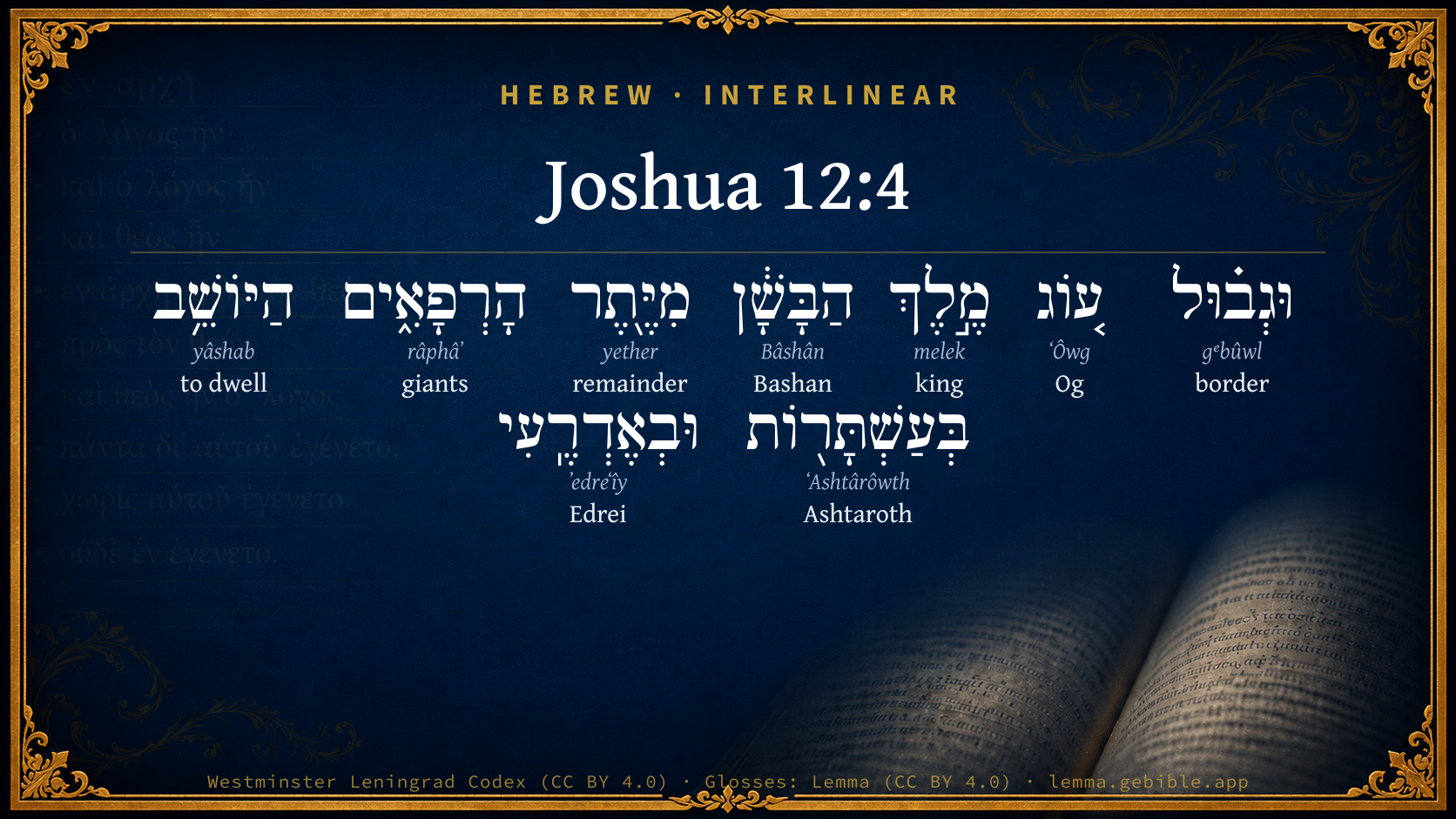
וּבְאֶדְרֶֽעִי
ʼedreʻîy
H154
“and · in/at · Edrei”
Conjunction + Preposition + Noun, Proper
Part of Speech
Conjunction + Preposition + Noun
Type
Proper
Full BDB Definition

Origin: from the equivalent of H153

TWOT: None

Edrei = "goodly pasture" - a chief city of Bashan, north of Jabbok river
  1. וּגְב֗וּל gᵉbûwl H1366 “and · border of” Conjunction + Noun, Common, Masculine, Singular, Construct
  2. ע֚וֹג ʻÔwg H5747 “Og” Noun, Proper
  3. מֶ֣לֶךְ melek H4428 “king of” Noun, Common, Masculine, Singular, Construct
  4. הַבָּשָׁ֔ן Bâshân H1316 “the · Bashan” Particle, Definite Article + Noun, Proper
  5. מִיֶּ֖תֶר yether H3499 “from · remainder of” Preposition + Noun, Common, Masculine, Singular, Construct
  6. הָרְפָאִ֑ים râphâʼ H7497 “the · giants” Particle, Definite Article + Noun, Proper
  7. הַיּוֹשֵׁ֥ב yâshab H3427 “the · dwelling” Particle, Definite Article + Verb, Qal, Participle Active, Masculine, Singular, Absolute
  8. בְּעַשְׁתָּר֖וֹת ʻAshtârôwth H6252 “in/at · Ashtaroth” Preposition + Noun, Proper

About this verse

These counts appear in no published source. They are computed here, from the morphology-tagged text and Lemma’s own curated glosses. What Lemma adds →

9
words
9
distinct lemmas
Historical
section

Notable vocabulary

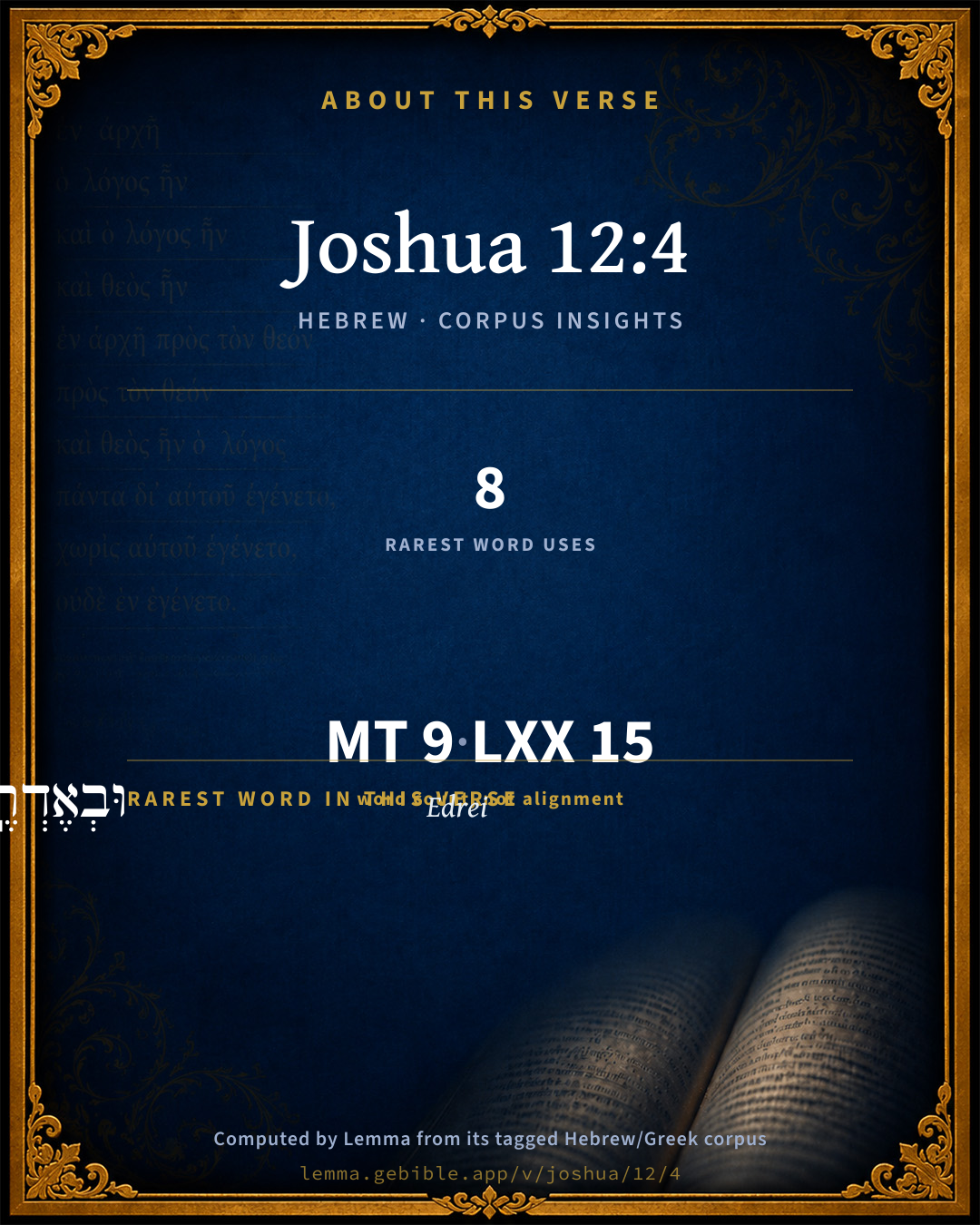
The rarest word here is וּבְאֶדְרֶֽעִי Edrei H154 — appearing just 8 times in the whole Hebrew Bible.

Shared distinctive vocabulary

וּבְאֶדְרֶֽעִי Edrei H154 occurs in 8 verses of the Hebrew Bible. Also found in:

Grammatical profile

  • 1 verb
  • 8 nouns

Verb forms

  • הַיּוֹשֵׁ֥ב Qal · Participle Active

Hebrew & Septuagint length

In English translation the verse runs 21 words from the Hebrew and 17 from the Septuagint (LXX English) — closely comparable.

A rough comparison of the two English renderings, which tokenize alike — not a word-level alignment.

Word counts can differ between the Hebrew and the Greek without any difference in meaning — e.g. the Hebrew direct-object marker אֵת has no separate Greek word, and Greek often adds the article ὁ.

In the original languages it is 9 Hebrew tokens and 15 Greek tokens — but the two are counted differently (Hebrew bundles its prefixes and suffixes into one token; the Greek is in lemma form), so that isn’t a like-for-like length.

Cross-references

5

Topical passages linked to Joshua 12:4 in the Treasury of Scripture Knowledge — connected by theme and wording, ordered by reader-vote popularity; previews shown in the World English Bible.

  • Deuteronomy 1:4 after he had struck Sihon the king of the Amorites, who lived in Heshbon, and Og the king of Bashan, who lived in Ashtaroth, at Edrei.
  • Numbers 21:33–35 They turned and went up by the way of Bashan: and Og the king of Bashan went out against them, he and all his people, to battle at Edrei.
  • Deuteronomy 3:10–11 all the cities of the plain, and all Gilead, and all Bashan, to Salecah and Edrei, cities of the kingdom of Og in Bashan.
  • Joshua 13:12 all the kingdom of Og in Bashan, who reigned in Ashtaroth and in Edrei (the same was left of the remnant of the Rephaim); for these did Moses strike, and drove them out.
  • Deuteronomy 3:1–7 Then we turned, and went up the way to Bashan: and Og the king of Bashan came out against us, he and all his people, to battle at Edrei.

Cross-references courtesy of OpenBible.info (CC BY 4.0).

Hebrew and Greek witnesses Masoretic Hebrew ↔ Greek Septuagint

The same verse in the two great witnesses to the Old Testament, shown verse-for-verse.

These are two independent witnesses, not word-aligned to each other, and the Septuagint is shown in lemma (dictionary) form.

Hebrew Joshua 12:4 Masoretic · Westminster Leningrad Codex

וּגְב֗וּל ע֚וֹג מֶ֣לֶךְ הַבָּשָׁ֔ן מִיֶּ֖תֶר הָרְפָאִ֑ים הַיּוֹשֵׁ֥ב בְּעַשְׁתָּר֖וֹת וּבְאֶדְרֶֽעִי

and the border of Og king of Bashan, of the remnant of the Rephaim, who lived at Ashtaroth and at Edrei,

World English Bible · Public Domain

Greek LXX Joshua 12:4 Septuagint · lemma form

καί ωγ βασιλεύς βασαν ὑπολείπω ἐκ ὁ γίγας ὁ καταοἰκέω ἐν ασταρωθ καί ἐν εδραϊν

And Og king of Basan, who lived in Astaroth and in Edrain, was left of the giants

LXX2012 (modern English Septuagint) · Public Domain

Hebrew: Westminster Leningrad Codex (CC BY 4.0). Greek: Septuagint (public domain); English from LXX2012 (modern English Septuagint) (Public Domain). How the Septuagint differs from the Hebrew →

Targum (Aramaic paraphrase)

1

The Targum is the ancient Jewish Aramaic paraphrase of the Hebrew Scriptures — an interpretive translation, not the Hebrew text itself. Onkelos (literal) and Pseudo-Jonathan (expansive) render the Torah, and Jonathan the Prophets. Coverage is partial: where no permissively-licensed English translation exists for a verse, only the Aramaic is shown. This is verse-level text, not a word-by-word alignment to the Hebrew.

  1. Targum Jonathan Prophets (Joshua–Malachi)
    וּתְחוּם עוֹג מַלְכָּא דְמַתְנָן מִשְׁאַר גִבָּרַיָא דְיָתֵיב בְּעַשְׁתָּרוֹת וּבְאֶדְרְעִי:

    (no public-domain English translation for this verse)

    Targum Jonathan — Aramaic: “Mikraot Gedolot” (public domain). English: “Sefaria Community Translation” (CC0 1.0 (public-domain dedication)); “London "Chaldee Paraphrase," 1871” (public domain). Text via Sefaria.

Commentary

Notes on Joshua 12:4 from classic Christian and Jewish commentators (each source and its license shown beneath its notes). The classic Christian expositions comment on the surrounding passage and are grouped to its opening verse, so a note may address several verses; the Jewish commentaries on the Tanakh (Rashi and others) are per-verse, so they appear only where the commentator wrote on this verse.

Lemma curates 59 commentaries, every one of them public domain or Creative Commons licensed, each selected and text-cleaned for this edition rather than reprinted as found. About our sources →

Trapp's Complete Commentary

John Trapp

Jos 12:4 And the coast of Og king of Bashan, [which was] of the remnant of the giants, that dwelt at Ashtaroth and at Edrei,

Ver. 4. Which was of the remnant of giants.] Slain by the Ammonites. {Deu 2:20; Deu 3:11} Raphaims, they called themselves, that is, Physicians or Preservers; but indeed they were Zamzummims, that is, boisterous and abominable. Nomen inane, crimen immane.

John Trapp, A Commentary or Exposition upon All the Books of the Old and New Testament (1647–1656) — public domain. Text from a community e-Sword module.

Tyndale Open Study Notes

Tyndale Open Resources

12:4 King Og of Bashan: See Num 21:33-35. • The Rephaites were an indigenous people who lived on both sides of the Jordan. Many scholars have concluded that the Rephaites were unusually tall (see Deut 3:11). • Ashtaroth and Edrei: Many rulers of large kingdoms had palaces in more than one of their cities. The fact that Joshua credits only Og with more than one capital indicates that his kingdom was much larger than others Israel encountered, except for Sihon’s.

Tyndale Open Study Notes — © Tyndale Open Resources, licensed CC BY-SA 4.0. Text via the HelloAO Bible API.

Adam Clarke's Commentary

Verse 4. Coast of Og king of Bashan] Concerning this person see the notes on De 3:11, and on Nu 21:35, c.

The remnant or the giants] Or, Rephaim. See the notes on Ge 6:4; Ge 14:5, and De 2:7; De 2:11.

Adam Clarke's Commentary on the Bible (1810–1826) — public domain. Text from a community e-Sword/MySword module.

The Cambridge Bible for Schools and Colleges

gen. ed. J. J. S. Perowne

4. the coast of Og] See Num_21:33; Num_21:35; Deu_3:4; Deu_3:10.

at Ashtaroth] The residence of Og. It is now called Tel Ashterah, or Asherah. The Tel (hill) rises to a height of between fifty and a hundred feet from the level of the plain, in which ruins lie scattered. At the foot of the hill are ancient foundations of walls and copious springs.

at Edrei] = Strength. Here, “in the Thermopylæ of his kingdom,” Og was slain. See Num_21:33-35; Deu_3:1-3. On a rocky promontory, 1½ miles wide, and 2½ miles long, south-west of the basaltic district of Argob, rose the city, “without water, without access save over rocks, and through defiles almost impracticable. Strength and security seem to have been the great objects kept in view, and to these all other advantages were sacrificed.” By the Greeks it was called Adraa; by the Crusaders Adratum, also Civitas Bernardi de Stampis, now Edr’a. In a.d. 1142 the Crusaders under Baldwin III. made a sudden attack upon it, but without success. The historian of the Crusades, in his account of this incident, refers to the immense subterranean cisterns that abound in the neighbourhood of the city, among the rocks, and the modern traveller is astonished at the extent and number of reservoirs, not only here but in all the other towns and villages in the Lejah, and in Jebel Haurân. Porter’s Handbook, 11. 533, 534.

The Cambridge Bible for Schools and Colleges (gen. ed. J. J. S. Perowne; Cambridge University Press, 1878–1918) — public domain. Text from a community e-Sword module.

John Gill's Exposition

And the coast of Og king of Bashan,.... The country that he reigned over, who was another king of the Amorites, smitten by Israel in the times of Moses:

which was of the remnant of the giants; See Gill on Deu 3:11,

that dwelt at Ashtaroth and at Edrei; of which two places see Deu 1:4; it seems as if Og had a palace in each of those cities, and sometimes was at one and sometimes at another, as is usual with kings.

John Gill's Exposition of the Whole Bible (1746–1763) — public domain (CC PDM 1.0). Text via the HelloAO Bible API.

Haydock's Catholic Bible Commentary

Og. See Numbers xxi. 33., and Deuteronomy iii. 11.

George Leo Haydock (1774–1849), Haydock's Catholic Family Bible and Commentary, 1859 edition — public domain. Excludes Psalms (Douay-Rheims chapter numbering differs from Protestant) and Deuterocanonical books (Catholic canon only).

Matthew Poole's English Annotations

To wit, successively; sometimes at the one, sometimes at the other city; both being his royal mansions.

Matthew Poole's English Annotations on the Holy Bible (1683–1685) — public domain. Text from a community e-Sword/MySword module.

Whedon's Commentary on the Bible

Daniel D. Whedon

4. The coast of Og — The territory of this king, with its boundaries.

Remnant of the giants — Or, of the Rephaim. A race of giants who once peopled Eastern Palestine. Gen_14:5. On Og’s gigantic stature see at Deu_3:11. On Ashtaroth and Edrei see note at Jos_13:31.

[5. Salcah — A city in the eastern border of Bashan, now called Sulkhad. It stands on a conical hill at the southern extremity of Jebel Hauran. J.L. Porter, writing in 1868, says: “It has long been deserted, and yet, as nearly as I could estimate, five hundred of its houses are still standing, and from three to four hundred families might settle in it at any moment without laying a stone, or spending an hour’s labour on repairs. The circumference of the town and castle together is about three miles.” The Geshurites were the inhabitants of Geshur, a district on the borders of Bashan and Syria, probably embracing, as Porter concludes, the northern section of the wild and rocky region now known as el-Lejah. The Maachathites occupied a region on the north of Palestine, and apparently extending from near the fountains of the Jordan under Hermon eastward to the plain of Damascus and the defiles of the Argob. Both the Geshurites and the Maachathites were warlike peoples, and were not expelled from their coasts by the warriors of Israel. Jos_13:13. On the tribal divisions of this trans-Jordanic territory see notes on Jos_13:15-33.]

Daniel D. Whedon (gen. ed.), Commentary on the Old and New Testaments (1874–1909) — public domain. Text from a community e-Sword module.

The Pulpit Commentary

The giants. Hebrew, Rephaim. (cf. Gen_14:5 Gen_15:20; also Jos_17:15) The word, according to Ewald, is equivalent to "stretched out." It was also applied to the dead. The Rephaim were one of the various tribes of giants, like the Anakims, Zuzims, and Emims, of whom we read in the land of Canaan. They occupied the land of Bashan and "half Gilead that is, its northern portion. (see Deu_3:13) The term "remnant" would imply that they had suffered some reverses at the hands of the other tribes, though they still remained in possession of their populous territory in the north. This view is confirmed by Gen_14:5. Ashtaroth. (see note on Jos_9:10) Edrei. Or "the strong city," "the city of the arm," according to Gesen., "Thes.," s.v. This name, together with the immense number of ruined cities which have been found of late years in a marvellous state of preservation in this region, shows that Og was a powerful monarch. The ease with which he was overcome bears witness to the enervating effects of luxury and licentiousness upon a people of strong physique, vast numbers, and high civilisation.

The Pulpit Commentary (1880–1919), ed. H.D.M. Spence-Jones & Joseph S. Exell — public domain. Text from a community e-Sword module.

John Wesley's Explanatory Notes

Ashtaroth and Edrei - Sometimes at the one, sometimes at the other city; both being his royal mansions. But Israel made one grave serve him, who could not be contented with one palace.

John Wesley, Explanatory Notes Upon the Whole Bible (1754–1765) — public domain. Text via the GEBible commentary corpus.

Lesson kit

Teaching starters — assembled from the data on this page, not authored interpretation. Every prompt links to the verse data it draws on. Edit before teaching.

Joshua, in the Historical, opens this verse with 9 words (9 distinct Hebrew lemmas). Its most distinctive word is ʼedreʻîy (“Edrei”). A historical commentator’s framing appears above. Read the whole chapter for the surrounding context.

Discussion questions

  1. How does “Edrei” (ʼedreʻîy) shape what this verse is saying?
  2. How does Numbers 21:33, which shares the word «Edrei», read alongside this verse?
  3. These translations render this verse differently. What is at stake in choosing one wording over another?
  4. «הַיּוֹשֵׁ֥ב» is a Qal Participle Active verb. How does that grammatical form shape the action described?
  5. Compare how Trapp's Complete Commentary and Tyndale Open Study Notes read this verse. Where do they agree or differ?

Things to notice

Reading settings

Reading text

Shown beneath each verse's original-language words.

Old Testament
Old Testament edition

Read the OT as the Masoretic Hebrew (MT) or the Greek Septuagint (LXX).

English shown for the Greek Septuagint (in the Hebrew ↔ Greek comparison).

Comparing translations? Open the Compare panel on any verse page to stack up to four side by side.