
Numbers 21:23

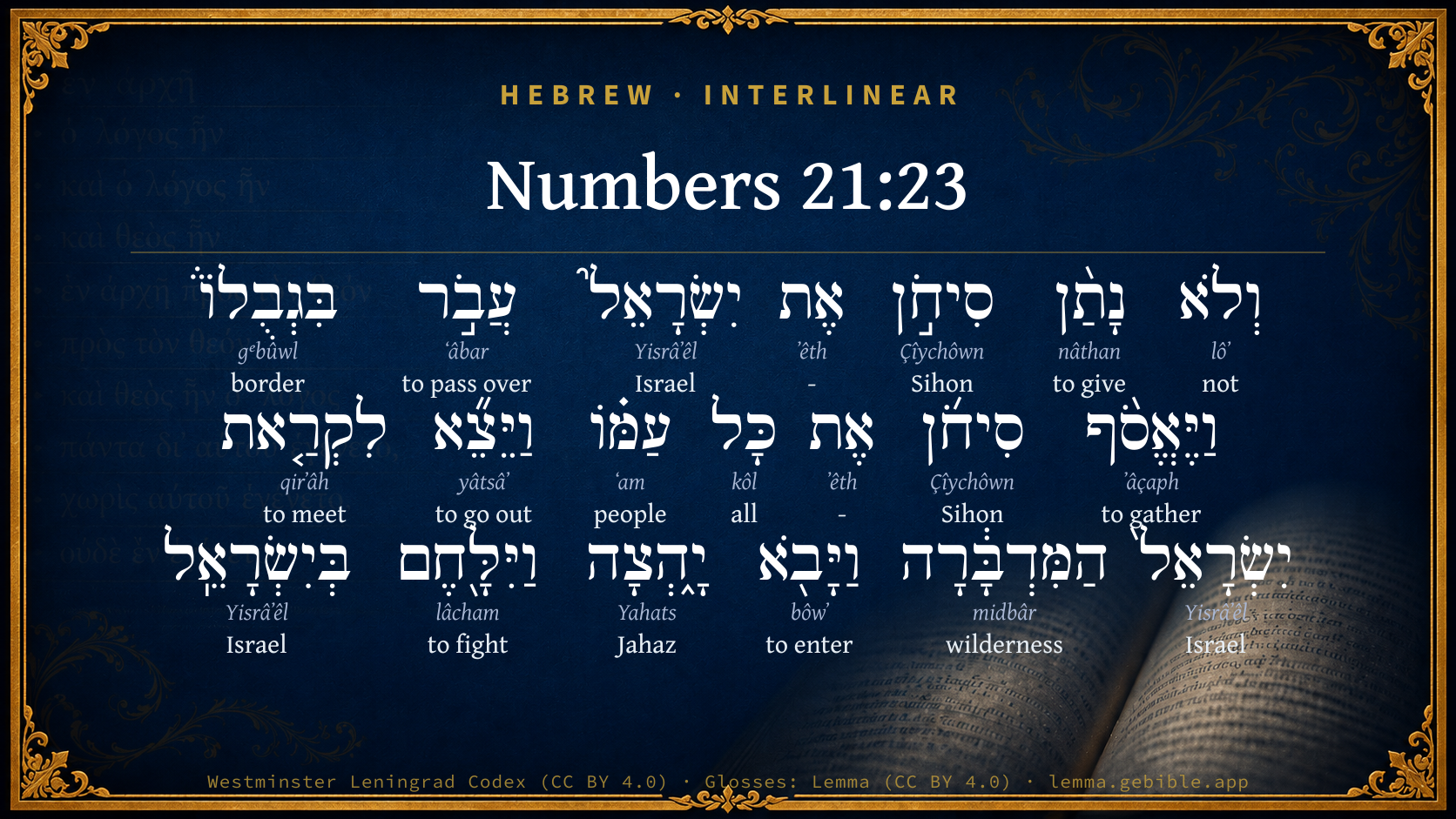
Hebrew (Westminster Leningrad Codex) Numbers 21:23 appears in the Hebrew Old Testament. The text above is from the Westminster Leningrad Codex. Each word links to its Strong’s number, a concise gloss, and parsing drawn from the Open Scriptures Hebrew Bible morphology. Click any word for its full Brown-Driver-Briggs (BDB) entry.
Download image
Cite this verse

Numbers 21:23 (World English Bible). Public Domain. Lemma interlinear Bible study tool, https://lemma.gebible.app/v/numbers/21/23.

Show BibTeX & RIS
BibTeX
RIS
English Translation
Sihon would not allow Israel to pass through his border: but Sihon gathered all his people together, and went out against Israel into the wilderness, and came to Jahaz; and he fought against Israel.
World English Bible · Public Domain
Highlights
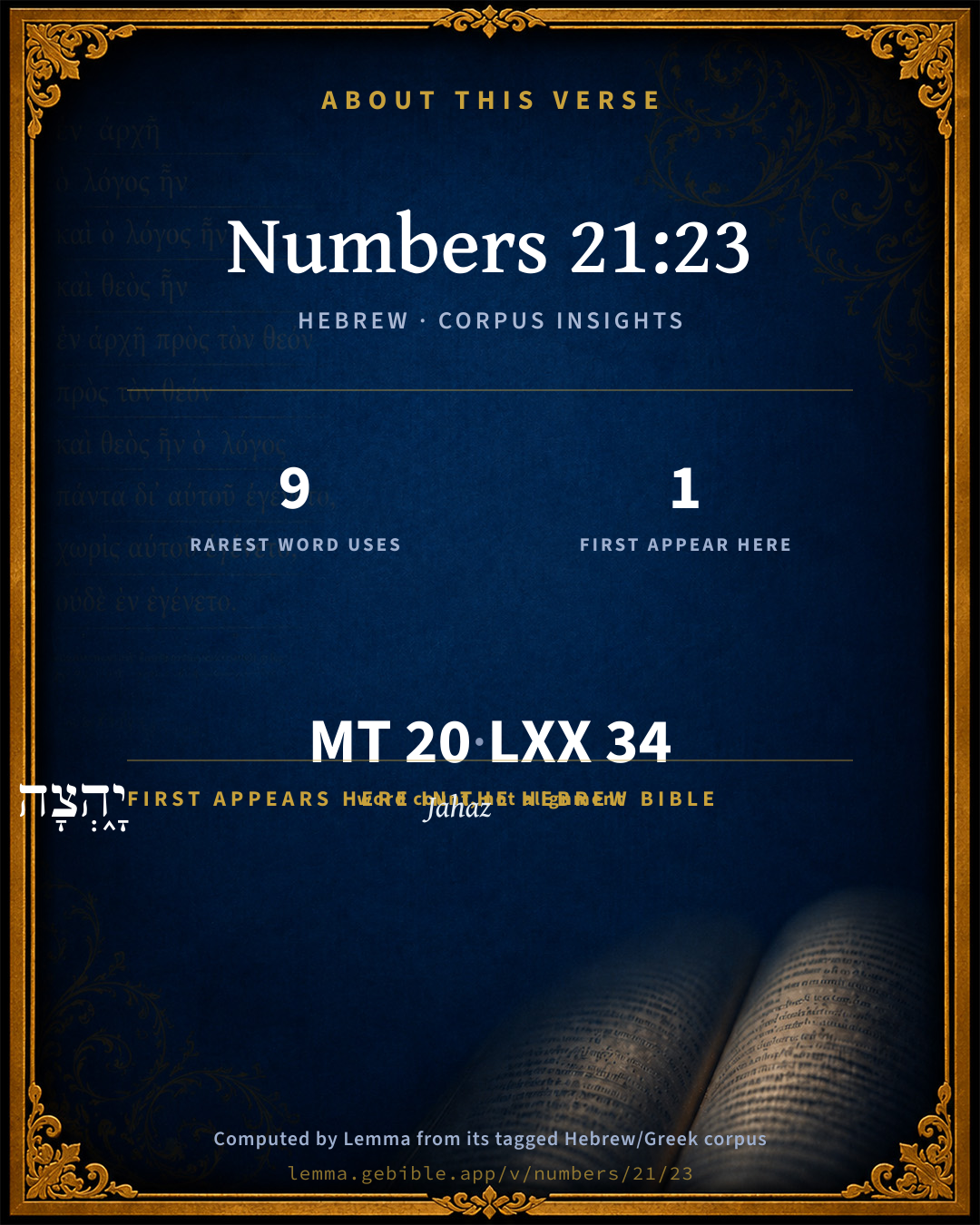
  • 1 first appearance in the Hebrew Bible
Full analysis ↓
Download a study sheet

One document with this verse’s original text, its word-by-word gloss line, the meaning frame, cross-references with their text, attributed commentary, and full source and license credits — printable, and it pastes into notes with its structure intact.

This verse Autodidact and up

Study sheet (.html) Plain text (.txt)

A passage Seminary Student

Up to 50 verses in one chapter. A passage sheet keeps up to 6 commentary sources and 12 cross-references per verse, in the order this page ranks them, and says so on the sheet whenever that leaves anything out. Ask for a single verse and you get the Autodidact verse sheet above.

Everything on this page stays free to read, with no account — the sheet is a download of what is already on screen, not access to it.

Want to remove ads? Support Godless Engineer
Compare translations 3

The same verse in 3 English versions, stacked beneath the original-language interlinear above. Click any original word for its lexicon entry.

Each is an independent rendering of the whole verse — the interlinear is not word-aligned to these translations.

Highlighted words mark where these versions differ — a whole-verse word diff, not a word-by-word alignment.

  • World English Bible Public Domain
    Sihon would not allow Israel to pass through his border: but Sihon gathered all his people together, and went out against Israel into the wilderness, and came to Jahaz; and he fought against Israel.
  • King James Version Public Domain
    And Sihon would not suffer Israel to pass through his border: but Sihon gathered all his people together, and went out against Israel into the wilderness: and he came to Jahaz, and fought against Israel.
  • unfoldingWord Literal Text CC BY-SA 4.0
    And Sihon did not give Israel to pass through his border, and Sihon gathered all his people and went out to meet Israel toward the wilderness, and he came to Jahaz and fought against Israel.

unfoldingWord Literal Text — © unfoldingWord, licensed CC BY-SA 4.0. Word-aligned USFM3 via Door43 (git.door43.org/unfoldingWord/en_ult).

Versions to compare (up to 4)

3 of 4 selected

Show all 18 translations

Every available English version of this verse, each an independent rendering of the whole verse.

  • World English Bible Public Domain
    Sihon would not allow Israel to pass through his border: but Sihon gathered all his people together, and went out against Israel into the wilderness, and came to Jahaz; and he fought against Israel.
  • Berean Standard Bible Public Domain
    But Sihon would not let Israel pass through his territory. Instead, he gathered his whole army and went out to confront Israel in the wilderness. When he came to Jahaz, he fought against Israel.
  • Majority Standard Bible Public Domain
    But Sihon would not let Israel pass through his territory. Instead, he gathered his whole army and went out to confront Israel in the wilderness. When he came to Jahaz, he fought against Israel.
  • King James Version Public Domain
    And Sihon would not suffer Israel to pass through his border: but Sihon gathered all his people together, and went out against Israel into the wilderness: and he came to Jahaz, and fought against Israel.
  • American Standard Version (1901) Public Domain
    And Sihon would not suffer Israel to pass through his border: but Sihon gathered all his people together, and went out against Israel into the wilderness, and came to Jahaz; and he fought against Israel.
  • Revised Version (1885) Public Domain
    And Sihon would not suffer Israel to pass through his border: but Sihon gathered all his people together, and went out against Israel into the wilderness, and came to Jahaz: and he fought against Israel.
  • Geneva Bible (1599) Public Domain
    But Sihon gaue Israel no licence to passe through his countrey, but Sihon assembled all his people, and went out against Israel into the wildernesse: and he came to Iahoz, and fought against Israel.
  • Douay-Rheims (1899) Public Domain
    And he would not grant that Israel should pass by his borders: but rather gathering an army, went forth to meet them in the desert, and came to Jasa, and fought against them.
  • Young's Literal Translation Public Domain
    And Sihon hath not suffered Israel to pass through his border, and Sihon gathereth all his people, and cometh out to meet Israel into the wilderness, and cometh in to Jahaz, and fighteth against Israel.
  • Literal Standard Version CC BY-SA 4.0
    And Sihon has not permitted Israel to pass through his border, and Sihon gathers all his people, and comes out to meet Israel in the wilderness, and comes to Jahaz, and fights against Israel.
  • Unlocked Literal Bible CC BY-SA 4.0
    But King Sihon would not allow Israel to pass through their border. Instead, Sihon gathered all his army together and attacked Israel in the wilderness. He came to Jahaz, where he fought against Israel.
  • unfoldingWord Literal Text CC BY-SA 4.0
    And Sihon did not give Israel to pass through his border, and Sihon gathered all his people and went out to meet Israel toward the wilderness, and he came to Jahaz and fought against Israel.
  • Darby Bible Public Domain
    But Sihon would not suffer Israel to go through his border; and Sihon gathered all his people, and went out against Israel into the wilderness, and came to Jahaz, and fought against Israel.
  • World Messianic Bible Public Domain
    Sihon would not allow Israel to pass through his border, but Sihon gathered all his people together, and went out against Israel into the wilderness, and came to Jahaz. He fought against Israel.
  • Webster's Bible Public Domain
    And Sihon would not suffer Israel to pass through his border: but Sihon collected all his people, and went out against Israel into the wilderness: and he came to Jahaz, and fought against Israel:
  • Free Bible Version CC BY-SA 4.0
    But Sihon refused to allow the Israelites to travel through his territory. Instead, he called out his whole army and went out to meet the Israelites head-on in the desert. When he arrived at Jahaz, he attacked the Israelites.
  • Bible in Basic English Public Domain
    And Sihon would not let Israel go through his land; but got all his people together and went out against Israel into the waste land, as far as Jahaz, to make war on Israel.
  • JPS Tanakh (1917) Public Domain
    And Sihon would not suffer Israel to pass through his border; but Sihon gathered all his people together, and went out against Israel into the wilderness, and came to Jahaz; and he fought against Israel.

Literal Standard Version (2020), Covenant Press — licensed CC BY-SA 4.0. Text via the HelloAO Bible API (eBible.org). Unlocked Literal Bible (unfoldingWord) — licensed CC BY-SA 4.0. Text via the HelloAO Bible API (eBible.org). unfoldingWord Literal Text — © unfoldingWord, licensed CC BY-SA 4.0. Word-aligned USFM3 via Door43 (git.door43.org/unfoldingWord/en_ult). Free Bible Version, Dr. Jonathan Gallagher — licensed CC BY-SA 4.0. Text via the HelloAO Bible API (eBible.org).

Word by word

More ways to search: Search by grammar → Find every occurrence → Compare this word →

Practice this passage: Drill this verse → Learn its vocabulary →

יָ֑הְצָה
Yahats
H3096
“Jahaz · toward”
Noun, Proper + Suffix, Demonstrative
Part of Speech
Noun
Type
Proper
Full BDB Definition

Origin: from an unused root meaning to stamp

TWOT: None

Jahaz or Jahazah or Jahzah = "trodden down" - a place in Reuben east of the Dead Sea where Israel defeated Sihon king of the Amorites; site uncertain
  1. וְלֹא lôʼ H3808 “and · not” Conjunction + Particle, Negative
  2. נָתַ֨ן nâthan H5414 “to give” Verb, Qal, Perfect, 3rd Person, Masculine, Singular
  3. סִיחֹ֣ן Çîychôwn H5511 “Sihon” Noun, Proper
  4. אֶת ʼêth H853 “-” Particle, Direct Object
  5. יִשְׂרָאֵל֮ Yisrâʼêl H3478 “Israel” Noun, Proper
  6. עֲבֹ֣ר ʻâbar H5674 “to pass over” Verb, Qal, Infinitive Construct
  7. בִּגְבֻלוֹ֒ gᵉbûwl H1366 “in/at · border · his” Preposition + Noun, Common, Masculine, Singular, Construct + Suffix, Personal, 3rd Person, Masculine, Singular
  8. וַיֶּאֱסֹ֨ף ʼâçaph H622 “and · to gather” Conjunction + Verb, Qal, Sequential Imperfect, 3rd Person, Masculine, Singular
  9. סִיחֹ֜ן Çîychôwn H5511 “Sihon” Noun, Proper
  10. אֶת ʼêth H853 “-” Particle, Direct Object
  11. כָּל kôl H3605 “all of” Noun, Common, Masculine, Singular, Construct
  12. עַמּ֗וֹ ʻam H5971 “people · his” Noun, Common, Masculine, Singular, Construct + Suffix, Personal, 3rd Person, Masculine, Singular
  13. וַיֵּצֵ֞א yâtsâʼ H3318 “and · to go out” Conjunction + Verb, Qal, Sequential Imperfect, 3rd Person, Masculine, Singular
  14. לִקְרַ֤את qirʼâh H7125 “to meet” Preposition + Verb, Qal, Infinitive Construct
  15. יִשְׂרָאֵל֙ Yisrâʼêl H3478 “Israel” Noun, Proper
  16. הַמִּדְבָּ֔רָה midbâr H4057 “the · wilderness · toward” Particle, Definite Article + Noun, Common, Masculine, Singular, Absolute + Suffix, Demonstrative
  17. וַיָּבֹ֖א bôwʼ H935 “and · to enter” Conjunction + Verb, Qal, Sequential Imperfect, 3rd Person, Masculine, Singular
  18. וַיִּלָּ֖חֶם lâcham H3898 “and · to fight” Conjunction + Verb, Niphal, Sequential Imperfect, 3rd Person, Masculine, Singular
  19. בְּיִשְׂרָאֵֽל Yisrâʼêl H3478 “in/at · Israel” Preposition + Noun, Proper

About this verse

These counts appear in no published source. They are computed here, from the morphology-tagged text and Lemma’s own curated glosses. What Lemma adds →

20
words
16
distinct lemmas
Pentateuch
section

Notable vocabulary

The rarest word here is יָ֑הְצָה Jahaz H3096 — appearing just 9 times in the whole Hebrew Bible.

First appearance in Scripture

This word makes its first canonical appearance in the Hebrew Bible here:

  • יָ֑הְצָה Jahaz H3096

Shared distinctive vocabulary

יָ֑הְצָה Jahaz H3096 occurs in 9 verses of the Hebrew Bible. Also found in:

Grammatical profile

  • 7 verbs
  • 10 nouns
  • 3 particles

Verb forms

  • נָתַ֨ן Qal · Perfect
  • עֲבֹ֣ר Qal · Infinitive Construct
  • וַיֶּאֱסֹ֨ף Qal · Sequential Imperfect
  • וַיֵּצֵ֞א Qal · Sequential Imperfect
  • לִקְרַ֤את Qal · Infinitive Construct
  • וַיָּבֹ֖א Qal · Sequential Imperfect
  • וַיִּלָּ֖חֶם Niphal · Sequential Imperfect

Repetition

Words recur within this verse — often emphatic in Hebrew:

  • יִשְׂרָאֵל֮ Israel H3478 ×3
  • סִיחֹ֣ן Sihon H5511 ×2

Hebrew & Septuagint length

In English translation the verse runs 34 words from the Hebrew and 44 from the Septuagint (LXX English) — closely comparable.

A rough comparison of the two English renderings, which tokenize alike — not a word-level alignment.

Word counts can differ between the Hebrew and the Greek without any difference in meaning — e.g. the Hebrew direct-object marker אֵת has no separate Greek word, and Greek often adds the article ὁ.

In the original languages it is 20 Hebrew tokens and 34 Greek tokens — but the two are counted differently (Hebrew bundles its prefixes and suffixes into one token; the Greek is in lemma form), so that isn’t a like-for-like length.

Cross-references

6

Topical passages linked to Numbers 21:23 in the Treasury of Scripture Knowledge — connected by theme and wording, ordered by reader-vote popularity; previews shown in the World English Bible.

  • Judges 11:20 But Sihon didn't trust Israel to pass through his border; but Sihon gathered all his people together, and encamped in Jahaz, and fought against Israel.
  • Deuteronomy 29:7–8 When you came to this place, Sihon the king of Heshbon, and Og the king of Bashan, came out against us to battle, and we struck them:
  • Numbers 20:21 Thus Edom refused to give Israel passage through his border: why Israel turned away from him.
  • Deuteronomy 2:30–32 But Sihon king of Heshbon would not let us pass by him; for Yahweh your God hardened his spirit, and made his heart obstinate, that he might deliver him into your hand, as at this day.
  • Isaiah 15:4 Heshbon cries out, and Elealeh; their voice is heard even to Jahaz: therefore the armed men of Moab cry aloud; his soul trembles within him.
  • Jeremiah 48:34 From the cry of Heshbon even to Elealeh, even to Jahaz have they uttered their voice, from Zoar even to Horonaim, to Eglath Shelishiyah: for the waters of Nimrim also shall become desolate.

Cross-references courtesy of OpenBible.info (CC BY 4.0).

Hebrew and Greek witnesses Masoretic Hebrew ↔ Greek Septuagint

The same verse in the two great witnesses to the Old Testament, shown verse-for-verse.

These are two independent witnesses, not word-aligned to each other, and the Septuagint is shown in lemma (dictionary) form.

Hebrew Numbers 21:23 Masoretic · Westminster Leningrad Codex

וְלֹא נָתַ֨ן סִיחֹ֣ן אֶת יִשְׂרָאֵל֮ עֲבֹ֣ר בִּגְבֻלוֹ֒ וַיֶּאֱסֹ֨ף סִיחֹ֜ן אֶת כָּל עַמּ֗וֹ וַיֵּצֵ֞א לִקְרַ֤את יִשְׂרָאֵל֙ הַמִּדְבָּ֔רָה וַיָּבֹ֖א יָ֑הְצָה וַיִּלָּ֖חֶם בְּיִשְׂרָאֵֽל

Sihon would not allow Israel to pass through his border: but Sihon gathered all his people together, and went out against Israel into the wilderness, and came to Jahaz; and he fought against Israel.

World English Bible · Public Domain

Greek LXX Numbers 21:23 Septuagint · lemma form

καί οὐ δίδωμι σηων ὁ ἰσραήλ παραἔρχομαι διά ὁ ὅριον αὐτός καί συνἄγω σηων πᾶς ὁ λαός αὐτός καί ἐκἔρχομαι παρατάσσω ὁ ἰσραήλ εἰς ὁ ἔρημος καί ἔρχομαι εἰς ιασσα καί παρατάσσω ὁ ἰσραήλ

And Seon did not allow Israel to pass through his borders, and Seon gathered all his people, and went out to set the battle in array against Israel into the wilderness; and he came to Jassa, and set the battle in array against Israel.

LXX2012 (modern English Septuagint) · Public Domain

Hebrew: Westminster Leningrad Codex (CC BY 4.0). Greek: Septuagint (public domain); English from LXX2012 (modern English Septuagint) (Public Domain). How the Septuagint differs from the Hebrew →

Targum (Aramaic paraphrase)

2

The Targum is the ancient Jewish Aramaic paraphrase of the Hebrew Scriptures — an interpretive translation, not the Hebrew text itself. Onkelos (literal) and Pseudo-Jonathan (expansive) render the Torah, and Jonathan the Prophets. Coverage is partial: where no permissively-licensed English translation exists for a verse, only the Aramaic is shown. This is verse-level text, not a word-by-word alignment to the Hebrew.

  1. Targum Onkelos Torah (Genesis–Deuteronomy)
    וְלָא שְׁבַק סִיחוֹן יָת יִשְׂרָאֵל לְמֶעְבַּר בִּתְחוּמֵיהּ וּכְנַשׁ סִיחוֹן יָת כָּל עַמֵיהּ וּנְפַק לָקֳדָמוּת יִשְׂרָאֵל לְמַדְבְּרָא וַאֲתָא לְיָהַץ וְאַגִיחַ קְרָבָא בְּיִשְׂרָאֵל

    (no public-domain English translation for this verse)

    Targum Onkelos — Aramaic: “Onkelos Genesis” (public domain); “Onkelos Exodus” (public domain); “Onkelos Leviticus” (public domain); “Onkelos Numbers” (public domain); “Onkelos Deuteronomy” (public domain). English: “Sefaria Community Translation” (CC0 1.0 (public-domain dedication)); “J.W. Etheridge. The Targums of Onkelos and Jonathan Ben Uzziel on the Pentateuch. London: Longmans, Green, 1862” (public domain). Text via Sefaria.

  2. Targum Pseudo-Jonathan Torah (Genesis–Deuteronomy)
    וְלָא שְׁבַק סִיחוֹן יַת יִשְרָאֵל לְמֶעֱבַר בִּתְחוּמֵיהּ וּכְנַשׁ סִיחוֹן יַת כָּל עַמֵיהּ וּנְפַק לִקְדָמוּת יִשְרָאֵל לְמַדְבְּרָא וְאָתָא לְיָהַץ וְאַגַח קְרָבָא בְּיִשְרָאֵל

    But Sihon would not permit Israel to pass through his limit, but constrained all his people, and came out to Jahaz, and made war against Israel.

    Targum Pseudo-Jonathan — Aramaic: “Targum Jonathan on Genesis” (public domain); “Targum Jonathan on Exodus” (public domain); “Targum Jonathan on Leviticus” (public domain); “Targum Jonathan on Numbers” (public domain); “Targum Jonathan on Deuteronomy” (public domain). English: “The Targum of Jonathan ben Uzziel, trans. J. W. Etheridge, London, 1862” (public domain). Text via Sefaria.

Commentary

Notes on Numbers 21:23 from classic Christian and Jewish commentators (each source and its license shown beneath its notes). The classic Christian expositions comment on the surrounding passage and are grouped to its opening verse, so a note may address several verses; the Jewish commentaries on the Tanakh (Rashi and others) are per-verse, so they appear only where the commentator wrote on this verse.

Lemma curates 59 commentaries, every one of them public domain or Creative Commons licensed, each selected and text-cleaned for this edition rather than reprinted as found. About our sources →

Trapp's Complete Commentary

John Trapp

Num 21:23 And Sihon would not suffer Israel to pass through his border: but Sihon gathered all his people together, and went out against Israel into the wilderness: and he came to Jahaz, and fought against Israel.

Ver. 23. And Sihon would not.] He durst not trust them: men muse as they use: God had also hardened his heart, that he might come forth to fetch his own destruction. {Deu 2:30} Judgment need not go to find wicked men out; they run to meet their bane.

John Trapp, A Commentary or Exposition upon All the Books of the Old and New Testament (1647–1656) — public domain. Text from a community e-Sword module.

The Cambridge Bible for Schools and Colleges

gen. ed. J. J. S. Perowne

23. the wilderness] See on Num_21:13.

Jahaz] Deu_2:32, Isa_15:4, Jer_48:34. The form Jahzah is used in Jos_13:18; Jos_21:36, Jdg_11:20 (Heb.), Jer_48:21, 1Ch_6:78. The site is unknown, but it evidently lay on the eastern boundary of Sihon’s territory, since he came thither to prevent Israel from crossing it. In agreement with this it is twice mentioned with Kedemoth (Jos_13:18; Jos_21:36 f.), which is the name of ‘the wilderness’ in Deu_2:26, and twice seems to be named as a limit of Moab, at some distance from Heshbon (Isa_15:4, Jer_48:34).

The Cambridge Bible for Schools and Colleges (gen. ed. J. J. S. Perowne; Cambridge University Press, 1878–1918) — public domain. Text from a community e-Sword module.

John Gill's Exposition

For Heshbon was the city of Sihon the king of the Amorites,.... His royal city, where he kept his palace, where he had resided for some time, and perhaps some of his predecessors; and therefore being now in his possession when taken by the Israelites, they had a good right and title to keep it, and dwell in it: and indeed this is here given as a reason of it:

who had fought against the former king of Moab; either the king that reigned before Balak, or some king of Moab, that reigned formerly, against whom one of the name of Sihon, which might be a common name to the kings of the Amorites, as Pharaoh to the Egyptians, had engaged in war:

and taken all his land out of his hand, even unto Arnon; and had been in the hands of the Amorites some years; and therefore the Moabites had no reason to object to the Israelites dwelling in it, and possessing it, which they had not taken from them, but from the Amorites in a lawful war. And for proof of this, reference is had to the bards and poets of those times, who were the persons that transmitted in verse the history of famous actions to posterity.

John Gill's Exposition of the Whole Bible (1746–1763) — public domain (CC PDM 1.0). Text via the HelloAO Bible API.

Haydock's Catholic Bible Commentary

Jasa was not far from the Arnon, between Medaba and Dibon, Isaias xv. 4. (Eusebius)

George Leo Haydock (1774–1849), Haydock's Catholic Family Bible and Commentary, 1859 edition — public domain. Excludes Psalms (Douay-Rheims chapter numbering differs from Protestant) and Deuterocanonical books (Catholic canon only).

Matthew Poole's English Annotations

Jahaz, a city, of which see Deu 2:32; Jer 48:21.

Matthew Poole's English Annotations on the Holy Bible (1683–1685) — public domain. Text from a community e-Sword/MySword module.

Whedon's Commentary on the Bible

Daniel D. Whedon

23. Jahaz — “A place trodden down.” See Jos_13:18, note.

Fought against Israel — According to Josephus the Amorite army contained every man in the nation fit to bear arms. Being unable to fight when away from the shelter of their cities, and being galled by the slings and arrows of the Hebrews, in their intense thirst the Amorites rushed to the stream, and to the shelter of the ravine of the Arnon, and were slaughtered in vast numbers.

Daniel D. Whedon (gen. ed.), Commentary on the Old and New Testaments (1874–1909) — public domain. Text from a community e-Sword module.

The Pulpit Commentary

And he came to Jahaz, or Jahzah, a place of which we know nothing.

The Pulpit Commentary (1880–1919), ed. H.D.M. Spence-Jones & Joseph S. Exell — public domain. Text from a community e-Sword module.

Rashi

Rabbi Shlomo Yitzchaki (Rashi)

לא נתן סיחון וגו׳ AND SIHON WOULD NOT SUFFER [ISRAEL TO PASS THROUGH HIS BOUNDARY] — For all the Canaanite kings paid him tribute, because he protected them that no hostile forces should pass through his land against them. As soon as Israel said to him, “Let me pass through they land”, he answered them: “The whole purpose of my dwelling here is to protect them against you, and yet you speak thus!” (Midrash Tanchuma, Chukat 23).

ויצא לקראת ישראל AND HE WENT OUT AGAINST ISRAEL — Even if Heshbon had been full of people as puny as gnats, no human being could have captured it, and if Sihon had been (resided) in a weak village no human being could have overcome him. How much the more was he invincible whilst he dwelt in Heshbon. Therefore the Holy One, blessed be He, said: Why should I trouble My children to all this extent, to besiege each city? He therefore put it into the hearts of all the men of war to go forth from the cities, and they assembled all of them in one spot, and there they fell in battle; from there Israel proceeded to the cities and there were none to resist them, for there were only women and children there (Midrash Tanchuma, Chukat 23).

Rashi on the Tanakh — English translations: “The Judaica Press complete Tanach with Rashi, translated by A. J. Rosenberg” (CC BY 4.0); “Pentateuch with Rashi's commentary by M. Rosenbaum and A.M. Silbermann, 1929-1934” (public domain); “The Metsudah Tanach series, Lakewood, N.J” (CC BY 4.0); and “The Book of Joshua, Metsudah Publications, 1997” (CC BY 4.0). Text via Sefaria.

Lesson kit

Teaching starters — assembled from the data on this page, not authored interpretation. Every prompt links to the verse data it draws on. Edit before teaching.

Numbers, in the Pentateuch, opens this verse with 20 words (16 distinct Hebrew lemmas). Its most distinctive word is Yahats (“Jahaz”). A historical commentator’s framing appears above. Read the whole chapter for the surrounding context.

Discussion questions

  1. How does “Jahaz” (Yahats) shape what this verse is saying?
  2. The word “Jahaz” first appears here in Scripture. What is being introduced at this debut?
  3. Deuteronomy 2:32 shares the word «Jahaz» with this verse. How do the two illuminate each other?
  4. “Israel” occurs 3× in this one verse. What is the effect of the repetition?
  5. The translations on this page render this verse differently — a whole-verse word diff, not a word-by-word alignment. What might account for the different wordings?
  6. The verb «נָתַ֨ן» is Qal Perfect. How does its form color the action?
  7. Reading how Trapp's Complete Commentary and The Cambridge Bible for Schools and Colleges read this verse, where do the two commentators agree and where do they part?

Things to notice

Reading settings

Reading text

Shown beneath each verse's original-language words.

Old Testament
Old Testament edition

Read the OT as the Masoretic Hebrew (MT) or the Greek Septuagint (LXX).

English shown for the Greek Septuagint (in the Hebrew ↔ Greek comparison).

Comparing translations? Open the Compare panel on any verse page to stack up to four side by side.