
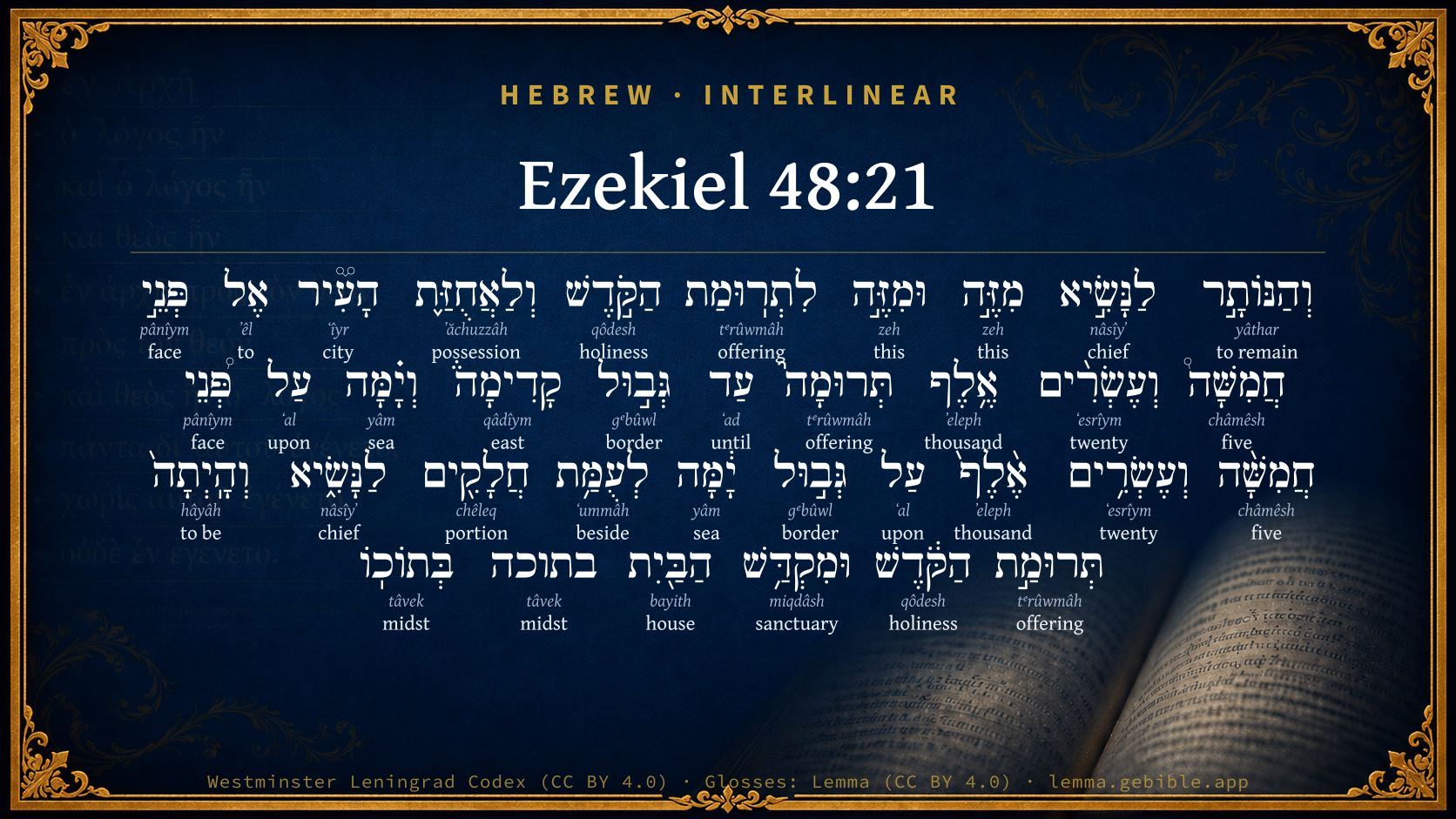
Ezekiel 48:21

Hebrew (Westminster Leningrad Codex) Ezekiel 48:21 appears in the Hebrew Old Testament. The text above is from the Westminster Leningrad Codex. Each word links to its Strong’s number, a concise gloss, and parsing drawn from the Open Scriptures Hebrew Bible morphology. Click any word for its full Brown-Driver-Briggs (BDB) entry.
Download image
Cite this verse

Ezekiel 48:21 (World English Bible). Public Domain. Lemma interlinear Bible study tool, https://lemma.gebible.app/v/ezekiel/48/21.

Show BibTeX & RIS
BibTeX
RIS
English Translation
The residue shall be for the prince, on the one side and on the other of the holy offering and of the possession of the city; in front of the twenty-five thousand of the offering toward the east border, and westward in front of the twenty-five thousand toward the west border, answerable to the portions, it shall be for the prince: and the holy offering and the sanctuary of the house shall be in the midst of it.
World English Bible · Public Domain
Download a study sheet

One document with this verse’s original text, its word-by-word gloss line, the meaning frame, cross-references with their text, attributed commentary, and full source and license credits — printable, and it pastes into notes with its structure intact.

This verse Autodidact and up

Study sheet (.html) Plain text (.txt)

A passage Seminary Student

Up to 50 verses in one chapter. A passage sheet keeps up to 6 commentary sources and 12 cross-references per verse, in the order this page ranks them, and says so on the sheet whenever that leaves anything out. Ask for a single verse and you get the Autodidact verse sheet above.

Everything on this page stays free to read, with no account — the sheet is a download of what is already on screen, not access to it.

Want to remove ads? Support Godless Engineer
Compare translations 3

The same verse in 3 English versions, stacked beneath the original-language interlinear above. Click any original word for its lexicon entry.

Each is an independent rendering of the whole verse — the interlinear is not word-aligned to these translations.

Highlighted words mark where these versions differ — a whole-verse word diff, not a word-by-word alignment.

  • World English Bible Public Domain
    The residue shall be for the prince, on the one side and on the other of the holy offering and of the possession of the city; in front of the twenty-five thousand of the offering toward the east border, and westward in front of the twenty-five thousand toward the west border, answerable to the portions, it shall be for the prince: and the holy offering and the sanctuary of the house shall be in the midst of it.
  • King James Version Public Domain
    And the residue shall be for the prince, on the one side and on the other of the holy oblation, and of the possession of the city, over against the five and twenty thousand of the oblation toward the east border, and westward over against the five and twenty thousand toward the west border, over against the portions for the prince: and it shall be the holy oblation; and the sanctuary of the house shall be in the midst thereof.
  • unfoldingWord Literal Text CC BY-SA 4.0
    The rest of the land on either side of the holy offering and the city area will be for the prince. The prince’s tract of land to the east will extend for twenty-five thousand cubits from boundary of the holy offering to the eastern border—and his tract to the west will extend for twenty-five thousand cubits to the western border. In the middle will be the holy offering, and the holy place of the temple will be in its midst.

unfoldingWord Literal Text — © unfoldingWord, licensed CC BY-SA 4.0. Word-aligned USFM3 via Door43 (git.door43.org/unfoldingWord/en_ult).

Versions to compare (up to 4)

3 of 4 selected

Show all 18 translations

Every available English version of this verse, each an independent rendering of the whole verse.

  • World English Bible Public Domain
    The residue shall be for the prince, on the one side and on the other of the holy offering and of the possession of the city; in front of the twenty-five thousand of the offering toward the east border, and westward in front of the twenty-five thousand toward the west border, answerable to the portions, it shall be for the prince: and the holy offering and the sanctuary of the house shall be in the midst of it.
  • Berean Standard Bible Public Domain
    The remaining area on both sides of the holy portion and of the property of the city will belong to the prince. He will own the land adjacent to the tribal portions, extending eastward from the 25,000 cubits of the holy district toward the eastern border, and westward from the 25,000 cubits to the western border. And in the center of them will be the holy portion and the sanctuary of the temple.
  • Majority Standard Bible Public Domain
    The remaining area on both sides of the holy portion and of the property of the city will belong to the prince. He will own the land adjacent to the tribal portions, extending eastward from the 25,000 cubits of the holy district toward the eastern border, and westward from the 25,000 cubits to the western border. And in the center of them will be the holy portion and the sanctuary of the temple.
  • King James Version Public Domain
    And the residue shall be for the prince, on the one side and on the other of the holy oblation, and of the possession of the city, over against the five and twenty thousand of the oblation toward the east border, and westward over against the five and twenty thousand toward the west border, over against the portions for the prince: and it shall be the holy oblation; and the sanctuary of the house shall be in the midst thereof.
  • American Standard Version (1901) Public Domain
    And the residue shall be for the prince, on the one side and on the other of the holy oblation and of the possession of the city; in front of the five and twenty thousand of the oblation toward the east border, and westward in front of the five and twenty thousand toward the west border, answerable unto the portions, it shall be for the prince: and the holy oblation and the sanctuary of the house shall be in the midst thereof.
  • Revised Version (1885) Public Domain
    And the residue shall be for the prince, on the one side and on the other of the holy oblation and of the possession of the city, in front of the five and twenty thousand of the oblation toward the east border, and westward in front of the five and twenty thousand toward the west border, answerable unto the portions, it shall be for the prince: and the holy oblation and the sanctuary of the house shall be in the midst thereof.
  • Geneva Bible (1599) Public Domain
    And the residue shalbe for the prince on the one side and on the other of the oblation of the Sanctuarie, and of the possession of the citie, ouer against the fiue and twentie thousand of the oblation toward the East border, and Westward ouer against the fiue and twentie thousande towarde the West border, ouer against shalbe for the portion of the prince: this shall be the holy oblation, and the house of the Sanctuarie shalbe in the middes thereof.
  • Douay-Rheims (1899) Public Domain
    And the residue shall be for the prince on every side of the firstfruits of the sanctuary, and of the possession of the city over against the five and twenty thousand of the firstfruits unto the east border: toward the sea also over against the five and twenty thousand, unto the border of the sea, shall likewise be the portion of the prince: and the firstfruits of the sanctuary, and the sanctuary of the temple shall be in the midst thereof.
  • Young's Literal Translation Public Domain
    `And the residue `is' for the prince, on this side and on that side of the heave-offering of the holy `portion', and of the possession of the city, on the front of the five and twenty thousand of the heave-offering unto the east border, and westward, on the front of the five and twenty thousand on the west border, over-against the portions of the prince; and the heave-offering of the holy `portion', and the sanctuary of the house, hath been in its midst.
  • Literal Standard Version CC BY-SA 4.0
    And the remainder [is] for the prince, on this side and on that side of the raised-offering of the holy [portion], and of the possession of the city, on the front of the twenty-five thousand of the raised-offering to the east border, and westward, on the front of the twenty-five thousand on the west border, alongside the portions of the prince; and the raised-offering of the holy [portion], and the sanctuary of the house, has been in its midst.
  • Unlocked Literal Bible CC BY-SA 4.0
    The rest of the land on either side of the holy offering and the city area will be for the prince. The prince's tract of land to the east will extend for twenty-five thousand cubits from boundary of the holy offering to the eastern border—and his tract to the west will extend for twenty-five thousand cubits to the western border. In the middle will be the holy offering, and the holy place of the temple will be in its midst.
  • unfoldingWord Literal Text CC BY-SA 4.0
    The rest of the land on either side of the holy offering and the city area will be for the prince. The prince’s tract of land to the east will extend for twenty-five thousand cubits from boundary of the holy offering to the eastern border—and his tract to the west will extend for twenty-five thousand cubits to the western border. In the middle will be the holy offering, and the holy place of the temple will be in its midst.
  • Darby Bible Public Domain
    And the rest shall be for the prince, on the one side and on the other of the holy heave-offering and of the possession of the city, in front of the five and twenty thousand of the heave-offering toward the east border, and westward in front of the five and twenty thousand toward the west border, answering to the [other] portions: it shall be for the prince; and the holy heave-offering and the sanctuary of the house shall be in the midst of it.
  • World Messianic Bible Public Domain
    “The remainder shall be for the prince, on the one side and on the other of the holy offering and of the possession of the city; in front of the twenty-five thousand of the offering toward the east border, and westward in front of the twenty-five thousand toward the west border, alongside the portions, it shall be for the prince. The holy offering and the sanctuary of the house shall be in the middle of it.
  • Webster's Bible Public Domain
    And the residue shall be for the prince, on the one side and on the other of the holy oblation, and of the possession of the city, over against the five and twenty thousand of the oblation towards the east border, and westward over against the five and twenty thousand towards the west border, over against the portions for the prince: and it shall be the holy oblation; and the sanctuary of the house shall be in the midst of it.
  • Free Bible Version CC BY-SA 4.0
    The land that remains on both sides of the holy allocation and of the area for the city will belong to the prince. This land will be next to the tribal allocations and extend east from the 25,000 cubits of the holy section to the eastern border, on the other side west from the 25,000 cubits to the western border. In the middle of them will be the holy section and the Temple sanctuary.
  • Bible in Basic English Public Domain
    And the rest is to be for the prince, on this side and on that side of the holy offering and of the property of the town, in front of the twenty-five thousand to the east, as far as the east limit, and to the west, in front of the twenty-five thousand, as far as the west limit, and of the same measure as those parts; it will be the property of the prince: and the holy offering and holy place of the house will be in the middle of it.
  • JPS Tanakh (1917) Public Domain
    And the residue shall be for the prince, on the one side and on the other of the holy offering and of the possession of the city, in front of the five and twenty thousand of the offering toward the east border, and westward in front of the five and twenty thousand toward the west border, answerable unto the portions, it shall be for the prince; and the holy offering and the sanctuary of the house shall be in the midst thereof.

Literal Standard Version (2020), Covenant Press — licensed CC BY-SA 4.0. Text via the HelloAO Bible API (eBible.org). Unlocked Literal Bible (unfoldingWord) — licensed CC BY-SA 4.0. Text via the HelloAO Bible API (eBible.org). unfoldingWord Literal Text — © unfoldingWord, licensed CC BY-SA 4.0. Word-aligned USFM3 via Door43 (git.door43.org/unfoldingWord/en_ult). Free Bible Version, Dr. Jonathan Gallagher — licensed CC BY-SA 4.0. Text via the HelloAO Bible API (eBible.org).

Word by word

More ways to search: Search by grammar → Find every occurrence → Compare this word →

Practice this passage: Drill this verse → Learn its vocabulary →

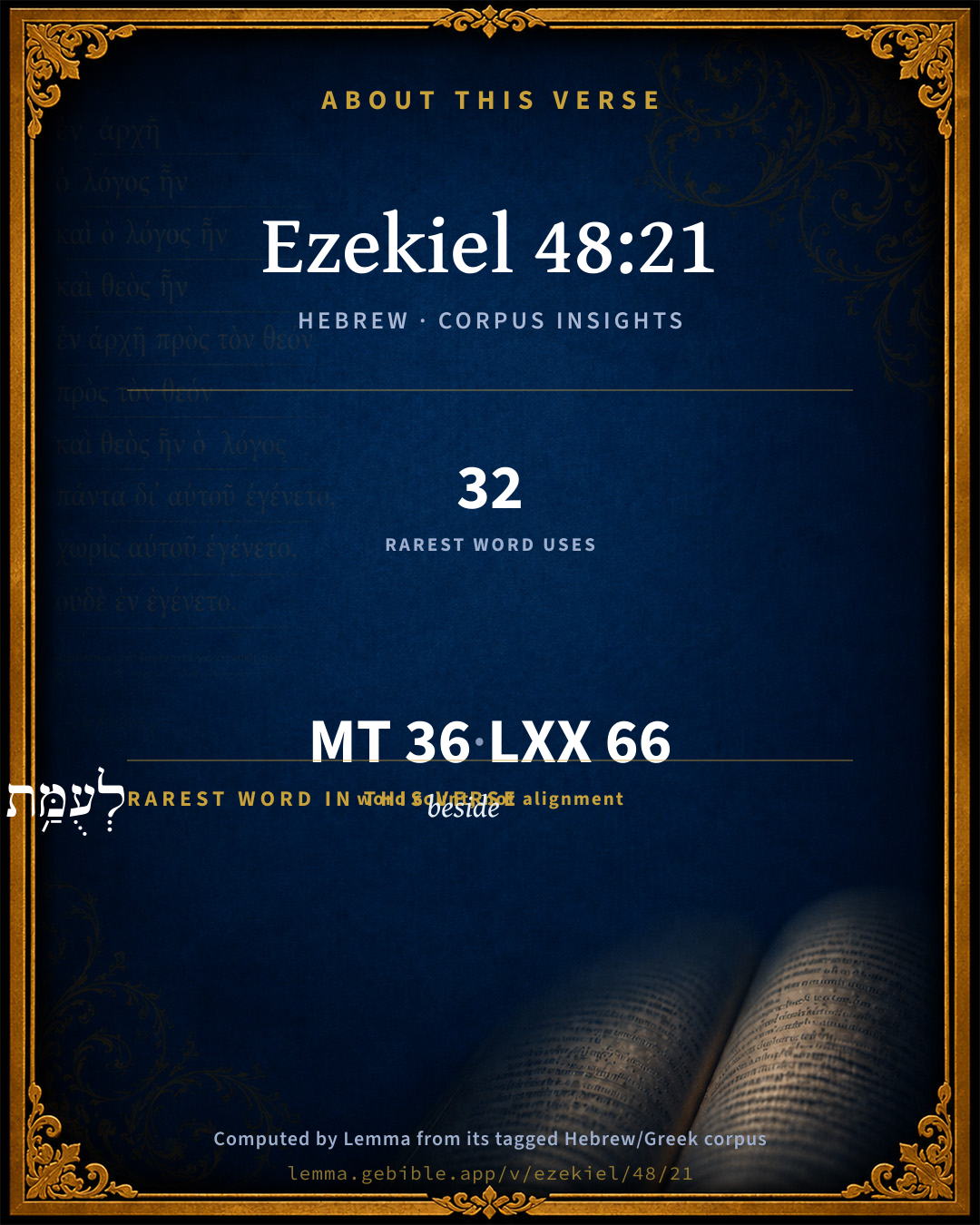
לְעֻמַּ֥ת
ʻummâh
H5980
“to/for · beside of”
Preposition + Noun, Common, Feminine, Singular, Construct
Part of Speech
Preposition + Noun
Type
Common
Gender
Feminine
Number
Singular
State
Construct
Full BDB Definition

Origin: from H6004

TWOT: 1640f

juxtaposition - used only as a preposition - close by, side by side with, alongside of, parallel with - agreeing with, corresponding to, exactly as, close beside - correspondingly to
  1. וְהַנּוֹתָ֣ר yâthar H3498 “and · the · remaining” Conjunction + Particle, Definite Article + Verb, Niphal, Participle Active, Masculine, Singular, Absolute
  2. לַנָּשִׂ֣יא nâsîyʼ H5387 “to/for the · chief” Preposition, Determined + Noun, Common, Masculine, Singular, Absolute
  3. מִזֶּ֣ה zeh H2088 “from · this” Preposition + Pronoun, Demonstrative, Masculine, Singular
  4. וּמִזֶּ֣ה zeh H2088 “and · from · this” Conjunction + Preposition + Pronoun, Demonstrative, Masculine, Singular
  5. לִתְרֽוּמַת tᵉrûwmâh H8641 “to/for · offering of” Preposition + Noun, Common, Feminine, Singular, Construct
  6. הַקֹּ֣דֶשׁ qôdesh H6944 “the · holiness” Particle, Definite Article + Noun, Common, Masculine, Singular, Absolute
  7. וְלַאֲחֻזַּ֪ת ʼăchuzzâh H272 “and · to/for · possession of” Conjunction + Preposition + Noun, Common, Feminine, Singular, Construct
  8. הָעִ֟יר ʻîyr H5892 “the · city” Particle, Definite Article + Noun, Common, Feminine, Singular, Absolute
  9. אֶל ʼêl H413 “to” Preposition
  10. פְּנֵ֣י pânîym H6440 “face(s) of” Noun, Common, Both, Plural, Construct
  11. חֲמִשָּׁה֩ châmêsh H2568 “five” Adjective, Cardinal number, Masculine, Singular, Absolute
  12. וְעֶשְׂרִ֨ים ʻesrîym H6242 “and · twenty” Conjunction + Adjective, Cardinal number, Both, Plural, Absolute
  13. אֶ֥לֶף ʼeleph H505 “thousand” Adjective, Cardinal number, Both, Singular, Absolute
  14. תְּרוּמָה֮ tᵉrûwmâh H8641 “offering” Noun, Common, Feminine, Singular, Absolute
  15. עַד ʻad H5704 “until” Preposition
  16. גְּב֣וּל gᵉbûwl H1366 “border of” Noun, Common, Masculine, Singular, Construct
  17. קָדִימָה֒ qâdîym H6921 “east · toward” Noun, Common, Masculine, Singular, Absolute + Suffix, Demonstrative
  18. וְיָ֗מָּה yâm H3220 “and · sea · toward” Conjunction + Noun, Common, Masculine, Singular, Absolute + Suffix, Demonstrative
  19. עַל ʻal H5921 “upon” Preposition
  20. פְּ֠נֵי pânîym H6440 “face(s) of” Noun, Common, Both, Plural, Construct
  21. חֲמִשָּׁ֨ה châmêsh H2568 “five” Adjective, Cardinal number, Masculine, Singular, Absolute
  22. וְעֶשְׂרִ֥ים ʻesrîym H6242 “and · twenty” Conjunction + Adjective, Cardinal number, Both, Plural, Absolute
  23. אֶ֨לֶף֙ ʼeleph H505 “thousand” Adjective, Cardinal number, Both, Singular, Absolute
  24. עַל ʻal H5921 “upon” Preposition
  25. גְּב֣וּל gᵉbûwl H1366 “border of” Noun, Common, Masculine, Singular, Construct
  26. יָ֔מָּה yâm H3220 “sea · toward” Noun, Common, Masculine, Singular, Absolute + Suffix, Demonstrative
  27. חֲלָקִ֖ים chêleq H2506 “portions” Noun, Common, Masculine, Plural, Absolute
  28. לַנָּשִׂ֑יא nâsîyʼ H5387 “to/for the · chief” Preposition, Determined + Noun, Common, Masculine, Singular, Absolute
  29. וְהָֽיְתָה֙ hâyâh H1961 “and · to be” Conjunction + Verb, Qal, Sequential Perfect, 3rd Person, Feminine, Singular
  30. תְּרוּמַ֣ת tᵉrûwmâh H8641 “offering of” Noun, Common, Feminine, Singular, Construct
  31. הַקֹּ֔דֶשׁ qôdesh H6944 “the · holiness” Particle, Definite Article + Noun, Common, Masculine, Singular, Absolute
  32. וּמִקְדַּ֥שׁ miqdâsh H4720 “and · sanctuary of” Conjunction + Noun, Common, Masculine, Singular, Construct
  33. הַבַּ֖יִת bayith H1004 “the · house” Particle, Definite Article + Noun, Common, Masculine, Singular, Absolute
  34. בתוכה tâvek H8432 “in/at · midst · her” Preposition + Noun, Common, Masculine, Singular, Construct + Suffix, Personal, 3rd Person, Feminine, Singular
  35. בְּתוֹכֽוֹ tâvek H8432 “in/at · midst · his” Preposition + Noun, Common, Masculine, Singular, Construct + Suffix, Personal, 3rd Person, Masculine, Singular

About this verse

These counts appear in no published source. They are computed here, from the morphology-tagged text and Lemma’s own curated glosses. What Lemma adds →

36
words
23
distinct lemmas
Prophets
section

Shared distinctive vocabulary

לְעֻמַּ֥ת beside H5980 occurs in 28 verses of the Hebrew Bible. Also found in:

Grammatical profile

  • 2 verbs
  • 22 nouns
  • 6 adjectives
  • 2 pronouns
  • 4 prepositions

Verb forms

  • וְהַנּוֹתָ֣ר Niphal · Participle Active
  • וְהָֽיְתָה֙ Qal · Sequential Perfect

Repetition

Words recur within this verse — often emphatic in Hebrew:

  • לִתְרֽוּמַת offering H8641 ×3
  • לַנָּשִׂ֣יא chief H5387 ×2
  • הַקֹּ֣דֶשׁ holiness H6944 ×2
  • פְּנֵ֣י face H6440 ×2
  • חֲמִשָּׁה֩ five H2568 ×2
  • וְעֶשְׂרִ֨ים twenty H6242 ×2
  • אֶ֥לֶף thousand H505 ×2
  • גְּב֣וּל border H1366 ×2
  • וְיָ֗מָּה sea H3220 ×2
  • עַל upon H5921 ×2
  • בתוכה midst H8432 ×2
  • מִזֶּ֣ה this H2088 ×2

Hebrew & Septuagint length

In English translation the verse runs 78 words from the Hebrew and 81 from the Septuagint (LXX English) — closely comparable.

A rough comparison of the two English renderings, which tokenize alike — not a word-level alignment.

Word counts can differ between the Hebrew and the Greek without any difference in meaning — e.g. the Hebrew direct-object marker אֵת has no separate Greek word, and Greek often adds the article ὁ.

In the original languages it is 36 Hebrew tokens and 66 Greek tokens — but the two are counted differently (Hebrew bundles its prefixes and suffixes into one token; the Greek is in lemma form), so that isn’t a like-for-like length.

Cross-references

7

Topical passages linked to Ezekiel 48:21 in the Treasury of Scripture Knowledge — connected by theme and wording, ordered by reader-vote popularity; previews shown in the World English Bible.

  • Ezekiel 48:22 Moreover from the possession of the Levites, and from the possession of the city, being in the midst of that which is the prince's, between the border of Judah and the border of Benjamin, it shall be for the prince.
  • Ezekiel 34:23–24 I will set up one shepherd over them, and he shall feed them, even my servant David; he shall feed them, and he shall be their shepherd.
  • Ezekiel 37:24 My servant David shall be king over them; and they all shall have one shepherd: they shall also walk in my ordinances, and observe my statutes, and do them.
  • Ezekiel 45:7–8 [Whatever is] for the prince [shall be] on the one side and on the other side of the holy offering and of the possession of the city, in front of the holy offering and in front of the possession of the city, on the west side westward, and on the east side eastward; and in length answerable to one of the portions, from the west border to the east border.
  • Ezekiel 48:8 By the border of Judah, from the east side to the west side, shall be the offering which you shall offer, twenty-five thousand [reeds] in breadth, and in length as one of the portions, from the east side to the west side: and the sanctuary shall be in the midst of it.
  • Ezekiel 48:10 For these, even for the priests, shall be the holy offering: toward the north twenty-five thousand [in length], and toward the west ten thousand in breadth, and toward the east ten thousand in breadth, and toward the south twenty-five thousand in length: and the sanctuary of Yahweh shall be in the midst of it.
  • Hosea 1:11 The children of Judah and the children of Israel will be gathered together, and they will appoint themselves one head, and will go up from the land; for great will be the day of Jezreel.

Cross-references courtesy of OpenBible.info (CC BY 4.0).

Hebrew and Greek witnesses Masoretic Hebrew ↔ Greek Septuagint

The same verse in the two great witnesses to the Old Testament, shown verse-for-verse.

These are two independent witnesses, not word-aligned to each other, and the Septuagint is shown in lemma (dictionary) form.

Hebrew Ezekiel 48:21 Masoretic · Westminster Leningrad Codex

וְהַנּוֹתָ֣ר לַנָּשִׂ֣יא מִזֶּ֣ה וּמִזֶּ֣ה לִתְרֽוּמַת הַקֹּ֣דֶשׁ וְלַאֲחֻזַּ֪ת הָעִ֟יר אֶל פְּנֵ֣י חֲמִשָּׁה֩ וְעֶשְׂרִ֨ים אֶ֥לֶף תְּרוּמָה֮ עַד גְּב֣וּל קָדִימָה֒ וְיָ֗מָּה עַל פְּ֠נֵי חֲמִשָּׁ֨ה וְעֶשְׂרִ֥ים אֶ֨לֶף֙ עַל גְּב֣וּל יָ֔מָּה לְעֻמַּ֥ת חֲלָקִ֖ים לַנָּשִׂ֑יא וְהָֽיְתָה֙ תְּרוּמַ֣ת הַקֹּ֔דֶשׁ וּמִקְדַּ֥שׁ הַבַּ֖יִת בתוכה בְּתוֹכֽוֹ

The residue shall be for the prince, on the one side and on the other of the holy offering and of the possession of the city; in front of the twenty-five thousand of the offering toward the east border, and westward in front of the twenty-five thousand toward the west border, answerable to the portions, it shall be for the prince: and the holy offering and the sanctuary of the house shall be in the midst of it.

World English Bible · Public Domain

Greek LXX Ezekiel 48:21 Septuagint · lemma form

ὁ δέ περισσός ὁ ἀποἡγέομαι ἐκ οὗτος καί ἐκ οὗτος ἀπό ὁ ἀπαρχή ὁ ἅγιος καί εἰς ὁ κατάσχεσις ὁ πόλις ἐπί πέντε καί εἴκοσι χιλιάς μῆκος ἕως ὁ ὅριον ὁ πρός ἀνατολή καί πρός θάλασσα ἐπί πέντε καί εἴκοσι χιλιάς ἕως ὁ ὅριον ὁ πρός θάλασσα ἔχω ὁ μερίς ὁ ἀποἡγέομαι καί εἰμί ὁ ἀπαρχή ὁ ἅγιος καί ὁ ἁγίασμα ὁ οἶκος ἐν μέσος αὐτός

And the prince shall have the remainder on this side and on that side from the first fruits of the sanctuary, and there shall be a possession of the city, for five and twenty thousand cubits in length, to the eastern and western borders, for five and twenty thousand to the western borders, next to the portions of the prince; and the first fruits of the holy things and the sanctuary of the house shall be in the midst of it.

LXX2012 (modern English Septuagint) · Public Domain

Hebrew: Westminster Leningrad Codex (CC BY 4.0). Greek: Septuagint (public domain); English from LXX2012 (modern English Septuagint) (Public Domain). How the Septuagint differs from the Hebrew →

Targum (Aramaic paraphrase)

1

The Targum is the ancient Jewish Aramaic paraphrase of the Hebrew Scriptures — an interpretive translation, not the Hebrew text itself. Onkelos (literal) and Pseudo-Jonathan (expansive) render the Torah, and Jonathan the Prophets. Coverage is partial: where no permissively-licensed English translation exists for a verse, only the Aramaic is shown. This is verse-level text, not a word-by-word alignment to the Hebrew.

  1. Targum Jonathan Prophets (Joshua–Malachi)
    וּדְאִשְׁתָּאַר לְרַבָּא מִכָּא וּמִכָּא לְאַפְרָשׁוּת קוּדְשָׁא וּלְאַחֲסָנַת קַרְתָּא לָקֳבֵיל חַמְשָׁא וְעַסְרִין אַלְפִין אַפְרָשׁוּתָא עַד תְּחוּם מַדִינְחָא וּמַעֲרָבָא לָקֳבֵיל עַסְרִין וְחַמְשָׁא אַלְפִין עַד תְּחוּם מַעֲרָבָא לָקֳבֵיל חַד מִן חוּלְקַיָא לְרַבָּא וּתְהֵי אַפְרָשׁוּת קוּדְשָׁא וְכֵיבַשׁ מַקְדַשׁ בֵּיתָא בְּגַוֵיהּ:

    (no public-domain English translation for this verse)

    Targum Jonathan — Aramaic: “Mikraot Gedolot” (public domain). English: “Sefaria Community Translation” (CC0 1.0 (public-domain dedication)); “London "Chaldee Paraphrase," 1871” (public domain). Text via Sefaria.

Commentary

Notes on Ezekiel 48:21 from classic Christian and Jewish commentators (each source and its license shown beneath its notes). The classic Christian expositions comment on the surrounding passage and are grouped to its opening verse, so a note may address several verses; the Jewish commentaries on the Tanakh (Rashi and others) are per-verse, so they appear only where the commentator wrote on this verse.

Lemma curates 59 commentaries, every one of them public domain or Creative Commons licensed, each selected and text-cleaned for this edition rather than reprinted as found. About our sources →

Trapp's Complete Commentary

John Trapp

Eze 48:21 And the residue [shall be] for the prince, on the one side and on the other of the holy oblation, and of the possession of the city, over against the five and twenty thousand of the oblation toward the east border, and westward over against the five and twenty thousand toward the west border, over against the portions for the prince: and it shall be the holy oblation; and the sanctuary of the house [shall be] in the midst thereof.

Ver. 21. And the residue shall be for the prince.] His occasions are many, and therefore his proportion is very large; yet must he not be regni dilapidator, the waster of the kingdom, by his profuseness, as our Henry III was called, whereby he became ill-beloved of his people.

John Trapp, A Commentary or Exposition upon All the Books of the Old and New Testament (1647–1656) — public domain. Text from a community e-Sword module.

Joseph Benson's Commentary

Eze 48:21. The residue shall be for the prince on the one side and on the other, &c. — The prince’s part shall be extended, both on the east and west side of the several allotments belonging to the priests, the Levites, and the city. Over against the five and twenty thousand, &c. — The particle אל פני, translated over against, is rendered before, in the parallel text, Eze 45:7, and thus interpreted makes the sense clearer, the words then importing, that the prince’s portion was to run along eastward and westward, like a frontier before the holy portions; and to extend eastward to Jordan, or the Dead sea, and westward to the great sea, retaining its breadth of twenty-five thousand cubits from north to south.

Joseph Benson's Commentary on the Old and New Testaments (1811–1818) — public domain. Text from a community e-Sword module.

Tyndale Open Study Notes

Tyndale Open Resources

48:21-29 The area filling out the rest of the central portion to the east and west of the holy square was assigned to the prince. The prince was more important than the rest of the laity, but he was below the priests and Levites. The same message was delivered by the architecture of the Temple complex.

Tyndale Open Study Notes — © Tyndale Open Resources, licensed CC BY-SA 4.0. Text via the HelloAO Bible API.

Adam Clarke's Commentary

Verse 21. And the residue - for the prince] His portion was alongside that of the Levites, from west to east; these were on each side twenty-five thousand cubits in length, from the east to the west. by twelve thousand five hundred cubits in breadth from north to south. The space both above and below was equal, between the tribe of Judah and that of Benjamin to north and south; and the portion of the Levites, which had Judah and Benjamin to the north and south, and the portion of the prince to the east and to the west. See the map.

Adam Clarke's Commentary on the Bible (1810–1826) — public domain. Text from a community e-Sword/MySword module.

Ellicott's Commentary for English Readers

(21) The residue shall be for the prince.—The length of the oblation from east to west is supposed to leave a strip at either end which is assigned to the prince. This strip is to extend from north to south, the whole width of the oblation. The expression “over against the portions for the prince” is somewhat obscure from its extreme brevity and want of punctuation in our version; it means that the part of the oblation over against the tribe portions shall be for the prince—i.e., he is to have all that is left of the oblation between it and the portions assigned to the tribes. As already said, this was geographically impossible on the estimate of the length of the cubit here adopted. Even if the cubit were reduced to eighteen inches, which is the smallest estimate that can well be made, the side of the oblation would still be 42î6ô miles long, or more than the distance between the Jordan and the Mediterranean at its northern end. It is quite idle, therefore, to attempt any calculation of the prince’s portion. The description is necessarily ideal, and no hint is given in the vision of how much was intended for the prince. If it be suggested that the prophet may have had in mind measures following the uneven surface of the ground and the sinuosities of the roads. it can only be replied that such a supposition at once destroys all possibility of following his measures, and is singularly opposed to the whole symmetry of his description, as well as inconsistent with the equality of the measure on the four sides.

A Bible Commentary for English Readers, edited by Charles John Ellicott (1878–1897) — public domain. Text from a community e-Sword module.

The Cambridge Bible for Schools and Colleges

gen. ed. J. J. S. Perowne

21, 22. The domain of the prince. The domain of the Levites, priests and city formed a square of 25,000 cubits in the heart of the country. The portion of the prince shall be the land from the E. of this square to the Jordan, and from the W. of it to the sea. The “five and twenty thousand” here is the breadth N. to S.; the prince’s domain shall be of the same breadth and be “over against” the square on the E. and W.

over against the portions] Or, by the side of the portions, it shall be for the prince; and the holy oblation, and the sanctuary of the house shall be in the midst thereof. The “portions” here are those of the tribes, which run from the Jordan to the sea; the prince’s domain shall run alongside of them, i.e. Judah’s on the N. and Benjamin’s on the S. And the holy oblation lies between the two halves of the prince’s domain.

The Cambridge Bible for Schools and Colleges (gen. ed. J. J. S. Perowne; Cambridge University Press, 1878–1918) — public domain. Text from a community e-Sword module.

John Gill's Exposition

And by the border of Gad, at the south side southward,.... Of the sanctuary of the Lord, of the portion of the priests and Levites, of the city, and what belonged to that, and of the prince's portion. The description begins at the northern part of the land, and ends in the southern:

the border shall be even from Tamar unto the waters of strife in Kadesh; and to the river toward the great sea; See Gill on Eze 47:19.

John Gill's Exposition of the Whole Bible (1746–1763) — public domain (CC PDM 1.0). Text via the HelloAO Bible API.

Albert Barnes' Notes on the Bible

Or, “And the residue shall be for the prince - on the one side and on the other side of the holy oblation and of the possession of the city over against the 25,000 of the oblation toward the east border, and westward over against the 25,000 toward the west border, over against the portions (of Judah and Benjamin, between which the oblation was included), shall be “for the prince; and it shall be that the holy oblation and the sanctuary of the house shall be in the midst thereof.” This exactly describes the position of the prince’s allotments on the borders of the “oblations.”

Albert Barnes' Notes on the Bible (1834–1885) — public domain. Text from a community e-Sword/MySword module.

Haydock's Catholic Bible Commentary

Thereof. The domains of the prince touched the limits of Juda on the north, and of Benjamin on the south, as the portion of Levi did also. The prince occupied the east and west square of this division. (Haydock)

George Leo Haydock (1774–1849), Haydock's Catholic Family Bible and Commentary, 1859 edition — public domain. Excludes Psalms (Douay-Rheims chapter numbering differs from Protestant) and Deuterocanonical books (Catholic canon only).

Matthew Poole's English Annotations

The residue of the land, which is a great portion, for it is the remainder of twelve and a half taken out of sixty; so that the remainder will be forty-seven and a half.

On the one side; suppose it be the cast side, there will be twenty-three and three quarters.

On the other side; on the west just as much, twenty-three and three quarters.

Of the possession of the city; the residue of that which is on each side, east and west of the five thousand square area.

Over against the five and twenty thousand; which amounts out of the priests’, Levites’, and city portion.

Toward the east border of the land of Canaan; all from the east side of the twenty-five thousand to the utmost bounds eastward, shall be the prince’s portion, and so likewise on the west side westward to the great sea.

Over against the portions for the prince; these twenty-five thousand on both sides lay over against, or run parallel with, the breadth of the prince’s portion, but the length of the prince’s portion on each side did exceed the length of the holy portion and the city land, as twenty-three and three quarters exceeds twelve and a half.

The sanctuary; the holy mount.

Of the house; of the temple of God.

In the midst thereof; of the land assigned to the priests, which lay as described, bounded and guarded with the prince’s portion at east and west ends.

Matthew Poole's English Annotations on the Holy Bible (1683–1685) — public domain. Text from a community e-Sword/MySword module.

The Pulpit Commentary

Vers. 21, 22 The prince"s portion should take up the residue of the original oblation, or terumah (see ver. 8), from which had been withdrawn the aforesaid square containing the portions of the Levites, the priests, and the city. This residue should consist of two strips of land, situated one on each side of the holy oblation (here, of the priests and Levites) and of the possession of the city, and running along the whole length of the five and twenty thousand of the oblation (here the three portions composing the square), and extending eastward to the Jordan and westward to the Mediterranean. The last two clauses of ver. 21, which should read, And the holy oblation and the sanctuary of the house shall be in the midst of it, implies that the two parts of the prince"s portion, the eastern and the western, should be equal. Ver. 22 teaches that the whole intermediate territory between the border of Judah (in the north of the terumah) and the border of Benjamin (in the south of the terumah), from the possession of the Levites (the north portion of the terumah) and from (equivalent to "to") the possession of the city (the southern portion of the terumah), should belong to the prince. The mention of the possession of the Levites and the possession of the city as the extreme portions of the terumah, appears to indicate $hat the priests" portion lay between. Ewald translates as if the prophet meant to say the sanctuary should lie between the possession of the Levites and the possession of the city (in the first place), and between the two parts of the prince"s land (in the second place), and yet again between the border of Judah and the border of Benjamin (in the third place): but to read thus the text must be changed.

The Pulpit Commentary (1880–1919), ed. H.D.M. Spence-Jones & Joseph S. Exell — public domain. Text from a community e-Sword module.

unfoldingWord translationNotes

Door43 World Missions Community

the holy offering

See how you translated this in Ezekiel 48:18.

twenty-five thousand cubits

Each long cubit was about 54 centimeters. See how you translated this in Ezekiel 40:5. AT: "25,000 cubits" or "about 13.5 kilometers" (See: Biblical Distance)

translationWords

prince

holy place

temple

Levi

Judah

Benjamin

unfoldingWord translationNotes — © Distant Shores Media and the Door43 World Missions Community, licensed CC BY-SA 4.0. Source: git.door43.org/Door43/en_tn.

Rashi

Rabbi Shlomo Yitzchaki (Rashi)

And the remainder shall be for the prince, etc. and the remainder of the length of the great separation.

on either side to the east and to the west of the offering of the Sanctuary and the possession of the city.

alongside 25,000 of the offering alongside the 25,000 width of the offering extending to the eastern border of the entire land of Israel.

and to the west, alongside, etc. and likewise to the west, facing the three strips of the priests, the Levites, and the city’s possession, in the width of 25,000.

the western border [Heb. עַל-גְבוּל יָמָּה,] like עַד גְבוּל יָמָּה, until the ocean.

opposite the portions opposite the length of the tribes’ portions.

shall belong to the prince [lit. to the prince,] it shall be.

and the offering of the Sanctuary... shall be i.e., the strip of the priests.

and the Sanctuary of the House shall be in its midst Everything is in the middle of the inheritance of the prince.

Rashi on the Tanakh — English translations: “The Judaica Press complete Tanach with Rashi, translated by A. J. Rosenberg” (CC BY 4.0); “Pentateuch with Rashi's commentary by M. Rosenbaum and A.M. Silbermann, 1929-1934” (public domain); “The Metsudah Tanach series, Lakewood, N.J” (CC BY 4.0); and “The Book of Joshua, Metsudah Publications, 1997” (CC BY 4.0). Text via Sefaria.

Lesson kit

Teaching starters — assembled from the data on this page, not authored interpretation. Every prompt links to the verse data it draws on. Edit before teaching.

Ezekiel, in the Prophets, opens this verse with 36 words (23 distinct Hebrew lemmas). Its most distinctive word is ʻummâh (“beside”). A historical commentator’s framing appears above. Read the whole chapter for the surrounding context.

Discussion questions

  1. The word ʻummâh carries the sense “beside.” How does it shape the verse?
  2. Exodus 25:27 shares the word «beside» with this verse. How do the two illuminate each other?
  3. “offering” occurs 3× in this one verse. What is the effect of the repetition?
  4. These translations render this verse differently; the difference is in the English rendering, not the original. What questions does that raise?
  5. The verb «וְהַנּוֹתָ֣ר» is Niphal Participle Active. How does its form color the action?
  6. Reading how Trapp's Complete Commentary and Joseph Benson's Commentary read this verse, where do the two commentators agree and where do they part?

Things to notice

Reading settings

Reading text

Shown beneath each verse's original-language words.

Old Testament
Old Testament edition

Read the OT as the Masoretic Hebrew (MT) or the Greek Septuagint (LXX).

English shown for the Greek Septuagint (in the Hebrew ↔ Greek comparison).

Comparing translations? Open the Compare panel on any verse page to stack up to four side by side.