
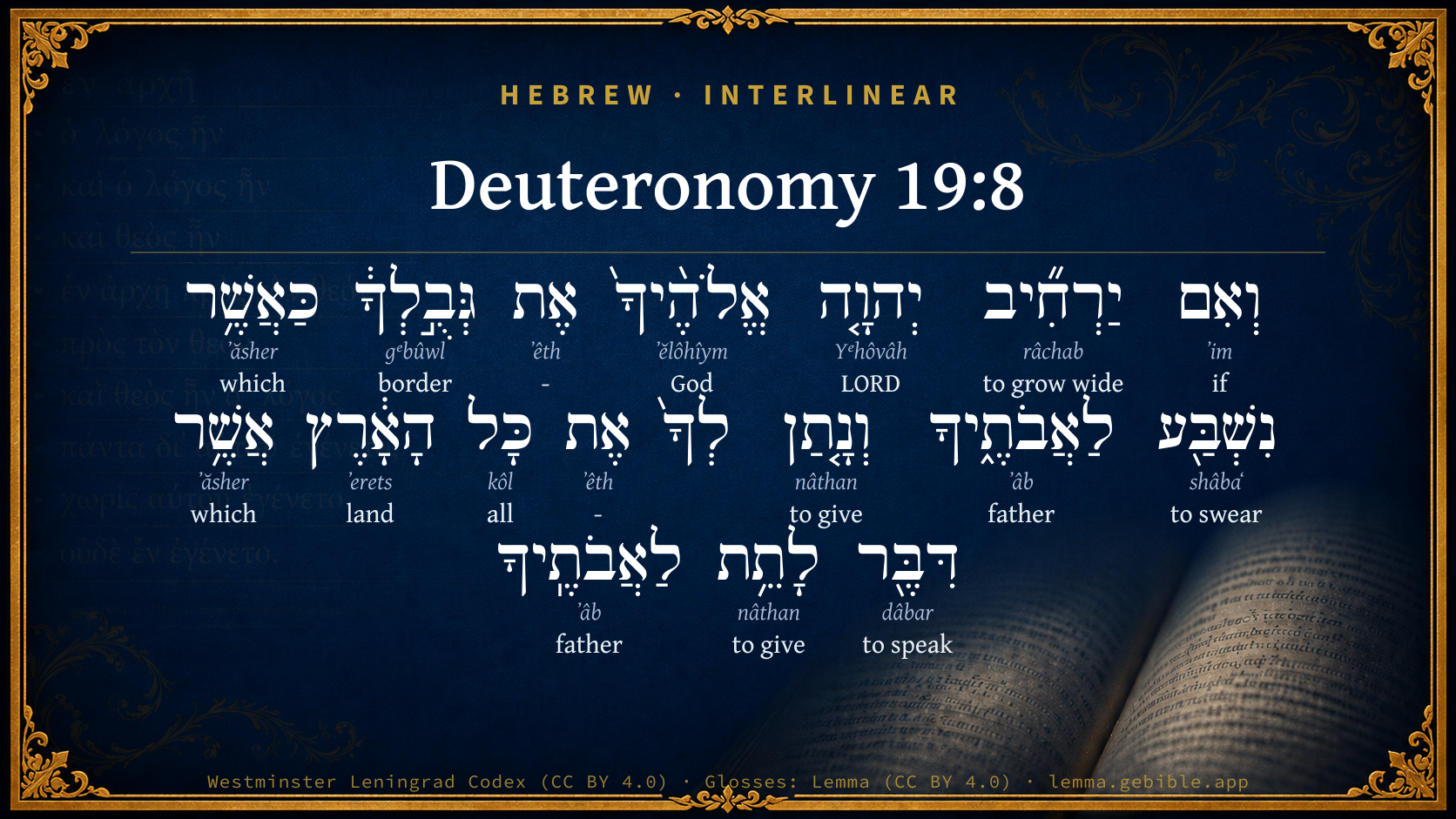
Deuteronomy 19:8

Hebrew (Westminster Leningrad Codex) Deuteronomy 19:8 appears in the Hebrew Old Testament. The text above is from the Westminster Leningrad Codex. Each word links to its Strong’s number, a concise gloss, and parsing drawn from the Open Scriptures Hebrew Bible morphology. Click any word for its full Brown-Driver-Briggs (BDB) entry.
Download image
Cite this verse

Deuteronomy 19:8 (World English Bible). Public Domain. Lemma interlinear Bible study tool, https://lemma.gebible.app/v/deuteronomy/19/8.

Show BibTeX & RIS
BibTeX
RIS
English Translation
If Yahweh your God enlarge your border, as he has sworn to your fathers, and give you all the land which he promised to give to your fathers;
World English Bible · Public Domain
Download a study sheet

One document with this verse’s original text, its word-by-word gloss line, the meaning frame, cross-references with their text, attributed commentary, and full source and license credits — printable, and it pastes into notes with its structure intact.

This verse Autodidact and up

Study sheet (.html) Plain text (.txt)

A passage Seminary Student

Up to 50 verses in one chapter. A passage sheet keeps up to 6 commentary sources and 12 cross-references per verse, in the order this page ranks them, and says so on the sheet whenever that leaves anything out. Ask for a single verse and you get the Autodidact verse sheet above.

Everything on this page stays free to read, with no account — the sheet is a download of what is already on screen, not access to it.

Want to remove ads? Support Godless Engineer
Compare translations 3

The same verse in 3 English versions, stacked beneath the original-language interlinear above. Click any original word for its lexicon entry.

Each is an independent rendering of the whole verse — the interlinear is not word-aligned to these translations.

Highlighted words mark where these versions differ — a whole-verse word diff, not a word-by-word alignment.

  • World English Bible Public Domain
    If Yahweh your God enlarge your border, as he has sworn to your fathers, and give you all the land which he promised to give to your fathers;
  • King James Version Public Domain
    And if the LORD thy God enlarge thy coast, as he hath sworn unto thy fathers, and give thee all the land which he promised to give unto thy fathers;
  • unfoldingWord Literal Text CC BY-SA 4.0
    And if Yahweh your God enlarges your borders, as he has sworn to your fathers, and gives to you all the land that he spoke to give to your fathers;

unfoldingWord Literal Text — © unfoldingWord, licensed CC BY-SA 4.0. Word-aligned USFM3 via Door43 (git.door43.org/unfoldingWord/en_ult).

Versions to compare (up to 4)

3 of 4 selected

Show all 18 translations

Every available English version of this verse, each an independent rendering of the whole verse.

  • World English Bible Public Domain
    If Yahweh your God enlarge your border, as he has sworn to your fathers, and give you all the land which he promised to give to your fathers;
  • Berean Standard Bible Public Domain
    And if the LORD your God enlarges your territory, as He swore to your fathers, and gives you all the land He promised them,
  • Majority Standard Bible Public Domain
    And if the LORD your God enlarges your territory, as He swore to your fathers, and gives you all the land He promised them,
  • King James Version Public Domain
    And if the LORD thy God enlarge thy coast, as he hath sworn unto thy fathers, and give thee all the land which he promised to give unto thy fathers;
  • American Standard Version (1901) Public Domain
    And if Jehovah thy God enlarge thy border, as he hath sworn unto thy fathers, and give thee all the land which he promised to give unto thy fathers;
  • Revised Version (1885) Public Domain
    And if the LORD thy God enlarge thy border, as he hath sworn unto thy fathers, and give thee all the land which he promised to give unto thy fathers;
  • Geneva Bible (1599) Public Domain
    And when the Lord thy God enlargeth thy coastes (as he hath sworne vnto thy fathers) and giueth thee all the lande which he promised to giue vnto thy fathers,
  • Douay-Rheims (1899) Public Domain
    And when the Lord thy God shall have enlarged thy borders, as he swore to thy fathers, and shall give thee all the land that he promised them,
  • Young's Literal Translation Public Domain
    `And if Jehovah thy God doth enlarge thy border, as He hath sworn to thy fathers, and hath given to thee all the land which He hath spoken to give to thy fathers --
  • Literal Standard Version CC BY-SA 4.0
    And if your God YHWH enlarges your border, as He has sworn to your fathers, and has given to you all the land which He has spoken to give to your fathers—
  • Unlocked Literal Bible CC BY-SA 4.0
    If Yahweh your God enlarges your borders, as he has sworn to your ancestors to do, and gives you all the land that he promised to give to your ancestors;
  • unfoldingWord Literal Text CC BY-SA 4.0
    And if Yahweh your God enlarges your borders, as he has sworn to your fathers, and gives to you all the land that he spoke to give to your fathers;
  • Darby Bible Public Domain
    And if Jehovah thy God enlarge thy border, as he hath sworn unto thy fathers, and give thee all the land which he promised to give unto thy fathers
  • World Messianic Bible Public Domain
    If the LORD your God enlarges your border, as he has sworn to your fathers, and gives you all the land which he promised to give to your fathers;
  • Webster's Bible Public Domain
    And if the LORD thy God shall enlarge thy limits, as he hath sworn to thy fathers, and give thee all the land which he promised to give to thy fathers;
  • Free Bible Version CC BY-SA 4.0
    Should the Lord your God expand your territory, as he promised your forefathers, and give you all the land he said he would,
  • Bible in Basic English Public Domain
    And if the Lord your God makes wide the limits of your land, as he said in his oath to your fathers, and gives you all the land which he undertook to give to your fathers;
  • JPS Tanakh (1917) Public Domain
    And if the LORD thy God enlarge thy border, as He hath sworn unto thy fathers, and give thee all the land which He promised to give unto thy fathers —

Literal Standard Version (2020), Covenant Press — licensed CC BY-SA 4.0. Text via the HelloAO Bible API (eBible.org). Unlocked Literal Bible (unfoldingWord) — licensed CC BY-SA 4.0. Text via the HelloAO Bible API (eBible.org). unfoldingWord Literal Text — © unfoldingWord, licensed CC BY-SA 4.0. Word-aligned USFM3 via Door43 (git.door43.org/unfoldingWord/en_ult). Free Bible Version, Dr. Jonathan Gallagher — licensed CC BY-SA 4.0. Text via the HelloAO Bible API (eBible.org).

Word by word

More ways to search: Search by grammar → Find every occurrence → Compare this word →

Practice this passage: Drill this verse → Learn its vocabulary →

יַרְחִ֞יב
râchab
H7337
“to grow wide”
Verb, Hiphil, Imperfect, 3rd Person, Masculine, Singular
Part of Speech
Verb
Stem
Hiphil
Form
Imperfect
Person
3rd Person
Gender
Masculine
Number
Singular
Full BDB Definition

Origin: a primitive root

TWOT: 2143

to be or grow wide, be or grow large - (Qal) to be widened, be enlarged - (Niphal) broad or roomy pasture (participle) - (Hiphil) - to make large - to enlarge
  1. וְאִם ʼim H518 “and · if” Conjunction + Conjunction
  2. יְהוָ֤ה Yᵉhôvâh H3068 “LORD” Noun, Proper
  3. אֱלֹהֶ֨יךָ֙ ʼĕlôhîym H430 “God(s) · your” Noun, Common, Masculine, Plural, Construct + Suffix, Personal, 2nd Person, Masculine, Singular
  4. אֶת ʼêth H853 “-” Particle, Direct Object
  5. גְּבֻ֣לְךָ֔ gᵉbûwl H1366 “border · your” Noun, Common, Masculine, Singular, Construct + Suffix, Personal, 2nd Person, Masculine, Singular
  6. כַּאֲשֶׁ֥ר ʼăsher H834 “like/as · which” Preposition + Particle, Relative
  7. נִשְׁבַּ֖ע shâbaʻ H7650 “to swear” Verb, Niphal, Perfect, 3rd Person, Masculine, Singular
  8. לַאֲבֹתֶ֑יךָ ʼâb H1 “to/for · fathers · your” Preposition + Noun, Common, Masculine, Plural, Construct + Suffix, Personal, 2nd Person, Masculine, Singular
  9. וְנָ֤תַן nâthan H5414 “and · to give” Conjunction + Verb, Qal, Sequential Perfect, 3rd Person, Masculine, Singular
  10. אֶת ʼêth H853 “-” Particle, Direct Object
  11. כָּל kôl H3605 “all of” Noun, Common, Masculine, Singular, Construct
  12. הָאָ֔רֶץ ʼerets H776 “the · land” Particle, Definite Article + Noun, Common, Both, Singular, Absolute
  13. אֲשֶׁ֥ר ʼăsher H834 “which” Particle, Relative
  14. דִּבֶּ֖ר dâbar H1696 “to speak” Verb, Piel, Perfect, 3rd Person, Masculine, Singular
  15. לָתֵ֥ת nâthan H5414 “to give” Preposition + Verb, Qal, Infinitive Construct
  16. לַאֲבֹתֶֽיךָ ʼâb H1 “to/for · fathers · your” Preposition + Noun, Common, Masculine, Plural, Construct + Suffix, Personal, 2nd Person, Masculine, Singular

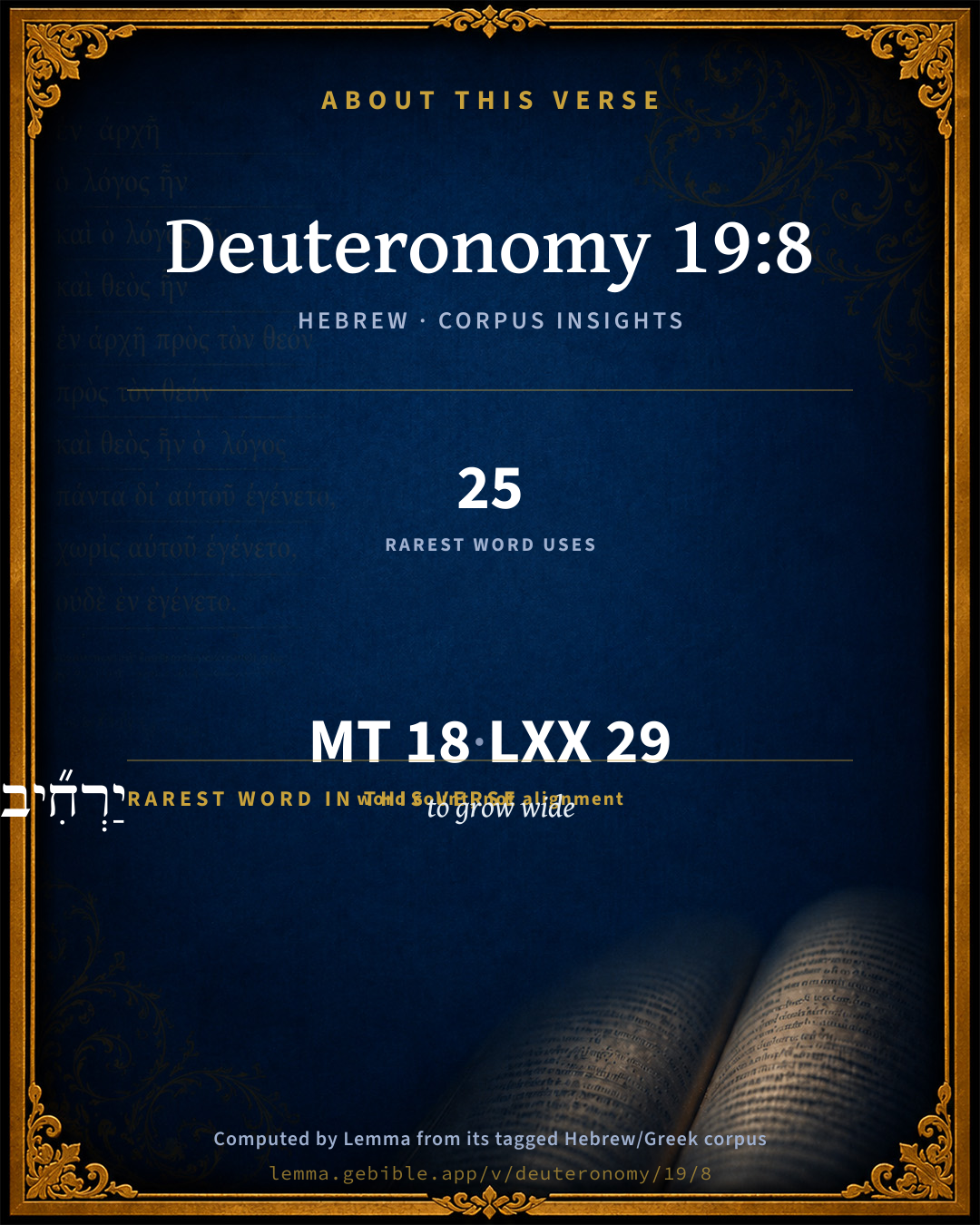
About this verse

These counts appear in no published source. They are computed here, from the morphology-tagged text and Lemma’s own curated glosses. What Lemma adds →

18
words
13
distinct lemmas
Pentateuch
section

Notable vocabulary

The rarest word here is יַרְחִ֞יב to grow wide H7337 — appearing just 25 times in the whole Hebrew Bible.

Shared distinctive vocabulary

יַרְחִ֞יב to grow wide H7337 occurs in 25 verses of the Hebrew Bible. Also found in:

Grammatical profile

  • 5 verbs
  • 7 nouns
  • 1 preposition
  • 1 conjunction
  • 4 particles

Verb forms

  • יַרְחִ֞יב Hiphil · Imperfect
  • נִשְׁבַּ֖ע Niphal · Perfect
  • וְנָ֤תַן Qal · Sequential Perfect
  • דִּבֶּ֖ר Piel · Perfect
  • לָתֵ֥ת Qal · Infinitive Construct

Repetition

Words recur within this verse — often emphatic in Hebrew:

  • לַאֲבֹתֶ֑יךָ father H1 ×2
  • וְנָ֤תַן to give H5414 ×2
  • כַּאֲשֶׁ֥ר which H834 ×2

Hebrew & Septuagint length

In English translation the verse runs 28 words from the Hebrew and 33 from the Septuagint (LXX English) — closely comparable.

A rough comparison of the two English renderings, which tokenize alike — not a word-level alignment.

Word counts can differ between the Hebrew and the Greek without any difference in meaning — e.g. the Hebrew direct-object marker אֵת has no separate Greek word, and Greek often adds the article ὁ.

In the original languages it is 18 Hebrew tokens and 29 Greek tokens — but the two are counted differently (Hebrew bundles its prefixes and suffixes into one token; the Greek is in lemma form), so that isn’t a like-for-like length.

Cross-references

8

Topical passages linked to Deuteronomy 19:8 in the Treasury of Scripture Knowledge — connected by theme and wording, ordered by reader-vote popularity; previews shown in the World English Bible.

  • Genesis 15:18–21 In that day Yahweh made a covenant with Abram, saying, "To your seed have I given this land, from the river of Egypt to the great river, the river Euphrates:
  • Exodus 23:31 I will set your border from the Red Sea even to the sea of the Philistines, and from the wilderness to the River; for I will deliver the inhabitants of the land into your hand, and you shall drive them out before you.
  • Exodus 34:24 For I will drive out nations before you and enlarge your borders; neither shall any man desire your land when you go up to appear before Yahweh, your God, three times in the year.
  • Deuteronomy 12:20 When Yahweh your God shall enlarge your border, as he has promised you, and you shall say, I will eat flesh, because your soul desires to eat flesh; you may eat flesh, after all the desire of your soul.
  • Genesis 28:14 Your seed will be as the dust of the earth, and you will spread abroad to the west, and to the east, and to the north, and to the south. In you and in your seed will all the families of the earth be blessed.
  • Deuteronomy 11:24–25 Every place whereon the sole of your foot shall tread shall be yours: from the wilderness, and Lebanon, from the river, the river Euphrates, even to the hinder sea shall be your border.
  • 1 Kings 4:21 Solomon ruled over all the kingdoms from the River to the land of the Philistines, and to the border of Egypt: they brought tribute, and served Solomon all the days of his life.
  • Ezra 4:20 There have been mighty kings also over Jerusalem, who have ruled over all [the country] beyond the River; and tribute, custom, and toll, was paid to them.

Cross-references courtesy of OpenBible.info (CC BY 4.0).

Hebrew and Greek witnesses Masoretic Hebrew ↔ Greek Septuagint

The same verse in the two great witnesses to the Old Testament, shown verse-for-verse.

These are two independent witnesses, not word-aligned to each other, and the Septuagint is shown in lemma (dictionary) form.

Hebrew Deuteronomy 19:8 Masoretic · Westminster Leningrad Codex

וְאִם יַרְחִ֞יב יְהוָ֤ה אֱלֹהֶ֨יךָ֙ אֶת גְּבֻ֣לְךָ֔ כַּאֲשֶׁ֥ר נִשְׁבַּ֖ע לַאֲבֹתֶ֑יךָ וְנָ֤תַן לְךָ֙ אֶת כָּל הָאָ֔רֶץ אֲשֶׁ֥ר דִּבֶּ֖ר לָתֵ֥ת לַאֲבֹתֶֽיךָ

If Yahweh your God enlarge your border, as he has sworn to your fathers, and give you all the land which he promised to give to your fathers;

World English Bible · Public Domain

Greek LXX Deuteronomy 19:8 Septuagint · lemma form

ἐάν δέ ἐνπλατύνω κύριος ὁ θεός σύ ὁ ὅριον σύ ὅς τρόπος ὄμνυμι ὁ πατήρ σύ καί δίδωμι σύ κύριος πᾶς ὁ γῆ ὅς εἶπον δίδωμι ὁ πατήρ σύ

And if the Lord shall enlarge your borders, as he swore to your fathers, and the Lord shall give to you all the land which he said he would give to your fathers;

LXX2012 (modern English Septuagint) · Public Domain

On this verse, The Cambridge Bible for Schools and Colleges discusses the Septuagint’s reading. Read the note in Commentary ↓

Hebrew: Westminster Leningrad Codex (CC BY 4.0). Greek: Septuagint (public domain); English from LXX2012 (modern English Septuagint) (Public Domain). How the Septuagint differs from the Hebrew →

Targum (Aramaic paraphrase)

2

The Targum is the ancient Jewish Aramaic paraphrase of the Hebrew Scriptures — an interpretive translation, not the Hebrew text itself. Onkelos (literal) and Pseudo-Jonathan (expansive) render the Torah, and Jonathan the Prophets. Coverage is partial: where no permissively-licensed English translation exists for a verse, only the Aramaic is shown. This is verse-level text, not a word-by-word alignment to the Hebrew.

  1. Targum Onkelos Torah (Genesis–Deuteronomy)
    וְאִם יַפְתֵּי יְיָ אֱלָהָךְ יָת תְּחוּמָךְ כְּמָא דִי קַיִים לַאֲבָהָתָךְ וְיִתֶּן לָךְ יָת כָּל אַרְעָא דִי מַלִיל לְמִתַּן לַאֲבָהָתָךְ

    (no public-domain English translation for this verse)

    Targum Onkelos — Aramaic: “Onkelos Genesis” (public domain); “Onkelos Exodus” (public domain); “Onkelos Leviticus” (public domain); “Onkelos Numbers” (public domain); “Onkelos Deuteronomy” (public domain). English: “Sefaria Community Translation” (CC0 1.0 (public-domain dedication)); “J.W. Etheridge. The Targums of Onkelos and Jonathan Ben Uzziel on the Pentateuch. London: Longmans, Green, 1862” (public domain). Text via Sefaria.

  2. Targum Pseudo-Jonathan Torah (Genesis–Deuteronomy)
    וְאִין יַפְתֵּי יְיָ אֱלָהָכוֹן יַת תְּחוּמְכוֹן הֵיכְמָא דְקַיֵּים לְאַבְהַתְכוֹן וְיִתֵּן לְכוֹן יַת כָּל אַרְעָא דְקַיֵּים לְמִתַּן לְאַבְהַתְכוֹן

    And if the Lord your God enlarge your border, as He hath sworn to your fathers, and give you all the land which He Hath sworn to your fathers to give,

    Targum Pseudo-Jonathan — Aramaic: “Targum Jonathan on Genesis” (public domain); “Targum Jonathan on Exodus” (public domain); “Targum Jonathan on Leviticus” (public domain); “Targum Jonathan on Numbers” (public domain); “Targum Jonathan on Deuteronomy” (public domain). English: “The Targum of Jonathan ben Uzziel, trans. J. W. Etheridge, London, 1862” (public domain). Text via Sefaria.

Commentary

Notes on Deuteronomy 19:8 from classic Christian and Jewish commentators (each source and its license shown beneath its notes). The classic Christian expositions comment on the surrounding passage and are grouped to its opening verse, so a note may address several verses; the Jewish commentaries on the Tanakh (Rashi and others) are per-verse, so they appear only where the commentator wrote on this verse.

Lemma curates 59 commentaries, every one of them public domain or Creative Commons licensed, each selected and text-cleaned for this edition rather than reprinted as found. About our sources →

Trapp's Complete Commentary

John Trapp

Deu 19:8 And if the LORD thy God enlarge thy coast, as he hath sworn unto thy fathers, and give thee all the land which he promised to give unto thy fathers;

Ver. 8. And give thee all the land.] From Nile to Euphrates; {Gen 15:18} which by reason of their sins he never did. Pray we with Jabez, {1Ch 4:10} "Oh that thou wouldest bless me indeed, and enlarge my coast (my heart), and that thine hand might be with me," &c. "When thou shalt have enlarged mine heart," saith David, "then will I run the way of thy commandments." {Psa 119:32}

John Trapp, A Commentary or Exposition upon All the Books of the Old and New Testament (1647–1656) — public domain. Text from a community e-Sword module.

Joseph Benson's Commentary

Deu 19:8-9. If the Lord thy God enlarge thy coast — As far as the Euphrates. If thou shalt keep all these commandments — This shows that the promise of enlarging their border was conditional, and the condition not being performed the promise was never accomplished, so that there was no need for three more cities of refuge. This the Jewish writers themselves own. “Yet the holy blessed God,” say they, “did not command it in vain, for in the days of Messiah the Prince, they shall be added.” They expect it in the letter: but we know it has in Christ its spiritual accomplishment. For the borders of the gospel Israel are enlarged according to the promise: and in the Lord our righteousness, refuge is provided for all that by faith flee to him.

Joseph Benson's Commentary on the Old and New Testaments (1811–1818) — public domain. Text from a community e-Sword module.

Geneva Bible (1599)

Geneva Bible translators

When thou goest over Jordan to possess the whole land of Canaan.

Geneva Bible (1599) marginal notes — public domain. Text via Bolls.life.

Jamieson, Fausset & Brown

Robert Jamieson, A. R. Fausset & David Brown

And if the Lord thy God enlarge thy coast--Three additional sanctuaries were to be established in the event of their territory extending over the country from Hermon and Gilead to the Euphrates (see Gen 15:18; Exo 23:31). But it was obscurely hinted that this last provision would never be carried into effect, as the Israelites would not fulfil the conditions, namely, "that of keeping the commandments, to love the Lord, and walk ever in his ways." In point of fact, although that region was brought into subjection by David and Solomon, we do not find that cities of refuge were established; because those sovereigns only made the ancient inhabitants tributary, instead of sending a colony of Israelites to possess it. The privilege of sanctuary cities, however, was given only for Israelites; and besides, that conquered territory did not remain long under the power of the Hebrew kings.

Jamieson, Fausset & Brown — Commentary Critical and Explanatory on the Whole Bible (1871) — public domain (CC PDM 1.0). Text via the HelloAO Bible API.

The Cambridge Bible for Schools and Colleges

gen. ed. J. J. S. Perowne

8. enlarge thy border] See on Deu_12:20, and the introd. to this law.

as he hath sworn, etc.] See on Deu_1:8.

and give thee … thy fathers] Redundant after previous clause, and (though confirmed by LXX B and other Codd.) probably not original, Luc. omits. The readings here differ much in the versions and their Codd. shewing how readily scribes altered and expanded the text.

The Cambridge Bible for Schools and Colleges (gen. ed. J. J. S. Perowne; Cambridge University Press, 1878–1918) — public domain. Text from a community e-Sword module.

John Gill's Exposition

If thou shalt keep all these commandments to do them, which I command thee this day,.... A phrase often met with before, and signifies the putting in practice the several laws, moral, ceremonial, and judicial, which Moses was now making a repetition of, and enjoining the observance of them by a divine authority:

to love the Lord thy God; which is the source and spring of genuine obedience to the commands of God:

and to walk ever in his ways; noting constancy and perseverance in them; now all this is mentioned as the condition of the enlargement of their coast, which would be the case if a due and constant regard was had to the laws of God:

and then shall thou add three cities more besides these three; three more in the land of Canaan, besides the three now ordered to be separated in it, and besides the three on the other side of Jordan; so that there would have been nine in all, if these had been ever added; but that time never came: the Jews expect the addition of these three cities in the days of the Messiah (y) but the Messiah is already come, and all those cities, as they were typical of him, have had their accomplishment in him the antitype of them, of which See Gill on Num 35:29.

(y) Maimon. Hilchot Rotzeach, c. 8. sect. 4.

John Gill's Exposition of the Whole Bible (1746–1763) — public domain (CC PDM 1.0). Text via the HelloAO Bible API.

Haydock's Catholic Bible Commentary

And when. Septuagint, "but if." This condition was never fulfilled, at all times; (ver. 9,) and therefore the Israelites could blame only themselves, if the promises which God had made to Abraham, Isaac, and Jacob, (Genesis xv., xxvi., xxviii., and xxxv.,) were not realized. (Haydock) --- Though the country was conquered under David and Solomon, the Israelites did not drive out the former inhabitants, (Calmet) nor did they keep possession for any long time. (Haydock)

George Leo Haydock (1774–1849), Haydock's Catholic Family Bible and Commentary, 1859 edition — public domain. Excludes Psalms (Douay-Rheims chapter numbering differs from Protestant) and Deuterocanonical books (Catholic canon only).

Matthew Poole's English Annotations

Enlarge thy coast, as far as Euphrates. See Gen 15:18; Exo 23:31; Deu 1:7.

Matthew Poole's English Annotations on the Holy Bible (1683–1685) — public domain. Text from a community e-Sword/MySword module.

Whedon's Commentary on the Bible

Daniel D. Whedon

8-10. Then shalt thou add — Here are directions for three additional cities of refuge in case the boundaries of the nation, should be in the future extended.

Daniel D. Whedon (gen. ed.), Commentary on the Old and New Testaments (1874–1909) — public domain. Text from a community e-Sword module.

The Pulpit Commentary

Vers. 8, 9. In case their land should be extended, in ease they should come to possess the whole territory promised by God to the patriarchs, so that their domain should reach from the Nile to the Euphrates (Gen_15:18) an event which should be realized only if they should continue steadfast in their obedience to all that God had enjoined upon them, and an event which in point of fact never was realized, for even under David and Solomon there were extensive territories within these limits which were not incorporated with the kingdom of Israel in that case they were to add other three cities of refuge to those already appointed.

The Pulpit Commentary (1880–1919), ed. H.D.M. Spence-Jones & Joseph S. Exell — public domain. Text from a community e-Sword module.

John Wesley's Explanatory Notes

Enlarge thy coast - As far as Euphrates.

John Wesley, Explanatory Notes Upon the Whole Bible (1754–1765) — public domain. Text via the GEBible commentary corpus.

unfoldingWord translationNotes

Door43 World Missions Community

General Information:

Moses is still speaking to the people of Israel.

enlarges your borders

"gives you more land to possess"

as he has sworn to your ancestors to do

"like he promised your ancestors that he would do"

if you keep all these commandments to do them

"if you obey all these commandments"

to always walk in his ways

How God wants a person to live or behave is spoken of as if it were Yahweh's way or road. A person who obeys Yahweh is spoken of as if he were walking on Yahweh's way or road. AT: "to always obey him" (See: Metaphor)

then you must add three more cities for yourself

The full meaning of this statement can be made explicit. AT: "then you must choose three more cities for a person to escape to if he accidentally kills someone" (See: Numbers and Assumed Knowledge and Implicit Information)

besides these three

"in addition to the three cities you already established" (See: Numbers)

Do this so that innocent blood is not shed

This can be stated in active form. AT: "Do this so that family members do not kill an innocent person" (See: Active or Passive)

innocent blood is not shed

Here "blood" represents a person's life. To shed blood means to kill a person. This can be stated in active form. AT: "no one kills an innocent person" (See: Metonymy and Active or Passive)

in the midst of the land

"in the land" or "in the territory"

Yahweh your God is giving you for as an inheritance

The land that Yahweh is giving the people of Israel is spoken of as if it were an inheritance. (See: Metaphor)

so that no bloodguilt may be on you

The people of Israel being guilty for a person dying because they did not build a city where he would be safe from the "blood avenger" is spoken of as if the guilt of his death is on them. (See: Metaphor)

bloodguilt

Here "blood" represents a life and "bloodguilt" refers to the guilt someone has for killing an innocent person. (See: Metonymy)

may be on you

This means that if a family member kills an innocent person, then all the people of Israel will be guilty for letting that happen.

translationWords

oath

promise

love

walk

innocent

blood

inherit

unfoldingWord translationNotes — © Distant Shores Media and the Door43 World Missions Community, licensed CC BY-SA 4.0. Source: git.door43.org/Door43/en_tn.

Rashi

Rabbi Shlomo Yitzchaki (Rashi)

ואם ירחיב … כאשר נשבע AND IF [THE LORD THY GOD] ENLARGE [THY TERRITORY], AS HE HATH SWORN [UNTO THY FATHERS] to give thee the land of the Kenite, the Kenizzite and the Kadmonite (Sifrei Devarim 184:3).

Rashi on the Tanakh — English translations: “The Judaica Press complete Tanach with Rashi, translated by A. J. Rosenberg” (CC BY 4.0); “Pentateuch with Rashi's commentary by M. Rosenbaum and A.M. Silbermann, 1929-1934” (public domain); “The Metsudah Tanach series, Lakewood, N.J” (CC BY 4.0); and “The Book of Joshua, Metsudah Publications, 1997” (CC BY 4.0). Text via Sefaria.

Ramban (Nachmanides)

Rabbi Moshe ben Nachman (Ramban / Nachmanides)

AND IF THE ETERNAL THY G-D ENLARGE THY BORDER. This section deals with a future event, and I have already mentioned it in the section [i.e., the Seder] of Behold, I set before you. For first he stated, When the Eternal thy G-d shall cut off the nations, whose land the Eternal giveth thee, the expression whose land the Eternal giveth thee referring to all the seven nations that He mentions everywhere. So also he speaks with reference to them, And the Eternal thy G-d will cast out those nations before thee;, 7:22. whereas for the wickedness of these nations;, 9:4. and the Eternal will drive out all these nations from before you;, 11:23. but of the cities of these peoples, and so also in many other places. And now he commanded that after taking possession of their land and dwelling in it, he shall set aside three cities, completing [the performance of] the commandment with their designation, as He said there, there shall be for you six cities of refuge, and He further said, Ye shall give three cities beyond the Jordan, and three cities shall ye give in the land of Canaan., Verse 14. And since the three cities beyond the Jordan eastward had already been set aside by Moses (above, 4:41), the designation of the three cities in the land of Canaan thus completed the fulfillment of this commandment. He did not command in the Torah that there be more than these six cities. Similarly all commandments of the Torah that become binding after taking possession and settling upon [the Land] become obligatory after the conquest of these seven nations. Only regarding this commandment, however, he added here, And if the Eternal thy G-d enlarge thy border and he did not say “as He hath promised thee,” as he said in the section, When the Eternal thy G-d shall enlarge thy border, as He hath promised thee with reference to meat of a secular meal. This was because G-d did not promise them anywhere to give them [land] except for [that of] these seven nations. However, here he mentioned the patriarchs, as he said, And if the Eternal thy G-d enlarge thy border, as He hath sworn unto thy fathers, and give thee all the land which He promised to give unto thy fathers, this being an allusion to all ten nations that were promised to Abraham.Now he made here a condition, if thou shalt [in time to come] keep all this commandment to do it etc. [then another three cities of refuge would be designated in addition to the six already discussed in Scripture]. Now it is clear that they will not inherit even the seven nations if they transgress the Torah as he has said many times — hearken unto the statutes etc. that ye may live, and go in and possess the Land; and thou shalt write upon them all the words of this Law etc. that thou mayest go in unto the Land; For if ye shall diligently keep all this commandment etc., then will the Eternal drive out all these nations from before you. And when Achan, who was but an individual, transgressed the devoted thing, it was stated, Therefore the children of Israel cannot stand before their enemies, they turn their backs before their enemies., 7:12. If so, [the question arises], why was this condition made only concerning these three cities, stating, And if the Eternal thy G-d enlarge thy border etc. if thou shalt keep all this commandment [when the conquest of the seven nations is also conditional upon observing the Torah]? The reason for this is, that it was the Divine Will before Him, blessed be He, that yet in the days of Moses and Joshua, He would give them possession of the lands of the seven nations which He had promised them while they were still in Egypt and in the wilderness, 34:11. because it was known to Him that they were deserving [of the lands] by virtue of their merits. Therefore He obligated them in the observance of all commandments upon the conquest of these [nations], and He further obligated them [in the commandment] of the six cities of refuge, and so Joshua designated [the cities]. But concerning the three remaining ones he made a condition, if thou shalt keep all this commandment etc. to love the Eternal thy G-d, and to walk forever in His ways etc., that is to say, that they would all observe the entire Torah, [they would then become obligated to set aside three additional cities]. There is no commandment dependent upon this condition except for [the designation] of these three cities.But what reason was there to state, if thou shalt keep all this commandment etc. to walk ‘kol hayamim’ (forever) in His ways — then shalt thou add three cities more for thee, for who knows what will ever happen afterwards? Now Rabbi Abraham ibn Ezra commented: “kol hayamim — [all the days] without interruption between them.” This is not correct. Rather, the purport of the verse is as follows: “If thou shalt keep all this commandment, when your merit attains a degree that you will keep all the commandments, loving G-d with a perfect everlasting love, so that it should be apparent to Him that you will never again sin, then He will broaden your boundary and give you all the [ten] nations [He promised to Abraham].” This is a reference to the days of which he said, And the Eternal thy G-d will open thy heart, and the heart of thy seed, the expression the heart of thy seed indicating [the people of] all future days, similar to what is written in the Prophets, And I will give them one heart and one way, that they may fear Me forever; for the good of them, and of their children after them; and I will make an everlasting covenant with them etc., and I will put My fear in their hearts, that they shall not depart from Me. Then when He shall make an everlasting covenant with them they will set aside these three cities [as cities of refuge].

Ramban (Nachmanides) on the Tanakh — English translation: “Commentary on the Torah by Ramban (Nachmanides). Translated and annotated by Charles B. Chavel. New York, Shilo Pub. House, 1971-1976” (CC BY 4.0). Text via Sefaria.

Lesson kit

Teaching starters — assembled from the data on this page, not authored interpretation. Every prompt links to the verse data it draws on. Edit before teaching.

Deuteronomy, in the Pentateuch, opens this verse with 18 words (13 distinct Hebrew lemmas). Its most distinctive word is râchab (“to grow wide”). A historical commentator’s framing appears above. Read the whole chapter for the surrounding context.

Discussion questions

  1. What does “to grow wide” (râchab) contribute to the verse as a whole?
  2. How does Genesis 26:22, which shares the word «to grow wide», read alongside this verse?
  3. What does the repetition of “father” (2× in this one verse) do in this verse?
  4. The translations on this page render this verse differently — a whole-verse word diff, not a word-by-word alignment. What might account for the different wordings?
  5. «יַרְחִ֞יב» is a Hiphil Imperfect verb. How does that grammatical form shape the action described?
  6. Compare how Trapp's Complete Commentary and Joseph Benson's Commentary read this verse. Where do they agree or differ?

Things to notice

Reading settings

Reading text

Shown beneath each verse's original-language words.

Old Testament
Old Testament edition

Read the OT as the Masoretic Hebrew (MT) or the Greek Septuagint (LXX).

English shown for the Greek Septuagint (in the Hebrew ↔ Greek comparison).

Comparing translations? Open the Compare panel on any verse page to stack up to four side by side.