
Joshua 13:26

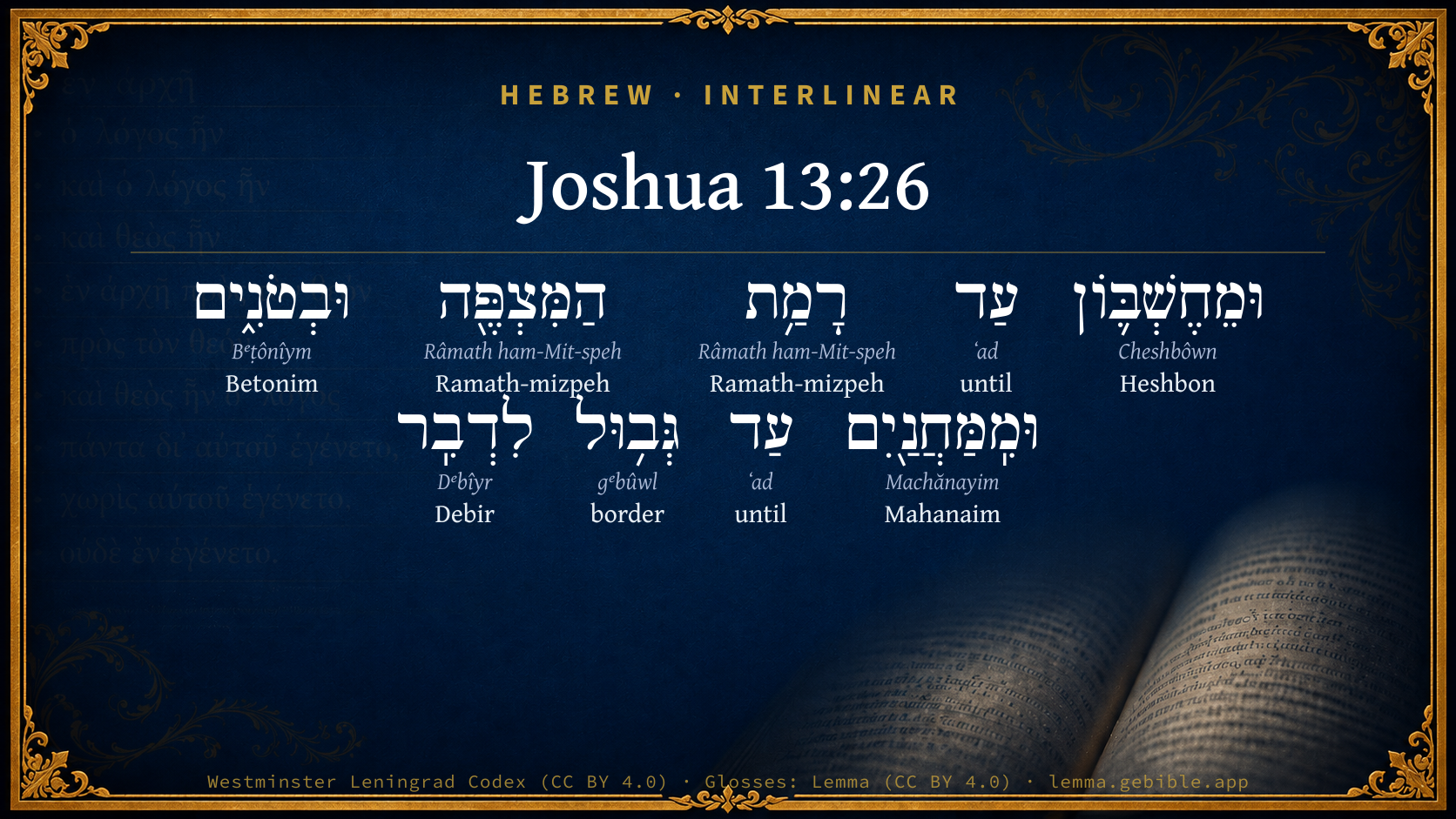
Hebrew (Westminster Leningrad Codex) Joshua 13:26 appears in the Hebrew Old Testament. The text above is from the Westminster Leningrad Codex. Each word links to its Strong’s number, a concise gloss, and parsing drawn from the Open Scriptures Hebrew Bible morphology. Click any word for its full Brown-Driver-Briggs (BDB) entry.
Download image
Cite this verse

Joshua 13:26 (World English Bible). Public Domain. Lemma interlinear Bible study tool, https://lemma.gebible.app/v/joshua/13/26.

Show BibTeX & RIS
BibTeX
RIS
English Translation
and from Heshbon to Ramath Mizpeh, and Betonim; and from Mahanaim to the border of Debir;
World English Bible · Public Domain
Highlights
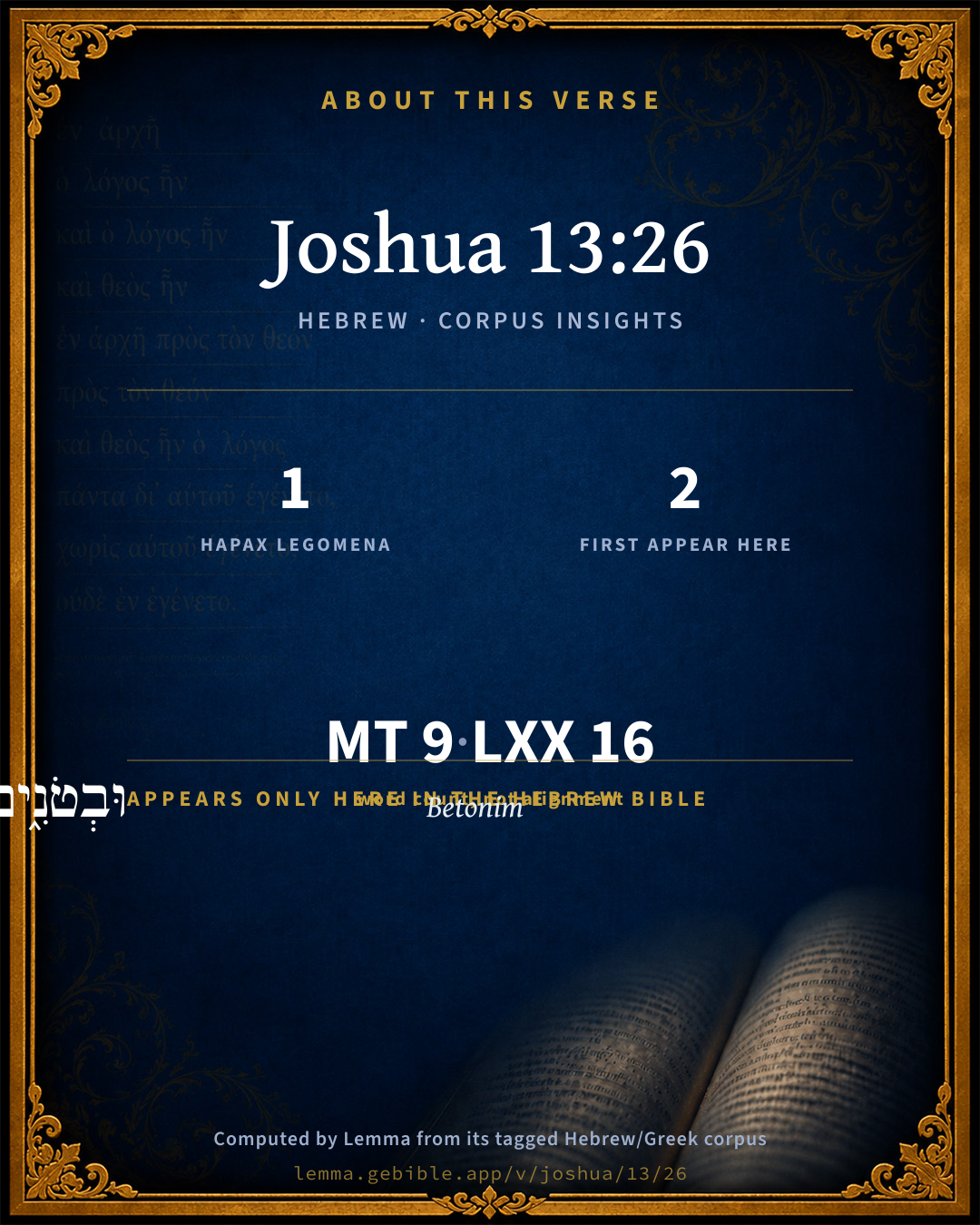
  • 1 hapax legomenon — only here in the Hebrew Bible
  • 2 first appearances in the Hebrew Bible
Full analysis ↓
Download a study sheet

One document with this verse’s original text, its word-by-word gloss line, the meaning frame, cross-references with their text, attributed commentary, and full source and license credits — printable, and it pastes into notes with its structure intact.

This verse Autodidact and up

Study sheet (.html) Plain text (.txt)

A passage Seminary Student

Up to 50 verses in one chapter. A passage sheet keeps up to 6 commentary sources and 12 cross-references per verse, in the order this page ranks them, and says so on the sheet whenever that leaves anything out. Ask for a single verse and you get the Autodidact verse sheet above.

Everything on this page stays free to read, with no account — the sheet is a download of what is already on screen, not access to it.

Want to remove ads? Support Godless Engineer
Compare translations 3

The same verse in 3 English versions, stacked beneath the original-language interlinear above. Click any original word for its lexicon entry.

Each is an independent rendering of the whole verse — the interlinear is not word-aligned to these translations.

Highlighted words mark where these versions differ — a whole-verse word diff, not a word-by-word alignment.

  • World English Bible Public Domain
    and from Heshbon to Ramath Mizpeh, and Betonim; and from Mahanaim to the border of Debir;
  • King James Version Public Domain
    And from Heshbon unto Ramathmizpeh, and Betonim; and from Mahanaim unto the border of Debir;
  • unfoldingWord Literal Text CC BY-SA 4.0
    and from Heshbon unto Ramath Mizpah and Betonim, and from Mahanaim unto the border of Debir,

unfoldingWord Literal Text — © unfoldingWord, licensed CC BY-SA 4.0. Word-aligned USFM3 via Door43 (git.door43.org/unfoldingWord/en_ult).

Versions to compare (up to 4)

3 of 4 selected

Show all 18 translations

Every available English version of this verse, each an independent rendering of the whole verse.

  • World English Bible Public Domain
    and from Heshbon to Ramath Mizpeh, and Betonim; and from Mahanaim to the border of Debir;
  • Berean Standard Bible Public Domain
    the territory from Heshbon to Ramath-mizpeh and Betonim, and from Mahanaim to the border of Debir;
  • Majority Standard Bible Public Domain
    the territory from Heshbon to Ramath-mizpeh and Betonim, and from Mahanaim to the border of Debir;
  • King James Version Public Domain
    And from Heshbon unto Ramathmizpeh, and Betonim; and from Mahanaim unto the border of Debir;
  • American Standard Version (1901) Public Domain
    and from Heshbon unto Ramath-mizpeh, and Betonim; and from Mahanaim unto the border of Debir;
  • Revised Version (1885) Public Domain
    and from Heshbon unto Ramath-mizpeh, and Betonim; and from Mahanaim unto the border of Debir;
  • Geneva Bible (1599) Public Domain
    And from Heshbon vnto Ramoth, Mizpeh, and Betonim: and from Mahanaim vnto the borders of Debir:
  • Douay-Rheims (1899) Public Domain
    And from Hesebon unto Ramoth, Masphe and Betonim: and from Manaim unto the borders of Dabir.
  • Young's Literal Translation Public Domain
    and from Heshbon unto Ramath-Mispeh, and Betonim, and from Mahanaim unto the border of Debir,
  • Literal Standard Version CC BY-SA 4.0
    and from Heshbon to Ramath-Mispeh, and Betonim, and from Mahanaim to the border of Debir,
  • Unlocked Literal Bible CC BY-SA 4.0
    from Heshbon to Ramath Mizpah and Betonim, from Mahanaim to the territory of Debir.
  • unfoldingWord Literal Text CC BY-SA 4.0
    and from Heshbon unto Ramath Mizpah and Betonim, and from Mahanaim unto the border of Debir,
  • Darby Bible Public Domain
    and from Heshbon to Ramath-Mizpeh, and Betonim; and from Mahanaim to the border of Debir;
  • World Messianic Bible Public Domain
    and from Heshbon to Ramath Mizpeh, and Betonim; and from Mahanaim to the border of Debir;
  • Webster's Bible Public Domain
    And from Heshbon to Ramath-mizpeh, and Betonim; and from Mahanaim to the border of Debir;
  • Free Bible Version CC BY-SA 4.0
    stretching from Heshbon to Ramath-mizpeh and Betonim, and from Mahanaim to the Debir region.
  • Bible in Basic English Public Domain
    And from Heshbon to Ramath-mizpeh, and Betonim; and from Mahanaim to the edge of Debir;
  • JPS Tanakh (1917) Public Domain
    and from Heshbon unto Ramath-mizpeh, and Betonim; and from Mahanaim unto the border of Lidbir;

Literal Standard Version (2020), Covenant Press — licensed CC BY-SA 4.0. Text via the HelloAO Bible API (eBible.org). Unlocked Literal Bible (unfoldingWord) — licensed CC BY-SA 4.0. Text via the HelloAO Bible API (eBible.org). unfoldingWord Literal Text — © unfoldingWord, licensed CC BY-SA 4.0. Word-aligned USFM3 via Door43 (git.door43.org/unfoldingWord/en_ult). Free Bible Version, Dr. Jonathan Gallagher — licensed CC BY-SA 4.0. Text via the HelloAO Bible API (eBible.org).

Word by word

More ways to search: Search by grammar → Find every occurrence → Compare this word →

Practice this passage: Drill this verse → Learn its vocabulary →

About this verse

These counts appear in no published source. They are computed here, from the morphology-tagged text and Lemma’s own curated glosses. What Lemma adds →

9
words
7
distinct lemmas
Historical
section

Notable vocabulary

1 hapax legomenon — a word that appears only here in the entire Hebrew Bible:

  • וּבְטֹנִ֑ים Betonim H993

First appearance in Scripture

These words make their first canonical appearance in the Hebrew Bible here:

  • רָמַ֥ת Ramath-mizpeh H7434
  • וּבְטֹנִ֑ים Betonim H993

Grammatical profile

  • 7 nouns
  • 2 prepositions

Repetition

Words recur within this verse — often emphatic in Hebrew:

  • עַד until H5704 ×2
  • רָמַ֥ת Ramath-mizpeh H7434 ×2

Hebrew & Septuagint length

In English translation the verse runs 16 words from the Hebrew and 16 from the Septuagint (LXX English) — the same length.

A rough comparison of the two English renderings, which tokenize alike — not a word-level alignment.

Word counts can differ between the Hebrew and the Greek without any difference in meaning — e.g. the Hebrew direct-object marker אֵת has no separate Greek word, and Greek often adds the article ὁ.

In the original languages it is 9 Hebrew tokens and 16 Greek tokens — but the two are counted differently (Hebrew bundles its prefixes and suffixes into one token; the Greek is in lemma form), so that isn’t a like-for-like length.

Cross-references

11

Topical passages linked to Joshua 13:26 in the Treasury of Scripture Knowledge — connected by theme and wording, ordered by reader-vote popularity; previews shown in the World English Bible.

  • 2 Samuel 17:27 It happened, when David was come to Mahanaim, that Shobi the son of Nahash of Rabbah of the children of Ammon, and Machir the son of Ammiel of Lodebar, and Barzillai the Gileadite of Rogelim,
  • 2 Samuel 2:8 Now Abner the son of Ner, captain of Saul's host, had taken Ish-bosheth the son of Saul, and brought him over to Mahanaim;
  • Genesis 31:49 and Mizpah, for he said, "Yahweh watch between me and you, when we are absent one from another.
  • Genesis 32:1–2 Jacob went on his way, and the angels of God met him.
  • Joshua 20:8 Beyond the Jordan at Jericho eastward, they assigned Bezer in the wilderness in the plain out of the tribe of Reuben, and Ramoth in Gilead out of the tribe of Gad, and Golan in Bashan out of the tribe of Manasseh.
  • Joshua 21:38 Out of the tribe of Gad, Ramoth in Gilead with its suburbs, the city of refuge for the manslayer, and Mahanaim with its suburbs,
  • Judges 10:17 Then the children of Ammon were gathered together, and encamped in Gilead. The children of Israel assembled themselves together, and encamped in Mizpah.
  • Judges 11:11 Then Jephthah went with the elders of Gilead, and the people made him head and chief over them: and Jephthah spoke all his words before Yahweh in Mizpah.
  • Judges 11:29 Then the Spirit of Yahweh came on Jephthah, and he passed over Gilead and Manasseh, and passed over Mizpeh of Gilead, and from Mizpeh of Gilead he passed over to the children of Ammon.
  • 2 Samuel 9:4–5 The king said to him, Where is he? Ziba said to the king, Behold, he is in the house of Machir the son of Ammiel, in Lo Debar.
  • 1 Kings 22:3 The king of Israel said to his servants, "You know that Ramoth-gilead is ours, and we are still, and don't take it out of the hand of the king of Syria?"

Cross-references courtesy of OpenBible.info (CC BY 4.0).

Hebrew and Greek witnesses Masoretic Hebrew ↔ Greek Septuagint

The same verse in the two great witnesses to the Old Testament, shown verse-for-verse.

These are two independent witnesses, not word-aligned to each other, and the Septuagint is shown in lemma (dictionary) form.

Hebrew Joshua 13:26 Masoretic · Westminster Leningrad Codex

וּמֵחֶשְׁבּ֛וֹן עַד רָמַ֥ת הַמִּצְפֶּ֖ה וּבְטֹנִ֑ים וּמִֽמַּחֲנַ֖יִם עַד גְּב֥וּל לִדְבִֽר

and from Heshbon to Ramath Mizpeh, and Betonim; and from Mahanaim to the border of Debir;

World English Bible · Public Domain

Greek LXX Joshua 13:26 Septuagint · lemma form

καί ἀπό εσεβων ἕως ραμωθ κατά ὁ μασσηφα καί βοτανιν καί μααναιν ἕως ὁ ὅριον δαβιρ

And from Esebon to Araboth by Massepha, and Botanim, and Maan to the borders of Daebon,

LXX2012 (modern English Septuagint) · Public Domain

Hebrew: Westminster Leningrad Codex (CC BY 4.0). Greek: Septuagint (public domain); English from LXX2012 (modern English Septuagint) (Public Domain). How the Septuagint differs from the Hebrew →

Targum (Aramaic paraphrase)

1

The Targum is the ancient Jewish Aramaic paraphrase of the Hebrew Scriptures — an interpretive translation, not the Hebrew text itself. Onkelos (literal) and Pseudo-Jonathan (expansive) render the Torah, and Jonathan the Prophets. Coverage is partial: where no permissively-licensed English translation exists for a verse, only the Aramaic is shown. This is verse-level text, not a word-by-word alignment to the Hebrew.

  1. Targum Jonathan Prophets (Joshua–Malachi)
    וּמֵחֶשְׁבּוֹן עַד רָמַת מִצְפַּיָא וּבְטוֹנִים וּמִמַחֲנָיִם עַד תְחוּם לִדְבִיר:

    (no public-domain English translation for this verse)

    Targum Jonathan — Aramaic: “Mikraot Gedolot” (public domain). English: “Sefaria Community Translation” (CC0 1.0 (public-domain dedication)); “London "Chaldee Paraphrase," 1871” (public domain). Text via Sefaria.

Commentary

Notes on Joshua 13:26 from classic Christian and Jewish commentators (each source and its license shown beneath its notes). The classic Christian expositions comment on the surrounding passage and are grouped to its opening verse, so a note may address several verses; the Jewish commentaries on the Tanakh (Rashi and others) are per-verse, so they appear only where the commentator wrote on this verse.

Lemma curates 59 commentaries, every one of them public domain or Creative Commons licensed, each selected and text-cleaned for this edition rather than reprinted as found. About our sources →

Trapp's Complete Commentary

John Trapp

Jos 13:26 And from Heshbon unto Ramathmizpeh, and Betonim; and from Mahanaim unto the border of Debir;

Ver. 26. Ramathmizpeth.] Called also Ramoth in Gilead. {Jos 20:8}

John Trapp, A Commentary or Exposition upon All the Books of the Old and New Testament (1647–1656) — public domain. Text from a community e-Sword module.

Adam Clarke's Commentary

Verse 26. Ramath-mizpeh] The same as Ramoth-gilead. It was one of the cities of refuge, Jos 20:8; De 4:47.

Mahanaim] Or the two camps. Situated on the northern side of the brook Jabbok, celebrated for the vision of the two camps of angels which Jacob had there; see Ge 32:2.

Adam Clarke's Commentary on the Bible (1810–1826) — public domain. Text from a community e-Sword/MySword module.

The Cambridge Bible for Schools and Colleges

gen. ed. J. J. S. Perowne

26. and from Heshbon] Thus the extension northward of the tribe is expressed, unto Ramath-mizpeh, which is identical with the early sanctuary at which Jacob and Laban set up their cairn of stones, and which received the names of Mizpeh, Galeed, and Jegar-Sahadutha, and which probably was the same as the famous Ramoth-gilead, where (a) Ahab was slain (1Ki_22:1-37), (b) his son Joram was wounded by Hazael (2Ki_8:28), (c) Jehu was anointed king (2Ki_9:1-6). It is the modern es-Salt on the road from Jericho to Damascus.

and Betonim] a town somewhere on the northern boundary of Gad. Its site was unknown to Jerome.

and from Mahanaim] in the east, unto Debir, on the heights which border the Jordan on the west. Mahanaim (= the two hosts) is famous in the history (a) of Jacob’s return from Padanaram (Gen_32:2), (b) of Ishbosheth’s reign (2Sa_2:8), (c) of David’s flight from Absalom (2Sa_17:24; 2Sa_17:27). The site of Debir is undetermined.

The Cambridge Bible for Schools and Colleges (gen. ed. J. J. S. Perowne; Cambridge University Press, 1878–1918) — public domain. Text from a community e-Sword module.

John Gill's Exposition

And in the valley, Betharam,.... The same with Bethharan; see Gill on Num 32:36,

and Bethnimrah; sometimes called Nimrah, Num 32:3; near to which were some waters, called the waters of Nimrim, Isa 15:6; It was in Jerom's (p) time a large village; it seems to have its name from leopards, which perhaps had their haunts hereabout:

and Succoth: the place where Jacob pitched his tent after he had passed over Jabbok; it is called in the Jerusalem Talmud (q) Thaarabah:

and Zaphon; which in the same Talmud is Amatho or Amathus, which Jerom says (r) is a village beyond Jordan, twenty one miles from Pella to the south, though he places it in the tribe of Reuben:

the rest of the kingdom of Sihon king of Heshbon; which was not given to the tribe of Reuben, Jos 13:21,

Jordan and his border; that is, the cities which were near it, as Kimchi; or that were upon the bank of it, as Jarchi:

even unto the edge of the sea of Chinnereth; the same with the lake of Gennesaret, Luk 5:1,

on the other side Jordan eastward; the other from that in which the inheritance of Gad lay, which was beyond Jordan, from the land of Canaan.

(p) De loc. Heb. fol. 93. I. (q) T. Hieros. Sheviith, fol. 38. 4. (r) De loc. Heb. fol. 88. E.

John Gill's Exposition of the Whole Bible (1746–1763) — public domain (CC PDM 1.0). Text via the HelloAO Bible API.

Matthew Poole's English Annotations

From Heshbon, either exclusively or inclusively. See Poole on "Jos 13:17".

Ramath-mizpeh, called Ramoth-gilead, or Ramoth in Gilead, Jos 20:8, and elsewhere

Mahanaim, exclusively; for Mahanaim was in the portion of Manasseh, beyond Jabbok, which was the border of Gad and Manasseh.

Matthew Poole's English Annotations on the Holy Bible (1683–1685) — public domain. Text from a community e-Sword/MySword module.

Whedon's Commentary on the Bible

Daniel D. Whedon

26. From Heshbon — Which belonged to the Reubenites, (Jos_13:17,) but stood so near the boundary between Reuben and Gad as to be occupied in common by both tribes. Compare Jos_13:17 and Jos_21:39, notes.

Ramath-mizpeh — Probably identical with Ramoth-gilead and Mizpeh of Gilead, which was allotted to the Levites and appointed one of the cities of refuge. Jos_20:8; Jos_21:38. Most modern scholars are inclined to locate it at the village of es-Salt, thirty miles north of Heshbon. “This is indicated,” says Porter, “(1) by its position on the summit of a steep hill; (2) by its old ecclesiastical name, Saltus Hieralicus, which appears to point to its original sacerdotal and holy character; (3) by the fact that about two miles to the northwest of es-Salt is the highest peak of the mountain range, still bearing the name Jebel Jilead; (4) by the statement of Eusebius that Ramoth-Gilead lay in the fifteenth mile from Philadelphia towards the west, and this is the exact distance of es-Salt from Rabbath-Ammon.” From its lofty position and sacred character it became a great sanctuary of the eastern tribes. See Jdg_10:17, note.

Betonim — Probably identical with a ruined village Batneh, marked on the maps of Menke and Van de Velde about five miles west of es-Salt.

Mahanaim — The place where Jacob met with the angels of God, and therefore called by a name which signifies a double host or camp. Gen_32:2, note. It stood on the border between Gad and Manasseh, (Jos_13:30,) and was assigned to the Levites. Chap. Jos_21:38. Here after Saul’s death Abner made Ishbosheth king, (2Sa_2:8,) and to this place David fled during the rebellion of Absalom. Its site is yet a matter of uncertainty. Some think it is the modern Mahneh, near Jebel Ajlun; while Porter suggests that it may have stood upon the site now occupied by the ruins of Gerasa. The border of Debir is utterly unknown. The Hebrew for of Debir is לדבר, and the first letter ל, lamedh, may be a part of the name, Lidbir. Reland thinks it may be the same as Lodebar, which, according to 2Sa_9:4, must have been in this same vicinity.

Daniel D. Whedon (gen. ed.), Commentary on the Old and New Testaments (1874–1909) — public domain. Text from a community e-Sword module.

The Pulpit Commentary

Ramath-Mizpeh. This is identified with Ramoth-Gilead by Vandevelde, and must have been the Mizpeh of Gilead mentioned in Jud_1:11:29. It is supposed to be identical with the place called Mizpah, Galeed, and Jegar-sahadutha by Jacob and Laban respectively. (Gen_31:47-49) If it be the same as Ramoth-Gilead, it is the scene of the celebrated battle against the Syrians, in which Ahab lost his life, (1Ki 22) and where the fall of the dynasty of Omri was brought about by the revolt of Jehu. (2Ki 9) Conder, however, thinks the two are distinct places, and fixes Ramoth-Mizpeh on the north border of Gad, about 25 reties west of Bozrah.

Mahanaim The dual of hnhm two hosts or camps. It received its name from Jacob, who with his own company met the angels of God, and who commemorated the meeting by this name. (see Gen_32:2) Here Ishbesheth was crowned. (2Sa_2:8) Here David took refuge when he crossed the Jordan, to avoid falling into the hands of Absalom. (2Sa_17:24) Debir. Not the Debir mentioned in Jos 10, but another Debir in the land of Gilead, whose site is unknown.

The Pulpit Commentary (1880–1919), ed. H.D.M. Spence-Jones & Joseph S. Exell — public domain. Text from a community e-Sword module.

John Wesley's Explanatory Notes

Ramath-mizpeh - Called Ramoth-Gilead, or Ramoth in Gilead. Mahanaim - Exclusively; for Mahanaim was in the portion of Manasseh, beyond Jabbok, which was the border of Gad and Manasseh.

John Wesley, Explanatory Notes Upon the Whole Bible (1754–1765) — public domain. Text via the GEBible commentary corpus.

Lesson kit

Teaching starters — assembled from the data on this page, not authored interpretation. Every prompt links to the verse data it draws on. Edit before teaching.

Joshua, in the Historical, opens this verse with 9 words (7 distinct Hebrew lemmas). Its most distinctive word is Bᵉṭônîym (“Betonim”). A historical commentator’s framing appears above. Read the whole chapter for the surrounding context.

Discussion questions

  1. How does “Betonim” (Bᵉṭônîym) shape what this verse is saying?
  2. This verse holds 1 word here found nowhere else in the Hebrew Bible. What might the rare word draw attention to?
  3. 2 words here appear for the first time in Scripture. What is being introduced at this debut?
  4. 2 Samuel 17:27 shares this passage’s theme. How do the two illuminate each other?
  5. “until” occurs 2× in this one verse. What is the effect of the repetition?
  6. These translations render this verse differently; the difference is in the English rendering, not the original. What questions does that raise?
  7. Reading how Trapp's Complete Commentary and Adam Clarke's Commentary read this verse, where do the two commentators agree and where do they part?

Things to notice

  • 1 word in this verse appears nowhere else in the Hebrew Bible.
  • 2 words make their first canonical appearance in Scripture here.
  • This verse counts 9 Hebrew ↔ 16 Greek words.
  • These translations choose different wording for 4 words in this verse.
  • “until” occurs 2× in this single verse.

Reading settings

Reading text

Shown beneath each verse's original-language words.

Old Testament
Old Testament edition

Read the OT as the Masoretic Hebrew (MT) or the Greek Septuagint (LXX).

English shown for the Greek Septuagint (in the Hebrew ↔ Greek comparison).

Comparing translations? Open the Compare panel on any verse page to stack up to four side by side.