Joshua 24:30

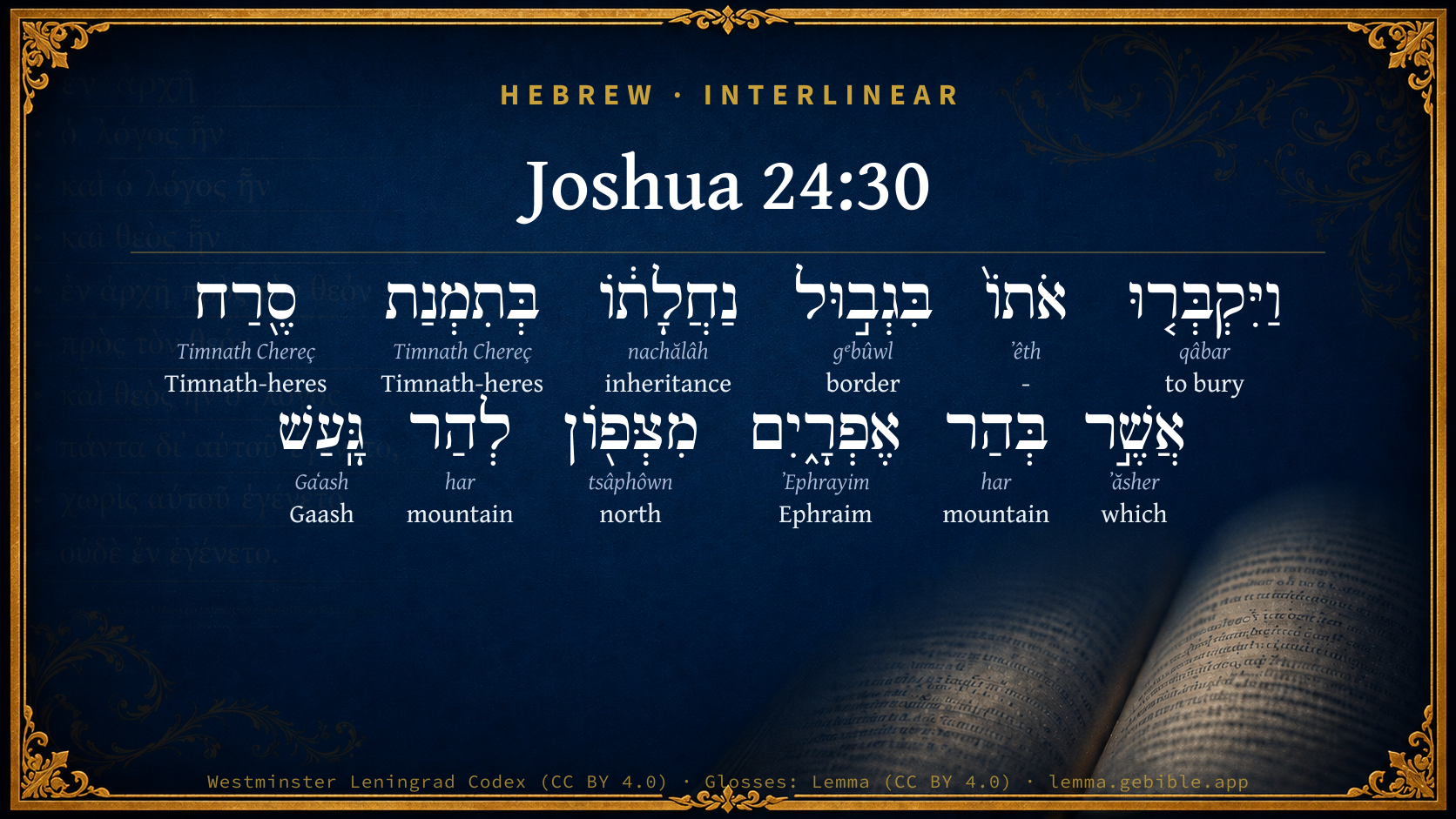
Hebrew (Westminster Leningrad Codex) Joshua 24:30 appears in the Hebrew Old Testament. The text above is from the Westminster Leningrad Codex. Each word links to its Strong’s number, a concise gloss, and parsing drawn from the Open Scriptures Hebrew Bible morphology. Click any word for its full Brown-Driver-Briggs (BDB) entry.
Download image
Cite this verse

Joshua 24:30 (World English Bible). Public Domain. Lemma interlinear Bible study tool, https://lemma.gebible.app/v/joshua/24/30.

Show BibTeX & RIS
BibTeX
RIS
English Translation
They buried him in the border of his inheritance in Timnathserah, which is in the hill-country of Ephraim, on the north of the mountain of Gaash.
World English Bible · Public Domain
Highlights Full analysis ↓
Download a study sheet

One document with this verse’s original text, its word-by-word gloss line, the meaning frame, cross-references with their text, attributed commentary, and full source and license credits — printable, and it pastes into notes with its structure intact.

This verse Autodidact and up

Study sheet (.html) Plain text (.txt)

A passage Seminary Student

Up to 50 verses in one chapter. A passage sheet keeps up to 6 commentary sources and 12 cross-references per verse, in the order this page ranks them, and says so on the sheet whenever that leaves anything out. Ask for a single verse and you get the Autodidact verse sheet above.

Everything on this page stays free to read, with no account — the sheet is a download of what is already on screen, not access to it.

Want to remove ads? Support Godless Engineer
Compare translations 3

The same verse in 3 English versions, stacked beneath the original-language interlinear above. Click any original word for its lexicon entry.

Each is an independent rendering of the whole verse — the interlinear is not word-aligned to these translations.

Highlighted words mark where these versions differ — a whole-verse word diff, not a word-by-word alignment.

  • World English Bible Public Domain
    They buried him in the border of his inheritance in Timnathserah, which is in the hill-country of Ephraim, on the north of the mountain of Gaash.
  • King James Version Public Domain
    And they buried him in the border of his inheritance in Timnathserah, which is in mount Ephraim, on the north side of the hill of Gaash.
  • unfoldingWord Literal Text CC BY-SA 4.0
    And they buried him in the border of his inheritance, in Timnath Serah, which in the hill country of Ephraim, from the north to Mount Gaash.

unfoldingWord Literal Text — © unfoldingWord, licensed CC BY-SA 4.0. Word-aligned USFM3 via Door43 (git.door43.org/unfoldingWord/en_ult).

Versions to compare (up to 4)

3 of 4 selected

Show all 18 translations

Every available English version of this verse, each an independent rendering of the whole verse.

  • World English Bible Public Domain
    They buried him in the border of his inheritance in Timnathserah, which is in the hill-country of Ephraim, on the north of the mountain of Gaash.
  • Berean Standard Bible Public Domain
    And they buried him in the land of his inheritance, at Timnath-serah in the hill country of Ephraim, north of Mount Gaash.
  • Majority Standard Bible Public Domain
    And they buried him in the land of his inheritance, at Timnath-serah in the hill country of Ephraim, north of Mount Gaash.
  • King James Version Public Domain
    And they buried him in the border of his inheritance in Timnathserah, which is in mount Ephraim, on the north side of the hill of Gaash.
  • American Standard Version (1901) Public Domain
    And they buried him in the border of his inheritance in Timnathserah, which is in the hill-country of Ephraim, on the north of the mountain of Gaash.
  • Revised Version (1885) Public Domain
    And they buried him in the border of his inheritance in Timnath-serah, which is in the hill country of Ephraim, on the north of the mountain of Gaash.
  • Geneva Bible (1599) Public Domain
    And they buried him in ye border of his inheritance in Timnath-serah, which is in mount Ephraim, on the Northside of mount Gaash.
  • Douay-Rheims (1899) Public Domain
    And they buried him in the border of his possession in Thamnathsare, which is situate in mount Ephraim, on the north side of mount Gaas.
  • Young's Literal Translation Public Domain
    and they bury him in the border of his inheritance, in Timnath-Serah, which `is' in the hill-country of Ephraim, on the north of the hill of Gaash.
  • Literal Standard Version CC BY-SA 4.0
    and they bury him in the border of his inheritance, in Timnath-Serah, which [is] in the hill-country of Ephraim, on the north of the hill of Gaash.
  • Unlocked Literal Bible CC BY-SA 4.0
    They buried him within the border of his own inheritance, at Timnath Serah, which is in the hill country of Ephraim, north of Mount Gaash.
  • unfoldingWord Literal Text CC BY-SA 4.0
    And they buried him in the border of his inheritance, in Timnath Serah, which in the hill country of Ephraim, from the north to Mount Gaash.
  • Darby Bible Public Domain
    And they buried him in the border of his inheritance in Timnath-serah, which is in mount Ephraim, on the north side of the mountain of Gaash.
  • World Messianic Bible Public Domain
    They buried him in the border of his inheritance in Timnathserah, which is in the hill country of Ephraim, on the north of the mountain of Gaash.
  • Webster's Bible Public Domain
    And they buried him in the border of his inheritance in Timnath-serah, which is in mount Ephraim, on the north side of the hill of Gaash.
  • Free Bible Version CC BY-SA 4.0
    They buried him in Timnath-serah in the hill country of Ephraim, north of Mount Gaash, the land he had been allocated.
  • Bible in Basic English Public Domain
    And they put his body in the earth in the land of his heritage in Timnath-serah, in the hill-country of Ephraim, to the north of Mount Gaash.
  • JPS Tanakh (1917) Public Domain
    And they buried him in the border of his inheritance in Timnath-serah, which is in the hill-country of Ephraim, on the north of the mountain of Gaash.

Literal Standard Version (2020), Covenant Press — licensed CC BY-SA 4.0. Text via the HelloAO Bible API (eBible.org). Unlocked Literal Bible (unfoldingWord) — licensed CC BY-SA 4.0. Text via the HelloAO Bible API (eBible.org). unfoldingWord Literal Text — © unfoldingWord, licensed CC BY-SA 4.0. Word-aligned USFM3 via Door43 (git.door43.org/unfoldingWord/en_ult). Free Bible Version, Dr. Jonathan Gallagher — licensed CC BY-SA 4.0. Text via the HelloAO Bible API (eBible.org).

Word by word

More ways to search: Search by grammar → Find every occurrence → Compare this word →

Practice this passage: Drill this verse → Learn its vocabulary →

גָּֽעַשׁ
Gaʻash
H1608
“Gaash”
Noun, Proper
Part of Speech
Noun
Type
Proper
Full BDB Definition

Origin: from H1607

TWOT: None

Gaash = "quaking" - a mountain of Ephraim where Joshua was buried
  1. וַיִּקְבְּר֤וּ qâbar H6912 “and · to bury” Conjunction + Verb, Qal, Sequential Imperfect, 3rd Person, Masculine, Plural
  2. אֹתוֹ֙ ʼêth H853 “- · him” Particle, Direct Object + Suffix, Personal, 3rd Person, Masculine, Singular
  3. בִּגְב֣וּל gᵉbûwl H1366 “in/at · border of” Preposition + Noun, Common, Masculine, Singular, Construct
  4. נַחֲלָת֔וֹ nachălâh H5159 “inheritance · his” Noun, Common, Feminine, Singular, Construct + Suffix, Personal, 3rd Person, Masculine, Singular
  5. בְּתִמְנַת Timnath Chereç H8556 “in/at · Timnath-heres” Preposition + Noun, Proper
  6. סֶ֖רַח Timnath Chereç H8556 “Timnath-heres” Noun, Proper
  7. אֲשֶׁ֣ר ʼăsher H834 “which” Particle, Relative
  8. בְּהַר har H2022 “in/at · mountain of” Preposition + Noun, Common, Masculine, Singular, Construct
  9. אֶפְרָ֑יִם ʼEphrayim H669 “Ephraim” Noun, Proper
  10. מִצְּפ֖וֹן tsâphôwn H6828 “from · north of” Preposition + Noun, Common, Feminine, Singular, Construct
  11. לְהַר har H2022 “to/for · mountain of” Preposition + Noun, Common, Masculine, Singular, Construct

About this verse

These counts appear in no published source. They are computed here, from the morphology-tagged text and Lemma’s own curated glosses. What Lemma adds →

12
words
10
distinct lemmas
Historical
section

Notable vocabulary

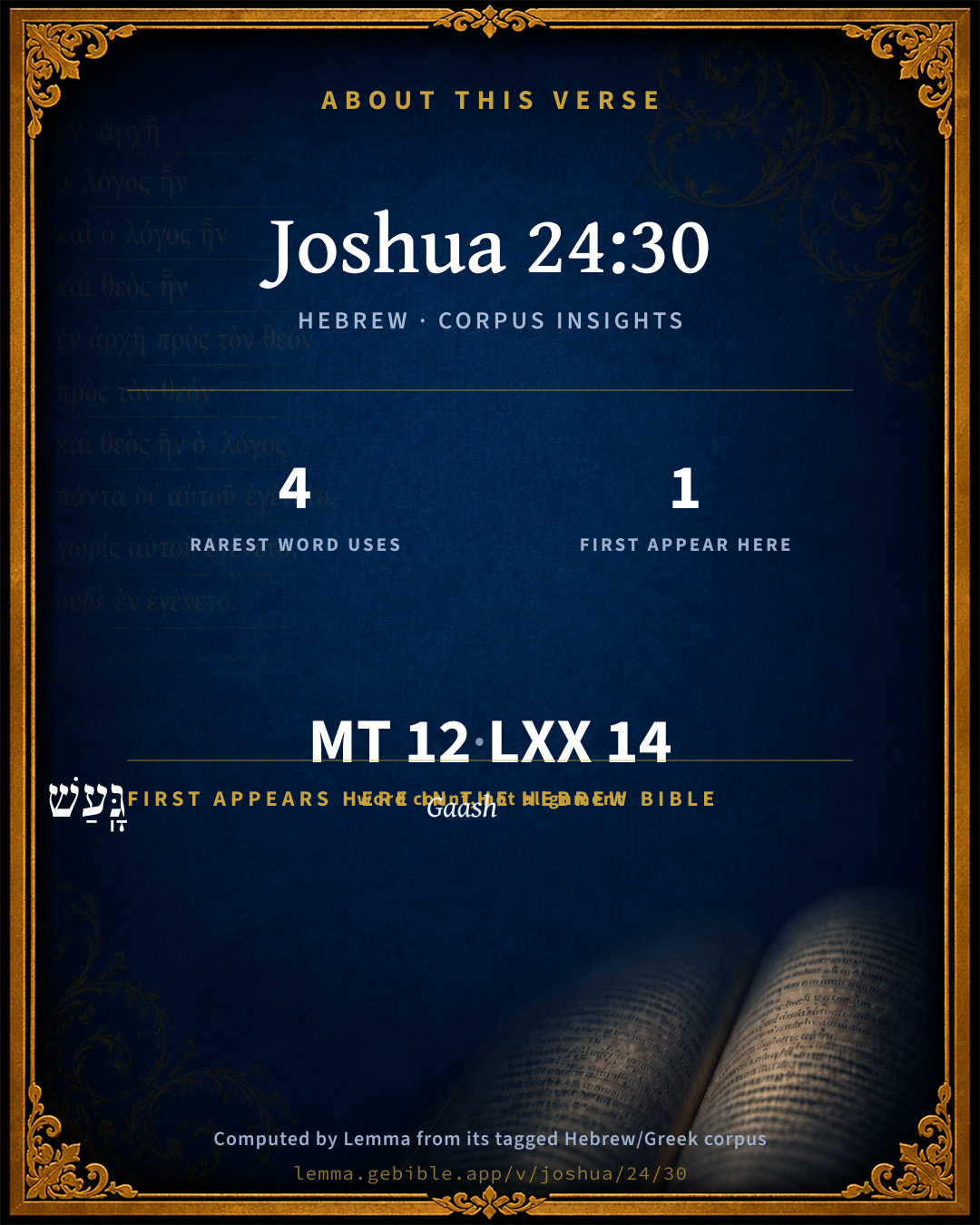
The rarest word here is גָּֽעַשׁ Gaash H1608 — appearing just 4 times in the whole Hebrew Bible.

First appearance in Scripture

This word makes its first canonical appearance in the Hebrew Bible here:

  • גָּֽעַשׁ Gaash H1608

Shared distinctive vocabulary

גָּֽעַשׁ Gaash H1608 occurs in 4 verses of the Hebrew Bible. Also found in:

Grammatical profile

  • 1 verb
  • 9 nouns
  • 2 particles

Verb forms

  • וַיִּקְבְּר֤וּ Qal · Sequential Imperfect

Repetition

Words recur within this verse — often emphatic in Hebrew:

  • בְּתִמְנַת Timnath-heres H8556 ×2
  • בְּהַר mountain H2022 ×2

Hebrew & Septuagint length

In English translation the verse runs 26 words from the Hebrew and 69 from the Septuagint (LXX English) — the Septuagint runs noticeably longer here. See the side-by-side →

A rough comparison of the two English renderings, which tokenize alike — not a word-level alignment.

Word counts can differ between the Hebrew and the Greek without any difference in meaning — e.g. the Hebrew direct-object marker אֵת has no separate Greek word, and Greek often adds the article ὁ.

In the original languages it is 12 Hebrew tokens and 14 Greek tokens — but the two are counted differently (Hebrew bundles its prefixes and suffixes into one token; the Greek is in lemma form), so that isn’t a like-for-like length.

Cross-references

3

Topical passages linked to Joshua 24:30 in the Treasury of Scripture Knowledge — connected by theme and wording, ordered by reader-vote popularity; previews shown in the World English Bible.

  • Joshua 19:50 according to the commandment of Yahweh they gave him the city which he asked, even Timnathserah in the hill-country of Ephraim; and he built the city, and lived therein.
  • Judges 2:9 They buried him in the border of his inheritance in Timnath Heres, in the hill country of Ephraim, on the north of the mountain of Gaash.
  • 2 Samuel 23:30 Benaiah a Pirathonite, Hiddai of the brooks of Gaash.

Cross-references courtesy of OpenBible.info (CC BY 4.0).

Hebrew and Greek witnesses Masoretic Hebrew ↔ Greek Septuagint

The same verse in the two great witnesses to the Old Testament, shown verse-for-verse.

Here the Septuagint runs noticeably longer than the Hebrew — LXX2012 (modern English Septuagint) 69 words vs World English Bible 26. A rough length comparison of the two English translations, not a word-level alignment — read both below.

These are two independent witnesses, not word-aligned to each other, and the Septuagint is shown in lemma (dictionary) form.

Hebrew Joshua 24:30 Masoretic · Westminster Leningrad Codex

וַיִּקְבְּר֤וּ אֹתוֹ֙ בִּגְב֣וּל נַחֲלָת֔וֹ בְּתִמְנַת סֶ֖רַח אֲשֶׁ֣ר בְּהַר אֶפְרָ֑יִם מִצְּפ֖וֹן לְהַר גָּֽעַשׁ

They buried him in the border of his inheritance in Timnathserah, which is in the hill-country of Ephraim, on the north of the mountain of Gaash.

World English Bible · Public Domain

Greek LXX Joshua 24:30 Septuagint · lemma form

καί γίγνομαι μετά ἐκεῖνος καί ἀποθνήσκω ἰησοῦς υἱός ναυη δοῦλος κύριος ἑκατόν δέκα ἔτος

And they buried him by the borders of his inheritance in Thamnasarach in the mount of Ephraim, northward of the mount of Galaad: there they put with him into the tomb in which they buried him, the knives of stone with which he circumcised the children of Israel in Galgala, when he brought them out of Egypt, as the Lord appointed them; and there they are to this day.

LXX2012 (modern English Septuagint) · Public Domain

On this verse, Adam Clarke's Commentary discusses the Septuagint’s reading. Read the note in Commentary ↓

Hebrew: Westminster Leningrad Codex (CC BY 4.0). Greek: Septuagint (public domain); English from LXX2012 (modern English Septuagint) (Public Domain). How the Septuagint differs from the Hebrew →

Targum (Aramaic paraphrase)

1

The Targum is the ancient Jewish Aramaic paraphrase of the Hebrew Scriptures — an interpretive translation, not the Hebrew text itself. Onkelos (literal) and Pseudo-Jonathan (expansive) render the Torah, and Jonathan the Prophets. Coverage is partial: where no permissively-licensed English translation exists for a verse, only the Aramaic is shown. This is verse-level text, not a word-by-word alignment to the Hebrew.

  1. Targum Jonathan Prophets (Joshua–Malachi)
    וּקְבַרוּ יָתֵיהּ בִּתְחוּם אַחֲסַנְתֵּיהּ בְּתִמְנַת סֶרַח דִי בְּטוּרָא דְבֵית אֶפְרַיִם מִצִפּוּנָא לְטוּר גָעַשׁ:

    (no public-domain English translation for this verse)

    Targum Jonathan — Aramaic: “Mikraot Gedolot” (public domain). English: “Sefaria Community Translation” (CC0 1.0 (public-domain dedication)); “London "Chaldee Paraphrase," 1871” (public domain). Text via Sefaria.

Commentary

Notes on Joshua 24:30 from classic Christian and Jewish commentators (each source and its license shown beneath its notes). The classic Christian expositions comment on the surrounding passage and are grouped to its opening verse, so a note may address several verses; the Jewish commentaries on the Tanakh (Rashi and others) are per-verse, so they appear only where the commentator wrote on this verse.

Lemma curates 59 commentaries, every one of them public domain or Creative Commons licensed, each selected and text-cleaned for this edition rather than reprinted as found. About our sources →

The Cambridge Bible for Schools and Colleges

gen. ed. J. J. S. Perowne

30. And they buried him in the border of his inheritance in Timnath-serah] For the probable site of this spot, see above, Jos_19:50. A photograph brought out by the “Palestine Exploration Committee” gives a representation of the tomb of Joshua. “It is certainly the most striking monument in the country,” says Lieut. Conder, “and strongly recommends itself to the mind as an authentic site.” The tomb is a square chamber, with five excavations in three of its sides, the central one forming a passage leading into a second chamber beyond. A great number of lamp-niches cover the walls of the porch—upwards of 200—arranged in vertical rows. A single cavity with a niche for a lamp may be identified, it is thought, with the resting-place of the warrior-chief of Israel.

the hill of Gaash] This mountain is also mentioned in Jdg_2:9; 2Sa_23:30; 1Ch_11:32. The Alexandrine and Arabic versions have appended to Jos_24:30 the traditionary legend that the knives of stone, with which Joshua performed the rite of circumcision at Gilgal, were buried with him.

The Cambridge Bible for Schools and Colleges (gen. ed. J. J. S. Perowne; Cambridge University Press, 1878–1918) — public domain. Text from a community e-Sword module.

Trapp's Complete Commentary

John Trapp

Jos 24:30 And they buried him in the border of his inheritance in Timnathserah, which [is] in mount Ephraim, on the north side of the hill of Gaash.

Ver. 30. In Timnathserah.] {See Trapp on "Jos 19:50"}

John Trapp, A Commentary or Exposition upon All the Books of the Old and New Testament (1647–1656) — public domain. Text from a community e-Sword module.

Tyndale Open Study Notes

Tyndale Open Resources

24:30 Timnath-serah: See 19:49-51.

Tyndale Open Study Notes — © Tyndale Open Resources, licensed CC BY-SA 4.0. Text via the HelloAO Bible API.

Adam Clarke's Commentary

Verse 30. And they buried him - in Timnath-serah] This was his own inheritance, as we have seen Jos 19:50. The Septuagint add here, "And they put with him there, in the tomb in which they buried him, the knives of stone with which he circumcised the children of Israel in Gilgal, according as the Lord commanded when he brought them out of Egypt; and there they are till this day." St. Augustine quotes the same passage in his thirtieth question on the book of Joshua, which, in all probability, he took from some copy of the Septuagint. It is very strange that there is no account of any public mourning for the death of this eminent general; probably, as he was buried in his own inheritance, he had forbidden all funeral pomp, and it is likely was privately interred.

Adam Clarke's Commentary on the Bible (1810–1826) — public domain. Text from a community e-Sword/MySword module.

John Gill's Exposition

And the children of Israel served the Lord all the days of Joshua,.... Without going into idolatrous practices:

and all the days of the elders that overlived Joshua; that lived a few years longer than he; some of them that came young out of Egypt, and were now elderly men; and some of them doubtless were of the court of the seventy elders; these could not overlive Joshua a great many years, for, in the times of Chushanrishathaim, Israel fell into idolatry, Jdg 2:6,

and which had known all the works of the Lord, that he had done for Israel; in Egypt, at the Red sea, in the wilderness, as well as since their coming into the land of Canaan.

John Gill's Exposition of the Whole Bible (1746–1763) — public domain (CC PDM 1.0). Text via the HelloAO Bible API.

Haydock's Catholic Bible Commentary

Thamnathsare. Judges ii. 9. The last word is written hares (eros) the first and last letters being transposed in one of these places. It may probably be in this verse, as we read of Mount Hares, Judges i. 35. Kennicott rather thinks that Sare is the proper reading, as it is found in the Syriac, Arabic, and Vulgate versions of the Book of Judges. He observes, that if we were to read in an English historian that the renowned Marlborough was buried at Blenheim, near Woodstock, and a few pages after that his remains were interred "at Blenmein, &c., we should naturally conclude that two letters had exchanged their places. And may we not allow the same in this part of the sacred history, as it is universally printed" in Hebrew? (Dis. i.) Some, however, maintain that Thamnath hares was so called, on account of "the image of the sun" being placed in the tomb of Josue, along with the knives of stone used by him in circumcision, which last the Septuagint and St. Augustine (q. 30,) admit. But these must be reckoned among the Jewish or Oriental fables, (Calmet) though it is not improbable but the circumcising knives might be thus preserved, as a monument of the covenant made with the Israelites. (Haydock) --- Gaas. This was another name for Mount Sare, or Hares, a part of Mount Ephraim; where St. Jerome tells us St. Paula visited the tomb of Josue. It was shewn near Thamna in the days of Eusebius. (Calmet) --- No mention is made of mourning, as for Moses, &c., to insinuate that under the law the saints descended into limbo, but are admitted into paradise under the gospel. (St. Jerome, mans. 34.) (Worthington)

George Leo Haydock (1774–1849), Haydock's Catholic Family Bible and Commentary, 1859 edition — public domain. Excludes Psalms (Douay-Rheims chapter numbering differs from Protestant) and Deuterocanonical books (Catholic canon only).

The Pulpit Commentary

In the border of his inheritance in Timnath-Serah. Rather, perhaps, within the border. For Timnath-Serah, see note on Jos_19:50. The burial-place of Joshua has been supposed to be identified by the Palestine Exploration Committee. Lieutenant Conder describes what he saw at Tibneh. Amid a number of tombs he found one evidently, from more than 200 lamp niches on the walls of the porch, the sepulchre of a man of distinction. The simple character of the ornamentation, he thinks, and the entire absence of it in the interior of the tomb itself, not only suggest an early date, but are in harmony with the character of the simple yet noble-minded warrior, whose tomb it is supposed to be (see Quart. Paper, oct. 1873). In later papers, however (see Oct. 1877, and Jan. 1878), Lieutenant Conder abandons Tibneh for Kerr Haris, on the ground that Jewish tradition, usually found to be correct, is in its favour. And more mature reflection has induced him to modify his former opinion as to the early date of the tombs. Until these researches commenced, the situation of the hill Gaash was unknown, though it is mentioned in 2Sa_23:30 ("the brooks" or "valleys of Gaash"), and 1Ch_11:32. Nothing in these places serves to identify it. This passage is copied, with a few minute verbal discrepancies, into the Book of Judges, (Jos_2:6-9) a strong ground, according to all ordinary haws of literary criticism, for concluding that the latter book was written after the former. This is the chain of evidence by which the authenticity of the historical books of the Scriptures is established, not, of course, beyond the reach of cavil or dispute, but to the satisfaction of practical men. The LXX as well as the Arabic translators have added here the following words: "There they placed with him in the sepulchre, in which they buried him there, the stone knives with which he circumcised the children of Israel in Gilgal, when he led them out from Egypt, as the Lord commanded, and they are there unto this day." This passage is not found in the Hebrew. And as the Arabic and the LXX do not altogether agree, the probability seems to be that some apocryphal legend was inserted here at a very early date.

Vers. 30, 32, 33. Three graves.

Such is the story of life. The end of it is always in some sepulchre. "They buried Joshua." "They buried the bones of Joseph." "They buried Eleazer." So the land is taken in possession. Every grave becoming a stronger link, binding the people to each other and to the land God gave them. Look at these graves. And observe

I EVERY LIFE AT LAST FINDS A GRAVE. However strong the frame and long the conflict, at last the priest must lay down the censer, the statesman resign command, the warrior retire from fields of strife. Immortality is not for earthly surroundings, nor for the imperfect spirit and body we have here. If we are to live forever it must be somewhere where character is perfect, and a frame suited for a perfect spirit is enjoyed. It is well that an existence so faulty is so brief. Out of Eden it is better that we should be out of reach of any tree of life that can give earthly immortality. The average life is long enough for the average power of enjoying it. And it is well that it should be "rounded off by sleep." This destiny is too much overlooked. It may be so contemplated as only to injure us. When we anticipate it with dread, without the light of God"s smile upon it or of His home beyond it, when it only shrivels up the warmth and energy of life, then its influence is harmful. But it need not have any such influence. If we remember that God is love and death a Divine institution, we shall feel that there must be some service rendered by even death; and this feeling destroying the dread of it, we shall then be in a condition to profit by its helpful influence. Amongst many wholesome influences these may be noted:

(1) It should correct the folly that wastes life. Some make two mistakes. They treat time as if it were eternity, and eternity as if it were time. And this mistake produces a purposeless existence that turns life to no account. The thought of death should wake those wasteful of life. It reminds us that the day of life has its task, that there is a serious account to be rendered of how we spent it. It says, "Awake thou that sleepest, and arise from the dead." It bids us live while we live, and work while it is called day.

(2) It comforts the heavy laden. Life has many burdens. Duty is often a heavy load. Regrets, cares, sorrows make between them a burden of huge dimensions. God"s saints, though they take more peacefully what is sent them, are not insensible to its troubles. On the contrary, "many are the afflictions of the righteous." Death comes when the burden is too heavy, and whispers, "It is not for long." "The light affliction is but for a moment." The glory is eternal.

"Brief life is here our portion, Brief sorrow, short-lived care, The life that knows no ending, The tearless life is there.

How many would have fainted utterly but for the thought, that trials were only mortal. If to some death had seemed a great foe, to many others it has seemed the

"Kind umpire of men"s miseries, Which, with sweet enlargement, does dismiss us hence.

If it is a great consoler of the suffering, observe further

(3) it gives zest to every activity of life. How vapid would life become if death were not the lot of men! How dull the activity which had eternity for its work! How poor the low delight would become if anything fixed forever the conditions which for the moment are sufficient to produce it. But a brief life, ever changing, with no time to waste, gives keenness and zest and joy to all our existence. And lastly, it makes us look for immortality. It raises the eye above. The other world is lighted by those who, dying, enter it. The thought of our own impending death makes us desire some "everlasting habitation" when the stewardship here is ended. So mortality protects immortality, keeps it from being forgotten, undervalued, or endangered. And, like some schoolmaster whose harshness yet helps the learning of some lesson, so death is the great instructor and preparer for the life beyond. Lament not Joshua, or Joseph, or Eleazer. Death is mercy to all such. It is not a calamity, it is the sleep God gives His beloved. If it is well to remember that all life comes to a grave, it is still more important to remember

II THAT NEITHER LIFE NOR USEFULNESS END THERE.

(1) Life does not end there. Who could imagine that that grave at Timnathserah was the end of Joshua? When ripest and fittest for high employment, to what purpose would have been "the waste of such ointment"? "God gathers up fragments that nothing may be lost;" would He waste such a splendid aggregate of saintly forces? Men could not believe it. Jacob spoke of his approaching death as a being gathered to his people," as if his great ancestors were all above waiting to welcome him. What nature has whispered to the hearts of all men the Saviour has revealed more clearly. He has abolished death." And now we rejoice to believe life does not end, but only takes a new departure from the grave. Death in the ease of all God"s saints is only the fulfilment of the Saviours promise, "I will come again and receive you unto Myself." If life does not end with the grave, observe

(2) usefulness does not end with it. There is something touching in these earliest graves of Israel Machpelah, Shechem, Timnath, Mount Ephraim. Such graves were thrones, on each of which a great spirit sat and ruled, teaching spirituality, truth, courage, communion with God. The very graves consecrated the land. As of the great cathedral of Florence the poet sang:

"In Santa Croce"s holy precincts lie Ashes which make it holier. Dust which is Even in itself an immortality;

So we feel these graves were a leavening consecration which made Palestine indeed a holy land. England is rich in graves. Its soil is rich with the dust of the great and good.

"Half the soil has trod the rest In poets, heroes, martyrs, sages.

What impulses of courage, of philanthropy, and consecration have come from the graves of Bruce, of Howard, of the Wesleys: of a multitude that none can number? If we have the Divine life within us, death cannot end our usefulness. On the contrary, its touch canonises. Death makes the neglected counsel the revered oracle; and the neglected example the pattern on the mount; and the despised creed the life giving truth. "Except a corn of wheat fall into the ground and die it abides alone; but if it die, it bringeth forth much fruit." Death robs us of rulership over a few things only to give us rulership over many things. Let us live so that, like these, our graves may brighten and bless the land of our burial. G.

The Pulpit Commentary (1880–1919), ed. H.D.M. Spence-Jones & Joseph S. Exell — public domain. Text from a community e-Sword module.

Rashi

Rabbi Shlomo Yitzchaki (Rashi)

In Simnas-serach. This was its actual name. Elsewhere it is called Simnas-cheres because they erected a figure of the sun upon his grave, to indicate that he is the one that caused the sun to stand still, and all who pass by it say, “Woe for the loss of this one, who did such a great thing and died.” Others say its actual name was Simnas-cheres, and why was it called Simnas- serach? because its fruit would rot because of their abundant richness.

The Storming Mountain It was so named to teach us that the hill stormed [shook] and threatened to kill them, because the people did not eulogize him properly.

Rashi on the Tanakh — English translations: “The Judaica Press complete Tanach with Rashi, translated by A. J. Rosenberg” (CC BY 4.0); “Pentateuch with Rashi's commentary by M. Rosenbaum and A.M. Silbermann, 1929-1934” (public domain); “The Metsudah Tanach series, Lakewood, N.J” (CC BY 4.0); and “The Book of Joshua, Metsudah Publications, 1997” (CC BY 4.0). Text via Sefaria.

Lesson kit

Teaching starters — assembled from the data on this page, not authored interpretation. Every prompt links to the verse data it draws on. Edit before teaching.

Joshua, in the Historical, opens this verse with 12 words (10 distinct Hebrew lemmas). Its most distinctive word is Gaʻash (“Gaash”). The Greek Septuagint runs longer here. A historical commentator’s framing appears above. Read the whole chapter for the surrounding context.

Discussion questions

  1. The word Gaʻash carries the sense “Gaash.” How does it shape the verse?
  2. This is the first place “Gaash” appears in Scripture (first appears here). What does its debut here establish?
  3. How does Judges 2:9, which shares the word «Gaash», read alongside this verse?
  4. What does the repetition of “Timnath-heres” (2× in this one verse) do in this verse?
  5. The Septuagint runs longer here than the Hebrew. What might account for the difference?
  6. These translations render this verse differently. What is at stake in choosing one wording over another?
  7. «וַיִּקְבְּר֤וּ» is a Qal Sequential Imperfect verb. How does that grammatical form shape the action described?
  8. Compare how The Cambridge Bible for Schools and Colleges and Trapp's Complete Commentary read this verse. Where do they agree or differ?

Things to notice

Reading settings

Reading text

Shown beneath each verse's original-language words.

Old Testament
Old Testament edition

Read the OT as the Masoretic Hebrew (MT) or the Greek Septuagint (LXX).

English shown for the Greek Septuagint (in the Hebrew ↔ Greek comparison).

Comparing translations? Open the Compare panel on any verse page to stack up to four side by side.