
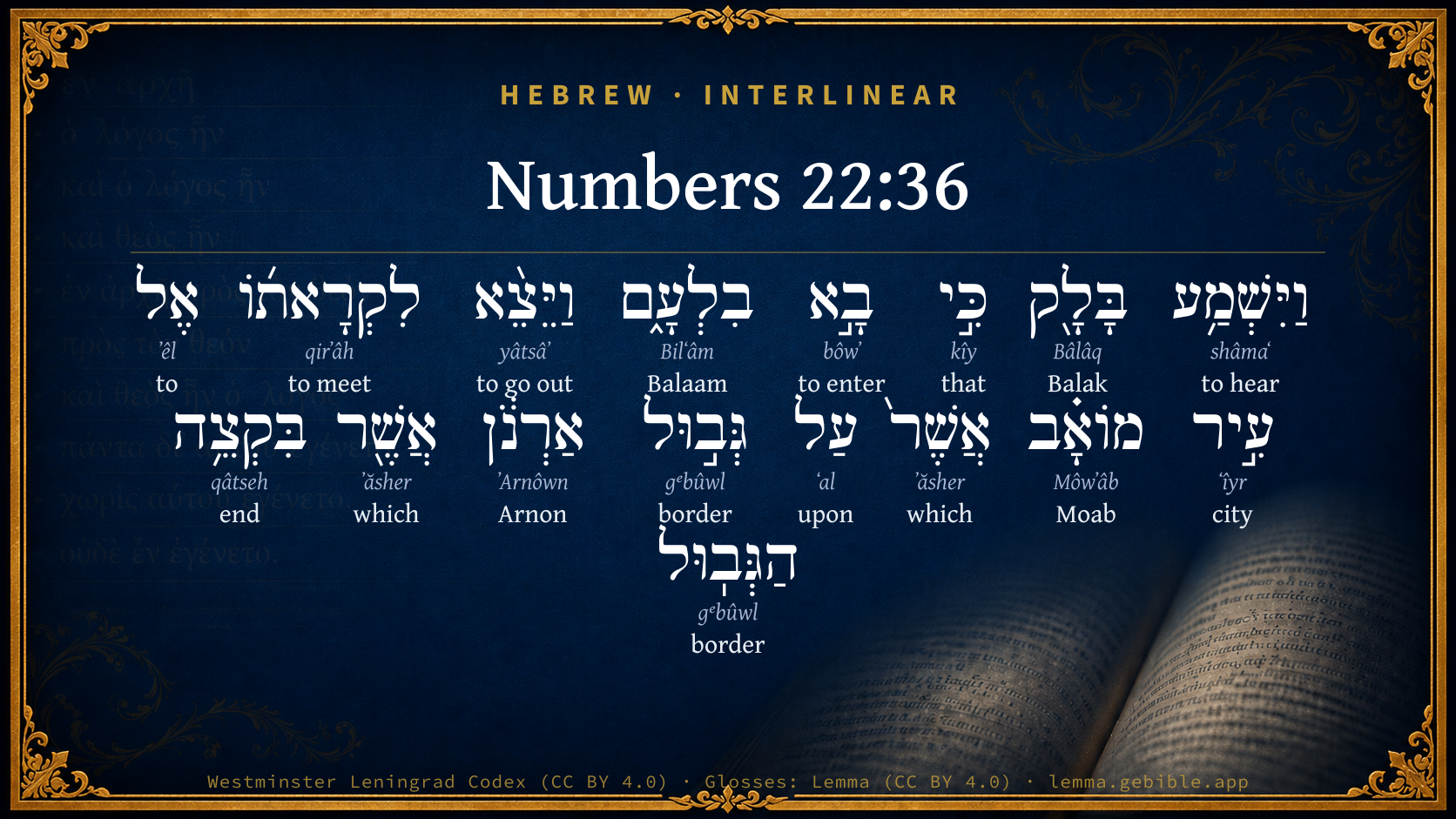
Numbers 22:36

Hebrew (Westminster Leningrad Codex) Numbers 22:36 appears in the Hebrew Old Testament. The text above is from the Westminster Leningrad Codex. Each word links to its Strong’s number, a concise gloss, and parsing drawn from the Open Scriptures Hebrew Bible morphology. Click any word for its full Brown-Driver-Briggs (BDB) entry.
Download image
Cite this verse

Numbers 22:36 (World English Bible). Public Domain. Lemma interlinear Bible study tool, https://lemma.gebible.app/v/numbers/22/36.

Show BibTeX & RIS
BibTeX
RIS
English Translation
When Balak heard that Balaam was come, he went out to meet him to the City of Moab, which is on the border of the Arnon, which is in the utmost part of the border.
World English Bible · Public Domain
Download a study sheet

One document with this verse’s original text, its word-by-word gloss line, the meaning frame, cross-references with their text, attributed commentary, and full source and license credits — printable, and it pastes into notes with its structure intact.

This verse Autodidact and up

Study sheet (.html) Plain text (.txt)

A passage Seminary Student

Up to 50 verses in one chapter. A passage sheet keeps up to 6 commentary sources and 12 cross-references per verse, in the order this page ranks them, and says so on the sheet whenever that leaves anything out. Ask for a single verse and you get the Autodidact verse sheet above.

Everything on this page stays free to read, with no account — the sheet is a download of what is already on screen, not access to it.

Want to remove ads? Support Godless Engineer
Compare translations 3

The same verse in 3 English versions, stacked beneath the original-language interlinear above. Click any original word for its lexicon entry.

Each is an independent rendering of the whole verse — the interlinear is not word-aligned to these translations.

Highlighted words mark where these versions differ — a whole-verse word diff, not a word-by-word alignment.

  • World English Bible Public Domain
    When Balak heard that Balaam was come, he went out to meet him to the City of Moab, which is on the border of the Arnon, which is in the utmost part of the border.
  • King James Version Public Domain
    And when Balak heard that Balaam was come, he went out to meet him unto a city of Moab, which is in the border of Arnon, which is in the utmost coast.
  • unfoldingWord Literal Text CC BY-SA 4.0
    And Balak heard that Balaam had come, and he went out to meet him at a city of Moab that on the border of the Arnon, which at the edge of the border.

unfoldingWord Literal Text — © unfoldingWord, licensed CC BY-SA 4.0. Word-aligned USFM3 via Door43 (git.door43.org/unfoldingWord/en_ult).

Versions to compare (up to 4)

3 of 4 selected

Show all 18 translations

Every available English version of this verse, each an independent rendering of the whole verse.

  • World English Bible Public Domain
    When Balak heard that Balaam was come, he went out to meet him to the City of Moab, which is on the border of the Arnon, which is in the utmost part of the border.
  • Berean Standard Bible Public Domain
    When Balak heard that Balaam was coming, he went out to meet him at the Moabite city on the Arnon border, at the edge of his territory.
  • Majority Standard Bible Public Domain
    When Balak heard that Balaam was coming, he went out to meet him at the Moabite city on the Arnon border, at the edge of his territory.
  • King James Version Public Domain
    And when Balak heard that Balaam was come, he went out to meet him unto a city of Moab, which is in the border of Arnon, which is in the utmost coast.
  • American Standard Version (1901) Public Domain
    And when Balak heard that Balaam was come, he went out to meet him unto the City of Moab, which is on the border of the Arnon, which is in the utmost part of the border.
  • Revised Version (1885) Public Domain
    And when Balak heard that Balaam was come, he went out to meet him unto the City of Moab, which is on the border of Arnon, which is in the utmost part of the border.
  • Geneva Bible (1599) Public Domain
    And when Balak heard that Balaam came, he went out to meete him vnto a citie of Moab, which is in the border of Arnon, euen in the vtmost coast.
  • Douay-Rheims (1899) Public Domain
    And when Balac heard it he came forth to meet him in a town of the Moabites, that is situate in the uttermost borders of Arnon.
  • Young's Literal Translation Public Domain
    And Balak heareth that Balaam hath come, and goeth out to meet him, unto a city of Moab, which `is' on the border of Arnon, which `is' in the extremity of the border;
  • Literal Standard Version CC BY-SA 4.0
    And Balak hears that Balaam has come, and goes out to meet him, to a city of Moab, which [is] on the border of Arnon, which [is] in the extremity of the border;
  • Unlocked Literal Bible CC BY-SA 4.0
    When Balak heard that Balaam had come, he went out to meet him at a city in Moab at the Arnon, which is on the border.
  • unfoldingWord Literal Text CC BY-SA 4.0
    And Balak heard that Balaam had come, and he went out to meet him at a city of Moab that on the border of the Arnon, which at the edge of the border.
  • Darby Bible Public Domain
    And when Balak heard that Balaam came, he went out to meet him, to the city of Moab, which is on the border of the Arnon, which is at the extremity of the border.
  • World Messianic Bible Public Domain
    When Balak heard that Balaam had come, he went out to meet him to the City of Moab, which is on the border of the Arnon, which is in the utmost part of the border.
  • Webster's Bible Public Domain
    And when Balak heard that Balaam had come, he went out to meet him to a city of Moab, which is in the border of Arnon, which is in the utmost limit.
  • Free Bible Version CC BY-SA 4.0
    When Balak found out that Balaam was on his way, he went out to meet him at the Moabite town on the border at the Arnon River, the farthest point of his territory.
  • Bible in Basic English Public Domain
    Now Balak, hearing that Balaam had come, went to the chief town of Moab, on the edge of the Arnon, in the farthest part of the land, for the purpose of meeting him.
  • JPS Tanakh (1917) Public Domain
    And when Balak heard that Balaam was come, he went out to meet him unto Ir-moab, which is on the border of Arnon, which is in the utmost part of the border.

Literal Standard Version (2020), Covenant Press — licensed CC BY-SA 4.0. Text via the HelloAO Bible API (eBible.org). Unlocked Literal Bible (unfoldingWord) — licensed CC BY-SA 4.0. Text via the HelloAO Bible API (eBible.org). unfoldingWord Literal Text — © unfoldingWord, licensed CC BY-SA 4.0. Word-aligned USFM3 via Door43 (git.door43.org/unfoldingWord/en_ult). Free Bible Version, Dr. Jonathan Gallagher — licensed CC BY-SA 4.0. Text via the HelloAO Bible API (eBible.org).

Word by word

More ways to search: Search by grammar → Find every occurrence → Compare this word →

Practice this passage: Drill this verse → Learn its vocabulary →

אַרְנֹ֔ן
ʼArnôwn
H769
“Arnon”
Noun, Proper
Part of Speech
Noun
Type
Proper
Full BDB Definition

Origin: from H7442

TWOT: None

Arnon = "rushing stream" - a river and surrounding valley in south Palestine, forms the border between Moab and the Amorites
  1. וַיִּשְׁמַ֥ע shâmaʻ H8085 “and · to hear” Conjunction + Verb, Qal, Sequential Imperfect, 3rd Person, Masculine, Singular
  2. בָּלָ֖ק Bâlâq H1111 “Balak” Noun, Proper
  3. כִּ֣י kîy H3588 “that” Conjunction
  4. בָ֣א bôwʼ H935 “to enter” Verb, Qal, Perfect, 3rd Person, Masculine, Singular
  5. בִלְעָ֑ם Bilʻâm H1109 “Balaam” Noun, Proper
  6. וַיֵּצֵ֨א yâtsâʼ H3318 “and · to go out” Conjunction + Verb, Qal, Sequential Imperfect, 3rd Person, Masculine, Singular
  7. לִקְרָאת֜וֹ qirʼâh H7125 “to meet · him” Preposition + Verb, Qal, Infinitive Construct + Suffix, Personal, 3rd Person, Masculine, Singular
  8. אֶל ʼêl H413 “to” Preposition
  9. עִ֣יר ʻîyr H5892 “city of” Noun, Common, Feminine, Singular, Construct
  10. מוֹאָ֗ב Môwʼâb H4124 “Moab” Noun, Proper
  11. אֲשֶׁר֙ ʼăsher H834 “which” Particle, Relative
  12. עַל ʻal H5921 “upon” Preposition
  13. גְּב֣וּל gᵉbûwl H1366 “border of” Noun, Common, Masculine, Singular, Construct
  14. אֲשֶׁ֖ר ʼăsher H834 “which” Particle, Relative
  15. בִּקְצֵ֥ה qâtseh H7097 “in/at · end of” Preposition + Noun, Common, Both, Singular, Construct
  16. הַגְּבֽוּל gᵉbûwl H1366 “the · border” Particle, Definite Article + Noun, Common, Masculine, Singular, Absolute

About this verse

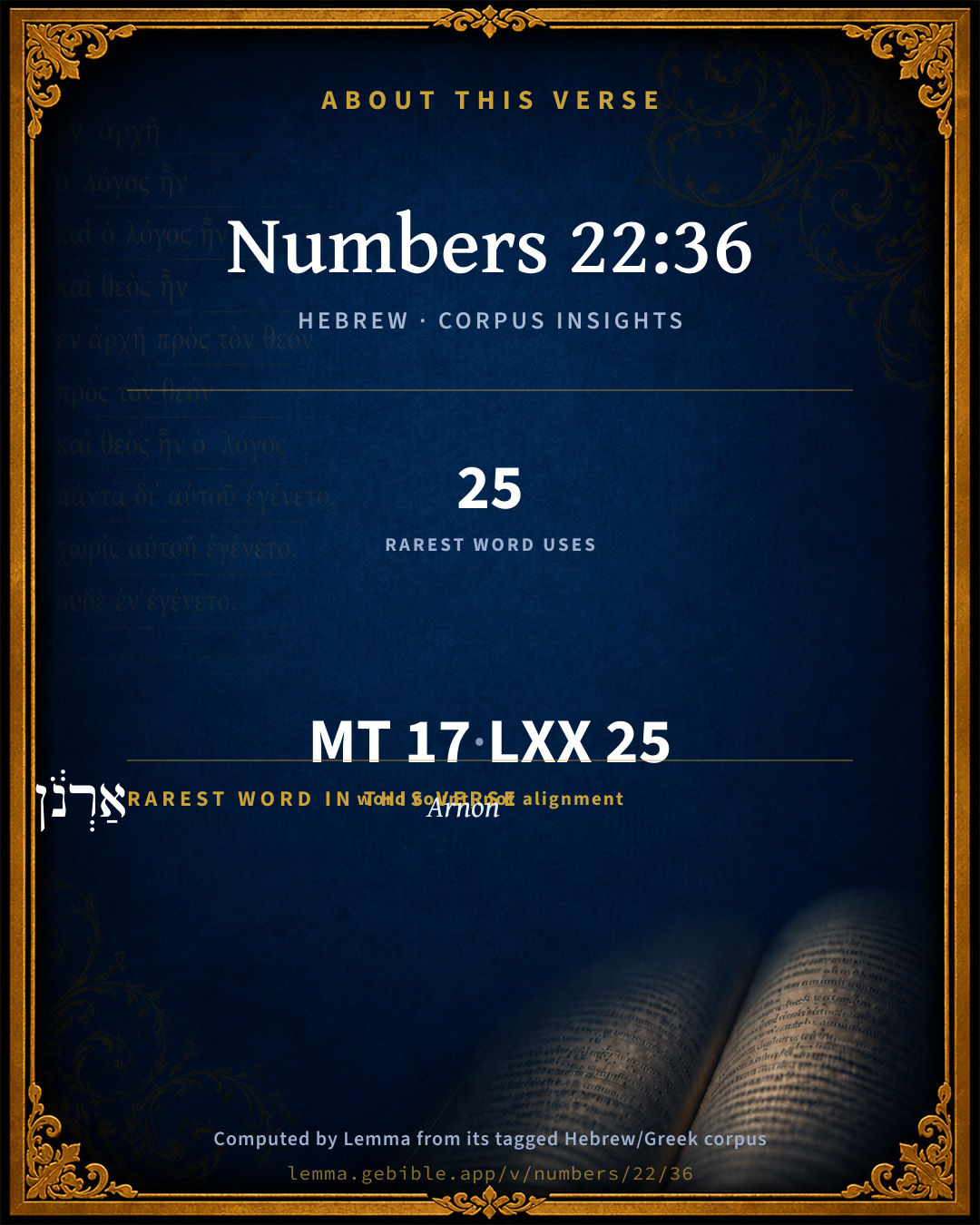
These counts appear in no published source. They are computed here, from the morphology-tagged text and Lemma’s own curated glosses. What Lemma adds →

17
words
15
distinct lemmas
Pentateuch
section

Notable vocabulary

The rarest word here is אַרְנֹ֔ן Arnon H769 — appearing just 25 times in the whole Hebrew Bible.

Shared distinctive vocabulary

אַרְנֹ֔ן Arnon H769 occurs in 23 verses of the Hebrew Bible. Also found in:

Grammatical profile

  • 4 verbs
  • 8 nouns
  • 2 prepositions
  • 1 conjunction
  • 2 particles

Verb forms

  • וַיִּשְׁמַ֥ע Qal · Sequential Imperfect
  • בָ֣א Qal · Perfect
  • וַיֵּצֵ֨א Qal · Sequential Imperfect
  • לִקְרָאת֜וֹ Qal · Infinitive Construct

Repetition

Words recur within this verse — often emphatic in Hebrew:

  • גְּב֣וּל border H1366 ×2
  • אֲשֶׁר֙ which H834 ×2

Hebrew & Septuagint length

In English translation the verse runs 35 words from the Hebrew and 35 from the Septuagint (LXX English) — the same length.

A rough comparison of the two English renderings, which tokenize alike — not a word-level alignment.

Word counts can differ between the Hebrew and the Greek without any difference in meaning — e.g. the Hebrew direct-object marker אֵת has no separate Greek word, and Greek often adds the article ὁ.

In the original languages it is 17 Hebrew tokens and 25 Greek tokens — but the two are counted differently (Hebrew bundles its prefixes and suffixes into one token; the Greek is in lemma form), so that isn’t a like-for-like length.

Cross-references

12

Topical passages linked to Numbers 22:36 in the Treasury of Scripture Knowledge — connected by theme and wording, ordered by reader-vote popularity; previews shown in the World English Bible.

  • Isaiah 16:2 For it shall be that, as wandering birds, as a scattered nest, so shall the daughters of Moab be at the fords of the Arnon.
  • Jeremiah 48:20 Moab is disappointed; for it is broken down: wail and cry; tell you it by the Arnon, that Moab is laid waste.
  • Acts 28:15 From there the brothers, when they heard of us, came to meet us as far as The Market of Appius and The Three Taverns. When Paul saw them, he thanked God, and took courage.
  • Genesis 14:17 The king of Sodom went out to meet him, after his return from the slaughter of Chedorlaomer and the kings who were with him, at the valley of Shaveh (the same is the King's Valley).
  • Genesis 18:2 He lifted up his eyes and looked, and saw that three men stood opposite him. When he saw them, he ran to meet them from the tent door, and bowed himself to the earth,
  • Genesis 46:29 Joseph made ready his chariot, and went up to meet Israel, his father, in Goshen. He presented himself to him, and fell on his neck, and wept on his neck a good while.
  • Exodus 18:7 Moses went out to meet his father-in-law, and bowed and kissed him. They asked each other of their welfare, and they came into the tent.
  • Numbers 21:13–14 From there they traveled, and encamped on the other side of the Arnon, which is in the wilderness, that comes out of the border of the Amorites: for the Arnon is the border of Moab, between Moab and the Amorites.
  • Deuteronomy 2:24 Rise up, take your journey, and pass over the valley of the Arnon: behold, I have given into your hand Sihon the Amorite, king of Heshbon, and his land; begin to possess it, and contend with him in battle.
  • Deuteronomy 3:8 We took the land at that time out of the hand of the two kings of the Amorites who were beyond the Jordan, from the valley of the Arnon to Mount Hermon;
  • Judges 11:18 Then they went through the wilderness, and went around the land of Edom, and the land of Moab, and came by the east side of the land of Moab, and they encamped on the other side of the Arnon; but they didn't come within the border of Moab, for the Arnon was the border of Moab.
  • 1 Samuel 13:10 It came to pass that as soon as he had made an end of offering the burnt offering, behold, Samuel came; and Saul went out to meet him, that he might greet him.

Cross-references courtesy of OpenBible.info (CC BY 4.0).

Hebrew and Greek witnesses Masoretic Hebrew ↔ Greek Septuagint

The same verse in the two great witnesses to the Old Testament, shown verse-for-verse.

These are two independent witnesses, not word-aligned to each other, and the Septuagint is shown in lemma (dictionary) form.

Hebrew Numbers 22:36 Masoretic · Westminster Leningrad Codex

וַיִּשְׁמַ֥ע בָּלָ֖ק כִּ֣י בָ֣א בִלְעָ֑ם וַיֵּצֵ֨א לִקְרָאת֜וֹ אֶל עִ֣יר מוֹאָ֗ב אֲשֶׁר֙ עַל גְּב֣וּל אַרְנֹ֔ן אֲשֶׁ֖ר בִּקְצֵ֥ה הַגְּבֽוּל

When Balak heard that Balaam was come, he went out to meet him to the City of Moab, which is on the border of the Arnon, which is in the utmost part of the border.

World English Bible · Public Domain

Greek LXX Numbers 22:36 Septuagint · lemma form

καί ἀκούω βαλακ ὅτι ἥκω βαλααμ ἐκἔρχομαι εἰς συνάντησις αὐτός εἰς πόλις μωαβ ὅς εἰμί ἐπί ὁ ὅριον αρνων ὅς εἰμί ἐκ μέρος ὁ ὅριον

And when Balac heard that Balaam was come, he went out to meet him, to a city of Moab, which is on the borders of Arnon, which is on the extreme part of the borders.

LXX2012 (modern English Septuagint) · Public Domain

Hebrew: Westminster Leningrad Codex (CC BY 4.0). Greek: Septuagint (public domain); English from LXX2012 (modern English Septuagint) (Public Domain). How the Septuagint differs from the Hebrew →

Targum (Aramaic paraphrase)

2

The Targum is the ancient Jewish Aramaic paraphrase of the Hebrew Scriptures — an interpretive translation, not the Hebrew text itself. Onkelos (literal) and Pseudo-Jonathan (expansive) render the Torah, and Jonathan the Prophets. Coverage is partial: where no permissively-licensed English translation exists for a verse, only the Aramaic is shown. This is verse-level text, not a word-by-word alignment to the Hebrew.

  1. Targum Onkelos Torah (Genesis–Deuteronomy)
    וּשְׁמַע בָּלָק אֲרֵי אָתָא בִלְעָם וּנְפַק לָקֳדָמוּתֵה לְקַרְתָּא דְמוֹאָב דִי עַל תְּחוּם אַרְנוֹן דִי בִּסְטַר תְּחוּמָא

    (no public-domain English translation for this verse)

    Targum Onkelos — Aramaic: “Onkelos Genesis” (public domain); “Onkelos Exodus” (public domain); “Onkelos Leviticus” (public domain); “Onkelos Numbers” (public domain); “Onkelos Deuteronomy” (public domain). English: “Sefaria Community Translation” (CC0 1.0 (public-domain dedication)); “J.W. Etheridge. The Targums of Onkelos and Jonathan Ben Uzziel on the Pentateuch. London: Longmans, Green, 1862” (public domain). Text via Sefaria.

  2. Targum Pseudo-Jonathan Torah (Genesis–Deuteronomy)
    וּשְׁמַע בָּלָק אֲרוּם אָתָא בִלְעָם וּנְפַק לִקְדָמוּתֵיהּ לְקַרְתָּא דְמוֹאָב דְעַל תְּחוּם אַרְנוֹן דְבִסְטַר תְּחוּמָא

    And Balak heard that Bileam was coming, and came out to meet him at a city of Moab on the border of Arnon, which is on the side of the frontier.

    Targum Pseudo-Jonathan — Aramaic: “Targum Jonathan on Genesis” (public domain); “Targum Jonathan on Exodus” (public domain); “Targum Jonathan on Leviticus” (public domain); “Targum Jonathan on Numbers” (public domain); “Targum Jonathan on Deuteronomy” (public domain). English: “The Targum of Jonathan ben Uzziel, trans. J. W. Etheridge, London, 1862” (public domain). Text via Sefaria.

Commentary

Notes on Numbers 22:36 from classic Christian and Jewish commentators (each source and its license shown beneath its notes). The classic Christian expositions comment on the surrounding passage and are grouped to its opening verse, so a note may address several verses; the Jewish commentaries on the Tanakh (Rashi and others) are per-verse, so they appear only where the commentator wrote on this verse.

Lemma curates 59 commentaries, every one of them public domain or Creative Commons licensed, each selected and text-cleaned for this edition rather than reprinted as found. About our sources →

Matthew Henry's Commentary

We have here the meeting between Balak and Balaam, confederate enemies to God's Israel; but here they seem to differ in their expectations of the success. 1. Balak speaks of it with confidence, not doubting but to gain his point now that Balaam had come. In expectation of this, he went out to meet him, even to the utmost border of his country (Num 22:36), partly to gratify his own impatient desire to see one he had such great expectations from, and partly to do honour to Balaam, and so to engage him with his utmost power to serve him. See what respect heathen princes paid to those that had but the name and face of prophets, and pretended to have any interest in heaven; and how welcome one was that came with his mouth full of curses. What a shame is it then that the ambassadors of Christ are so little respected by most, so much despised by some, and that those are so coldly entertained who bring tidings of peace and a blessing! Balak has now nothing to complain of but that Balaam did not come sooner, Num 22:37. And he thinks that he should have considered the importunity Balak had used, Did I not earnestly send to thee? (and the importunity of people inferior to kings has prevailed with many against their inclinations), and that he should also have considered Balak's intentions concerning him: Am not I able to promote thee to honour? Balak, as king, was in his own kingdom the fountain of honour, and Balaam should have his choice of all the preferments that were in his gift; he therefore thinks himself affronted by Balaam's delays, which looked as if he thought the honours he prepared not worthy his acceptance. Note, Promotion to honour is a very tempting bait to many people; and it were well if we would be drawn into the service of God by the honour he sets before us. Why do we delay to come unto him? Is not he able to promote us to honour? 2. Balaam speaks doubtfully of the issue, and bids Balak not depend to much upon him (Num 22:38): "Have I now any power at all to say any thing? I have come, but what the nearer am I? Gladly would I curse Israel; but I must not, I cannot, God will not suffer me." He seems to speak with vexation at the hook in his nose and the bridle in his jaws, such as Sennacherib was tied up with, Isa 37:29. 3. They address themselves with all speed to the business. Balaam is nobly entertained over night, a sacrifice of thanksgiving is offered to the gods of Moab, for the safe arrival of this welcome guest, and his is treated with a feast upon the sacrifice, Num 22:40. And the next morning, that no time might be lost, Balak takes Balaam in his chariot to the high places of his kingdom, not only because their holiness (such as it was), he thought, might give some advantage to his divinations, but their height might give him a convenient prospect of the camp of Israel, which was to be the butt or mark at which he must shoot his envenomed arrows. And now Balaam is really as solicitous to please Balak as ever he had pretended to be to please God. See what need we have to pray every day, Our Father in heaven, lead us not into temptation.

Matthew Henry's Commentary on the Whole Bible (1708–1710) — public domain (CC PDM 1.0). Text via the HelloAO Bible API.

The Biblical Illustrator

Joseph S. Exell

Num_22:36-41

Balaam went with Balak.

The meeting between Balak and Balaam

We have here the meeting between Balak and Balaam, confederate enemies to Gods Israel; but here they seem to differ in their expectations of the success.

1. Balak speaks of it with confidence, not doubting but to gain his point now Balaam was come. In expectation of this he went out to meet him, even to the utmost border of his country (Num_22:36); partly to gratify his own impatient desire to see one he had such great expectations from, and partly to do honour to Balaam, and so to engage him with his utmost power to serve him. See what respect heathen princes paid to those that had but the name of prophets, and how welcome one was that came with his mouth full of curses. What a shame is it, then, that the ambassadors of Christ are so little respected by most, and that they are so coldly entertained who bring tidings of peace and blessing! Note, promotion to honour is a very tempting bait to many people; and it were well if we would be drawn into the service of God by the honour He sets before us. Why do we delay to come unto, Him? Is not He able to promote us to honour?

2. Balaam speaks doubtfully of the issue, and bids Balak not depend too much upon him. Have I now any power at all to say anything? (Num_22:38). I am come, but what the nearer am I? Gladly would I curse Israel; but I must not, I cannot, God will not suffer me. He seems to speak with vexation at the hook in his nose, and the bridle in his jaws; such as Sennacherib was tied up with (Isa_37:29).

3. They address themselves with all speed to the business; Balaam is nobly entertained overnight, a sacrifice of thanksgiving is offered to the gods of Moab for the safe arrival of this welcome guest, and he is treated with a feast upon the sacrifice (Num_22:40); and the next morning, that no time might be lost, Balak takes Balaam in his chariot to the high places of his kingdom, not only because their holiness (such as it was), he thought, might give some advantage to his divinations, but their height might give him a convenient prospect of the camp of Israel, which was to be the mark at which he must shoot his envenomed arrows. And now Balaam is really as solicitous to please Balak as ever he pretended to be to please God. See what need we have to pray every day, Our Father in heaven, lead us not into temptation. (Matthew Henry, D. D.)

.

The Biblical Illustrator, edited by Joseph S. Exell (c. 1880s–1900s) — public domain. Text from a community e-Sword module.

Joseph Benson's Commentary

Num 22:36-38. In the utmost coast — Not far from the camp of the Israelites, whom he desired him to curse. Have I now any power at all, &c. — He here lets Balak know he was under the overruling power of God, whose commands he could not gainsay.

Joseph Benson's Commentary on the Old and New Testaments (1811–1818) — public domain. Text from a community e-Sword module.

Whedon's Commentary on the Bible

Daniel D. Whedon

BALAAM RECEIVED BY BALAK, Num_22:36-41.

36. He went out to meet him — This compliment indicates the greatness of Balaam’s reputation and the greatness of Balak’s expectations. See Gen_14:17-18; Gen_46:29; Exo_18:7. Because of this act of Moab, and because a like honour was not done to Israel when he appeared on the border of Moab on his exode from Egypt, Jehovah’s former command, “Thou shalt not distress Moab,” was changed into this: “Thou shalt not seek their peace nor their prosperity all the days of thy life.” See Deu_23:3-6.

Unto a city of Moab — This frontier city on the Arnon must have been Areopolis, or Ar. See Num_21:15, note.

Daniel D. Whedon (gen. ed.), Commentary on the Old and New Testaments (1874–1909) — public domain. Text from a community e-Sword module.

Keil & Delitzsch

C. F. Keil & F. Delitzsch

Reception of Balaam by the King of the Moabites. - Num 22:36, Num 22:37. As soon as Balak heard of Balaam's coming, he went to meet him at a city on the border of the Arnon, which flowed at the extreme (north) boundary (of the Moabitish territory), viz., at Areopolis (see at Num 21:15), probably the capital of the kingdom at one time, but now reduced to a frontier town, since Sihon the Amorite had taken all the land as far as the Arnon; whilst Rabbah, which was farther south, had been selected as the residence of the king. By coming as far as the frontier of his kingdom to meet the celebrated soothsayer, Balak intended to do him special honour. But he would not help receiving him with a gentle reproof for not having come at his first invitation, as if he, the king, had not been in a condition to honour him according to his merits.

Keil & Delitzsch — Biblical Commentary on the Old Testament (1861–1891) — public domain (CC PDM 1.0). Text via the HelloAO Bible API. (Old Testament only.)

Tyndale Open Study Notes

Tyndale Open Resources

22:36 It is likely that this meeting place was in the northeastern corner of Balak’s small kingdom.

Tyndale Open Study Notes — © Tyndale Open Resources, licensed CC BY-SA 4.0. Text via the HelloAO Bible API.

Geneva Bible (1599)

Geneva Bible translators

Near the place where the Israelites camped.

Geneva Bible (1599) marginal notes — public domain. Text via Bolls.life.

Jamieson, Fausset & Brown

Robert Jamieson, A. R. Fausset & David Brown

when Balak heard that Balaam was come, he went out to meet him--Politeness requires that the higher the rank of the expected guest, greater distance is to be gone to welcome his arrival.

Jamieson, Fausset & Brown — Commentary Critical and Explanatory on the Whole Bible (1871) — public domain (CC PDM 1.0). Text via the HelloAO Bible API.

Ellicott's Commentary for English Readers

(36) A city of Moab.—Better, the city of Moab. (Comp. Num_21:15.)

Which is in the utmost coast.—Or, which flows at the extremity of the border. Sihon, the Amorite, had taken possession of the Moabitish territory as far as the Arnon.

A Bible Commentary for English Readers, edited by Charles John Ellicott (1878–1897) — public domain. Text from a community e-Sword module.

The Cambridge Bible for Schools and Colleges

gen. ed. J. J. S. Perowne

36. unto the City of Moab] unto Ir of Moab. The Heb. form of the name Ar of Moab (Num_21:28).

which is on the border of Arnon] i.e. the border or boundary formed by the Arnon. Moab at this time possessed no land north of the Arnon; Ir (Ar) of Moab thus lay on their northern border. The following clause defines the locality further.

which is at the end of the border] Since Balaam was coming from the east, ‘the end’ must be the eastern end; that is to say Ir (Ar) of Moab lay somewhere on the upper, eastern, course of the Arnon.

The Cambridge Bible for Schools and Colleges (gen. ed. J. J. S. Perowne; Cambridge University Press, 1878–1918) — public domain. Text from a community e-Sword module.

John Gill's Exposition

And Balaam went with Balak,.... From Ar of Moab, or, however, from the place where they met, to the royal city where Balak had his palace, and seems to be the place following:

and they came to Kirjathhuzoth; which Jarchi interprets a city full of streets, a populous place, having a multitude of men, women, and children in the streets of it; and the same writer suggests as if Balak's view in this was to move the pity of Balaam, that such a number of people might not be rooted out and destroyed.

John Gill's Exposition of the Whole Bible (1746–1763) — public domain (CC PDM 1.0). Text via the HelloAO Bible API.

Haydock's Catholic Bible Commentary

A town. Eusebius thinks it was Ar, the capital.

George Leo Haydock (1774–1849), Haydock's Catholic Family Bible and Commentary, 1859 edition — public domain. Excludes Psalms (Douay-Rheims chapter numbering differs from Protestant) and Deuterocanonical books (Catholic canon only).

Matthew Poole's English Annotations

That by this great honour he might give him a taste and earnest of those great rewards he designed him, and thereby oblige him to use his utmost skill and interest for him.

The utmost coast; not far from the camp of the Israelites, whom he desired him to curse.

Matthew Poole's English Annotations on the Holy Bible (1683–1685) — public domain. Text from a community e-Sword/MySword module.

The Pulpit Commentary

Unto a city of Moab, or, "unto Ir-Moab" (bawOm ryiAla), probably the same as the Ar mentioned in chapter 21:15 as the boundary town of Moab at that time.

Vers. 36-38. Balaam and Balak meet at last.

I BALAK"S SOLICITUDE TO CONCILIATE BALAAM AND SHOW HIM HONOUR. Balak does not yet know what unhealed wounds may be in the prophet"s pride, or whether that pride has been sufficiently pleased by the dignity of the second deputation and the extent of the promises it has made. He does all he can, therefore, to minister to Balaam"s vanity.

The children of this world are wiser in their generation than the children of light. They will leave nothing undone to gain their ends; they will creep to reach them, if they cannot reach them standing erect. Balak goes to meet the prophet at the utmost border of his land. It is a dangerous thing to offend the powerful ones of this world; they must be kept in good humour. How different from the spirit in which God would have us approach him or any one whom he may send! If he sends to bless us, it is because of our need; he is not a man, that he should be kept in a favourable disposition by our flatteries and fawnings. We need to remember this. Cornelius had a sincere desire to serve God, but very mistaken apprehensions in some respects of what God required, seeing how he fell before Peter"s feet and worshipped him. Let us take heed lest in our anxiety to offer God what we think he wants we are found utterly insensible as to what he really wants. We cannot be too solicitous to please God, if only we are doing it according to his will; we cannot be too solicitous to conciliate.men, if only we are doing it for their good. There is nothing degrading or unmanly, nothing that compels cringing or obsequiousness, in the service of God. When we bow before the grandees and plutocrats of the world and watch their wishes as a dog the eyes of its master, then we are reptiles, not men. We must be all things to all men only when it will save them, not simply to advantage ourselves.

II BALAAM AND BALAK MEET, IN SPITE OF ALL THE HINDRANCES PUT IN THE WAY. Balak of course has his own notion of these hindrances; he thinks they lay in Balaam"s waiting for a sufficient inducement; and very likely he congratulates himself on his insight, his knowledge of the world, his pertinacity, his choice of agents, and of the right sort of bait to attract Balaam. Yet after all Balak had not the slightest idea of what great hindrances he had overcome. If he had known of God"s interferences, he might have been prouder than ever; that is, if the knowledge of these interferences had not changed his pride to alarm. Balak"s earnest sending had been more potent and fascinating than, in his greeting to Balaam, he unwittingly supposed. It had outweighed the direct commands of God, the mission of the angel, the influence of a very peculiar miracle and a very narrow escape from death. How much there must have been in Balaam"s greedy heart to draw him on when even mighty and unusual obstacles like these could only stay him for a moment! Balak drew him because in his heart there was something to be drawn; and they came together as streams that, rising miles apart, and winding much through intervening lands, yet meet at last because each pursues its natural course.

All the obstacles put in our way to perdition will not save us if we are bent on the carnal attractions to be found in that way. Drawing is a mutual thing. There was nothing in Balaam"s heart to be drawn towards God. The hugest magnet will do no more than the least to attract another body to it unless in that body there is something to be attracted.

III THE MEETING, AFTER ALL, DOES NOT SEEM A SATISFACTORY ONE. One would have thought that, after overcoming so many hindrances, these two kindred spirits would have met each other with cordial congratulations. But instead of this being so, Balak must show himself a little hurt with what he thinks Balaam"s want of confidence in his word and prerogative as king. And though Balaam"s difficulty has not lain in these things, he cannot explain the misunderstanding; he has to hear that word "wherefore" as if he heard it not. "Lo, I am come unto thee." that must be sufficient. And as to Balak"s expectations, he can only fall back upon the old misleading generalities; he cannot meet the king with the open, eager, joyous countenance of one who sees success within his grasp. Balak, he sees, has more confidence in him than he can possibly have in himself, considering the strange things he has experienced since he set out on his journey. It is not even the proverbial slip between the cup and the lip that he has to prepare for. It is not the probability of success with the possibility of failure, but the strong probability of failure with just the possibility of success. "Have I now any power at all to say anything? the word that God putteth in my mouth, that shall I speak." Not that we are to suppose Balak was unduly taken aback by such a want of ardour and sympathy in Balaam. Very likely he thought it was nothing more than a proper professional deference to Jehovah, and that in the event all would be right; just as men say "God willing" and "please God" when they are in the midst of schemes where God"s will and pleasure are never thought of at all. Y.

The Pulpit Commentary (1880–1919), ed. H.D.M. Spence-Jones & Joseph S. Exell — public domain. Text from a community e-Sword module.

John Wesley's Explanatory Notes

In the utmost coast - Not far from the camp of the Israelites, whom he desired him to curse.

John Wesley, Explanatory Notes Upon the Whole Bible (1754–1765) — public domain. Text via the GEBible commentary corpus.

Kretzmann's Popular Commentary

Paul E. Kretzmann

Balak’s charge to Balaam

v. 36. And when Balak heard that Balaam was come, he went out to meet him. unto a city of Moab which is in the border of Arnon, which is in the utmost coast, in the extreme northeastern section of the country, where the sources of the Arnon are found in the hills of the desert. This showed the eagerness of Balak and the confidence which he placed in the soothsayer’s power.

v. 37. And Balak said unto Balaam, Did I not earnestly send unto thee to call thee? Wherefore camest thou not unto me? Am I not able indeed to promote thee to honor? Balak felt that he must reprove Balaam at least to that extent, since the wizard’s behavior at the first invitation was such as to imply doubt in the king’s ability or willingness to bestow his bounty.

v. 38. And Balaam said unto Balak, Lo, I have come unto thee, a statement which implied that his coming had been connected with some difficulties; have I now any power at all to say anything? The word that God putteth in my mouth, that shall I speak. This was not a statement of humble submission to the will of God, but one by which Balaam intended to clear his skirts in advance. The terror of the Lord was still upon him, and he felt that he would finally be obliged to submit to the will of God. At the same time, he indicated that, so far as he was concerned, he would gladly accede to the king’s wishes.

v. 39. And Balaam went with Balak, ready, if possible, to do his bidding; and they came unto Kir-jath-huzoth, a city or town near the hills which run parallel to the Jordan.

v. 40. And Balak offered oxen and sheep, sacrifices of prayer which he apparently intended for the true God, whose favor he hoped to gain in this manner, and sent to Balaam, and to the princes that were with him. To share in the sacrificial feast of the king was considered a great honor.

v. 41. And it came to pass on the morrow that Balak took Balaam and brought him up into the high places of Baal, to Bamot-Baal, the first height from which a person could get a glimpse of Israel’s camp, that thence he might see the utmost part of the people. Balak acted upon the idea that Balaam must have at least a part of the children of Israel before his eyes if his curse was to be effective. As the Son of God withstood Balaam in his evil intention of bringing a curse upon God’s people, so He now strengthens and upholds His Church in all its trials and keeps its enemies from doing it lasting harm.

Paul E. Kretzmann, Popular Commentary of the Bible (1921–1924) — public domain. Text from a community e-Sword module.

unfoldingWord translationNotes

Door43 World Missions Community

Arnon

This is the name of a river. See how you translated it in Numbers 21:13.

Did I not send men to you to summon you?

This rhetorical question is used to rebuke Balaam for delaying to come. This can be translated as a statement. AT: "Surely I sent men to summon you." (See: Rhetorical Question)

Why did you not come to me?

This rhetorical question is used to rebuke Balaam for delaying to come. This can be translated as a statement. AT: "You should have come to me!" (See: Rhetorical Question)

Am I not able to honor you?

This rhetorical question is used to rebuke Balaam for delaying to come. This can be translated as a statement. AT: "Surely you know that I am able to pay you money for coming to me." (See: Rhetorical Question)

translationWords

Moab

honor

unfoldingWord translationNotes — © Distant Shores Media and the Door43 World Missions Community, licensed CC BY-SA 4.0. Source: git.door43.org/Door43/en_tn.

Rashi

Rabbi Shlomo Yitzchaki (Rashi)

וישמע בלק AND BALAK HEARD [THAT BALAAM WAS COMING] — He sent messengers to announce this to him.

אל עיר מואב [AND HE WENT TOWARDS HIM] UNTO THE CITY OF MOAB — to his metropolis, the most important city he had, as much as to say: See what these Israelites wish to exterminate (Midrash Tanchuma, Balak 10).

Rashi on the Tanakh — English translations: “The Judaica Press complete Tanach with Rashi, translated by A. J. Rosenberg” (CC BY 4.0); “Pentateuch with Rashi's commentary by M. Rosenbaum and A.M. Silbermann, 1929-1934” (public domain); “The Metsudah Tanach series, Lakewood, N.J” (CC BY 4.0); and “The Book of Joshua, Metsudah Publications, 1997” (CC BY 4.0). Text via Sefaria.

Lesson kit

Teaching starters — assembled from the data on this page, not authored interpretation. Every prompt links to the verse data it draws on. Edit before teaching.

Numbers, in the Pentateuch, opens this verse with 17 words (15 distinct Hebrew lemmas). Its most distinctive word is ʼArnôwn (“Arnon”). A historical commentator’s framing appears above. Read the whole chapter for the surrounding context.

Discussion questions

  1. The word ʼArnôwn carries the sense “Arnon.” How does it shape the verse?
  2. How does Numbers 21:13, which shares the word «Arnon», read alongside this verse?
  3. What does the repetition of “border” (2× in this one verse) do in this verse?
  4. These translations render this verse differently; the difference is in the English rendering, not the original. What questions does that raise?
  5. «וַיִּשְׁמַ֥ע» is a Qal Sequential Imperfect verb. How does that grammatical form shape the action described?
  6. Compare how Matthew Henry's Commentary and The Biblical Illustrator read this verse. Where do they agree or differ?

Things to notice

Reading settings

Reading text

Shown beneath each verse's original-language words.

Old Testament
Old Testament edition

Read the OT as the Masoretic Hebrew (MT) or the Greek Septuagint (LXX).

English shown for the Greek Septuagint (in the Hebrew ↔ Greek comparison).

Comparing translations? Open the Compare panel on any verse page to stack up to four side by side.