
Joshua 13:30

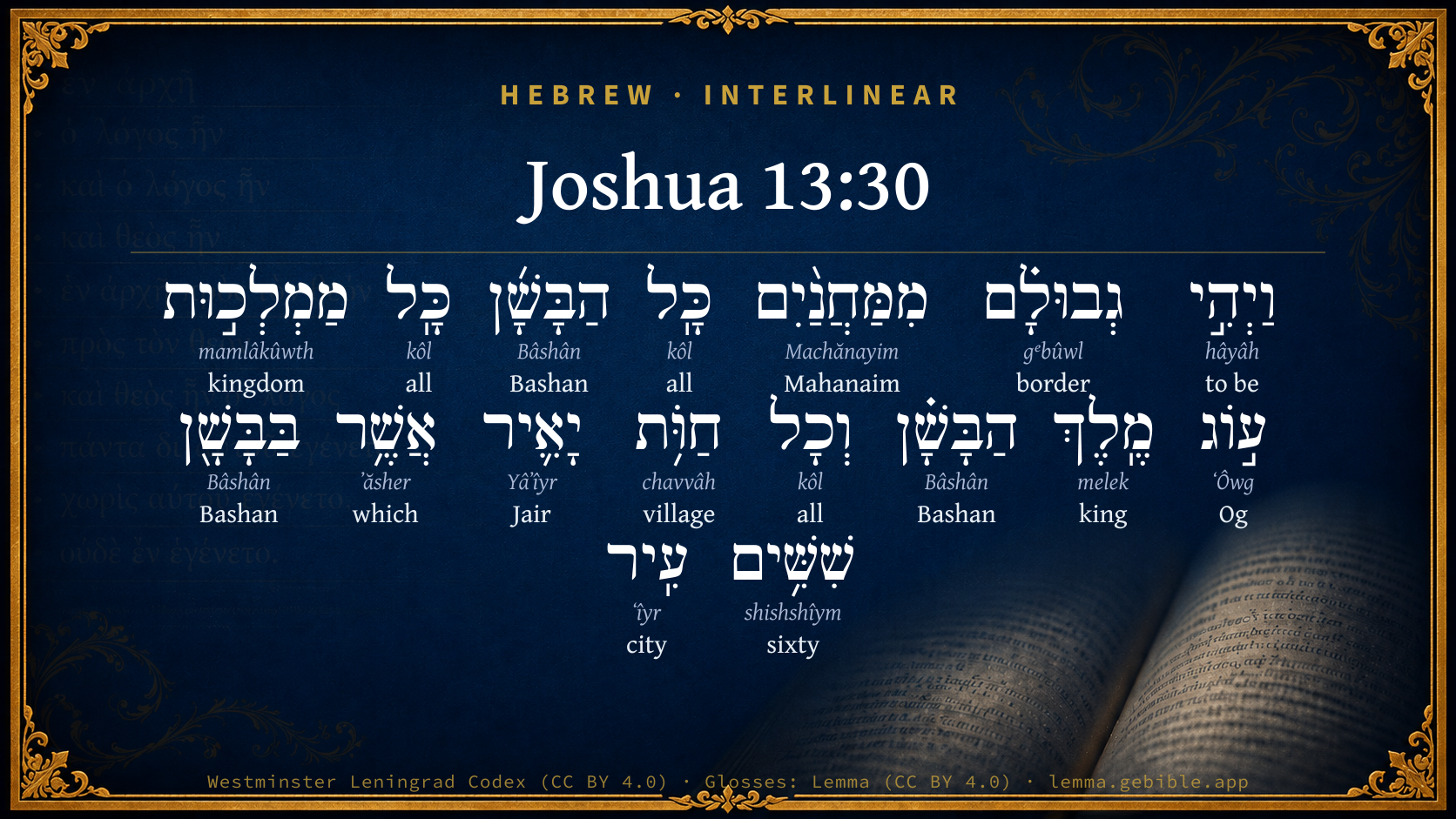
Hebrew (Westminster Leningrad Codex) Joshua 13:30 appears in the Hebrew Old Testament. The text above is from the Westminster Leningrad Codex. Each word links to its Strong’s number, a concise gloss, and parsing drawn from the Open Scriptures Hebrew Bible morphology. Click any word for its full Brown-Driver-Briggs (BDB) entry.
Download image
Cite this verse

Joshua 13:30 (World English Bible). Public Domain. Lemma interlinear Bible study tool, https://lemma.gebible.app/v/joshua/13/30.

Show BibTeX & RIS
BibTeX
RIS
English Translation
Their border was from Mahanaim, all Bashan, all the kingdom of Og king of Bashan, and all the towns of Jair, which are in Bashan, sixty cities:
World English Bible · Public Domain
Download a study sheet

One document with this verse’s original text, its word-by-word gloss line, the meaning frame, cross-references with their text, attributed commentary, and full source and license credits — printable, and it pastes into notes with its structure intact.

This verse Autodidact and up

Study sheet (.html) Plain text (.txt)

A passage Seminary Student

Up to 50 verses in one chapter. A passage sheet keeps up to 6 commentary sources and 12 cross-references per verse, in the order this page ranks them, and says so on the sheet whenever that leaves anything out. Ask for a single verse and you get the Autodidact verse sheet above.

Everything on this page stays free to read, with no account — the sheet is a download of what is already on screen, not access to it.

Want to remove ads? Support Godless Engineer
Compare translations 3

The same verse in 3 English versions, stacked beneath the original-language interlinear above. Click any original word for its lexicon entry.

Each is an independent rendering of the whole verse — the interlinear is not word-aligned to these translations.

Highlighted words mark where these versions differ — a whole-verse word diff, not a word-by-word alignment.

  • World English Bible Public Domain
    Their border was from Mahanaim, all Bashan, all the kingdom of Og king of Bashan, and all the towns of Jair, which are in Bashan, sixty cities:
  • King James Version Public Domain
    And their coast was from Mahanaim, all Bashan, all the kingdom of Og king of Bashan, and all the towns of Jair, which are in Bashan, threescore cities:
  • unfoldingWord Literal Text CC BY-SA 4.0
    And their border was from Mahanaim, all of Bashan, all of the kingdom of Og, the king of Bashan, and all of the towns of Jair, which in Bashan, 60 cities.

unfoldingWord Literal Text — © unfoldingWord, licensed CC BY-SA 4.0. Word-aligned USFM3 via Door43 (git.door43.org/unfoldingWord/en_ult).

Versions to compare (up to 4)

3 of 4 selected

Show all 18 translations

Every available English version of this verse, each an independent rendering of the whole verse.

  • World English Bible Public Domain
    Their border was from Mahanaim, all Bashan, all the kingdom of Og king of Bashan, and all the towns of Jair, which are in Bashan, sixty cities:
  • Berean Standard Bible Public Domain
    The territory from Mahanaim through all Bashan—all the kingdom of Og king of Bashan, including all the towns of Jair that are in Bashan, sixty cities;
  • Majority Standard Bible Public Domain
    The territory from Mahanaim through all Bashan—all the kingdom of Og king of Bashan, including all the towns of Jair that are in Bashan, sixty cities;
  • King James Version Public Domain
    And their coast was from Mahanaim, all Bashan, all the kingdom of Og king of Bashan, and all the towns of Jair, which are in Bashan, threescore cities:
  • American Standard Version (1901) Public Domain
    And their border was from Mahanaim, all Bashan, all the kingdom of Og king of Bashan, and all the towns of Jair, which are in Bashan, threescore cities:
  • Revised Version (1885) Public Domain
    And their border was from Mahanaim, all Bashan, all the kingdom of Og king of Bashan, and all the towns of Jair, which are in Bashan, threescore cities:
  • Geneva Bible (1599) Public Domain
    And their border was from Mahanaim, euen all Bashan, to wit, all the kingdome of Og King of Bashan, and all the townes of Iair which are in Bashan, threescore cities,
  • Douay-Rheims (1899) Public Domain
    The beginning whereof is this: from Manaim all Basan, and all the kingdoms of Og king of Basan, and all the villages of Jair, which are in Basan, threescore towns.
  • Young's Literal Translation Public Domain
    And their border is from Mahanaim, all Bashan, all the kingdom of Og king of Bashan, and all the small towns of Jair, which `are' in Bashan, sixty cities;
  • Literal Standard Version CC BY-SA 4.0
    And their border is from Mahanaim, all Bashan, all the kingdom of Og king of Bashan, and all the small towns of Jair, which [are] in Bashan—sixty cities;
  • Unlocked Literal Bible CC BY-SA 4.0
    Their territory was from Mahanaim, all Bashan, all the kingdom of Og king of Bashan, and all the towns of Jair, which are in Bashan, sixty cities;
  • unfoldingWord Literal Text CC BY-SA 4.0
    And their border was from Mahanaim, all of Bashan, all of the kingdom of Og, the king of Bashan, and all of the towns of Jair, which in Bashan, 60 cities.
  • Darby Bible Public Domain
    their territory was from Mahanaim, all Bashan, the whole kingdom of Og the king of Bashan, and all the villages of Jair, which are in Bashan, sixty cities.
  • World Messianic Bible Public Domain
    Their border was from Mahanaim, all Bashan, all the kingdom of Og king of Bashan, and all the villages of Jair, which are in Bashan, sixty cities.
  • Webster's Bible Public Domain
    And their border was from Mahanaim, all Bashan, all the kingdom of Og king of Bashan, and all the towns of Jair, which are in Bashan, sixty cities:
  • Free Bible Version CC BY-SA 4.0
    Their territory stretched from Manahaim through the whole of Bashan, all the kingdom of Og, and all the towns of Jair in Bashan—sixty in all.
  • Bible in Basic English Public Domain
    And their limit was from Mahanaim, all Bashan, all the kingdom of Og, king of Bashan, and all Havvoth-Jair, in Bashan, sixty towns;
  • JPS Tanakh (1917) Public Domain
    And their border was from Mahanaim, all Bashan, all the kingdom of Og king of Bashan, and all the villages of Jair, which are in Bashan, threescore cities;

Literal Standard Version (2020), Covenant Press — licensed CC BY-SA 4.0. Text via the HelloAO Bible API (eBible.org). Unlocked Literal Bible (unfoldingWord) — licensed CC BY-SA 4.0. Text via the HelloAO Bible API (eBible.org). unfoldingWord Literal Text — © unfoldingWord, licensed CC BY-SA 4.0. Word-aligned USFM3 via Door43 (git.door43.org/unfoldingWord/en_ult). Free Bible Version, Dr. Jonathan Gallagher — licensed CC BY-SA 4.0. Text via the HelloAO Bible API (eBible.org).

Word by word

More ways to search: Search by grammar → Find every occurrence → Compare this word →

Practice this passage: Drill this verse → Learn its vocabulary →

חַוֺּ֥ת
chavvâh
H2333
“villages of”
Noun, Common, Feminine, Plural, Construct
Part of Speech
Noun
Type
Common
Gender
Feminine
Number
Plural
State
Construct
Full BDB Definition

Origin: properly, the same as H2332 (life-giving, i.e. living-place)

TWOT: 617a

village, town, tent village
  1. וַיְהִ֣י hâyâh H1961 “and · to be” Conjunction + Verb, Qal, Sequential Imperfect, 3rd Person, Masculine, Singular
  2. גְבוּלָ֗ם gᵉbûwl H1366 “border · their” Noun, Common, Masculine, Singular, Construct + Suffix, Personal, 3rd Person, Masculine, Plural
  3. מִמַּחֲנַ֨יִם Machănayim H4266 “from · Mahanaim” Preposition + Noun, Proper
  4. כָּֽל kôl H3605 “all of” Noun, Common, Masculine, Singular, Construct
  5. הַבָּשָׁ֜ן Bâshân H1316 “the · Bashan” Particle, Definite Article + Noun, Proper
  6. כָּֽל kôl H3605 “all of” Noun, Common, Masculine, Singular, Construct
  7. מַמְלְכ֣וּת mamlâkûwth H4468 “kingdom of” Noun, Common, Feminine, Singular, Construct
  8. ע֣וֹג ʻÔwg H5747 “Og” Noun, Proper
  9. מֶֽלֶךְ melek H4428 “king of” Noun, Common, Masculine, Singular, Construct
  10. הַבָּשָׁ֗ן Bâshân H1316 “the · Bashan” Particle, Definite Article + Noun, Proper
  11. וְכָל kôl H3605 “and · all of” Conjunction + Noun, Common, Masculine, Singular, Construct
  12. יָאִ֛יר Yâʼîyr H2971 “Jair” Noun, Proper
  13. אֲשֶׁ֥ר ʼăsher H834 “which” Particle, Relative
  14. בַּבָּשָׁ֖ן Bâshân H1316 “in/at the · Bashan” Preposition, Determined + Noun, Proper
  15. שִׁשִּׁ֥ים shishshîym H8346 “sixty” Adjective, Cardinal number, Both, Plural, Absolute
  16. עִֽיר ʻîyr H5892 “city” Noun, Common, Feminine, Singular, Absolute

About this verse

These counts appear in no published source. They are computed here, from the morphology-tagged text and Lemma’s own curated glosses. What Lemma adds →

17
words
13
distinct lemmas
Historical
section

Notable vocabulary

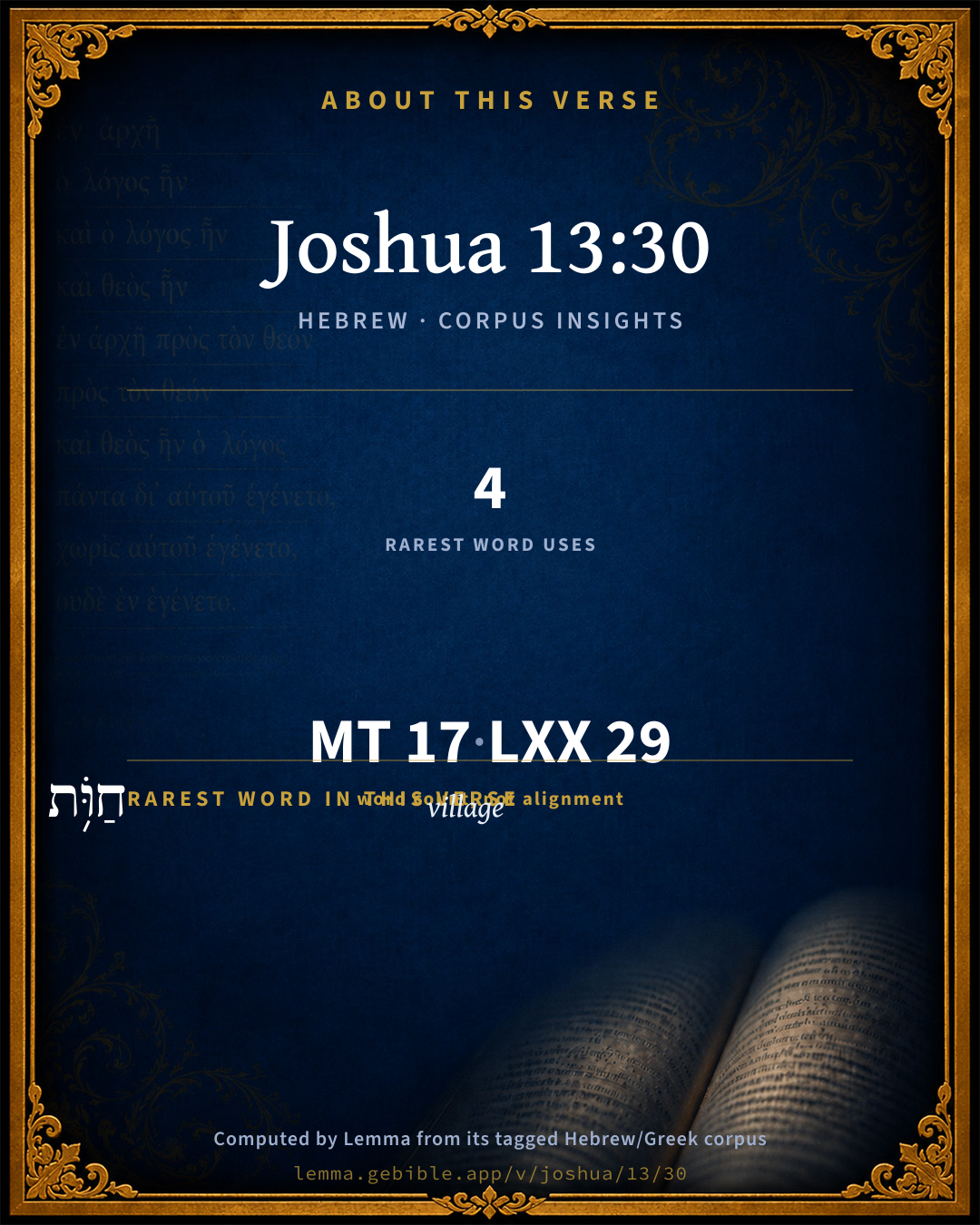
The rarest word here is חַוֺּ֥ת village H2333 — appearing just 4 times in the whole Hebrew Bible.

Shared distinctive vocabulary

חַוֺּ֥ת village H2333 occurs in 4 verses of the Hebrew Bible. Also found in:

Grammatical profile

  • 1 verb
  • 14 nouns
  • 1 adjective
  • 1 particle

Verb forms

  • וַיְהִ֣י Qal · Sequential Imperfect

Repetition

Words recur within this verse — often emphatic in Hebrew:

  • כָּֽל all H3605 ×3
  • הַבָּשָׁ֜ן Bashan H1316 ×3

Hebrew & Septuagint length

In English translation the verse runs 27 words from the Hebrew and 36 from the Septuagint (LXX English) — closely comparable.

A rough comparison of the two English renderings, which tokenize alike — not a word-level alignment.

Word counts can differ between the Hebrew and the Greek without any difference in meaning — e.g. the Hebrew direct-object marker אֵת has no separate Greek word, and Greek often adds the article ὁ.

In the original languages it is 17 Hebrew tokens and 29 Greek tokens — but the two are counted differently (Hebrew bundles its prefixes and suffixes into one token; the Greek is in lemma form), so that isn’t a like-for-like length.

Cross-references

4

Topical passages linked to Joshua 13:30 in the Treasury of Scripture Knowledge — connected by theme and wording, ordered by reader-vote popularity; previews shown in the World English Bible.

  • Joshua 13:26 and from Heshbon to Ramath Mizpeh, and Betonim; and from Mahanaim to the border of Debir;
  • Numbers 32:39–41 The children of Machir the son of Manasseh went to Gilead, and took it, and dispossessed the Amorites who were therein.
  • Deuteronomy 3:13–15 and the rest of Gilead, and all Bashan, the kingdom of Og, gave I to the half-tribe of Manasseh; all the region of Argob, even all Bashan. (The same is called the land of Rephaim.
  • 1 Chronicles 2:21–23 Afterward Hezron went in to the daughter of Machir the father of Gilead, whom he took [as wife] when he was sixty years old; and she bore him Segub.

Cross-references courtesy of OpenBible.info (CC BY 4.0).

Hebrew and Greek witnesses Masoretic Hebrew ↔ Greek Septuagint

The same verse in the two great witnesses to the Old Testament, shown verse-for-verse.

These are two independent witnesses, not word-aligned to each other, and the Septuagint is shown in lemma (dictionary) form.

Hebrew Joshua 13:30 Masoretic · Westminster Leningrad Codex

וַיְהִ֣י גְבוּלָ֗ם מִמַּחֲנַ֨יִם כָּֽל הַבָּשָׁ֜ן כָּֽל מַמְלְכ֣וּת ע֣וֹג מֶֽלֶךְ הַבָּשָׁ֗ן וְכָל חַוֺּ֥ת יָאִ֛יר אֲשֶׁ֥ר בַּבָּשָׁ֖ן שִׁשִּׁ֥ים עִֽיר

Their border was from Mahanaim, all Bashan, all the kingdom of Og king of Bashan, and all the towns of Jair, which are in Bashan, sixty cities:

World English Bible · Public Domain

Greek LXX Joshua 13:30 Septuagint · lemma form

καί γίγνομαι ὁ ὅριον αὐτός ἀπό μααναιμ καί πᾶς βασιλεία βασανι καί πᾶς βασιλεία ωγ βασιλεύς βασαν καί πᾶς ὁ κώμη ιαϊρ ὅς εἰμί ἐν ὁ βασανῖτις ἑξήκοντα πόλις

And their borders were from Maan, and all the kingdom of Basan, and all the kingdom of Og king of Basan, and all the villages of Jair, which are in the region of Basan, sixty cities:

LXX2012 (modern English Septuagint) · Public Domain

Hebrew: Westminster Leningrad Codex (CC BY 4.0). Greek: Septuagint (public domain); English from LXX2012 (modern English Septuagint) (Public Domain). How the Septuagint differs from the Hebrew →

Targum (Aramaic paraphrase)

1

The Targum is the ancient Jewish Aramaic paraphrase of the Hebrew Scriptures — an interpretive translation, not the Hebrew text itself. Onkelos (literal) and Pseudo-Jonathan (expansive) render the Torah, and Jonathan the Prophets. Coverage is partial: where no permissively-licensed English translation exists for a verse, only the Aramaic is shown. This is verse-level text, not a word-by-word alignment to the Hebrew.

  1. Targum Jonathan Prophets (Joshua–Malachi)
    וַהֲוָה תְּחוּמֵיהוֹן מִמַחֲנַיִם כָּל מַתְנָן כָּל מַלְכוּתֵיהּ דְעוֹג מַלְכָּא דְמַתְנָן וְכָל כַּפְרָנֵי יָאִיר דִבְמַתְנָן שִׁתִּין קִרְוִין:

    (no public-domain English translation for this verse)

    Targum Jonathan — Aramaic: “Mikraot Gedolot” (public domain). English: “Sefaria Community Translation” (CC0 1.0 (public-domain dedication)); “London "Chaldee Paraphrase," 1871” (public domain). Text via Sefaria.

Commentary

Notes on Joshua 13:30 from classic Christian and Jewish commentators (each source and its license shown beneath its notes). The classic Christian expositions comment on the surrounding passage and are grouped to its opening verse, so a note may address several verses; the Jewish commentaries on the Tanakh (Rashi and others) are per-verse, so they appear only where the commentator wrote on this verse.

Lemma curates 59 commentaries, every one of them public domain or Creative Commons licensed, each selected and text-cleaned for this edition rather than reprinted as found. About our sources →

Trapp's Complete Commentary

John Trapp

Jos 13:30 And their coast was from Mahanaim, all Bashan, all the kingdom of Og king of Bashan, and all the towns of Jair, which [are] in Bashan, threescore cities:

Ver. 30. See Num 32:41.

John Trapp, A Commentary or Exposition upon All the Books of the Old and New Testament (1647–1656) — public domain. Text from a community e-Sword module.

Joseph Benson's Commentary

Jos 13:30. All the towns of Jair — Who, though of the tribe of Judah, by the father, (1Ch 2:21-22,) yet is called the son of Manasseh, (Num 32:41,) because he married a daughter of Manasseh, and wholly associated himself with those valiant Manassites; and with their help took sixty cities or great towns, (Deu 3:4; Deu 3:14,) which thence were called the towns of Jair.

Joseph Benson's Commentary on the Old and New Testaments (1811–1818) — public domain. Text from a community e-Sword module.

Tyndale Open Study Notes

Tyndale Open Resources

13:30-31 Jair was a great-grandson of Manasseh (1 Chr 2:21-22). Makir was one of Manasseh’s sons. It is unclear whether the land allotted to these tribes in north Gilead was distinguished from the land that the tribe of Gad received there.

Tyndale Open Study Notes — © Tyndale Open Resources, licensed CC BY-SA 4.0. Text via the HelloAO Bible API.

Adam Clarke's Commentary

Verse 30. The towns of Jair] These were sixty cities; they are mentioned afterwards, and in 1Ch 2:21, c. They are the same with the Havoth-jair mentioned Nu 32:41. Jair was son of Segub, grandson of Esron or Hezron, and great-grandson of Machir by his grandmother's side, who married Hezron of the tribe of Judah. See his genealogy, 1Ch 2:21-24.

Adam Clarke's Commentary on the Bible (1810–1826) — public domain. Text from a community e-Sword/MySword module.

The Cambridge Bible for Schools and Colleges

gen. ed. J. J. S. Perowne

30. from Mahanaim] Which formed its southern border. For “the kingdom of Og” see above, Jos_13:12.

all the towns of Jair] The whole of Bashan embraced

(i) The Havoth-Jair, sixty cities in the district of Argob (Deu_3:4), which had been captured by Jair the son of Manasseh and called after his name (Num_32:41; Deu_3:14).

(ii) “half Gilead,” i.e. the northern half, together with the two capitals, Ashtaroth and Edrei.

The Cambridge Bible for Schools and Colleges (gen. ed. J. J. S. Perowne; Cambridge University Press, 1878–1918) — public domain. Text from a community e-Sword module.

John Gill's Exposition

And half Gilead,.... The other half not given to the Gadites, who had that half of it which Sihon possessed, and the tribe of Manasseh that half of it which Og possessed, see Deu 3:12,

and Ashtaroth, and Edrei, cities of the kingdom of Og in Bashan; which are particularly mentioned, because royal cities, Jos 13:10; see Deu 1:4,

were pertaining unto the children of Machir the son of Manasseh; and who was his only son; however, to his posterity only was this inheritance given, though not to them all:

even to one half of the children of Machir, by their families; which seems to confirm it that Manasseh had no other son, since his whole posterity, both the half tribe on the other side, as well as that in the land of Canaan, were denominated from him; though he seems to have had another son, who perhaps died without issue, Ch1 7:14.

John Gill's Exposition of the Whole Bible (1746–1763) — public domain (CC PDM 1.0). Text via the HelloAO Bible API.

Haydock's Catholic Bible Commentary

Towns, which were conquered by Jair, of the tribe of Juda; though he belonged, in some degree, to that of Manasses, by his grandmother, Numbers xxxii. 41.

George Leo Haydock (1774–1849), Haydock's Catholic Family Bible and Commentary, 1859 edition — public domain. Excludes Psalms (Douay-Rheims chapter numbering differs from Protestant) and Deuterocanonical books (Catholic canon only).

Matthew Poole's English Annotations

Jair, who, though of the tribe of Judah by the father, 1Ch 2:21,22, yet is called the son of Manasseh, Num 32:41, because he married a daughter of Manasseh, and wholly associated himself with those valiant Manassites, and with their help took sixty cities or great towns, Deu 3:4,14, which thence were called the towns of Reuben and Gad.

Matthew Poole's English Annotations on the Holy Bible (1683–1685) — public domain. Text from a community e-Sword/MySword module.

Whedon's Commentary on the Bible

Daniel D. Whedon

30. All Bashan — This region, distinguished for its fertility, thrifty herds and flocks, and lofty oaks, extended from Gilead on the south to Mount Hermon on the north, and from the Jordan valley on the west far into the eastern and northeastern desert. See on Deu_3:1-14.

All the towns of Jair — That is, the towns that were taken by Jair, the son of Manasseh, and called by his own name. Num_32:41. They have the name Havoth-jair and Bashan-havoth-jair, (Deu_3:14,) and Porter affirms the two names are not to be confounded. “The towns of Havoth-jair were situated in Gilead south of the river Hieromax, while those of Bashan-havoth-jair were in Bashan, and identical with the sixty great cities of Argob.” According to this distinction the threescore cities here mentioned constituted Bashan-havoth-jair. See 1Ki_4:13, note.

Daniel D. Whedon (gen. ed.), Commentary on the Old and New Testaments (1874–1909) — public domain. Text from a community e-Sword module.

The Pulpit Commentary

The towns of Jair. Literally, Havoth-Jair, as in Num_32:41 Deu_3:14. The word tYij is derived from hwj to live, and the word is compared by Gesenius to the names Eisleben and the like in Germany. So we use the phrase "five," as synonymous with "dwell." Why the term is confined to these particular cities is not known. Gesenius regards it as equivalent to "nomadic encampment." But the ruins of the giant cities of Bashan, recently rediscovered in our own time (by Mr. Cyril Graham, in 1857), and displaying all the signs of high civilisation, dispose of this idea. These cities are mentioned in Deu_3:4 as "threescore cities, all the region of Argob," and again in ver. 13, "all the region of Argob with all Bashan, which is called the land of giants." "To the east he (Abraham) would leave the barren and craggy fatnesses of the formidable Argob, still (i.e. , in Abraham"s time, not Joshua"s) the asylum of the fiercest outlaws; and would jealously avoid the heathen haunts in groves and on high places where smoke arose to the foul image, and the frantic dance swept round." (Tomkins, "Studies on the Time of Abraham," p. 69. See also note on "Judah upon Jordan," Jos_19:34) Threescore cities. (cf. Jos_17:1) It was the martial character, as well as the half tribe of Manasseh, that qualified him to receive and subdue this important territory with its wide extent and teeming population. In the article on Manasseh in Smith"s "Dictionary of the Bible," reference is made to the fact that, while Ephraim only sent 20, 800, and Western Manasseh 18, 000, Reuben, Gad, and Eastern Manasseh sent the immense number of 120, 000, and this while Abner, the supporter of Ishbosheth, had his headquarters at Mahanaim. But the numbers are suspicious, especially when Judah, always a powerful tribe, comes below the insignificant tribe of Simeon in number. And a comparison of 2Sa_5:1 with 1Ch_12:22, 1Ch_12:23, would lead to the idea that the coronation of David after the death of Ishbosheth is the event referred to. (see also 1Ch_12:38-40)

The Pulpit Commentary (1880–1919), ed. H.D.M. Spence-Jones & Joseph S. Exell — public domain. Text from a community e-Sword module.

John Wesley's Explanatory Notes

Of Jair - Who, though of the tribe of Judah, by the father, 1 Chron. ii, 21, 22, yet is called the son of Manasseh, Num. xxxii, 41, because he married a daughter of Manasseh, and wholly associated himself with those valiant Manassites; and with their help took sixty cities or great towns, Deut. iii, 4, 14, which thence were called the towns of Jair.

John Wesley, Explanatory Notes Upon the Whole Bible (1754–1765) — public domain. Text via the GEBible commentary corpus.

Lesson kit

Teaching starters — assembled from the data on this page, not authored interpretation. Every prompt links to the verse data it draws on. Edit before teaching.

Joshua, in the Historical, opens this verse with 17 words (13 distinct Hebrew lemmas). Its most distinctive word is chavvâh (“village”). A historical commentator’s framing appears above. Read the whole chapter for the surrounding context.

Discussion questions

  1. How does “village” (chavvâh) shape what this verse is saying?
  2. How does Numbers 32:41, which shares the word «village», read alongside this verse?
  3. What does the repetition of “all” (3× in this one verse) do in this verse?
  4. These translations render this verse differently. What is at stake in choosing one wording over another?
  5. «וַיְהִ֣י» is a Qal Sequential Imperfect verb. How does that grammatical form shape the action described?
  6. Compare how Trapp's Complete Commentary and Joseph Benson's Commentary read this verse. Where do they agree or differ?

Things to notice

Reading settings

Reading text

Shown beneath each verse's original-language words.

Old Testament
Old Testament edition

Read the OT as the Masoretic Hebrew (MT) or the Greek Septuagint (LXX).

English shown for the Greek Septuagint (in the Hebrew ↔ Greek comparison).

Comparing translations? Open the Compare panel on any verse page to stack up to four side by side.