
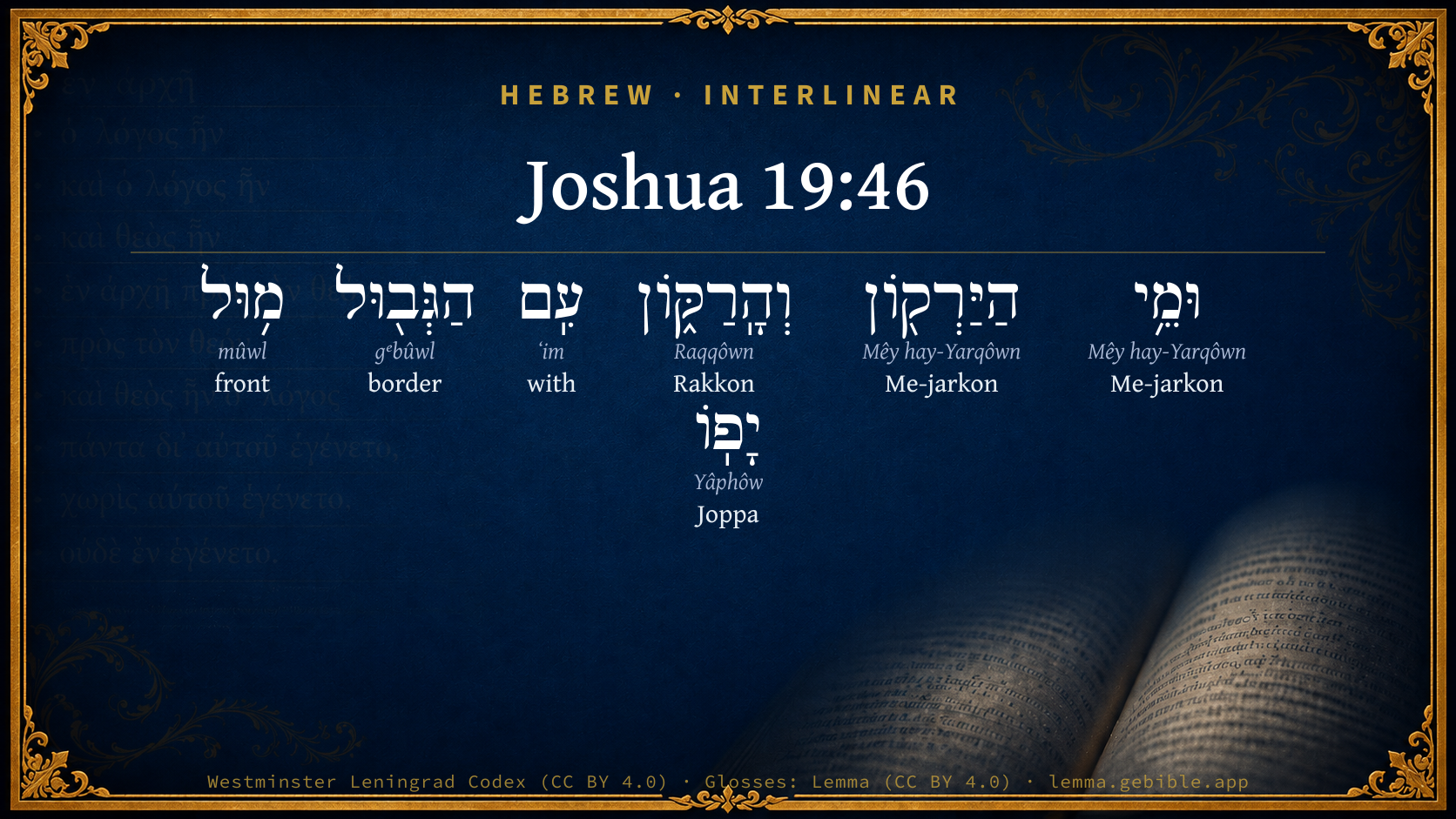
Joshua 19:46

Hebrew (Westminster Leningrad Codex) Joshua 19:46 appears in the Hebrew Old Testament. The text above is from the Westminster Leningrad Codex. Each word links to its Strong’s number, a concise gloss, and parsing drawn from the Open Scriptures Hebrew Bible morphology. Click any word for its full Brown-Driver-Briggs (BDB) entry.
Download image
Cite this verse

Joshua 19:46 (World English Bible). Public Domain. Lemma interlinear Bible study tool, https://lemma.gebible.app/v/joshua/19/46.

Show BibTeX & RIS
BibTeX
RIS
English Translation
and Me-jarkon, and Rakkon, with the border over against Joppa.
World English Bible · Public Domain
Highlights
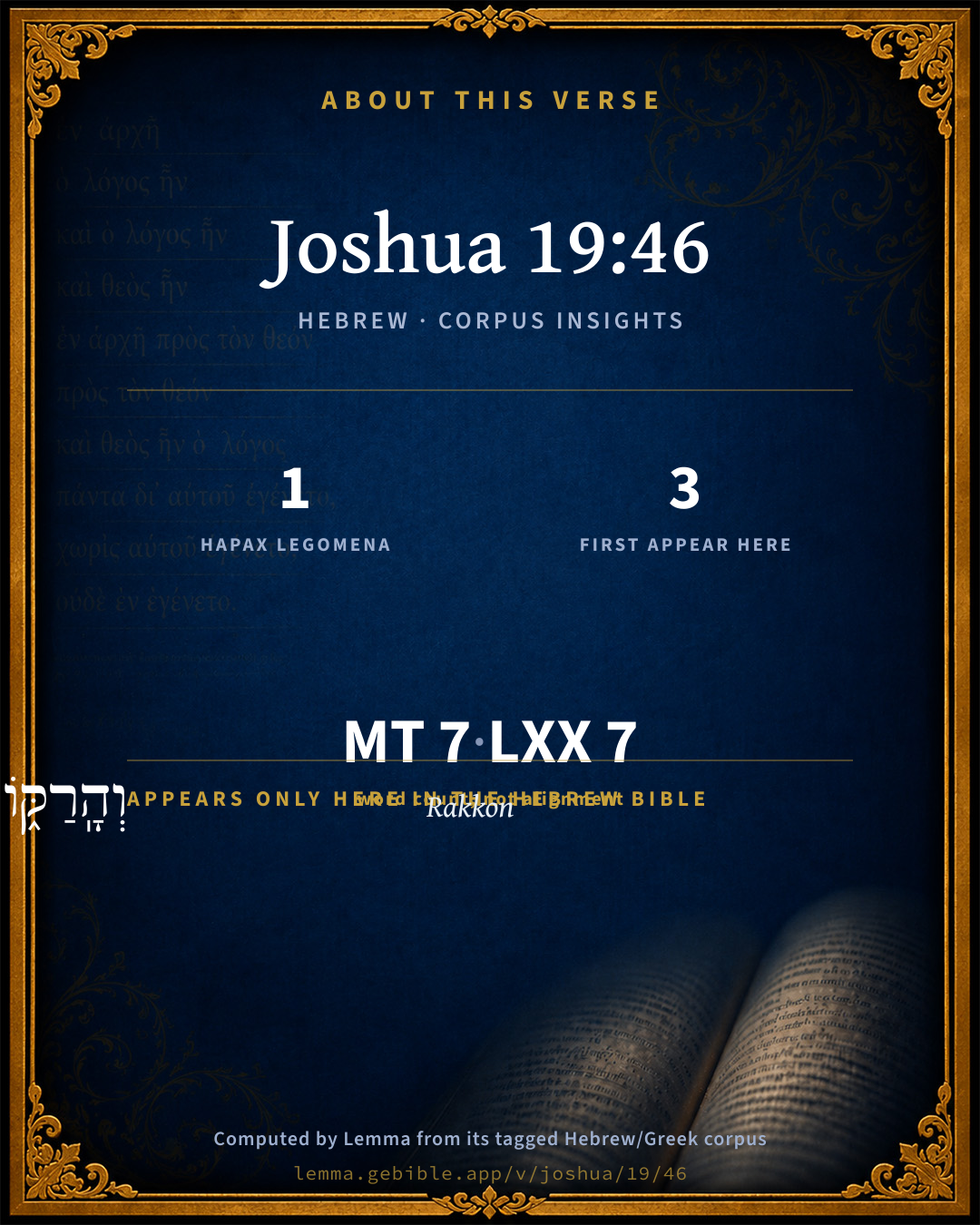
  • 1 hapax legomenon — only here in the Hebrew Bible
  • 3 first appearances in the Hebrew Bible
Full analysis ↓
Download a study sheet

One document with this verse’s original text, its word-by-word gloss line, the meaning frame, cross-references with their text, attributed commentary, and full source and license credits — printable, and it pastes into notes with its structure intact.

This verse Autodidact and up

Study sheet (.html) Plain text (.txt)

A passage Seminary Student

Up to 50 verses in one chapter. A passage sheet keeps up to 6 commentary sources and 12 cross-references per verse, in the order this page ranks them, and says so on the sheet whenever that leaves anything out. Ask for a single verse and you get the Autodidact verse sheet above.

Everything on this page stays free to read, with no account — the sheet is a download of what is already on screen, not access to it.

Want to remove ads? Support Godless Engineer
Compare translations 3

The same verse in 3 English versions, stacked beneath the original-language interlinear above. Click any original word for its lexicon entry.

Each is an independent rendering of the whole verse — the interlinear is not word-aligned to these translations.

Highlighted words mark where these versions differ — a whole-verse word diff, not a word-by-word alignment.

  • World English Bible Public Domain
    and Me-jarkon, and Rakkon, with the border over against Joppa.
  • King James Version Public Domain
    And Mejarkon, and Rakkon, with the border before Japho.
  • unfoldingWord Literal Text CC BY-SA 4.0
    and Me Jarkon and Rakkon with the border in front of Joppa.

unfoldingWord Literal Text — © unfoldingWord, licensed CC BY-SA 4.0. Word-aligned USFM3 via Door43 (git.door43.org/unfoldingWord/en_ult).

Versions to compare (up to 4)

3 of 4 selected

Show all 18 translations

Every available English version of this verse, each an independent rendering of the whole verse.

  • World English Bible Public Domain
    and Me-jarkon, and Rakkon, with the border over against Joppa.
  • Berean Standard Bible Public Domain
    Me-jarkon, and Rakkon, including the territory across from Joppa.
  • Majority Standard Bible Public Domain
    Me-jarkon, and Rakkon, including the territory across from Joppa.
  • King James Version Public Domain
    And Mejarkon, and Rakkon, with the border before Japho.
  • American Standard Version (1901) Public Domain
    and Me-jarkon, and Rakkon, with the border over against Joppa.
  • Revised Version (1885) Public Domain
    and Me-jarkon, and Rakkon, with the border over against Joppa.
  • Geneva Bible (1599) Public Domain
    And Me-iarkon, and Rakkon, with the border that lieth before Iapho.
  • Douay-Rheims (1899) Public Domain
    And Mejarcon and Arecon, with the border that looketh towards Joppe,
  • Young's Literal Translation Public Domain
    and Me-Jarkon, and Rakkon, with the border over-against Japho.
  • Literal Standard Version CC BY-SA 4.0
    and Me-Jarkon, and Rakkon, with the border in front of Joppa.
  • Unlocked Literal Bible CC BY-SA 4.0
    Me Jarkon, and Rakkon along with the territory across from Joppa.
  • unfoldingWord Literal Text CC BY-SA 4.0
    and Me Jarkon and Rakkon with the border in front of Joppa.
  • Darby Bible Public Domain
    and Me-jarkon, and Rakkon, with the border over against Japho.
  • World Messianic Bible Public Domain
    Me Jarkon, and Rakkon, with the border opposite Joppa.
  • Webster's Bible Public Domain
    And Me-jarkon, and Rakkon, with the border before Japho.
  • Free Bible Version CC BY-SA 4.0
    Me-jarkon, Rakkon, along with the territory opposite Joppa.
  • Bible in Basic English Public Domain
    And on the west was... opposite Joppa.
  • JPS Tanakh (1917) Public Domain
    and Me-jarkon, and Rakkon, with the border over against Joppa.

Literal Standard Version (2020), Covenant Press — licensed CC BY-SA 4.0. Text via the HelloAO Bible API (eBible.org). Unlocked Literal Bible (unfoldingWord) — licensed CC BY-SA 4.0. Text via the HelloAO Bible API (eBible.org). unfoldingWord Literal Text — © unfoldingWord, licensed CC BY-SA 4.0. Word-aligned USFM3 via Door43 (git.door43.org/unfoldingWord/en_ult). Free Bible Version, Dr. Jonathan Gallagher — licensed CC BY-SA 4.0. Text via the HelloAO Bible API (eBible.org).

Word by word

More ways to search: Search by grammar → Find every occurrence → Compare this word →

Practice this passage: Drill this verse → Learn its vocabulary →

About this verse

These counts appear in no published source. They are computed here, from the morphology-tagged text and Lemma’s own curated glosses. What Lemma adds →

7
words
6
distinct lemmas
Historical
section

Notable vocabulary

1 hapax legomenon — a word that appears only here in the entire Hebrew Bible:

  • וְהָֽרַקּ֑וֹן Rakkon H7542

First appearance in Scripture

These words make their first canonical appearance in the Hebrew Bible here:

  • וּמֵ֥י Me-jarkon H4313
  • וְהָֽרַקּ֑וֹן Rakkon H7542
  • יָפֽוֹ Joppa H3305

Grammatical profile

  • 5 nouns
  • 2 prepositions

Repetition

A word recurs within this verse — often emphatic in Hebrew:

  • וּמֵ֥י Me-jarkon H4313 ×2

Hebrew & Septuagint length

In English translation the verse runs 10 words from the Hebrew and 10 from the Septuagint (LXX English) — the same length.

A rough comparison of the two English renderings, which tokenize alike — not a word-level alignment.

Word counts can differ between the Hebrew and the Greek without any difference in meaning — e.g. the Hebrew direct-object marker אֵת has no separate Greek word, and Greek often adds the article ὁ.

In the original languages it is 7 Hebrew tokens and 7 Greek tokens — but the two are counted differently (Hebrew bundles its prefixes and suffixes into one token; the Greek is in lemma form), so that isn’t a like-for-like length.

Cross-references

5

Topical passages linked to Joshua 19:46 in the Treasury of Scripture Knowledge — connected by theme and wording, ordered by reader-vote popularity; previews shown in the World English Bible.

  • 2 Chronicles 2:16 and we will cut wood out of Lebanon, as much as you shall need; and we will bring it to you in floats by sea to Joppa; and you shall carry it up to Jerusalem.
  • Jonah 1:3 But Jonah rose up to flee to Tarshish from the presence of Yahweh. He went down to Joppa, and found a ship going to Tarshish; so he paid its fare, and went down into it, to go with them to Tarshish from the presence of Yahweh.
  • Acts 9:36 Now there was at Joppa a certain disciple named Tabitha, which when translated, means Dorcas. This woman was full of good works and acts of mercy which she did.
  • Acts 9:43 It happened, that he stayed many days in Joppa with one Simon, a tanner.
  • Acts 10:8 Having explained everything to them, he sent them to Joppa.

Cross-references courtesy of OpenBible.info (CC BY 4.0).

Hebrew and Greek witnesses Masoretic Hebrew ↔ Greek Septuagint

The same verse in the two great witnesses to the Old Testament, shown verse-for-verse.

These are two independent witnesses, not word-aligned to each other, and the Septuagint is shown in lemma (dictionary) form.

Hebrew Joshua 19:46 Masoretic · Westminster Leningrad Codex

וּמֵ֥י הַיַּרְק֖וֹן וְהָֽרַקּ֑וֹן עִֽם הַגְּב֖וּל מ֥וּל יָפֽוֹ

and Me-jarkon, and Rakkon, with the border over against Joppa.

World English Bible · Public Domain

Greek LXX Joshua 19:46 Septuagint · lemma form

καί ἀπό θάλασσα ιερακων ὅριον πλησίον ιόππης

And westward of Hieracon the border was near to Joppa.

LXX2012 (modern English Septuagint) · Public Domain

On this verse, The Pulpit Commentary discusses the Septuagint’s reading. Read the note in Commentary ↓

Hebrew: Westminster Leningrad Codex (CC BY 4.0). Greek: Septuagint (public domain); English from LXX2012 (modern English Septuagint) (Public Domain). How the Septuagint differs from the Hebrew →

Targum (Aramaic paraphrase)

1

The Targum is the ancient Jewish Aramaic paraphrase of the Hebrew Scriptures — an interpretive translation, not the Hebrew text itself. Onkelos (literal) and Pseudo-Jonathan (expansive) render the Torah, and Jonathan the Prophets. Coverage is partial: where no permissively-licensed English translation exists for a verse, only the Aramaic is shown. This is verse-level text, not a word-by-word alignment to the Hebrew.

  1. Targum Jonathan Prophets (Joshua–Malachi)
    וּמֵי הַיַרְקוֹן וְרַקוֹן עִם תְּחוּמָא דִי לָקֳבֵיל יָפוֹ:

    (no public-domain English translation for this verse)

    Targum Jonathan — Aramaic: “Mikraot Gedolot” (public domain). English: “Sefaria Community Translation” (CC0 1.0 (public-domain dedication)); “London "Chaldee Paraphrase," 1871” (public domain). Text via Sefaria.

Commentary

Notes on Joshua 19:46 from classic Christian and Jewish commentators (each source and its license shown beneath its notes). The classic Christian expositions comment on the surrounding passage and are grouped to its opening verse, so a note may address several verses; the Jewish commentaries on the Tanakh (Rashi and others) are per-verse, so they appear only where the commentator wrote on this verse.

Lemma curates 59 commentaries, every one of them public domain or Creative Commons licensed, each selected and text-cleaned for this edition rather than reprinted as found. About our sources →

Geneva Bible (1599)

Geneva Bible translators

Called Joppa.

Geneva Bible (1599) marginal notes — public domain. Text via Bolls.life.

Adam Clarke's Commentary

Verse 46. Japho.] The place since called Joppa, lying on the Mediterranean, and the chief sea-port, in the possession of the twelve tribes.

Adam Clarke's Commentary on the Bible (1810–1826) — public domain. Text from a community e-Sword/MySword module.

The Cambridge Bible for Schools and Colleges

gen. ed. J. J. S. Perowne

46. Me-jarkon, and Rakkon] still remain to be discovered.

with the border before Japho] i.e. with the whole district extending to the suburbs opposite to Japho.

Japho] (= “beauty”) is the Hebrew form of the more familiar Joppa (2Ch_2:16; Eze_3:7). It was situated on the south-west coast of Palestine, and having a harbour attached to it was afterwards the port of Jerusalem. It was the spot (a) whither the cedar and pinewood were floated from Phœnicia by Hiram, king of Tyre, for Solomon’s temple (2Ch_2:16); (b) whither similar materials were conveyed by the permission of Cyrus for the rebuilding of the second temple under Zerubbabel (Eze_3:7); (c) where Jonah took ship to flee “from the presence of the Lord” (Jon_1:3); (d) where Jonathan Maccabæus met Ptolemy (1Ma_11:6); (e) where St Peter had the vision on the housetop of Simon the tanner (Act_10:9-18). On the east the town is surrounded by a wide circle of gardens and groves of noble trees. “The figs and oranges of Joppa are noted for their size and flavour. The water-melons, which thrive on the sandy soil around, are in great repute, and are carried in great numbers to Alexandria and Cairo. Through all Syria, too, they have a reputation.… The horticulturist Bové, who visited the place in 1832, observed three kinds of figs, apricots, almonds, pomegranates, peaches, oranges, pears, and apples, plums, bananas and grapes, while the sugar-cane grows to the height of five or six feet.” Ritter, Geog. Pal. iv. 259. In a.d. 1188 Saladin destroyed its fortifications, to be rebuilt by Richard of England, who was here confined by sickness. In 1253 it was occupied by St Louis, and afterwards fell into the hands first of the Sultans of Egypt and then of the Turks.

The Cambridge Bible for Schools and Colleges (gen. ed. J. J. S. Perowne; Cambridge University Press, 1878–1918) — public domain. Text from a community e-Sword module.

John Gill's Exposition

And the coast of the children of Dan went out too little for them,.... Being a very numerous tribe, the cities allotted them were not sufficient for them; or rather, leaving out the supplement "too little", the words will run, it "went out from them"; they lost part of it, being driven out of the valley into the mountain by the Amorites, Jdg 1:34; which obliged them to seek out elsewhere for habitations:

therefore the children of Dan went out to fight against Leshem; called Laish, Jdg 18:1, where the whole story is related of their lighting against this place and taking it; which, though some time after the death of Joshua, is here recorded to give at once an account of the inheritance of Dan; and which is no argument against Joshua's being the writer of this book, as is urged; since it might be inserted by another hand, Ezra, or some other inspired man, for the reason before given:

and took and smote it with the edge of the sword, and possessed it,

and dwelt therein; being a Canaanitish city, they put all in it to the sword, as the Lord had commanded, and took possession of it for an habitation:

and called Leshem Dan, after the name of Dan their father; this is the place which is always meant, where the phrase is used "from Dan to Beersheba", Jdg 20:1, this being at the utmost northern border of the land of Canaan, as Beersheba was at the further part of the southern coast of it. It was, according to Jerom (c), situated near Paneas, out of which the river Jordan flowed; and Kimchi on the text observes, their Rabbins (d) say, that Leshem is Pamias (i.e. Paneas), and that Jordan flows from the cave of Pamias, and had its name because it descended from Dan; and so Josephus (e) says, that Panium is a cave under a mountain, from whence rise the springs of Jordan, and is the fountain of it; and Pliny also says (f), the river Jordan rises out of the fountain Paneas. This city was enlarged and beautified by Philip Herod, and he called it by the name of Caesarea Philippi, both in honour of Tiberius Caesar (g) and after his own name, by which name it goes in Mat 16:13; and is called in the Jerusalem Targum on Gen 14:14, Dan of Caesarea.

(c) De loc. Heb. fol. 93. A. (d) T. Bab. Megillah, fol. 6. 1. & Bava Bathra, fol. 74. 2. (e) Antiqu. l. 15. c. 10. sect. 3. De Bello Jud. l. 1. c. 21. sect. 3. & l. 3. c. 9. sect. 7. (f) Nat. Hist. l. 5. c. 15. (g) Joseph. Antiqu. l. 18. c. 2. sect. 1.

John Gill's Exposition of the Whole Bible (1746–1763) — public domain (CC PDM 1.0). Text via the HelloAO Bible API.

Albert Barnes' Notes on the Bible

Japho (the modern Jaffa, or Yafa), elsewhere (see the margin) called Joppa, is often mentioned in the history of the Maccabees and was, as it still is, the leading port of access to Jerusalem both for pilgrims and for merchandise. It is a very ancient town.

Albert Barnes' Notes on the Bible (1834–1885) — public domain. Text from a community e-Sword/MySword module.

Haydock's Catholic Bible Commentary

Mejarcon, "the waters of Jarcon" and Arecon, were near Joppe. (Calmet)

George Leo Haydock (1774–1849), Haydock's Catholic Family Bible and Commentary, 1859 edition — public domain. Excludes Psalms (Douay-Rheims chapter numbering differs from Protestant) and Deuterocanonical books (Catholic canon only).

Whedon's Commentary on the Bible

Daniel D. Whedon

[46. Japho — The ancient Joppa, modern Jaffa, the famous seaport town of Palestine, distinguishable alike in sacred and common history. Hither the Lebanon timber was brought in floats for building Solomon’s temple, (2Ch_2:16,) and also for the second temple under Zerubbabel. Ezr_3:7. Here Jonah embarked when he sought to flee from the presence of Jehovah. Here Peter raised Tabitha, and here was the house of Simon the tanner, where Peter had his vision. See cut of modern town at Act_9:42.]

Daniel D. Whedon (gen. ed.), Commentary on the Old and New Testaments (1874–1909) — public domain. Text from a community e-Sword module.

The Pulpit Commentary

Before. Or opposite. Japho. The Joppa of the New Testament, and the modern Jaffa. It is called Joppa in 2Ch_2:16, in Ezr_3:7, and in the book of Jonah, (Jon_1:3) in which places it is mentioned as a famous seaport, a position it still maintains, being still, as it was of old, the port of Jerusalem. The LXX and Vulgate have Joppa here, and it is unfortunate that our translators, in this instance only, should have adhered to the Hebrew form. Joppa appears to have been an important city in the time of the Maccabees. (see RAPC 1Ma 10:75, 76; and RAPC 2Ma 4:21) Its mention in the New Testament as the place where St. Peter"s vision occurred will be known to all. The name signifies "beauty," though Joppa does not seem to be distinguished above all other places in Palestine by the beauty of its situation. But according to Hovers, Japho signifies in Phoenician, "high place." It is certainly built on a range of terraces above the sea, but the term "high place" would seem unsuitable. The soil is very productive, and it is "the only harbour in Central Palestine" (Ritter).

The Pulpit Commentary (1880–1919), ed. H.D.M. Spence-Jones & Joseph S. Exell — public domain. Text from a community e-Sword module.

Lesson kit

Teaching starters — assembled from the data on this page, not authored interpretation. Every prompt links to the verse data it draws on. Edit before teaching.

Joshua, in the Historical, opens this verse with 7 words (6 distinct Hebrew lemmas). Its most distinctive word is Raqqôwn (“Rakkon”). A historical commentator’s framing appears above. Read the whole chapter for the surrounding context.

Discussion questions

  1. How does “Rakkon” (Raqqôwn) shape what this verse is saying?
  2. This verse holds 1 word here found nowhere else in the Hebrew Bible. What might the rare word draw attention to?
  3. 3 words here appear for the first time in Scripture. What is being introduced at this debut?
  4. 2 Chronicles 2:16 shares this passage’s theme. How do the two illuminate each other?
  5. “Me-jarkon” occurs 2× in this one verse. What is the effect of the repetition?
  6. These translations render this verse differently. What is at stake in choosing one wording over another?
  7. Reading how Geneva Bible (1599) and Adam Clarke's Commentary read this verse, where do the two commentators agree and where do they part?

Things to notice

  • 1 word in this verse appears nowhere else in the Hebrew Bible.
  • 3 words make their first canonical appearance in Scripture here.
  • This verse counts 7 Hebrew ↔ 7 Greek words.
  • These translations choose different wording for 10 words in this verse.
  • “Me-jarkon” occurs 2× in this single verse.

Reading settings

Reading text

Shown beneath each verse's original-language words.

Old Testament
Old Testament edition

Read the OT as the Masoretic Hebrew (MT) or the Greek Septuagint (LXX).

English shown for the Greek Septuagint (in the Hebrew ↔ Greek comparison).

Comparing translations? Open the Compare panel on any verse page to stack up to four side by side.