
1 Kings 4:21

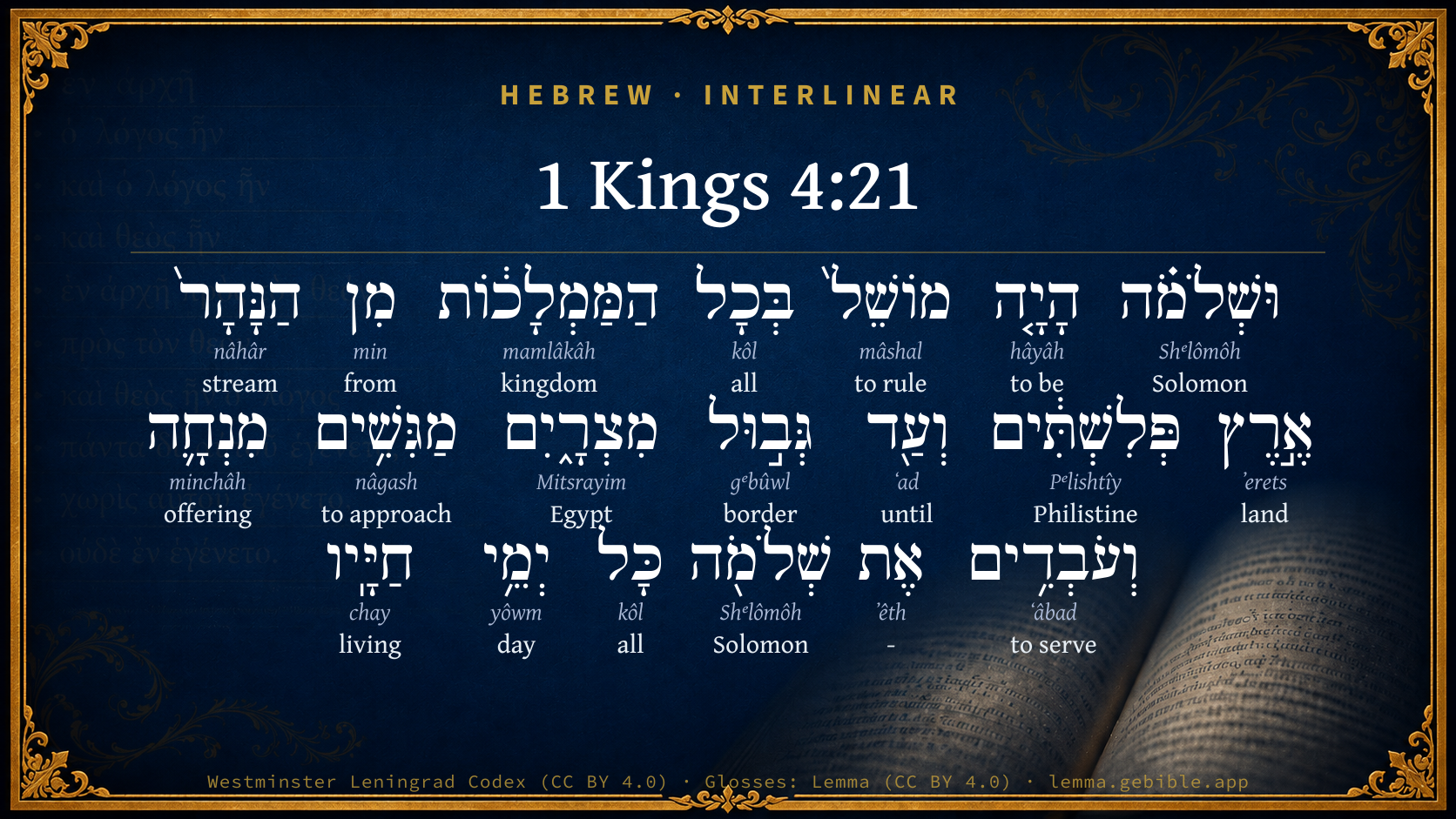
Hebrew (Westminster Leningrad Codex) 1 Kings 4:21 appears in the Hebrew Old Testament. The text above is from the Westminster Leningrad Codex. Each word links to its Strong’s number, a concise gloss, and parsing drawn from the Open Scriptures Hebrew Bible morphology. Click any word for its full Brown-Driver-Briggs (BDB) entry.
Download image
Cite this verse

1 Kings 4:21 (World English Bible). Public Domain. Lemma interlinear Bible study tool, https://lemma.gebible.app/v/1-kings/4/21.

Show BibTeX & RIS
BibTeX
RIS
English Translation
Solomon ruled over all the kingdoms from the River to the land of the Philistines, and to the border of Egypt: they brought tribute, and served Solomon all the days of his life.
World English Bible · Public Domain
Download a study sheet

One document with this verse’s original text, its word-by-word gloss line, the meaning frame, cross-references with their text, attributed commentary, and full source and license credits — printable, and it pastes into notes with its structure intact.

This verse Autodidact and up

Study sheet (.html) Plain text (.txt)

A passage Seminary Student

Up to 50 verses in one chapter. A passage sheet keeps up to 6 commentary sources and 12 cross-references per verse, in the order this page ranks them, and says so on the sheet whenever that leaves anything out. Ask for a single verse and you get the Autodidact verse sheet above.

Everything on this page stays free to read, with no account — the sheet is a download of what is already on screen, not access to it.

Want to remove ads? Support Godless Engineer
Compare translations 3

The same verse in 3 English versions, stacked beneath the original-language interlinear above. Click any original word for its lexicon entry.

Each is an independent rendering of the whole verse — the interlinear is not word-aligned to these translations.

Highlighted words mark where these versions differ — a whole-verse word diff, not a word-by-word alignment.

  • World English Bible Public Domain
    Solomon ruled over all the kingdoms from the River to the land of the Philistines, and to the border of Egypt: they brought tribute, and served Solomon all the days of his life.
  • King James Version Public Domain
    And Solomon reigned over all kingdoms from the river unto the land of the Philistines, and unto the border of Egypt: they brought presents, and served Solomon all the days of his life.
  • unfoldingWord Literal Text CC BY-SA 4.0
    And Solomon was ruling over all of the kingdoms from the River the land of the Philistines and to the border of Egypt, bringing tribute and serving Solomon all of the days of his life.

unfoldingWord Literal Text — © unfoldingWord, licensed CC BY-SA 4.0. Word-aligned USFM3 via Door43 (git.door43.org/unfoldingWord/en_ult).

Versions to compare (up to 4)

3 of 4 selected

Show all 18 translations

Every available English version of this verse, each an independent rendering of the whole verse.

  • World English Bible Public Domain
    Solomon ruled over all the kingdoms from the River to the land of the Philistines, and to the border of Egypt: they brought tribute, and served Solomon all the days of his life.
  • Berean Standard Bible Public Domain
    And Solomon reigned over all the kingdoms from the Euphrates to the land of the Philistines, as far as the border of Egypt. These kingdoms offered tribute and served Solomon all the days of his life.
  • Majority Standard Bible Public Domain
    And Solomon reigned over all the kingdoms from the Euphrates to the land of the Philistines, as far as the border of Egypt. These kingdoms offered tribute and served Solomon all the days of his life.
  • King James Version Public Domain
    And Solomon reigned over all kingdoms from the river unto the land of the Philistines, and unto the border of Egypt: they brought presents, and served Solomon all the days of his life.
  • American Standard Version (1901) Public Domain
    And Solomon ruled over all the kingdoms from the River unto the land of the Philistines, and unto the border of Egypt: they brought tribute, and served Solomon all the days of his life.
  • Revised Version (1885) Public Domain
    And Solomon ruled over all the kingdoms from the River unto the land of the Philistines, and unto the border of Egypt: they brought presents, and served Solomon all the days of his life.
  • Geneva Bible (1599) Public Domain
    And Salomon reigned ouer all kingdomes, from the Riuer vnto the lande of the Philistims, and vnto the border of Egypt, and they brought presents, and serued Salomon all the dayes of his life.
  • Douay-Rheims (1899) Public Domain
    And Solomon had under him all the kingdoms from the river to the land of the Philistines,. even to the border of Egypt: and they brought him presents, and served him, all the days of his life.
  • Young's Literal Translation Public Domain
    And Solomon hath been ruling over all the kingdoms, from the River `to' the land of the Philistines and unto the border of Egypt: they are bringing nigh a present, and serving Solomon, all days of his life.
  • Literal Standard Version CC BY-SA 4.0
    And Solomon has been ruling over all the kingdoms, from the River [to] the land of the Philistines and to the border of Egypt: they are bringing a present near, and serving Solomon, all [the] days of his life.
  • Unlocked Literal Bible CC BY-SA 4.0
    Solomon ruled over all the kingdoms from the River to the land of the Philistines and to the border of Egypt. They brought tribute and served Solomon all the days of his life.
  • unfoldingWord Literal Text CC BY-SA 4.0
    And Solomon was ruling over all of the kingdoms from the River the land of the Philistines and to the border of Egypt, bringing tribute and serving Solomon all of the days of his life.
  • Darby Bible Public Domain
    And Solomon ruled over all kingdoms from the river to the land of the Philistines, and as far as the border of Egypt: they brought presents, and served Solomon all the days of his life.
  • World Messianic Bible Public Domain
    Solomon ruled over all the kingdoms from the River to the land of the Philistines, and to the border of Egypt. They brought tribute and served Solomon all the days of his life.
  • Webster's Bible Public Domain
    And Solomon reigned over all kingdoms from the river to the land of the Philistines, and to the border of Egypt: they brought presents, and served Solomon all the days of his life.
  • Free Bible Version CC BY-SA 4.0
    Solomon ruled over all the kingdoms from the Euphrates River to the land of the Philistines, right up to the border of Egypt. They presented tribute to Solomon and served him during his lifetime.
  • Bible in Basic English Public Domain
    And Solomon was ruler over all the kingdoms from the River to the land of the Philistines, and as far as the edge of Egypt; men gave him offerings and were his servants all the days of his life.
  • JPS Tanakh (1917) Public Domain
    (5-1) And Solomon ruled over all the kingdoms from the River unto the land of the Philistines, and unto the border of Egypt; they brought presents, and served Solomon all the days of his life.

Literal Standard Version (2020), Covenant Press — licensed CC BY-SA 4.0. Text via the HelloAO Bible API (eBible.org). Unlocked Literal Bible (unfoldingWord) — licensed CC BY-SA 4.0. Text via the HelloAO Bible API (eBible.org). unfoldingWord Literal Text — © unfoldingWord, licensed CC BY-SA 4.0. Word-aligned USFM3 via Door43 (git.door43.org/unfoldingWord/en_ult). Free Bible Version, Dr. Jonathan Gallagher — licensed CC BY-SA 4.0. Text via the HelloAO Bible API (eBible.org).

Word by word

More ways to search: Search by grammar → Find every occurrence → Compare this word →

Practice this passage: Drill this verse → Learn its vocabulary →

מוֹשֵׁל֙
mâshal
H4910
“ruling”
Verb, Qal, Participle Active, Masculine, Singular, Absolute
Part of Speech
Verb
Stem
Qal
Form
Participle Active
Gender
Masculine
Number
Singular
State
Absolute
Full BDB Definition

Origin: a primitive root

TWOT: 1259

to rule, have dominion, reign - (Qal) to rule, have dominion - (Hiphil) - to cause to rule - to exercise dominion
  1. וּשְׁלֹמֹ֗ה Shᵉlômôh H8010 “and · Solomon” Conjunction + Noun, Proper
  2. הָיָ֤ה hâyâh H1961 “to be” Verb, Qal, Perfect, 3rd Person, Masculine, Singular
  3. בְּכָל kôl H3605 “in/at · all of” Preposition + Noun, Common, Masculine, Singular, Construct
  4. הַמַּמְלָכ֔וֹת mamlâkâh H4467 “the · kingdoms” Particle, Definite Article + Noun, Common, Feminine, Plural, Absolute
  5. מִן min H4480 “from” Preposition
  6. הַנָּהָר֙ nâhâr H5104 “the · stream” Particle, Definite Article + Noun, Common, Masculine, Singular, Absolute
  7. אֶ֣רֶץ ʼerets H776 “land of” Noun, Common, Both, Singular, Construct
  8. פְּלִשְׁתִּ֔ים Pᵉlishtîy H6430 “Philistines” Noun, Gentilic, Masculine, Plural, Absolute
  9. וְעַ֖ד ʻad H5704 “and · until” Conjunction + Preposition
  10. גְּב֣וּל gᵉbûwl H1366 “border of” Noun, Common, Masculine, Singular, Construct
  11. מִצְרָ֑יִם Mitsrayim H4714 “Egypt” Noun, Proper
  12. מַגִּשִׁ֥ים nâgash H5066 “approaching” Verb, Hiphil, Participle Active, Masculine, Plural, Absolute
  13. מִנְחָ֛ה minchâh H4503 “offering” Noun, Common, Feminine, Singular, Absolute
  14. וְעֹבְדִ֥ים ʻâbad H5647 “and · serving” Conjunction + Verb, Qal, Participle Active, Masculine, Plural, Absolute
  15. אֶת ʼêth H853 “-” Particle, Direct Object
  16. שְׁלֹמֹ֖ה Shᵉlômôh H8010 “Solomon” Noun, Proper
  17. כָּל kôl H3605 “all of” Noun, Common, Masculine, Singular, Construct
  18. יְמֵ֥י yôwm H3117 “days of” Noun, Common, Masculine, Plural, Construct
  19. חַיָּֽיו chay H2416 “living things · his” Noun, Common, Masculine, Plural, Construct + Suffix, Personal, 3rd Person, Masculine, Singular

About this verse

These counts appear in no published source. They are computed here, from the morphology-tagged text and Lemma’s own curated glosses. What Lemma adds →

20
words
18
distinct lemmas
Historical
section

Grammatical profile

  • 4 verbs
  • 13 nouns
  • 2 prepositions
  • 1 particle

Verb forms

  • הָיָ֤ה Qal · Perfect
  • מוֹשֵׁל֙ Qal · Participle Active
  • מַגִּשִׁ֥ים Hiphil · Participle Active
  • וְעֹבְדִ֥ים Qal · Participle Active

Repetition

Words recur within this verse — often emphatic in Hebrew:

  • וּשְׁלֹמֹ֗ה Solomon H8010 ×2
  • בְּכָל all H3605 ×2

Hebrew & Septuagint length

In English translation the verse runs 33 words from the Hebrew and 28 from the Septuagint (LXX English) — closely comparable.

A rough comparison of the two English renderings, which tokenize alike — not a word-level alignment.

Word counts can differ between the Hebrew and the Greek without any difference in meaning — e.g. the Hebrew direct-object marker אֵת has no separate Greek word, and Greek often adds the article ὁ.

Cross-references

14

Topical passages linked to 1 Kings 4:21 in the Treasury of Scripture Knowledge — connected by theme and wording, ordered by reader-vote popularity; previews shown in the World English Bible.

  • Genesis 15:18 In that day Yahweh made a covenant with Abram, saying, "To your seed have I given this land, from the river of Egypt to the great river, the river Euphrates:
  • Joshua 1:4 From the wilderness, and this Lebanon, even to the great river, the river Euphrates, all the land of the Hittites, and to the great sea toward the going down of the sun, shall be your border.
  • Psalms 68:29 Because of your temple at Jerusalem, Kings shall bring presents to you.
  • Exodus 23:31 I will set your border from the Red Sea even to the sea of the Philistines, and from the wilderness to the River; for I will deliver the inhabitants of the land into your hand, and you shall drive them out before you.
  • 1 Kings 4:24 For he had dominion over all [the region] on this side the River, from Tiphsah even to Gaza, over all the kings on this side the River: and he had peace on all sides round about him.
  • 2 Chronicles 9:26–31 He ruled over all the kings from the River even to the land of the Philistines, and to the border of Egypt.
  • Deuteronomy 11:24 Every place whereon the sole of your foot shall tread shall be yours: from the wilderness, and Lebanon, from the river, the river Euphrates, even to the hinder sea shall be your border.
  • 2 Chronicles 17:5 Therefore Yahweh established the kingdom in his hand; and all Judah brought to Jehoshaphat tribute; and he had riches and honor in abundance.
  • 2 Chronicles 32:23 Many brought gifts to Yahweh to Jerusalem, and precious things to Hezekiah king of Judah; so that he was exalted in the sight of all nations from thenceforth.
  • Ezra 4:20 There have been mighty kings also over Jerusalem, who have ruled over all [the country] beyond the River; and tribute, custom, and toll, was paid to them.
  • Psalms 72:8–11 He shall have dominion also from sea to sea, From the River to the ends of the earth.
  • Psalms 76:11 Make vows to Yahweh your God, and fulfill them! Let all of his neighbors bring presents to him who is to be feared.
  • 1 Samuel 10:27 But certain worthless fellows said, How shall this man save us? They despised him, and brought him no present. But he held his peace.
  • 2 Kings 17:3 Against him came up Shalmaneser king of Assyria; and Hoshea became his servant, and brought him tribute.

Cross-references courtesy of OpenBible.info (CC BY 4.0).

Hebrew and Greek witnesses Masoretic Hebrew ↔ Greek Septuagint

The same verse in the two great witnesses to the Old Testament, shown verse-for-verse.

These are two independent witnesses, not word-aligned to each other, and the Septuagint is shown in lemma (dictionary) form.

Hebrew 1 Kings 4:21 Masoretic · Westminster Leningrad Codex

וּשְׁלֹמֹ֗ה הָיָ֤ה מוֹשֵׁל֙ בְּכָל הַמַּמְלָכ֔וֹת מִן הַנָּהָר֙ אֶ֣רֶץ פְּלִשְׁתִּ֔ים וְעַ֖ד גְּב֣וּל מִצְרָ֑יִם מַגִּשִׁ֥ים מִנְחָ֛ה וְעֹבְדִ֥ים אֶת שְׁלֹמֹ֖ה כָּל יְמֵ֥י חַיָּֽיו

Solomon ruled over all the kingdoms from the River to the land of the Philistines, and to the border of Egypt: they brought tribute, and served Solomon all the days of his life.

World English Bible · Public Domain

Greek LXX 1 Kings 4:21 Septuagint · lemma form
28 And they carried the barley and the straw for the horses and the chariots to the place where the king might be, each according to his charge.

LXX2012 (modern English Septuagint) · Public Domain

On this verse, Keil & Delitzsch discusses the Septuagint’s reading. Read the note in Commentary ↓

Hebrew: Westminster Leningrad Codex (CC BY 4.0). Greek: Septuagint (public domain); English from LXX2012 (modern English Septuagint) (Public Domain). How the Septuagint differs from the Hebrew →

Commentary

Notes on 1 Kings 4:21 from classic Christian and Jewish commentators (each source and its license shown beneath its notes). The classic Christian expositions comment on the surrounding passage and are grouped to its opening verse, so a note may address several verses; the Jewish commentaries on the Tanakh (Rashi and others) are per-verse, so they appear only where the commentator wrote on this verse.

Lemma curates 59 commentaries, every one of them public domain or Creative Commons licensed, each selected and text-cleaned for this edition rather than reprinted as found. About our sources →

John Gill's Exposition

For he had dominion over all the region on this side the river,.... Or beyond the river Euphrates, in the sense before given, Kg1 4:21; which accounts for the plenty of provisions he had, and the revenue with which he supported such a table he kept:

from Tiphsah even to Azzah; or Gaza, one of the five principalities of the Philistines. Tiphsah is thought to be the Thapsacus of Pliny (d) which both he and Ptolemy (e) place near the river Euphrates, since called Amphipolis; the former places it in Syria, the latter in Arabia Deserta; and which Strabo (f), from Eratosthenes, describes as 4800 furlongs or six hundred miles from Babylon, and from the place where Mesopotamia begins not less than two thousand furlongs or two hundred and fifty miles:

over all the kings on this side the river; the river Euphrates, or beyond it, in the sense before explained, as the kings of Syria, Arabia, &c.

and he had peace on all sides round about him; in which he was a type of Christ, the Prince of peace.

(d) Nat. Hist. l. 5. c. 24. (e) Geograph. l. 5. c. 19. (f) Geograph. l. 16. p. 514.

John Gill's Exposition of the Whole Bible (1746–1763) — public domain (CC PDM 1.0). Text via the HelloAO Bible API.

Trapp's Complete Commentary

John Trapp

1Ki 4:21 And Solomon reigned over all kingdoms from the river unto the land of the Philistines, and unto the border of Egypt: they brought presents, and served Solomon all the days of his life.

Ver. 21. And Solomon reigned over all kingdoms.] Not all the kingdoms of the world, a κοσμοκρατωρ, - as some Hebrews make him, - but over all kingdoms thereabout. He was a most potent and flourishing monarch.

All the days of his life.] Notwithstanding his apostasy, through God’s longsufferance: so that his reign represented the church triumphant, as David’s reign had done the church militant.

John Trapp, A Commentary or Exposition upon All the Books of the Old and New Testament (1647–1656) — public domain. Text from a community e-Sword module.

Joseph Benson's Commentary

1Ki 4:21. From the river — Euphrates; for so far David, having conquered the Syrians, extended his empire, which Solomon also maintained in that extent. And so God’s promise concerning the giving the whole land, as far as Euphrates, to the Israelites, was fulfilled. And if the Israelites had multiplied so much that the land of Canaan would not have sufficed them, having God’s grant of all the land as far as Euphrates, they might have seized upon it whensoever occasion required. The land of the Philistines — Which is to be understood inclusively; for the Philistines were within Solomon’s dominion. The border of Egypt — Unto the river Sihor, which was the border between Egypt and Canaan. And served — By tribute, or other ways, as he needed and required.

Joseph Benson's Commentary on the Old and New Testaments (1811–1818) — public domain. Text from a community e-Sword module.

Keil & Delitzsch

C. F. Keil & F. Delitzsch

Solomon's Regal Splendour. - Kg1 4:21. "Solomon was ruler over all the kingdoms from the river (Euphrates) onwards, over the land of the Philistines to the border of Egypt, who brought presents and were subject to Solomon his whole life long." Most of the commentators supply ועד before פלשׁתּים ארץ (even to the land of the Philistines) after the parallel passage Ch2 9:26, so that the following גּבוּל ועד would give a more precise definition of the terminus ad quem. But it is by no means probable that ועד, which appears to be indispensable, should have dropped out through the oversight of a copyist, and it is not absolutely necessary to supply it, inasmuch as בּ may be repeated in thought before ארץ פ from the preceding clause. The participle מגּשׁים is construed ad sensum with ממלכות. Bringing presents is equivalent to paying tribute, as in Sa2 8:2, etc.

Vv. 22-28. The splendour of the court, the consumption in the royal kitchen (Kg1 4:22-25), and the well-filled stables (Kg1 4:26-28), were such as befitted the ruler of so large a kingdom.

Kg1 4:22-23

The daily consumption of לחם (food or provisions) amounted to thirty cors of fine meal (סלת = חטּים סלת, fine sifted meal, Exo 29:2; for סלת see also Lev 2:2), and sixty cors of קמח, ordinary meal, ten fattened oxen, twenty pasture oxen, which were brought directly from the pasture and slaughtered, and a hundred sheep, beside different kinds of game. כּר, κορός, the later name for חמר, the largest dry and also liquid (Kg1 5:11), measure of capacity, contained ten ephahs or baths, i.e., according to the calculation made by Thenius, 15,300 cubic inches (Dresden) = about 1 7/8 scheffel;

(Note: The scheffel is about an English sack (vid., Flgel's Dict.). - Tr.)

so that ninety cors would amount to 171 scheffel, from which 28,000 lbs. of bread could be baked (Theol. Stud. und Krit. 1846, pp. 132,133). And "if we reckon 2 lbs. of bread to each person, there would be 14,000 persons in Solomon's court," The consumption of flesh would be quite in proportion to that of bread; for ten fattened oxen, twenty oxen from the pasture, and a hundred sheep, yield more than 21,000 lbs. of meat, that is to say, a pound and a half for each person, "assuming, according to the statements of those who are acquainted with the matter, that the edible meat of a fat ox amounts to 600 lbs., that of an ox from the pasture to 400 lbs., and that of a sheep to 70 lbs." (Thenius ut sup.). This daily consumption of Solomon's court will not appear too great, if, on the one hand, we compare it with the quantity consumed at other oriental courts both of ancient and modern times,

(Note: According to Athen. Deipnos. iv. 10, the kings of Persia required a thousand oxen a day; and according to Tavernier, in Rosenmller's A. u. N. Morgenland, iii. pp. 166,167, five hundred sheep and lambs were slaughtered daily for the Sultan's court.)

and if, on the other hand, we bear in mind that not only the numerous attendants upon the king and his harem, but also the royal adjutants and the large number of officers employed about the court, were supplied from the king's table, and that their families had also to be fed, inasmuch as the wages in oriental courts are all paid in kind. In addition to this, game was also supplied to the king's table: viz., איּל stags, צבי gazelles, יחמוּר fallow-deer, and אבוּסים בּרבּרים "fattened fowl." The meaning of אבוּסים is doubtful. The earlier translators render it birds or fowl. Kimchi adopts the rendering "capons;" Tanch. Hieroz. "geese," so called from their pure (בּרר) white feathers; and both Gesenius and Dietrich (Lex.) decide in favour of the latter. The word must denote some special kind of fowl, since edible birds in general were called צפּרים (Neh 5:18).

Kg1 4:24-25

Solomon was able to appropriate all this to his court, because (כּי) he had dominion, etc.;...and (Kg1 4:25) Israel and Judah enjoyed the blessings of peace during the whole of his reign. הנּהר בּכל־עבר, "over all the other side of the river (Euphrates)," i.e., not the land on the east, but that on the west of the river. This usage of speech is to be explained from the fact that the author of our books, who was living in exile on the other side of the Euphrates, describes the extent of Solomon's kingdom taking that as his starting-point. Solomon's power only extended to the Euphrates, from Tiphsach in the north-east to Gaza in the south-west. תּפסח (crossing, from פּסח) is Thapsacus, a large and wealthy city on the western bank of the Euphrates, at which the armies of the younger Cyrus and Alexander crossed the river (Xen. Anab. i. 4; Arrian, Exped. Alex. iii. 7). Gaza, the southernmost city of the Philistines, the present Guzzeh; see at Jos 13:3. The הנּהר עבר מלכי are the kings of Syria who were subjugated by David (Sa2 8:6 and Sa2 10:19), and of the Philistines (Sa2 8:1). "And he had peace on all sides round about." This statement does not "most decidedly contradict Kg1 11:23.," as Thenius maintains; for it cannot be proved that according to this passage the revolt of Damascus had taken place before Solomon's reign (Ewald and others; see at Kg1 11:23.).

Kg1 4:25

"Judah and Israel sat in safety, every one under his vine and his fig-tree." This expresses the undisturbed enjoyment of the costly productions of the land (Kg2 18:31), and is therefore used by the prophets as a figure denoting the happiness of the Messianic age (Mic 4:4; Zac 3:10). "From Dan to Beersheba," as in Jdg 20:1, etc.

Kg1 4:26

This verse is not to be regarded "as a parenthesis according to the intention of the editor," but gives a further proof of the peace and prosperity which the kingdom and people enjoyed under Solomon. Solomon had a strong force of war chariots and cavalry, that he might be able to suppress every attempt on the part of the tributary kings of Syria and Philistia to revolt and disturb the peace. "Solomon had 4000 racks of horses for his chariots, and 12,000 riding horses," which were kept partly in Jerusalem and partly in cities specially built for the purpose (Kg1 9:19; Kg1 10:26; Ch2 1:14; Ch2 9:25). ארבּעים (40) is an old copyist's error for ארבּעה (4), which we find in the parallel passage Ch2 9:25, and as we may also infer from Kg1 10:26 and Ch2 1:14, since according to these passages Solomon had 1400 רכב or war chariots. For 4000 horses are a very suitable number for 1400 chariots, though not 40,000, since two draught horses were required for every war chariot, and one horse may have been kept as a reserve. ארוה does not mean a team (Ges.), but a rack or box in a stable, from ארה, carpere. According to Vegetius, i. 56, in Bochart (Hieroz. i. p. 112, ed. Ros.), even in ancient times every horse had it own crib in the stable just as it has now. Bttcher (n. ex. Krit. Aehrenl. ii. p. 27) is wrong in supposing that there were several horses, say at least ten, to one rack. מרכּב is used collectively for "chariots."

Kg1 4:27-28

"And" = a still further proof of the blessings of peace - "those prefects (Kg1 4:7.) provided for king Solomon, and all who came to the king's table, i.e., who were fed from the royal table, every one his month (see at Kg1 4:7), so that nothing was wanting (Kg1 4:28), and conveyed the barley (the ordinary food of cattle in Palestine and the southern lands, where oats are not cultivated) and the straw for the horses and coursers to the place where it ought to be. To שׁם יהיה אשׁר the lxx, Vulg., and others supply המּלך as the subject: wherever the king might stay. This is certainly more in harmony with the imperfect יהיה than it would be to supply הרכשׁ, as Bochart and others propose; still it is hardly correct. For in that case ולרכשׁ לסּוּסים could only be understood as referring to the chariot horses and riding horses, which Solomon kept for the necessities of his court, and not to the whole of the cavalry; since we cannot possibly assume that even if Solomon changed his residence according to the season and to suit his pleasure, or on political grounds, as Thenius supposes, though this cannot by any means be inferred from Kg1 9:18 and Kg1 9:19, he took 16,000 horses about with him. But this limitation of the clause is evidently at variance with the context, since ולרכב לסּוּסים too plainly refer back to Kg1 4:6. Moreover, "if the king were intended, he would certainly have been mentioned by name, as so many other subjects and objects have come between." For these reasons we agree with Bttcher in taking יהיה indefinitely: "where it (barley and straw) was wanted, according to the distribution of the horses." רכשׁ probably denotes a very superior kind of horse, like the German Renner (a courser or race-horse). כּמשׁפּטו אישׁ, every one according to his right, i.e., whatever was appointed for him as right.

Keil & Delitzsch — Biblical Commentary on the Old Testament (1861–1891) — public domain (CC PDM 1.0). Text via the HelloAO Bible API. (Old Testament only.)

Geneva Bible (1599)

Geneva Bible translators

Which is Euphrates.

Geneva Bible (1599) marginal notes — public domain. Text via Bolls.life.

Jamieson, Fausset & Brown

Robert Jamieson, A. R. Fausset & David Brown

Solomon reigned over all kingdoms from the river--All the petty kingdoms between the Euphrates and the Mediterranean were tributary to him. Similar is the statement in Kg1 4:24.

Jamieson, Fausset & Brown — Commentary Critical and Explanatory on the Whole Bible (1871) — public domain (CC PDM 1.0). Text via the HelloAO Bible API.

Adam Clarke's Commentary

Verse 21. Solomon reigned over all kingdoms] The meaning of this verse appears to be, that Solomon reigned over all the provinces from the river Euphrates to the land of the Philistines, even to the frontiers of Egypt. The Euphrates was on the east of Solomon's dominions; the Philistines were westward on the Mediterranean sea; and Egypt was on the south. Solomon had, therefore, as tributaries, the kingdoms of Syria, Damascus, Moab, and Ammon, which lay between the Euphrates and the Mediterranean. See Calmet. Thus he appears to have possessed all the land that God covenanted with Abraham to give to his posterity.

Adam Clarke's Commentary on the Bible (1810–1826) — public domain. Text from a community e-Sword/MySword module.

Ellicott's Commentary for English Readers

(21) And Solomon reigned.—His dominion is described as extending on the south to the land of the Philistines and the border of Egypt, including what we call Arabia (see Psa_72:10, and comp. 1Ki_10:15); on the east to “the river” Euphrates, as far north as Tiphsah (the Greek Thapsacus); on the west it would, of course, be bounded by the sea; and on the north it extended far beyond Damascus, probably up to the borders of the Assyrian Empire. It seems also clear that the Syrian Kingdoms (like the kingdom of Tyre), were allies on a footing of some dependence, though not exactly tributaries. This extension of dominion was the fruit of the warlike energy of the two preceding reigns. As in all ancient Eastern empires, it represented, not an organised monarchy, but the supremacy of a dominant kingdom’ over tributaries gathered round—“the kings on this side the river” who “brought presents”—apparently at that time numerous, and ruling over small territories. Such an empire would rise rapidly, and as rapidly fall to pieces; and in Solomon’s case it was sustained less by military power than by the peaceful forces of wealth and policy, and was largely dependent on his own personal ascendancy.

A Bible Commentary for English Readers, edited by Charles John Ellicott (1878–1897) — public domain. Text from a community e-Sword module.

The Cambridge Bible for Schools and Colleges

gen. ed. J. J. S. Perowne

21–28. Extent of Solomon’s Kingdom, the provision for his table, his stud (Not in Chronicles)

21. This verse in the Hebrew is the beginning of Chapter 5, which has therefore 32 verses instead of 18 as in the English division. The LXX. and the Vulgate divide as in the A.V., but the former has a different order of the verses, putting after 1Ki_4:19, the other verses as follows 27, 28, 22, 23, 24, 29, 30, 31, 32, 33, 34. Of 1Ki_4:20-21; 1Ki_4:25-26 the LXX. has no notice, and adds a passage after 34, on which see note there.

over all kingdoms] The country was governed by a number of petty kings who all owned Solomon as their lord superior.

from the river] i.e. The River par excellence, viz. the Euphrates.

unto the land of the Philistines] There is no word for ‘unto’ in the sentence. It would seem best therefore to repeat the previous preposition, and render ‘over the land of the Philistines.’ The first section of the verse will thus embrace the kingdoms to the north and east of Israel and Judah, the second those to the south and west. It should be mentioned that in 2Ch_9:26 the preposition ‘unto’ is expressed in the Hebrew. The Vulgate here, in consequence of the absence of any preposition, translates ‘a flumine terræ Philistiim.’

they brought presents] The noun is singular, and comprehends all that sort of offerings which tributaries rendered to their chief lord, but to which the more euphemious name of ‘gift’ or ‘present’ was assigned. Cp. for the character of these gifts 2Sa_8:2; 2Sa_8:6, where they are described as tribute from nations who became servants to king David; and in 2Ki_17:4, we learn that they were presented year by year, and the failure in such service was ground enough for suspicion of conspiracy and for commencing war against the defaulter.

The Cambridge Bible for Schools and Colleges (gen. ed. J. J. S. Perowne; Cambridge University Press, 1878–1918) — public domain. Text from a community e-Sword module.

Albert Barnes' Notes on the Bible

Solomon’s empire, like all the great empires of Asia down to the time of the Persians, consisted of a congeries of small kingdoms, all ruled by their own kings 1Ki 4:24, who admitted the suzerainty of the Jewish monarch, and paid him “presents,” i. e., an annual tribute (see 1Ki 10:25).

Unto the land of the Philistines - There is no word corresponding to “unto” in the Hebrew. The construction should be, “Solomon reigned over all the kingdoms from the river (i. e., the Euphrates: see the marginal references), over the land of the Philistines,” etc. The writer draws attention to the fact that the extent of Solomon’s kingdom was in accordance with the promises made to Abraham, Moses, and Joshua.

Albert Barnes' Notes on the Bible (1834–1885) — public domain. Text from a community e-Sword/MySword module.

Haydock's Catholic Bible Commentary

The river. Euphrates. (Challoner) --- To, or "of the land," terræ. (Haydock) --- This river may denote the torrent Besor, as Solomon’s dominions extended not only as far as Gaza, but also to the oriental branch of the Nile, ver. 24. Thus one verse explains the other. There were, indeed, no kingdoms (Calmet) in this portion of land, which is now quite barren: but formerly it had several cities, and they belonged to various kings of Egypt, Arabia, the Philistines, &c. (Haydock) --- Hebrew may be rendered "from the river, (Euphrates) the land of the Philistines, and to the border," &c., (Calmet) agreeably to 2 Paralipomenon ix. 26. He exercised authority over all the kings from the river Euphrates to the land, &c. Hebrew, "the river even unto," &c. Solomon had all the kings of Syria, Ammon, the Philistines, &c., under him; so that his empire took in all that had been promised to Abraham. (Haydock) See St. Augustine, q. 21. (Josue)

George Leo Haydock (1774–1849), Haydock's Catholic Family Bible and Commentary, 1859 edition — public domain. Excludes Psalms (Douay-Rheims chapter numbering differs from Protestant) and Deuterocanonical books (Catholic canon only).

Matthew Poole's English Annotations

From the river Euphrates; for so far David, having conquered the Syrians, extended his empire, which Solomon also maintained in that extent. And so God’s promise concerning the giving of the whole land, as far as Euphrates, to the Israelites, was fulfilled. And if the Israelites had multiplied so much that the land of Canaan would not suffice them, having God’s grant of all the land as far as Euphrates, they might have seized upon it whensoever occasion required.

Unto the land of the Philistines, which is to be understood inclusively; for it is unreasonable to think that the Philistines were not within Solomon’s dominion.

Unto the border of Egypt; unto the river Sihor, which was the border between Egypt and Canaan, Jos 13:3. Compare Gen 15:18.

Served Solomon, by tribute, or other ways, as he needed and required.

Matthew Poole's English Annotations on the Holy Bible (1683–1685) — public domain. Text from a community e-Sword/MySword module.

Whedon's Commentary on the Bible

Daniel D. Whedon

21. The river — The great Euphrates, far to the east. Compare Gen_15:18.

Land of the Philistines — On the Mediterranean coast to the west of Judea.

Border of Egypt — At the south. Within these limits there were now many kingdoms.

Brought presents, and served Solomon — These subject kingdoms doubtless preserved their separate organization and nationality, as when independent, but were ever ready both to contribute to the annual revenues of Solomon, and also to furnish, when occasion offered, their quota of men for any public service. Thus, too, the fame of Solomon became registered in the records of the kings of the East. Ezr_4:20.

Daniel D. Whedon (gen. ed.), Commentary on the Old and New Testaments (1874–1909) — public domain. Text from a community e-Sword module.

The Pulpit Commentary

And Solomon reigned Heb. was reigning over all kingdoms Heb. the kingdoms. That is, as suzerain, as is explained presently. So that Psa_72:10, 11 had its fulfilment from the river i.e., the Euphrates, the river of that region: so called Gen_31:21 Exo_23:31; 2Sa_10:16. In Gen_15:18 it is called "the great river, the river Euphrates." Similarly Jos_1:4 unto not in the Hebrew. It is found in the parallel passage, 2Ch_9:26, and perhaps we may safely supply it here. Its omission may have been occasioned by the recurrence of the same word (d) presently. Some would render, "reigned over the land," etc., supplying B in thought from above. But "unto" seems to be required after "from." Cf. ver. 24 the land of the Philistines this, i.e., the Mediterranean shore, was the western border of his realm, and unto the border of Egypt this was his southern boundary. We have here a reference to Gen_15:18, the promise which now first received its fulfilment: they brought presents i.e., tribute. Similar expressions, 2Sa_8:2; 2Ki_17:3, 2Ki_17:4, and especially Psa_72:10. What the presents were we are told, 1Ki_10:25, where, however, see note and served Solomon all the days of his life.

The daily consumption of the royal household is now related to show the grandeur and luxury of the court. And it agreed well with the greatness of the kingdom. The lavish provision of Oriental palaces was evidently a subject of wonder and of boasting to the ancients, as the inscriptions and monuments show.

The Pulpit Commentary (1880–1919), ed. H.D.M. Spence-Jones & Joseph S. Exell — public domain. Text from a community e-Sword module.

John Wesley's Explanatory Notes

The river - Euphrates: for so far David, having conquered the Syrians, extended his empire, which Solomon also maintained in that extent. And so God's promise concerning the giving the whole land, as far as Euphrates, to the Israelites, was fulfilled. And, if the Israelites had multiplied so much that the land of Canaan would not suffice them, having God's grant of all the land as far as Euphrates, they might have seized upon it whensoever occasion required. The land of the Philistines - Which is to be understood inclusively; for the Philistines were within Solomon's dominion. The border of Egypt - Unto the river Sihor, which was the border between Egypt and Canaan. And served - By tribute, or other ways, as he needed and required.

John Wesley, Explanatory Notes Upon the Whole Bible (1754–1765) — public domain. Text via the GEBible commentary corpus.

Lesson kit

Teaching starters — assembled from the data on this page, not authored interpretation. Every prompt links to the verse data it draws on. Edit before teaching.

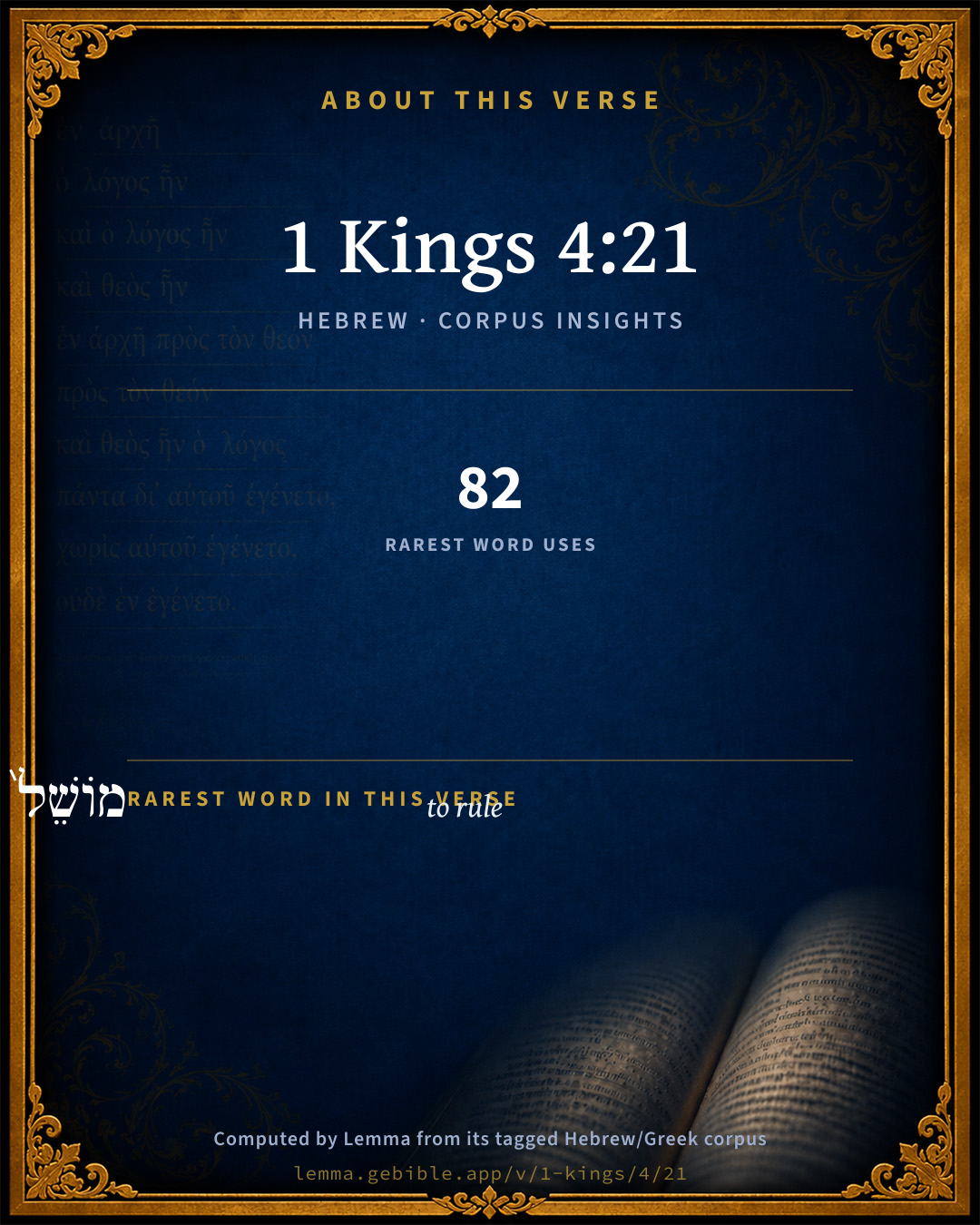
1 Kings, in the Historical, opens this verse with 20 words (18 distinct Hebrew lemmas). Its most distinctive word is mâshal (“to rule”). A historical commentator’s framing appears above. Read the whole chapter for the surrounding context.

Discussion questions

  1. How does “to rule” (mâshal) shape what this verse is saying?
  2. Genesis 15:18 shares this passage’s theme. How do the two illuminate each other?
  3. “Solomon” occurs 2× in this one verse. What is the effect of the repetition?
  4. The translations on this page render this verse differently — a whole-verse word diff, not a word-by-word alignment. What might account for the different wordings?
  5. The verb «הָיָ֤ה» is Qal Perfect. How does its form color the action?
  6. Reading how John Gill's Exposition and Trapp's Complete Commentary read this verse, where do the two commentators agree and where do they part?

Things to notice

Reading settings

Reading text

Shown beneath each verse's original-language words.

Old Testament
Old Testament edition

Read the OT as the Masoretic Hebrew (MT) or the Greek Septuagint (LXX).

English shown for the Greek Septuagint (in the Hebrew ↔ Greek comparison).

Comparing translations? Open the Compare panel on any verse page to stack up to four side by side.