
Psalms 78:54

Hebrew (Westminster Leningrad Codex) Psalms 78:54 appears in the Hebrew Old Testament. The text above is from the Westminster Leningrad Codex. Each word links to its Strong’s number, a concise gloss, and parsing drawn from the Open Scriptures Hebrew Bible morphology. Click any word for its full Brown-Driver-Briggs (BDB) entry.
Download image
Cite this verse

Psalms 78:54 (World English Bible). Public Domain. Lemma interlinear Bible study tool, https://lemma.gebible.app/v/psalms/78/54.

Show BibTeX & RIS
BibTeX
RIS
English Translation
He brought them to the border of his sanctuary, To this mountain, which his right hand had taken.
World English Bible · Public Domain
Download a study sheet

One document with this verse’s original text, its word-by-word gloss line, the meaning frame, cross-references with their text, attributed commentary, and full source and license credits — printable, and it pastes into notes with its structure intact.

This verse Autodidact and up

Study sheet (.html) Plain text (.txt)

A passage Seminary Student

Up to 50 verses in one chapter. A passage sheet keeps up to 6 commentary sources and 12 cross-references per verse, in the order this page ranks them, and says so on the sheet whenever that leaves anything out. Ask for a single verse and you get the Autodidact verse sheet above.

Everything on this page stays free to read, with no account — the sheet is a download of what is already on screen, not access to it.

Want to remove ads? Support Godless Engineer
Compare translations 3

The same verse in 3 English versions, stacked beneath the original-language interlinear above. Click any original word for its lexicon entry.

Each is an independent rendering of the whole verse — the interlinear is not word-aligned to these translations.

Highlighted words mark where these versions differ — a whole-verse word diff, not a word-by-word alignment.

  • World English Bible Public Domain
    He brought them to the border of his sanctuary, To this mountain, which his right hand had taken.
  • King James Version Public Domain
    And he brought them to the border of his sanctuary, even to this mountain, which his right hand had purchased.
  • unfoldingWord Literal Text CC BY-SA 4.0
    And he brought them to the border of his holiness, this mountain that his right hand acquired.

unfoldingWord Literal Text — © unfoldingWord, licensed CC BY-SA 4.0. Word-aligned USFM3 via Door43 (git.door43.org/unfoldingWord/en_ult).

Versions to compare (up to 4)

3 of 4 selected

Show all 18 translations

Every available English version of this verse, each an independent rendering of the whole verse.

  • World English Bible Public Domain
    He brought them to the border of his sanctuary, To this mountain, which his right hand had taken.
  • Berean Standard Bible Public Domain
    He brought them to His holy land, to the mountain His right hand had acquired.
  • Majority Standard Bible Public Domain
    He brought them to His holy land, to the mountain His right hand had acquired.
  • King James Version Public Domain
    And he brought them to the border of his sanctuary, even to this mountain, which his right hand had purchased.
  • American Standard Version (1901) Public Domain
    And he brought them to the border of his sanctuary, To this mountain, which his right hand had gotten.
  • Revised Version (1885) Public Domain
    And he brought them to the border of his sanctuary, to this mountain, which his right hand had purchased.
  • Geneva Bible (1599) Public Domain
    And he brought them vnto the borders of his Sanctuarie: euen to this Mountaine, which his right hand purchased.
  • Douay-Rheims (1899) Public Domain
    And he brought them into the mountain of his sanctuary: the mountain which his right hand had purchased. And he cast out the Gentiles before them: and by lot divided to them their land by a line of distribution.
  • Young's Literal Translation Public Domain
    And He bringeth them in unto the border of His sanctuary, This mountain His right hand had got,
  • Literal Standard Version CC BY-SA 4.0
    And He brings them to the border of His sanctuary, || This mountain His right hand had acquired,
  • Unlocked Literal Bible CC BY-SA 4.0
    Then he brought them to the border of his holy land, to this mountain that his right hand acquired.
  • unfoldingWord Literal Text CC BY-SA 4.0
    And he brought them to the border of his holiness, this mountain that his right hand acquired.
  • Darby Bible Public Domain
    And he brought them to his holy border, this mountain, which his right hand purchased;
  • World Messianic Bible Public Domain
    He brought them to the border of his sanctuary, to this mountain, which his right hand had taken.
  • Webster's Bible Public Domain
    And he brought them to the border of his sanctuary, even to this mountain, which his right hand had purchased.
  • Free Bible Version CC BY-SA 4.0
    He brought them to the border of his holy land, to this mountainous land that he had conquered for them.
  • Bible in Basic English Public Domain
    And he was their guide to his holy land, even to the mountain, which his right hand had made his;
  • JPS Tanakh (1917) Public Domain
    And He brought them to His holy border, to the mountain, which His right hand had gotten.

Literal Standard Version (2020), Covenant Press — licensed CC BY-SA 4.0. Text via the HelloAO Bible API (eBible.org). Unlocked Literal Bible (unfoldingWord) — licensed CC BY-SA 4.0. Text via the HelloAO Bible API (eBible.org). unfoldingWord Literal Text — © unfoldingWord, licensed CC BY-SA 4.0. Word-aligned USFM3 via Door43 (git.door43.org/unfoldingWord/en_ult). Free Bible Version, Dr. Jonathan Gallagher — licensed CC BY-SA 4.0. Text via the HelloAO Bible API (eBible.org).

Word by word

More ways to search: Search by grammar → Find every occurrence → Compare this word →

Practice this passage: Drill this verse → Learn its vocabulary →

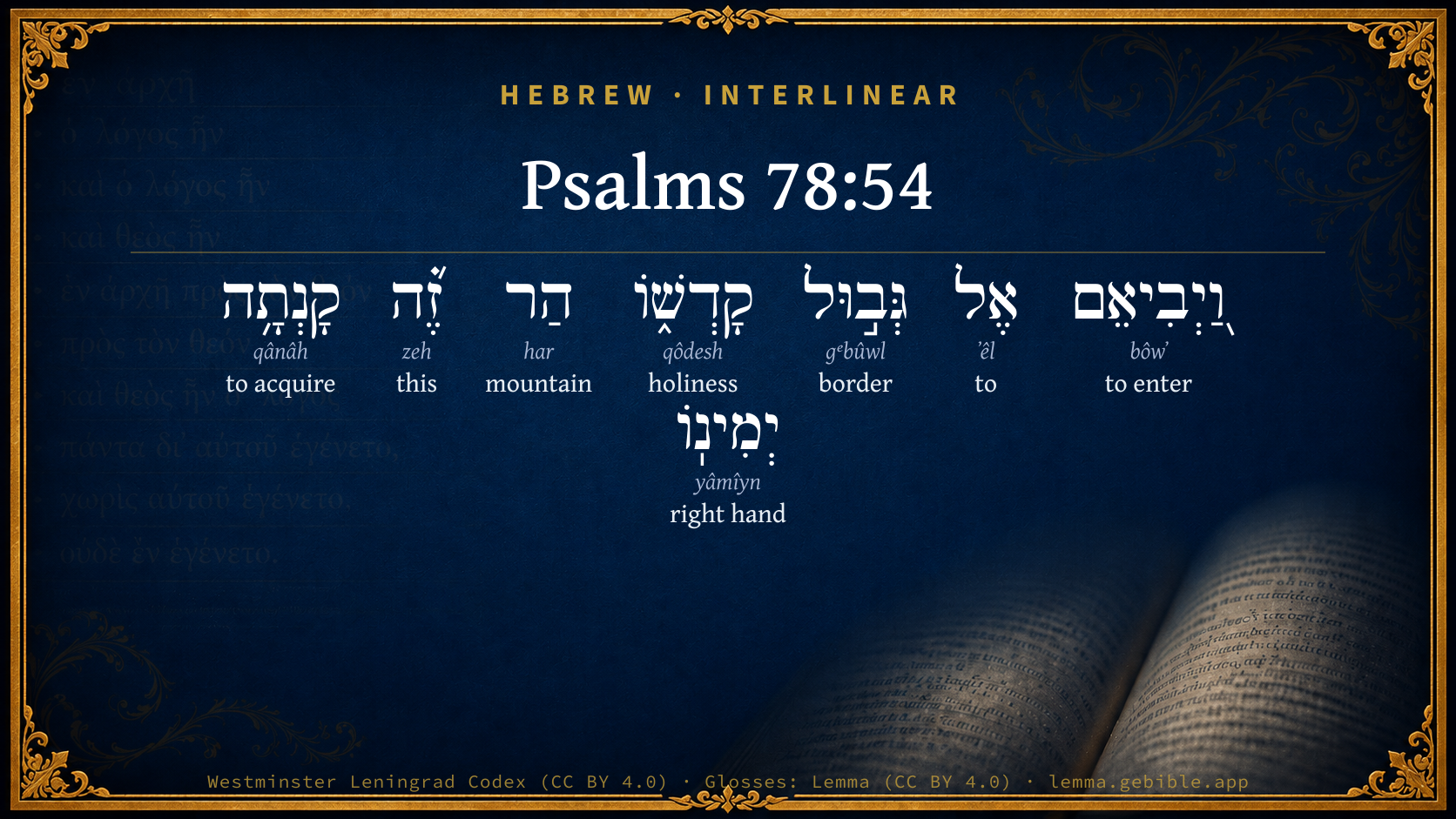
קָנְתָ֥ה
qânâh
H7069
“to acquire”
Verb, Qal, Perfect, 3rd Person, Feminine, Singular
Part of Speech
Verb
Stem
Qal
Form
Perfect
Person
3rd Person
Gender
Feminine
Number
Singular
Full BDB Definition

Origin: a primitive root

TWOT: 2039

to get, acquire, create, buy, possess - (Qal) - to get, acquire, obtain - of God originating, creating, redeeming His people - possessor - of Eve acquiring - of acquiring knowledge, wisdom - to buy - (Niphal) to be bought - (Hiphil) to cause to possess
  1. וַ֭יְבִיאֵם bôwʼ H935 “and · to enter · them” Conjunction + Verb, Hiphil, Sequential Imperfect, 3rd Person, Masculine, Singular + Suffix, Personal, 3rd Person, Masculine, Plural
  2. אֶל ʼêl H413 “to” Preposition
  3. גְּב֣וּל gᵉbûwl H1366 “border of” Noun, Common, Masculine, Singular, Construct
  4. קָדְשׁ֑וֹ qôdesh H6944 “holiness · his” Noun, Common, Masculine, Singular, Construct + Suffix, Personal, 3rd Person, Masculine, Singular
  5. הַר har H2022 “mountain of” Noun, Common, Masculine, Singular, Construct
  6. זֶ֝֗ה zeh H2088 “this” Pronoun, Demonstrative, Masculine, Singular
  7. יְמִינֽוֹ yâmîyn H3225 “right hand · his” Noun, Common, Feminine, Singular, Construct + Suffix, Personal, 3rd Person, Masculine, Singular

About this verse

These counts appear in no published source. They are computed here, from the morphology-tagged text and Lemma’s own curated glosses. What Lemma adds →

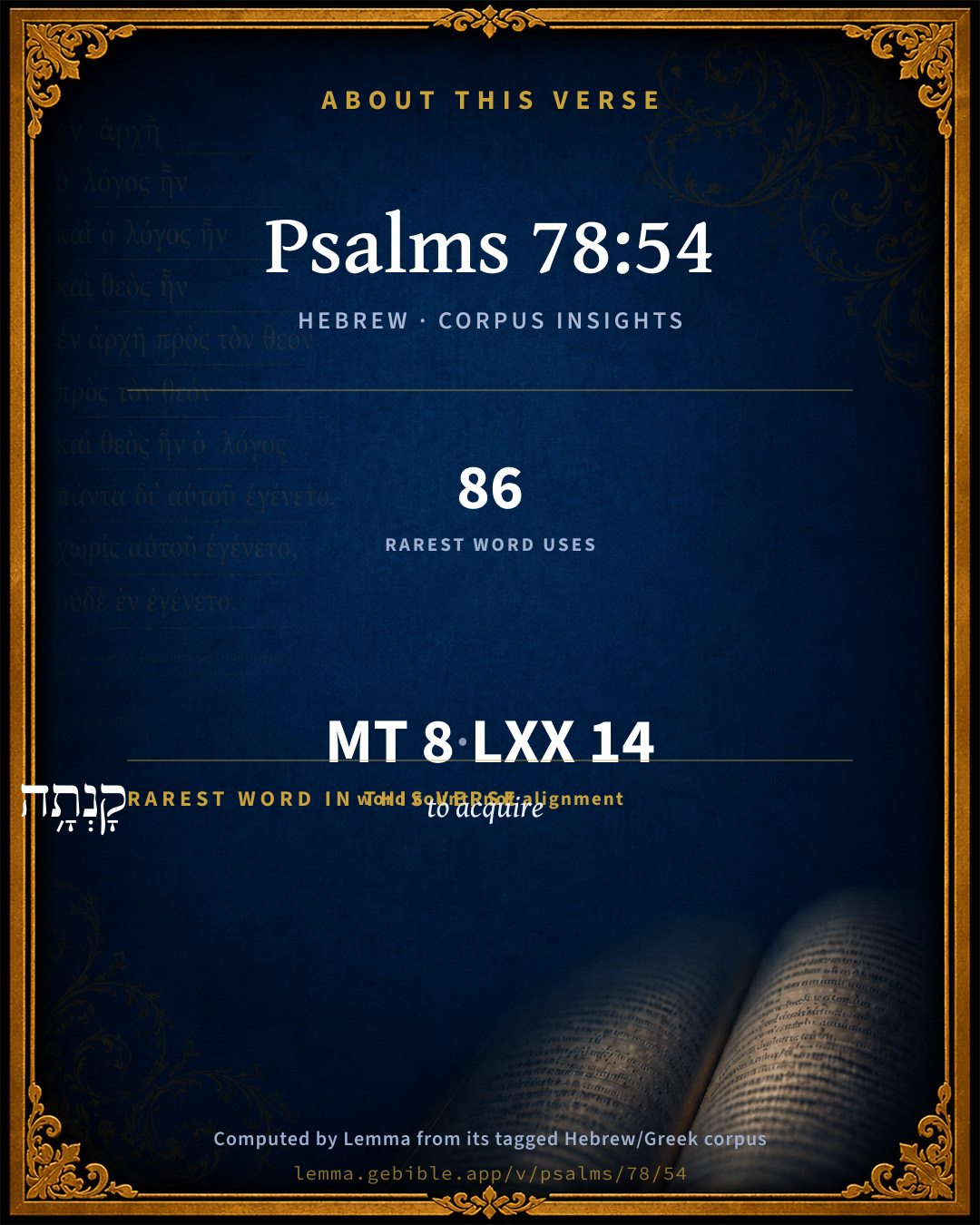
8
words
8
distinct lemmas
Wisdom
section

Grammatical profile

  • 2 verbs
  • 4 nouns
  • 1 pronoun
  • 1 preposition

Verb forms

  • וַ֭יְבִיאֵם Hiphil · Sequential Imperfect
  • קָנְתָ֥ה Qal · Perfect

Hebrew & Septuagint length

In English translation the verse runs 18 words from the Hebrew and 19 from the Septuagint (LXX English) — closely comparable.

A rough comparison of the two English renderings, which tokenize alike — not a word-level alignment.

Word counts can differ between the Hebrew and the Greek without any difference in meaning — e.g. the Hebrew direct-object marker אֵת has no separate Greek word, and Greek often adds the article ὁ.

In the original languages it is 8 Hebrew tokens and 14 Greek tokens — but the two are counted differently (Hebrew bundles its prefixes and suffixes into one token; the Greek is in lemma form), so that isn’t a like-for-like length.

Cross-references

8

Topical passages linked to Psalms 78:54 in the Treasury of Scripture Knowledge — connected by theme and wording, ordered by reader-vote popularity; previews shown in the World English Bible.

  • Psalms 44:3 For they didn't get the land in possession by their own sword, Neither did their own arm save them; But your right hand, and your arm, and the light of your face, Because you were favorable to them.
  • Exodus 15:17 You shall bring them in, and plant them in the mountain of your inheritance, The place, Yahweh, which you have made for yourself to dwell in; The sanctuary, Lord, which your hands have established.
  • Psalms 68:16 Why do you look in envy, you rugged mountains, At the mountain where God chooses to reign? Yes, Yahweh will dwell there forever.
  • Isaiah 11:9 They shall not hurt nor destroy in all my holy mountain; for the earth shall be full of the knowledge of Yahweh, as the waters cover the sea.
  • Daniel 9:16–20 Lord, according to all your righteousness, let your anger and please let your wrath be turned away from your city Jerusalem, your holy mountain; because for our sins, and for the iniquities of our fathers, Jerusalem and your people are become a reproach to all who are round about us.
  • Daniel 11:45 He shall plant the tents of his palace between the sea and the glorious holy mountain; yet he shall come to his end, and none shall help him.
  • Ephesians 1:14 who is a pledge of our inheritance, to the redemption of God's own possession, to the praise of his glory.
  • Exodus 15:13 "You, in your loving kindness, have led the people that you have redeemed. You have guided them in your strength to your holy habitation.

Cross-references courtesy of OpenBible.info (CC BY 4.0).

Hebrew and Greek witnesses Masoretic Hebrew ↔ Greek Septuagint

The same verse in the two great witnesses to the Old Testament, shown verse-for-verse.

You’re reading Greek Psalm 77 (Hebrew Psalm 78). The Septuagint counts the superscription, so verse numbers can differ from the Hebrew — chapter-level alignment, not verse-by-verse. Numbering follows Rahlfs.

These are two independent witnesses, not word-aligned to each other, and the Septuagint is shown in lemma (dictionary) form.

Hebrew Psalms 78:54 Masoretic · Westminster Leningrad Codex

וַ֭יְבִיאֵם אֶל גְּב֣וּל קָדְשׁ֑וֹ הַר זֶ֝֗ה קָנְתָ֥ה יְמִינֽוֹ

He brought them to the border of his sanctuary, To this mountain, which his right hand had taken.

World English Bible · Public Domain

Greek LXX Greek Psalm 77:54 Septuagint · lemma form

καί εἰςἄγω αὐτός εἰς ὅριον ἁγίασμα αὐτός ὄρος οὗτος ὅς κτάομαι ὁ δεξιός αὐτός

And he brought them in to the mountain of his sanctuary, this mountain which his right hand had purchased.

LXX2012 (modern English Septuagint) · Public Domain

On this verse, Albert Barnes' Notes on the Bible discusses the Septuagint’s reading. Read the note in Commentary ↓

Hebrew: Westminster Leningrad Codex (CC BY 4.0). Greek: Septuagint (public domain); English from LXX2012 (modern English Septuagint) (Public Domain). How the Septuagint differs from the Hebrew →

Commentary

Notes on Psalms 78:54 from classic Christian and Jewish commentators (each source and its license shown beneath its notes). The classic Christian expositions comment on the surrounding passage and are grouped to its opening verse, so a note may address several verses; the Jewish commentaries on the Tanakh (Rashi and others) are per-verse, so they appear only where the commentator wrote on this verse.

Lemma curates 59 commentaries, every one of them public domain or Creative Commons licensed, each selected and text-cleaned for this edition rather than reprinted as found. About our sources →

Trapp's Complete Commentary

John Trapp

Psa 78:54 And he brought them to the border of his sanctuary, [even to] this mountain, [which] his right hand had purchased.

Ver. 54. And he brought them to the border of his sanctuary] i.e. Of Judea, which country he had consecrated to himself for the place and chief seat of religion; whence it is called, the holy land. It had been a loathsome land, Ezr 9:11, filled with filthiness from corner to corner, but now otherwise. How it was afterwards again polluted, see Isa 1:21-23.

Even to this mountain] Moriah, whereon stood the temple; or, to this mountainous country of Judea.

Which his right hand, &c.] See Psa 44:3.

John Trapp, A Commentary or Exposition upon All the Books of the Old and New Testament (1647–1656) — public domain. Text from a community e-Sword module.

J. A. Alexander on Psalms

Joseph Addison Alexander

54. (Psa 78:54) And brought them to his holy border, this mountain (which) his right hand won. The bound or border of his holiness, the frontier of the land which he had set apart as holy. This mountain may, agreeably to Hebrew usage, mean this hilly country, as it does in Deu 3:25. But there is no doubt a particular reference to mount Zion, in the wide sense, as the central point of the theocracy, designated as such long before the conquest of Canaan. See Gen 22:14, and compare Exo 15:13; Exo 15:17. His right hand, the exertion of his strength. Won, purchased, not in the restricted modern sense of buying, but in the old and wide sense of acquiring.

Joseph Addison Alexander, The Psalms Translated and Explained (1850) — public domain. Text from a community e-Sword module.

Geneva Bible (1599)

Geneva Bible translators

Meaning, Canaan, which God had consecrated to himself, and appointed to his people.

Geneva Bible (1599) marginal notes — public domain. Text via Bolls.life.

Adam Clarke's Commentary

Verse 54. The border of his sanctuary] קדשו kodsho, "of his holy place," that is, the land of Canaan, called afterwards the mountain which his right hand had purchased; because it was a mountainous country, widely differing from Egypt, which was a long, continued, and almost perfect level.

Adam Clarke's Commentary on the Bible (1810–1826) — public domain. Text from a community e-Sword/MySword module.

Ellicott's Commentary for English Readers

(54) This mountain—i.e., Zion, though from its apposition to border some prefer to take it of all the mountain country of Judæa.

Purchased.—Rather, acquired.

A Bible Commentary for English Readers, edited by Charles John Ellicott (1878–1897) — public domain. Text from a community e-Sword module.

The Cambridge Bible for Schools and Colleges

gen. ed. J. J. S. Perowne

54. The border of his sanctuary may mean the land of Canaan, as that in which He purposed to place His temple, and this mountain may denote Mount Zion. But it is preferable to render to his holy border, the land separate from all other lauds, to be consecrated by His Presence, and known henceforth as the Holy Land: and in the next line, to the mountain land, which &c. This is the sense in Exo_15:17, which evidently was in the poet’s mind. Cp. Deu_3:25; Isa_11:9.

The Cambridge Bible for Schools and Colleges (gen. ed. J. J. S. Perowne; Cambridge University Press, 1878–1918) — public domain. Text from a community e-Sword module.

John Gill's Exposition

He cast out the Heathen also before them,.... The seven nations, the Hittites, Girgashites, Amorites, Canaanites, Perizzites, Hivites, and Jebusites, Deu 7:1.

and divided them an inheritance by line: the land of Canaan was divided among the nine tribes and a half by Joshua, the other two and a half having had their portion assigned them on the other side; this distribution was made very exactly by lot, by line, and measure, so that every tribe had their proper portion and inheritance; see Jos 13:6,

and made the tribes of Israel to dwell in their tents; in the cities, towns, villages, and houses of the Heathen cast out before them.

John Gill's Exposition of the Whole Bible (1746–1763) — public domain (CC PDM 1.0). Text via the HelloAO Bible API.

Albert Barnes' Notes on the Bible

And he brought them to the border of his sanctuary - The Septuagint and the Latin Vulgate render this, “to the mountain of his holiness”; that is, his holy mountain. But the reference is rather to the whole land of Canaan. He brought them to the borders of that land - the land of promise - the holy land. They who came out from Egypt did not indeed enter that land, except Caleb and Joshua, but they were conveyed to its borders before all of them fell. It was true also that the people - the Hebrew people - came to the promised land, and secured its possession.

Even to this mountain - Mount Zion, for the object of the psalm was to show that the worship of God was properly celebrated there. See Psa 78:68. The meaning is not that the people who came out of Egypt actually inherited that mountain, but that their descendants - the people of God - had been put in possession of it.

Which his right hand had purchased - Had procured, or obtained possession of. That is, he had secured it by his power.

Albert Barnes' Notes on the Bible (1834–1885) — public domain. Text from a community e-Sword/MySword module.

Matthew Poole's English Annotations

Of his sanctuary; or, of his holiness, or his holy place i.e. the land of Canaan, which is so called, Ezr 9:8; Zec 2:12, &c., as being separated by God from all other lands for his people and service, and sanctified by his presence and dwelling in it.

This mountain; either,

1. The mountain upon which the tabernacle or temple stood. Or rather,

2. The mountainous country of Canaan, which called a land of hills and valleys, Deu 11:11. And the word mountain is oft used in Scripture for a mountainous country, as Gen 36:8; Deu 1:7; Jos 11:21.

Matthew Poole's English Annotations on the Holy Bible (1683–1685) — public domain. Text from a community e-Sword/MySword module.

The Treasury of David

Charles H. Spurgeon

Ver. 54. And he brought them to the border of his sanctuary. He conducted them to the frontier of the Holy Land, where he intended the tabernacle to become the permanent symbol of his abode among his people. He did not leave them halfway upon their journey to their heritage; his power and wisdom preserved the nation till the palm trees of Jericho were within sight on the other side of the river.

Even to this mountain, which his right hand had purchased. Nor did he leave them then, but still conducted them till they were in the region round about Zion, which was to be the central seat of his worship. This the Lord had purchased in type of old by the sacrifice of Isaac, fit symbol of the greater sacrifice which was in due season to be presented there: that mountain was also redeemed by power, when the Lord's right hand enabled his valiant men to smite the Jebusites, and take the sacred hill from the insulting Canaanite. Thus shall the elect of God enjoy the sure protection of the Lord of hosts, even to the border land of death, and through the river, up to the hill of the Lord in glory. The purchased people shall safely reach the purchased inheritance.

Ver. 54. He brought them to the border of his sanctuary, or holiness; that is, to the holy land; so called in diverse respects, but especially because of his sanctuary, the place of his residence; to which he makes all the land to be but as bounds and limits, because of the eminency of that place, the holiness whereof did, as it were, spread to all other parts of the land, as if the whole had been a sanctuary, and consecrated ground. It is therefore to the honour of the whole land, as well as of the sanctuary, that he calleth it, the holy border, a border of his sanctuary. Westminster Assembly's Annotations.

None.

Charles H. Spurgeon's The Treasury of David (1869–1885) — public domain. Psalms only. Text from a community e-Sword/MySword module.

Whedon's Commentary on the Bible

Daniel D. Whedon

54. Border of his sanctuary—The border of his holy place, that is, Canaan, so called because measured by line, limited and devoted for ever to the covenanted people for the moral ends of God’s great plan of redemption.

This mountain—Either parallel to “holy place,” in the previous hemistich, or the author anticipates himself, and the phrase is to be understood of the mountains of Judah, in which were Zion and Moriah, as the religious centre of the nation. See Psa_78:68

Daniel D. Whedon (gen. ed.), Commentary on the Old and New Testaments (1874–1909) — public domain. Text from a community e-Sword module.

The Pulpit Commentary

And he brought them to the Border of his sanctuary. The "sanctuary" is here probably the Holy Land, as in Exo_15:17; or we may translate wOvdq lWbg "his holy territory." Even to this mountain.

Mount Zion, on which the writer regards himself as standing while his words are chanted in the temple service. Which his right hand had purchased; or, had gotten, "had won." God"s right hand won the whole land for his people.

The Pulpit Commentary (1880–1919), ed. H.D.M. Spence-Jones & Joseph S. Exell — public domain. Text from a community e-Sword module.

John Wesley's Explanatory Notes

Holy place - The land of Canaan, separated by God from all other lands. Mountain - The mountainous country of Canaan; the word mountain is often used in scripture for a mountainous country.

John Wesley, Explanatory Notes Upon the Whole Bible (1754–1765) — public domain. Text via the GEBible commentary corpus.

unfoldingWord translationNotes

Door43 World Missions Community

General Information:

The writer continues to describe what God did for the people of Israel.

his right hand acquired

The words "right hand" are a metonym for power. AT: "he won for himself using his own power" (See: Metonymy)

assigned them their inheritance

Possible meanings are 1) God assigned the Israelites their inheritance in the land in which the other nations had once lived or 2) God assigned to the nations he had driven out an inheritance somewhere else. "gave them land that would always be theirs"

in their tents

Possible meanings are 1) he settled Israel in their own tents in the land or 2) he settled Israel in the tents from which he had driven the other nations. Most of these "tents" were actually houses, both when the other nations lived in them and when the Israelites lived in them. AT: "in their homes" (See: Idiom)

translationWords

holy

right hand

cast out

nation

assign

inherit

tribe

Israel

tent

unfoldingWord translationNotes — © Distant Shores Media and the Door43 World Missions Community, licensed CC BY-SA 4.0. Source: git.door43.org/Door43/en_tn.

Lesson kit

Teaching starters — assembled from the data on this page, not authored interpretation. Every prompt links to the verse data it draws on. Edit before teaching.

Psalms, in the Wisdom, opens this verse with 8 words (8 distinct Hebrew lemmas). Its most distinctive word is qânâh (“to acquire”). A historical commentator’s framing appears above. Read the whole chapter for the surrounding context.

Discussion questions

  1. The word qânâh carries the sense “to acquire.” How does it shape the verse?
  2. Psalms 44:3 shares this passage’s theme. How do the two illuminate each other?
  3. The translations on this page render this verse differently — a whole-verse word diff, not a word-by-word alignment. What might account for the different wordings?
  4. The verb «וַ֭יְבִיאֵם» is Hiphil Sequential Imperfect. How does its form color the action?
  5. Reading how Trapp's Complete Commentary and J. A. Alexander on Psalms read this verse, where do the two commentators agree and where do they part?

Things to notice

Reading settings

Reading text

Shown beneath each verse's original-language words.

Old Testament
Old Testament edition

Read the OT as the Masoretic Hebrew (MT) or the Greek Septuagint (LXX).

English shown for the Greek Septuagint (in the Hebrew ↔ Greek comparison).

Comparing translations? Open the Compare panel on any verse page to stack up to four side by side.